Introduction
The number of certified organic crop acres in the United States increased by an average of 24% per year between 1992 and 20051. Since meat and milk are the fastest growing sectors of the organic industry, demand for organic grains is high and organic grain prices have been about double those of conventional grains since 2000, even as conventional grain prices soared and decreased again during the period 2006 to 2008Reference Streff and Dobbs2–5. Organic price premiums have attracted the interest of an increasing number of conventional grain farmers who are considering adopting or have recently adopted organic production methods. Many farmers and agricultural professionals, however, are uncertain about the profitability and risk associated with organic grain and forage production. In the US, Federal Government Agencies, State Departments of Agriculture and Cooperative Extension personnel have been increasing their programming in organic grain and forage production and marketing to facilitate informed decision-making about organic grain and forage production opportunities1, 6–Reference Mainville, Farrell, Groover and Mundy8.
Recent studies report that corn, soybean and wheat yields in organic systems in the Midwest and the mid-Atlantic regions of the US, and corn yield in California tend to be lower than or similar to those in conventional systemsReference Drinkwater, Wagoner and Sarrantonio9–Reference Cavigelli, Teasdale and Conklin16. Production costs tend to be lower in organic than in conventional systemsReference Archer, Jaradat, Johnson, Weyers, Gesch, Forcella and Kludze15, Reference Archer, Jaradat, Johnson, Weyers, Gesch, Forcella and Kludze17–Reference Clark, Klonsky, Livingston and Temple21. Net returns are similar to or lower than in conventional systems when no organic price premiums are included, depending on whether reductions in yield and therefore revenue are greater or lesser than cost reductionsReference Welsh10, Reference Hanson, Johnson, Peters and Janke17, Reference Smith, Clapperton and Blackshaw20, Reference Hanson, Lichtenberg and Peters22, Reference Hanson and Musser23. Hanson et al.Reference Hanson, Johnson, Peters and Janke17 and Hanson and MusserReference Hanson and Musser23 found that organic systems in Pennsylvania had lower risk than conventional systems. In almost all cases, when organic price premiums were included in the analyses, organic systems outperformed conventional systemsReference Archer, Jaradat, Johnson, Weyers, Gesch, Forcella and Kludze15, Reference Archer, Jaradat, Johnson, Weyers, Gesch, Forcella and Kludze18–Reference Clark, Klonsky, Livingston and Temple21, Reference Hanson and Musser23, Reference Archer and Kludze24, even when price premiums were set at 50% of existing levelsReference Mahoney, Olson, Porter, Huggins, Perillo and Crookston19, Reference Archer and Kludze24.
The impact of crop rotation length and diversity on economic performance, which can impact agronomic performanceReference Porter, Huggins, Perillo, Quiring and Crookston13, Reference Cavigelli, Teasdale and Conklin16, has been studied in the upper US Midwest and in Canada for organic systems. These studies provide mixed results, indicating that the impact of crop rotation length and diversity on economic performance depends on specific crops used in a particular rotation and on location. In southern Minnesota, returns were greater and risk was lower for a 4-year corn–soybean–oats/alfalfa–alfalfa rotation than a 2-year corn–soybean rotation when managed using organic practices with no organic premiumsReference Mahoney, Olson, Porter, Huggins, Perillo and Crookston19. Archer and KludzeReference Archer and Kludze24, also in southern Minnesota, showed that risk was lower for a 2-year organic corn–soybean rotation than for a 4-year organic corn–soybean–spring wheat/alfalfa–alfalfa rotation using a stochastic simulation approach. Archer et al.Reference Archer, Jaradat, Johnson, Weyers, Gesch, Forcella and Kludze15 showed no differences in net present value of returns between the same 2-year and 4-year rotations although production costs were lower for the 4-year than for the 2-year rotation. Delate et al.Reference Delate, Duffy, Chase, Holste, Friedrich and Wantate18 showed no differences in economic performance between a 3-year corn–soybean–oat/alfalfa and a 4-year corn–soybean–oat/alfalfa–alfalfa rotation in Iowa. In Alberta, Canada, returns were greater for a 4-year wheat–field pea (Pisum sativum L.)–oilseed [canola (Brassica napus L.) or flax (Linum usitatissimum L.)]–sweet clover (Melilotus officinalis [L.] Lam.) rotation than a 2-year wheat–sweet clover organic rotation but were least for a 4-year wheat–barley (Hordeum vulgare L.) and field pea–fenugreek (Trigonella foenum-graecum L.) and ryegrass (Lolium multiflorum Lam.)–oilseed and berseem clover (Trifolium alexandrinum L.) organic rotation, for which compost, hauling and application costs were highReference Smith, Clapperton and Blackshaw20.
Results from the mid-Atlantic region show that economic returns to management for organic grain production can be competitive with a conventional tillage corn–soybean–corn–corn–soybean rotation even without organic price premiumsReference Hanson, Johnson, Peters and Janke17, Reference Hanson, Lichtenberg and Peters22, Reference Hanson and Musser23. However, organic systems outperformed conventional systems only from 1986 to 1990 when the crop rotation in the organic system was corn–small grain/soybean–small grain/red clover and not from 1991 to 1995 when the crop rotation in the organic system was vetch/corn–rye/soybean–wheat. Additional information is needed for the Coastal Plains portion of the mid-Atlantic region of the United States, where our study site is located. This region, where 29% of land remains under agricultural productionReference Atorand, Denver and Pitchford25, encompasses portions of New Jersey, Pennsylvania, Delaware, Maryland, Virginia and North Carolina. Also, previous results from the mid-Atlantic region have not explored the impact of crop rotation length and diversity on economic performance of organic systems or compared organic systems with conventional no-till systems, which are an important management system in the mid-Atlantic region.
We report here on six years of economic data from a long-term cropping systems study in Maryland, the USDA–ARS Beltsville Farming Systems Project (FSP), which was established in 1996 to evaluate the sustainability of organic and conventional cropping systems. Earlier results from this site, covering the years 1996 through 2005, showed that corn and soybean yields were, in general, greater in conventional than in organic systems, that corn yield among organic systems increased with increasing rotation length and diversity, and that there were no consistent differences in wheat yield among systemsReference Cavigelli, Teasdale and Conklin16. Those results also showed that, on average, 73, 23 and 4% of the difference in corn yield between conventional and organic systems was associated with low nitrogen availability, weed competition and corn population, respectively. Differences in soybean yields resulted solely from weed competition. In this paper, we report on production costs and economic performance of the systems with and without organic price premiums during 6 years following the organic transition period. These years were chosen for this analysis because inconsistent management among field replicates and a severe drought from 1997 to 1999 made comparisons of rotations during earlier years problematic.
Materials and Methods
Study site
The study site is 16 ha in size and is at the western edge of the Atlantic Coastal Plain at the USDA–ARS Beltsville Agricultural Research Center in Maryland. The dominant soil types are Christiana (fine, kaolinitic and mesic Typic Paleudults), Matapeake (fine-silty, mixed, semiactive and mesic Typic Hapludults), Keyport (fine, mixed, semiactive, mesic and Aquic Hapludults) and Mattapex (fine-silty, mixed, active and mesic Aquic Hapludults) silt loams. The site had not been tilled for 11 years prior to plot establishment in 1996. The 30-year average annual precipitation at the site is 1110 mm, distributed evenly through the year. Average annual temperature is 12.8°C.
Cropping systems and cultural practices
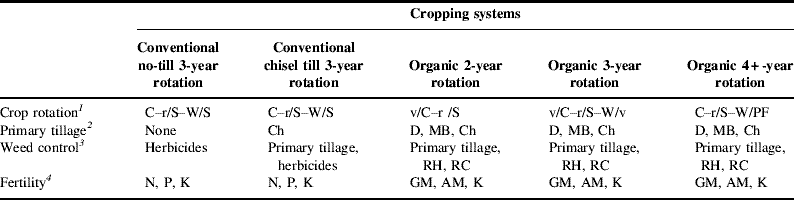
The FSP, which was established in 1996, includes two conventional systems and three organic systems (Table 1) that reflect typical rotations used by farmers in the mid-Atlantic region. Cropping systems were selected after consulting with regional grain farmers, including organic farmers; extension agents, specialists and researchers from the University of Maryland, Delaware State University and the University of Delaware; farm managers from various regional governmental and non-governmental organizations; and a representative of the National Center of Appropriate Technology's Appropriate Technology Transfer for Rural Areas agency. Management practices are reviewed annually by a group of University of Maryland extension specialists and Beltsville Agricultural Research Center farm managers and by a separate, informal group of organic farmers from Maryland. Any changes in management (e.g., crop variety selection and herbicide program) are made in consultation with these groups. The site is not certified organic because the distance between the conventional and organic plots (usually 2 m; see below) does not meet certification requirements; however, organic management practices at the site follow USDA National Organic Program practices.
Overview of cropping systems management at the USDA-ARS Beltsville FSP.
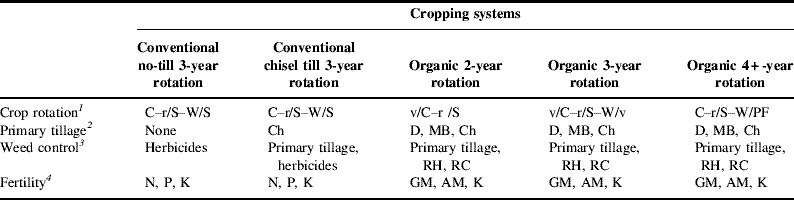
1 C, corn; S, soybean; W, wheat; W/S, wheat followed by double-cropped soybean; PF, perennial forage crop, either red clover+orchard grass (2000–2001) or alfalfa (2001–2005); r, rye cover crop; v, hairy vetch green manure cover crop. No-till and chisel till rotations in 2000 were C–W/S (see Table 2).
2 D, disk; MB, moldboard plow; Ch, chisel plow. See Tables 3–5 for details regarding specific implements used for each crop.
3 RH, rotary hoe; RC, row cultivator; both of which were used for corn and soybean only; rotary hoe was not used from 2000 to 2002 in Org2 and Org3 since a reduced tillage system was used then, as described in the text.
4 N included ammonium nitrate, urea ammonium nitrate; P was triple super phosphate; K was potassium chloride in conventional systems and potassium sulfate in organic systems; rates are provided in Tables 3–5; GM, green manures; AM, animal manures.
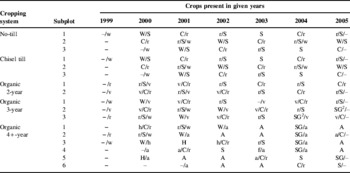
The planned crop rotation in the two conventional systems is a three-year corn–rye cover crop/full-season soybean–wheat/double-crop soybean rotation, a common rotation in this area (Table 2). One system uses no-till (NT) management and the other uses chisel tillage (CT) for primary tillage. Both are common practices in the region. The three organic cropping systems differ from each other in crop rotation length and complexity: a two-year hairy vetch/corn–rye/soybean rotation (Org2), a three-year vetch/corn–rye/soybean–wheat/vetch rotation (Org3) and a four- to six-year corn–rye/soybean–wheat/red clover/orchard grass–red clover/orchard grass or alfalfa–alfalfa–alfalfa–alfalfa rotation (Org4+). The designation Org4+ is used to indicate a rotation length of four to six years. From 1996 to 2000 the rotation was 4 years in length and red clover/orchard grass was the forage crop. Beginning in 2000, alfalfa was planted as the forage crop and a transition from a four- to a six-year rotation was initiated. This change was made because alfalfa provides more nitrogen to a succeeding crop than does a clover-grass mix, and corn crops in this rotation showed signs of nitrogen limitation. In 2001, both types of forage crop (in separate plots) were present as part of this transition; from 2002 to 2005 alfalfa was the only forage crop present (Table 2).
CropsFootnote 1 present in each subplot of the five cropping systems of the USDA-ARS Beltsville FSP during the study period, 2000 to 2005. The number of subplots for a given cropping system reflects the number of years in the crop rotation. Cover crops planted in fall 1999 are included and those planted in the fall 2005 are not included because costs of establishing cover crops in the fall were allocated to the succeeding cash crop. By similar reasoning, wheat planted in fall 1999 is included, while wheat planted in fall 2005 is not included.

1 A, alfalfa; C, corn; H, red clover plus orchard grass that was harvested as hay; r, rye cover crop; S, soybean; SG, Sudan grass; v, hairy vetch cover crop; W, wheat. Capital letters indicate crops that were harvested in a given year; lower case letters indicate crops that were planted in the fall and those that served as green manures.
2 Not included in economic analyses, as described in the text.
The organic cropping systems reflect typical crop rotations and practices used by farmers in the mid-Atlantic area (personal communication, E. Dengler, Natural Resources Conservation Service, Maryland; C. Lawrence, Natural Resources Conservation Service, Virginia; E. Fry, L. Howard, N. Maravell, B. Mason, A. Reed and S. Ward, Maryland organic farmers). The 2-year rotation is considered organic-compliant through the state of Maryland organic certification program since it includes four crops (including two cover crops) in two years (personal communication, W. Rawlings, Maryland Department of Agriculture).
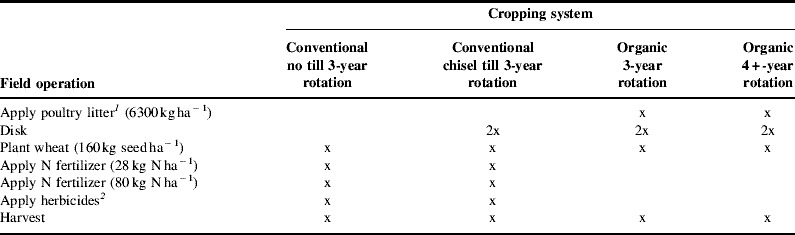
Each crop in each crop rotation was represented every year (with exceptions noted below and in Table 2). Cropping systems are replicated four times in a split-plot design with system assigned to whole plots and crop rotation phase assigned to subplots. For example, in Org3 there are three subplots. In a given year, one subplot is planted to corn in the spring following a hairy vetch cover crop that was planted the previous fall, followed by a rye cover crop in the fall (e.g., subplot 1 in 2001, Table 2). A second subplot is planted to soybean in the spring following the rye cover crop and is then planted to wheat in the fall (e.g., subplot 2 in 2001). In a third subplot, wheat that was planted the previous fall is harvested in the summer and vetch is planted in late August or early September (e.g., subplot 3 in 2001). Each subplot is 9.1 m wide and 111 m long; there is a grassed alleyway 2 m in width between most whole plots. Typical field operations are presented in Tables 3–5 for corn, soybean and wheat, respectively. Commercial-scale farm equipment was used for all field management operations.
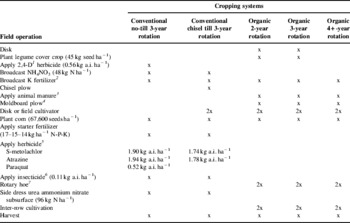
Typical field operations and rates of application of materials for corn in five cropping systems at the USDA-ARS Beltsville FSP, Beltsville, Maryland.

1 2,4-dichlorphenoxyacetic acid.
2 KCl in NT and CT applied at 46 kg K2O ha−1; K2SO4 in Org2 and Org3 applied at 37 kg K2O ha−1 and at 60 kg K2O ha−1 in Org4+, all in accordance with soil test results.
3 Broiler litter applied at 2240 and 6720 kg ha−1 in Org2 in 2000 and 2003, respectively; at 2240 and 4480 kg ha−1 in Org3 in 2000 and 2003, respectively; and at 5600 kg ha−1 in Org4+ in 2000. Layer litter applied at 6720 kg ha−1 in Org2 and Org4+ in 2004 and 2005 and in Org3 in 2004. Dairy manure slurry applied in Org4+ in 2002 at 124,000 liters ha−1. Manure rates were adjusted in accordance with measured or visually estimated cover crop biomass levels and are thus different by year and by system. Average nutrient content of animal manures was 2.51% N, 2.37% P2O5 and 1.99% K2O.
4 Moldboard plow used in Org2 and Org3, 2003 to 2005 and in Org4+, 2000 to 2005. There was no primary tillage in Org2 and Org3 from 2000 to 2002; instead, the vetch cover crop was crushed using a roller in May and corn was planted directly through the residue using a high-residue no-till drill.
5 S-metolachlor, 2-chloro-N-(2-ethyl-6-methylphenyl)-N-(2-methoxy-1-methylethyl) acetamide; atrazine, 6-chloro-N-ethyl-N′-(1-methylethyl)-1,3,5-triazine-2,4-diamine); paraquat, 1,1′-dimethyl-4,4′-bipyridinium ion. Beginning in 2004 simazine (6-chloro- N, N′-diethyl-1,3,5-triazine-2,4-diamine) was applied at 1.78 and 1.22 kg a.i. ha−1 in NT and CT, respectively, to address late season grass emergence and metolachlor and atrazine concentrations were reduced to 1.33 and 0.34 kg a.i. ha−1, respectively.
6 Permethrin, (3-phenoxyphenyl)methyl cis,trans-(+−)-3-(2,2-dichloroethenyl)-2,2-dimethylcyclopropanecarboxylate, applied in NT and CT in 2004 and 2005 to control cutworms (Family Noctuidae).
7 Rotary hoe not used from 2000 to 2002 in Org2 and Org3 in accordance with the reduced tillage system in place during these years (see footnote 4).
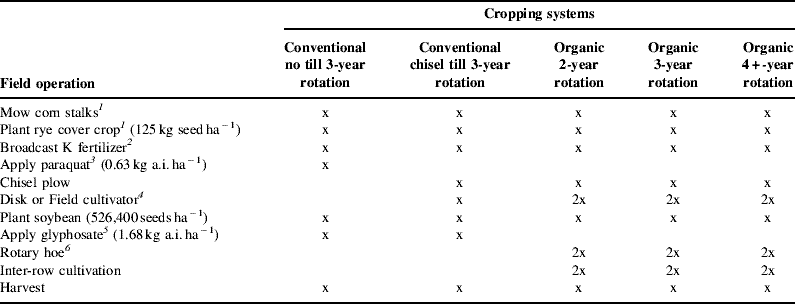
Typical field operations for full-season soybean in five cropping systems at the USDA-ARS Beltsville FSP, Beltsville, Maryland.
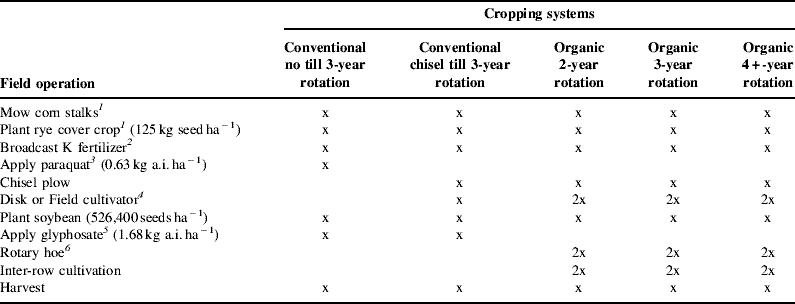
1 Rye was not planted in NT and CT in fall 1999.
2 KCl applied in NT and CT at 76 and 104 kg K2O ha−1; K2SO4 applied in Org2 and Org3 at 37 kg K2O ha−1 and in Org4+ at 76 kg K2O ha−1, all in accordance with soil test results.
3 1,1′-dimethyl-4,4′-bipyridinium ion.
4 Chisel plow used for primary tillage in organic systems from 2003 to 2005; there was no primary tillage in the organic systems from 2000 to 2002; instead, the rye cover crop was mowed in May and soybean was planted directly through the residue using a high-residue no-till drill.
5 N-(phosphonomethyl)glycine.
6 Rotary hoe not used from 2000 to 2002 in organic systems in accordance with the reduced tillage system in place during these years (see footnote 4).
Typical field operations for wheat in four cropping systems at the USDA-ARS Beltsville FSP, Beltsville, Maryland.
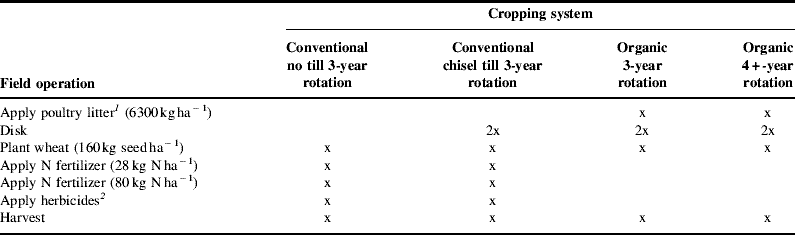
1 Poultry litter incorporated into soil in fall except in fall 1999; topdressed in March 2000. Average nutrient content of poultry litter was 2.97% N, 3.00% P2O5 and 2.32% K2O.
2 Trifensulfuron, 3-[[[[(4-methoxy-6-methyl-1,3,5-triazin-2-yl)amino]carbonyl] amino]sulfonyl]-2-thiophenecarboxylic acid applied at 18 g a.i. ha−1; tribenuron, 2-[[[[(4-methoxy-6-methyl-1,3,5-triazin-2-yl)methylamino] carbonyl]amino]sulfonyl]benzoic acid applied at 9 g a.i. ha−1.
Management changes
Management practices within some cropping systems were changed (Tables 1 and 2) to adapt to evolving conditions, an approach that might more closely reflect farmer decisions than does a rigid adherence to a predetermined rotation sequence, which is the typical approach in experiment station settings. For example, the crop rotation in the two conventional systems was a 2-year corn–wheat/double-crop soybean rotation until 2000. The rotation was expanded to the current 3-year rotation in 2001 by including a full-season soybean crop after the corn to reduce diseases caused by various organisms (including Septoria leaf and glume blotches, tan spot and scab) in wheat following corn in the NT systemReference Alley, Brann, Stromber, Hagood, Herbert, Jones and Griffith26. At the time, wheat grain prices were low and using fungicides was deemed uneconomical. Both the 2- and the 3-year rotations are common in the mid-Atlantic region. Also, as previously described, Org4+ was expanded from a 4- to a 6-year rotation beginning in fall 2000. Despite these changes, the fundamental differences among the five systems remained distinct from each other from 2000 through 2005, i.e., the NT and CT were managed using practices common in the region and the three organic systems differed in crop rotation length and complexity, while relying on cultivation for weed control and on organic sources for nitrogen inputs.
Corn
In the organic systems, the hairy vetch cover crop, which was drilled after harvest of the previous soybean (Org2) or wheat (Org3) crop, or the perennial forage crop (Org4+) served as a green manure to supply nitrogen for corn. Animal manure (usually poultry litter; Table 3) was applied in the spring to supplement green manure nitrogen in 2000 in Org2; in 2000, 2003 and 2004 in Org3; and in 2000, 2002 and 2005 in Org 4+ when visual assessment and/or biomass sampling of green manure crop biomass suggested there was insufficient legume cover to provide adequate nitrogen. In addition, animal manure alone was applied in spring 2003, 2004 and 2005 in Org2 when wet soil conditions the previous fall did not allow timely planting of the vetch cover crop, and in spring 2004 in Org4+ since the wet weather in 2003 killed the established alfalfa crop. Manure was used conservatively because of excessive soil P at this site (169 ppm Mehlich I P2O5; >103 ppm is considered excessive in Maryland). High soil P is common in the mid-Atlantic region and has raised concerns among organic farmers in the area about the ability to maintain yields in the long-term without further increasing soil P levels (personal communication A. Cooper, E. Fry, N. Maravell, B. Mason and C. Spies, Maryland organic farmers). Corn was planted 2–3 weeks later in the organic than in the conventional systems to maximize green manure crop biomass and N content and to allow weeds to germinate prior to final seedbed preparation.
From 2000 to 2002 a reduced tillage system was used in Org2 and Org3Reference Teasdale and Rosecrance27. Instead of primary tillage, the hairy vetch cover crop was crushed using a corn stalk chopper after flowering and left on the soil surface as a mulch; corn was then planted using a no-till planter, and a high residue cultivator was used two to three times for weed control. A more traditional organic management protocol was used from 2003 to 2005 to address weed problems that occurred in the reduced tillage systemReference Cavigelli, Teasdale and Conklin16.
Soybean
Full-season soybean was planted two to three weeks later in the organic systems than in the conventional systems to allow weeds to germinate prior to final seedbed preparation. When a reduced tillage system was used in the organic systems from 2000 to 2002, the rye cover crop was killed by mowing after flowering, soybean was planted using a no-till planter and a high residue cultivator was used for weed control.
Winter wheat
Due to wet soil conditions, wheat was not planted in any system in the fall of 2002 and 2003 and in the organic systems in the fall of 2004 (Table 2). Thus, full-season soybean was planted instead of double-cropped soybean in NT and CT in 2003 and 2004. In Org3 and Org4+, a Sudan grass (Sorghum vulgare var. sudanense Hitchc.) silage crop was planted in plots in which wheat would have been harvested in 2004 and 2005. The Sudan grass in Org3 was not included in the economic analyses because a forage crop was considered too much of a deviation in this otherwise grain-based rotation, i.e., a farmer who uses Org3 would not likely own the equipment necessary to cut and harvest a forage crop. However, all three subplots were included in the economic analyses for Org3, reflecting loss of the wheat crop.
Forage crops
The perennial forage crops in Org4+ were sown in late August or early September and were harvested up to four times each year. All alfalfa died in late summer 2003 due to wet soil conditions. All plots that were planned to be in alfalfa in 2004 were planted to Sudan grass in late spring, the Sudan grass was harvested as haylage in late summer, and alfalfa was replanted in the fall (Table 2). The Sudan grass crop was included in the analyses for Org4+ since this system already included forage crops.
Enterprise analyses
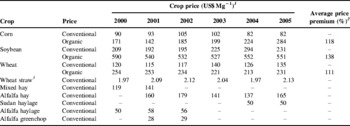
Enterprise budgets were constructed for each crop (except for Sudan grass in Org3 as noted above) for each year from 2000 to 2005 based on field activity records. Production costs included costs of input materials (pesticide, fertilizer, seed, lime and manure) and field operations (tillage, planting, materials application, cultivation, harvesting and hauling). Costs of establishing cover crops were allocated to the succeeding cash crop. Field operation costs, including the cost of liquid dairy manure and application (used in 2002 for corn in Org4+), are based on Maryland custom work chargesReference Johnson28, which include labor and machinery operating costs (fuel, lubrication and repairs) and a portion of the fixed costs of machinery ownership. All costs were adjusted to 2006 dollars, using the index for crop farm input prices published by the USDA National Agricultural Statistics Service29. Poultry litter cost was estimated at US$11 Mg−1 based on prices paid by local farm managers (personal communication, D. Shirley, USDA–ARS; N. Maravell, Maryland organic farmer), and assuming that the manure source is located near the fields where it is applied, i.e., a minimal transportation cost is included in the cost of the material. The cost of management and the fixed costs associated with land and building ownership are assumed to be the same for each cropping system and therefore were not included in the analysis.
Corn, wheat and soybean were harvested as dry grain. In the conventional systems wheat straw was harvested. Since organic farmers in Maryland often do not harvest wheat straw, preferring instead to use the straw to build soil quality and reduce nutrient, especially potassium, exports (personal communication, N. Maravell, Maryland Organic Food and Farming Association; E. Fry; Maryland organic farmer), we did not harvest the wheat straw in this study. Forage crops were usually harvested as hay, but also as haylage or greenchop depending on farm management needs at the time; appropriate prices were used in the analysis (Table 6). All harvested crops were treated as cash crops, contributing to revenue (defined as crop price times yield). In the mid-Atlantic region, the vast majority of organic grain crops are grown and sold as feed- rather than food-grade grain due to the extra challenges of growing and marketing food grade crops, the proximity of organic animal industries, and the lack of brokers to help coordinate the purchase and sale of organic food grade grains (personal communication, R. Hood, L. Howard and N. Maravell, Maryland organic farmers; K. Fedor and W. Rawlings, Maryland Department of Agriculture; J. Rhodes, Maryland Cooperative Extension).
Conventional and organic crop prices used to assess the economic performance of five cropping systems at the USDA-ARS Beltsville FSP, Beltsville, Maryland, 2000 to 2005.

1 Conventional prices obtained from the Maryland Office of USDA–NASS30. Organic prices obtained from Streff and DobbsReference Streff and Dobbs2 for 2000 to 2003, and HamiltonReference Hamilton3 for 2004 and 2005.
2 For years when all five cropping systems were represented: for corn, 2000–2005; for soybean, 2001–2005; for wheat, 2000–2002.
3 US$ bale−1.
Economic returns were calculated on a dollars per hectare basis by subtracting costs from revenue. Because management, land and building costs were not included in the analysis, the net returns obtained here are more correctly termed ‘returns to management, land and buildings’. Out of these returns, farmers could expect to make payments toward such long-term costs as buildings, machinery, land, etc. Average statewide prices for conventionally produced corn, soybean, wheat, hay and straw were obtained from the Maryland Office of the US Department of Agriculture's National Agricultural Statistics Service30 (Table 6). Prices for organically produced crops, which are based on annual midpoint prices for US organic corn, wheat and soybeansReference Streff and Dobbs2, Reference Hamilton3, are also included in Table 6. These prices were comparable to prices received in the Maryland area at the time (personal communication, S. Smelter, Kreamer Feed, Inc., Kreamer, PA). No organic premiums were used to calculate returns for hay, haylage and greenchop since forage products were not of the quality required by the organic dairy industry (personal communication, L. Vough, University of Maryland). All economic analyses were carried out twice: once assuming that organic price premiums were obtained for organic corn, soybean and wheat, and then using conventional prices for both conventional and organic crops. While organic crop prices were about twice those of conventional prices from 2000 to 2005 (Table 6), and remained so as of March 20094, 5, these premiums could decline if new production outpaces increases in demandReference Mainville, Farrell, Groover and Mundy8, Reference Mahoney, Olson, Porter, Huggins, Perillo and Crookston19, Reference Archer and Kludze24. Conducting analyses using conventional prices illustrates a baseline measurement and a potential future scenario.
Annual returns are expressed in present value terms to account for the time value of moneyReference Archer, Jaradat, Johnson, Weyers, Gesch, Forcella and Kludze15 over the 6-year study span. Compounded values were calculated as

where CV is the compounded value of net returns, V is uncompounded value of net returns, r is interest rate and t is an index of years from 0 to 5, running backwards from 2005 to 2000. Thus t=5 represents 2000 and t=0 represents 2005. An average interest rate of 6% was chosen for this analysis. The net present value of returns for a given enterprise was calculated by summing the compounded returns for the relevant years.
Risk analysis
Risk for the full crop rotations in each system was assessed using the method of Musser et al.Reference Musser, Ohannesian and Benson31 in which a lower confidence limit for returns, L, is calculated as

where E is the average net return, K is the number of standard deviations required to satisfy the farmer that average returns in a given year will exceed L at a given level of probability and S is the standard deviation. We set the lower confidence limit at 75%, which means that average returns in three of four years will exceed L. For a normal distribution, K=0.674 for a 75% lower confidence limitReference Hanson, Johnson, Peters and Janke17.
Statistical analyses
Analyses of variance for economic returns were conducted by year and crop with cropping system as a fixed effect and block as random effect using PROC MIXED in SAS, Version 9.132. Analyses across years were conducted as above except with block and year as random effects.
Results and Discussion
Crop yields
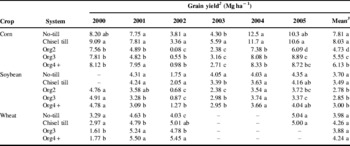
Crop yields—especially those of corn and soybean—varied with year (Table 7), largely due to annual differences in rainfallReference Cavigelli, Teasdale and Conklin16. For example, rainfall from May to August 2002 was 60% of the 30-year average (404 mm), while rainfall from May to July 2003 was 158% of the 30-year average (310 mm); crop yields were commensurately low during these years (Table 7). There were no differences in average grain yields between NT and CT, and average corn and soybean yields in these conventional systems were greater than in the three organic systems (Table 7). Among organic systems, average corn yield increased with increasing crop rotation length and diversity, being 41, 31 and 24% less than in CT (8.03 Mg ha−1) in Org2, Org3 and Org4+, respectivelyReference Cavigelli, Teasdale and Conklin16 (Table 7). Soybean yield in the organic systems was, on average, 19% lower in the organic (average=2.88 Mg ha−1) than in the conventional (average=3.57 Mg ha−1) systems and there were no consistent differences in wheat yield among any systems (overall average, 2000 to 2002=4.09 Mg ha−1; Table 7). There were no consistent impacts of crop rotation length and complexity among organic systems on soybean or wheat yields. A multiple regression analysis showed that nitrogen, weeds and plant population were associated with 73, 23 and 4%, respectively, of differences in corn yields between the CT and the organic systems, and weeds were associated with 100% of soybean yield differences between the CT and organic systemsReference Cavigelli, Teasdale and Conklin16. It is possible that different planting dates and crop varieties in conventional and organic systems, which were not included in these analyses, might also have impacted these results.
Grain yields for corn, full-season soybean and wheat harvested from cropping systems at the USDA–ARS Beltsville FSP, Beltsville, Maryland.Footnote 1 Org2, Org3, and Org4+ are, respectively, a 2-year, a 3-year, and a 4- to 6-year organic crop rotation.

1 From Cavigelli et al.Reference Cavigelli, Teasdale and Conklin16.
2 Values within crop and year followed by the same letter are not significantly different at P<0.05.
3 Means are for years when all five cropping systems were represented: for corn, 2000–2005; for soybean, 2001–2005; for wheat, 2000–2002.
Average crop yields in organic systems have been shown to equal those in conventional systems in Iowa (corn and soybean)Reference Delate and Cambardella14, Reference Delate, Duffy, Chase, Holste, Friedrich and Wantate18, Pennsylvania (corn and soybean)Reference Drinkwater, Wagoner and Sarrantonio9, Reference Hanson, Johnson, Peters and Janke17, Reference Hanson, Lichtenberg and Peters22, Reference Hanson and Musser23, Reference Pimentel, Hepperley, Hanson, Douds and Seidel33, Minnesota (soybean but not corn)Reference Archer, Jaradat, Johnson, Weyers, Gesch, Forcella and Kludze15, Reference Archer and Kludze24 and California (corn)Reference Poudel, Horwath, Lanini, Temple and van Bruggen12. Our results may have differed from these study results due to differences in soil fertility and weed control. For example, as noted by Delate et al., high organic crop yields in their study are predicated on adequate soil fertilityReference Delate, Duffy, Chase, Holste, Friedrich and Wantate18. In addition to the Mollisols in Iowa being inherently more fertile than the Ultisols on which our study was conducted, the Iowa researchers added compost containing a total of 135 kg N ha−1 each year prior to planting corn. We have shown that lower N inputs in our organic than in our conventional systems were associated with lower corn yields in the organic systems in part because we limited application of animal manures due to high soil PReference Cavigelli, Teasdale and Conklin16. Delate and CambardellaReference Delate and Cambardella14 recognized that increasing soil P was a concern in their organic systems. Delate and CambardellaReference Delate and Cambardella14 also noted that weed control was very effective in their 4-year study. By contrast, weed control in our study was variable and was associated with 23 and 19% lower average corn and soybean yields, respectively, in organic than conventional systemsReference Cavigelli, Teasdale and Conklin16.
Performance of conventional crops among studies also differed. For example, yields in our conventional systems were significantly greater than those in the Pennsylvania (Rodale) study. Conventional corn and soybean yields (7.04 and 2.50 Mg ha−1, respectively) at Rodale for the years 1991 to 1995Reference Hanson, Lichtenberg and Peters22, when their organic legume systems were essentially identical to Org3 in our study, were lower than in our study by 12 and 28%, respectively. This difference is even more substantial when 2002, a year with extremely low yields in all systems due to very dry soil conditions, is not included in our results. In that case, conventional corn and soybean yields at Rodale were 21 and 34%, respectively, lower than conventional corn and soybean yields at FSP. When 2002 data are not included in the FSP means, average organic corn yields were similar between sites (6.84 and 6.55 Mg ha−1 for Rodale and FSP, respectively) and organic soybean yields at FSP were greater than at Rodale by 30%. Thus, differences in organic and conventional corn and soybean yields between these two sites reflect more strongly differences in conventional rather than organic crop yields.
Our results are more consistent with those from Minnesota in which corn yields were at least 34% lower in organic than in conventional systemsReference Archer, Jaradat, Johnson, Weyers, Gesch, Forcella and Kludze15, Reference Archer and Kludze24. As in the Minnesota studyReference Archer, Jaradat, Johnson, Weyers, Gesch, Forcella and Kludze15, weed pressure at our site was exacerbated in years when wet soil conditions in the spring precluded ideal timing of rotary hoeing or cultivation activitiesReference Cavigelli, Teasdale and Conklin16. We believe differences in crop yields between organic and conventional systems in our study provide a good indication of expected organic and conventional crop yields in the Coastal Plains region of the mid-Atlantic region. They reflect regional constraints to organic grain crop production and the ability to produce high-yielding conventional crops. Constraints in the mid-Atlantic region include soils with less inherent N fertility and soil organic matter than, for example, Midwest Mollisols and high soil P that precludes regular, large additions of animal manures.
Crop yields among our organic systems followed a similar pattern as that reported by Mahoney et al.Reference Mahoney, Olson, Porter, Huggins, Perillo and Crookston19, who showed greater corn yield following alfalfa (in an organic 4-year corn–soybean–oats/alfalfa–alfalfa rotation) than in a two-year organic corn–soybean rotation in a 10-year study. However, Archer et al.Reference Archer, Jaradat, Johnson, Weyers, Gesch, Forcella and Kludze15, in a 4-year study, found no differences in corn yield in similar 4- versus 2-year rotations, and Delate and CambardellaReference Delate and Cambardella14 found no differences in corn yields in a 3-year corn–soybean–oats/alfalfa versus a 4-year corn–soybean–oats/alfalfa–alfalfa rotation. One possible reason that Archer et al.Reference Archer, Jaradat, Johnson, Weyers, Gesch, Forcella and Kludze15 and Delate and Cambardella'sReference Delate and Cambardella14 results differed from ours and those of Mahoney et al.Reference Mahoney, Olson, Porter, Huggins, Perillo and Crookston19 is that their shorter (4-year) studies included the first 2 or 3 years of an organic transition period, during which time rotation impacts may not be apparent yet.
Enterprise analysis
Production costs
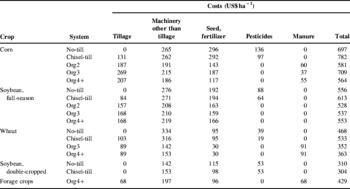
Average total cost of production for each crop except double-cropped soybean was greater for CT than for all other cropping systems (Table 8). While pesticide costs (almost exclusively herbicides) were lower for CT than for NT, tillage costs for CT were substantial and resulted in total costs for CT that were 10–14% greater than in NT for corn, soybean and wheat. Average total cost of production for corn in NT was greater than for corn in Org2 and Org4+ by 20–24%, respectively, but less than for corn in Org3 by 2%. Costs of production were greater in Org3 than in Org2 largely because the cost of planting the vetch cover crop was greater in Org3 than in Org 2. Vetch was planted every year in Org3 but only in 3 of 6 years in Org 2 due to wet soil conditions after soybean harvest in October 2002, 2003 and 2004 (Table 2). Soils are much less likely to be too wet to plant for extended periods of time in late August or early September, when vetch was planted in Org3. Costs of production were greater in Org3 than in Org4+ because establishment costs for the perennial forage crop that preceded the corn crop in Org4+ were allocated to the forage portion of that rotation, while the cost of establishing the vetch cover crop was allocated to the corn in Org3 and Org2.
Average production costs by crop for five cropping systems at the FSP, Beltsville, Maryland. Org2, Org3 and Org4+ are, respectively, a 2-year, a 3-year and a 4- to 6-year organic crop rotation.Footnote 1

1 Means are for years when all five cropping systems were represented: for corn, 2000–2005 (not including 2002, as described in text); for soybean, 2001–2005; for wheat, 2000–2002; for hay, 2000–2005.
Average total cost of production for full-season soybean in the three organic systems was only 1–5% less than that for NT. Tillage costs in the organic systems were about equal to the difference in fertilizer, pesticide and application costs between NT and the organic systems. For wheat, average total production costs were 29–51% greater for conventional than for organic systems due to costs of purchasing and applying fertilizers and pesticides, and harvesting straw in the conventional systems. Cost of harvesting straw is reflected in machinery costs; costs of spreading and incorporating wheat straw in the organic systems are incorporated in wheat harvest and vetch seedbed preparation costs (Table 8).
Most other studies have also found that costs of production are usually lower in organic than in tilled conventional systems due to reduced fertilizer and pesticide materials and application costsReference Archer, Jaradat, Johnson, Weyers, Gesch, Forcella and Kludze15, Reference Hanson, Johnson, Peters and Janke17–Reference Clark, Klonsky, Livingston and Temple21. However, our study seems to be the first to report costs of production for organic systems compared to NT systems. While lower cost of production has been heralded as an advantage for organic production systems compared to conventional systemsReference Delate, Duffy, Chase, Holste, Friedrich and Wantate18, Reference Hanson, Lichtenberg and Peters22, Reference Pimentel, Hepperley, Hanson, Douds and Seidel33, our results show that this may not be the case when the conventional systems are NT, at least for corn and soybean. A lack of substantial difference in production costs between NT and organic systems may be a previously unidentified reason that farmers, especially those using NT practices, may not choose to adopt organic production practices.
Corn
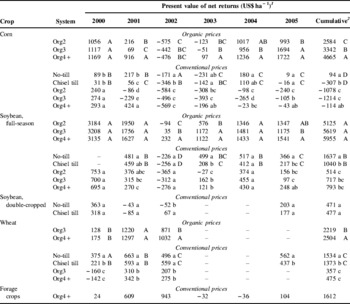
With organic price premiums, present value of net returns for corn was substantially greater for Org2 and Org3 than for the two conventional systems in 3 of 6 years (2000, 2004 and 2005; Table 9). Returns for Org4+ were considerably greater than for the conventional systems in 5 of 6 years (all years except 2002 when corn and soybean yields were very low in Org4+) and were greater than for Org2 (2001, 2003 and 2005) and Org3 (2001, 2003 and 2004) in 3 of 6 years. Those years in which organic price premiums did not provide greater net returns for corn in organic than in conventional systems (Org2 and Org3 in 2001 and 2003, all organic systems in 2002) were years when corn grain yield was much lower than in conventional systems due to limited nitrogen availability and/or weed competition in the organic systemsReference Cavigelli, Teasdale and Conklin16. In 2002 and 2003, respectively, the effects of these management challenges were exacerbated by the very dry and very wet weather previously mentioned. Returns for the period 2000 to 2005 were substantially greater for organic systems than for conventional systems and increased with increasing crop rotation length and diversity (Table 9). This pattern among organic systems reflects corn grain yields (Table 7) more strongly than it reflects production costs (Table 8).
Present value of net returns for individual crops in five cropping systems at the FSP, Beltsville, Maryland, with and without price premiums for organic crops.

1 Results of means comparisons between conventional systems and organic systems when organic premiums are used to calculate returns for organic systems are indicated by upper case letters; when followed by the same upper case letter within a column for a given crop, means are not significantly different at P<0.05; lower case letters are used in the same manner to compare results when no organic price premiums are used.
2 Values are for years when all five cropping systems were represented: for corn, 2000–2005; for soybean, 2001–2005; for double-cropped soybean, 2000–2002 and 2005; for wheat, 2000–2002; for forage crops, 2000–2005.
Similar results are presented in one of the few economic analyses of organic production systems that includes an analysis of returns by individual crop. That study, conducted from 1999 to 2001 in Iowa, shows that returns for corn with organic price premiums were substantially greater than for conventional cornReference Delate, Duffy, Chase, Holste, Friedrich and Wantate18. These authors, however, found no impact of crop rotation length between a 3-year and a 4-year rotation on returns for organic corn.
When conventional prices were used, present value of net returns for corn was among the highest for NT (2002–2005) and for Org4+ in 4 of 6 years (2000, 2001, 2003 and 2005; Table 9). Returns for Org4+ were equal to or greater than for NT in four of these years (2000, 2001, 2003 and 2005). Returns for Org2 and Org3 were among the lowest for all years except 2000 when yields in these two systems were 92 and 95%, respectively, of those in NT (Table 7).
With conventional prices, present value of net returns for corn was often negative in all five systems and cumulative returns for 2000 through 2005 were positive for NT only (Table 9). However, if 2002, a year that was not representative due to very poor yield in all systems, is removed from the analysis, cumulative present value of net returns are positive and not statistically different for Org4+ (US$456 ha−1) and NT (US$265 ha−1). Without the 2002 data, returns for CT (US$40 ha−1) were less than for Org4+ and NT but substantially greater than for Org2 and Org3 (−US$494 and −US$718 ha−1, respectively). Returns for Org4+ were similar to those for NT because lower yields (Table 7) were balanced by lower production costs for Org4+ compared to NT (Table 8). Greater net returns for NT than CT reflected lower production costs in NT (Table 8) rather than differences in yield (Table 7). On the other hand, lower returns for Org2 and Org3 than for the conventional systems were due to lower yields (Table 7) rather than to large differences in production costs (Table 8).
The average price for organic corn was 118% greater than for conventional corn during the period 2000 to 2005 (Table 6). Returns for corn would have been equal to those for NT at average organic price premiums of 38, 39 and 6% for Org2, Org3 and Org4+, respectively. Returns would have been equal to those for CT at average organic premiums of 24 and 27%, respectively, for Org2 and Org3.
Soybean
When organic price premiums were used, net returns for full-season soybean were greater for the three organic systems than for the two conventional systems every year except 2003 (Table 9) when returns for Org2 were not different than for NT. Soybean yield in Org2 was ~80% of that in Org3 and Org4+ that year (Table 7) due to poor weed controlReference Cavigelli, Teasdale and Conklin16. Net returns for Org4+ were greater than for Org2 (2002 and 2003) and Org3 (2002 and 2005) in 2 of 5 years and net returns for Org3 were greater than for Org2 in 2003 only; there were no other differences in net returns among the organic systems. Cumulative present value of net returns for 2001 through 2005 was not different among the three organic systems (US$5566 on average) and was greater than in the NT system by a factor of 3.4 on average and greater than in the CT system by a factor of 5.4 on average (Table 9). Soybean analyses do not include the year 2000 because there were no full-season soybeans in NT and CT that year, as described previously.
The Iowa study that includes an economic analysis of returns by individual crop shows similar results for soybean as for corn: returns for soybean with organic price premiums were substantially greater than for conventional soybean but there was no impact of a 3-year versus a 4-year rotation on returns for organic soybeanReference Delate, Duffy, Chase, Holste, Friedrich and Wantate18.
With conventional prices, full-season soybean was a profitable crop in most systems all years, except for 2002 when low yields (Table 7) resulted in negative returns for soybean in all systems (Table 9). In 2 of the 5 years when full-season soybean was present in all five systems (2002 and 2004) there were no statistical differences in net returns among the five systems. In the other 3 years, returns were among the greatest for NT and CT. There were no consistent patterns among the three organic systems but in the 3 years when there were differences among organic systems (2001, 2003 and 2005), returns for Org3 were no different than those for CT, while returns for Org 2 were lower than for CT only in 2003 and returns for Org4+ were lower than for CT only in 2001.
Cumulative present value of net returns for the years 2001 to 2005, when full-season soybean was present in all systems, was 57% greater for NT than for CT, which, in turn, was 102% greater than for Org2 but not greater than for Org3 and Org4+ (Table 9). Net returns for soybean were greater for NT than for CT as a result of lower production costs in NT (Table 8) and not to differences in yield (Table 7). Lower net returns in the organic systems compared to NT were due to lower yields (Table 7) rather than to any substantial differences in production costs (Table 8). The pattern of net returns between CT and the organic systems was affected by differences in both yields and costs of production (Tables 7 and 8). There were no differences in cumulative net returns among the three organic systems, reflecting similar average soybean yield and production costs among these three systems.
During the time period 2001 to 2005, the average price for organic soybean was 138% greater than for conventional soybean (Table 6). Returns for soybean would have been equal to those for NT at average organic price premiums of 33, 25 and 22% for Org2, Org3 and Org4+, respectively. Returns for soybean would have been equal to those for CT at average organic price premiums of 15, 9 and 6% for Org2, Org3 and Org4+, respectively.
There were few differences in net returns for double-cropped soybean between NT and CT (Table 9). Returns were positive in 3 of 4 years for CT (2000, 2002 and 2005) and 2 of 4 years for NT (2000 and 2005). Returns for double-cropped soybean were lower than those for full-season soybean in those years when both were grown (present value of net returns for NT and CT combined, for full-season soybean=US$521 ha−1; for double-cropped soybean=US$474 ha−1); while yield was generally lowerReference Cavigelli, Teasdale and Conklin16, costs of production were also considerably lower for double-cropped than for full-season soybean (Table 8).
Wheat
When organic price premiums were included for organically grown wheat, returns were greater for the two organic systems than for the two conventional systems in 2 of 3 years (2001 and 2002; Table 9) even though wheat straw sales were included in the returns for CT and NT but not for the organic systems. In 2000, returns for the organic systems were lower than for NT and similar to that for CT even with organic premiums. These differences were due to lower yields in the organic than the conventional systems but, more importantly, to not selling the wheat straw produced in the organic systems. Cumulative returns for the years 2000 to 2002 were greatest in Org4+, followed by Org3, then NT, then CT.
We know of no other US or Canadian studies that compare returns for a small grain crop between organic and conventional systems. The only other study with which we are familiar that included individual crop data for small grains in organic systems found no difference in returns for oats in a 3-year versus a 4-year rotationReference Delate, Duffy, Chase, Holste, Friedrich and Wantate18.
When conventional prices were used, present value of net returns for wheat for the years 2000 to 2002 and 2005 (wet weather in fall 2002 and 2003 precluded planting wheat that would have been harvested in 2003 and 2004, respectively) was greater for NT than for CT in 2 of 4 years (2000 and 2005) and cumulative return was greater for NT than for CT (Table 9). These results reflect lower production costs for NT than for CT (Table 8) rather than differences in yield (Table 7). Net returns for NT and CT were always greater than for Org3 and Org4+ even though production costs were significantly lower in the organic than in the conventional systems (Table 8). This was because wheat straw accounted for 68 and 78% of returns in NT and CT, respectively. While wheat grain prices were low during this time, Maryland had (and continues to have) strong markets for straw in the construction, residential and horse industries. Returns for wheat grain alone for the years 2000 to 2002 were US$519 and 302 ha−1 for NT and CT, respectively, indicating that the sale of straw has a much larger impact on returns from wheat than does production practice. Incorporating wheat straw into soil—which can contribute significantly to soil carbonReference Paustian, Collins, Paul, Paul, Paustian, Elliott and Cole34 and conserve soil nutrients, especially potassium—is a common, although not ubiquitous, practice among organic farmers in the mid-Atlantic region (personal communication, N. Maravell and E. Fry, Maryland organic farmers). There were no differences in net returns for wheat between the two organic systems.
For this time period, the average price for organic wheat was 110% greater than for conventional wheat (Table 6). Returns for organic wheat would have been equal to those for NT at an average organic premium of 75 and 61% for Org3 and Org4+, respectively. Returns for organic wheat would have been equal to those for CT at an average organic premium of 60 and 49% for Org3 and Org4+, respectively. If straw sales are not included in returns for wheat, returns for organic wheat would have been equal to those for NT at an average organic premium of 10 and 2% for Org3 and Org4+, respectively, and both organic systems would have greater net returns than wheat in CT.
Forage crops
Red clover plus orchard grass (2000 and 2001) and alfalfa (2001–2005) were profitable enterprises in 4 of 6 years in Org4+ (2000–2002 and 2005). Returns in 2003 and 2004 were negative because the alfalfa died in all plots during 2003 due to extremely wet weather. Yield in 2003 and 2004 was therefore low and establishment costs, which were allocated to 2004 returns, were higher than usual as all plots, regardless of stand age, had to be replanted (Table 2). Net returns for forage crops were US$1612 ha−1 for the period 2000 through 2005, US$1588 ha−1 for the period 2001 through 2005, and US$1576 ha−1 for the period 2000 through 2001, all of which are much greater than returns for corn, soybean and wheat, respectively, grown in the organic systems during the same periods and when no organic premiums were included (Table 9). Returns for forage crops were also greater than for corn in NT and CT. These results are consistent with other data from Maryland that show that forage crops are significantly more profitable than conventional cornReference Gardner, Chase, Haigh, Lichtenberg, Lynch, Musser and Parker35. However, when organic premiums are obtained for corn, soybean and wheat net returns for these crops are much greater than that for forage crops (Table 9). We know of no other studies that have presented economic returns for the forage portion of organic rotations independent of results for the full rotation.
Full rotations
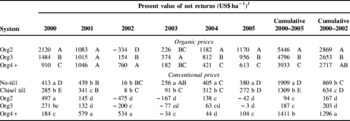
When organic price premiums are used in the analysis, annual returns were greater for all organic systems than for all conventional systems during years with normal rainfall (2000, 2001, 2004 and 2005; Table 10). The only exception is Org4+ in 2004, which had poor returns for alfalfa (Table 9), and in which no wheat had been planted the previous fall, two changes dictated by wet soil conditions. In part because of inconsistencies in crop rotations due to extreme weather conditions, there were no consistent patterns in net returns among the organic systems during the 6-year study period, 2000 to 2005. For example, in 2002, when rainfall from May to September was 60% of the 30-year average, corn and soybean yields were very low in all organic systems (Table 7) and returns were inversely proportional to the frequency of these summer annual crops in the rotation, i.e., returns were greatest in Org4+ and least in Org2. Conversely, in 2000, 2004 and 2005 returns for Org2 were greater than for Org3 and Org4+ because forage crops had low returns (2000 and 2004) due to high establishment costs and/or wheat was absent (2004 and 2005) due to weather conditions.
Present value of net returns for five cropping systems at the FSP, Beltsville, Maryland, with and without price premiums for organic crops.

1 Results of means comparisons between conventional systems and organic systems when organic premiums are used to calculate returns for organic systems are indicated by upper case letters; when followed by the same upper case letter within a column, means are not significantly different at P<0.05; lower case letters are used in the same manner to compare results when no organic price premiums are used.
Cumulative present values with organic premiums were substantially greater for all three organic systems than for the conventional systems (Table 10). During the full study period, 2000 to 2005, net present value was greatest for Org2, which included a high revenue-producing soybean crop in half of all subplots each year and which did not include any fall-planted cash crops. Lower net present values for Org3 and Org4+ than for Org2 during this time period reflect the lack of complete rotations (no wheat from 2003 to 2005, and loss of alfalfa in 2003) in these systems during 3 of these 6 years (Table 2). While the incomplete rotations reduce our ability to compare full rotations for the entire 6-year study period, these inconsistencies likely reflect challenges that farmers with similar rotations might also face. Despite these challenges, cumulative present value for Org4+, which had the lowest returns among the organic systems, was approximately double that for NT, the conventional system with the greatest present value.
The period 2000 to 2002 covers years when all cropping phases of all organic rotations were present and avoids the years when alfalfa died due to wet weather (2003) and wheat was not present (2003–2005) because it was not planted the previous fall due to wet soil conditions. From 2000 to 2002, cumulative net returns for Org2 were greater than for Org3 by 8%, while those for Org4+ were not statistically different than for Org2 or Org3. Cumulative net returns for the three organic systems were greater than for the conventional systems by a factor of 3–4.5 (Table 10).
Our results are similar to a number of other studies that show net returns for organic systems being substantially greater than for conventional systems when organic price premiums are included in the analysisReference Archer, Jaradat, Johnson, Weyers, Gesch, Forcella and Kludze15, Reference Delate, Duffy, Chase, Holste, Friedrich and Wantate18, Reference Mahoney, Olson, Porter, Huggins, Perillo and Crookston19, Reference Clark, Klonsky, Livingston and Temple21, Reference Hanson and Musser23, Reference Archer and Kludze24. Two of these studies showed that returns for organic systems would be greater than for conventional systems even when price premiums were set at 50% of existing premiums at the time of the analysesReference Mahoney, Olson, Porter, Huggins, Perillo and Crookston19, Reference Archer and Kludze24. Our results are also consistent with these results in that we showed that returns for organic crops would equal those for conventional crops with organic premiums that are 5–33% of existing premiums for corn, 4–24% of existing premiums for soybean, and 0–9% of existing premiums for wheat. Our results, however, indicate that organic premiums are necessary for organic systems to compete with conventional systems in the mid-Atlantic region, in part because yield potential in conventional systems in our region seems to be greater than, for example, in Pennsylvania, as discussed earlier.
Costs of production may also differ regionally. Other studies have highlighted two important costs of production that can vary considerably and which can influence the outcome of economic analyses: laborReference Delate, Duffy, Chase, Holste, Friedrich and Wantate18, Reference Hanson, Lichtenberg and Peters22 and manure transportation and materials costsReference Archer, Jaradat, Johnson, Weyers, Gesch, Forcella and Kludze15, Reference Delate, Duffy, Chase, Holste, Friedrich and Wantate18, Reference Smith, Clapperton and Blackshaw20, Reference Archer and Kludze24. Since labor costs are generally recognized as being higher, albeit distributed more evenly across time, in organic than conventional systems, changes in labor costs tend to have a larger impact on economic returns in organic than in conventional systemsReference Delate, Duffy, Chase, Holste, Friedrich and Wantate18, Reference Hanson, Lichtenberg and Peters22. Labor costs in our analysis were relevant to our region as they were incorporated in the Maryland custom rates used for each farming operation. Given the current uncertain global economic situation, the importance of labor costs will need to be given close scrutiny in future analyses.
A number of authors emphasize the importance of obtaining manures and composts on-farm or from nearby locations because transportation costs can make manure or compost cost-prohibitiveReference Archer, Jaradat, Johnson, Weyers, Gesch, Forcella and Kludze15, Reference Delate, Duffy, Chase, Holste, Friedrich and Wantate18, Reference Smith, Clapperton and Blackshaw20, Reference Archer and Kludze24. For example, Delate et al.Reference Delate, Duffy, Chase, Holste, Friedrich and Wantate18 showed that returns for both 3- and 4-year organic rotations were lower than for a conventional corn–soybean rotation when a compost cost of US$18 Mg−1 is included in the analysis. When the cost of the compost was set at US$0 Mg−1, which assumes that the compost is produced on-farm, returns were significantly greater in the two organic systems than in the conventional system. We used a cost of manure in our study of US$11 Mg−1, which assumed a source near our plots. However, it should be noted that sourcing manure in the mid-Atlantic region has become more challenging since 2005 (personal communication, D. Shirley and J. Spargo, USDA-ARS) since demand for animal manures tends to track the price of fertilizers, which have increased since then.
When conventional pricing was used, present value of net returns for the full rotations was greatest for NT in 4 of 6 years (2000 and 2003–2005) and for Org4+ in the other 2 years (Table 10). Net returns for CT were less than for NT all years except 2002, greater than for Org2 and Org3 all years except 2000, and greater than for Org4+ all years except 2001 and 2002. Years with low returns for Org4+ (2000, 2003 and 2004) were years when returns for the forage crops were low (Table 9) due to high production costs and/or poor yields (data not shown). Cumulative present value over the full study period, 2000 to 2005, was, on average, 40% greater for NT than for Org4+ and CT (Table 10). For the 2000 to 2002 period, the years when all crops were present in all organic systems, cumulative present value for Org4+ was 49% greater than for NT and 104% greater than for CT (Table 10). Cumulative present value for Org2 and Org3 was substantially lower than for the other systems during both study periods.
Our results are consistent with those for the Rodale site for the years 1991 to 1995, when their organic legume system was essentially identical to our Org3 systemReference Hanson, Lichtenberg and Peters22. During this time period, returns without organic premiums were lower for the organic than for a conventional, tilled system, even though crop yields in the conventional system were lower than in our study.
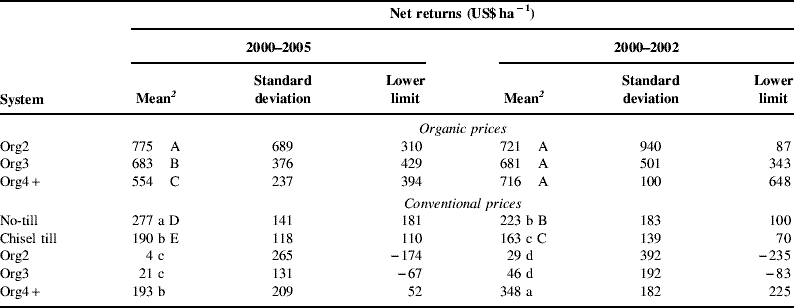
To explore the economic risk associated with each rotation, mean annual returns, standard deviation and lower confidence limits for the full rotations are presented across the two different time periods: 2000 to 2002, when all crops were present in all organic rotations and 2000 to 2005, which includes years when full rotations were not always present in all systems (Table 10). When organic price premiums were included, mean net returns were either inversely related to the length and complexity of the rotation (2000–2005) or equal among the three organic rotations (2000–2002). This result suggests that growing only crops for which there are significant organic premiums rather than soil building crops (forage crops, which did not receive an organic premium in our study, and wheat) may offer economic advantages in the short term. However, Org2 also had the highest variability of returns and highest risk among organic systems with price premiums (a smaller lower limit represents a greater risk; Table 11).
Mean annual net returnsFootnote 1, standard deviation of net returns, and 75% lower confidence limit of net returns for five cropping systems at the FSP, Beltsville, Maryland, for two time periods, with and without price premiums for organic systems.
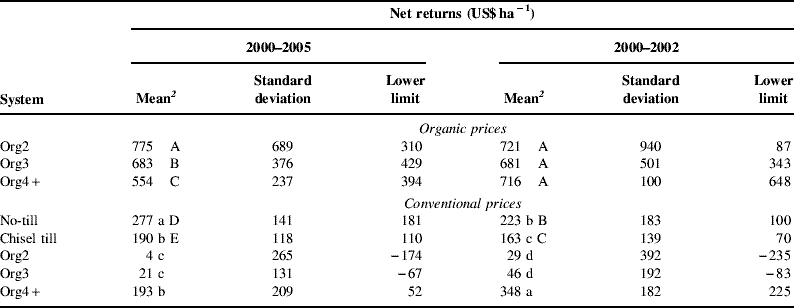
1 Summary values of net returns over variable costs are computed from values in Table 9.
2 Results of means comparisons between conventional systems and organic systems when organic premiums are used to calculate returns for organic systems are indicated by upper case letters; when followed by the same upper case letter within a column, means are not significantly different at P<0.05; lower case letters are used in the same manner to compare results when no organic price premiums are used.
When the 2000 to 2002 timeframe was used, there was a strong negative relationship between risk and the length and diversity of the crop rotation. The lower limits for Org3 and Org4+ were 3.9 and 7.4 times greater, respectively, than for Org2. Despite differences in relative economic performance for the three organic systems based on the study period selected, the three organic systems substantially outperformed the two conventional systems in net returns when organic price premiums were included: on average, net returns for organic systems were 2.4–3.2 and 3.5–4.3 times greater than those for NT and CT, respectively. Except for Org2 during the time period 2000 to 2002, risk for the organic systems was always at least 1.7 and 2.8 times lower than for NT and CT, respectively.
With conventional pricing, NT had greater mean annual returns and lower risk than CT (Table 11). As for individual crops, these differences were due to typically lower production costs for NT than for CT, while yields were similar for the two systems. When all years were included in the analysis and conventional prices were used, returns were greater and risk was lower for NT than for all other systems. However, when only years with complete organic rotations, 2000 to 2002, were used, Org4+ had the greatest returns and lowest risk, indicating that incorporating a forage crop into a grain rotation can increase returns and lower risk when all crops are managed organically and no price premiums are obtained. Mahoney et al.Reference Mahoney, Olson, Porter, Huggins, Perillo and Crookston19 reached a similar conclusion in southern Minnesota. Alternatively, results from the 2000 to 2005 period indicate that including alfalfa in the rotation can add a level of risk that is realized in an extremely wet year such as 2003 when alfalfa died. In either case, without organic premiums, returns were substantially greater and risks were substantially lower for Org4+ than for Org2 and Org3, indicating there was a positive relationship between crop rotation length and complexity among the three organic systems when no organic premiums were received.
Our results probably explain why short crop rotations similar to Org2 have been adopted by a number of organic farmers in the mid-Atlantic region, especially those who have recently converted to organic systems (personal communication, L. Howard, Maryland organic farmer; C. Lawrence, Natural Resources Conservation Service, Virginia), i.e., these systems can have higher short-term returns than longer rotations. These systems may also be easier to manage, at least in the short term, because they include crops with which area farmers have previous experienceReference Mainville, Farrell, Groover and Mundy8. Short crop rotations that include only summer annual crops, however, can result in increased weed populationsReference Teasdale, Mangum, Radhakrishnan and Cavigelli36 and, as we have shown here, result in greater economic risk. The fact that many established, mid-Atlantic organic grain farmers include perennial forage crops in their rotations suggests they understand these long-term consequences of relying on short-term crop rotations (personal communication, N. Maravell and E. Fry).
Conclusions
Our results show that when organic price premiums are included, net returns were at least 2.4 times greater and risk was at least 1.7 times lower for organic systems (except for Org2) than for conventional systems under the conditions described over this study period (2000–2005) in Maryland. It is important to note that these results occurred despite greater management challenges in the organic systems than in the conventional systems: wheat was not planted for 3 years in the organic systems due to wet fall weather (and 2 years in the conventional systems for the same reason), alfalfa died in Org4+ in 2003 and had to be replanted, and weed control was often less than optimal in the organic systems as wet weather in the spring limited our ability to rotary hoe or cultivate in a timely manner in some years.
Over the full 6-year study period, 2000 to 2005, when organic systems received price premiums, Org2 had the greatest net present value and greatest mean returns but also had the greatest variability of returns and greatest risk among organic systems. With organic premiums, Org4+ had the lowest variability of returns and Org3 or Org4+, depending on the time period used, had the lowest risk. For the period 2000 to 2002, the years when all crops were present in all organic systems, mean annual returns and net present value were similar among organic rotations but variability and risk were lowest with Org4+. The Org4+ system thus appears to be a good choice for farmers with management resources to carry out the extended rotation.
On a crop-by-crop basis, economic differences were also noted. Among the organic systems, returns for corn increased with increasing crop rotation length and diversity, reflecting yield patterns and lower production costs for Org4+ than for Org3. Returns for wheat also increased with increasing crop rotation length and diversity. However, returns for soybean, which had the greatest net present value of any of the crops when organic premiums were included, did not vary with crop rotation length and diversity. Because soybean had the greatest returns, Org2, which had soybean in the rotation most frequently, had the greatest returns among organic rotations during the study period. This likely explains why a number of organic grain farmers in the mid-Atlantic region are using these shorter rotations, which include a high proportion of high-revenue crops relative to soil-conserving crops such as winter wheat and perennial forage crops.
It is important to note that there are often marketing and post-harvest costs and risks associated with obtaining organic price premiums that are not accounted for in this analysis. These costs include time involved in certifying a farm, identifying, contacting and developing a relationship with grain buyers, and drawing up contracts. Risks include an insurance system that is less well developed for the organic than for conventional markets, and inherent risks involved with emerging markets in generalReference Mainville, Farrell, Groover and Mundy8. Our analysis shows that marketing and post-harvest costs might easily be captured and that greater risks could be justified with current price premiums since organic crops would have been as profitable as conventional crops with price premiums for corn (2000–2005), soybean (2001–2005) and wheat (2000–2002) that were 5–32%, 4–24% and 45–68%, respectively, of premium prices averaged over the course of the study (2000–2005). These results also indicate that organic systems could be competitive with conventional systems even if price premiums decrease—to a point—in response to increasing production relative to demand. Our results also show that including a forage crop in a grain production system reduces economic risk, improves revenue, and can make economic returns from an organic rotation competitive with conventionally grown rotations even, in some years, when price premiums are not obtained. Managing a forage crop, however, requires specialized equipment and identifying a market, the full costs of which are not included in this analysis.
While grain prices, both organic and conventional, have fluctuated considerably since 2005, organic price premiums, as of March 2009, for organic feed grains remain similar—117% for corn (compared to 118% from 2000 to 2005), 123% for soybean (compared to 138% from 2001 to 2005)—or somewhat lower—53% for wheat (compared to 111% from 2000 to 2002)—than those reported for the period 2000 to 2005 in this studyReference Streff and Dobbs2–5. Thus, we believe that the general conclusions derived from this study comparing economic returns between organic and conventional systems are likely to be valid in the current economic situation.