Introduction
The global production of biodiesel is steadily increasing, with Brazil being one of the largest producers along with Germany, the United States and France. This is due to the wide range of oil crops grown for biodiesel production in Brazil, and the fact that the country has the technology for the development of biofuels. Since January 2010, Resolution No. 6/2009 of the National Energy Policy Council (NEPC), Brazil, has required the mandatory addition of 5% biofuel to all diesel oil sold throughout the country. In the same year, the annual production of biodiesel was approximately 2.6 trillion litres (ANP National Oil Agency, Reference ANP NATIONAL OIL AGENCY2011).
According to Thompson and He (Reference THOMPSON and HE2006), for every 50 litres of biodiesel produced approximately 4.0 kg of crude glycerol, considered a residual co-product, is generated. The recent boost in the use of biodiesel around the world and the availability of large amounts of glycerol are generating interest in the use of this co-product in animal feed.
Crude glycerine is already commonly used in the pharmaceutical and food industries, but undergoes an expensive purification process, which makes animal feed a good destination for excess product. The poultry industry has a great demand for concentrated energy feeds, which accounts for about 70% of the diet. Currently, given the availability of glycerine on the world market, an increase in its use is expected, especially as an energy source in poultry diets. Use of this co-product as dietary energy on a large scale could mitigate the costs of other major feedstuffs, especially corn.
Although it has a relatively variable chemical composition, a major component of crude glycerine is glycerol, which represents some 80 to 90% of this product. The remainder consists of water, ash, fatty acids and traces of protein and methanol (Swiatkiewicz and Koreleski, Reference SWIATKIEWICZ and KORELESKI2009). It is known that glycerol is a normal part of the metabolism of animal cells, originating via lipolysis in adipose tissue or serum lipoproteins. However, knowledge of the metabolic implications of exogenous supplementation of high levels of glycerol in poultry diets is essential if it is to be used by the industry. Thus, the objective of this review is to discuss the main metabolic aspects involved in the use of glycerol by birds and to help further our understanding of the main effects of this feed as an energy source in poultry diets.
Composition of crude glycerine
Glycerol is the principal constituent of crude glycerine. It is an organic compound with an alcohol moiety; propane-1, 2, 3-triol. It is liquid at room temperature, hygroscopic, odourless and viscous and has a sweet taste (IUPAC, Reference IUPAC1993). It forms part of the structure of oil and animal and vegetable fats, and is linked to fatty acids, especially stearic, oleic, linoleic and palmitic acid, thus forming triglycerides.
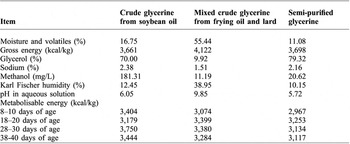
Composition of different sources of glycerine (as feed) evaluated in broilers at different ages.

Source: Lima (Reference LIMA2011)
Studies have shown that the chemical composition of crude glycerine may vary, which makes it difficult to accurately determine the nutrient content. Jung and Batal (Reference JUNG and BATAL2011) evaluated the composition of ten co-products from the United States and found that the percentage of glycerol ranged from 34 to 86%, methanol from 0.01 to 3%, moisture from 8 to 35%, fat from 0.01 to 30% and ash from 0.01 to 4%. This variability can be attributed to the different processes and reagents used in the preparation of biodiesel. Table 1 shows the chemical composition of three glycerines, one derived from soybean oil, one from a mixture of cooking oil and lard and another from semi-purified glycerine. All were simultaneously tested by Lima (Reference LIMA2011) in broilers.
In Brazil, the most widely used reagents in biodiesel production are methanol (for alcohol trans-esterification and purification of biodiesel) and sodium hydroxide (catalyst), which generates a high concentration of sodium and methanol in the final glycerine product (Menten et al., Reference MENTEN, MIYADA and BERENCHTEIN2008). Thus, it is important to have prior knowledge of the chemical composition of glycerine before diverting it to use in animal feed.
Metabolism of glycerol
Glycerol can be found in the bloodstream of animals and their cells, being derived from lipolysis in adipose tissue, triglycerides in serum lipoproteins or dietary fat. In biochemical terms, there are three known functions of glycerol:
• Constituent of the skeleton of triglycerides
• Transport of reducing equivalents (glycerol-3-phosphate) from the cytosol to the mitochondria for oxidative phosphorylation
• Precursor of gluconeogenesis, such as the carbon skeleton
The amount of free glycerol in feeds is relatively low. Normally this molecule is found in triglycerides. In a study on mice, Kato et al. (Reference KATO, HAYASHI, INOUE and YUASA2004) showed that glycerol can be absorbed either actively or passively in the gut. The sodium-dependent active transport system is responsible for 70% of the total transport of glycerol. After absorption, glycerol can be metabolised in the liver or in muscle, but the majority (75%) is metabolised in the liver (Lin et al., Reference LIN, ROMSOS and LEVEILLE1976). There is no equivalent information for birds, but it is believed that the metabolism is similar.
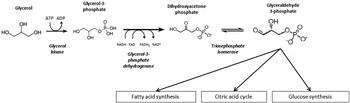
Once in the body, glycerol is metabolised to glyceraldehyde-3-phosphate with the participation of the enzyme glycerol kinase. This compound is then used in the formation of lipid (fatty acid synthesis) or glucose (gluconeogenesis), or is oxidised to provide energy (via the glycolytic pathway) (Figure 1).
Pathway of glycerol use by animal cells.

Glycerol kinase only acts in the liver. In adipose tissue, glycerol-3-phosphate is obtained from dihydroxyacetone molecules by glycerol-3-phosphate dehydrogenase. In muscle tissue, Toews (Reference TOEWS1996) demonstrated the use of glycerol in the rat diaphragm muscle by glycerol reductase, involving the participation of NADPH. In the kidneys, the use of glycerol can vary and may reach one fifth of the total of glycerol used by organism, making it difficult to eliminate glycerol from the urine (Lin et al., Reference LIN, ROMSOS and LEVEILLE1976).
The fate of glycerol in the body is directly linked to the metabolic state of the animal. In the hypoglycaemic condition (fasting), the body releases non-esterified fatty acids and glycerol. Upon return to normal glycaemia status, fatty acids are reincorporated into adipose tissue. Given the difficulty that adipocytes encounter in incorporating the free glycerol, fatty tissue uses glucose for the formation of glycerol-3-phosphate to esterify fatty acids (Coppack et al., Reference COPPACK, PERSSON, JUDD and MILES1999). The other glycerol molecules released in the hypoglycaemic state are used by the liver and other tissues in the ways described above.
Although glycerol is an alcohol, its fate is influenced primarily by two hormones that are essential for the intermediary metabolism of carbohydrates and lipids. Insulin and glucagon are responsible for the release or storage of glucose and, consequently, for directing the metabolism of glycerol. Glucagon is a potent lipolytic hormone in birds, while insulin acts as an anti-lipolytic hormone, inhibiting the release of glycerol and free fatty acids in adipose tissue and stimulating the conversion of glucose and glycerol to fat (Rutz, Reference RUTZ2008). In mammals, catecholamines are potent lipolytic agents. This feature is found in birds only when these hormones are found in high concentrations. The action of these hormones is extremely important in attempts to understand the fate of dietary glycerol in birds. In other words, when the body is in a positive energy metabolic state it will give preference to allocating free glycerol for lipid synthesis, stimulated by the increase in the insulin/glucagon ratio. Thus, the amount of carbohydrates and lipids in the diet can influence the fate of glycerol in the body. Other situations such as stress or high ambient temperatures (heat stress) that may interfere with the release of these hormones can influence the fate of dietary glycerol.
Glycerine as a source of energy in diets
The field of animal nutrition is constantly seeking new sources of feeds. In recent studies, crude glycerine has been shown to be viable in animal production without risk to the quality of the end product. Dozier et al. (Reference DOZIER, KERR, CORZO, KIDD, WEBER and BREGENDAHL2008), Lammers et al. (Reference LAMMERS, KERR, HONEYMAN, STALDER, DOZIER III, WEBER, KIDD and BREGENDAHL2008a) and Menten et al. (Reference MENTEN, MIYADA and BERENCHTEIN2008) considered the use of crude glycerine due to its high energy value. However, variability in its chemical composition can interfere in the quality of product.
Work was carried out on broilers, laying hens and quail to determine the energy values of crude glycerine. Dozier et al. (Reference DOZIER, KERR, CORZO, KIDD, WEBER and BREGENDAHL2008) conducted three experiments on broilers to determine the apparent metabolisable energy corrected for nitrogen balance (AMEn) of crude glycerine (87% glycerol, 280 ppm methanol, 1.26% sodium and 3,625 kcal/kg gross energy). In the first experiment birds aged 4 to 11 days were fed diets containing 0 or 6% crude glycerine. The AMEn (as total feed) was 3,621 kcal/kg. In other experiments the authors used birds from 17 to 24 and 38 to 45 days of age, and included 0, 3, 6 and 9% crude glycerine in the diets. The AMEn values were, respectively, 3,331 and 3,349 kcal/kg for each age period. In a pooled analysis of the three phases, the authors reported an AMEn of 3,434 kcal/kg. In relation to gross energy (3,625 kcal/kg), there was a recovery of 95%. In turn, Mclea et al. (Reference MCLEA, BALL, KILPATRICK and ELLIOTT2011), studying two sources of glycerine for broilers, obtained values of 3,516 and 3,631 kcal/kg, with a recovery of 85 and 76%, respectively.
According to Lima (Reference LIMA2011), the AMEn value of different glycerines may vary depending on the type of glycerine tested, the age of the birds and also the technique used to measure the energy. According to the author, an imbalance between the amount of glycerol and triglycerides is common in different types of glycerine due to the different protocols used to extract biodiesel. Variations were also observed by Jung and Batal (Reference JUNG and BATAL2011), who found the concentration of glycerol to vary from 34 to 86% and fat from 0.01 to 30%. Consequently, the gross energy of these glycerines varied from 3,337 to 6,742 kcal/kg.
Dozier et al. (Reference DOZIER, KERR and BRANTON2011) tested 11 different sources of glycerine and observed AMEn values ranging from 3,254 to 4,135 kcal/kg. Higher values were observed in glycerines from soybean oil compared to animal fat (tallow).
With regard to age, Lima (Reference LIMA2011) observed higher AMEn values in crude glycerine evaluated in broilers in the initial phase of growth. The authors obtained values of 4,461 kcal/kg in DM during the second week of age, 4,419 kcal/kg during the third and 3,715 kcal/kg in broilers aged 38–40 days old. Similar patterns of energetic use of glycerine by birds of different ages had been observed by Dozier et al. (Reference DOZIER, KERR, CORZO, KIDD, WEBER and BREGENDAHL2008). These studies suggested that young birds have a higher capacity to use this co-product, probably due to the accelerated metabolism of these animals which is associated with the better use of glycerol and other nutrients by tissues.
In laying hens, Lammers et al. (Reference LAMMERS, KERR, HONEYMAN, STALDER, DOZIER III, WEBER, KIDD and BREGENDAHL2008a) replaced glucose monohydrate with crude glycerine (87% glycerol, 0.03% methanol, 1.3% sodium, 3.2% ash and 0.12% fat and 3,625 kcal/kg gross energy), and found AMEn value of the glycerine of 3,805 kcal/kg. This may be related to the negative nitrogen balance that is common in laying hens. The authors also observed that the inclusion of 10 and 15% crude glycerine increased the moisture levels in the excrement, attributed to the excess sodium in the diet. This increase was similarly observed in broilers by Lima (Reference LIMA2011) and Guerra et al. (Reference GUERRA, MURAKAMI, GARCIA, URGNANI, MOREIRA and PICOLI2011) that suggested more care with management of the broiler litter was needed for birds fed these types of diets. The high capacity of laying hens to take advantage of glycerine was reaffirmed by Swiatkiewicz and Koreleski (Reference SWIATKIEWICZ and KORELESKI2009), when working with crude glycerine (74% glycerol, 0.04% protein, 0.4% fat and 3.7% ash). The AMEn value in this case was 3,970 kcal/kg.
In quail, Batista (Reference BATISTA2010) found an AMEn value of 4,564 kcal/kg for crude glycerine and 3,069 kcal/kg for semi-purified glycerine. Energy recovery was 87 and 86%, respectively, compared to the gross energy. Pasquetti (Reference PASQUETTI2011) estimated values of 4,893 kcal/kg and 2,476 kcal/kg for crude glycerine and semi-purified glycerine, respectively. These results further illustrated the variability among glycerines obtained via different types of processing.
The above-mentioned studies demonstrated that the AMEn values of crude glycerine differ due to variation in its composition, especially regarding levels of glycerol. It is necessary to take into account the levels of this substance in glycerine in order to predict the AMEn of the product. Other substances like sodium and/or potassium must also be considered, as they cause wet litter at higher concentrations.
The different energy values of glycerines make it difficult to indicate their actual AMEn value. To do this, it is necessary to determine the type of glycerine and its chemical composition. Further work in this direction, especially using techniques to establish prediction equations, is required.
Limitations in the use of crude glycerine in diets
Crude glycerine is not subjected to the purification process during the production of biodiesel, and as a result, may contain residues. The two most common residues are methanol and sodium.
Methanol is used in the transesterification reaction of biodiesel. A mixture composed of water, glycerine and methanol passes through the distillation process. Most of the methanol is recovered, but inefficiency of the process allows traces of this substance to remain in glycerine. The amount of methanol varies according to the process used.
Dasari (Reference DASARI2007) collected samples of glycerine from different industries in the United States and found a methanol concentration ranging from 100 to 11,500 ppm. This variation is considered high. Even so, studies demonstrating the negative effects of the methanol associated with glycerine on animal performance in broilers or laying hens are scarce.
Lammers et al. (Reference LAMMERS, KERR, WEBER, BREGENDAHL, LONERGAN, PRUSA, AHN, STOFFREGEN, DOZIER III and HONEYMAN2008b) evaluated a crude glycerine containing 3,200 ppm of methanol in post-weaning pigs fed for 138 days with diets containing 5 and 10% of crude glycerine and found no indication of toxicity. However, according to Vale (Reference VALE2007), methanol has a high toxicity in animals due to neurological disorders and blindness arising from destruction of the optic nerve. In addition, during its metabolism, methanol is converted, in the liver, to formaldehyde via alcohol dehydrogenase and to formic acid via aldehyde dehydrogenase (Schep et al., Reference SCHEP, SLAUGHTER, VALE and BEASLEY2009). Formate, on the other hand, is toxic because it inhibits mitochondrial cytochrome c oxidase, causing the symptoms of hypoxia at the cellular level and metabolic acidosis, among a variety of other metabolic disturbances (McMartin et al., Reference McMARTIN, MARTIN-AMAT, NOKER and TEPHLY1979).
The residual sodium found in glycerine is a result of using sodium hydroxide as a catalyst for biodiesel production. According to Menten et al. (Reference MENTEN, MIYADA and BERENCHTEIN2008), depending on the catalyst used, crude glycerine can contain from 6 to 8% sodium or potassium salts. Cerrate et al. (Reference CERRATE, YAN, WANG, COTO, SACAKLI and WALDROUP2006) observed that diets containing 10% crude glycerine led to higher moisture levels in the excreta of chickens. Lammers et al. (Reference LAMMERS, KERR, HONEYMAN, STALDER, DOZIER III, WEBER, KIDD and BREGENDAHL2008a) reported a similar increase in wet excreta when including 10 and 15% glycerine in the diet. Thus, it is evident that the excess sodium in the crude glycerine limits the level of inclusion of this co-product in poultry diets, although no tolerance levels have been established to date.
Inclusion of glycerine and poultry performance
Various experiments have been conducted in order to verify the effects of the inclusion of glycerine on the performance of broilers. As described above, the residual sodium in glycerine limits the level of inclusion of this ingredient.
Negative effects on performance were reported by Cerrate et al. (Reference CERRATE, YAN, WANG, COTO, SACAKLI and WALDROUP2006) following the inclusion of 10% glycerine with a gross energy of 3,596 kcal/kg. The authors observed a decrease in feed intake and a lower final weight of the birds, plus lower feed conversion. However, with the inclusion of 5% glycerine, performance was similar to that of the control group. At this level, there was also a higher breast yield in the birds. According to the authors, this improvement can be attributed to higher nitrogen retention due to the increased availability of amino acids that would otherwise be directed to the gluconeogenic pathway to supply energy to animal cells.
Other authors confirmed that the optimal level of crude glycerine inclusion in the broiler diet was close to 5% (Lessard et al., Reference LESSARD, LEFRANCOIS and BERNIER1993; Cerrate et al., Reference CERRATE, YAN, WANG, COTO, SACAKLI and WALDROUP2006; Guerra et al., Reference GUERRA, MURAKAMI, GARCIA, URGNANI, MOREIRA and PICOLI2011, Mclea et al., Reference MCLEA, BALL, KILPATRICK and ELLIOTT2011), although one study recommended 10% (Simon et al., Reference SIMON, BERGNER and SCHWABE1996). Mclea et al. (Reference MCLEA, BALL, KILPATRICK and ELLIOTT2011) suggest that that glycerol kinase enzyme may become saturated above 67 g/kg inclusion in a diet. Another possible explanation is the change in the nutritional composition of the diet. According to Kroupa et al. (Reference KROUPA, SUCHÝ, STRAKOVÁ and HERZIG2011), the replacement of soybean oil with glycerol were manifested by increased nitrogen free extracts and NaCl, and decreased total protein, crude fat (essential fatty acids) and starch in experimental diets.
In laying hens, Lammers et al. (Reference LAMMERS, KERR, HONEYMAN, STALDER, DOZIER III, WEBER, KIDD and BREGENDAHL2008a) found no differences in reproductive performance using 15% crude glycerine, although this ingredient was only fed for 10 days. In an experiment conducted by Swiatkiewicz and Koreleski (Reference SWIATKIEWICZ and KORELESKI2009), the inclusion of 6% crude glycerine did not affect bird performance or egg quality parameters. In turn, Yalçín et al. (Reference YALÇÍN, EROL, ÖZSOY, ONBAŞILAR, YALÇÍN and ÜNER2010) observed that hens fed diets with 7.5% glycerol had the same egg quality (egg breaking strength, egg shape index, egg shell thickness, shell weight percentage, albumen height, albumen index, yolk index, yolk weight percentage and Haugh unit) compared to control diet, but consumed significantly less feed. In this work, the inclusion of 2.5 and 5% glycerol in diets had no significant effects on feed intake during the 16 week experimental period, but 5% inclusion increased the egg yolk cholesterol concentration and decreased the ratio of monounsaturated fatty acids to saturated fatty acids. According to authors, these differences in fatty acid profile might have been due to the differences in the amount and profile of fatty acids remaining in crude glycerol or the reduction in corn in the diet due to the addition of glycerol. The poorest quality eggs, taking into account both flavour and taste after boiling, was found for hens fed 4% rapeseed glycerine (Koreleski et al., Reference KORELESKI, ŚWIĄTKIEWICZ and ARCZEWSKA-WŁOSEK2011).
In quail, Batista (Reference BATISTA2010) found no significant differences in weight gain and feed intake when they included 4, 8, 12 and 16% crude glycerine in the diet. In terms of feed conversion, there was a linear increase with the inclusion of semi-purified glycerine. Conversely, Pasquetti (Reference PASQUETTI2011) observed a linear increase in weight gain and food consumption levels when using up to 15% crude glycerine (57% glycerol, 5.5% moisture, 22% fat, 2% sodium) without affecting the body composition of the birds. These results indicated that more studies should be conducted with glycerine from different sources and birds at different stages of production.
Conclusions
The use of glycerine in poultry diets is imminent, since it is a good source of dietary energy. However, as there is wide variation in the chemical composition of glycerine, it is essential to obtain full knowledge of the composition of this product. Most work on birds indicates the inclusion of between 5 and 10% glycerine in the diet for broilers and laying hens and 15% for quail. However, a better understanding of the relationship between the quality of glycerine and its role as a source of dietary energy will allow the formulation of balanced diets to improve poultry performance.