

Here, we give the first comprehensive report on fossilised remains of mosauroids from Upper Cretaceous rocks in the Big Bend region of west Texas. Mosasauroidea (sensu Bell, Reference Bell, Callaway and Nicholls1997; see also Camp Reference Camp1923) is a monophyletic group of marine adapted lizards. The earliest known mosasauroid appears in the fossil record of the Middle East at approximately 98 Ma (Polcyn et al. Reference Polcyn, Tchernov, Jacobs, Tomida and Vickers-Rich1999), a time when a number of squamate clades entered the marine realm (Bardet et al. Reference Bardet, Houssaye, Rage and Suberbiola2008). A relatively small number of pre-Coniacian mosasauroids are known (Carroll & deBraga Reference Carroll and deBraga1992; Bardet et al. Reference Bardet, Suberbiola and Jalil2003; Dutchack & Caldwell Reference Dutchak and Caldwell2006, Reference Dutchak and Caldwell2009; Smith & Buchy Reference Smith and Buchy2008), and many display a plesiomorphic limb configuration similar to terrestrial lizards, also referred to as the plesiopedal condition (Bell & Polcyn Reference Bell and Polcyn2005). Furthermore, many of these plesiopedal forms retain a primitive configuration of the pelvis in which the ilium is anchored to the vertebral column via sacral ribs, a condition Caldwell & Palci (Reference Caldwell and Palci2007) referred to as plesiopelvic. Derived mosasaurs are known from many hundreds of specimens found in rocks of Coniacian through Maastrichtian age worldwide (Russell Reference Russell1967; Nicholls & Russell Reference Nicholls and Russell1990) and possess fin-like limbs and a pelvis that is no longer solidly anchored to the vertebral column via the sacral ribs. This advanced morphology of the limb and pelvis is referred to as the hydropedal condition (sensu Bell & Polcyn, Reference Bell and Polcyn2005) and the hydropelvic condition (sensu Caldwell & Palci, Reference Caldwell and Palci2007), respectively.
There is broad concensus that hydropedal-hydropelvic forms comprise four subfamilies within Mosasauridae; the Halisaurinae, Mosasaurinae, Plioplatecarpinae, and Tylosaurinae (Russell Reference Russell1967; Bell Reference Bell, Callaway and Nicholls1997; Bardet et al. Reference Bardet, Pereda Suberbiola, Iarochene, Bouya and Amaghzaz2005). Polcyn & Bell (Reference Polcyn and Bell2005) also used the clade name Russellosaurina to include the subfamilies Tylosaurinae, Plioplatecarpinae, and closely related forms which together form a monophyletic clade that is the sister taxon to Mosasaurinae. Within his Mosasauridae, Bell (Reference Bell, Callaway and Nicholls1997) used the name Natantia for the clade that includes both Mosasaurinae and Russellosaurina (sensu Polcyn & Bell, Reference Polcyn and Bell2005) and recovered Halisaurinae (sensu Bardet et al Reference Bardet, Pereda Suberbiola, Iarochene, Bouya and Amaghzaz2005) as sister taxon to Natantia. Historically, plesiopedal forms were considered a monophyletic clade (Carroll & de Braga Reference Carroll and deBraga1992) or a paraphyletic group outside of Mosasauridae (Bell Reference Bell, Callaway and Nicholls1997); however, in more recent phylogenetic analyses, a number of plesiopedal forms (both plesiopelvic and hydropelvic) have been recovered at the base of subfamily level clades within Mosasauridae, otherwise comprised of hydropedal forms, suggesting a more complex early evolutionary history for the group (Bell & Polcyn Reference Bell and Polcyn2005; Polcyn & Bell Reference Polcyn and Bell2005; see also Caldwell & Palci Reference Caldwell and Palci2007). Although many aspects of the taxonomy of the group has yet to be formally revised, there is growing acceptance of this more complex view of mosasaur evolution; specifically, the recognition that subfamily identity was established early in the evolution of the group and that there is significant convergent evolution within the various subfamily divisions of mosasauroids (Caldwell Reference Caldwell2012).
Occurrences of mosasauroids in the Big Bend region range in age from late middle Turonian to possibly Early Campanian. Most of the Turonian records for the region were reported previously by Bell (Reference Bell, Santucci and McClelland1995) and Bell & VonLoh (Reference Bell, VonLoh, Martin, Hogenson and Benton1998) and those are included here for completeness of the record. A number of good specimens from the Late Coniacian have been recovered by one of us (KB) from the uppermost Boquillas Formation in the Terlingua area. The other authors have found a few well-preserved specimens scattered widely throughout the Boquillas and Pen Formations. A few specimens were found by various workers in the past. All specimens are deposited in collections at the University of Texas at Austin or the Shuler Museum of Palaeontology at Southern Methodist University in Dallas.
Institutional abbreviations. BBNP, Big Bend National Park, Brewster County, Texas; FGM, Fryxell Geology Museum, Augustana College, Rock Island, Illinois; FHSM, Sternberg Museum, Fort Hayes State University, Hayes, Kansas; SMU, Shuler Museum of Palaeontology, Southern Methodist University, Dallas, Texas; TMM, Texas Memorial Museum, University of Texas at Austin, Austin, Texas.
1. Geological setting
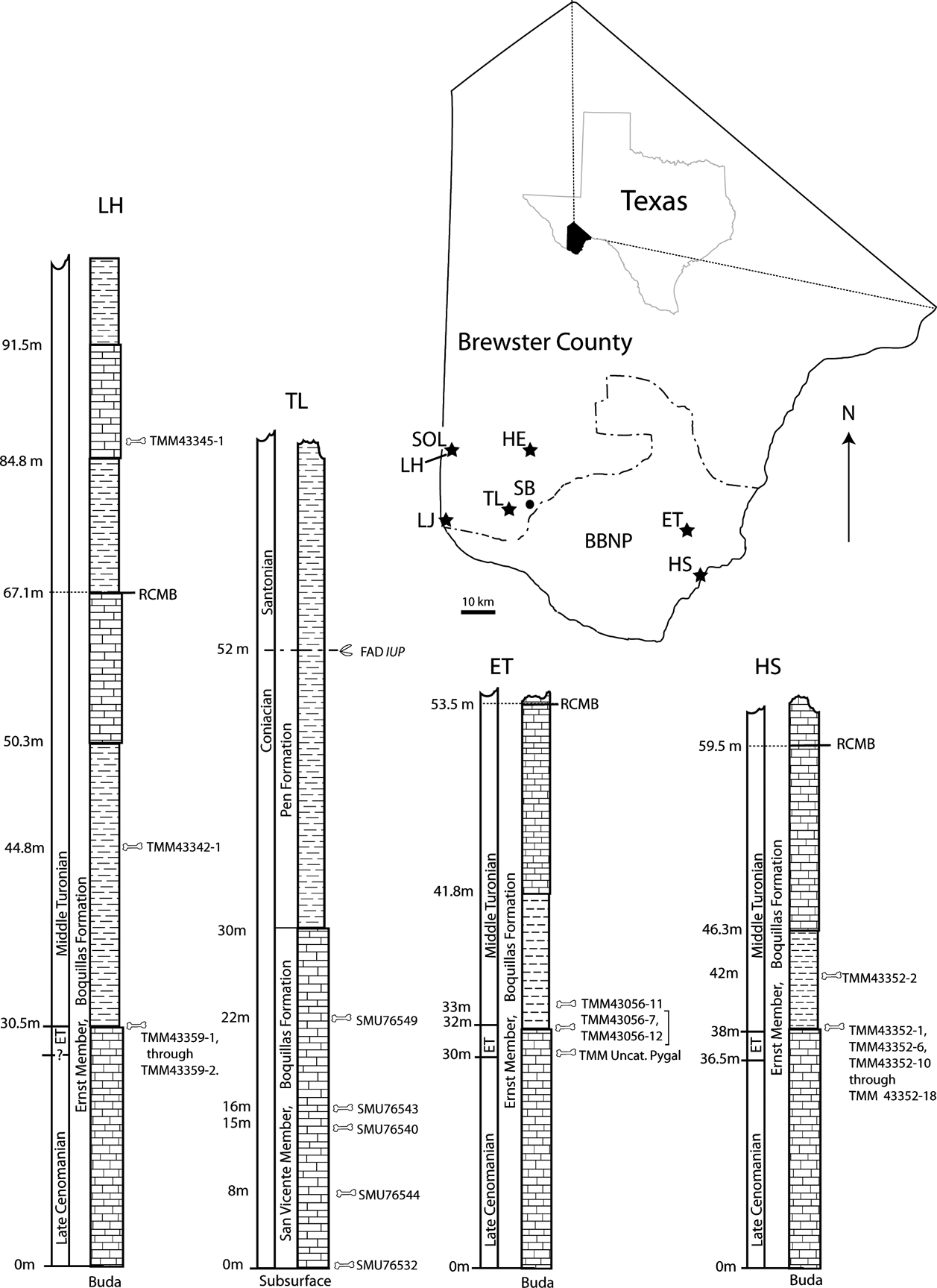
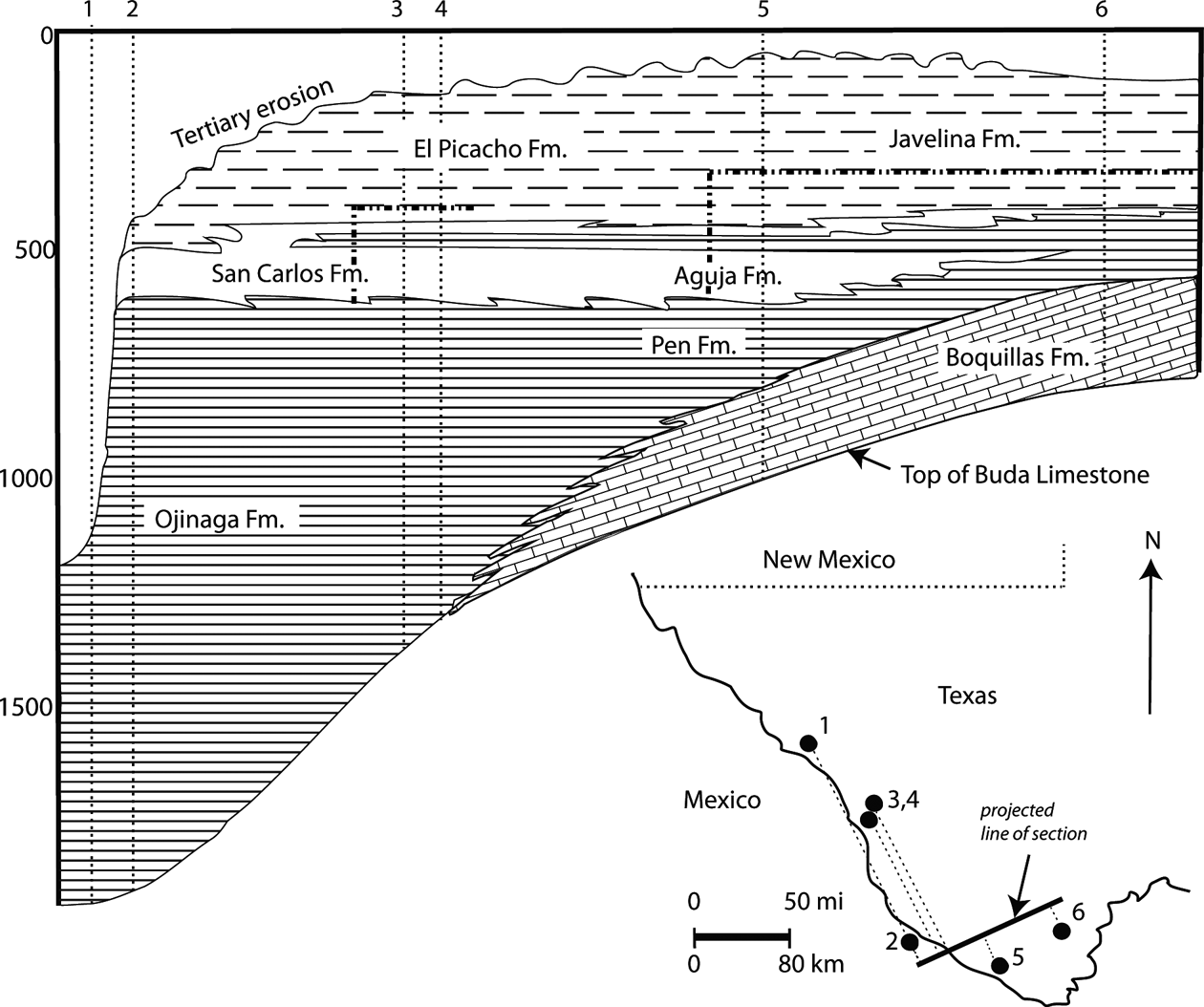
The Big Bend Region of Texas occupies an area of trans-Pecos Texas that is generally defined by a major southward excursion of the Rio Grande, which separates Texas from Mexico. Big Bend National Park occupies the central part of a large area bounded by this excursion (Fig. 1). Late Cretaceous marine rock outcrops are widespread in the region. These consist of, in ascending order, the Del Rio Clay and Buda Limestone of Early to middle Cenomanian age, the Boquillas Formation of Late Cenomanian to Early Santonian age, and the Pen Formation of Late Coniacian to early Campanian age (Maxwell et al. Reference Maxwell, Lonsdale, Hazzard and Wilson1967; see also Fig. 2).
Overview map showing Big Bend region in Brewster County in Texas with localities indicated by stars and select measured sections referred to in text. Big Bend National Park (BBNP) boundary indicated by dashed line. Black circle (SB) indicates the town of Study Butte. Measured sections are from Left-hand Shut-up (LH), Terlingua Ghost Town (TL), Ernst Tinaja (ET) and Hot Springs (HS). Hen Egg Mountain (HE) and Solitario (SOL) sections are not illustrated. Positions of mosasaur occurrences in illustrated sections are indicated with corresponding measurements relative to underlying contacts or lowest exposure in the section (TL); generalised lithologies represented by standard shale and limestone patterns. Abbreviations on section illustrations: ET=early Turonian; RCMB=rusty chert marker bed, a distinctive marker found across the entire region; FAD IUP=stratgraphically lowest occurrence of Inoceramus (Cremnoceramus) undulatoplicatus found to date, here taken to indicate the best approximation of the base of the Santonian Stage.

Cross-section of Late Cretaceous stratigraphy of the Big Bend region. Marine units include Boquillas Formation, Pen Formation, lowermost portions of Aguja and San Carlos formations, and Ojinaga Formation. Redrawn from Lehman (Reference Lehman1985, Reference Lehman, Busbey and Lehman1989). Lateral sections projected into line of fence diagram. Sections: 1=Sierra de Cieneguilla; 2=Sierra de Ojinaga; 3 & 4=Sierra Vieja; 5=western part of Big Bend National Park; 6=eastern part of Big Bend National Park. Mosasaurs discussed in this study occur in the Boquillas and Pen formations in the general area of sections 5 and 6.
The “Boquillas Flags” were named by Udden (Reference Udden1907) and later revised by Maxwell et al. (Reference Maxwell, Lonsdale, Hazzard and Wilson1967) to include all of the overlying beds of alternating, limestone, chalk, and marls to the base of the Pen Formation. They also included both the Boquillas and Pen formations in a group they named the Terlingua Group, and divided the Boquillas into two members; the Ernst Member below and the San Vicente Member above. Based on paleontological identifications from outcrops primarily within Big Bend National Park, they assigned a late Cenomanian through Turonian age for the Ernst Member and a Coniacian age for the San Vicente Member.
Several years of fieldwork have yielded refined stratigraphic positions of these intervals. Based on a section measured at Ernst Tinaja (type section of the Ernst Member) and using high resolution sequence stratigraphic methods, the Cenomanian–Turonian boundary was identified 28·3 m above the base of the Ernst Member. This occurs 65 cm above the top of a 30 cm bentonite couplet consisting of interbedded yellow, white, and maroon clays. Within this couplet is a thin bed of burrowed silty limestone with a diverse ammonite fauna representing perhaps as much as three Late Cenomanian ammonite zones. At 1·5 m above the Cenomanian–Turonian boundary is the highest hard limestone bed in this interval. It is 10–15 cm thick, with an undulatory base and iron-stained burrows on top. Its density and profuse borings suggest this bed represents a condensed zone or hardground. Immediately above this begins an 8·3 m-thick section strongly dominated by thick shale intervals with thin calcarenite beds and numerous, thin bentonite stringers. Many of the calcarenites contain sparse vertebrate teeth and bones, including the stratigraphically lowest mosasauroid specimens recovered from West Texas. The thickest and richest of these vertebrate concentrations occurs as a bed 10 cm thick, lying only 30 cm above the burrowed hardground bed. A specimen of Coilopoceras springeri was recovered 2 m above the base of this shale-dominated interval. This ammonite is the indicator taxon of the upper part of the Prionocyclus hyatti Zone of late middle Turonian age (Hancock et al. Reference Hancock, Kennedy, Cobban, Caldwell and Kauffman1993).
The Hot Springs locality in Big Bend National Park is approximately 15 km south of Ernst Tinaja. Here small specimens of Prionocylus hyatti were found at 2·5 m and 4·4 m above the base of this same shale-dominated sequence. A vertebrate concentration up to 15 cm thick, densely packed with teeth, bones, coprolites, and rip-up clasts, occurs here directly in contact with the highest hard burrowed limestone bed, again suggesting the presence of a condensed interval. At this locality, using marker bed lithologic correlations to Ernst Tinaja, we can place the Cenomanian–Turonian boundary at 2·5±0·2 m below the base of this shaly interval. Thus, the maximum possible stratigraphic thickness that represents the lower Turonian interval here is 5·2 m. At Ernst Tinaja, the same interval is a maximum of 2·5 m thick. If we are correct in identifying a condensed zone below the shaly interval, the most likely thicknesses for the lower Turonian is 1·5 m at Ernst Tinaja and 2·5 m at Hot Springs. The lower Turonian is unusually thin here compared to other localities in Trans-Pecos Texas, where it is approximately 50 m thick at Gold Hill, Jeff Davis County, Texas 260 km to the north northwest (Hook Reference Hook1983). At Chispa Summit, Culberson County, Texas, 275 km to the north-west, the lower Turonian interval is at least 9 m thick (Kennedy et al. Reference Kennedy, Cobban, Hancock and Hook1989). Non-fossiliferous beds and covered intervals there prevent measuring a reliable thickness for the lower Turonian, but it could possibly be as much as 138 m thick.
The same late middle Turonian sequence of shale with minor calcarenite beds can be found at numerous localities on the eastern flanks of the Solitario (Fig. 1) up to 80 km to the west northwest of the Hot Springs locality. Here, the vertebrate concentration is slightly thinner (0–5 cm) and found 0·5–1·2 m above the highest hard limestone in the Cenomanian–Turonian boundary sequence, with many of the calcarenites in the overlying shaly interval containing widely dispersed vertebrate remains, including mosasauroids and the dolichosaur, Coniasaurus crassidens. Within two miles of the mouth of the Lefthand Shut-up as it exits the Solitario, numerous specimens of P. hyatti and Coilopoceras springeri were found in this interval. Specimens of Prionocyclus hyatti are not uncommon in this area at various positions as high as 92 m above the base of the Boquillas, indicating that the upper middle Turonian ranges here from 32 m to at least 92 m above the base of the Ernst Member. We have not found mosasauroid fossils between 92 metres above the base and the top of the Ernst Member, and as a result, we have not attempted to measure the upper Turonian portion of the section.
The San Vicente Member of the Boquillas Formation contains generally softer chalky limestone beds that tend to be of more uniform thickness than the Ernst Member, with more soft marl and shaley beds near the top. The member was assigned a Coniacian age by Maxwell et al. (Reference Maxwell, Lonsdale, Hazzard and Wilson1967). They also indicated that the upper few metres of this unit in several places contained the distinctive bivalve, Inoceramus undulatoplicatus. Considering that inasmuch as I. (Cremnoceramus) undulatoplicatus is now the diagnostic marker for the base of the Santonian Stage (Gale et al. Reference Gale, Kennedy, Lees, Petrizzo and Walaszczyk2007), the highest portions of the San Vicente Member in the eastern portions of the Big Bend region should be considered Santonian in age.
The contact between the Boquillas and Pen formations is diachronous according to Lehman (Reference Lehman, Busbey and Lehman1989), being older on the west and younger in the eastern part of the study area. We have found biostratigraphic evidence that lends additional support to Lehman's depositional model for the Late Cretaceous rocks of the region. As noted above, the first appearance of I. (C.) undulatoplicatus occurs just below the top of the San Vicente Member in the eastern part of the region. However, in the Terlingua area, the first appearance (FAD) of this distinctive bivalve is approximately 22 m above the base of the Pen Formation (Fig. 1), indicating that deposition of the Pen Formation began earlier in the western part of the region. Also, this bivalve is present north of Study Butte, Texas, in outcrops of Pen Formation subjected to contact metamorphism by the Cenozoic intrusion that now forms Bee Mountain. Unfortunately, a more reliable stratigraphic position could not be established here.
To date, the Aguja Formation in the region has produced only scattered and severely abraded vertebrae that can only be referred to Mosasauridae and, thus, are excluded from the following systematic palaeontology section. Only the lower regressive part of this unit is marine (Lehman Reference Lehman, Busbey and Lehman1989).
2. Systematic palaeontology
Squamata Oppel, Reference Oppel1811
Mosasauroidea Camp, Reference Camp1923
Mosasauridae Gervais, Reference Gervais1853
Tylosaurinae Williston, Reference Williston1897
Tylosaurus Marsh, Reference Marsh1872
Tylosaurus kansasensis Everhart, Reference Everhart2005
Referred specimen. SMU76543.
Age and stratigraphic position. Late Coniacian; approximately 14 metres below the contact of the San Vicente Member of the Boquillas Formation with the overlying Pen Formation.
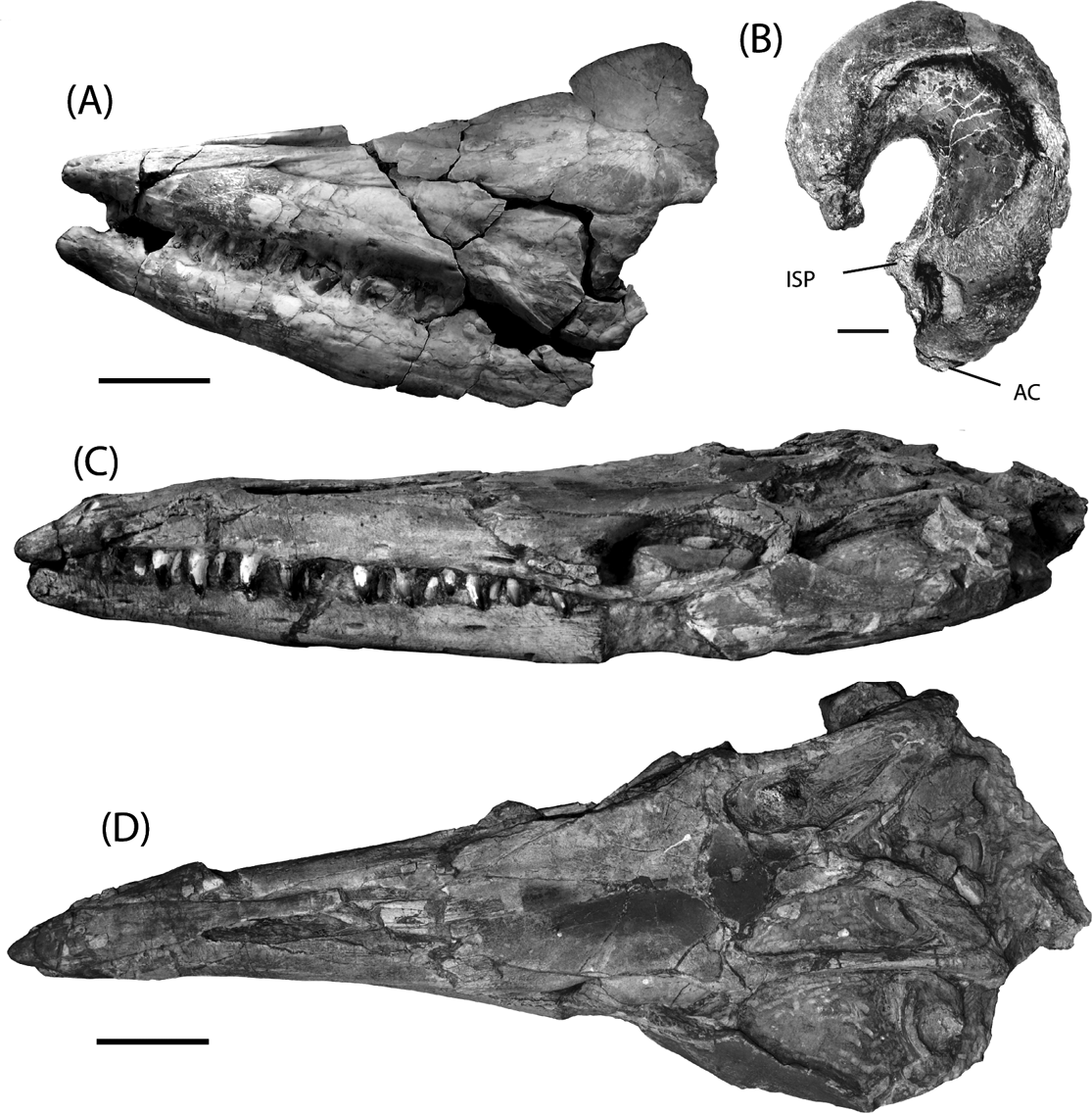
Description. The referred individual consists of an essentially complete, slightly disarticulated skull (Fig. 3A) and a large portion of the postcranial materials. The relatively small premaxilla bears a distinctly rounded conical and comparatively short premaxillary rostrum. The maxillary-premaxillary suture rises almost vertically from the dentigerous margin and then sweeps backward and upward toward the narial opening, which begins above the fourth maxillary tooth. The tooth carinae are not serrate. The posterior end of the frontal displays posteriorly projecting prongs that would create a rather tight embrasure of the anterior end of the parietal, although the latter is not in articulation. We observe that this character is well demonstrated on a specimen (FHSM VP-78) referred but not figured by Everhart (Reference Everhart2005), where the two prongs from the frontal lap back onto the parietal and closely embrace the parietal foramen, which sits at the anteriormost end of the parietal. The quadrate (Fig. 3B) is short, rounded, and robust in overall aspect with a very small nubbin representing the infrastapedial process and a thick quadratic ala. The vertical quadratic shaft below the nubbin is also extremely short, essentially consisting only of the bulbous articular condyle. This condition is consistent with both FHSM-VP-2295, the holotype, and FGM V-43, a specimen referred to this taxon in the original description (Everhart Reference Everhart2005).
Representative tylosaurine specimens from the study area: (A) Tylosaurus kansasensis, SMU76543, partially collapsed anterior part of skull in dorsolateral view; (B) right quadrate of Tylosaurus kansasensis SMU76543 in lateral view; Tylosaurus nepaeolicus SMU76546 in (C) left lateral and (D) left lateral view. Abbreviations: AC=articular condyle of quadrate; ISP=infrastapedial process of quadrate. Scale bars=5 cm (A, C, D); 1 cm (B).
Remarks. It is not surprising to find a specimen of Tylosaurus kansasensis occurring in the same stratigraphic interval with T. nepaeolicus, as this is true in the Smoky Hill Chalk of Kansas. There, in the type area of both, they occur together in the upper Coniacian portion of the chalk (Everhart Reference Everhart2005). However, this is the first report of T. kansasensis outside of western Kansas. The specimen was found approximately 10 km (6 mi) southwest of Terlingua Ghost Town.
Tylosaurus nepaeolicus (Cope), Reference Cope1874
Referred specimens. SMU76532, SMU76544, SMU76546.
Age and stratigraphic position. Late Coniacian; all are from the upper 30 metres of the San Vicente Member of the Boquillas Formation.
Description. SMU76532 is an essentially complete, mostly articulated skeleton. It was somewhat compressed by compaction of the enclosing sediment during fossilisation. The quadrates were recovered along with a portion of the anterior tail, pelvic girdle and hind limb elements associated with a scattering of smaller materials representing stomach contents. The quadrates are typical of Tylosaurus nepaeolicus with a relatively large, open stapedial notch and a moderately-sized infrastapedial process situated relatively low on the vertical quadratic shaft. The specimen was found 1·6 km (1 mi) southeast of Terlingua Ghost Town.
SMU76544 consists of an exceptionally large skull and partial postcrania. Much of the postcrania remain in the outcrop awaiting excavation. The skull measures 1·3 metres from the tip of the premaxilla to the posterior end of the suspensorium. The skull is only partially prepared, but the posterodorsal portion of the skull roof clearly shows the typical T. nepaeolicus condition, possessing a broad anteriorly convex fronto-parietal suture and a parietal foramen situated well posterior to that, and unserrated carinae of the marginal teeth. This and the SMU76546 were found approximately 10 km (6 mi) southwest of Terlingua Ghost Town.
SMU76546 is a complete articulated skull (Fig. 3C, D) and partial postcrania. It was not significantly compressed during fossilisation and preserves an exceptional degree of articulation. The dentaries possess 13 teeth, and the maxillaries possess 12 teeth on the left and 13 on the right. The tooth carinae have no serrations. The anterior end of the premaxilla is slightly distorted downward across the tip end of the dentaries, which gives it an unusually conical, locally swollen, appearance; however, the rostrum is typically extended well beyond the most anterior teeth and closely compares with most specimens of this taxon. The maxillary-premaxillary suture rises slowly and trends backward toward the narial opening in a gentle curve. The narial opening begins above the fourth maxillary tooth. The fronto-parietal suture is broadly convex anteriorly and the parietal foramen lies a significant distance behind this suture as in typical specimens of T. nepaeolicus. One quadrate is quite well exposed on the left side of the posterior skull and displays all the typical attributes of T. nepaeolicus.
Tylosaurinae Williston, Reference Williston1897
Tylosaurinae incertae sedis
Referred specimen. TMM 43345-1.
Age and stratigraphic position. Late middle Turonian; Ernst Member of the Boquillas Formation, approximately 85 m (280 ft) above the base of the unit.
Description. TMM 43345-1 consists of most of an articulated skull, several cervical and trunk vertebrae, and ribs. A portion of the left side of the snout, including the premaxilla, was lost prior to discovery. The specimen is currently being prepared, but what is available for examination includes the posterior portion of the left side of the mandibles, some vertebrae broken in cross section and some teeth. The posterior mandible has essentially parallel upper and lower margins with a thick rounded dorsal margin, indicative of its russellosaurine relationships. The retroarticular process is rather strongly deflected downwardls, creating a broad notch at the lower posterior edge of the unit, and the teeth are moderately large and distinctly striated. Together, these suggest tylosaurine affinities.
Remarks. The ammonite Prionocyclus hyatti has been found just slightly above the horizon that produced this specimen, suggesting an age for this specimen as late middle Turonian. TMM 43345-1 is the only well-preserved tylosaurine skull of middle Turonian age currently known. Only a few tylosaurine specimens consisting of isolated elements of concurrent age are known from northeast Texas (Polcyn et al. Reference Polcyn, Bell, Shimada, Everhart and Everhart2008). Despite distinct differences from other described Tylosaurus taxa, none of these elements is sufficient to diagnose a new taxon. However, these materials do corroborate the presence of an early large tylosaurine in the Turonian of the Gulf Coastal region and suggests early evolution of large body size in tylosaurine mosasaurs.
Plioplatecarpinae Williston, Reference Williston1897
Platecarpus Cope, Reference Cope1869
Platecarpus planifrons Cope, Reference Cope1874
Referred specimens. TMM 43354-1, SMU76542.
Age and stratigraphic position. ?Middle to Late Coniacian; TMM 43354-1 is probably from near the middle of the San Vicente Member of the Boquillas Formation; SMU76542 is from the upper 30 metres of the San Vicente Member of the Boquillas Formation.
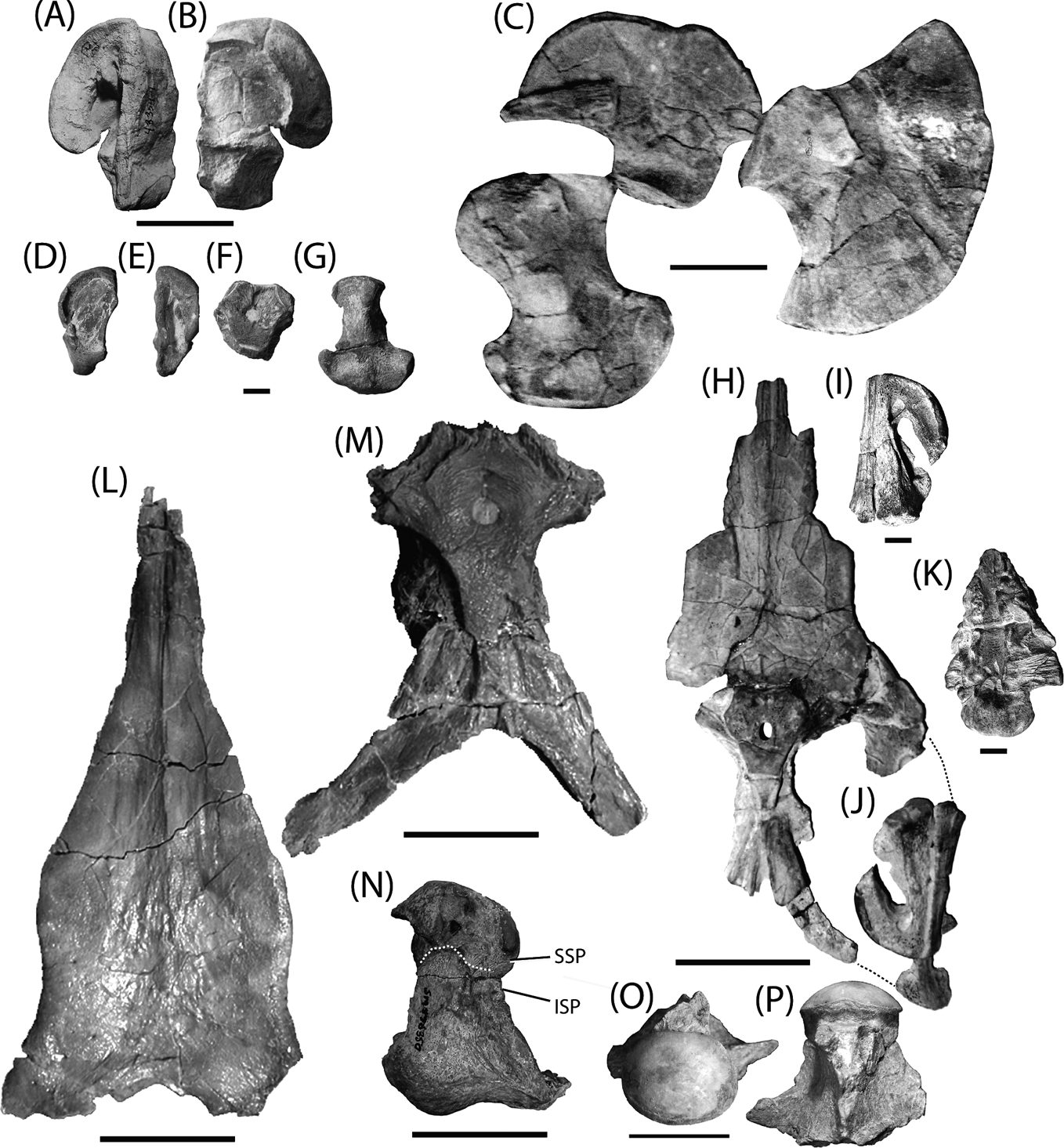
Description. TMM 43354-1 is the anterior half of an individual possessing a complete skull, numerous vertebrae, and anterior appendicular elements. The skeleton is slightly disarticulated and somewhat compressed by compaction but the bone surfaces and morphology are well preserved. The right maxilla has positions for 12 teeth and the left dentary appears slightly tapered and flatly truncated in the anteriormost portion. The dorsal surface of the skull exhibits morphologies readily comparable to the type material of the taxon with no median ridge on the frontal and a typical parietal table. The left quadrate possesses a vertical median ridge with an acutely sharp ridge at its mid-height (Fig. 4A), the condition seen in the quadrate of the type of P. planifrons. This element also preserves the expanded extrastapedial cartilage in place within the lateral aperture of the quadrate (Fig. 4B). The anterior appendicular elements (Fig. 4C) are worthy of note, in that the scapula is somewhat smaller than the coracoid and bears a slight concave inflection in the dorsal margin near its mid-width. The coracoid has no emargination for the anterior coracoid foramen, although there is a slight concave inflection similar to that in the scapula at the appropriate position for such a foramen. The humerus is slightly elongated relative to its width as is seen in several specimens that conform to this taxon.
Representative plioplatecarpine specimens from the study area. (A–C) Platecarpus planifrons TMM 43354-1: (A) left quadrate in medial view; (B) lateral view; (C) pectoral girdle and humerus as preserved in situ. (D–G) Platecarpus planifrons SMU76542: (D) right quadrate in lateral view; (E) right quadrate in medial view; (F) anterior portion of fragmentary parietal; (G) extensor view of right humerus. (H–K) Platecarpus aff. P. planifrons SMU76540: (H) dorsal view of skull roof; (I) medial view of right quadrate (note two ridges descending from mid-height of medial vertical ridge); (J) postorbitofrontal and squamosal as preserved in situ with skull roof portion; (K) dorsal view of articulated basioccipital and basisphenoid. (L–N) Ectenosaurus sp., SMU76350: (L) frontal in dorsal view; (M) parietal in dorsal view; (N) left quadrate in posterior view. (O–P) Plioplatecarpinae incertae sedis, TMM 41449-1: (O) posterior view of anterior trunk vertebra; (P) ventral view of same. Abbreviations: SSP=suprastapedial process of quadrate; ISP=infrastapedial process of quadrate. Scale bars=5 cm (A–C, H, J, L–P); 1cm (D–G, I, K).
SMU76542 is a fragmentary specimen consisting of a right quadrate (Fig. 4D, E), triangular parietal table (Fig. 4F), a right humerus (Fig. 4G), and a few jaw, vertebral, and limb fragments. The quadrate is well preserved, though the bone surface is slightly exfoliated, and possesses a sharp-edged medial portion of the median ridge (Fig. 4E), consistent with the type of P. planifrons. The humerus (Fig. 4G) is slightly elongated, as noted previously for this taxon. A portion of the postglenoid process appears to have been broken away or crushed inward as a result of compactional contact with another bone. The path for the radial nerve is a distinct disto-lateral groove that is closed over only at the condylar margin.
Remarks. TMM 43354-1 was recovered from a position low within shale-dominated outcrops on the southwest flanks of Sawmill Mountain, approximately 5 km north of Terlingua Ghost Town. These exposures resemble portions of a published section in Maxwell et al. (Reference Maxwell, Lonsdale, Hazzard and Wilson1967, pl. 8). Their Sawmill Mountain section illustrates a shaly upper half of the San Vicente Member underlain by a thick limestone bed with many “Ostrea” congesta. Except for colour, the described section is consistent with outcrop lithologies where this mosasaur was found. Indeed, if the stratigraphic position is correct as interpreted, the inferred age of this specimen could be middle Coniacian. The fragmentary specimen, SMU76542, was found weathered, completely free on dip slopes low within the upper 30 metres of the San Vicente Member southeast of Terlingua Ghost Town. Recently, Konishi & Caldwell (Reference Konishi and Caldwell2011) proposed the genus name Plesioplatecarpus to accept the single species Platecarpus planifrons. Given the current dynamics of mosasaur research, we defer acceptance of the new name pending the description and phylogenetic analyses of a number of new plioplateacarpine specimens.
Platecarpus aff. P. planifrons
Referred specimen. SMU76540.
Age and stratigraphic position. Late Coniacian; approx 19 metres below the contact of the San Vicente Member of the Boquillas Formation with the overlying Pen Formation.
Description. This specimen, from a productive locality about 10 km (6 mi) southwest of Terlingua Ghost Town, consists of a disarticulated skull and a few vertebrae. The skull is missing the snout including the prefrontals and is slightly compressed as a result of sediment compaction. The frontal (Fig. 4H) is significantly smaller than that of the type of Platecarpus planifrons, but otherwise similar. It has no medial dorsal ridge and the medial portion of the frontoparietal suture is distinctive concave posteriorly. However, the best preserved of the two quadrates (Fig. 4I, J) has an additional small ridge on the medial face of the vertical shaft just posterior to the sharp-edged medial portion of the median ridge. This accessory ridge is not present on the type material or on other specimens of P. planifrons from this area. In addition, the dorsal surface of the basioccipital possesses a pair of rounded canals distinctly separated by a thin median septum (Fig. 4K).
Remarks. Some characters of the median quadrate and basioccipital canals prevent us from confidently assigning this specimen to the species Platecarpus planifrons. The median septum separating the canals in the floor of the basioccipital is present in some Turonian plioplatecarpines (e.g. holotype skull of Angolosaurus bocagei Antunes, Reference Antunes1964; Russellosaurus coheni Polcyn & Bell, Reference Polcyn and Bell2005), but most specimens of P. planifrons which preserve this canal display a single bilobate canal (coalesced pair of canals) with only a slight sagittal constriction. The accessory median ridge of the medial quadrate is unknown in other specimens of P. planifrons.
Ectenosaurus Russell, Reference Russell1967
Ectenosaurus sp.
Referred specimen. SMU76350.
Age and stratigraphic position. Unknown position within the Pen Formation but assigned an age of middle to late Santonian on the basis of calcareous nanofossils.
Description. The new specimen shares with Ectenosaurus clidastoides a relatively slender frontal and supraorbital frontal emargination (Fig. 4L). The shape of the frontal is typical of plioplatecarpines but its anterior portion is protracted forward much more so than seen in specimens of Platecarpus. It closely approaches the condition seen in Ectenosaurus clidastoides but the frontal does not have a distinctly high median ridge as in that taxon. The overall shape of the parietal, its suture with the frontal and the position of the pineal foramen are consistent with referral to Ectenosaurus, but it is more elongate and retains a well defined parasagittal ridge, unlike Ectenosaurus clidastoides (Fig. 4M). The quadrate of SMU76350 possesses a short suprastapedial process that meets an enlarged infrastapedial process as in Ectenosaurus (Fig. 4N).
Remarks. The specimen was recovered from the southwestern flanks of Hen Egg Mountain about 15 miles north of Study Butte, Brewster County, where it occurred within a down-faulted block. Its precise stratigraphic relationships are obscured by covered contacts and lack of reliable marker beds.
Plioplatecarpinae Williston, Reference Williston1897
Plioplatecarpinae incertae sedis
Referred specimen. TMM 41449-1.
Age and stratigraphic position. ?Early Campanian; Pen Formation, approximately 30 m below top of the unit.
Description. The specimen consists of nine well preserved vertebrae from the anterior end of the trunk of a single individual. What is probably the anteriormost vertebra consists of a badly damaged centrum, preserving only the posterior condyle which is slightly dorso-ventrally compressed. Other vertebrae preserve the neural arches and are in relatively good condition. The posterior condyles are about equidimensional in width and height and are probably mid- to posterior-trunk vertebrae. One of these is shown in Figure 4 (O, P).
Remarks. The morphology and dimensions are consistent with equivalent vertebrae from other plioplatecarpine specimens, including Platecarpus. The specimen is from a TMM locality in faulted exposures near Payne's Waterhole, in the vicinity of Hen Egg Mountain, Brewster County. Although the specimen was recovered from a faulted block, its stratigraphic relationship with the top of the Pen Formation is known, suggesting an Early Campanian age (fide Lehman Reference Lehman, Busbey and Lehman1989).
Russellosaurina Polcyn & Bell, Reference Polcyn and Bell2005
Russellosaurina incertae sedis
Referred specimens. TMM 43056-12, TMM 43342-1, TMM 43352-2, TMM 43352-16, TMM 43352-18, TMM 43359-4, TMM 43352-1, TMM 43352-14.
Age and stratigraphic position. Late middle Turonian; all from approximately 32–47 m above the base of the Ernst Member of the Boquillas Formation.
Description. Two moderately sized vertebrae, TMM 43352-2 and TMM 43352-18, from the Hot Springs locality in BBNP have ventral facets that indicate an articulating haemal arch condition. Among more derived hydropedal forms, as demonstrated by the size of these vertebrae, this condition is indicative of some type of russellosaurine, although less generalised assignments are currently not possible.
Four individual teeth with well-developed carinae all show fine medial striations, indicating that they are referable to Russellosaurina. TMM 43056-12 is from Ernst Tinaja and TMM 43352-16 is from Hot Springs. TMM 43342-1 and TMM 43359-4 are from localities about 1·6 km north of the exit of the Lefthand Shut-up drainage from the flanks of the Solitario (Fig. 1).
A partial right prootic, TMM 43352-1, from the Hot Springs locality is tentatively assigned to Russellosaurina, because its size generally corresponds to an individual with vertebrae of the size as those presented by TMM 43352-2 and TMM 43352-18, above. The most striking character of this prootic is the large diameter of the semicircular canals that are exposed by breakage and at the sutural surface for the opisthotic. The diameter is at least four to five times that of other known mosasaurs, but similar in some respects to more terrestrial lizards, suggesting this element belongs to a relatively primitive form.
A partial right splenial, TMM 43352-14, from the Hot Springs locality was considered to be tentatively referable to Russellosaurina (Bell & VonLoh Reference Bell, VonLoh, Martin, Hogenson and Benton1998), based on similarity to Russellosaurus coheni Polcyn & Bell, Reference Polcyn and Bell2005 although TMM 43352-14 is slightly more conservative.
Remarks. All of these specimens were described and their stratigraphic positions given previously by Bell (Reference Bell, Santucci and McClelland1995) and Bell & VonLoh (Reference Bell, VonLoh, Martin, Hogenson and Benton1998).
Mosasaurinae Williston, Reference Williston1897
Clidastes liodontus Merriam, Reference Merriam1894
Referred specimen. TMM 43343-1.
Age and stratigraphic position. Late Coniacian or Early Santonian; lower part of Pen Formation.
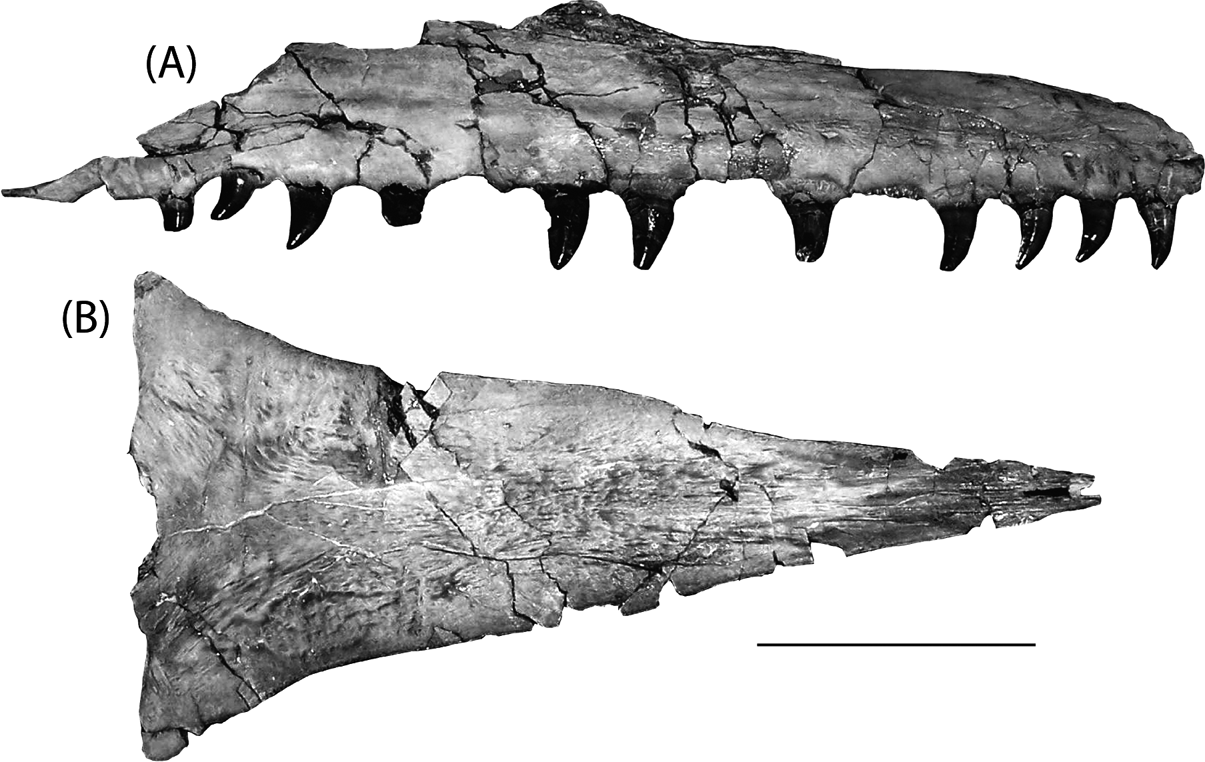
Remarks. The specimen consists of the complete skull and a few cervical vertebrae of an individual. The premaxilla is very pointed with a moderately protruding, conical premaxillary rostrum. The maxillae are elongate and slender, each containing 15 tooth positions (Fig. 5A). The frontal (Fig. 5B) bears a sigmoidal lateral margin as in the type specimen. The quadrates do not possess an infrastapedial process. The condyles of the cervical vertebrae are virtually circular and there is a long posteroventral tubercle on the atlas synapophysis. All of the observed morphology is consistent with the type material and numerous other specimens referred to the taxon.
Clidastes liodontus, TMM 43343-1: (A) lateral view of complete right maxilla; (B) dorsal view of complete frontal. Scale bar=10 cm.
Remarks. TMM 43343-1 is from outcrops immediately southwest of Hen Egg Mountain, Brewster County, close to the locality of the Ectenosaurus specimen discussed above. It also is from a down-faulted block that obscures local formational contacts. Presence of very light coloured chalky clays interbedded with gray clays suggests this part of the Pen Formation lies not far above the carbonate deposition of the underlying Boquillas Formation and, thus, is Late Coniacian or Early Santonian in age.
Mosasurinae? incertae sedis
Referred specimens. TMM 43056-3, TMM 43056-7, TMM 43352-11.
Age and stratigraphic position. Late middle Turonian; all from approximately 32–44 m above the base of the Ernst Member, Boquillas Formation.
Description. Among the disarticulated elements of basal mosasauroids that were described by Bell & VonLoh (Reference Bell, VonLoh, Martin, Hogenson and Benton1998) from late middle Turonian exposures in the Big Bend region are three presacral vertebrae that may be referrable to Mosasaurinae based on their elongated centra and the sub-circular shape of their condyles.
Remarks. Although tentative, our referral to Mosasaurinae is reasonable on the basis of the characters noted and the knowledge of other basal members of Mosasaurinae that are known from the middle Turonian of north Texas and Kansas (Bell & Polcyn Reference Bell and Polcyn2005; Polcyn et al. Reference Polcyn, Bell, Shimada, Everhart and Everhart2008). Although similar to Dallasaurus in many respects, these vertebrae are insufficiently preserved to allow confident referral to that taxon, even though they are probably temporally sympatric.
Mosasauroidea incertae sedis
Referred specimens. TMM 43056-4, TMM-43352-6, TMM-43352-12, TMM 43352-13.
Age and stratigraphic position. Latest Cenomanian and late middle Turonian; all from approximately 30–44 m above the base of the Ernst Member, Boquillas Formation.
Description. A number of completely disarticulated elements of basal mosasauroids were described by Bell & VonLoh (Reference Bell, VonLoh, Martin, Hogenson and Benton1998) from late middle Turonian exposures in Big Bend National Park and the eastern flanks of the Solitario in western Brewster County (Fig. 1). Most of the specimens consist of individual vertebrae of small (1–1·5 m), presumably primitive mosasauroids. Two fragments, TMM 43352-13, represent the opposite ends of what is likely the same humerus of a distinctly primitive-limbed form (“plesiopedal” sensu Bell & Polcyn, Reference Bell and Polcyn2005; “aigialosaur-grade” sensu Bell & VonLoh, Reference Bell, VonLoh, Martin, Hogenson and Benton1998). Two of the caudal vertebrae, TMM 43056-4 and TMM 43352-12, may be referable to Russellosaurina because of the presence of facets for haemal arch articulations. However, the phylogenetic relationships of a number of small plesiopedal forms with articulating haemal arches lie outside of Russellosaurina (Bell & Polcyn Reference Bell and Polcyn2005; Polcyn & Bell Reference Polcyn and Bell2005). It should be noted that the plesiopedal-plesiopelvic mosasaur Vallecillosaurus (Smith & Buchy Reference Smith and Buchy2008), reported from the early Turonian of Mexico, possesses articulating haemals, though affinities with that taxon are yet to be established.
Remarks. One fragmentary vertebra, TMM 43352-6 from the Hot Springs Locality (late middle Turonian) in Big Bend National Park, is from the posterior trunk series of a small, probably plesiopedal individual and is distinct from all other known basal mosasauroids (Bell & VonLoh Reference Bell, VonLoh, Martin, Hogenson and Benton1998, fig. 6). The shape of the centrum is extremely depressed, as indicated by the major portion of the condyle that remains. The overall aspect is of a small but very wide vertebra with widely separated zygopophyses, and downwardly sloping and rather flattened synapophyses. The compressed centrum is reminiscent of halisaurine mosasaurs, but those are not known to have posterior trunk vertebrae so strongly compressed. Since the report by Bell & VonLoh (Reference Bell, VonLoh, Martin, Hogenson and Benton1998), another pygal vertebra (TMM uncatalogued specimen) of the same strongly compressed morphology was recovered by acidising matrix from the Ernst Tinaja locality in Big Bend National Park. The source of the acidised sample is from 30–35 cm below the highest bed of Cenomanian Age (Will Elder, pers. comm. 1995).
3. Conclusions
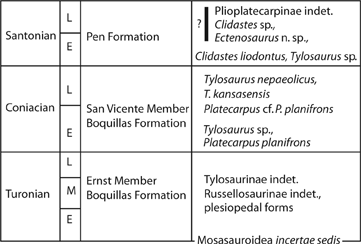
In recent years, reports of Turonian-aged mosasauroids from North America have allowed reassessment of phylogentic relationships and patterns of morphological evolution within the clade (Bell & Polcyn Reference Bell and Polcyn2005; Polcyn & Bell Reference Polcyn and Bell2005). These and other discoveries have also demonstrated Turonian diversity in basal forms (Bell & VonLoh Reference Bell, VonLoh, Martin, Hogenson and Benton1998; Smith & Buchy Reference Smith and Buchy2008) and early subfamilial cladogenesis of mosasaurs (Polcyn et al. Reference Polcyn, Bell, Shimada, Everhart and Everhart2008). The long-ranging and diverse mosasauroid fauna represented in the Turonian through Early Campanian marine rocks of the Big Bend region contributes significantly to that record (Table 1).
Synopsis of the stratigraphic and chronostratigraphic distribution of Late Cretaceous Mosasauroids from the Big Bend Region, Texas.
In this contribution, we have documented the chronostratigraphic occurrences of mosasauroids in the Big Bend region. The oldest mosasauroid from this area is of latest Cenomanian to middle Turonian age and exhibits very unusually compressed posterior trunk and pygal vertebrae, and its size suggests that it is likely a plesiopedal form. At least two other small plesiopedal forms of typical basal mosasauroid morphology and vertebral dimensions are found in the middle Turonian. Most of these cannot be referred with confidence to specific major clades within Mosasauroidea given our current state of knowledge of relationships and the fragmentary nature of the material. A number of larger, more derived late middle Turonian forms are referable to Russellosaurina. One of these appears to be the oldest well-preserved tylosaurine known and suggests attainment of large body size early in the evolution of tylosaurines.
Middle to late Coniacian taxa are generally similar in faunal composition to that of western Kansas from the lower portions of the Smoky Hill Chalk, including the presence of a relatively newly described form from that region, Tylosaurus kansasensis Everhart, Reference Everhart2005. An Ectenosaurus that appears to be similar to, but distinct from, E. clidastoides occurs in the middle to late Santonian. The oldest definitive mosasaurines in the Big Bend region occur in the latest Coniacian or earliest Santonian, represented by Clidastes, temporally similar to the Kansas record. It is not surprising that the Big Bend mosasaur fauna is similar to that from the temporally equivalent interval in Kansas, as Texas lies essentially at the southern mouth of the Western Interior Cretaceous Seaway and only about one thousand kilometres away. However, several small plesiopedal forms are found in Texas, while only two vertebrae of a basal mosasaurine have been reported from Kansas (Polcyn et al. Reference Polcyn, Bell, Shimada, Everhart and Everhart2008), but this may an artefact of collecting bias. Nonetheless, the documented diversity of the basal and derived Turonian mosasauroids of this region is currently unprecedented elsewhere.
4. Acknowledgments
We owe a great deal of appreciation to William (Bill) Cobban for identifying numerous ammonites. Alan Titus also helped with additional ammonite identifications. We thank Will Elder and acknowledge the late Bill Sliter for field assistance and help measuring sections in 1995 and informative discussions regarding stage boundaries at localities within Big Bend National Park. We wish to thank the National Park Service staff at BBNP for providing research permits to the first author. Phil Koepp of the NPS assisted in field work, along with Patricia Bell, Sandy Polcyn, and James and Kathy Lamb. We thank Michael Caldwell and Theagarten Lingham-Soliar, whose reviews greatly improved this manuscript.