Owing to its social relevance for the maintenance of peace and stable democracies, the topic of collective memory has attracted the attention of political scientists, sociologists and historians (see, for example, Booth Reference Booth2001; de Brito et al. Reference de Brito, Gonzalez Enriquez and Aquilar2001; Connerton Reference Connerton1989; Gibson Reference Gibson2004; Olick Reference Olick2007; Rose Reference Rose2009; Schwartz Reference Schwartz1991, Reference Schwartz1996; Winter Reference Winter2006). Scholars of collective memories have long been preoccupied with the question of how far our memories are functions of the past and how far they are affected by the present. Two major schools of thought have emerged, emphasizing fundamentally different aspects in theorizing the origin of collective memories: presentism and essentialism (see Olick Reference Olick2007: 7–8; Schwartz Reference Schwartz1991: 221–2; also Aguilar Reference Aguilar2002: 14–15). Presentism views collective memory as a function of present factors, political interests and social conditions.Footnote 1 In contrast, essentialism views collective memory as a fundamental matter of the past (see, for example, Schudson Reference Schudson1992).
In order to shed light on this major debate, this article examines the role of transitional justice in shaping the collective memory of the previous regimes. Does transitional justice alter the memory of the past? Transitional justice is uniquely positioned to illuminate the dilemma about the origin of collective memory. Transitional justice can be defined as a set of measures devised by transitional countries to deal with the past (see Kritz Reference Kritz1995; Stan and Nedelsky Reference Stan and Nedelsky2013; Teitel Reference Teitel2000). It provides us with an excellent opportunity to examine whether views of wrongdoing are determined by the wrongdoing itself or whether these views are redefined by policies that have been designed to deal with it.
To investigate the role of transitional justice, this article examines its subset, which consists of lustration laws (see Letki Reference Letki2002; Szczerbiak Reference Szczerbiak2002; Williams et al. Reference Williams, Szczerbiak and Fowler2005). Lustration law can be defined as ‘a special public employment law that regulates the access of members of the former repressive apparatus to public positions in the new democracy’ (David Reference David2006: 350). This article conceptualizes collective memory as a process that captures present attitudes to past wrongdoing. Since transitional justice predominantly concerns the attribution of, or impunity from, responsibility for the past, this article only operationalizes a subset of collective memory that concerns individual responsibility and a moral judgment on the past. We shall look for evidence that would enable us to link the pertinent aspect of collective memory to transitional lustration laws or to historical conditions, finding support for either presentism or essentialism.
Our approach to collective memory may be considered narrow and reductionist, but we believe that the benefits of the trade-off outweigh its costs. First, our approach allows us to study empirically the topic of collective memory, which is under-researched owing to existing conceptualizations that are often too broad. With a measure of agnosticism, Olick (Reference Olick2007: 23–33), for instance, relegates the use of social surveys on collective memory into the snapshots of a ‘collected memory’. Second, our approach provides us with an opportunity to depart from the line of empirical research that draws on psychological conceptions of memory as a process of retrieving information about the past (Hirst et al. Reference Hirst, Phelps, Buckner, Budson, Cuc, Gabrieli, Johnson, Lustig, Lyle, Mather, Meksin, Mitchell, Ochsner, Schacter, Simons and Vaidya2009). We are not interested in giving quizzes to determine the accuracy of an historical event – for example, to discover people's recall of which of the Twin Towers fell first. We are interested in observing the evolution of the social meaning of historical transgressions and of views about historical transgressors. Any changes observed in these aspects would shed light on the dilemma of presentism versus essentialism.
The article focuses on the Czech Republic, Hungary and Poland, which adopted three archetypal lustration systems (David Reference David2006: 350). In order to examine empirically the impact of transitional justice on the two aspects of collective memory, we devised a vignette-based questionnaireFootnote 2 that simulated a wrongdoing in the past, examined whether any differences existed between people in the three countries and discussed the empirical outcomes in light of historical differences in the three countries. Thanks to the generous support of the United States Institute of Peace, the experiment was embedded in nationwide surveys in the Czech Republic, Hungary and Poland in 2007.
Transitional Law and Memories of The Past
According to the proponents of presentism, the past is a function of present factors, conditions and interests (Halbwachs Reference Halbwachs1992). The interplay of political interests in shaping collective memory has been evident in numerous instances of memory entrepreneurship (Jelin Reference Jelin2003: 33) by manipulative leaders (see Kaufman Reference Kaufman2001: 5–7). The resurrection of the nationalism of Great Serbia, which invoked the symbolic defeat at the Kosovo Field in 1389 in order to justify territorial ambitions seven centuries later, is a prominent example. In less tragic – though similarly telling – examples, revisiting the period spanning the Civil War and First World War has democratized George Washington in the US, and the historical context of the Second World War has reinvented the leadership of Abraham Lincoln (see Schwartz Reference Schwartz1991, Reference Schwartz1996).
In the essentialist viewpoint, memory is a function of the past, or at least, according to its moderate stream, the past tends to resist present conditions (see, for example, Schudson Reference Schudson1992). The past is seen as a determining factor of collective memory in situations when it becomes embedded in social structures (see, for example, Olick Reference Olick2007: 7). Examples of such structures may be generations whose memories are shaped in their formative years (Mannheim Reference Mannheim1952: 297); social hierarchies and ranks which have been formed in response, or negation, to hierarchies that existed in anciens régimes; commemorative rituals (Connerton Reference Connerton1989) and social identity (cf. Burke Reference Burke2004) that may be derived from an opposition to historical transgressors, such as the national identities of Baltic states, Israel and South Korea (see Buruma Reference Buruma1994). Such social structures then function as carriers of collective memories.
Although the literature offers two fundamentally different schools of thought, one can imagine that past and present explanations of memory may coexist, although their influence may vary.Footnote 3 For instance, the influence of present factors may increase as a result of changes in social structure as time progresses. If generations are carriers of social memory, as assumed by essentialists, then generational changes may result in changes in collective memory (Schuman and Scott Reference Schuman and Scott1989). Olick (Reference Olick1999) has therefore introduced a third perspective, claiming that collective memory may be a function of the past, the present and commemorative processes in between.
Analysing the impact of legal measures, especially those under the umbrella of transitional justice, may serve as an important indicator that would allow us to test whether a particular narrative of the past stems from the past or whether it is a result of subsequent events: a changing dynamic of political power, parliamentary negotiations and other present factors that are projected into the laws. According to Markovits (Reference Markovits2001), transitional laws affect what we remember and forget about the past. Each decision-maker tends to ‘push for that version of the past which best advances his interests in the present’ (Markovits Reference Markovits2001: 513). Thus, the main reason for looking at transitional justice is that, owing to its primary purpose of dealing with the past, transitional justice is intertwined with the memory of the past (de Brito Reference de Brito2010; de Brito et al. Reference de Brito, Gonzalez Enriquez and Aquilar2001; Gibson Reference Gibson2004). It allows us to examine whether collective memory is a function of the past or a function of transitional justice.
A number of scholars have studied the origin of transitional justice extensively and acknowledged that political decisions on transitional justice can be attributed to a variety of factors. For instance, scholars attribute the choice of transitional justice to the level of repression in the past and the ideological rigidity of the previous regime (Moran Reference Moran1994; Nedelsky Reference Nedelsky2004; Stan Reference Stan2009); the balance of power in transition (Huntington Reference Huntington1991); the politics of the present (Szczerbiak Reference Szczerbiak2002) and the interplay of heterogeneous factors (Welsh Reference Welsh1996). The variety of factors in play indicates, at the outset, that transitional laws are far from being path-dependent projections of the past. The very notion of the choice between transitional justice methods suggests that there is at best only a limited role for the past in affecting that choice.
It has been widely acknowledged that all political and legal processes convey particular ideological messages to the rest of society (Wuthnow Reference Wuthnow1987: 14). In addition to their instrumental purpose, they carry intangible dimensions through which they express particular symbolic meanings. Although these insights originate in cultural sociology, political science as well as law has long assumed the existence of social dynamics formulated in these theories (Edelman Reference Edelman1964; Kertzer Reference Kertzer1988). For instance, the deterrence theory of punishment is not primarily concerned with the tangible hardship imposed on the offender but with a message of threat to all would-be offenders in society. Although different policies or sanctions have different expressive powers, they all send particular signals to society (Kahan Reference Kahan1996).
The operation of the social mechanism that underpins symbolic politics can also be illustrated in non-transitional justice settings. Guilty verdicts and the variation in the length of imprisonment essentially affect not only offenders but the whole of society. In addition to the already-mentioned deterrent effect, punishment is an assessment of the wrongdoers’ behaviours and attributions of their responsibility, which are both communicated to society. Let us consider a small thought experiment. For instance, what does the length of sentence (a matter of the present) tell us about wrongdoing (a matter of the past)? We can reasonably expect that the harsher the penalty is, the stronger the message about the gravity of wrongdoing and about a wrongdoer's individual responsibility. We can also expect that two different judgments for essentially the same wrongdoings may convey different messages about the gravity of each of the two wrongdoings and wrongdoers’ responsibilities. Since transitional justice measures can also be viewed as symbolic communications through which the present assesses the wrongdoing committed in the past, different strategies of transitional justice may convey different ideological messages about the same past.
Transitional Justice Strategies
The question of transitional justice strategies raises the problem of effective classification of transitional justice measures. Strategies of transitional justice have been conveniently classified along the lines of areas of law. Scholars typically distinguish constitutional justice, reparatory justice, criminal justice and administrative justice (see Teitel Reference Teitel2000). However, legal scholarship has only a limited explanatory value in social science. It explains the loci of transitional justice strategies within the legal order without paying attention to the variation within each level and similarities between different levels. The legal discourse would lead us to think that constitutional law, which is the highest in the hierarchy of legal order, conveys a stronger message of condemnation than criminal law. In society, however, it matters little whether – for instance – impunity originates in constitutional or criminal law. It is the impunity that matters.
For this reason, we distinguish three perpetrator-centred strategies that arise from a question of ‘what should be done about the guilty’ (Neier Reference Neier1990): retribution, revelation and reconciliation (David Reference David2011). Retribution includes various measures that impose sanctions against transgressors, including criminal trials, dismissals, banning a political party, confiscation of property, pensions, and so on. Revelation includes a variety of shaming penalties that expose transgressors, such as truth-telling at truth commissions, opening of secret archives and exposure through the lustration process. Reconciliation includes all those measures in which the transgressor admits responsibility, such as apologies, affidavits and confessions in the amnesty committee of the Truth and Reconciliation Commission in South Africa.
The adoption of any of the strategies renders a particular assessment of: (1) the individual responsibility of transgressors; and (2) their condemnation.
-
(1) The message of retributive justice is that an individual acted as a moral agent, was fully responsible for his or her action and was punished accordingly. We hypothesize that retributive strategy expresses: (a) individual responsibility and (b) condemnation of the transgressor.
-
(2) On the other hand, revelation postulates a structural responsibility because the exposed individuals ‘blame the system’ and ‘make excuses’ (Stinchcombe Reference Stinchcombe1995). Such signals are amplified when the exposure is pursued as a method of establishing the transparency of the system instead of a naming-and-shaming process. The absence of dismissal further strengthens the impression that the individuals should not be punished since they are victims of the system (David Reference David2006). They are not responsible for their actions, similar to how a contract drawn up under duress is invalid. We therefore hypothesize that revelation signifies: (a) lack of individual responsibility; and (b) lack of condemnation of the transgressor.
-
(3) Reconciliation takes something from both strategies. It postulates individual responsibility: it is the wrongdoer who confesses and/or apologizes, acting as a moral agent. In doing so, he or she tries to dissociate himself or herself from the wrongdoing and to appear capable of moral development (see David Reference David2011; Govier Reference Govier2002; Murphy and Hampton Reference Murphy and Hampton1988). Consequently, we hypothesize that reconciliation signifies: (a) individual responsibility; and (b) lack of condemnation.
Table 1 summarizes our three hypotheses.
Hypothesized Effects of Transitional Justice Strategies

Lustration Laws in Central Europe
In order to deal with administrative and security personnel in the state apparatuses inherited from previous regimes, several countries in Central and Eastern Europe adopted so-called ‘lustration laws’ (see, for example, Letki Reference Letki2002; Szczerbiak Reference Szczerbiak2002). Defined as transitional public employment laws, these laws were very controversial in their design and implementation (see David Reference David2006: 348, n. 5). While most scholars focused on the origin of lustration lawsFootnote 4 and their context in the socioeconomic transformation (Eyal Reference Eyal2000; Eyal et al. Reference Eyal, Szelényi and Townsley1998), their effects have also been debated (see, for example, Choi and David Reference Choi and David2012; Horne and Levi Reference Horne and Levi2004; Letki Reference Letki2002). In focusing on strategies of transitional justice, we are only interested in the method on which the laws were based. We examine lustration systems rather than lustration laws per se, which would include an inquiry into their logic and essence, rather than inquiries into the nuances of their scope and procedures (David Reference David2006: 351, 2011).
The theoretical significance of lustration laws rests in their heterogeneity. Lustration laws approved in Central and Eastern Europe can be classified along the three different strategies of transitional justice outlined above. We shall only focus on the archetypal strategies adopted in the Czech Republic, Hungary and Poland. The Czech lustration law was an example of retribution; the Hungarian lustration law was an example of revelation; and Poland's lustration law serves as an instance of a reconciliatory strategy. Together, they stand not as an instance of transitional justice but as its subset, reflecting the variation of perpetrator-centred strategies.
The first lustration law was approved in Czechoslovakia in 1991 (see, for example, David Reference David2003; Priban Reference Priban2007). The law effectively provided for dismissal, or demotion, of all persons in prescribed capacities who worked or were associated with the repressive apparatus of the socialist regime. Applicants for specified leading posts in the state sector were obliged to submit a lustration certificate issued by the Ministry of the Interior, which screened the background of the applicant. Positive lustration – a finding of collaboration – or negative lustration were the only possible outcomes. This black-or-white vision did not provide space to accommodate any mitigating circumstances, and thus categorically postulated individual responsibility for the past. In contrast to Hungarian and Polish models of lustration, dismissal signified the greater gravity of the past wrongdoing.
Hungary approved its lustration law in 1994 (see, for example, Barrett et al. Reference Barrett, Hack and Munkácsi2007; Oltay Reference Oltay1994).Footnote 5 In contrast to the retributive nature of the Czech lustration law, the Hungarian lustration law was based on the revelation of the public official's link with the repressive apparatus – that is, the secret police. The law could thus contribute to a greater transparency of public life. Public officials were screened by committees of three judges and, if evidence of collaboration was found, the official could resign without being exposed or could retain his or her post in exchange for his or her exposure. By legislating exposure, the lawmaker acknowledged the prominent role of repressive structures in initiating collaboration rather than the individual choice of the collaborator. It signalled that the wrongdoing was not a serious offence that would warrant a dismissal.
After a number of failed attempts, followed by protracted negotiations, Poland approved its lustration law in 1997 and implemented it between 1999 and 2006 (see, for example, Czarnota Reference Czarnota2007; David Reference David2011). The law was not only fundamentally different from the Czech model, it also turned the Hungarian model upside down. Instead of entrusting the truth revelation to a state body, the Polish lustration was based on the self-revelation or self-exposure of public officials. All holders or applicants for specified positions had to submit affidavits that detailed their involvement in the previous regime. These affidavits were then verified and, if found true, the official could hold a position of trust even if he or she had collaborated with the proscribed sections of the repressive apparatus. He or she would be dismissed only in cases of dishonesty. Clearly, the individual was constructed as a moral agent, and in this sense the Polish system resembles the retributive system in the Czech Republic. However, similar to Hungary, the absence of dismissal signifies that collaboration was not seen as a serious problem that would deserve dismissal. Moreover, the affidavits can be viewed as loyalty tests; once the persons demonstrated that they were willing to play by the rules of the new system, their condemnation becomes redundant because they represent themselves as reformed persons.
To sum up, each of the three Central European countries attached different consequences to the act of collaboration with the past regime. This provides us with an opportunity to examine whether individual responsibility and demands for condemnation can be attributed to the past collaboration or to the present methods of dealing with collaboration.
Research Method
In order to test our hypotheses effectively, we have devised a vignette-based questionnaire. Respondents in the three countries heard the same story of a wrongdoing that occurred in all socialist regimes. The wrongdoing was a breach of interpersonal trust by secret informing, which was typically dealt with after 1989 by the lustration laws. The rationale was to compare the impact that the fundamentally different methods of the three lustration laws have on the perception of the wrongdoing. We have selected relatively low-level wrongdoing because only this type of wrongdoing was dealt with differently in these three countries. Conversely, we have not selected criminal cases. The resolution of criminal cases was rather one-dimensional as they usually resulted in a greater or smaller punishment, or no punishment at all. Thus, our findings only concern secret informing as the most typical type of wrongdoing and prevent us from making generalizations for all cases of wrongdoing.
Respondents followed a fictional, though common, real-life story of Mr Novák in the Czech Republic, Mr Nowak in Poland and Mr Kovács in Hungary; we consulted local experts to make sure that the surnames are common and do not resemble any significant lustration case. Respondents heard a wrongdoing that frequently occurred in workplaces: a person was secretly passing information about his colleagues’ political opinions to the secret police.
Respondents were then asked questions about Mr Novák's perceived agency and his eventual condemnation. The questions were answered on the Likert scale. The question concerning condemnation did not pose any problem. Indeed, everybody can pass a positive or negative moral judgment based on the vignette. However, the question about moral agency was not explicitly derived from the vignette. During the pre-piloting of the questionnaire respondents frequently gave a neutral answer. After consulting survey experts, the survey questionnaire suppressed the neutral answer in that question. Consequently, the scale for condemnation ranged from 0 to 4, while the scale for agency ranged from 0 to 3. The neutral answer was already suppressed in the questionnaire. The wording of the questionnaire was quite simple:
Vignette: ‘Now I would like to tell you a short story and ask you some questions about your opinions of the story. In the 1980s, Mr Novák worked as an expert in an enterprise. For several years Mr Novák was secretly writing reports against his then colleagues. These reports were critical of his colleagues who criticized the political system which existed in our country before 1989.’
Agency: ‘Did Mr Novák write the reports from his own initiative or did the then system force him to do so?’
Condemnation: ‘Today, should Mr Novák be morally condemned for his past?’
The questionnaire was developed in English and translated into Czech, Hungarian and Polish languages.Footnote 6 Then an independent reverse translation to English was solicited to reconcile any differences that arose. In total, six bilingual speakers were working on the questionnaire translations. The questionnaire was then piloted by means of 20 face-to-face interviews in each country, which resulted in a fine-tuning of the questionnaire wording. Thanks to the support of the United States Institute of Peace, the questionnaire was embedded in the nationwide surveys of 3,050 respondents in the Czech Republic, Hungary and Poland in 2007. The surveys were conducted by three prominent survey agencies in Central Europe: namely, Czech CVVM, Hungarian Tárki and Polish OBOP. Since OBOP and CVVM also surveyed persons younger than 18 years, these cases were excluded from the analysis to make an effective comparison with the results of Tárki.
Results
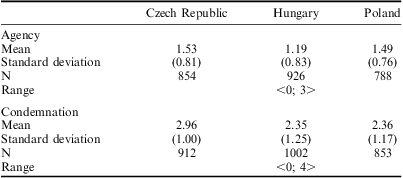
The results from the comparisons of means are presented in Table 2. At first glance, the results are striking from the historical point of view. But in accordance with our hypothesis (1), the sample mean for agency in the Czech Republic corresponds with the sample mean for agency in Poland. The results of the Anova test show that the mean difference of 0.04 is not statistically significant. More importantly, the sample mean for agency in Hungary, which stands at 1.19, significantly differs (p < 0.001) from the mean for agency in the Czech Republic, which is 1.53, as well as from the mean in Poland, which is 1.49 (p < 0.001). This suggests that Hungarians are more likely to think that a person who informed about his colleagues in his workplace was a victim of the oppressive structures of the previous regime than Czechs and Poles.
The Means for Agency and Condemnation in the Czech Republic, Hungary and Poland

Note: The results from Anova analyses further reveal that the mean for agency in the Czech Republic significantly differs from that in Hungary (p < 0.001) but it does not significantly differ from that in Poland (p = 0.271); the mean for condemnation in the Czech Republic significantly differs from the mean in Hungary (p < 0.001) as well as from the mean in Poland (p < 0.001); and the mean for agency in Hungary significantly differs from the mean in Poland (p < 0.001); and the mean for condemnation in Hungary does not significantly differ from that of Poland (p = 0.842).
Turning to condemnation, the results are again in line with our hypothesis (2). The mean for condemnation in the Czech Republic stands at 2.96, which is the highest among the three countries. The mean for condemnation in Hungary is 2.35. This is almost the same as the mean for condemnation in Poland, which stands at 2.36. The results obtained from Anova analyses show that there is no significant mean difference between Hungary and Poland. Nevertheless, there is a significant difference between the Czech Republic and Hungary (p < 0.001); and the Czech Republic and Poland (p < 0.001).
Consequently, the results reveal that the Czech Republic, which adopted a lustration system based on the retributive strategy of transitional justice, has the highest scores in agency demands for condemnation. On the other hand, Hungary, which adopted a lustration system based on the revelation of past collaboration, has the lowest scores in both the attribution of agency and demand for condemnation. Poland, which adopted a lustration system based on the reconciliatory strategy of public confessions, has scores almost as high in agency as the Czech Republic and almost as low in condemnation as Hungary.
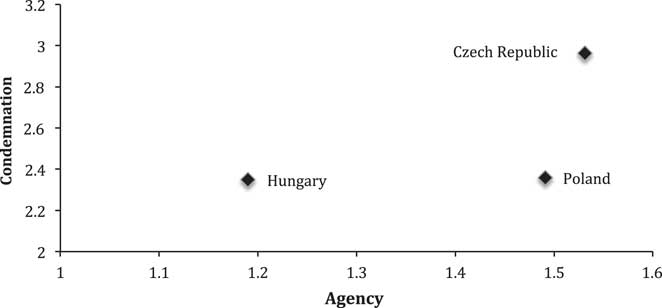
Thus, in line with our hypotheses (Table 1), the retributive and the reconciliatory models tend to foster a perception of transgressors as individual agents. The revelation and the reconciliatory models then lead to low demands for public condemnation of the same wrongdoing. The pairing of the countries based on their mean scores is captured in Figure 1.
Attributions of Wrongdoers’ Agency and Demands for Condemnation for the Same Wrongdoing in the Czech Republic, Hungary and Poland
Note: The figure presents the findings from our survey (Table 2).

Discussion
The results of the three opinion poll surveys have been exactly in accordance with our hypotheses. Transitional justice seems to be a determining factor of the perception that people in the three countries have about the past. However, before we can reach any conclusions, we have to consider the problem of endogeneity; the mean scores that we have measured may be endogenous to the countries under study. Something else may have been present even before a transitional justice strategy was chosen and lustration laws implemented. In that case, we would not be measuring an effect of lustration systems but an effect of that ‘something else’ that may be entrenched in the cultural landscape of the three countries in Central and Eastern Europe.
The claim of endogeneity can be weakened, although never completely ruled out, by three major theoretical and historical arguments. Our conclusion that the effects can be attributed to lustration systems rather than to other variables may be supported by the following considerations. First, the pattern of our findings corresponds with our theoretical considerations, which postulate causal relations. Second, Poland appears in a peculiar position in that pattern, following the Czech Republic in one aspect and Hungary in another. Third, the historical conditions in Hungary and Czechoslovakia before 1989 suggest a completely different pattern of individual responsibility and the need for condemnation from the one we have found.
First, we have extended the theory of presentism, according to which the past is a function of the present. We have chosen three distinct lustration systems as proxies for the present transitional justice factors and argued that these three systems fundamentally differ in a particular constellation of two aspects: attributing individual responsibility for the past and postulating condemnation for the past. The fact that the pattern of our findings (Figure 1) corresponds with our theorization (Table 1) suggests that the memory of the past may be shaped by the present. More empirical evidence is necessary to determine whether we have established causality.
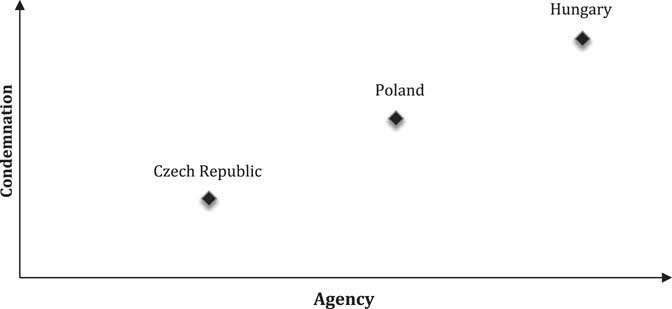
Second, the position of Poland is particularly intriguing. The view of individual responsibility is on a par with the Czech Republic and demand for condemnation is on a par with Hungary. This seems to be an ‘anomaly’ that could be conveniently explained by the effect of its lustration system. Although the system – owing to its resemblance to the South African Truth and Reconciliation Commission – has been labelled as reconciliatory, Poland is far from being reconciled to the past (David Reference David2006, 2011). In fact, every significant step in the Polish lustration process was subject to protracted negotiations and political quarrels (Grzelak Reference Grzelak2005) and the public has been deeply divided about the past for a number of years (Szczerbiak Reference Szczerbiak2002: 559). It would also be reasonable to expect that Poles would be divided in each of the two studied aspects rather than having almost extreme positions in each. If there were no influence from the lustration process, the location of Poland would be closer to a line between the Czech Republic and Hungary (see Figure 2). Instead, Poles tend to lean towards Czechs in attributing individual responsibility and to Hungarians in waiving any penalties for collaboration (see Figure 1). They display opinions similar to those postulated by Poland's lustration system.
Historical Perspective on Wrongdoers’ Agency and Demands for Condemnation for the Same Wrongdoing in the Czech Republic, Hungary and Poland
Note: We assume that under normal circumstances the relationship between agency and condemnation would be linear. The demand for the condemnation of a wrongdoer would increase as he or she is viewed of as a moral agent. The more severe an undemocratic regime was, the more a wrongdoer is viewed as having acted under duress, the less he or she is seen as having been a moral agent and the less he or she is condemned today. Before 1989, the Czech Republic, as a part of Czechoslovakia, experienced the most stringent socialist regime, while Hungary had the mildest regime. The position of Poland could be seen as somewhere in between.

Third, the historical conditions in Czechoslovakia and Hungary before 1989 suggest a completely different pattern of attributing individual responsibility and demanding condemnation (see Stan Reference Stan2009). Czechoslovakia had the most stringent totalitarian regime in Central Europe. While Poland and Hungary negotiated their way out of communism, Václav Havel was still held as a political prisoner of the regime in Prague. The fall of the Berlin Wall had little impact on the Czechoslovak regime, which tried to suppress the demonstrations until 17 November 1989. In Hungary, the scope for individual liberty was considerably wider as ideological rigidity gradually relaxed during the 1980s. Thus, it would seem reasonable to expect that Czechoslovaks did not have much leverage for resisting ‘offers’ of clandestine collaboration. Clearly, people recruited for collaboration were exposed to considerably larger pressures in Czechoslovakia than in Hungary. Hence, the historical conditions painted a different pattern to the one we have found. We would expect that the scope for individual responsibility, and consequently demands for condemnation, would be higher in Hungary than in the Czech Republic (see Figure 2). In other words, if the attribution of individual responsibility and demands for sanctions were based on historical facts, as argued by essentialists, then the Czech Republic and Hungary would have to switch positions in Figure 1.
Our consideration suggests that there must have been a change in the discourse on individual responsibility in Czechoslovakia and in Hungary. The final question that remains to be answered is how and why individual responsibility was postulated in Czechoslovakia and why it was not postulated in Hungary. In other words, in order to complete our argumentation that the present construction of the past in lustration systems supersedes historical conditions, we have to demonstrate the social mechanism of the shift. This means delineating the mechanisms of how structural responsibility changed to individual responsibility in Czechoslovakia and how individual responsibility turned into structural responsibility in Hungary.
In Czechoslovakia, the major lustration debate redefined the role of the individual in the past. The Czechoslovak lustration law was primarily prospective; it did not mete out punishment to the socialist regime (David Reference David2003). With a blend of genuine intentions to secure democratic transition and political interests (cf. Elster Reference Elster2004: 82) to get rid of political competitors and redistribute offices to newly formed centre-right parties (Civic Democratic Party and Civic Democratic Alliance), the legislators argued that people who collaborated in the past should not be eligible to hold certain positions in the new democracy because they had not been able to withstand the pressure of the socialist regime. The record of their weakness was then considered a risk for the nascent democracy. For this reason, the law required that collaborators were removed from public office but not exposed. The secrecy provisions in the law are clear evidence that individual responsibility was not the original intention of Czech lustrations (David Reference David2003: 423–4). Individual responsibility was only attributed to collaborators ex post through the implementation of the law. If someone is dismissed, he or she must have done something in the past.
The shift from individual to structural responsibility in Hungary occurred from an interplay among three factors: timing; the political struggle in the second democratic elections that undermined its legitimacy; and the consequences of the implementation of the lustration law. Timing seems to be a critical factor which shaped the kind of lustration system that was approved. The centre-right coalition was only able to approve the lustration law in 1994. By that time, the social hardship of economic reforms had eroded confidence in the centre-right government and people started to compare their current situation with the socialist regime (see CEU 1992–6). Thus, unlike the Czechoslovak lustration law, which pursued dismissals without exposing individuals, Hungarian law was based on the exposure of former collaborators.
It has been alleged that in approving the law, which incorporated shaming as the only sanction, the ruling coalition attempted to discredit the opposition coalition of the Hungarian Socialist Party (Magyar Szocialista Párt – MSZP) and Social Democratic Party (Szociáldemokrata Párt – SZDP), a view that was reinforced by the fact that the law was passed on the eve of parliamentary elections that the ruling coalition was about to lose (Oltay Reference Oltay1994). In addition to the timing, the perceived political expediency in approving the lustration law rested in targeting the two parties who were expected to have a larger number of former secret collaborators in their ranks than others: the Socialist Party, an ex-communist party, and the Social Democratic Party, an ex-dissident party. The law was seen as being twisted for political purposes. Moreover, the renewal of the coalition between the Socialist Party and the Social Democratic Party after the 1994 elections, in which the latter effectively granted moral concessions to the former, further dented the legitimacy of the lustration process in Hungary. If dissidents could work with communists, why was a law needed to deal with the past?
The implementation of the lustration law then exposed collaborators who denied any personal responsibility for the past. Those who were publicly exposed typically denied their involvement with the previous regime and claimed that they were forced to collaborate, or they admitted collaborating for patriotic reasons.Footnote 7 Once the credibility of the process was questioned, the acceptance of the individuals’ excuses was given larger prominence than the judicially verified outcomes of collaboration. The switch from individual to structural responsibility was complete.
Limitations
Although we have been able to present some theoretical and historical arguments against the problem of endogeneity, we cannot completely rule out the possibility that something else may have caused the different perceptions that people in the three countries have about secret informing. For instance, we can never rule out the role of the media, which could magnify a short-term impulse and shift it in a particular direction. Ideally, the survey would be repeated in order to determine the direction in which the collective memory is evolving. Thus, critics may point out that what is measured here is a ‘collected memory’, rather than a ‘collective memory’, as theorized by Olick (Reference Olick2007: 23–33).
Conclusion
The problem of malleability versus durability of collective memory underpins one of the major debates in the area of conflict resolution, democratization, history and social studies. This article has contributed to the debate by using transitional justice strategies as a proxy for a presentist influence, claiming that the strategies redefined the historical-mental picture of the past in the three countries and delineated the social mechanism of ‘changing history’. It has come to the conclusion that it is likely that the past is a function of the present.
These findings, if supported by further research, could have implications in countries dealing with various legacies of wars, civil wars, ethnic conflict and authoritarian regimes. They signal to the democratization and conflict resolution communities that many protracted transitions are in fact ‘manageable’. It may not be the past that creates obstacles to peace and democracy but its representation by present political forces and policies. The roots of conflicts may not be in the past, in some ancient or primordial hatreds, but in the present. These findings do not attempt to trivialize the wrongdoings that did occur in the past; neither do they suggest that historical injustices should not be rectified. They may merely provide the conflict resolution community with a degree of measured optimism that the past may not be an insurmountable obstacle to peace. The present may be the problem.