Introduction
The large Mesozoic odonatan clade Isophlebioptera Bechly, Reference Bechly1996 comprises no less than 11 families (Bechly, Reference Bechly1996; Nel et al., Reference Nel, Bechly, Delclòs and Huang2009; see also Phylogenetic Systematics of Odonata, https://bechly.lima-city.de/system.htm), recorded between the Late Triassic and the Late Cretaceous. Some are very diverse (e.g., Campterophlebiidae Handlirsch, Reference Handlirsch1920 and Isophlebiidae Handlirsch, Reference Handlirsch1920), while others are very poorly documented (e.g., the small family Paragonophlebiidae Nel, Reference Nel2009; note that the genus Mongolothemis Pritykina and Vasilenko, Reference Pritykina and Vasilenko2014 is a junior synonym of Paragonophlebia Nel, Reference Nel2009, as these authors ignored Nel’s paper and erroneously attributed this fossil to the Euthemistidae Pritykina, Reference Pritykina1968). Among these damsel-dragonflies, the small Jurassic family Selenothemistidae Handlirsch, Reference Handlirsch1939 comprises only three (or four) genera for a very wide distribution, as it is known from Western Europe, Antarctica, Kazakhstan, and maybe China, with the enigmatic taxon Paraliassophlebia Hong, Reference Hong1982 (see Bechly, Reference Bechly1996; see also Phylogenetic Systematics of Odonata, https://bechly.lima-city.de/system.htm). Here we describe the first accurate Chinese representative of this family, which is closely related to the Oxfordian representative from Kazakhstan.
Geologic settings
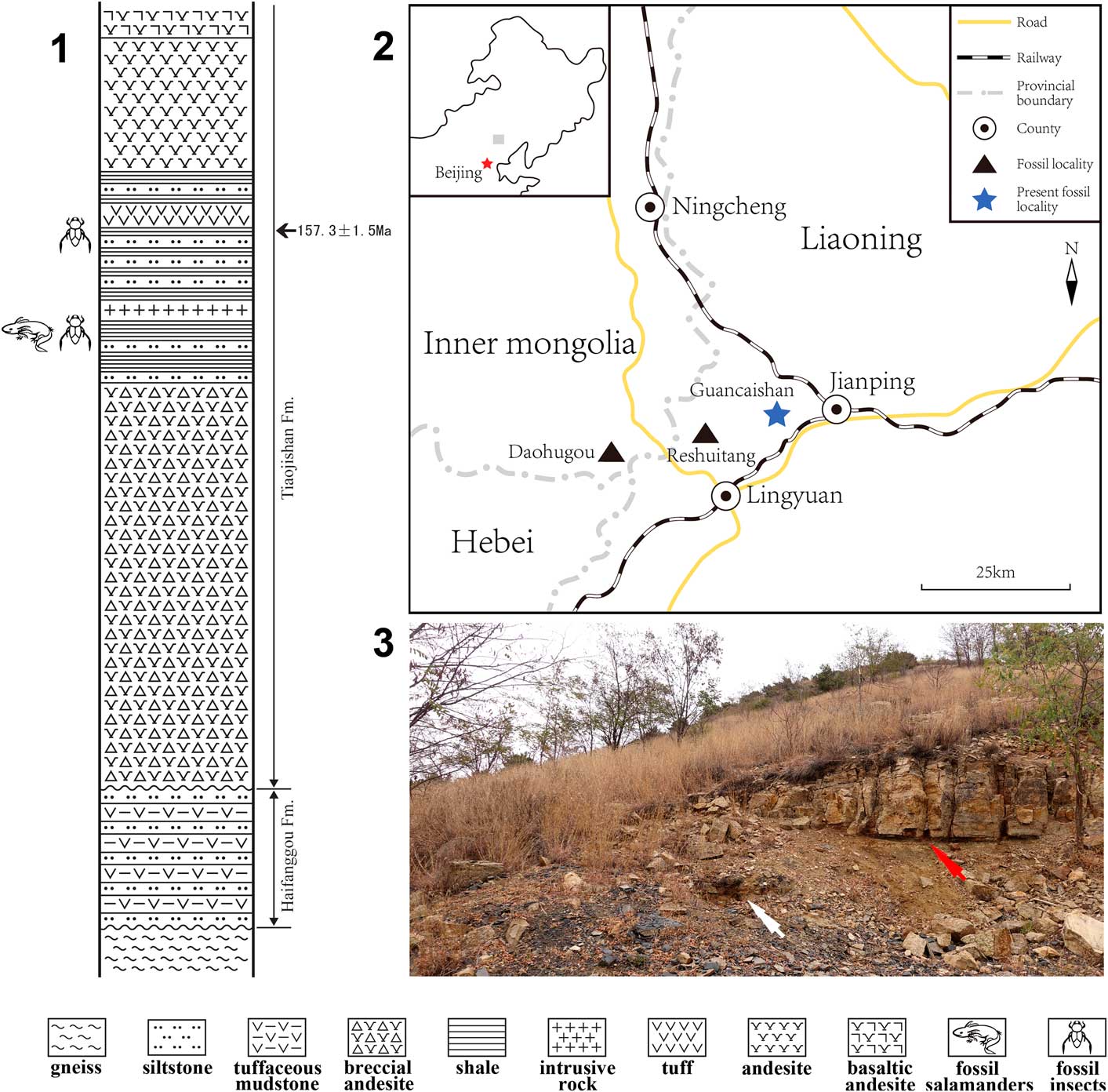
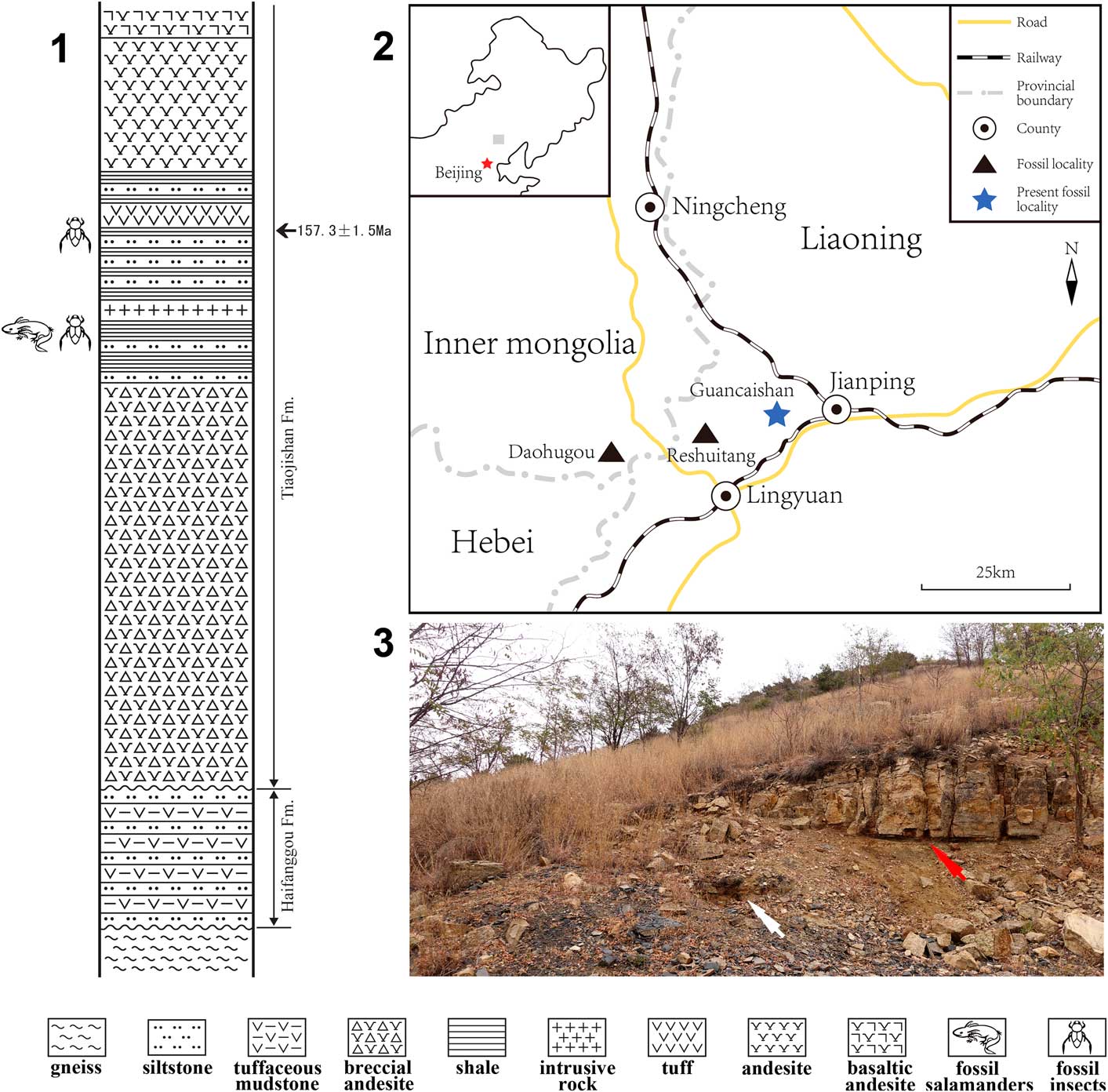
The new damsel-dragonfly comes from the Guancaishan locality near the Muyingzi Village, Shahai Township, Jianping County, Western Liaoning Province, NE China. The holotype was collected by one of us (C.C.) in 2013. The Guancaishan locality has yielded very rich fossils, including various insects, bivalves, plants, and especially abundant salamanders (Gao and Shubin, Reference Gao and Shubin2012; Wang et al., Reference Wang, Dong and Evans2015). The fossil insect was preserved in a black shale layer with a rich associated fossil entomofauna. A volcanic ash layer located less than 1 meter above the black shale was dated as 157.3±1.5 Ma (U-Pb SIMS), indicating that the insect lived in a period around the boundary of Oxfordian and Kimmeridgian (Huang, Reference Huang2016) (Fig. 1).
(1) Stratigraphic column for the Tiaojishan Formation at the Guancaishan locality, Jianping County, Liaoning Province, NE China. (2) Map showing the location of the Guancaishan locality. (3) Outcrop for fossil Odonata. White arrow indicates the black shale where the fossil was collected; red arrow indicates the volcanic ash layer slightly above the black shale (age 157.3 ± 1.5 Ma).
The new fossil can be attributed to the Linglongta biota, which belongs to the late assemblage of the famous Yanliao biota, while the early assemblage is represented by the Daohugou biota (Huang, Reference Huang2016). Huang (Reference Huang2015) suggested that the age of the Linglongta biota correlates with that of the Karatau biota. The studied fossil has been collected near the upper-most layer of the Linglongta beds at Guancaishan, indicating a possible slightly later age than that of Karatau, the latter being suggested as Oxfordian. Contrasting with the Daohugou biota represented by a very diverse and well-described entomofauna, the Linglongta biota (Tiaojishan Formation) has yielded numerous fossil insects but only one species (Coleoptera, Ommatidae) has been formally described based on a well-preserved compression from Daxishan, Jianchang County, Liaoning Province (Cai and Huang, Reference Cai and Huang2017). The new fossil damsel-dragonfly described here represents the first described fossil insect from the Guanchaishan locality and the second fossil described from the Tiaojishan Formation.
Materials and methods
The type specimen was prepared with a steel needle under microscope. The drawings were done using a drawing tube on a binocular microscope Nikon SMZ 1500. All images were made using a Canon 5D Mark III camera with a Canon MP-E 65 mm macro lens (F2.8, 1–5×); a Canon MT-24EX twin flash was used as the light source. Zerene Stacker Version 1.04 was used for image stacking. The specimen was examined with a LEO1530VP field emission scanning electron microscope (SEM), under 15.0 kV.
The nomenclature of the odonatan wing venation used in this paper is based on the interpretations of Riek and Kukalová-Peck (Reference Riek and Kukalová-Peck1984), as modified by Nel et al. (Reference Nel, Martínez-Delclòs, Paicheler and Henrotay1993) and Bechly (Reference Bechly1996). The higher classification of fossil Odonatoptera, as well as family and generic characters followed in the present work, are based on the phylogenetic system proposed by Bechly (Reference Bechly1996). Wing abbreviations are as follows: Arc=arculus; Ax=primary antenodal crossvein; C=costa; CuA=cubitus anterior; CuP=cubitus posterior; d=discoidal cell; IR=intercalary radial veins; MA=median anterior; MP=median posterior; N=nodus; ‘O’=oblique vein; Pt=pterostigma; RA=radius anterior; RP=radius posterior; sd=subdiscoidal space; Sn=subnodal crossvein. All measurements are given in millimeters.
Repositories and institutional abbreviations
NIGP: Nanjing Institute of Geology and Palaeontology CAS, Nanjing, China.
Systematic paleontology
Superorder Odonatoptera Martynov, Reference Martynov1932
Order Odonata Fabricius, Reference Fabricius1793
Clade Isophlebioptera Bechly, Reference Bechly1996
Family Selenothemistidae Handlirsch, Reference Handlirsch1939
Type genus
Selenothemis Handlirsch, Reference Handlirsch1920. Other genera: Turanothemis Pritykina, Reference Pritykina1968, Sinothemis new genus, Caraphlebia Carpenter, Reference Carpenter1969, Paraliassophlebia Hong, Reference Hong1982.
Genus Sinothemis new genus
Type species
Sinothemis difficilis n. sp.
Etymology
Named after Sinica, Latin name for China, and the suffix Themis (ancient Greek Titaness, personification of the divine order), frequently employed for taxa in this family. Gender masculine.
Remark
Sinothemis shares some characters with Selenothemis and others with Turanothemis. Its exact affinities will need a phylogenetic analysis to be solved.
Sinothemis difficilis new species
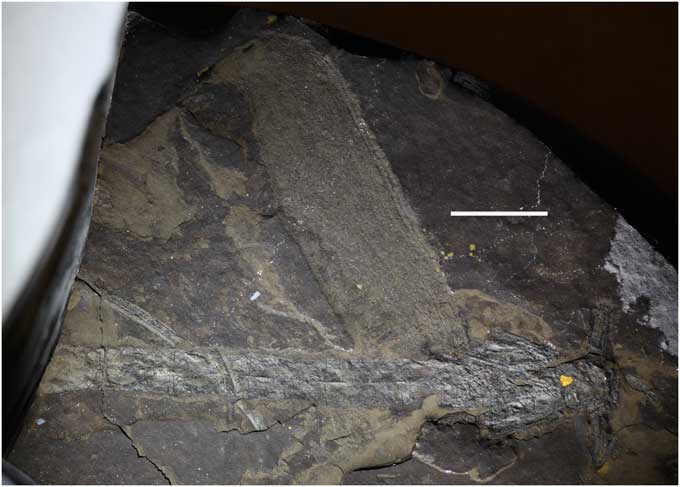
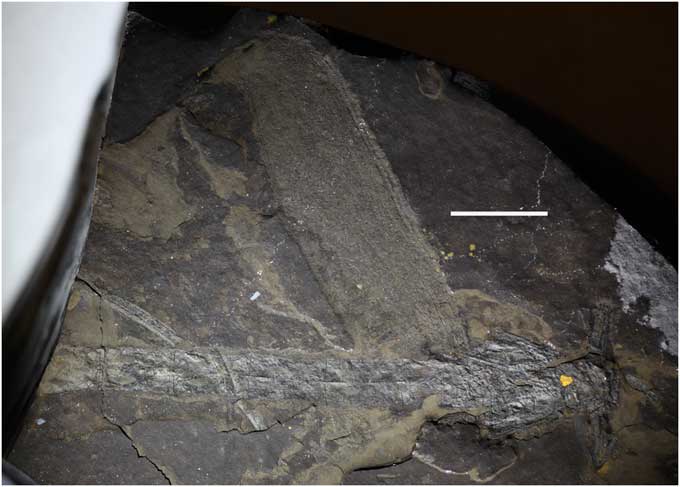
Sinothemis difficilis n. gen. n. sp., holotype NIGP167785, photograph of general habitus. Scale bar=10 mm.
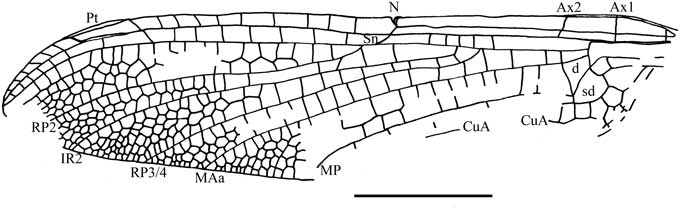
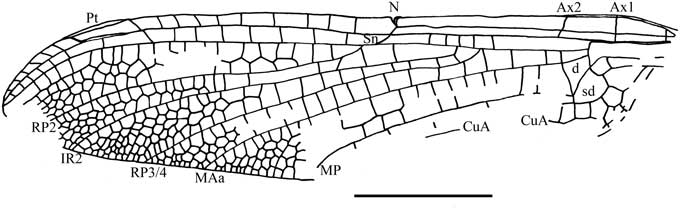
Sinothemis difficilis n. gen. n. sp., holotype NIGP167785, reconstruction of hindwing. Ax=primary antenodal crossvein; CuA=cubitus anterior; d=discoidal cell; IR=intercalary radial veins; MAa=median anterior; MP=median posterior; N=nodus; Pt=pterostigma; RP=radius posterior; sd=subdiscoidal space; Sn=subnodal crossvein. Scale bar=8 mm.
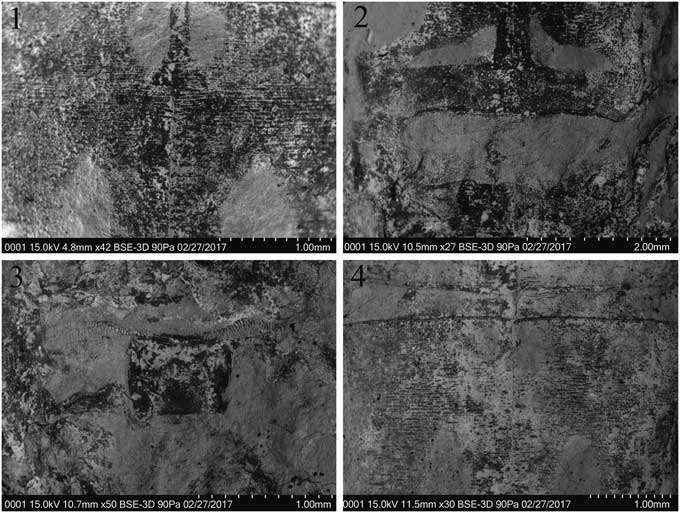
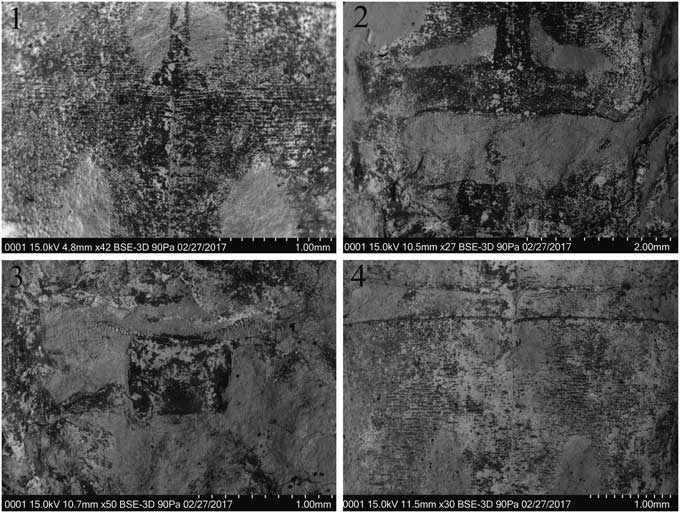
Sinothemis difficilis n. gen. n. sp., SEM scans showing the details on body surface (pattern and setae). (1) Detail of anterior part of third segment; (2) posterior part of first segment and anterior part of second; (3) detail of anterior part of first segment; (4) detail of anterior part of fifth segment.
Holotype
NIGP167785, stored at the Nanjing Institute of Geology and Palaeontology CAS, Nanjing, China.
Diagnosis (for genus and species)
Hindwing characters only. Wing ~41 mm long; base of RP2 not aligned with subnodus; only one oblique vein ‘O’; only one row of cells between RP3/4 and MAa well distal (five cells) of nodus level; only one row of cells between IR2 and RP3/4 well distal (three cells) of oblique vein.
Occurrence
Guancaishan, Jianping County, Liaoning Province, NE China; late Oxfordian to early Kimmeridgian.
Description
A thorax with nearly complete abdomen, fragments of legs, a nearly complete hindwing plus fragments of another attached.
Hindwing probably hyaline, 40.8 mm long, 10.0 mm wide at nodus; distance between base and arculus 5.4 mm, between arculus and nodus 11.7 mm, between nodus and pterostigma 15.0 mm, between pterostigma and apex 5.8 mm; wing very shortly petiolate; cells of anal area irregular, some being very small and others being very large, a large cell below CuP; median space free; submedian space with a curved vein CuP; a curved crossvein separating submedian and subdiscoidal spaces; subdiscoidal space posteriorly closed and very broad, with AA making a right angle in its basal part; discoidal cell free, basally closed, basal side 0.7 mm long, costal side 1.2 mm long, posterior side 1.5 mm long, distal side 2.0 mm long; RP and MA strongly separated at arculus; MAb more than twice as long as basal side of discoidal cell, MAb well aligned with distal free part of CuA; CuA divided into CuAa and CuAb; CuAb short, directed toward posterior wing margin and distally lost; only fragments of CuAa preserved, but CuAa and MP clearly parallel for a long distance, at least till below level of nodus, with probably one row of cells between; MP weakly curved, reaching posterior margin not far distal of nodus level, 24.0 mm from wing base; MAa nearly straight, more or less parallel to MP, with one row of cells in basal part of postdiscoidal area, 1.7 mm wide, this area being quite broader near posterior wing margin with 14 rows of small cells present; Ax0 visible, very near to wing base; two primary antenodal veins very strong, Ax1 1.5 mm basal of arculus and Ax2 1.7 mm distal of arculus, Ax1 nearly perpendicular to ScP and R+MA, Ax2 distinctly oblique; no secondary antenodal crossvein visible; five preserved antesubnodal crossveins between arculus and subnodus; base of RP3/4 6.5 mm distal of arculus, closer to nodus than to arculus; base of IR2 very close to that of RP3/4, 1.4 mm distally, originating distinctly from RP; nodal crossing and subnodus oblique; nine postnodal crossveins between C and RA not strictly aligned with the seven postsubnodal crossveins between RA and RP1; an oblique pterostigmal brace vein; only one crossvein below peterostigma; pterostigma not basally recessed, 4.3 mm long and strong, 0.9 mm wide; C and RA thickened along pterostigma; area between C and RA distal of pterostigma with six crossveins; RP2 not aligned with subnodus; two visible bridge crossveins; one oblique vein “O,” and one cell 1.3 mm distal of base of RP2; RP2 nearly straight; area between RP1 and RP2 with two rows of cells basal of pterostigma; base of IR1 three cells distal of subnodus, IR1 strongly zigzagged; base of pseudo-IR1 below distal side of pterostigma; pseudo-IR1 short and straight; area between MAa and RP3/4 widened distally; area between RP3/4 and IR2 strongly widened distally; area between IR2 and RP2 distally widened, with six to seven rows of cells along posterior wing margin; area between RP2 and IR1 progressively widened, with four rows of cells along posterior wing margin; area between pseudo-IR1 and RP1 not distally widened.
Abdomen parallel-sided, stout, and rather smooth (no setae or spines appear), with apex not preserved, at least 41.0 mm long, 4.5 mm wide; transverse carina visible (sensu Asahina Reference Asahina1954); no secondary genital apparatus visible (female); complex pattern of coloration preserved (see Figs. 2, 4).
Thorax stout, about 14.0 mm long and 8.0 mm wide; dorsal, ventral, and internal parts are heavily compressed and difficult to interpret. Fragments of legs are visible but incomplete. Nevertheless, they look strong. Head absent.
Etymology
Named difficilis for the very delicate preparation of the holotype, before study.
Remark
The pattern of coloration of the abdomen of this taxon is simpler than those of many extant Odonata but similar to those of the Epiophlebiidae.
Discussion
This fossil belongs to the clade Isophlebioptera Bechly, Reference Bechly1996 for the hindwing subdiscoidal space strongly expanded with a bulged posterior margin. Furthermore, it has all the characters of the family Selenothemistidae Handlirsch, Reference Handlirsch1939: hindwing distal side (MAb) of discoidal cell about twice as long as basal side; unique shape of hindwing subdiscoidal cell, with AA making a right angle and with a broad cell below CuP in anal area; postdiscoidal space not narrowed and RP3/4 not parallel to IR2 (Bechly, Reference Bechly1996). This family currently comprises the three genera Selenothemis Handlirsch, Reference Handlirsch1920 (Toarcian, Germany), Turanothemis Pritykina, Reference Pritykina1968 (Oxfordian, Karatau, Kazakhstan), and Caraphlebia Carpenter, Reference Carpenter1969 (early Middle Jurassic of Antarctica, after Towrow, Reference Townrow1967; Shen, Reference Shen1994), and possibly Paraliassophlebia Hong, Reference Hong1982 (Jiulongshan Formation, Middle Jurassic, North Hebei Province, China).
Sinothemis n. gen. shares with Selenothemis the base of RP2 not aligned with subnodus, unlike in Turanothemis, but Sinothemis has only one oblique vein ‘O’ as in Turanothemis, instead of two as in Selenothemis. Sinothemis also shares with Turanothemis the presence of only one crossvein below the pterostigma, unlike Selenothemis. Sinothemis differs from both Selenothemis and Turanothemis in the presence of only one row of cells between RP3/4 and MAa well distal (five cells) of nodus level, instead of zero to two as in these two genera; Sinothemis has only one row of cells between IR2 and RP3/4 well distal (three cells) of oblique vein, instead of zeor to one cell distal of ‘O’ as in Selenothemis and Turanothemis (Pritykina, Reference Pritykina1968; Nel et al., Reference Nel, Martínez-Delclòs, Paicheler and Henrotay1993). The original description and figure of Caraphlebia were in great part reconstructed (Carpenter, Reference Carpenter1969); Kelly and Nel (personal communication, 2018) revised this fossil that is rather poorly preserved. It strongly differs from Sinothemis, Selenothemis, and Turanothemis in having the bases of RP3/4 and IR2 very distant with four cells between them (an uncommon character in the Epiproctophora). Last, Paraliassophlebia could belong to the Selenothemistidae on the basis of the shape of the discoidal cell, but it differs from the other taxa in this family, including Sinothemis, in the subdiscoidal cell not greatly widened and AA not making a right angle, after Hong (Reference Hong1982).
Sinothemis seems to be more closely related to Turanothemis than to the other Selenothemistidae, supporting the similar ages of the two outcrops Karatau and Guancaishan. Both are the youngest representatives of the Selenothemistidae. It seems that this family became extinct during the latest Jurassic, while the closely related family Campterophlebiidae was still present and diverse in the Chinese Early Cretaceous (Li et al., Reference Li, Nel, Ren and Pang2012). The clade Isophlebioptera did not survive the great change in the odonatan fauna during the Cenomanian (Nel et al., Reference Nel, Nel, Petrulevičius, Perrichot, Prokop and Azar2010).
Acknowledgments
We sincerely thank two anonymous referees for their useful comments on the first version of the paper. This work was supported by the Ministry of Science and Technology (2016YFC0600406), the Strategic Priority Research Program of the Chinese Academy of Sciences (XDB18000000 and XDPB05), and the National Natural Science Foundation of China (41688103 and 91514302). This study is a contribution to UNESCO-IUGS IGCP Project 632.