INTRODUCTION
Intertidal communities vary in space and time (Underwood & Chapman, Reference Underwood and Chapman1998a; Underwood et al., Reference Underwood, Chapman and Connell2000). The interplay between biological (e.g. competition, predation, settlement and recruitment) and physical forces (e.g. wave exposure and topographical heterogeneity of the shore) has been reported to drive patterns of distribution of species on the shore (Paine, Reference Paine1966, Reference Paine1974; Dayton, Reference Dayton1971; Menge & Sutherland, Reference Menge and Sutherland1976; Sousa, Reference Sousa1984; Sih et al., Reference Sih, Crowley, McPeek, Petranka and Strohmeier1985; Menge, Reference Menge1991; Benedetti-Cecchi et al., Reference Benedetti-Cecchi, Bulleri and Cinelli2000; Boaventura et al., Reference Boaventura, Alexander, Santina, Smith, Ré, Cancela da Fonseca and Hawkins2002b). Among these forces, predation has been widely recognized as a key force influencing the structure and dynamics of intertidal communities (Paine, Reference Paine1974; Menge & Sutherland, Reference Menge and Sutherland1976; Sih et al., Reference Sih, Crowley, McPeek, Petranka and Strohmeier1985; Menge, Reference Menge2000).
The most evident effect of predation encompasses changes on prey density and distribution limits, while indirectly it can change diversity within the community (Paine, Reference Paine1974; Chilton & Bull, Reference Chilton and Bull1984; Sih et al., Reference Sih, Crowley, McPeek, Petranka and Strohmeier1985; Hall et al., Reference Hall, Raffaelli and Turrell1990; Yamada & Boulding, Reference Yamada and Boulding1996). Controlled manipulative field experiments using predator exclusion cages have been widely used in rocky intertidal systems to assess the impact of predators on prey populations (e.g. Menge & Sutherland, Reference Menge and Sutherland1976; Hall et al., Reference Hall, Raffaelli and Turrell1990; Connell, Reference Connell1997; Navarrete & Castilla, Reference Navarrete and Castilla2003; Silva et al., Reference Silva, Boaventura, Flores, Ré and Hawkins2004; Felsing et al., Reference Felsing, Glencrossa and Telfer2005; Sams & Keough, Reference Sams and Keough2007), and used in this study to assess predation effects on intertidal prey populations.
Crabs, fish, sea stars, birds, humans and even small rodents are considered to be important predators of intertidal prey on Atlantic and Pacific shores such as limpets, mussels and barnacles by controlling their abundance and distribution (Navarrete & Castilla, Reference Navarrete and Castilla1993; Norberg & Tedengren, Reference Norberg and Tedengren1995; Castilla, Reference Castilla1999; Coleman et al., Reference Coleman, Goss-Custard, Le V dit Durell and Hawkins1999; Carlton & Hodder, Reference Carlton and Hodder2003; Rius & Cabral, Reference Rius and Cabral2004; Monteiro et al., Reference Monteiro, Quinteira, Silva, Vieira and Almada2005; Cannicci et al., Reference Cannicci, Gomei, Dahdouh-Guebas, Rorandelli and Terlizzi2007; Markowska & Kidawa, Reference Markowska and Kidawa2007). In turn, these prey are known to be key space occupiers; their absence or reduced abundance will strongly influence intertidal community composition (Hawkins, Reference Hawkins1999; Hawkins et al., Reference Hawkins, Corte-Real, Pannacciulli, Weber and Bishop2000; Boaventura et al., Reference Boaventura, Ré, Cancela da Fonseca and Hawkins2002a; Cannicci et al., Reference Cannicci, Gomei, Boddi and Vannini2002). Patellid limpets are the most common limpets on Portuguese shores (Boaventura et al., Reference Boaventura, Ré, Cancela da Fonseca and Hawkins2002a) and are considered to be dominant grazers, playing a key role on European rocky shores by controlling algae abundance and distribution (Hawkins, Reference Hawkins1999). It is therefore important that we understand the role of predation in controlling their populations and consider possible cascade effects for the algae assemblages.
On Portuguese rocky shores, the limpet Patella depressa Pennant, the mussel Mytilus galloprovincialis Lamarck and the barnacle Chthamalus spp. are dominant mid-shore space occupiers (Boaventura et al., Reference Boaventura, Ré, Cancela da Fonseca and Hawkins2002a). Thus, this study tested for predation effects on the populations of these species on the mid-shore, where prey reach higher densities. Although this somewhat limits the comparison of our findings with that of similar studies made on other areas of the shore (e.g. Chilton & Bull, Reference Chilton and Bull1984), they remain valid and pertinent for the hypothesis tested and add to our knowledge on the subject. Crab species such as Pachygrapsus marmoratus (Fabricius) and Eriphia verrucosa (Forsskål) have been reported to be predators of limpets, mussels and barnacles on Portuguese rocky shores (Flores et al., Reference Flores, Cruz and Paula2001; Cannicci et al., Reference Cannicci, Gomei, Boddi and Vannini2002; Silva et al., Reference Silva, Boaventura, Flores, Ré and Hawkins2004). Also, small benthic fish such as blennies have been reported to include limpets in their diet on Portuguese shores (Monteiro et al., Reference Monteiro, Quinteira, Silva, Vieira and Almada2005) and thus, the predation effect of crabs and fish was considered in the present study, as exclusion cages would also prevent the feeding of both on the experimental plots.
Despite the extensive body of literature on predator–prey interactions and caging experiments on rocky shores throughout the world, little is still known about the role of predation by mobile aquatic predators in shaping intertidal prey populations on Portuguese rocky shores (but see Silva et al., Reference Silva, Boaventura, Flores, Ré and Hawkins2004), while predation is long recognized as a key structuring force on North-American shores (Paine, Reference Paine1974; Rilov & Schiel, Reference Rilov and Schiel2006). Previous observations on the central coast of Portugal, detected weak predatory effects of the crab Pachygrapsus marmoratus on populations of the intertidal limpet Patella depressa (Silva et al., Reference Silva, Boaventura, Flores, Ré and Hawkins2004). The present study adds to the existing information by analysing the predatory effect of crabs on important intertidal prey including mussels and barnacles and it examined the following hypotheses: (i) crabs are abundant predators on rocky shores and their abundance varies spatially between shores; and (ii) there is a significantly higher survival of limpets, mussels and barnacles in complete cages than on open cages or control plots.
MATERIALS AND METHODS
Study sites
Two rocky shores were surveyed on the central Portuguese coast: Paimogo (39°17′N 9°20′W) and Peralta (39°14′N 9°20′W), separated by approximately 5 km. In this region, tides are semidiurnal and tidal amplitude varies around 3–4 m. Two sampling sites (about 100 m apart and in minimum 20 m long) were selected at each shore representing continuous rock platforms (1 km long). Each shore was typical of the region.
Predator characterization
Due to logistic limitations and because previous studies in the region had reported that crabs are relevant predators of the prey analysed in the present study (Flores et al., Reference Flores, Cruz and Paula2001; Cannicci et al., Reference Cannicci, Gomei, Boddi and Vannini2002; Silva et al., Reference Silva, Boaventura, Flores, Ré and Hawkins2004), crabs were the only predators sampled although other predators such as small blennies may have been excluded by the cages in this study. Similar experiments using exclusion cages have, however, demonstrated the value of this experimental approach (Rilov & Schiel, Reference Rilov and Schiel2006; Silva, Reference Silva2008; Silva et al., Reference Silva, Hawkins, Boaventura and Thompson2008). To establish the identity, abundance and population structure of crabs, four nocturnal one hour searches were made by two observers between July and August 2007 on each shore at spring low-tides. This was because crabs reach their greatest activity period during nocturnal periods (Flores et al., Reference Flores, Cruz and Paula2001; Cannicci et al., Reference Cannicci, Gomei, Boddi and Vannini2002; Silva et al., Reference Silva, Boaventura, Flores, Ré and Hawkins2004). Searches were made by counting crabs that were actively feeding on the rock surface and thus easily detectable with a torch.
Predator exclusion experiments
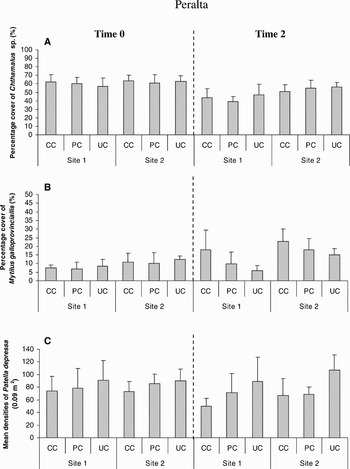
In order to test the null hypothesis that there were no significant predation effects on the abundance of limpets, barnacles and mussels, three experimental treatments were set up during spring 2007 (April–June): (i) uncaged treatment (UC), no cage but plot marked on the rock surface; (ii) partial cage (PC), half of the cage area with open sides which allowed predator entrance and a roof (cage control); and (iii) complete cage (CC), totally closed cage which prevented predator entrance. Cages (30 × 30 × 15 cm) were made of square mesh (6 × 6 mm welded plastic coated steel wire) covered with a 25 × 25 mm mesh galvanized metal for support and resistance. The partial cage treatment was considered to allow access to locally abundant crabs such as P. marmoratus, E. verrucosa and Necora puber and small fish such as Blenniidae and Gobiidae, but no other predators such as large fish (e.g. wrasse) and birds, while the total cage treatment was considered to exclude all predators. Six replicates of each treatment were randomly set at mid-shore level on the two sites per shore. Care was taken in cage design (e.g. mesh size) and maintenance (manual algae removal) to control cage artefacts such as shading, reduction of water flow, abnormally high algal growth and increased sedimentation within cages and prey movements (see Hall et al., Reference Hall, Raffaelli and Turrell1990; Connell, Reference Connell1997; Englund, Reference Englund1997; Navarrete & Castilla, Reference Navarrete and Castilla2003; Miller & Gaylord, Reference Miller and Gaylord2007). Care was also taken to select mid-intertidal areas very similar to each other in terms of biotic and abiotic characteristics, and also dominated by all the three prey species analysed in this study. The abundance and shell length of limpets and percentage covers of mussels and barnacles within the experimental plots were assessed in the beginning of the experiment (T0) and after two months (T2) (Figures 1 & 2). Because limpets were the only mobile prey considered these were marked at T0 with nail polish in order to identify predation effects on prey specific to each plot and to examine any migration or emigration. Potential cage artefacts were examined by comparing uncaged treatments to partial cages.
Percentage cover of Chthamalus sp. (A) and Mytilus galloprovincialis (B) and mean densities of Patella depressa (C) (±SE) in the predator exclusion study in the beginning (T0) and after two months of exclusion (T2) in Paimogo. CC, complete cage; PC, partial cage; UC, uncaged treatment.

Percentage cover of Chthamalus sp. (A) and Mytilus galloprovincialis (B) and mean densities of Patella depressa (C) (±SE) in the predator exclusion study in the beginning (T0) and after two months of exclusion (T2) in Peralta. CC, complete cage; PC, partial cage; UC, uncaged treatment.

Data analysis
In order to test the hypothesis that there was no predation effect on the abundance of limpets and percentage cover of barnacles and mussels, the change in their abundance and/or percentage cover data between T0 and T2 were analysed using a 3-way mixed model ANOVA. We also examined the change in the average shell length growth data for limpets between T0 and T2 for all plots to test if that recruitment or growth was not likely to influence our results. The factors tested were ‘treatment’ (fixed, orthogonal and 3 levels), ‘shore’ (random, orthogonal and 2 levels) and ‘site’ (random, nested in shore and 2 levels) with six replicates per treatment. Time was not considered as a factor in the design to avoid non-independence of data, since the same plots were measured at both times of the experiments. For all statistical analyses, Cochran's test was done prior to ANOVA to test for homogeneity of variances. Where variances were heterogeneous data were transformed and, after this the limitation persisted and thus analysis was made using non-transformed data, but a more conservative P value was used (P < 0.01) (Underwood, Reference Underwood1997). Where results were significant, the pairwise comparisons between groups were determined using SNK (Student–Newman–Keuls) a posteriori comparison tests. Tests of homogeneity, ANOVA and SNK tests were done using GMAV5 for Windows Statistical Software (Underwood & Chapman, Reference Underwood and Chapman1998b).
RESULTS
Predator characterization
The total number of crab species recorded on all four nights and both shores was: P. marmoratus (N = 536) and Eriphia verrucosa (N = 133), while Carcinus maenas (Linnaeus) (N = 6) and Necora puber (Linnaeus) (N = 4) were seldom detected. In Paimogo, P. marmoratus (N = 64) and E. verrucosa (N = 65) were both the dominant species while in Peralta, the most abundant species was by far P. marmoratus (N = 472), followed by E. verrucosa (N = 68). Crab abundance was very high with an average of 67 individuals of P. marmoratus species and an average of 17 individuals of E. verrucosa species being collected per night per shore.
Predator exclusion experiments
There was no evidence for the occurrence of cage artefacts: any algae growth was successfully removed when detected, no sedimentation was detected and limpet marking allowed tracking all individuals. All limpets were found to be very faithful to their home scars, only 295 individuals (out of 5383 at the start of the experiment—5.5%) were detected outside the plots but still within 30 cm of the open cage or plot edge. Reduced limpet emigration and immigration rates in similar exclusion experiments have been shown for patellid limpets in south-west Britain (Silva et al., Reference Silva, Hawkins, Boaventura and Thompson2008). ANOVA analyses on the abundance and/or percentage cover data of each of the target species revealed no significant differences between T0 and T2 in any of the tested factors (treatments, shores or sites) (P > 0.05; Table 1).
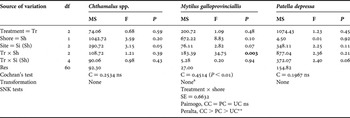
Analysis of variance testing for differences in the percentage cover of Chthamalus spp. and Mytilus galloprovincialis and in the abundance of Patella depressa, after two months of the predator exclusion study (T2) (N = 6). Significant effects are in bold.

ns, not significant; **P < 0.01; Pa, Paimogo; Pe, Peralta; S1, Site 1; S2, Site 2; CC, complete cage; PC, partial cage; UC, uncaged treatment; SNK, Student–Newman–Keuls. a, Data were not transformed, but a conservative P < 0.01 was used.
Since there were no significant differences between treatments at T2, predation was found not to be a significant force controlling the abundance and/or percentage cover of limpets, barnacles and mussels for the duration of the experimental period. However, a significant interaction was detected on the percentage cover of mussels between the factors ‘treatment’ and ‘shore’ (treatment × shore F2,4 = 34.75, P < 0.01; Table 1). SNK comparison tests revealed that significant differences between treatments were only detected in Peralta, where the complete cage treatment (CC) had significantly higher percentage cover of mussels than the uncaged (UC) and partial cage treatments (PC) (SNK tests, Table 1; Figure 2). We also examined the change in the average shell length growth data for limpets between T0 and T2 for all plots and there were no significant differences between treatments (ANOVA, F2,2 = 0.04, P = 0.963).
Due to the weak predator–prey interaction detected in the above ANOVA, power analyses were made for all three prey species on the non-significant factor ‘treatment’, to show that there was sufficient replication and power on the design and thus certify that any effects of predation would have been detected by the experiments if they occurred. Because the present study has similar methods and experimental design to Silva et al. (Reference Silva, Hawkins, Boaventura and Thompson2008), also made in European rocky shores but where strong predatory effects were detected, power was calculated using the effect size (a reduction of around 0.50 in limpets abundance) measured by those authors, in order to compare both experiments. Power calculations indicated that the experiment conducted in the present study was sufficiently replicated and was powerful enough to detect any effects of predation if they occurred (Power = 0.85 in barnacles, Power = 0.99 in mussels and Power = 0.99 in limpets). Power calculated using the effect size measured by Silva et al. (2008) in south-west Britain revealed that the experimental design used in the present study would be sufficiently replicated and powerful to detect predatory effects if it was run in south-west Britain instead of the central Portuguese coast (Power = 0.97), strengthening our results that predators had weak effects in our study.
DISCUSSION
This study was successful in examining the effects of predation on important intertidal species, thus adding new and valuable information on predator–prey interactions which had remained relatively unknown for Portuguese shores. Potential cage artefacts such as shading by algae growth were controlled and limpet emigration and/or immigration were considered minimal.
Our results support the hypothesis that for a two month period during the spring (April–June), predatory effects of crab and small fish on abundance of barnacles, mussels and limpet communities can be very weak on the Portuguese coast. These findings were considered to be consistent and valid as the study included large replication for each treatment (6) at large (km) and small (m) spatial scales. Power calculated using the effect size measured by Silva et al. (Reference Silva, Hawkins, Boaventura and Thompson2008) in south-west Britain, where strong predatory effects were detected, revealed that the experimental design used in the present study would be sufficiently replicated and powerful to detect predatory effects if it was run in south-west Britain instead of the central Portuguese coast (Power = 0.97). This strengthens our conclusion that predators had weak effects on Portuguese rocky shores during the period of this experiment.
Our main result of no predation effects contrasts with most similar studies which report severe predation effects (Paine, Reference Paine1974; Rilov & Schiel, Reference Rilov and Schiel2006; Silva et al., Reference Silva, Hawkins, Boaventura and Thompson2008). However, these so-called negative results are important to report due to the emphasis placed on strong predator–prey interactions as major community drivers on rocky shores and the often overlooked meaning of reduced predation effects. According to Hall et al. (Reference Hall, Raffaelli and Turrell1990), predators do not always play major roles in shaping community structure and these so-called negative results are under-reported. Other studies have also reported weak predator–prey interactions (Hall et al., Reference Hall, Raffaelli and Turrell1990; Connell, Reference Connell2001; Sams & Keough, Reference Sams and Keough2007) and a similar minimal predatory effect on abundance of limpets has also been already reported in other Portuguese rocky shores (see Silva et al., Reference Silva, Boaventura, Flores, Ré and Hawkins2004).
Despite the lack of a clear predation effect on prey abundance, a significant interaction between the factors treatment and shore was detected on the percentage cover of mussels. Significant differences between treatments were only detected in Peralta (see SNK tests), where the complete cage treatment (CC) showed a significantly higher percentage cover of mussels than uncaged treatment (UC) and partial cage (PC), indicating that mussel abundance reductions in PC and UC could be attributed to the effect of predators and/or could be possibly related to potential cage artefacts since significant differences were detected between UC and PC treatments, in Peralta.
Several hypotheses can be advanced to explain the relatively weak predatory effects shown by our data. It is possible that predators may remove prey but this effect may be weak relative to other processes that shape the abundance of prey such as recruitment. A recruitment ‘confounding’ effect on detection of predation effects has been reported for barnacles on the coast of south central Alaska by Carroll (Reference Carroll1996). On central Portuguese rocky shores, Silva et al. (Reference Silva, Boaventura and Ré2003) found that, despite juveniles limpets were present almost year-round, recruitment peaks were mostly found in winter months (December–February), mainly on the lower shore. Range & Paula (Reference Range and Paula2001) recorded densities of 17 recruits cm−2Chthamalus spat on the central west coast of Portugal and found that Chthamalus spp. recruited almost continuously throughout the year, with a peak between July and September and also found that recruitment was usually stronger on the lower shore levels but extended for a longer period higher on the shore. Unfortunately, no known data are available for peaks of mussel recruitment on the central Portuguese coast. Hence, high settlement and recruitment levels may have influenced prey abundance and thus preventing the detection of the predation effect in the examined time scale. Nevertheless, we examined the change in the average shell length growth data for limpets between T0 and T2 for all plots and these were very similar, indicating that recruitment or growth was not likely to influence our results.
Another explanation may be that predation has an effect in abundance of these prey species but the experiment may have run for a too short time to detect it. It seems likely that this is not a satisfactory explanation since, for example, strong effects of crab predation on the abundance of limpets were detected for the same exclusion time (two months) for south-west Britain in similar exclusion experiments (Silva et al., Reference Silva, Hawkins, Boaventura and Thompson2008) and, according to Connell & Anderson (Reference Connell and Anderson1999) approximately 3.5 months is sufficient time to assess the effects of predators (fish) on the structure of established assemblages. Furthermore, several other studies with longer experimental exclusion times (between 3 and 3.5 months) have also revealed weak predatory effects (Connell, Reference Connell2001; Silva et al., Reference Silva, Boaventura, Flores, Ré and Hawkins2004). Hall et al. (Reference Hall, Raffaelli and Turrell1990) suggested that predators do not always play major roles in shaping community structure and the effects of predation may be location and/or time specific. In times of plenty, when many alternative resources may be available for predators, or when predators are present in lower numbers, the consequences of predation may be more subtle and difficult to detect.
Although our results pertain only to the mid-shore for the reasons outlined before, our results also do not exclude the hypothesis of a more effective pressure by predators exerted on prey present lower on the shore, where recruits are common and where prey will be accessible for longer periods of submersion to subtidal predators such as crabs and fish. For example, predation pressure on limpets by crabs has been reported to be higher on smaller limpets which are more commonly found on the lower shore (Silva, Reference Silva2008; Silva et al., Reference Silva, Hawkins, Boaventura and Thompson2008). These grazers are known to display avoidance behaviours such as clamping down when in contact with moving predators (Branch & Marsh, Reference Branch and Marsh1978; Branch, Reference Branch1981; Espoz & Castilla, Reference Espoz and Castilla2000; Silva et al., Reference Silva, Boaventura, Flores, Ré and Hawkins2004) and this resistance is known to be less effective in juvenile prey (Navarrete & Castilla, Reference Navarrete and Castilla1993; Coleman et al., Reference Coleman, Goss-Custard, Le V dit Durell and Hawkins1999).
Finally it is also possible that the existing accentuated human exploitation of intertidal resources on the Portuguese coastline may be involved to a certain extent on the weak predation effects. Crustaceans are very important for the public in general in Portugal to supplement diet, commerce or for bait (Oliveira et al., Reference Oliveira, Machado, Jordão, Burford, Latruffe and Mcgregor2000; Rius & Cabral, Reference Rius and Cabral2004; Silva, Reference Silva2006; Barrento et al., Reference Barrento, Marques, Pedro, Vaz-Pires and Nunes2008). A significant human-driven reduction of predator abundance could be related to the weak predatory effects detected in the present study. Anthropogenic effects on intertidal dynamics have been reported throughout the world (e.g. Castilla, Reference Castilla1999, Reference Castilla2000; Thompson et al., Reference Thompson, Crowe and Hawkins2002; Davenport & Davenport, Reference Davenport and Davenport2006). Further experiments are required to examine this hypothesis, possibly using predator inclusions or comparing effects between protected and non-protected marine areas. Our study contrasts with numerous similar studies by showing weak predator–prey interactions on rocky shores, suggesting that predation may not always play major roles in shaping intertidal community structure.
ACKNOWLEDGEMENTS
This work was developed under the project ‘The role of predation in organizing rocky intertidal communities’ (PDCT/MAR/58544/2004) funded by the Portuguese Foundation for Science and Technology (FCT). The authors acknowledge the help of Abel Sousa Dias, João Gago and Valter Amaral during the field work. We also wish to thank two anonymous referees for help in preparation of the manuscript, with very constructive comments, and bringing it to its final form. The experimental field work complies with the current laws of the country in which the experiments were performed.