In his study of the aftermath of the Second World War in Europe, Keith Lowe identifies ‘the cult of heroism’ as central to the rebuilding of national identities after the war.Footnote 1 Nowhere was this more prevalent than in Britain, where an avalanche of war stories engulfed the reading public in the late 1940s and early 1950s. For the British, the need to see themselves as heroes, never wavering in the justness of their cause or the belief that they would succeed whatever insuperable problem confronted them, made the perfect antidote to the reality of an empty exchequer, draconian rationing and an empire on the brink of disintegration. Once such tale of extraordinary derring-do was the abduction in 1944 of General Kreipe, a German divisional commander based on the island of Crete.
Apart from a spurt of newspaper articles soon after the event orchestrated by the Political Warfare Executive, the story broke in 1949 when Ill Met By Moonlight, a first-hand account by W. Stanley (Billy) Moss, one of the two Special Operations Executive (SOE) officers involved in the kidnap, was serialized in Reynold's News in October, and on 3 January 1950 the BBC Home Service broadcast ‘Rendez-vous in Crete’, the first episode in a series called Now it can be told. At the heart of the tale lay the premise that the Germans did not take any direct retaliatory measures against the Cretan population since the British perpetrators had deflected all blame and responsibility onto themselves. It was at the time and remains a myth.
The idea of kidnapping a German general in Crete had been first mooted by the SOE officers Major Tom Dunbabin and Captain Xan Fielding; each had his own target in mind. Dunbabin (Reader in Classical Archaeology at Oxford before the war) reported to Cairo in September 1943 that
it should be easy to kidnap Müller (the commander of 22nd Air Landing Infantry Division). One of our agents is on good terms with his chauffeur, and he might be abducted on the road. Alternatively, it sounds easy to break into the Villa Ariadne with a strength of about twenty. This operation, if carried out, should be synchronised with Operation Bräuer.Footnote 2
Dunbabin was referring to Fielding's idea to abduct the German Fortress Commander, General Bräuer, which Fielding had earlier suggested, only to conclude later that ‘it's obvious to me now that capturing Generals…is out of the question as storms and breakdowns occur with such maddening frequency’.Footnote 3 Neither plan gained any traction with General Headquarters Middle East (GHQME) in Cairo.
However, their plans were then adopted and adapted by SOE's Major Patrick Leigh Fermor after his successful extraction of the Italian General Carta from the island in September 1943. Leigh Fermor had been operating in enemy-occupied Crete since June 1942, and his last action had been to smuggle General Angelo Carta off the island after the 8 September announcement of the Italian Armistice. Already in touch with the Italians through Major Tavana, the head of Italian counter-espionage on the island, Leigh Fermor had managed to arrange a meeting with the general to discuss how best to resist the German call for the disarmament of the large Italian contingent which garrisoned the east of the island. However, events moved far too quickly for any chance of successful negotiations, so a hastily improvised escape plan was put in place. Driven in his staff car towards Siteia, Carta and his aide got out and walked into the hills where they met up with Leigh Fermor; the car, pennant flying, kept going to Siteia where it was abandoned as ‘a false scent’.Footnote 4 The extraction of the party took place in late September in rough seas, with the result that Leigh Fermor inadvertently found himself headed for Cairo: his intention had been to remain in Crete.
Back in Cairo, mulling over the rescue of Carta one evening in the fashionable Club Royale de Chasse and de PêcheFootnote 5, Leigh Fermor took Dunbabin's and Fielding's ideas to the next stage and started detailed planning. Here was a way of hitting back at the Germans based on ‘our late adventure (General Carta) which suddenly took on the guise of a practice run for a much more serious undertaking’Footnote 6. One famous brainstorming session took place in the bathroom at Tara, the villa where Leigh Fermor lived. ‘While David Smiley and Billy McLeanFootnote 7 advised the would-be kidnappers on ambush techniques, Leigh Fermor drew maps of the target area on the steamy bathroom walls…’Footnote 8
The target, General Friedrich-Wilhelm Müller, was notorious for his ruthlessness. He had been responsible for the almost instant execution of fifty Cretans after the Special Boat Section (SBS) raid in June 1942 (a similar number of hostages, this time Jews and prisoners, were executed after the SBS raid the following July) and had overseen the operations in the Viannos and Ierapetra areas in September 1943 when eight villages were burnt to the ground and over four hundred persons – women and children among them – killed in reprisal for andartes attacks in the Kato Symi area which had resulted in the deaths of twelve German soldiers from 65th Infantry Regiment.
In December 1943, Leigh Fermor presented his plan to Major-General Stawell, the newly appointed commander of SOE's Force 133 in Cairo, who had replaced the disgraced Brigadier Keble.Footnote 9 Also present was the immensely experienced Colonel Bickham Sweet-Escott, who had been a member of SOE since its formation in July 1940 and had been sent from London to act as Stawell's senior staff officer for the general had no experience of special operations. Leigh Fermor argued that the abduction of Müller would be a severe blow to the self-confidence and prestige of German forces in Crete. It would also serve to bolster the morale of SOE and ISLD,Footnote 10 who were bogged down in the arduous and thankless task of trying to restrain random guerrilla activity prior to an Allied invasion. Furthermore, as Müller was universally loathed, it would have a tonic effect among the Cretans and be a triumph for the island's resistance movement, an Anglo-Cretan success story symbolizing the bond between the two peoples. Above all, it could be done with guile, stealth and timing in such a way that bloodshed, and thus reprisals, would be avoided.
Far from convinced that it would be a bloodless affair, Sweet-Escott expressed his own view:
I was asked whether I thought we should let this operation go ahead. I made myself exceedingly unpopular by recommending as strongly as I could that we should not. I thought that if it succeeded, the contribution to the war effort would be a fillip to Cretan morale, but that the price paid would certainly be heavy in Cretan lives.Footnote 11
He went on: ‘The sacrifice might possibly have been worthwhile in the black winter of 1942 when things were going badly. The result of carrying it out in 1944, when everyone knew that victory was merely a matter of months, would, I thought, hardly justify the cost.’
Sweet-Escott was overruled. Leigh Fermor later wrote: ‘To my amazement, the plan was accepted’.Footnote 12 Fielding had previously expressed the opinion that ‘it is manifestly ridiculous for a commando party to burn a few planes and leave a note saying “all my own work, don't blame the Cretans for this”. Without Cretan assistance the party could not land or reach their objective and the Germans know it’.Footnote 13 No one appears to have asked the question: What of reprisals, should Müller die in the abduction attempt?
From the day of its inception in July 1940, the issue of reprisals had proved fraught with difficulties for SOE. Under international law, reprisals remained ill-defined: since the First World War, when Germany as an occupying power had killed innocent members of the Belgium population to deter attacks on its troops and acts of sabotage against installations essential to its military operations, there had been a complete failure on the part of the nations of the world to limit or mitigate the practice. The list of war crimes drawn up by the Commission on Responsibilities of the 1919 Paris Peace Conference included murder and massacres, putting hostages to death, pillage, wanton devastation and destruction of property. Nowhere in the Commission's Report is the word ‘reprisals’ to be found.Footnote 14 Furthermore, under military law, reprisals were recognized as legitimate, admittedly within certain conditions and limitations, by Great Britain, the United States, France, and the Soviet Union among others.
In Chapter XIV of the British Manual of Military Law (published in 1914 and revised in 1936) reprisals were defined as ‘retaliation for illegitimate acts of warfare for the purpose of making the enemy comply in future with the recognized laws of war’; ‘they are by custom admissible as an indispensable means of ensuring legitimate warfare’, and further, ‘they are not a means of punishment or of arbitrary vengeance but of coercion.’ The United States Rules of Land Warfare, 1940, ruled that ‘… villages or houses…may be burned for acts of hostility from them where the guilty individuals cannot be identified, tried, and punished…’Footnote 15 Likewise, the British Manual of Military Law stated: ‘The custom of war permits as an act of reprisal the destruction of a house, by burning or otherwise, whose inmates, without possessing the rights of combatants, have fired on the troops.’Footnote 16 Para. 458 continued: ‘although collective punishment of the population is forbidden for the acts of individuals for which it cannot be regarded as collectively responsible, it may be necessary to resort to reprisals against a locality or community for some acts committed by its inhabitants or members who cannot be identified.’
Had the British Army found itself in the unlikely position of being an occupying power in Crete, it is probable that it would have adhered to the Laws and Customs of War as advertised in its own Manual of Military Law:
It is of little consequence whether the government imposed by the invader is called military or civil government, for in either case it is a government imposed by the necessity of war and, so far as it concerns the inhabitants of the rest of the world, the laws of war alone determine the legality of its acts. Political laws and constitutional privileges are as a matter of course suspended during occupation: for instance, the laws affecting recruitment and those concerning suffrage, the right of assembly, the right to bear arms, and the freedom of the press. Special orders may, however, be necessary to make the suspension of the laws known to the population of the occupied territory, for example, an order forbidding abler-bodied men of military age to quit the occupied territory.
For the occupier and the occupied, these key paragraphs formed an uneasy covenant, usually more respected in the breach than in the observance:
It is the duty of the occupant to see that the lives of inhabitants are respected, that their domestic peace and honour are not disturbed, that their religious convictions are not interfered with, and generally that duress, unlawful and criminal acts on their persons, and felonious actions as regards their property, are just as punishable as in times of peace… In return for this considerate treatment it is the duty of the inhabitants to behave in an absolutely peaceful manner, to carry out their ordinary pursuits as far as possible, to take part in no way in the hostilities, to refrain from every injury to the troops of the occupant, and from any act prejudicial to their operations, and to render obedience to the officials of the occupants. Any violation of this duty is punishable by the occupant.
So there was never any question that the raising, arming and training of secret armies in occupied Europe would invite an appropriate military response from the Germans under the Laws and Customs of War. SOE fully knew that a question of legitimacy would arise on account of the activities of the partisan or guerrilla bands it nurtured in German-occupied territory. For aside from the Laws and Customs of War, the Hague Regulations of 1907 specifically ruled that members of militia or a volunteer corps, even though they were not a part of the regular army, were lawful combatants only if (a) they were commanded by a responsible person, (b) if they possessed some distinctive insignia which could be observed at a distance, (c) if they carried arms openly, and (d) if they observed the laws and customs of war. In Yugoslavia and Greece this was clearly flouted. Indeed, in the 1947 case of United States of America v. Field Marshal List et al., the US military tribunal concluded that under the current laws of war the partisan fighters in South-East Europe could not be considered lawful belligerents under Article 1 of the Hague Convention No. IV 1907 and furthermore stated thst ‘we are obliged to hold that such guerrillas were franc tireurs who, upon capture, could be subjected to the death penalty. Consequently, no criminal responsibility attaches to the defendant List because of the execution of captured partisans…’Footnote 17
Initial German reprisal policy in the Balkans was promulgated by Field Marshal von Weichs on 28 April 1941 when he instructed German troops in Yugoslavia to shoot male civilians in any area of armed resistance: ‘If in any area an armed band appears, then even those men capable of bearing arms, who are seized because they were in proximity to the band, are to be shot to death, even if it cannot immediately be ascertained that they were connected to the band.’Footnote 18
A German document smuggled out of Crete in 1943 by Leigh FermorFootnote 19 records that 698 franc-tireurs were killed in the initial fighting. A German Commission of Enquiry heard evidence from soldiers that acts of cruelty had been committed by franc-tireurs and the Cretan population in general against German troops. Stories abounded of mutilated bodies, some decapitated and blinded, others with physical extremities cut off; one body of a German soldier was found crucified to a door. By the German staff's own reckoning, not all statements of atrocities were true, but General Student concluded on 31 May 1941 that ‘it is certain that the civilian population including women and boys have taken part in the fighting, committed sabotage, mutilated and killed wounded soldiers.’ Consequently, taking the Weichs line, he ordered ‘the severest reprisals’ to be carried out, notably the killings at Kondomari on 2 June where a large number of villagers were shot, and the destruction of Kandanos village the next day. In all, at least 250 men were executed; many more were randomly killed.Footnote 20
In August 1941, the Germans launched a punitive expedition – Special Action No.1 – against the villages of Alikianou, Skines, Fournes and others. Thirty-six men and two women were shot for resisting and attempting to escape; 109 males including boys were found guilty of armed resistance and shot. Skines, where arms and ammunition were found, was razed to the ground. The following month, another operation, this time officially called a ‘League of Nations’ undertaking, was carried out by the Germans on the Omalos Plateau. Military tribunalsFootnote 21 found 110 men guilty of resistance activities and shot forty-five.
On 16 September 1941 Field Marshal Keitel issued Hitler's ordersFootnote 22 for the suppression of insurgent movements in occupied territories. Field Marshal List, Wehrmacht Commander South-East, confirmed that these measures were to be applied by German troops throughout mainland Greece, and on 4 October 1941 he issued the following directive to General Paul Bader, the commander of LXV Corps in Yugoslavia:
The male population of the territories to be mopped up of bandits is to be handled according to the following points of view:
• Men who take part in combat are to be judged by court martial.
• Men in the insurgent territories, who were not encountered in battle, are to be examined and if a former participation in combat can be proven of them to be judged by court martial.
• If they are only suspected of having taken part in combat, of having offered the bandits support of any sort, or of having acted against the Wehrmacht in any way, to be held in a special collecting camp. They are to serve as hostages in the event that bandits appear, or anything against the Wehrmacht is undertaken in the territory mopped up or in their home localities, and in such cases they are to be shot.’Footnote 23
As the war against the partisans in the Balkans unfolded, it became clear to the Germans that unchecked reprisals were counter-productive, and they modified their policy as set out in Dr Hermann Neubacher's October 1943 report to Von Ribbentrop about German occupation policy in the Balkans.Footnote 24 In General Löhr's order of 22 December 1943,Footnote 25 he explained that
reprisal quotas are not fixed. The orders previously decreed concerning them are to be rescinded. The extent of the reprisal measures is to be established in advance in each individual case…. The procedure, of carrying out reprisal measures after a surprise attack or an act of sabotage at random on persons and dwellings, in the vicinity, close to the scene of the deed, shakes the confidence in the justice of the occupying power and also drives the loyal part of the population into the woods. This form of execution of reprisal measures is accordingly forbidden. If, however, the investigation on the spot reveals concealed collaboration or a conscientiously passive attitude of certain persons concerning the perpetrators then these persons above all are to be shot as bandit helpers and their dwellings destroyed…
Such persons are co-responsible first of all who recognise Communism.
From the German perspective, the policy of Cretan reprisals followed by a more conciliatory approach was effective. The number of people sentenced to death by Military Tribunals dropped from 224 in the period from May to 9 September 1941 to forty-five in the period 10 September 1941–31 August 1942. As Fielding reported on 22 May 1943, ‘it is the fear of reprisals which is the curse of Crete today.’Footnote 26
Aside from the Laws and Customs of War and German reprisal policy in Crete since 1941, the idea that the German occupying authorities would refrain from retaliation after the abduction of a senior officer appears wishful thinking. The Commander of Fortress Crete, General Bruno Bräuer, is often regarded by historians as tough but fair. General Kurt Student, who had commanded the airborne invasion of Crete, found him a steely personality who feared neither death nor devil, yet was upright and just. Another old comrade recalled the awe he was held in by the Cretan population as he moved around without a guard in the dense throng of people who promenaded in the evenings at the port of Chania.
As GOC Fortress Crete, Bräuer had overall responsibility for the conduct of all military forces on the island, and that included keeping Müller under control. So it is important not to forget that it was Bräuer who approved the post-SBS raid reprisals in 1943 and the reprisals for the Kato Symi andartes ambush that same year which resulted in the deaths of around 400 civilians and the destruction of seven villages. The latter action was in response to the killing of German soldiers by a band of Cretan andartes led by the headstrong Manolis Bandouvas, who had been armed by SOE on the recommendation of Leigh Fermor: ‘I am certain with the right handling, he will play the game’ and ‘my contention is that his gang is worth backing’.Footnote 27
Bräuer also sanctioned the murderous activities of Sergeant Schubert's Jagdcommando between September 1943 and January 1944, irrespective of the fact that he is said to have reprimanded Schubert for ‘wanton homicides’ at Kallikratis and Kali Sikia. Jagdkommando Schubert was de facto the general's own instrument of retribution. When he was tried for atrocities in Crete and Macedonia after the war, the court determined that ‘the accused Schubert (while serving as an NCO in the German army) received authorization from the garrison commander of Crete (Bräuer) to use his own initiative and judgment as the head of a special military unit with regards to the methods that he used in pursuing guerrillas and discovering hidden arms.’Footnote 28
Furthermore, SOE was aware of many German atrocities/reprisals in mainland Greece. In particular, the ‘atonement’ policy (Sühnemassnahmen) of the Germans in the Peloponnese was well known to Cairo. Between 6 November 1943 and 5 August 1944, at least 2,319 Greek hostages were hanged or shot in retaliation for the 410 Germans who were murdered, declared ‘missing’ or wounded. Most notoriously, in early December 1943, in response to the execution by ELAS of seventy-eight captured German soldiers near Kalavryta, over 690 Greek civilians were killed in reprisals and over 1,000 houses destroyed. In February and March 1944, guerrilla attacks on convoys near Tripolis and Alepochori, which resulted in the deaths of thirty-three German soldiers, led to the execution of 346 civilians.
Therefore, there was no evidence that the Germans would reverse their reprisal policy and swallow a story about ‘exclusive British involvement’. Indeed, in an 8 March 1944 SOE signal between MASSINGHAM and CAIRO, ‘repression’ is cited as a key factor in selecting NOAH'S ARKFootnote 29 targets: ‘no guerrilla activity should take place in these vicinities since this would result in repression.’Footnote 30 This clearly demonstrates that SOE was acutely aware of the dangers of provoking reprisals through ill-considered attacks and had concluded that in certain areas the risk was unacceptable.
Following Stawell's approval of the plan to abduct Müller, the SOE team comprising Leigh Fermor, Moss, Manolis Paterakis and Georgios Tyrakis received clearance to infiltrate in mid-January 1944 but due to adverse weather conditions only took off from Brindisi on the night of 5 February. The insertion was a failure. Leigh Fermor jumped first but on the second run-in, clouds obscured the dropping ground and after circling for forty minutes the aircraft returned to Italy. After several abortive attempts to parachute the team into Crete, Moss and the two Cretans finally arrived by sea on the night of 4 April.
General Müller, the original target, had left the island in mid-February and despite the enormous shifts of power on the Eastern Front and in Italy,Footnote 31 SOE Cairo still pressed ahead with this high risk-operation without any risk/reward review, this time to abduct his successor, General Kreipe, a dour disciplinarian who was the scourge of the indolent and slack German garrison rather than the nemesis of the Cretan resistance which his predecessor had been. A German company commander later recalled:
General Kreipe arrived in Crete at the beginning of March 1944, replacing Müller. He became highly unpopular in a few days among the soldiers because of his pettiness and rudeness; and to officers as well. He shouted at soldiers unjustly, (personally) took over the application of the speed-limit and instilled a very different tone in the Division.Footnote 32
After audaciously abducting the General, the SOE team left a sealed letter addressed to Bräuer in his staff car:
To the German Authorities in Crete
Gentlemen,
Your Divisional-Commander Kreipe was captured a short time ago by a British Raiding Force under our command. By the time you read this he and we will be on our way to Cairo.
We would like to point out most emphatically that this operation has been carried out without the help of Cretans or Cretan partisans, and the only guides used were serving soldiers of His Hellenic Majesty's Forces in the Middle East, who came with us.
Your general is an honourable prisoner of war and will be treated with all the consideration owing to his rank.
Any reprisals against the local population will be wholly unwarranted and unjust.
Auf baldiges Wiedersehen!
Major P. Leigh Fermor, Commanding Raiding Force
Captain W. S. Moss, Coldstream Guards
P.S. We are very sorry to leave this motor-car behind.Footnote 33
Such a cheeky supplication to ‘the German Authorities in Crete’ was naive in the extreme. All modern armies have a chain of command with more or less direct contact between each layer of formation and unit. It was inconceivable that Bräuer as Kommandant Festungskommand Kreta would be able to turn a blind eye to Cretan involvement, for his superiors well knew that the activities of SOE and SBS on the Greek mainland and islands were dependent on the support of the indigenous population.Footnote 34 Bräuer's direct report was to the Military Governor of Greece, General der Fleiger Wilhelm Speidel, whose HQ was in Athens. He in turn reported to General Oberst Alexander Löhr, Commander-in-chief South-East Europe. Neither of these commanders had ever given any quarter to partisans.
Sure enough, a message to Berlin from the Abwehr in Salonika (HQ Army Group E) was intercepted by Bletchley Park. Dated 1819 GMT 28 April, it read:
Generalmajor Kreipe's car was found deserted halfway between Heraklion and Rethymnon. His captors left a letter behind saying that an English commando party had carried off the general with the help of the Greeks, that he had not been harmed and that he was on his way to America. Letter contained an appeal to desist from reprisals on Greek population not implicated.Footnote 35
It was followed by another message an hour and a half later: ‘Generlamajor Kreipe, comd of 22nd Inf. Div. Creta, left Dienststelle Archane on 26 April 2230 hrs for his lodgings in Knossos. Has not arrived there and has disappeared up to the present. Whole Abw.Tr have been also employed on search.’Footnote 36
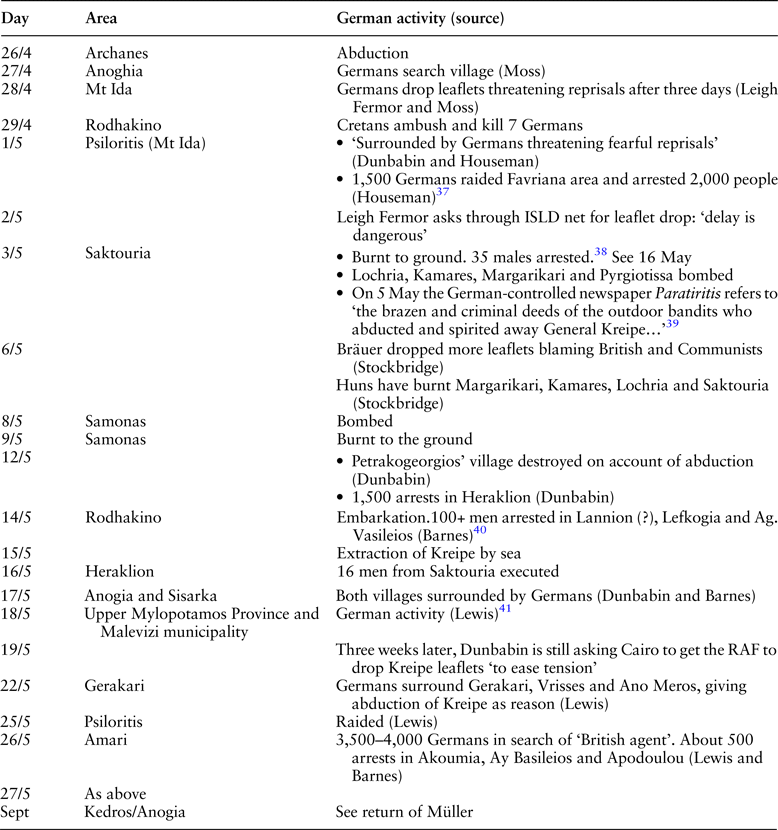
The German response was entirely predictable. Cordons were established, arrests made, leaflets dropped, villages bombed and burnt, and hostages shot.
Timetable of abduction, exfiltration and counter-measures

On 23 May, an Abwehr message from Sofia to Berlin was intercepted, stating that ‘General Kreipe, who was captured and taken away from Crete, is said to have been taken to Cairo on 16 May.’Footnote 42 This intelligence was correct, for Leigh Fermor had managed to extract Kreipe on 15 May; cordon and search operations were accordingly wound down. However, a subsequent SBS/SOE operation undoubtedly served to exacerbate the security situation as far as the Germans were concerned.Footnote 43
As part of a coordinated attack with the SBS, SOE's Billy Moss, the second-in-command of the Kreipe kidnap team, had been despatched to Crete in early JulyFootnote 44 by Brigadier Barker-Benfield, the new commander of Force 136 in Cairo. Although he came from an intelligence background, he had had no operational experience since 1919. It was to prove a woeful example of lack of communication between the two organizations. Commanded by Major Ian Patterson, a force of forty-one SBS raiders had been tasked by GHQME to destroy petrol and fuel dumps on the island.Footnote 45 When the reconnoitre patrols landed on the night of 1/2 July, Patterson was appalled to learn that ‘one of the bandit chiefs… had been briefed for an operation the same night [as the SBS attacks] while another party was apparently toying with the idea of attacking an HQ at Archanes.’Footnote 46 That party was Moss's, and it is clear that there was scant coordination by SOE with the SBS force commander, for Moss's task – apart from providing guides for the SBS – was to raise a small strike force to carry out a diversionary attack at the same time. His original plan was to attack the HQ of 22nd Air Landing Division at Ano Archanes where he hoped to find Kreipe's replacement, Major General Helmut Friebe, and mount a second abduction attempt.Footnote 47
Inevitably word soon got around that British commandos had landed, and many villagers spent the nights out in the hills to avoid reprisals: memories of German retaliation after the SBS raid the previous summer were still vivid. The SBS attacks duly went in on the night of 22/23 July and the raiders were extracted by 29 July.Footnote 48 They did a great deal of damage, destroying an estimated 150,000 gallons of petrol and killing thirty-two Germans. It was not lost on Müller, who had taken over from Bräuer as Kommandant Festungskommand Kreta that a previous commander, General Andrae, had been replaced after the 1942 SBS raid; the whole garrison therefore was brought to a high state of readiness.
Moss had received information from his Cretan contacts that he would be betrayed if he went ahead with the attack on the Divisional HQ, for they rightly feared draconian reprisals. He therefore abandoned his plan and instead opted to ambush enemy transport on the Heraklion-Rethymnon road with his small band of Cretan EOKFootnote 49 andartes and Russian escaped POWs. However, his hand was forced when, on 7 August, a German detachment from the garrison at Yeni Gave (Drosia) attempted to take fifty hostages, mostly women, in Anogia after the villagers had refused their demand for slave labourers. The detachment was surrounded and attacked by an ELAS band with seven Germans killed and their warrant officer captured.Footnote 50 It was only a matter of time before there was a retaliatory response in force.
In A War of Shadows, Moss recalled that ‘we found little difficulty in deciding what form the action should take. The Germans, bent on razing Anogia to the ground, would in all likelihood arrive upon the scene in the early morning. … if they could be waylaid before leaving their transport and deploying, Anogia might be saved.’Footnote 51 It was a clear-cut and laudable decision by an officer on the ground, for this was not the first time that the Germans had been in Anogia that year. On 16 February, Dunbabin had reported that they had put a cordon around the village, arrested ten men and executed a key member of the resistance. He signalled Cairo that ‘after the incident the survivors at once made it up with the local communists, agreed to act together against further German attacks, in the event invasion. If there are further arrests, plunder or burning of houses, they will defend themselves. A drop of arms is therefore urgent.’Footnote 52 On the morning of 8 August, Moss laid an ambush on the Damasta road. By the end of the day in three separate actions, fifty-seven German and Italian soldiers had been reported killed, wounded or captured; five enemy vehicles including an armoured car had been destroyed.
Müller, who had replaced Bräuer as the German Garrison Commander of Crete in July, watched these events unfold and after assessing the situation, issued the following order on 13 August:
Since the town of Anogia is a centre of the English espionage in Crete, since the Anogians carried out the murder of the sergeant of the Yeni-Gavé garrison and the garrison itself, since the Anogians carried out the sabotage at Damasta, since the andartes of various resistance bands find asylum and protection in Anogia, and since the abductors of General Kreipe passed through Anogia, using Anogia as a stopping place when transporting him, we order its RAZING to the ground and the execution of every male Anogian who is found within the village and within an area of one kilometre round it.
The abduction of Kreipe undisputedly triggered an intensive German reaction in early May which lasted through to early June, including the bombing and burning of villages. Although it was certainly not the sole reason for the Anogia reprisals in August, it was undoubtedly a significant contributory factor to Müller's decision. When the 822nd Infantry Battalion surrounded the villages of Ano Meros, Drygies, Gerakari, Vryses, Kardaki, Krya Vrysi, Gourgouthoi and Ano Meros on 22 August, they explicitly declared that the reason for their presence was the passage of General Kreipe through the area.
Until recently, a further factor to the German reaction has been conveniently overlooked. The day after the abduction, Alfred Fenske, Kreipe's driver, was murdered by Nikos Antonis, one of the Cretan andartes; his throat was slit and he was later decapitated, his body flung into a deep hole.Footnote 53 ‘The kidnappers…hid the head, leaving it to be collected later as a macabre souvenir.’Footnote 54 As far as the German garrison was concerned, from the first day of the abduction Fenske was posted ‘missing, believed killed’.
Total civilian deaths as a consequence of the abduction of Kreipe were calculated by Hans Prescher as 176 Cretans killed.Footnote 55 He estimated six villages were burnt. In a letter to Prescher of 11 June 2007, Leigh Fermor wrote ‘I am impressed by the care with which you have analysed all available sources. You have written a fair and balanced representation.’
Bräuer's and Müller's violent response to Kreipe's abduction was cited as a headline example of German war crimes by General Telford Taylor, the Chief of Counsel for the Prosecution, in his Opening statement of American Military Tribunal V's Trial No 7 (United States of America v. Wilhelm List, et al.) at Nuremberg when he referred to the German Army's own records: ‘In August and September 1944: thirteen villages destroyed in retaliation for the kidnapping of Lt. Gen. Kreipe.’
Leigh Fermor himself found ‘it deeply upsetting that, in spite of all our insistence in keeping clear of villages and avoiding incriminating the inhabitants, this tragedy (the destruction of Anogia) should be associated rightly or wrongly with the operation.’Footnote 56 Somewhat unconvincingly, he proposed that ‘in the months after our departure, by which time our route must have become widely known, details of the operation must have travelled from mouth to mouth until a garbled version reached the wrong ears, and finally those of the enemy.’Footnote 57
As to the outcomes of the abduction which Leigh Fermor had so persuasively put forward nine months before, it is difficult to quantify them. Did Cretan morale, previously poor according to Fielding, receive a fillip? Even if it was possible to measure it, did it matter in May 1944? Did the abduction deliver an Allied propaganda coup? In the greater picture, it was a small flash in a large pan. Kreipe as an intelligence asset proved worthless. The Germans withdrew uninterrupted from the Aegean, Crete included, between August and October that year. The German Kriegsmarine evacuated 37,138 soldiers, with a loss of 380 soldiers; the Luftwaffe evacuated 30,740 soldiers in 2,050 flights. After 30 October 1944, there were 11,828 Germans and 4,737 Italians left on Crete which by that time had become an irrelevance. The Ploeşti oilfields had been captured by the Red Army in August, Romania and Bulgaria were now on the side of the Allies and the last organized German units left Greece on 2 November. The garrison at Chania was never attacked although some German patrols were ambushed by andartes in the surrounding countryside. Axis forces in Crete finally surrendered to the British in May 1945. Ironically, due to the hostile activities of the KKE and ELAS towards all occupying forces,Footnote 58 the Germans were allowed to keep their side arms.
After the war, several of the main British actors, including Leigh Fermor, expressed their reservations about the guerrilla activity that had led to reprisals. In October 1989, Leigh Fermor wrote to Major Ralph Stockbridge, who had spent much of the war on Crete as an ISLD operative and expressed the view that ‘I wish the Damasta ambush hadn't taken place!’ Stockbridge annotated ‘So do I: this refers to Moss's totally undesirable attack on the Germans at Damasta, which ambush must have contributed to the destruction of Anogia’. While Stockbridge praised SOE for its EOK initiative and intelligence collection efforts, he had reservations about sabotage operations ‘unless they were absolutely necessary’. The SBS raids resulting in the destruction of enemy aircraft were in his opinion ‘of value’ but ‘minor operations involving the killing of a few German soldiers, whether carried out by commandos from Egypt or by local guerrilla bands, was [sic] criminally stupid since German reprisals were always bound to be much heavier’.Footnote 59
Colonel C. M. Woodhouse, the Allied Mission Commander in Greece, also believed that ‘by August 1943 (when Allied military superiority had been established over the Axis)… the value of guerrilla campaigns ceased to bear any proportion to the disasters which they brought upon the civilian population, and the political troubles which they laid up for the future.’Footnote 60
After VE day, even though the Allied Committee for War Criminals in London judged that after the assessment of the data provided by Greece,Footnote 61 1,127 Germans, 470 Italians, 242 Bulgarians and 410 Albanians were eligible to stand trial for war crimes, only a handful of culprits were brought to trial. In the case of Crete, under the auspices of the United Nations, a four-member Central Committee for ‘The Verification of Atrocities on Crete of the German and Italian Occupying Forces’ headed by the writer Nikos Kazantzakis was given the task to investigate Axis atrocities on the island. The Kazantzakis report enumerated the destruction of more than 106 Cretan villages and many massacres. Several mass graves were found in the area around the Agia Prison in the Hania area.
The Greek government eventually charged 36 Albanians, 243 Bulgarians and 339 Germans, of whom only a few were ever tried in the Greek Special Court Martial for War Criminals.Footnote 62 According to American sources, by 1948 only twenty-five collaborators and four war criminals had been judicially executed in Greece,Footnote 63 in stark contrast to the hundreds of leftists executed by the Greek authorities in the same period. Yesterday's enemy had become today's friend in the ranks of those fighting communism.
The Special Court Martial for War Criminals had been set up under Greek Constitutional Act No 90/1945. There was to be no appeal against its decisions, but appeals for clemency were permitted to a special council of the Ministry of Justice, and if rejected then to the King. In August 1945, the British Foreign Office informed the UN War Crimes Commission (UNWCC) that the Combined Chiefs of Staff had directed Supreme Headquarters Allied Forces Europe and Supreme Allied Commander Mediterranean that war criminals in British custody whose names appeared on the UNWCC CROWCASSFootnote 64 lists should be handed over ‘without question’ to those Allied countries in which the crimes were committed, providing they were not required as defendants or witnesses for trials in British Military Courts or the International Military Tribunal at Nuremberg.Footnote 65
Of the German senior officers engaged in prosecuting the war in South East Europe, Generals Andrae, Bräuer, and Müller,Footnote 66 all of whom were in British custody,Footnote 67 were handed over to the GreeksFootnote 68 by Commander Mediterranean Forces in June 1946 and put on trial in Athens on 31 October 1946 for war crimes in Crete. In the case of Andrae, the British Judge Advocate General stated that he had considered trying him for War Crimes committed against the British in Greece, ‘but as his crimes against the Greeks were far more serious’, it was considered that he should be tried by the Greek government.Footnote 69 The British authorities had also concluded that in the cases of Bräuer and Müller ‘there is no evidence in the Judge Advocate General's office that they have been concerned in war crimes against British nationals and as they commanded in Crete after British POWs had been moved from the island… there is no objection to them being handed over to the Greek authorities.’Footnote 70
General Student, the architect of initial German reprisals on the island, had been captured by the British at Flensburg on 28 May 1945 and tried by them on 6–10 May 1946 at Luneburg, where he was found guilty of three out of eight charges for war crimes against British and Commonwealth service personnel in Crete. Sentenced to five years imprisonment, he was released after two years and although wanted for extradition by the Greeks to answer charges of war crimes against the Greek civilian population was deemed unfit to travel on medical grounds. When the Greek Commissioner Dimitsas asked for his extradition in November 1947,Footnote 71 the British did not give their assent. He died in 1978.
The Greeks also made a formal request to the British for the handover of General Kreipe for War Crimes in November 1947. Likewise, it was not forthcoming. Following his interrogation in London, Kreipe had been transferred to a POW camp near Calgary in Canada and then returned to the UK where he was held at Island Farm Special Camp X1 at Bridgend in Wales. He was released in October 1947.
On 5 November 1946 Bräuer and Müller submitted a plea for deferment. Their argument: how could their wartime actions be assessed under Greek criminal law? Were Greek soldiers fighting in times of war on Bulgarian soil or Turkish soil subject to Bulgarian or Turkish criminal law? According to the Hague Convention, they were subject to German military law and the international laws of war. Their plea was rejected and at the end of the trial both were found guilty and sentenced to death. Andrae was found guilty of lesser offences and received four life sentences. He was released in 1952. Müller's wife, Dorothea, appealed to the British government on 20 December 1946:
My husband, Friedrich Wilhelm Müller, General of Infantry, has been sentenced to death in a Greek Court in Athens. As he had no German defence, as granted to the Nuremberg defendants, I beg to ask the Military Government to exercise their influence to defer the execution of the sentence and that a German defense will be granted to my husband. I am conscious that this is a Greek matter. But I do hope it will be possible for the British Government to communicate with the Greek government to allow a German defence.
The Foreign Office could find no good reason for interfering, concluding that Müller's interests had been properly looked after.Footnote 72
Their execution took place in Goudi at dawn on 20 May 1947. Bräuer's remains were later re-interred in the 1970s in the German War Cemetery on Hill 107 in Maleme after lobbying by the German Airborne Veterans Association. George Psychoundakis, Leigh Fermor's wartime runner, personally buried Bräuer's remains.
The fate of Bräuer and Müller remains controversial. As late as February 1944 the United Nations’ War Crimes Commission's Committee on Facts and EvidenceFootnote 73 (Committee 1) had initially decided that the taking of hostages was not as such a war crime and recognized that, although the practice was a harsh one which should be dispensed with, such practices for the purpose of maintaining the lines of communication of a belligerent occupant might be justified from the standpoint of the occupying force.
In the February 1948 trial of Field Marshal List and others,Footnote 74 the US Military Tribunal in Nuremberg ruled that
a reprisal is a response to an enemy's violation of the laws of war which would otherwise be a violation on one's own side. It is a fundamental rule that a reprisal may not exceed the degree of the criminal act it is designed to correct. Where an excess is knowingly indulged, it in turn is criminal and may be punished.
The same tribunal ruled:
it cannot be denied that the shooting of hostages or reprisal prisoners may under certain circumstances be justified as a last resort in procuring peace and tranquillity in occupied territory and has the effect of strengthening the position of a law-abiding occupant. The fact that the practice has been tortured beyond recognition by illegal and inhuman application cannot justify its prohibition by judicial fiat.
Although ListFootnote 75 was found not guilty of the crime of executing partisans, the tribunal agreed
with the contention of the defendant (List) that the guerrilla fighters with which he contended were not lawful belligerents entitling them to prisoner of war status upon capture. We are obliged to hold that such guerrillas were francs tireurs who, upon capture, could be subjected to the death penalty. Consequently, no criminal responsibility attaches to the defendant because of the execution of captured partisans in Yugoslavia and Greece during the time he was Armed Forces Commander Southeast.Footnote 76
List and two other senior officers were found guilty on the count of having ordered hostage taking and reprisal killings. Although sentenced to lifetime imprisonment, List was released in December 1952 on medical grounds and died in 1971. General Helmuth Felmy, Military Governor of Greece, was sentenced to fifteen years imprisonment, later reduced to ten. He died in 1965. General Wilhelm Speidel, who took over from Felmy, received twenty years imprisonment but was released in 1951 and died in 1970. None of the defendants was sentenced to death.
Given the wide discrepancies between the magnitude of the crimes of the German ‘Balkan Generals’ such as Felmy and Speidel as German Military Commanders in Greece which included Crete and the Aegean Islands and those of the German ‘Cretan Generals’, the trials and subsequent executions of Bräuer and Müller appear political rather than judicial. Had they been tried for war crimes by Allied Military Tribunals in Germany, both would probably have received prison sentences like List, Velmy, Speidel and Student.
One of the lasting legacies of the Second World War war-crime trials – albeit fifty years later – was the eventual establishment of the International Criminal Court at the Hague to ensure fair trials.
Alan Ogden has written four histories of SOE covering Southeast Europe, Italy, Greece and the Far East. In 2018 his monograph about Paddy Leigh Fermor in Romania, The Vagabond and the Princess, was published by Nine Elms; the following year, Master of Deception, his study of Peter Fleming's role in the war against Japan was published by Bloomsbury. His biography of General Sir Adrian Carton de Wiart VC is due in autumn 2021.