Congenital heart disease affects on average eight children per 1000 birthsReference Chew, Halliday, Riley and Penny 1 and can range in severity from minor, self-correcting defects to major deficits that require surgery or palliative care. More severe and complex forms of congenital heart disease can now be reliably detected via foetal cardiac ultrasound by 16–20 weeks of gestation.Reference Kumar, Newburger, Gauvreau, Kamenir and Hornberger 2 Worldwide, ∼40% of cases are detected in this way, with a recent Victorian study demonstrating that 53% of significant congenital cardiac lesions are diagnosed antenatally.Reference Chew, Halliday, Riley and Penny 1 Although an antenatal diagnosis results in improved morbidity and mortality in some lesions,Reference Kumar, Newburger, Gauvreau, Kamenir and Hornberger 2 it also results in expecting parents facing uncertainty regarding their unborn child's illness and may require them to make decisions on the continuation of pregnancy.Reference Wong, Chan, Cincotta, Lee-Tannock and Ward 3 , Reference Aite, Zaccara and Mirante 4 For children diagnosed post-natally, the symptoms may include fatigue, laboured breathing, cyanosis, and failure to thrive.Reference Lissauer and Clayden 5
Over the past 20 years, significant achievements in the medical treatment of congenital heart disease have resulted in reduced mortality and morbidity.Reference van der Bom, Zomer, Zwinderman, Meijboom, Bouma and Mulder 6 These advances have led to a shift in the research focus towards consideration of the psychosocial impact of congenital heart disease on both children and families. A diagnosis of life-threatening or serious congenital heart disease can have significant psychosocial implications for children and families. Research shows that parents of children with congenital heart disease experience higher levels of distress compared with parents with healthy childrenReference Carey, Nicholson and Fox 7 or with children with other chronic illnesses.Reference Lawoko and Soares 8 For the child, the consequences can include short-term psychological symptomsReference Hysing, Elgen, Gillberg, Lie and Lundervold 9 and, in the case of chronic conditions, psychological morbidity or an impaired health-related quality of life.Reference Ingerski, Modi and Hood 10 For families, the diagnosis of congenital heart disease may be associated with a range of emotions – guilt, fear, sadness, anxiety, and grief potentially exacerbated by the stressors of hospitalisation, family separation, and financial pressures.Reference Balluffi, Kassam-Adams, Kazak, Tucker, Dominguez and Helfaer 11 – Reference Franck, Mcquillan, Wray, Grocott and Goldman 13 The majority of studies conducted within this population focus on parental psychological symptoms;Reference Brosig, Mussatto, Kuhn and Tweddell 12 , Reference Doherty, McCusker and Molloy 14 however, there is also evidence of broader contributing psychosocial factors impacting adjustment. Social support,Reference Uzark and Crowley 15 , Reference Take and McCubbin 16 social resources, social disadvantage,Reference Lawoko and Soares 8 religion,Reference Ludlow and Levy 17 , Reference Rona, Smeeton, Beech, Barnett and Sharland 18 and family functioningReference Doherty, McCusker and Molloy 14 have been identified as important indicators, among others, of psychosocial outcome.
Resilience in the face of such stressors is common; yet, a significant proportion of families report persistent elevated distress requiring psychosocial intervention.Reference Kazak 19 Acute medical settings offer opportunities to implement preventative intervention models that target psychosocial risk factors in families impacted by their child's illness. However, accurately identifying families most in need of psychosocial intervention is complex,Reference Lindstrom, Aman and Norberg 20 with research to date suggesting that objective aspects of the child's illness are not the best predictors of long-term parental psychological adjustment.Reference Alderfer, Mougianis and Barakat 21 Moreover, approaches for systematic assessment of the psychosocial risk and evidence-based psychosocial interventions have not been readily available for acute paediatric healthcare settings.
Kazak and colleaguesReference Kazak 19 have proposed a conceptual framework for understanding the psychosocial risk experienced by families faced with a serious illness in their child. The Pediatric Psychosocial Preventative Health Model was developed within the child cancer field but has been found to be relevant in other forms of serious childhood illness, such as in the neonatal intensive care unit and gastroenterology unit.Reference Kazak 19 The model proposes a three-tiered risk framework comprising three categories corresponding to the suggested levels of psychosocial intervention: Universal – low risk, that is those who are able to adapt appropriately to their child's diagnosis with typical psychosocial intervention, Targeted – medium risk that is, those who require some psychosocial intervention, and Clinical – high risk that is, those who require the most intensive and continuing psychosocial intervention.Reference Kazak 19 In order to detect the psychosocial risk, Kazak et alReference Alderfer, Mougianis and Barakat 21 – Reference McCarthy, Clarke, Vance, Ashley, Heath and Anderson 25 have developed and validated a brief psychosocial screening measure, the Psychosocial Assessment Tool, which is based upon the identified risk factors in families of children with cancer and is designed to be completed by parents in the early stages after their child's diagnosis. Recent studies have subsequently validated this tool in the paediatric kidney transplantReference Pai, Tackett, Ittenbach and Goebel 26 and sickle cell disease populations.Reference Karlson, Leist-Haynes, Smith, Faith, Elkin and Megason 27
This study aimed to investigate the frequency and nature of parent psychosocial risk occurring after surgery for congenital heart disease and the impact of the time of diagnosis, antenatal or post-natal, using Kazak's Pediatric Psychosocial Preventative Health Model. In keeping with previous research, we expected that resilience would be common, regardless of the timing of diagnosis, with most parents functioning within the “universal range” and a very small number in the “clinical” range. Further, we predicted that socioenvironmental factors would have the greatest impact on psychosocial risk, with illness severity being less influential.
Method
Participants
The study sample was drawn from a larger, longitudinal study: the Take a Breath study, which aims to map the trajectory of psychosocial risk in families of children diagnosed with a severe childhood illness or injury acutely over an 18-month period. The recruitment period was between November 2010 and September 2011, at The Royal Children's Hospital Melbourne, Australia. For the purposes of this paper, cross-sectional data, representing consecutive admissions to the cardiology or paediatric intensive care units, for the purposes of cardiac surgery, were collected within 4 weeks after the child's surgery.
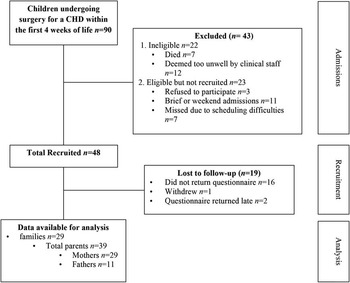
Participants were both mothers and fathers of patients who underwent cardiac surgery within the first month of life. When both parents had an active parenting role, the mother and father were invited to participate. Exclusion criteria were: parents having limited written or spoken English; another recent family trauma; or the child deemed either too medically unstable or not for active treatment by the clinical staff. Information on the recruitment rates, reasons for non-participation, and the drop our rates are provided in Figure 1. Owing to the Victorian Privacy Policy, which precludes collection of any information on non-participating individuals, data pertaining to illness severity and patient/family demographics of families were not available for analysis.
Recruitment process from admission to the hospital to data analysis.

Measures
Psychosocial risk was measured using The Psychosocial Assessment Tool,Reference Alderfer, Mougianis and Barakat 21 , Reference Pai, Patiño-Fernández and McSherry 24 a brief screening tool designed for assessing parent psychosocial risk factors in the context of their child's recent diagnosis of a serious childhood illness. The Psychosocial Assessment Tool contains seven subscales: Family Structure and Resources, Family Social Support, Family Problems, Parent Stress Reactions, Family Beliefs, Child Problems, and Sibling Problems. The Total Psychosocial Assessment Tool scores were used, with higher scores indicating a greater psychosocial risk. Subscale scores were rescaled to a range of 0–1, with the total Psychosocial Assessment Tool scores ranging from 0 to 7. The authors report good internal consistency for the total Psychosocial Assessment Tool score (α = 0.81). In the present study, owing to the young age at diagnosis of the child sample and in consultation with the original authors, the Psychosocial Assessment Tool was extended to include four novel items examining infant risk factors, namely, sleeping, feeding, crying, and bonding difficulties. Subsequently, the calculation of this subscale score was modified to account for eight rather than 15 items, as is used in the original Psychosocial Assessment Tool scoring.
Parents’ psychosocial risk was measured within 4 weeks after their child's surgery and stratified into a three-tiered framework: Universal (Total Psychosocial Assessment Tool score <1.0), Targeted (Total Psychosocial Assessment Tool score ≥1.0 and ≤1.9), and Clinical (Total Psychosocial Assessment Tool score ≥2.0).Reference Pai, Patiño-Fernández and McSherry 24 The number of days in hospital was used as a proxy measure for the severity of the child's illness.Reference Newgard, Fleischman, Choo, Ma, Hedges and McConnell 28 The parent education level was utilised as a proxy measure of the socioeconomic status;Reference Marmot, Fuhrer, Ettner, Marks, Bumpass and Ryff 29 , Reference Grzywacz, Almeida, Neupert and Ettner 30 further, the place of residence, Metropolitan or other, and parent age were also documented.
Procedure
The study was approved by The Royal Children's Hospital Human Research Ethics Committee (HREC 30044). The research team members monitored the daily admissions lists of the Cardiology and Paediatric Intensive Care Units and liaised with the clinical staff to identify eligible families. A member of the research team obtained written consent and administered the questionnaire to parents for completion. The parents were asked to return the questionnaires within 4 weeks after their child's surgery; however, a small number of questionnaires (n = 4) was collected at 6–13 weeks. Figure 1 details the flow of recruitment at each stage of the recruitment process.
Statistical analysis
Initially, to determine the effect of the putative sample confounds, independent sample t-tests compared the total Psychosocial Assessment Tool scores between those diagnosed antenatally and those diagnosed post-natally; the within-family Psychosocial Assessment Tool scores were analysed using Pearson's correlation. To examine the first study aim, the proportion of parents falling into each of the three Psychosocial Assessment Tool risk categories – Universal, Targeted, and Clinical – was calculated, and the nature of the endorsed items was explored. Finally, a multiple linear regression was conducted to explore the relationship between the Psychosocial Assessment Tool scores and the sociodemographic factors: parent age, parent education, that is, high school graduate or less, tertiary education, or post-graduate education; place of residence, that is, Metropolitan Melbourne or other; and illness severity, that is, days in hospital.
Results
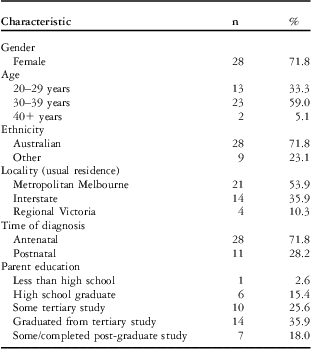
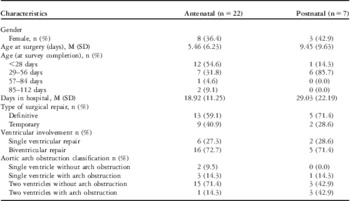
The demographic information for parents and patients is presented in Tables 1 and 2. Table 2 is stratified by the antenatal and post-natal diagnoses. The majority of the sample had an antenatal diagnosis (71.8%), with a similar degree of congenital heart disease severity between the antenatal and post-natal groups. The mean age at surgery was younger for the antenatal group (5.46 days, standard deviation = 6.23) than for the post-natal group (9.45 days, standard deviation = 9.63). The number of days hospitalised was also greater for the antenatal group.
Parent demographics (n = 39).

Missing data: age n = 1; ethnicity n = 2; marital status: n = 1; parent education: n = 1
Child characteristics (n = 29).

An independent samples t-test revealed no significant differences on the Psychosocial Assessment Tool total score between families of children diagnosed antenatally (M = 0.82, standard deviation =0.44) compared with those diagnosed post-natally (M = 0.79, standard deviation = 0.78), nor between those who received biventricular (M = 0.82, standard deviation = 0.57) repair and those who received single ventricle repair (M = 0.86, standard deviation = 0.52). Moreover, no significant correlation was found between mothers and fathers of same families on the Psychosocial Assessment Tool total score (dyad n = 10, r = 0.59, p > 0.05). Thus, data from all participants were included in all analyses conducted.
The Psychosocial Assessment Tool was completed a mean of 27.85 days (standard deviation = 27.32) after the child's cardiac surgery (range = 7–91). The majority of the sample was female (71.8%), of Australian ethnicity (71.8%), and had at least some tertiary education (79.5%).
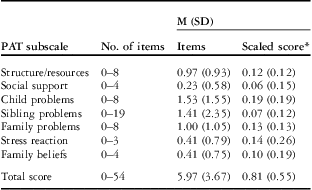
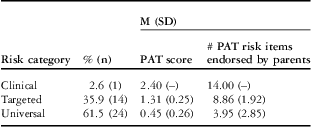
The mean number of items endorsed on the Psychosocial Assessment Tool was 5.97 (see Table 3). The most commonly endorsed items for mothers and fathers (n = 39) were: “caregiver experiencing excessive worry” (51.3%), “patient having trouble with a feeding routine” (48.7%), “patient having trouble with a sleeping routine” (43.6%), “specific areas of financial difficulty” (41.0%), “means of transportation to the Royal Children's Hospital” (38.5%), “patient cries a lot” (33.3%), and “caregivers having experienced sadness or depression” (25.6%). Child problems, stress reaction, and family problems were the most highly endorsed subscales (see Table 3). Risk stratification of families based on the Psychosocial Assessment Tool scores is presented in Table 4.
Descriptive statistics PAT subscale scores (n = 39).

PAT = Psychosocial Assessment Tool
*Scaled range = 0–1
Descriptive statistics for the PAT risk categories (n = 39).

PAT = Psychosocial Assessment Tool
Multiple linear regression examined the effect of sociodemographic variables and illness severity on the total Psychosocial Assessment Tool score. The sociodemographic variables included parental age, parental education, and place of residence, that is, metropolitan Melbourne or other; the length of hospital admission was used as a proxy for illness severity.Reference Newgard, Fleischman, Choo, Ma, Hedges and McConnell 28 The results indicate an overall significant model, F(5,31) = 2.88, p < 0.05, R2 = 0.32; however, parent age, place of residence, and days in hospital did not significantly contribute to the model (p > 0.05). Parental education level was the sole significant predictor of the total Psychosocial Assessment Tool score, with those having high school education less recording a significantly higher Psychosocial Assessment Tool than those with at least some tertiary education (β = −0.85, p = 0.005).
Discussion
The present study is one of the first to examine acute psychosocial risk in families of infants undergoing surgery for a congenital heart disease. On the basis of preliminary data, 38% of families rated themselves as experiencing psychosocial risk within the Targeted or Clinical ranges. Highly endorsed items were consistent with those reported in previous studies on parents of seriously ill children, with intrapersonal emotional items such as a caregiver having a history of excessive worry, sadness, or depression rating highly.Reference Kazak, Cant and Jensen 22 , Reference McCarthy, Clarke, Vance, Ashley, Heath and Anderson 25 Other highly endorsed items included three of the four novel items added to the Psychosocial Assessment Tool: the patient having trouble with feeding, eating, and crying, suggesting that the inclusion of these items may be important for the identification of infant-specific problems. Additional highly endorsed items appear to reflect the unique characteristics of this illness group. In Australia, because of the location of specialist paediatric cardiac services in major cities, many families have to relocate to receive life-saving surgery during their child's 1st year of life. Further, and consistent with previous research, most families reported that they were suffering financial difficulties.Reference Heath, Lintuuran, Rigguto, Tokatlian and McCarthy 31 This may be a particular issue in this cohort, wherein almost half of the participating families resided interstate or in regional areas and were therefore displaced during the initial and ongoing treatment periods. This typically resulted in families being left without a steady income and support of the extended family.
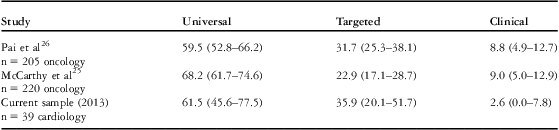
In line with the Pediatric Psychosocial Preventative Health Model, the majority of families (62%) were classified into the Universal, that is, lowest-risk, group. Of note, these rates are similar to those reported in previous studies on parents of children with serious medical diagnoses (see Table 5). These families, who demonstrated low levels of distress, would be expected to adapt well to their child's illness. A substantial percentage of families (36%) was classified as Targeted, that is, medium risk, and recorded an elevated risk for distress, whereas one parent was classified as Clinical, that is, high risk, representing significantly elevated or escalating levels of distress.Reference Kazak 19 With the targeted and clinical groups collapsed to represent the elevated psychosocial risk, the proportion of affected families is comparable with those reported in previous findings of other diagnosis groups. Of note, the proportion of parents reporting clinical levels of psychosocial risk in the cardiology sample did not reach the same magnitude as that in other diagnosis groups. This finding may have been influenced by the significant percentage of families not approached for the study owing to the clinical instability of their infant, resulting in the possibility that the more distressed families were excluded from the study. Other potential explanations include the likely less-protracted treatment period of congenital heart disease or the considerable number of families diagnosed antenatally in this cohort.
PAT risk group stratification for the present and previous studies at CHOP and RCH for mothers and fathers, % (95% CI).

CHOP = Children's Hospital of Philadelphia; PAT = Psychosocial Assessment Tool; RCH = Royal Children's Hospital
Interestingly, there were no differences in terms of psychosocial risk for families of infants diagnosed antenatally against those diagnosed post-natally. Recent studies have highlighted the previously underestimated impact of an antenatal diagnosis, for example, at 20 weeks gestation, of a congenital anomaly,Reference Fonseca, Nazare and Canavarro 32 , Reference Brosig, Whitstone, Frommelt and Leuthner 33 suggesting that an antenatal diagnosis can increase stress rates of parents during a transitional period already laden with elevated stress levels and potentially manifest in psychopathological symptoms. These findings underscore the need for support for parents, regardless of the timing of the diagnosis. Of note, the design of the present study did not include assessment of psychosocial risk immediately after the antenatal diagnosis, when elevated levels of psychosocial distress may have been found. Previous studies highlighting the implications of maternal psychological health during pregnancy on childhood development,Reference Berant, Mikulincer and Shaver 34 , Reference Van den Bergh, Mulder, Mennes and Glover 35 coupled with the present findings, warrant further exploration of the influence of post-natal versus antenatal diagnosis and the cumulative impact of a prenatal diagnosis, birth, and subsequent surgery on parental adjustment.
The parental educational level, as a proxy for the socioeconomic status, was the sole contributing environmental factor to the level of psychosocial risk in the present study, which is consistent with the results of previous research.Reference Vanderbilt, Bushley, Young and Frank 36 At a more general level, studies addressing the relationship between the socioeconomic status and psychosocial risk in families of ill children have had mixed results. Some studies have reported an association between a lower socioeconomic status and higher levels of acute parental distressReference Landolt, Buehlmann, Maag and Schiestl 37 , Reference Patiño-Fernández, Pai, Alderfer, Hwang, Reilly and Kazak 38 and others have shown no association.Reference Landolt, Buehlmann, Maag and Schiestl 37 , Reference Winston, Baxt, Kassam-Adams, Elliott and Kallan 39 , Reference Nugent, Ostrowski, Christopher and Delahanty 40 In addition, a lower parental socioeconomic status appears to negatively impact the child neurobehavioral outcomes.Reference Yeates, Swift and Taylor 41 , Reference Yeates, Taylor and Drotar 42 It is possible that parents with lower education may be less equipped to manage the complex informational and medical environment, particularly in the early stages of the child's illness. Further investigation into this relationship is warranted. Interestingly, parent age and gender were not found to influence psychosocial risk, contrary to the findings of previous research.Reference Heath, Lintuuran, Rigguto, Tokatlian and McCarthy 31 , Reference Fonseca, Nazare and Canavarro 32 This is potentially due to the large number of parents aged between 30 and 39 years (59.0%) and a bias due to the small number of fathers (28.2%). Finally, as predicted, the objective illness severity did not influence psychosocial risk.
The limitations of the present study must be considered. Given that these are preliminary data, the small sample size warrants caution when interpreting results. Further, the significant number of families who were unable to be approached owing to their child being medically unstable, along with the subset of families who consented to the study but did not return the questionnaires, may have biased the results, with a limited representation of the most severe cases of congenital heart disease and potential omission of the most distressed families. A larger sample size is required to address this limitation. Recruiting families during this sensitive time, although challenging, is necessary, given the importance of early identification of clinically relevant psychosocial information. Future studies may wish to explore other sensitive methods of recruiting families whose children are severely unwell.
It is important to note that the extended Psychosocial Assessment Tool is yet to be validated with families of children undergoing surgery for congenital heart disease. In support of its potential within this group, the incidence of an elevated psychosocial risk in parents of these children is similar to those reported in other serious childhood illness groups. Further, preliminary studies have found it to be a reliable and valid measure of psychosocial risk.Reference Alderfer, Mougianis and Barakat 21 , Reference Pai, Patiño-Fernández and McSherry 24 Findings to date are encouraging for its use in this population and warrant further investigation.
This early identification of distressed families with a child undergoing cardiac surgery will inform the delivery of interventions and further supports for families at risk of psychosocial stress. Although the large number of more severe cardiac conditions omitted from the sample is a limitation of the study, our findings highlight that parent distress in the context of serious illness is not restricted to the most severe illnesses and that natural adjustment to a child's condition cannot be assumed. The ability to identify these at-risk families early will help to direct the already limited clinical resources towards families most in need of support, while respecting the natural resilience of families and limiting unnecessary intervention. On the basis of these preliminary data, psychosocial screening of families of children undergoing surgery for a congenital heart disease appears promising; however, further application in this population is necessary.
Acknowledgements
The authors acknowledge the generosity of the participating families along with the contributions to the research made by Amy Coe, Anica Dimovski, Nathan Dowling, and Claudia Woolf.
Financial Support
The authors acknowledge the funding support for this project from the Pratt Foundation and the Victorian Government's Operational Infrastructure Support Program.