Introduction
Nine years have passed since human-induced pluripotent stem (iPS) cells were established. Japan is moving forward at an increasing rate in its efforts to use iPS cells in the fields of regenerative medicine as well as drug discovery. With expectation toward that field and support from Japanese citizens, Japanese government has focused on regenerative medicine as a national growth strategy and revised laws regulating its clinical trials and applications. In the present article, we report on the trends in regenerative medicine research as well as those in medical and pharmacology research using stem cells in Japan and discuss the characteristics of Japan’s growth strategy from a societal perspective.
Maintenance of Laws Associated with Regenerative Medicine in Japan
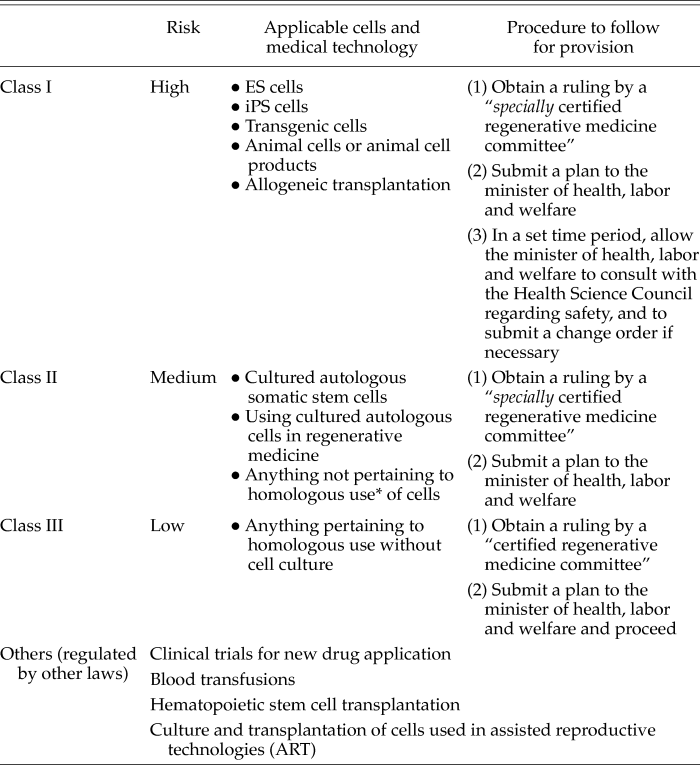
In November 2014, Japan enforced both the Act on the Safety of Regenerative Medicine [RM Act] and the Act on Securing Quality, Efficacy and Safety of Pharmaceuticals, Medical Devices, Regenerative and Cellular Therapy Products, Gene Therapy Products, and Cosmetics (shortened to the Pharmaceutical and Medical Device [PMD] Act). By approving the practice of regenerative medicine in medical institutions providing this service, committees that review plans to provide regenerative medicine, and the facilities where these cells are fabricated, the RM Act established several consistent safety standards with regard to providing regenerative medicine. Regardless of whether the regenerative medicine offered is part of a research or treatment framework, this law demands that the review structure consider the risks and firmly establish a monitoring framework. The RM Act divides regenerative medicine into three classes (Table 1). Class I involves procedures with the highest risk and includes regenerative medicine utilizing embryonic stem (ES) cells or iPS cells, animal cells, allogeneic transplantation, or genetic manipulation.Footnote 1
Protocols Required by the RM Act According to Risk Level

Source. Ministry of Health, Labor and Welfare. Saisei iryo tou no anzensei no kakuho tou ni kansuru houritsu shikou kisoku [Implementation regulations on the Act on the Safety of Regenerative Medicine] 2014 Oct 1; available at http://www.mhlw.go.jp/file/06-Seisakujouhou-10800000-Iseikyoku/0000063606.pdf (last accessed 16 Sept 2015).
* “Homologous use” is a cell administration technique used when the harvested cells share the same function as the cells in the region targeted for regenerative medicine. For example, if adipose cells are harvested from the abdomen, and if the stem cells from the adipose tissue are separated from these cells, they can be used for breast reconstruction following surgery for breast cancer. This is an example of homologous use of these cells.
The PMD Act is a revision of an already existing law on drug discovery approval, and the clinical trial tracks were greased so that regenerative medical products would become available to the general public with minimal hassle. Up until this point, the law regulated “pharmaceutical products,” “quasi-drugs,” “cosmetic products,” and “medical equipment”; with the establishment of the PMD Act, “products related to regenerative medicine” were added to this list. Clinical trials for regenerative medicine are different from those conducted to test pharmaceutical products, which makes it difficult to recruit a sufficient number of trial participants. As such, in addition to the normal course required for a clinical trial, a “conditional and time-limited approval” was newly implemented. According to this policy, a clinical trial can be approved even with a small number of subjects, so long as the efficacy of the trial is predicted and its safety is assured. In the seven years following approval, the number of subjects would be increased and an additional application would be submitted.
Effects of the RM Act: Strategies to Address Stem Cell Tourism and Private Practice
As is well known, up to this point in Japan, stem cell treatment that did not necessarily have confirmed safety or efficacy could still be provided in the confines of private practice. The Japanese Society for Regenerative Medicine has spoken out about regenerative medicine that was attempted within the realm of private practice, cautioning against the easy provision of regenerative medicine with unclear risks and benefits as well as advocating for the development of treatment methods that ensure patient safety and high applicability. However, in actuality, this paved the way for the emergence of stem cell treatment that was deemed “suspicious,” which developed into an international issue. In 2013, based on articles from some Japanese newspapersFootnote 2, Nature reported that “a clinic in the Hakata district of Fukuoka in southwest Japan, which has links to the Seoul-based biotechnology firm RNL Bio, has been treating some 500 South Koreans a month with stem cells.”Footnote 3 Japan was criticized by the international community for allowing such stem cell tourism. This issue was a strong consideration during the reworking of the laws on regenerative medicine.
Around the same time, a Japanese patient who had received an allogeneic adipose-derived mesenchymal stem cells infusion therapy as regenerative medicine reported, “I had emotional pain due to this treatment that was not sufficiently explained to me,” and sued the physician and hospital director at a clinic in Tokyo for damage compensation. The ruling on this trial was made in May 2015 in the Tokyo District Court.Footnote 4 The chief justice ruled that “even though the medical standards for this treatment were not established, the risks and benefits were not sufficiently explained” and ordered the physicians to provide JPY 1,840,000 in compensation to the patient.Footnote 5 This lawsuit was yet another example of how regenerative medicine offered in the confines of private practice does not necessarily always benefit the citizens, and of how an emotional barrier can be created between citizens and medical personnel. In addition, it raised awareness of the necessity of a very detailed explanation and an extremely sincere attitude from medical personnel when providing regenerative medicine with unclear risks and benefits.
By establishing the RM Act, certain regulations came to be placed on these unrestricted forms of regenerative medicine carried out in private practice. Indeed, the only requirement for provision of class II or III regenerative medicine is notification of the minister of health, labor and welfare, and as the government does not assign any monitoring body, some have questioned whether provision of inappropriate forms of regenerative medicine is, in fact, being prevented effectively.Footnote 6 That said, if the committee rulings are carried out appropriately, an improved outcome should be possible to a certain extent. The preceding regulations set the groundwork for Japanese citizens as well as all individuals who receive regenerative therapy in Japan to undergo regenerative medicine with the peace of mind that the safety and efficacy of such treatments are ensured.
Outcomes of the Clinical Trials for Popularized Regenerative Medicine Products and Accelerated Commercialization of Regenerative Medicine Products
Japanese citizens hope that safe regenerative medicine will become accessible in the near future. In the past Japan has suffered a drug lag problem due to strict regulations that slow the approval of pharmaceuticals, which has caused concern among its citizens. Thus revision of the PMD Act now allows regenerative medicinal products to be delivered into the hands of patients more easily and more quickly than before. In September 2015, a ruling was made by the Ministry of Health, Labor and Welfare Special Committee on Pharmaceuticals and Food Sanitation Advisory Board,Footnote 7 and it is anticipated that two regenerative medicinal products will be approved. Specifically, these are a human allogeneic mesenchymal stem cell–based regenerative medicine product (JR-031) from JCR PharmaceuticalsFootnote 8 and autologous skeletal myoblast sheets from Terumo Corporation.Footnote 9 The mesenchymal stem cells from JCR Pharma are considered a landmark product, as they are regenerative medicinal products that use allogeneic cells. In addition, the sheets from Terumo Corporation represent the first product subject to the “conditional and time-limited approval” established in the PMD Act. Until now, only two regenerative medicinal products came from Japan: namely, the JACE (autologous cultured epidermis) from Japan Tissue Engineering Co., Ltd. (J-TEC), and the JACC (autologous cultured cartilage) from J-TEC. This approval of the allogeneic mesenchymal stem cells or the skeletal myoblast sheets now opens the door for moving forward with clinical trials for cranial nerve regeneration among stroke victims or nerve regeneration among patients with spine injuries.Footnote 10
With the revisions of the law, commercialization of regenerative medicine in Japan is gaining speed. Fujifilm Corporation, a major film manufacturing company, bought out J-TEC in 2014. After setting up a solid operating base for development of regenerative medicine products, the company further strengthened its structure in 2015 by taking over Cellular Dynamics International, Inc., a bioventure company in the United States famous for its development and production of iPS cells.Footnote 11 Fujifilm is planning to become one of the front-runners in the development and provision of regenerative medicinal products and is supported by the citizens’ anticipation and hopes concerning regenerative medicine. Of course, this type of industrial movement is founded on a wealth of knowledge and technology concerning regenerative medicine that has been accumulating over decades of history. Building on that foundation is the momentum of the technological innovation of iPS cells, compounded by anticipation among the citizens and the response from the government in the form of a law revision, all of which are paving the way for business innovation. Regenerative medicine in Japan is thus a web of complex activities intertwining science, medicine, citizens, government, and private companies. There are high hopes for the future of regenerative medicine as a key industry, and it represents an important component of the country’s growth strategy.
Characteristics of Japan’s Growth Strategy: iPS Cells, Regenerative Medicine, and Pharmaceutical Development for Intractable Diseases
What, then, are some characteristics embodied by Japan’s growth strategy, which rests on regenerative medicine as one of its columns? Globally speaking, regenerative medicinal products that have been provided in the past included many skin- and cartilage-related products. However, the innovations enabled by iPS cells open the doors for far more expansive developments in technology. Considering that, in Japan, clinical research concerning regenerative medicine using iPS cells is moving forward in areas such as cardiomyocytes and neurocytes (both of these are already on the clinical trial track), hepatocytes, pancreatic islet cells, and the cornea, it is not difficult to see that the range of possibilities for research on regenerative medicine in Japan is quite vast.
Furthermore, medical research using iPS cells does not stop with regenerative medicine but, rather, extends its reach into innovations in the field of pharmacology as well. Research on intractable diseases using disease-specific iPS cells is a perfect example of this, and the development of new drugs to be used for treatment of intractable diseases is being led by the Japan Agency for Medical Research and Development, in a consortium called the Research Center Network for Realization of Regenerative Medicine. The hopes of the general public concerning research using iPS cells are focused not only on the provision of regenerative medicine but also on new drug discovery for intractable diseases.
Generally speaking, when developing new treatments and drugs for illnesses affecting many patients that already have an existing treatment method, it is difficult to come up with innovations that will markedly improve each patient’s quality of life (QOL). On the other hand, even if the benefit to the individual is small, the number of patients receiving that benefit can be a good indicator of the utility of that particular treatment method, the development of that drug, or even its commercial utility. Conversely, development of pharmaceuticals to treat intractable diseases may very well greatly improve the QOL of individual patients, but the total number of patients who benefit from this may be relatively small. On this point, the commercialization of regenerative medicine in Japan and the Japanese citizens’ hopes for drug development for intractable diseases seem to be somewhat incongruent with each other. However, this disconnect is precisely what the characteristics of Japan’s iPS cell research, regenerative medicine, and drug development hope to address. On the one hand, Japan’s growth strategy aims to achieve relatively high-level technological developments that would allow results from stem cell research focused on iPS cells to contribute to regenerative medicine and drug development for intractable diseases. On the other hand, it attempts to strike a balance with commercialization, allowing its citizens to access cutting-edge medical care in a relatively easy manner. This is truly a mesoscopic strategy.