Biological N fixation by symbiotic micro-organisms plays a key role in making atmospheric N largely available to other organisms and nodule formation by rhizobia in roots of many legume species represents a very important pathway (Postgate Reference POSTGATE1998). Estimates of the contribution of symbiotic fixation to total N content in soils range from 44 to 200 Tg y−1 (Bøckman Reference BØCKMAN1997).
Many studies of biological N fixation in tropical ecosystems have been conducted either in crops, plantations or pastures (España et al. Reference ESPAÑA, CABRERA-BISBAL and LÓPEZ2006, Räsänen et al. Reference RÄSÄNEN, ELVÄNG, JANSSON and LINDSTRÖM2001, Zurdo-Piñeiro et al. Reference ZURDO-PIÑEIRO, VELÁZQUEZ, LORITE, BRELLES-MARIÑO, SCHÖRODER, BEDMAR, MATEOS and MARTÍNEZ-MOLINA2004). Fewer studies on nodulation have been conducted in seasonally dry tropical ecosystems where legume species have established very successfully (Crews Reference CREWS1999) and these include the Miombo woodlands of Africa (Högberg & Alexander Reference HÖGBERG and ALEXANDER1995) and the semi-arid caatinga in Brazil (Teixeira et al. Reference TEIXEIRA, REINERT, RUMJANEK and BODDEY2006).
Tropical dry forests cover about 42% of intratropical vegetation worldwide (Murphy & Lugo Reference MURPHY, LUGO, Bullock, Mooney and Medina1995). Floristically, the Leguminosae represent the dominant family in these forests (Gentry Reference GENTRY, Bullock, Mooney and Medina1995). The high relative abundance of legumes in tropical floras may be greatly responsible for the high N availability generally found in tropical forests (Vitousek Reference VITOUSEK1984). Both litter (Sprent et al. Reference SPRENT, GEOGHEGAN, WHITTY and JAMES1996) and soil have high N concentrations, and N circulates at higher rates in tropical than in temperate and boreal forests (Vitousek & Sanford Reference VITOUSEK and SANFORD1986).
Studies on nutrient cycling in the tropical dry forest of the Chamela region on the Pacific coast of Mexico have shown high ecosystem N stocks (Jaramillo et al. Reference JARAMILLO, KAUFFMAN, RENTERÍA-RODRÍGUEZ, CUMMINGS and ELLINGSON2003) and dynamic fluxes of NO and N2O in response to water availability (Davidson et al. Reference DAVIDSON, MATSON, VITOUSEK, RILEY, DUNKIN, GARCÍA-MÉNDEZ and MAASS1993, García-Méndez et al. Reference GARCÍA-MÉNDEZ, MAASS, MATSON and VITOUSEK1991). A recent study of trehalose contents in roots and nodules of leguminous trees in the Chamela dry forest (Altamirano-Hernández et al. Reference ALTAMIRANO-HERNÁNDEZ, FARÍAS-RODRÍGUEZ, JARAMILLO and PEÑA-CABRIALES2004) showed that nodulation occurred in the field and suggested nodules may be involved in N fixation as well. Given the high number of potentially N-fixing legumes in this forest (Lott Reference LOTT1993), the understanding of the N cycle requires an assessment of nodule activity in the field. Thus, we selected leguminous species to establish the presence of nodules, to determine the seasonal dynamics of nodulation, and to quantify nitrogenase activity under field conditions.
The study was conducted in the Chamela Biological Station of the Universidad Nacional Autónoma de México, near the Pacific coast in the state of Jalisco, Mexico (19°30′N, 105°03′W). The climate is highly seasonal with a pronounced dry season. Precipitation averages 741 mm y−1 (1983–2002; García-Oliva pers. comm.), distributed mostly from June to October; on average, about 31% of the total annual precipitation falls in September (García-Oliva et al. Reference GARCÍA-OLIVA, MAASS and GALICIA1995). Total precipitation during the study year (1999) was 1132 mm, well above the average. Mean temperature is 25 °C, with less than a 5 °C difference between the coolest and warmest months. The landscape is of low hills (50–160 m elevation) with steep convex slopes. Soils are sandy-clay-loams, poorly developed, classified as Eutric Regosols in the FAO system, with a pH of 6–6.5 (Cotler et al. Reference COTLER, DURÁN, SIEBE, Noguera, Vega-Rivera, García-Aldrete and Quesada-Avendaño2002).
The flora of the Chamela region is composed of at least 1149 vascular plant species, 572 genera and 125 families (Lott Reference LOTT1993). Plant families with the greatest species richness are the Leguminosae, Euphorbiaceae, Rubiaceae and Bignoniaceae, with more than 10% of the species endemic to the states of Jalisco and Colima. We examined eight tree and one shrub species of legume. Some of the tree species are among the dominant in the dry forest at the Chamela Reserve (Durán et al. Reference DURÁN, BALVANERA, LOTT, SEGURA, PÉREZ-JIMÉNEZ, ISLAS, FRANCO, Noguera, Vega-Rivera, García-Aldrete and Quesada-Avendaño2002). The number of individuals sampled per species varied according to their availablity in the area and are indicated below in parentheses, next to their taxonomic identity. Five species were in subfamily Mimosoideae: Albizia occidentalis Brandegee (5), Chloroleucon mangense (Jacq.) Britton & Rose var. leucospermum (Brandegee) Barneby & Grimes (3), Lysiloma microphyllum Benth. (5), Piptadenia constricta (Micheli) Macbr. (13) and the shrub Pithecellobium platylobum (DC.) Urb. (1). Four species belonged to subfamily Papilionoideae: Erythrina lanata Rose (10), Lonchocarpus eriocarinalis Micheli (13), Lonchocarpus constrictus Pitt. (4) and Pterocarpus orbiculatus DC. (2). One previous report concerning the presence of nodules in their root systems in the Chamela dry forest involved five of these (A. occidentalis, E. lanata, L. eriocarinalis, L. microphyllum and P. constricta; Altamirano-Hernández et al. Reference ALTAMIRANO-HERNÁNDEZ, FARÍAS-RODRÍGUEZ, JARAMILLO and PEÑA-CABRIALES2004), but nitrogenase activity was not documented. Chloroleucon mangense, A. occidentalis and L. microphyllum have also been reported elsewhere as nodulating (Sprent Reference SPRENT2001). The other three species have not been yet reported in existing reviews (Allen & Allen Reference ALLEN and ALLEN1981, Brewbaker et al. Reference BREWBAKER, WILLERS and MACKLIN1990, de Faria et al. Reference DE FARIA, LEWIS, SPRENT and SUTHERLAND1989, Halliday Reference HALLIDAY1984, URL: http://www.ars-grin.gov/npgs/sbml/jhw/public_html/cgi-bin/nodulation.pl) or for the Chamela dry forest.
We looked for nodules in the plants’ rhizosphere to a maximum depth of 15 cm and in a 50 cm radius from the trunk. Nodules were separated from the roots to determine their size, colour and type (determinate or indeterminate) and were placed in incubation flasks to measure nitrogenase activity through acetylene reduction. Observations were made during the dry (April), rainy (July, August), and towards the end of the rainy (October, November) seasons in 1999. Five soil samples were collected from the 0–15-cm depth at each sampling date to determine gravimetric soil moisture. Nitrogenase enzyme activity was measured in the field during August and October with the acetylene reduction assay. Nodules of each species were placed in a glass jar and were incubated for 1 h. Incubation flasks contained 10% acetylene by volume. After incubation, a gas sample was taken in a 7-ml vacuum tube and was analysed in a gas chromatograph with a Poropak column and a flame ionization detector. Settings were 30 ml min−1 nitrogen flux, 35 ml min−1 H2, and 450 ml min−1 air; detector and injector temperatures were 120 °C and oven temperature was 100 °C. The amount of acetylene reduced during incubation was calculated according to Drevon (Reference DREVON1995) and Somasegaran & Hoben (Reference SOMASEGARAN and HOBEN1985) and was expressed as the enzyme specific activity in micromoles of ethylene (C2H4) produced per g of nodule (dry weight) per hour.
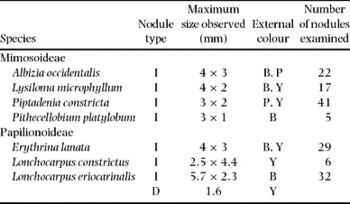
Nodules were observed in seven of the nine species. Only P. orbiculatus (Papilionoideae) and C. mangense (Mimosoideae) lacked nodules, which is in contrast to previous reports on C. mangense (Sprent Reference SPRENT2001). Nodules were predominantly indeterminate, ranged between 1.6 and 5.7 mm in size, and external coloration varied from yellow to brown (Table 1). Colour and size changes were observed in the sampling months. During the rainy season, reddish to brownish colours and larger sizes were commonly observed, whereas whitish to yellowish colours and small nodules were observed towards the end of the rainy season.
Physical features of nodules collected from legume tree species of the tropical dry forest in Chamela, Mexico. I = indeterminate, D = determinate, B = brown, P = pinkish, Y = yellow.

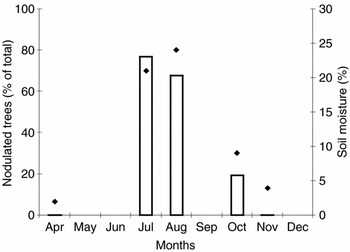
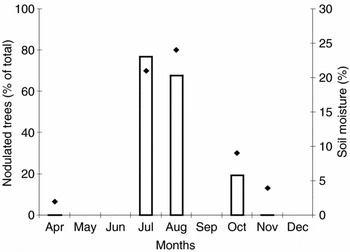
Rainfall quantity and distribution determine soil moisture, which in turn regulates rhizobium proliferation and survival, as well as root colonization (Zahran Reference ZAHRAN1999). Nodule abundance in the Chamela dry forest was markedly seasonal and clearly followed soil moisture variation (Figure 1). Nodules were absent from all individual trees assessed at the peak of the dry season (April), whereas a maximum 77% of individual trees were nodulated during July. The number of nodulated trees decreased considerably towards the end of the rainy season in November. The apparent synchrony between soil moisture and nodule presence suggests that biological N fixation is primarily controlled by soil water availability in this dry forest. Fine roots (< 1 mm), upon which nodules form, also respond to seasonal water availability in the Chamela dry forest, with an increase in production after the onset of rains (Castellanos et al. Reference CASTELLANOS, JARAMILLO, SANFORD and KAUFFMAN2001). Another study in tropical dry forest, but in the semi-arid region of Brazil, has also suggested water limitation to biological N fixation (Teixeira et al. Reference TEIXEIRA, REINERT, RUMJANEK and BODDEY2006).
Seasonal variation in the percentage of nodulated leguminous trees (bars) and gravimetric soil moisture (black diamonds) in the tropical dry forest of Chamela, Jalisco, Mexico. No samples were taken in May, June and September.
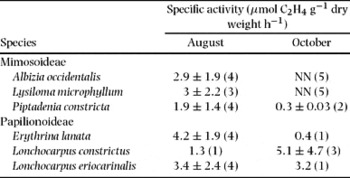
Nitrogenase enzyme activity was detected in the nodules after in situ application of the assay in six species (Table 2). Activity varied within and among species, which is not uncommon in other studies with species from the same (Frioni et al. Reference FRIONI, DODERA, MALATÉS and IRIGOYEN1998) or different (Saur et al. Reference SAUR, BONHÊME, NYGREN and IMBERT1998) genera. Nodule activity may also vary with soil age, with higher activity in younger than in older soils (Pearson & Vitousek Reference PEARSON and VITOUSEK2002). Seasonal variation in activity was also evident in that few or no active nodules could be found for some species late in the growing season (Table 2). Nodule activity in legumes of the Chamela TDF indicates symbiotic N-fixation is occurring in this ecosystem.
In situ acetylene reduction activity in nodules of legume tree species of the tropical dry forest in Chamela, Jalisco, Mexico. Values are mean and 1 ± SD. The number of individual trees per species used to perform the assay at each date is shown in parentheses. Lack of replication for some species indicates no active nodules were found except for that individual. NN = no active nodules were found.

The positive effect of N-fixing legumes on soil nutrient cycling rates has been shown in tropical forest plantations (Binkley & Giardina Reference BINKLEY, GIARDINA, Nambiar and Brown1997). Nodule mineralization and fine-root decomposition or root-exudate liberation may release available N to the soil solution (Zahran Reference ZAHRAN2001). The high percentage of legume species in the flora of the Chamela Reserve (Lott Reference LOTT1993) and the high abundance of some of them in the vegetation (Lonchocarpus and Piptadenia; Durán et al. Reference DURÁN, BALVANERA, LOTT, SEGURA, PÉREZ-JIMÉNEZ, ISLAS, FRANCO, Noguera, Vega-Rivera, García-Aldrete and Quesada-Avendaño2002), may explain the high soil N2O and NO fluxes at the onset of the rainy season (Davidson et al. Reference DAVIDSON, MATSON, VITOUSEK, RILEY, DUNKIN, GARCÍA-MÉNDEZ and MAASS1993, García-Méndez et al. Reference GARCÍA-MÉNDEZ, MAASS, MATSON and VITOUSEK1991), the high ecosystem N stocks (Jaramillo et al. Reference JARAMILLO, KAUFFMAN, RENTERÍA-RODRÍGUEZ, CUMMINGS and ELLINGSON2003), and the high N concentrations in leaves and litterfall (Jaramillo & Sanford Reference JARAMILLO, SANFORD, Bullock, Mooney and Medina1995, Rentería et al. Reference RENTERÍA, JARAMILLO, MARTÍNEZ-YRÍZAR and PÉREZ-JIMÉNEZ2005) in this tropical dry forest. Thus, forest conversion for agriculture and pasture as currently practiced, represents the removal of a key N source with potential implications for sustainable land use and for ecosystem recovery after abandonment.
ACKNOWLEDGEMENTS
We thank Dr Rodolfo Farías of the Universidad Michoacana de San Nicolás de Hidalgo and the personnel at the Estación de Biología Chamela, UNAM, for logistic support. Alfredo Pérez-Jiménez kindly helped with species identification in the field and Josué Altamirano and Raúl Ahedo provided technical support. This study was funded by project CGPI-990309 and by CONACYT project G27674-N.