As articulated by J. L. Schellenberg (Reference Schellenberg2006), the argument from divine hiddenness runs as follows: first, as a mere matter of definition, Schellenberg claims that
(1) If God exists, then God is unsurpassably great.
In addition, he asserts that
(2) An unsurpassably great being must be perfectly loving.
And thus, from (1) and (2), he infers that
(3) If God exists, then God is perfectly loving. (ibid., 10–11)Footnote 1
But now consider what it means to be perfectly loving. A perfectly loving being, says Schellenberg, is one that will seek explicit personal relationship with anyone capable of such relationship, provided such individuals aren't resisting it. In fact, Schellenberg claims that a perfectly loving being will seek such relationship for all times at which such individuals are capable and non-resisting (ibid., 25–26). Hence God, in creating the world, would ensure that everyone is in a position to experience personal relationship with him, provided such individuals are both capable and non-resisting.
Accordingly, Schellenberg claims that:
(4) If a perfectly loving God exists, then all who are capable and non-resisting are in a position to experience personal relationship with him (i.e., can do so just by choosing to) for all times at which they're both capable and non-resisting. (ibid., 28)
It's important to recognize that, according to Schellenberg, the kind of relationship that a perfectly loving God would seek is a reciprocal, explicit relationship (ibid., 18). God would seek the sort of relationship that most of us have with our parents, children, and friends, and which paradigmatically involves such things as support, trust, and guidance. At minimum, then, the kind of relationship a perfectly loving God would seek is one that entails belief in his existence. And since belief is involuntary for Schellenberg, being in a position to experience personal relationship with God simply by one's choice requires already believing in his existence. Hence:
(5) All who are capable and non-resisting are in a position to experience personal relationship with God (i.e., can do so just by choosing to) for all times at which they're both capable and non-resisting, only if such individuals believe that God exists. (ibid., 30–31)
However, (4) and (5) entail that:
(6) If a perfectly loving God exists, then all who are capable and non-resisting believe that God exists for all times at which they're both capable and non-resisting.
(6) constitutes Schellenberg's most novel contribution. As he conceives matters, there's an important connection between the nature of perfect love, on the one hand, and belief in the lover's existence, on the other. Distilled down to its most fundamental element, a perfectly loving God wouldn't permit the occurrence of capable non-resisting non-believers.
We can put all this a bit more simply. Schellenberg helpfully introduces the term non-resistant non-belief for all instances of non-belief concerning God's existence among those who are both capable and non-resisting.Footnote 2 Non-belief in such cases is non-resistant to the extent that such individuals lack belief through no fault of their own; such non-belief, for example, isn't the result of knowingly deceiving oneself on the question of God's existence (ibid., 64). With this term in hand, then, we can follow Schellenberg in restating (6) more simply as:
(6’) If a perfectly loving God exists, non-resistant non-belief doesn't occur. (ibid., 82)
But, plausibly,
(7) Non-resistant non-belief does occur,
and thus
(8) God doesn't exist.
This is an interesting and persuasive argument, and I shall indicate below a respect in which it has an advantage over a certain popular argument from evil. In the meantime, however, I want to consider how to defeat it.
In the next section, therefore, I discuss a popular form of response to the hiddenness argument, the ‘greater good defence’. My discussion in this section is a means to an end, however, for my main focus in this article is a subsidiary argument of Schellenberg's, one presented in defence of his hiddenness argument for atheism. This subsidiary argument I call the pre-eminent good argument. Having presented it, I then go on to show how this argument fails. I conclude by noting that while the pre-eminent good argument fails, this doesn't necessarily imply that the hiddenness argument is a failure – indeed, I contend that the hiddenness argument is very much alive and kicking.
The greater good defence
Most criticisms of the hiddenness argument take the form of a greater good defence. In order for a defence of this sort to succeed, two conditions must be met. First, there's:
Straitjacket: Necessarily, it's possible that divine hiddenness is a necessary condition of some proposed good.
Consider compulsory vaccination. It's commonly held that a parent is justified in inflicting a mild pain on his or her children only if such pain is a necessary condition (or possibly such a condition) for bringing about some great good, such as the good of immunization. In cases of immunization, the modality at issue (the ‘necessarily’ in Straitjacket) is practical or medical necessity. When it comes to God, however, the modality will need to be stronger, for God could easily create a world in which the pain of the nurse's needle isn't a necessary condition of immunization (or possibly such a condition). Instead, God will have to be burdened by a kind of logical straitjacket. In such cases, God's justified in permitting the possibility of hiddenness only if such permission is a logically necessary condition of some good.Footnote 3 Thus, letting ‘H’ stand for divine hiddenness and ‘G’ for some proposed good, we may say that H confines G when, necessarily, it's possible that H is a necessary condition of G.
To see this, let's take an example relevant to the problem of divine hiddenness. Richard Swinburne (Reference Swinburne1998) has argued that it's good that humans have the opportunity and responsibility to cooperatively bring others (as well as ourselves) to belief in God; especially good when such non-belief is non-resistant. However, we can bring someone to belief in God only if someone lacks belief in God, and thus God must hide himself in order to make the realization of this good possible. Thus Swinburne argues that the opportunity and responsibility of bringing non-resistant non-believers to belief in God – call this ‘responsibilitys’ – is confined by divine hiddenness. If correct, Straitjacket is met.
When it comes to providing a successful greater good defence, however, satisfying Straitjacket is clearly not sufficient. A second condition must be met. This second condition is that (for some good G picked out by Straitjacket):
Greatness: Necessarily, (i) G is greater or equal in value to H, (ii) there's no good G’ greater than G such that G’ implies ~G, and (iii) there's no good G’ equal in value to G such that G’ implies ~H.Footnote 4
(i) stipulates that the good confined by divine hiddenness is a greater good.Footnote 5 A good G is a greater good relative to an evil E just in case G is more good than E is bad, and an evil E is a greater evil relative to a good G just in case E is more bad than G is good.Footnote 6 It's for this reason that ‘greater’ isn't synonymous with ‘better’ in this context, for some evils are greater precisely because they're worse – that is, they're more bad on the scale of badness than the relevant good is good on the scale of goodness.
There's some disagreement in the literature, however, about whether hiddenness constitutes an evil. In his earliest presentation of the argument, Schellenberg (Reference Schellenberg2006, 6–7) says that the problem of divine hiddenness may be viewed as a kind of argument from evil, but he has since walked back this claim (Schellenberg (Reference Schellenberg2010) ). Swinburne (Reference Swinburne1998, ch. 11), in turn, characterizes hiddenness as an evil, writing thus of the ‘evils of agnosticism’. Since my interest at present is with Swinburne's account as an example of a greater good defence in relation to hiddenness, I will assume that hiddenness constitutes an evil or bad state of affairs. Nothing much hangs on this for the purposes of this article.Footnote 7
It's unclear whether Swinburne's good of responsibilitys is a greater good relative to hiddenness. Is responsibilitys more good than hiddenness is bad? It's true of course that the denial of divine hiddenness entails the prospect of personal relationship with God, and that this is a very great good; but it's not always the case that the absence of a good G is as bad as G is good.Footnote 8 In short, it's not clear whether hiddenness is as bad as personal relationship with God is good. If this were the case, then hiddenness would be a very bad state of affairs indeed, and so very unlikely that responsibilitys would constitute a greater good. However, any plausible judgement about this, it seems to me, must appeal to instrumental considerations, such as the suffering that hiddenness causes to non-resistant non-believers or the family members of said non-believers (to say nothing of Hell). But if the hiddenness argument is to serve as an independent argument from the problem of evil, as Schellenberg intends, then we should concede that Swinburne's good is indeed a greater good relative to hiddenness. When we don't factor the suffering caused by divine hiddenness into account, hiddenness isn't as bad as personal relationship with God is good. For the sake of argument, then, I shall proceed on the assumption that responsibilitys constitutes a greater good.
But this doesn't get us out of the woods quite yet. For Greatness consists of three parts: (i), (ii), and (iii). It must also be the case, for instance, that there's no distinct good greater than responsibilitys implying its absence. Those offering a greater good defence have often overlooked this important conjunct. (ii), however, constitutes Schellenberg's ace in the hole, for even if we can identify a greater good confined by divine hiddenness, as Swinburne purportedly does, the prospects for meeting (ii) look dim. In the next section, I turn to this important but neglected condition.
The pre-eminent good argument
The reason that the prospects for meeting (ii) look dim is that, for any good we identify, it will always be a lesser good relative to the good of personal relationship with God. Suppose, as we have, that the opportunity and responsibility to bring non-resistant non-believers to belief in God is a greater good confined by divine hiddenness. The difficulty is that the goodness of responsibilitys will always be outdone by the goodness of personal relationship with God, since the latter constitutes the highest possible good. But personal relationship with God entails the absence of divine hiddenness; and thus a perfectly loving God will never create a world in which he's hidden. Here, for example, is how Schellenberg puts the point:
Many serious objections to the divine hiddenness argument . . . have this in common: they concede that God has reason to make some sort of relationship with the Divine available but refer us to some additional reason they suppose to be available to God — usually expressed in terms of some great good God would or might seek to realize — in virtue of which God might permit nonresistant nonbelief for some time for some or all created persons, despite the Divine motivation to make Divine–human relationship at all times available to individuals . . . Various goods we know of might be enumerated and considered in doing so — such goods, for example, as moral freedom, [and] serious responsibility . . . But discussing all the issues that arise in connection with such goods would obviously take a great deal of time. Fortunately, there is a way around that. First, let's notice that if the most fundamental spiritual reality is a personal God, then all serious spiritual development must begin with what I have emphasized, namely, personal relationship with God. Second, such relationship with an infinitely rich personal reality would have to be the greatest good any human being could possibly experience, if God exists. But then, one wants to ask, why talk of some other good, for the sake of which God must sacrifice such relationship. (Schellenberg (Reference Schellenberg2007), 210)
And again, in his earlier work, he writes that:
God, if he exists and is perfectly loving, must also desire personal relationship with us for its own sake . . . This is, it seems to me, an important point. For it allows us to claim with full assurance that even if our well-being would be as well served for a time by the existence of a state of affairs entailing the absence of personal contact with God, God would not on that account be deterred from seeking personal relationship with us. His valuing of friendship for its own sake would in every case prevent him from actualizing the state of affairs in question. (Schellenberg (Reference Schellenberg2006), 23)
Accordingly, even if we grant that responsibilitys is a greater good confined by divine hiddenness, it will fail to satisfy condition (ii) because it isn't as great as the good of personal relationship with God. Moreover, these considerations extend to any good we might identify, since explicit personal relationship with God is the highest possible good. As such, the prospects for answering the hiddenness argument by way of a greater good defence appear doomed from the start.
I call this important sub-argument of Schellenberg's the ‘pre-eminent good argument’, for it centres on the observation that personal relationship with God is the highest possible good. Its conclusion is that greater good defences in relation to hiddenness – that is, attempts to account for hiddenness via the identification of some good which satisfies both Straitjacket and Greatness – can't possibly succeed. The existence of any such good is an impossibility. In order to see this, consider all of those possible worlds in which non-resistant non-belief and God coexist. Call such worlds hidden worlds. The pre-eminent good argument seeks to show that there can't be any such worlds – hidden worlds are an impossibility. The reason is that for any world containing hiddenness, greater good defences need to satisfy Greatness in addition to Straitjacket. The former, however, entails that for any proposed greater good, there can't be any good greater than it implying its absence. But Schellenberg contends there's always such a good, namely personal relationship with God. Consequently, on the assumption that greater good defences are the only game in town,Footnote 9 it follows that non-resistant non-belief and God can't possibly coexist.
In light of this, one can see that the pre-eminent good argument is ambitious. It attempts to prove not only that it's unlikely that greater good defences will succeed, but mainly that they can't possibly succeed. It follows from this that one can defeat the pre-eminent good argument by merely showing the possibility of some greater good's satisfying Straitjacket and Greatness. In the next section, I do precisely this.
Assessing worlds
In the previous section, we saw that since personal relationship with God is the pre-eminent good and entails the absence of divine hiddenness, God will never create a world in which he's hidden for the sake of some greater good. In this section, I want to place pressure on the contention that personal relationship with God is the highest possible good. If personal relationship with God isn't the highest possible good, then room is made for a viable greater good defence.
To some extent, this can be easily done. Consider the state of affairs consisting in one's having personal relationship with God. Now consider this state of affairs obtaining in addition to one's having the opportunity to have children and the responsibility to raise those children. This latter joint state of affairs is clearly better, all else equal, than the state of affairs consisting solely of personal relationship with God. Consequently, personal relationship with God can't be the highest possible good.Footnote 10
But one must do more than this to meet the pre-eminent good argument, for it needs to be shown that personal relationship with God doesn't always exceed any other good offered as an explanation of hiddenness. The previously identified good does no such thing. To this end, I aim to show that it's sometimes preferable to sacrifice a greater good for a distinct collection of lesser goods. This is best appreciated if we turn to considerations surrounding consequentialism in ethics.
The distribution of goods
Historically, consequentialism emerged in the form of utilitarianism, according to which the moral rightness or wrongness of an act was a matter of its maximizing overall net happiness. In recent years, however, proponents of consequentialism have identified factors other than the mere maximization of happiness as relevant to the determination of right action. For example, in addition to the maximization of overall well-being, Brad Hooker (Reference Hooker and Shafer-Landau2013, 430) identifies the distribution of overall well-being as one such factor. To show this, he has us consider two distinct distributions of well-being, [1] (Table 1) and [2] (Table 2):Footnote 11
Distribution of well-being [1]

Distribution of well-being [2]

If [1] and [2] represented distinct possible worlds, which world would you create? It's true of course that the total well-being in [1] exceeds the total well-being in [2] – and yet, despite this, [2] is preferable. [2] is the better world.
But notice that [2] lacks a good that [1] possesses – namely, members of alpha experiencing 10 units of well-being. This good is greater than any other individual good experienced in [2]. This bears an important implication: it's sometimes preferable to sacrifice a greater good for an alternative distribution of lesser goods. Suppose, for instance, that the members in alpha in [1] experience 10 units of well-being because each owns a private island. In addition, suppose the members in omega in [1] experience 1 unit of well-being because each owns a piece of crumb cake. (While these are admittedly crude examples, they nonetheless help to illustrate the general point.) Furthermore, suppose the members in alpha in [2] experience 9 units of well-being because each owns a private jet, whereas the members of omega in [2] experience 8 units of well-being because each owns a yacht. Supposing then that these goods account for the well-being distributions in [1] and [2], our preference for [2] over [1] is our preferring the sacrifice of a greater good – a private island – for a better distribution of lesser goods – a private jet and yacht. Put differently, the compound good alphas owning private jets and omegas owning yachts is greater than the compound good alphas owning private islands and omegas owning pieces of crumb cake. Consequently, it's sometimes preferable to sacrifice a greater good for a distinct distribution of lesser goods.
In this case, [2] is preferable because it involves a more just distribution; the circumstances as described in [2] are more fair. But there are additional scenarios in which a greater good may be sacrificed for a better collection of lesser goods, ones that don't involve considerations of justice or fairness. One such example is provided by Derek Parfit (Reference Parfit1984).
Increased beneficiaries
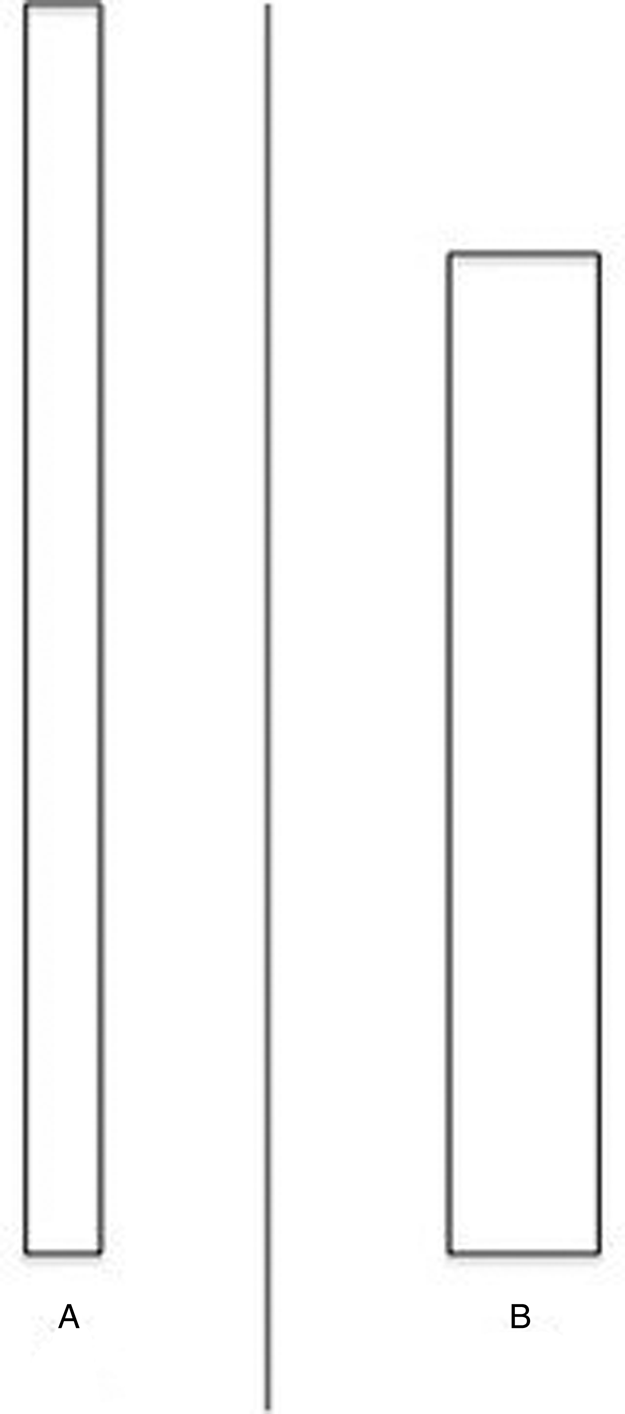
In the course of discussing issues surrounding future generations, Parfit (Reference Parfit1984, 355–356) mentions scenarios centring on ‘different number choices’. These are choices between two policies or outcomes in which there's a different number of people in each outcome. As one such example, Parfit notes that in some circumstances a better world results when we increase the human population at the expense of a small drop in everyone's respective level of well-being. He depicts this as shown in Figure 1 (the width of each block representing the number of people living, and its height representing the average quality of life among those living).
The number of persons (width) and the average quality of life (height) for two populations.

As Parfit explains, ‘[i]n B there are twice as many people living as in A, and these people are all worse off than everyone in A. But the lives of those in B, compared with those in A, are more than half as much worth living’ (ibid., 385). Here it seems justifiable to claim that B is the better choice. Suppose, for instance, that everyone who currently exists has a quality of life at level 10. Decreasing the average utility to a 9:9 distribution among ourselves and our progeny (resulting in a population twice our number) involves an increase in total well-being – ‘[t]wo bottles more than half full contain more than a bottle full’ (ibid., 387). Consequently, it sometimes happens that an increase in quantity (the number of people) results in a better world, despite an attendant loss in quality (the level of well-being per person). This, then, is a further instance in which a greater good may be sacrificed for a lesser.
In making this assertion, however, it needs to be noted that I merely intend to claim that it's sometimes better to sacrifice a greater good for an alternative collection of lesser goods. There will be cases in which this isn't warranted, and indeed Parfit emphasizes this in the context of what he labels ‘the repugnant conclusion’. The repugnant conclusion is that:
For any possible population of at least ten billion people, all with a very high quality of life, there must be some much larger imaginable population whose existence, if other things are equal, would be better, even though its members have lives that are barely worth living. (ibid., 388)
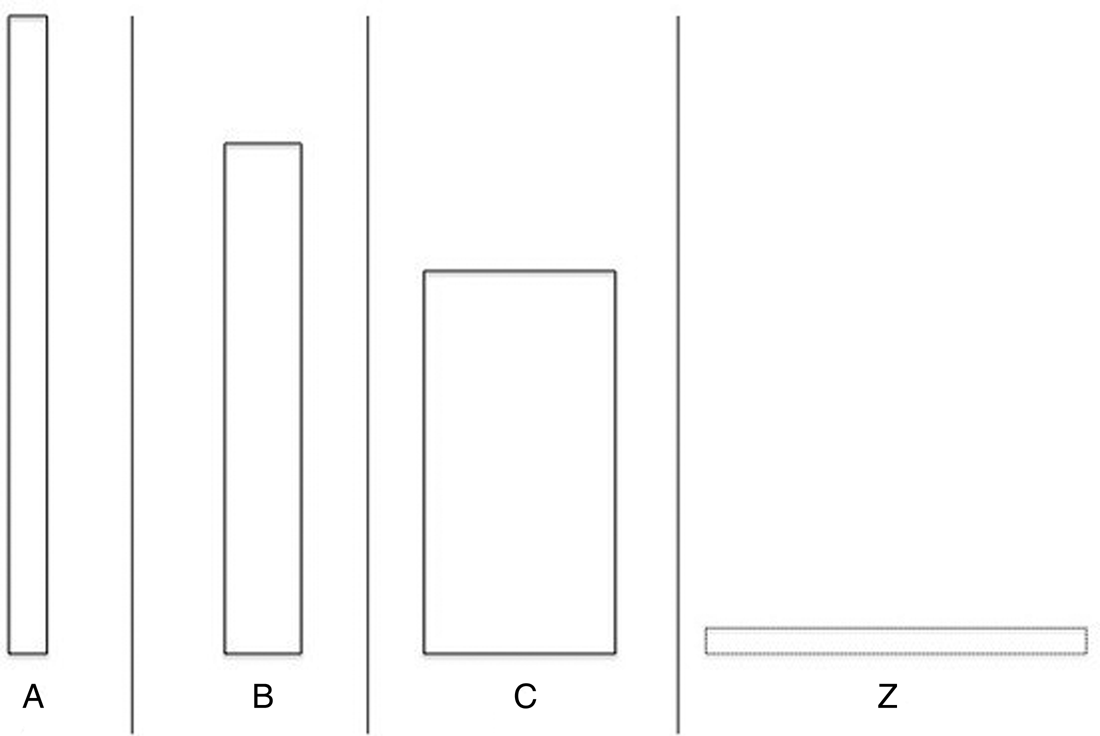
For any possible population (Parfit settles on 10 billion because he's interested in the likely size of the human population in coming decades), there will be an enormously larger population that has lives that are barely worth living, but which nonetheless results in greater total well-being: ‘[t]he greatest mass of milk might be found in a heap of bottles each containing only a single drop’ (ibid.). And thus the situation is one in which Z, as depicted in Figure 2 below, attains the highest overall good.
The number of persons (width) and the average quality of life (height) for four populations, with Z's width imagined to extend beyond the page.

Accordingly, it can't be the case that the considerably more numerous goods are pathetically good. If the sacrifice of a greater good for a collection of lesser goods is ever warranted, the individual goods must themselves be worth the sacrifice of the greater good. Parfit spends a great deal of time seeking a ‘principle of beneficence’ that makes sense of our judgements concerning A, B, and Z, although in the end he admits defeat. For our purposes, however, we may simply observe that it's sometimes preferable to sacrifice a greater good for an alternative collection of lesser goods.
Increased diversity
But there's a third example, one not mentioned by Parfit. It's sometimes preferable to sacrifice a greater good for a greater diversity of kinds of goods. We have Parfit's two bottles again, but this time rather than each containing milk alone, each contains distinct beverages.
Indeed, cases in which this is true are ubiquitous. Take the good that consists in learning and excelling at the piano. This is a very great good. But if excelling at the piano dominates my life, such that I rarely experience any admittedly lesser goods, we probably wouldn't consider it much of a life. Every free moment could be devoted to the piano, but it's sometimes better to defer this for a nap, or a movie, or a game of scrabble, and not merely in those instances in which our piano prowess would benefit. Or consider one's vacation time. Suppose, for instance, that the best country to visit is New Zealand; there's no greater country to visit. Should one therefore only take vacations in New Zealand? I should think not. So long as we visit New Zealand at some point in our lives (although even this isn't really required), we do well to visit other countries. The diversity of one's experience in such cases makes the good of visiting many countries better than the good monopolized by trips to New Zealand. A world monopolized by one kind of good is sometimes rightly regarded as a lesser world, even when this monopolizing good individually trumps all other goods.Footnote 12
The implications for the pre-eminent good argument are evident: God may sacrifice a greater good – such as personal relationship with God – in order to make way for a greater diversity of lesser goods. Suppose, for instance, that the opportunity and responsibility to cooperatively bring non-resistant non-believers to belief in God (LG1), the opportunity and responsibility to sustain theistic belief it's possible to lose (LG2), the chance to express commitment to and faith in God in the face of non-resistant non-belief (LG3), the ability to form virtuous characters in the face of non-resistant non-belief (LG4), the humility and appreciation realized upon attaining belief in God's existence (LG5), and the opportunity to develop proper attitudes attending the search for meaning in the face of death and non-resistant non-belief (LG6), among others, are all very great goods confined by divine hiddenness. You may question the ultimate value of such goods (as I do),Footnote 13 but that's irrelevant as far as the pre-eminent good argument is concerned. Since such goods entail the absence of personal relationship with God (PG), God can't actualize this whole collection of goods unless he also permits that some persons lack relationship with him for some time. And this diversity – LG1 through LG6 as well as PG (for some but not all) – may be a better state of affairs than a world monopolized by the good of personal relationship with God.
In fact, God need not sacrifice personal relationship with anyone at all; he need only delay it. In terms of the overall time at which these lesser goods exist, such goods may be dwarfed in comparison to the good of personal relationship with God; this earthly life might have responsibilitys but for a brief instant, such that personal relationship with God dominates one's afterlife for endless time. Indeed, as some have argued, such goods may even enhance the divine–human relationship.Footnote 14
In order to see what's being claimed here, it may help to visualize the relevant claim schematically. I'm claiming that – for temporal moments T1, T2, and T3, pre-eminent good PG, and lesser goods LG (lesser relative to PG) – it might be the case that world
W
T1: LG1, LG2, LG3, LG4, LG5, LG6, PG (for some but not all)
T2: PG (for all)
T3: PG (for all)
is a better world than
W*
T1: PG (for all)
T2: PG (for all)
T3: PG (for all).
If it's so much as possible that W is a better world than W* – indeed if it's so much as possible that there's some other collection of goods better than W*, a collection of goods not identified here – then the pre-eminent good argument fails. Since we have no reason to think that any such collection of goods is impossible, the pre-eminent good argument fails. In point of fact, I think we can do one better than this, for it seems to me that W is in fact better than W*. All else equal, the goodness in W exceeds the goodness in W*.
Objections and conclusions
At this point an objection may be raised. Imagine that P is the parent of two young children, Y and Z. Fortunately, the world in which they live is in one important respect a much better world than ours: in their world there isn't a single distant mother or father. All parents are loving and present in their children's lives.
Accordingly, in this world the very great good of perseverance in the face of parental abandonment has never been realized, but neither of course has the pain associated with parental abandonment. In such circumstances, then, doesn't my view imply that P can justifiably and intentionally abandon Y and Z for the sake of introducing a new kind of good into the world? The answer of course is that P isn't justified in doing so, even for the sake of introducing a new kind of good into the world. But my account seems to imply the opposite, and thus is unsatisfactory.
In response I want to mention two things. First, the case of parental abandonment includes a case of bringing about a new kind of good that leads to suffering, whereas the pre-eminent good argument is intended to bracket the relevance of suffering (otherwise the problem of divine hiddenness reduces to the problem of evil). Our treatment of the pre-eminent good argument merely concerns foregoing a greater good, for a time, in order to make room for a lesser good. And so the circumstances aren't completely analogous, and in all likelihood we're prone to focus on the suffering involved in parental abandonment when condemning it. If we remove the possibility of suffering (and thus the attendant parental responsibility), it's not clear P shouldn't forego the greater good for a lesser.
But even provided that no suffering occurs, the parent probably shouldn't abandon his or her children, and for the following reason. Even if the good of perseverance through parental abandonment can't be realized, there are probably many other ways in which the good of perseverance can be demonstrated. This can be demonstrated in one's studies, in recreational running, in ping pong, or in how we approach our careers. In short, there are similar kinds of goods in the vicinity here, rendering the parental abandonment case unnecessary. The fact that P shouldn't intentionally abandon Y and Z holds even if perseverance in the face of parental abandonment is a greater good relative to these other goods of perseverance; it's warranted, in other words, to settle for a lesser good of a certain kind when the cost in preferring a greater good of that kind is significant. This is, accordingly, a third condition on any acceptable greater good defence, namely:
Contiguous: It must be the case that greater good G, confined by and relative to S, doesn't have a contiguous lesser good G’ (itself confined by S’), such that the difference in value between S and S’ is significant (S being much worse than S’).
Two goods G and G’ are contiguous just in case each is of some relevant kind K, and such that the difference in value between them is marginal. As was suggested, the counterexample above fails Contiguous, for the good of perseverance in the face of parental abandonment has numerous contiguous goods: perseverance in the face of one's studies, say. The latter isn't as good as the former, but compared to what would be lost in the case of parental abandonment (the good of having a personal relationship with one's parents), the difference is marginal.
Here I think we've stumbled upon a particular virtue of the argument from divine hiddenness. For most of the goods offered as justifications of divine hiddenness – such as responsibilitys – the problem is that they have neighbouring goods that don't entail hiddenness. For instance, while lacking the opportunity and responsibility to bring non-resistant non-believers to belief in God might relinquish the need for natural theologians, it wouldn't remove the need for priests and pastors. One still has the opportunity and responsibility to bring resistant non-believers to belief in God, which by the admission of some theists is a very great good (although even here natural theologians may be of use).Footnote 15 And thus while a greater good defence may survive the pre-eminent good argument, it's not clear that it can survive an argument from Contiguous. Moreover, this is a virtue of the problem of hiddenness that the problem of evil lacks.Footnote 16 The reason is that contiguous goods are much harder to come by when it comes to the goods offered as explanations of suffering. What for instance would be a contiguous good of morally significant libertarian free will? Since such goods are in a league of their own, so to speak, an argument from evil from Contiguous is much less likely to succeed.
There's one final objection to consider, and the case of parental abandonment is illustrative. The discussion of parental abandonment suggests that the predominant motivation of parents is to increase the well-being of their children. But Schellenberg has argued that God would seek personal relationship for its own sake. God, in other words, is motivated to do as he does out of love. If the parents in our example were so motivated, the objection goes, they might not increase the well-being of their children if doing so would remove the possibility of personal relationship with them. Likewise, it may be argued that while W is a better world than W*, God will always choose personal relationship with him because he's primarily motivated by love.
In response I will say two things. First, leaving Contiguous aside (so assumed because our focus is on the pre-eminent good argument and not an argument from Contiguous), it seems incompatible with perfect love to choose W* over W. The reason is that, lacking contiguous goods, God would be seriously diminishing the well-being of those he has created. It's true that perfect love will seek personal relationship for its own sake, but it's contrary to the nature of perfect love to seek personal relationship at the expense of the serious diminishment of well-being, especially when that relationship can be had (and had plentifully) at some other time. Such a case involves a failure of perfect love.
Second, assuming this initial rejoinder can be met, we may simply concede the force of the objection. Yes, God would choose W* over W because he's primarily motivated by love rather than by well-being. This concession has clear implications for whether the hiddenness argument succeeds, but not for whether the pre-eminent good argument does. It does nothing to mitigate my response to the latter. In fact, if it does anything, it undercuts the pre-eminent good argument, because it suggests that God wouldn't always choose goods based on their degree of goodness.
Accordingly, even granting that personal relationship with God is a very great good, there's little reason to think it exceeds all other goods, and indeed good reason to think otherwise. For this reason we should reject the pre-eminent good argument. However, we've also seen that from the ashes of the pre-eminent good argument, there emerges an argument from Contiguous. Proponents of greater good defences in relation to hiddenness, therefore, would do well to be wary of the ‘noise and clamour’ coming from next door.Footnote 17