In a book published four years ago, Andrew Busch and I divided proposals to reform the presidential nomination process into two categories, which we called comprehensive and incremental (see Mayer and Busch Reference Mayer and Busch2004, chapter 5). Like any attempt to classify a complex reality, this distinction blurs a bit at the edges, but the basic idea should be clear. Comprehensive proposals call for major, far-reaching changes in the basic operations of the presidential nomination process; incremental proposals make more limited, marginal changes in the rules, while retaining the fundamental structure of the existing system.
As its title indicates, this article deliberately tries to offer an incremental approach to reform. I have chosen this path for two reasons. First, of all the major comprehensive proposals that have been put forward over the last several decades, I am not very impressed with any of them. A national primary would restrict presidential nomination races to candidates who were already well known or exceptionally well financed. Depending on the specific rules governing a national primary, it might also lead to the nomination of factional candidates who were highly popular among a narrow subgroup, but unacceptable to large segments of the party electorate. Regional primaries would give a huge advantage to candidates who happened to be popular in whatever region went first, and might also pose insurmountable barriers for lesser-known candidates. The Delaware or “small states first” plan would always give the decisive first crack at the candidates to a set of states that are more rural and less racially diverse than the rest of the country, while consigning the largest states to regular irrelevance. A national preprimary convention would simply take all the problems and disadvantages of the current system and transfer them to whatever process is used for selecting delegates to the preprimary convention.Footnote 1
Second, if there is one thing we should have learned from the last major attempt to rewrite the rules of the presidential nomination process, it is that large-scale changes often produce unintended consequences. The people who wrote the McGovern-Fraser guidelines in 1969 and 1970 did not want to lengthen the presidential nomination campaign, increase the number of primaries, create a highly frontloaded primary and caucus calendar, or turn national conventions into meaningless formalities put on largely for the benefit of television—but there is little doubt that the Democrats' new delegate selection rules did, in fact, bring all these effects in their wake.Footnote 2 Though virtually all students of the presidential nomination process recognize these untoward consequences, it is striking that very few appear to take them into account when planning the next round of reforms. A long list of political scientists have proposed quite sweeping changes in the nomination rules, without any acknowledgment that the full effects of reform can, at best, be imperfectly predicted.
THE PROBLEM: FRONTLOADING
Comprehensive reform proposals generally (though not invariably) begin by setting forth a set of values or criteria that a good policy or process is supposed to maximize. Incremental reforms, by contrast, tend to be problem oriented. The existing system is modified in order to remedy its most egregious shortcomings.
The reforms proposed in this article are designed to cope with what I believe is the most pressing problem now afflicting the presidential nomination process: frontloading. As most readers of this article will already know, frontloading is the name that has been given to an important recent trend in presidential nominations, in which more and more states schedule their primaries and caucuses near the beginning of the delegate-selection season. The result is a nomination calendar in which a large proportion of the delegates are selected within a few weeks after the process formally commences, as opposed to having the primaries and caucuses spread out evenly or having them concentrated near the end of the process.
I have singled out frontloading in this way for three reasons. First, frontloading is having and will continue to have a variety of negative effects on the presidential selection process. Frontloading increases the amount of early fundraising required and thereby limits the number of candidates who are able to mount a credible, competitive campaign. It makes presidential nomination campaigns increasingly superficial and nonsubstantive, and reduces voter turnout in many states. Above all, it gives most voters too little time to learn about most of the candidates and thus increases the likelihood that one of the parties will nominate a candidate who is unacceptable to many party supporters and/or general election voters.Footnote 3
Second, frontloading is the only major problem affecting the presidential nomination process that is still growing worse. There are a number of other widely deplored features of the presidential nomination process, but by the early twenty-first century, almost all of them had reached a point of stasis. By contrast, the movement of primaries and caucuses to earlier and earlier dates in the calendar grows worse with each nomination cycle. In 2008, we narrowly avoided holding the Iowa caucuses in 2007. As it was, the candidates, reporters, and voters all had to cope with the phenomenon of February 5, on which 23 states, including both California and New York, held their primaries or caucuses.
Finally, unlike some of the other problems that plague the presidential nomination process, frontloading is, as I hope to show in this article, potentially remediable.
REMODELING THE CALENDAR
Specifically, I propose two changes to the current rules. First, we should move the delegate-selection window, the time period in which all states must hold their primaries and caucuses, back about a month and a half. In 2008, the Democratic and Republican parties' national rules both forbid states from holding a primary or caucus before the first Tuesday in February. The Democrats specifically exempted Iowa, New Hampshire, Nevada, and South Carolina from this provision; the Republicans did not.Footnote 4 I propose instead that both parties' national rules should be changed so that no primaries or caucuses are allowed to take place until the third Tuesday in March. As in 2008, it is likely that a little cheating will take place—a small number of states will select their delegates before the official start of the window—but even if that occurs, the Iowa caucuses will at least take place in early March or mid-February, rather than on January 3.
This change will, in my opinion, have two beneficial consequences. First, it will mean that the pre-caucus and pre-primary campaigning in Iowa and New Hampshire are not disrupted by Christmas. If we are going to single out two states to lead off the delegate selection calendar and, for that reason, receive outsized attention from the candidates and the media, we may as well allow them to concentrate on that task and avoid the kind of situation in which it is difficult for candidates to run ads that say anything except “Merry Christmas.”
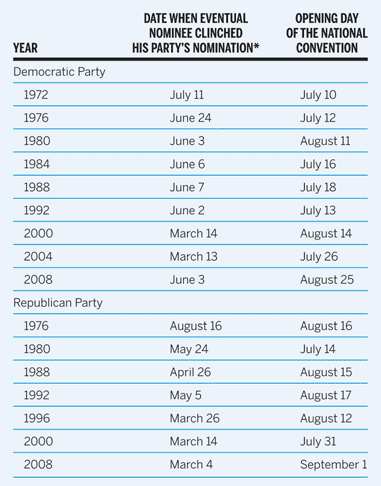
The second benefit of having the delegate-selection window start on the third Tuesday in March is that it will reduce the complications that ensue from having both parties' nominations settled by early March. Not so many years ago, before frontloading had become a serious problem, candidates in contested nomination races did not formally clinch their parties' nomination races until late May or early June (see Table 1). This allowed the winning candidates to have about a month or a month-and-a-half break from the rigors of public campaigning to heal intraparty wounds, select a vice-presidential candidate, and do a final touchup on the national platform. Then the national conventions would take place and shortly thereafter the general-election campaign would begin in earnest.
Dates on Which Presidential Candidates in Contested Races Clinched Their Party's Nomination, 1972–2004

* Date shown is the day on which the eventual nominee won enough pledged delegates to guarantee a first-ballot convention victory.
Source: 1976 and 2004 Democratic dates based on unpublished data from the Associated Press. All other dates are based on contemporary reports in the New York Times and Congressional Quarterly Weekly Report.
As more and more states have held their primaries in January, February, and early March, however, the general rule has been that contested nomination races are conclusively settled by the middle of March. The Obama-Clinton slugfest of 2008 was, of course, a notable exception to this pattern—but to find another exception, one must go back to 1992. The result has been the creation of a new period in presidential politics that James Ceaser and Andrew Busch (Reference Ceaser and Busch1997) have called the interregnum, in which two people are the de facto presidential nominees of the Democratic and Republican primaries, even though the national conventions, which will formally confer those nominations, are still many months away. These candidates are therefore compelled to start their general-election campaigning in mid-March or early April. Not only does this extend the already lengthy U.S. presidential campaign and thereby further exhaust the candidates, reporters, and voters; it also requires the candidates to raise a great deal of additional campaign money, particularly for television ads. It is this interregnum period, more than anything else, that explains why every major candidate in the 2008 presidential election except John Edwards decided to opt out of the federal matching-fund program. Any candidate who accepts matching funds also has to abide by the FECA nomination-season spending limit; and while that limit may be enough to run a competitive nomination campaign (which is all it was originally supposed to do), it is nowhere near enough to fund even a minimally active campaign during a four- or five-month interregnum period. The proposal I have made here does not entirely eliminate this problem, but it will at least greatly reduce it by pushing back the date on which both winning candidates have clinched their parties' nominations.
Pushing back the start of the delegate-selection season will make some aspects of the campaign more tolerable, but it will not remedy most of the problems associated with frontloading, which are due not to the date on which the primary season begins, but the concentration of the primaries at the start of the calendar. In order to give voters more time to learn about the candidates, we need to slow down the pace at which primaries take place.
Accordingly, I further propose that both parties adopt a schedule something like the following: During the first four weeks of the delegate-selection season, only one primary or caucus may be held each week. Which states get these coveted slots should be determined by joint action of the Democratic and Republican national parties, and may be done on either a random or purposeful basis. During the next four weeks, two primaries or caucuses would take place each week. And after that, beginning in week nine, any state can hold its primary or caucus any time it wants.
As I have already indicated, the point of this revised nomination calendar is to stretch out the beginning of the delegate-selection season. Whichever two states go first—I will address this subject below—would not immediately be followed by seven primaries and caucuses, as occurred in 2004, or by 13 primaries in the next two weeks, as occurred in 1996. The playing field would not be completely leveled—I don't know how that can ever be accomplished; the media would still be very important—again, I don't see how it can be otherwise; the two leadoff states would still have a disproportionate role in selecting the presidential candidates. But at least we would give the voters a bit more time to react to the results of early primaries and caucuses, to learn additional information about the candidates who win or do better than expected, and to have a greater opportunity for deliberation and second thoughts.
IMPLEMENTING THE REFORMS
Such, then, is the nature of the reforms I propose in the presidential nomination process. As already noted, it is not radical surgery; even if the reforms work as intended, no one will pronounce the resulting system perfect. But it would, in my judgment, be a substantial improvement over what we have now.
How should this proposal be implemented and enforced? The best vehicle for reforming the presidential nomination process, I believe, is joint action by the Democratic and Republican national parties. Another alternative is federal legislation, but for reasons developed at length elsewhere, I do not believe the federal government has the constitutional authority to compel the states to hold their primaries and caucuses on particular dates or the political parties to nominate their presidential candidates in particular ways (see Mayer and Busch Reference Mayer and Busch2004, chapter 6). Moreover, even if the federal government did have this authority, federal legislation in this area, once enacted, would be difficult to change, whereas the political parties have the incentive and institutional capacity to make changes and adaptations more quickly and effectively.
At the same time, I believe the changes in the nomination calendar would be better and more effective if the two major parties act together: if they agree on a common set of rules, at least with regard to scheduling, and then try to enforce them together. Getting 30 states to hold their primaries and caucuses a month or two later in the year is likely to be a difficult undertaking. It will be even more difficult if, say, only the Democratic Party adopts these new rules, and Republican governors and state legislators feel no compulsion, moral or otherwise, to go along.
Enforcement issues aside, having the Democratic and Republican parties operate under different delegate-selection calendars is, as both parties learned in 2000, productive of a great deal of mischief. In 2000, the Republican Party's national rules said that no state could hold a caucus or primary before the first Monday in February; the Democratic rules said that no primary or caucus except Iowa and New Hampshire could be held before the first Tuesday in March. The upshot was that Iowa and New Hampshire took place in mid- to late January, and then, on the Republican side, six more primaries were held over the next four weeks; there were, by contrast, no binding Democratic primaries or caucuses in February. For Democrats, this totally disrupted the pacing of their 2000 nomination race. Having narrowly lost the New Hampshire primary, Bill Bradley had no chance to build on that result: he lost every subsequent primary and caucus. It also meant that the Democratic candidates almost completely disappeared from the news, surrendering the spotlight and the national debate to the Republicans for the entire month of February.
On the Republican side, the February primaries were characterized by a high level of Democratic crossover voting, much of which was probably not an expression of genuine support for one of the Republican candidates, but a result of boredom or a desire to cause trouble for the other party. The worst example of this occurred in the Michigan primary, where the Democratic opponents of governor John Engler, a prominent early supporter of George W. Bush, urged their followers to vote in the Republican primary and cast their ballots for John McCain, in order to embarrass Engler. In the end, 17% of the votes in the Michigan Republican primary were cast by self-identified Democrats, 82% of whom voted for McCain.
Unfortunately, as I write this article in early September 2008, it is already too late to implement this reform—or any other reform—for the 2012 nomination season, at least in the Republican Party. And that state of affairs, in turn, underscores another significant obstacle to reform. At present, Democratic Party national rules permit the Democratic National Committee to change the party's delegate selection and nomination rules in the time period between national conventions. Thus, for example, the Democratic Party rules for 2008 were adopted in August 2006. The Republican National Committee, however, has no such powers. All rules governing the Republican presidential nomination process are set by the preceding national convention. That is to say, the rules for the 2012 Republican presidential nomination, including all rules pertaining to the timing of primaries and caucuses, were adopted at the party's 2008 convention and cannot be modified in the interim.
A national convention is not an auspicious setting for reforming the presidential nomination process. Contemporary conventions are, of course, tightly controlled by the nominees-to-be—and having come through the existing process victorious, they and their advisors are understandably not very sympathetic to arguments that the present system is seriously flawed. More importantly, any thorough-going restructuring of the nomination process is likely to be controversial and divisive—and no presidential campaign wants to have its carefully crafted image of party unity obscured by a fight over the rules.
In two of the last three nomination cycles, the Republicans learned these lessons the hard way. In both 2000 and 2008, a Republican Party rules committee spent a substantial amount of time analyzing the faults of the current system and considering a range of options, finally settled on an alternative, got the new plan approved by a number of other party bodies—only to have the presidential nominee-to-be pull the plug on the whole venture just days before the opening of the Republican National Convention.Footnote 5 If one hopes to have the parties reform their own presidential nomination processes, then, one important preliminary step is to have the next Republican National Convention change that party's rules so as to give the Republican National Committee some authority to modify the party's presidential nomination rules during the period between conventions.
IOWA AND NEW HAMPSHIRE
Finally, a word should be said about the role of Iowa and New Hampshire in nomination politics. As is well known, Iowa and New Hampshire have held the first caucus and first primary in the nation since, respectively, 1972 and 1920. Both states derive considerable benefit from their leadoff positions, including disproportionate attention from the candidates and the media, a lot of additional spending on hotels, restaurants, and television ads, and greatly enhanced influence on the crucial question of who gets nominated. And every four years, lots of other states complain about these manifest inequalities.
How should Iowa and New Hampshire be treated if we revamp the nomination calendar? There are two possibilities, both of which have their defenders. One is to keep these two states in the leadoff positions; the other is to treat Iowa and New Hampshire just as we treat the other 48. For example, if we choose states for the four initial slots by random selection, Iowa and New Hampshire would have just as good a chance as any other states to go first—but no better chance. Some years they might lead off the calendar; most years they would not.
In a perfect world, I am convinced that Iowa and New Hampshire would not be first every election cycle. Having the same two states lead off the nomination calendar year after year has a number of negative consequences for the American political system. Above all, since a great deal of every presidential nomination race is spent campaigning in these two states, the dominance of Iowa and New Hampshire seriously distorts the character of the public dialogue. Every four years, we discuss some issues and ignore others, not because these issues are inherently important or unimportant, but because they do or do not interest the residents of Iowa and New Hampshire. So, for example, almost every recent presidential candidate except John McCain has endorsed large subsidies for the production of ethanol—this in spite of the fact that most recent studies have shown that ethanol probably doesn't conserve energy or help the environment. Ethanol does very well in presidential politics because most of it is produced from corn and corn is a vital part of the Iowa economy. On the other end of the spectrum, I cannot remember the last time a Democratic nomination campaign included a substantial discussion of the role of race in American society or the problems of big cities, even though lots of Democratic votes are provided by racial minorities and urban residents and even though lots of Democrats believe that race and urban conditions are very important concerns. Why are these two issues so regularly ignored? The answer, I believe, is that the candidates spend so much of the campaign in Iowa and New Hampshire, two states that do not have sizable minority populations or large cities. It is worth noting in this connection that the unrepresentative qualities of Iowa and New Hampshire tend to be mutually reinforcing. The social and demographic groups that are conspicuously underrepresented in Iowa are, by and large, the same groups that are notably absent from the New Hampshire electorate.
This is not a perfect world, however, and a strong pragmatic argument can be made for letting these two states retain their leadoff positions. Moral or not, Iowa and New Hampshire have developed a very effective way of keeping their privileged places in the delegate-selection calendar. What they do, in effect, is blackmail the candidates. For example, in the lead-up to the 1996 Republican nomination race, the state of Arizona briefly threatened to hold its primary on the same day as New Hampshire's. New Hampshire responded by demanding that all Republican candidates sign a letter supporting New Hampshire and promising not to campaign in Arizona unless it moved its primary to a later date. Just in case no one got the point, at a state party meeting in January 1995, the New Hampshire state Republican chairman explicitly warned candidates who declined to support New Hampshire in its battle with Arizona not to bother campaigning in New Hampshire in 1996. Certain that New Hampshire would fight hard to retain its first-in-the-nation status, and much less certain that Arizona voters and politicians were that concerned about the issue, all but one of the candidates quickly knuckled under and signed the New Hampshire letter.Footnote 6
So maybe we should just concede the inevitable and let Iowa and New Hampshire stay where they are. Maybe—but a similarly pragmatic argument can be made for the opposite conclusion. Given the limited enforcement powers possessed by the national parties, the kind of plan I have sketched out earlier will work only if there is a substantial measure of voluntary cooperation by state parties and state governments, and that kind of cooperation is likely to be forthcoming only if most states feel they are being treated fairly. And it is unlikely that most states will feel equitably treated if two states always receive privileges that are unavailable to the other 48. The scheduling of the 2008 Michigan and Florida primaries in advance of both the Democratic and Republican party guidelines is testimony to this sense of dissatisfaction. In 2012, other states will also probably attempt to defy the rules.
As for the possibility that Iowa and New Hampshire will apply pressure to the candidates in order to retain their current privileges, the best response to blackmail is counter-blackmail. Both Iowa and New Hampshire are conspicuously short of blacks and Hispanics. Leaders from these two groups, particularly within the Democratic Party, should threaten to withhold their support from any candidate who does not sign a letter insisting that at least one of the first two delegate selection events be held in a state with a sizable percentage of racial minorities. (As 2008 amply indicates, it is not enough to schedule a primary of this type after Iowa and New Hampshire: Nevada and South Carolina got nowhere near the attention from the candidates and the media that Iowa and New Hampshire received.) As long as these groups present a united front, few Democratic candidates would be willing to resist the pressure. ■