In the past decade, a growing number of historical archaeologists have started using high-precision AMS radiocarbon dating, portable X-ray fluorescence (pXRF), instrument neutron activation analysis (INAA), stable isotope analysis, and other specialized analytical techniques to deepen our understanding of Indigenous-colonial encounters in North America (e.g., Blair Reference Blair2017; Manning and Hart Reference Manning and Hart2019; Panich Reference Panich2016; Schneider Reference Schneider2015; Thompson et al. Reference Thompson, Jefferies and Moore2019; Walder Reference Walder2018). As more archaeologists sidestep artificial barriers that prevent the adoption of methods and tools traditionally relegated to the “prehistory” subfield, new opportunities are emerging for adding depth and texture to postcontact site chronologies previously based on historical records or diagnostic artifacts alone. This report presents the results of a morphometric and laser ablation-inductively coupled plasma-mass spectrometry (LA-ICP-MS) analysis of glass beads collected from an adobe roomblock called the “Lost Adobe” (site CA-SCR-217H-T) at La Misión de la Exaltación de la Santa Cruz (hereafter, Mission Santa Cruz)—the first analysis of this kind for a colonial-era archaeological site in California. We used LA-ICP-MS specifically to address questions about when the Lost Adobe was occupied and, if possible, by whom.
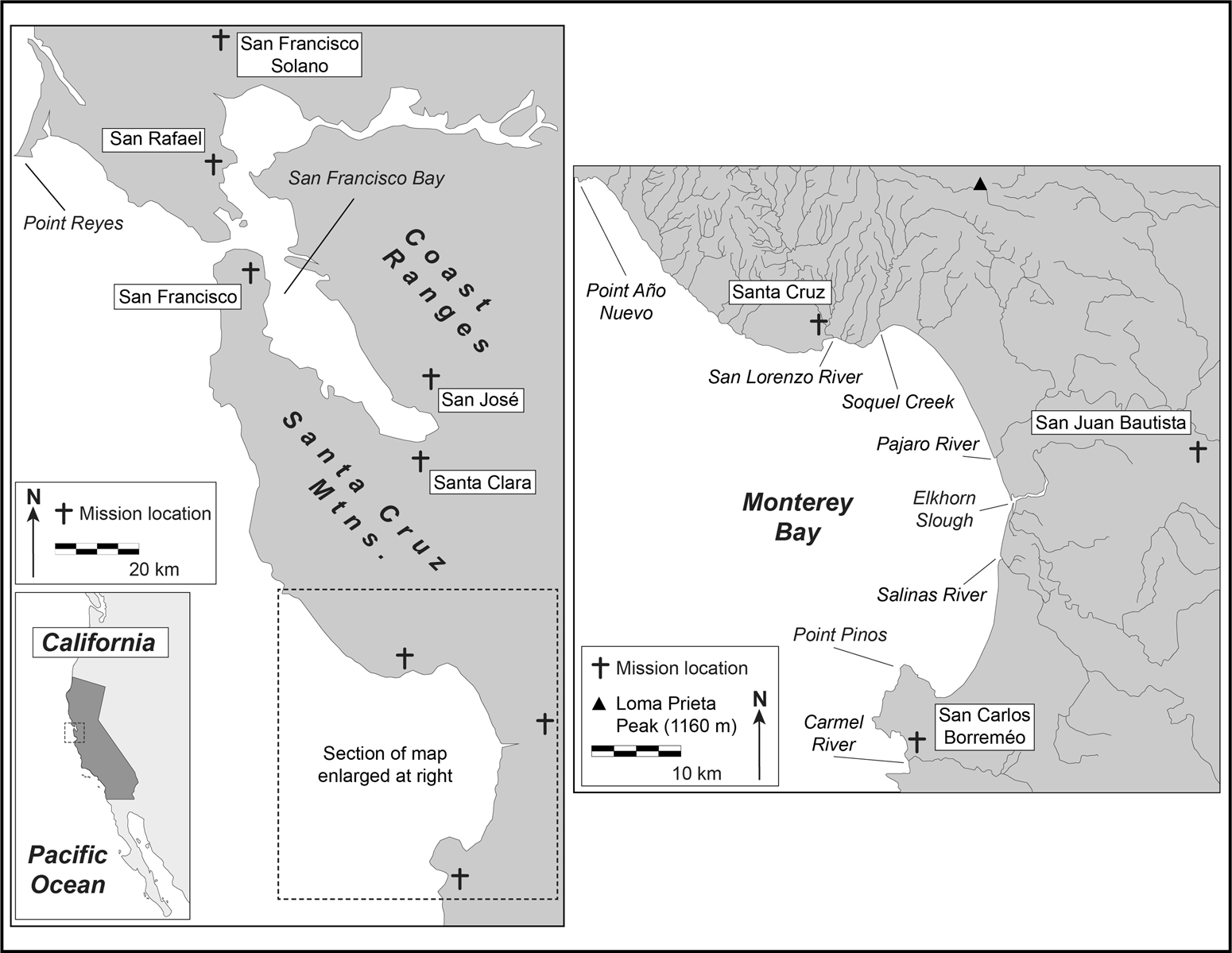
From written records, we know that Mission Santa Cruz was established in the territory of Indigenous Uypi (Ohlone) people in 1791; it was the twelfth of 21 Catholic missions established in Imperial Spain's province of Alta (upper) California between 1769 and 1823 (Figure 1). Adhering to a colonial strategy of Indigenous religious conversion, missionaries first targeted Ohlone communities of the Monterey Bay region, which had largely resisted relocation to Mission Santa Clara, a mission founded at the southern end of San Francisco Bay in 1777 (Rizzo Reference Rizzo2016). At the time of its founding, in addition to growing numbers of Ohlone people, Mission Santa Cruz also included two Franciscan priests, three soldiers, and at least seven Indigenous servants from Mission Santa Clara responsible for “carrying provisions” to outfit Mission Santa Cruz (Rizzo Reference Rizzo2016:60–61). Exposed to diseases and violence, the Monterey Bay Indigenous communities were reduced in number during the first two decades after Mission Santa Cruz opened (Jackson Reference Jackson1983, Reference Jackson1994:181–182). By the 1820s, Franciscan priests had started recruiting Yokuts people into the mission from lands farther east in the San Joaquin Valley. To attract and anchor Yokuts peoples to Mission Santa Cruz—a coastal mission approximately 100 miles from Yokuts homelands—Franciscan padres directed the construction of additional adobe housing in 1821 to host incoming families (Rizzo Reference Rizzo2016:252–253). The Lost Adobe may have been constructed at this time.
Central California and the Monterey Bay Area showing the locations of colonial missions and other landmarks.

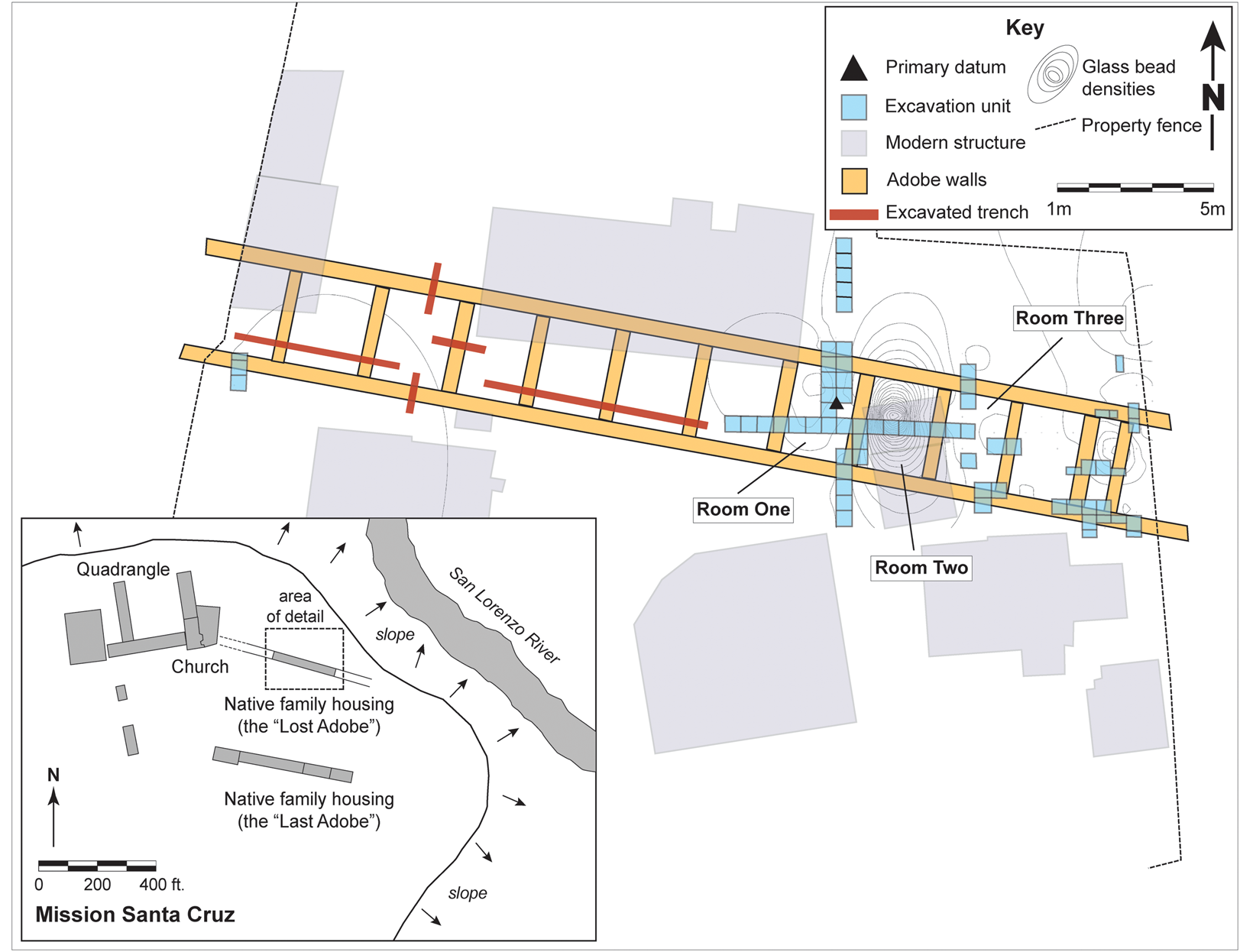
As the population of Mission Santa Cruz transitioned to a Yokuts plurality in the early 1800s, domestic spaces such as the Lost Adobe roomblock became microcosms of change and continuity. Excavating “Room 1” in the 1980s, archaeologists discovered a section of adobe wall (adobe bricks and clay roof tiles) that had toppled over, and below this feature (i.e., below 40 cm), they documented a hearth feature, numerous lithic tools, and shell beads (Figure 2). Excavating below a continuation of the same collapsed wall (i.e., below 40 cm) in an adjoining room (“Room 2”), archaeologists collected two phoenix buttons (terminus post quem [TPQ] of 1820) and hundreds of glass beads of various types (Edwards and Simpson-Smith Reference Edwards and Simpson-Smith1985; Ryan and Edwards Reference Ryan and Edwards2016–2017; Sprague Reference Sprague1998). The association of glass beads with two phoenix buttons might suggest that a Yokuts family once occupied this room. A third phoenix button, however, was collected in deposits above the wall fall (i.e., 20–40 cm) in Room 2 together with a 1790 silver real coin (20–30 cm).
The “Lost Adobe” of Mission Santa Cruz (CA-SCR-217H-T). Glass bead density map superimposed below the walls of Native family housing identified through excavation and trenching during the 1980s. Inset map redrawn from Allen (Reference Allen1998).

Given the written history of Mission Santa Cruz, do these finds reflect a pluralistic community, resilient Ohlone households (i.e., pre-1820), or the possessions of Yokuts newcomers? A more fundamental question addressed in this report is this: can the Lost Adobe's glass bead assemblage help refine the site's occupational history beyond the generic “colonial era” timestamp of 1791 to 1834—distinct start and end dates derived from written accounts? To help answer this question, we analyzed 100 glass beads using a conventional bead typology and LA-ICP-MS. After characterizing the Lost Adobe glass beads, we present the results of the chemical composition study and then briefly comment on the future for this analytical technique in the archaeology of colonialism.
Methods
Glass Beads and the Lost Adobe Excavations, 1981–1984
Missionaries typically relied on gifts such as glass beads to cajole religious converts. From the earliest cross-cultural encounters along the California coast from the sixteenth century to the nineteenth century, colonists exchanged strings of glass beads and other small gifts for resources and information (Lightfoot and Simmons Reference Lightfoot and Simmons1998). At religious missions such as Mission Santa Clara, Franciscan padres requested glass bead “bundles” as part of annual resupply shipments from New Spain's port at San Blas (Panich Reference Panich2014:737–738). Upon arrival, the beads would have been doled out to Native people, who, in turn, used them as currency and to decorate necklaces, baskets, and other beaded items (Duggan Reference Duggan2016:43). By 1814, padres at Mission Santa Cruz observed that Native people had incorporated glass beads into many of their cultural practices. For example, a husband-to-be was observed making a payment of “some colored beads . . . and small pieces of sea shell held together by a thread” (Geiger and Meighan Reference Geiger and Meighan1976:50) to his new wife's father, and padres learned that Native people made offerings of “food . . . and colored beads” during secret dances (Geiger and Meighan Reference Geiger and Meighan1976:122). The widespread adoption of glass beads at Mission Santa Cruz is supported by archaeology at the Lost Adobe and in other areas of the mission quadrangle. Assorted excavations within and around the still-standing Neary-Rodriguez Adobe (a.k.a., the “Last Adobe”) between 1978 and 1990, for example, resulted in a collection of over 1,000 glass beads (see Allen Reference Allen1995:93–101). Of these, more than three-quarters were removed from interior rooms of the mission adobe, presumably occupied by Native families (Allen Reference Allen1992, Reference Allen1998:70). Glass beads were also conveyed—often with shell (Olivella and clam) beads—to near and distant communities (e.g., Arkush Reference Arkush1993; Gamble and Zepeda Reference Gamble and Zepeda2002; Hull Reference Hull2009:207–208; Panich and Schneider Reference Panich and Schneider2015).
The Lost Adobe (CA-SCR-217H-T) is aligned approximately parallel to the Neary-Rodriguez Adobe, which is located 100 m south of the Lost Adobe and managed as part of Santa Cruz Mission State Historic Park (Figure 2). The Lost Adobe was discovered inadvertently in 1977 during a construction project (Edwards and Simpson-Smith Reference Edwards and Simpson-Smith1985:3). Four years later, a field crew from Cabrillo College gained permission to excavate a section of the mission-era adobe that extended into neighboring private property (Edwards and Simpson-Smith Reference Edwards and Simpson-Smith1985:4). Over the course of six field sessions between 1981 and 1984, archaeologists excavated 39 m3 of soil and exposed the foundations of the former adobe building through hand excavation and backhoe trenching (Edwards and Simpson-Smith Reference Edwards and Simpson-Smith1985:4). The resulting artifact assemblage included more than 1,000 glass beads and many other mission-period materials. The entire artifact assemblage was cataloged. Only a fraction of the glass bead assemblage, however, was fully analyzed, and a final report was never prepared because the landowners requested the return of all excavated materials. This study is one component of our reanalysis and reporting of the Lost Adobe artifact assemblage. Of the approximately 1,000 glass beads excavated from the Lost Adobe, only 508 beads have so far been made available for our research.
Qualitative Analysis
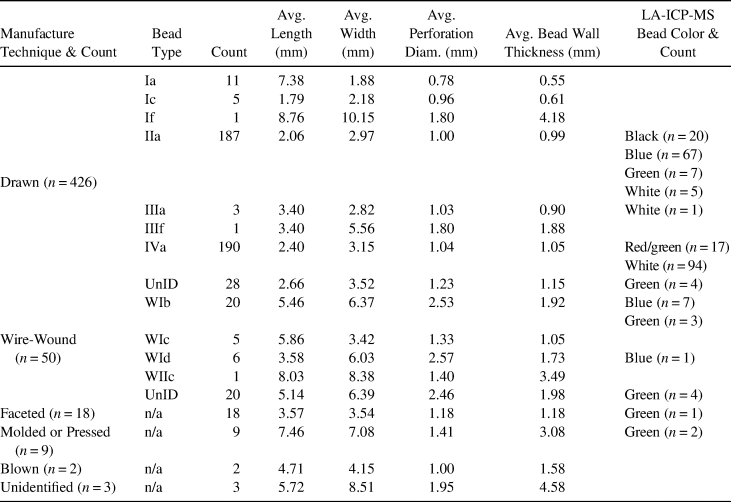
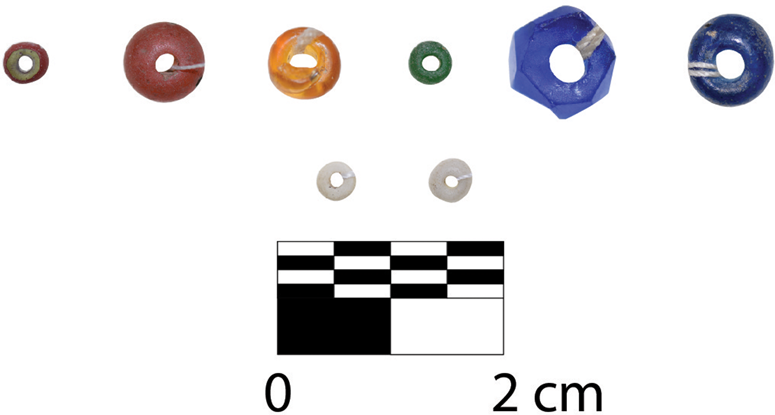
All 508 glass beads first underwent conventional attribute analysis. We later selected a subsample of 233 glass beads, including 100 white beads, for LA-ICP-MS analysis (Table 1). For the qualitative study, we followed the glass bead typology created by Kidd and Kidd (Reference Kidd and Kidd2012) and reexamined bead data from two preliminary studies completed before archaeologists returned the Lost Adobe materials to the property owner (Doane Reference Doane1992–1993; Meighan Reference Meighan1984). Our research involved designating bead types whenever possible, collecting key metric data (i.e., bead length, width, and wall thickness), and recording Munsell color, glass diaphaneity, manufacturing methods, and other bead attributes (Gelinas Reference Gelinas2018). After reviewing excavation records and plotting relevant bead data using mapping software (Gelinas Reference Gelinas2018), it became clear that more than half of the 508 glass beads in our study had been collected from a single 4 × 6 m room (“Room 2”) within the adobe roomblock (Figure 2). Given this opportunity to explore a large and diverse quantity of glass beads from a single room (Figure 3), we turned to chemical analysis of glass beads to better understand the adobe's history of occupation.
Summary of Lost Adobe Glass Beads (n = 508), Including Relevant Measurements and Bead Types (Counts and Colors) Analyzed with LA-ICP-MS.

Note: Bead types after Kidd and Kidd (Reference Kidd and Kidd2012).
Examples of glass beads from the Lost Adobe of Mission Santa Cruz, including white beads—Type IIa14 (bottom left) and Type IVa13 (bottom right)—analyzed with LA-ICP-MS. Note: Type IIIa8 bead is not pictured.

Chemical Composition Analysis
We analyzed 100 white glass beads using a Teledyne CETAC Analyte Excite 193 nanometer excimer Laser Ablation System attached to a Thermo XSERIES 2 Inductively Coupled Plasma Mass Spectrometer (Supplemental Table 1). Other colors we analyzed include blue, green, black, and red-on-green beads, but these data are not reported. Excimer lasers working at 193 nm wavelengths allow for a significant decrease in chemical fractionation as well as increased ablation/absorption yield (Gratuze Reference Gratuze and Janssens2013:203). Analytical protocol and calculation methods were adapted from Gratuze (Reference Gratuze1999) as well as Dussubieux and colleagues (Reference Dussubieux, Robertshaw and Glascock2009). To explore chronology based on opacifying agents, glass beads of the same color and manufacture (drawn opaque white) were selected for the LA-ICP-MS analysis.
Two runs of ablation were conducted on each white bead, and multiple runs were conducted on the red-on-green beads so as to analyze both colors. The isotope 30Si was employed as an internal standard, and the reference materials 610 and 612 from the National Institute for Standards and Technology were used for external standardization, along with the Corning Museum of Glass standards B, C, and D. These reference materials were analyzed under the same settings as the artifacts, and they were scanned at the beginning and end of each batch run and after every 25 samples. Data were collected on 55 elements. Presented below are the results obtained for each artifact normalized to 100% (Dussubieux and Karklins Reference Dussubieux and Karklins2016). All trace elements are presented in parts per million.
Results
Qualitative Analysis
The 100 white beads selected for LA-ICP-MS analysis are drawn, opaque, tubular, oblate globular, or disc shaped, and they are very small to medium in size (0.9–4.5 mm). A majority (n = 94) are Type IVa13 compound beads with bright white exteriors, light gray interiors, and heat-rounded edges (Kidd and Kidd Reference Kidd and Kidd2012:55). Five Type IIa beads (IIa12, n = 2; IIa14, n = 3) in the sample are disc shaped and “simple,” or single layered (Kidd and Kidd Reference Kidd and Kidd2012:48). Rounding out the sample, one Type IIIa8 glass bead is compound (white-over-light-gray) and tubular (Kidd and Kidd Reference Kidd and Kidd2012:53).
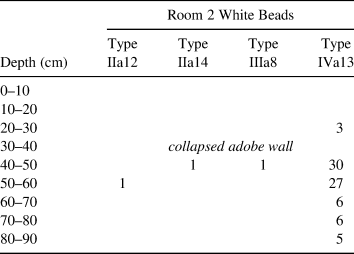
Of the 100 white glass beads selected for the LA-ICP-MS study, 80 were collected from Room 2 of the Lost Adobe (Table 2). Most, including one arsenic-rich bead discussed below, are from beneath the collapsed adobe wall (i.e., below 40 cm) in deposits associated with two phoenix buttons, which provide a temporal guidepost. Yet, even with an 1820 TPQ associated with both buttons, a third phoenix button and an earlier 1790 coin found above the collapsed wall complicate the occupational sequence. White drawn glass beads are generally associated with a broad time span that includes the entire mission period in Alta California (i.e., 1769–1830s), but some researchers have identified type-specific chronologies. For instance, Gibson's (Reference Gibson and Greenwood1975:71) “C4a” beads—a category of bead that includes Kidd and Kidd (Reference Kidd and Kidd2012) type IIa12, IIa14, IIIa8, and IVa13 beads—date from 1785 to 1816. More recently, Ross and coauthors. (Reference Ross, Kremkau, Cannon, Douglass, Reddy and Douglass2016:336, 347) determined that Type IVa13 beads date from 1771 to 1860 and that Type IIIa beads date from 1829 to 1860. As early as 1790, Franciscan missionaries at nearby Mission Santa Clara requested shipments of only white glass beads to appeal to Native preferences for specific colors (see Panich Reference Panich2014:738). Given this chronological context based on the beads’ morphological attributes alone, we turned to chemical composition analysis to help clarify the occupational history of Room 2 and the Lost Adobe structure.
Counts and Depths of 100 White Glass Beads in LA-ICP-MS Subsample.

Chemical Composition Analysis
Glass is a complicated substance made from silica, an alkali, a stabilizer, and a coloring agent that becomes molten when heated (Kidd and Kidd Reference Kidd and Kidd2012:40). Elements that function as colorants, decolorants, and opacifiers are useful for identifying compositional groups (Shugar and O'Connor Reference Shugar and O'Connor2011; Walder Reference Walder2018). For instance, differing opacifying agents can signify changes in recipes over time and act as chronological markers, and colorants and decolorants can signal minute differences in recipes and potential batches. INAA and pXRF are commonly used to identify opacifying agents in opaque white beads as proxies for site chronologies (Blair Reference Blair2017; Hancock et al. Reference Hancock, Aufreiter, Kenyon, Vandiver, Druzik, Merkel and Stewart1997,Reference Hancock, Aufreiter, Kenyon and Latta1999; Sempowski et al. Reference Sempowski, Nohe, Moreau, Kenyon, Karklins and Hancock2000). Our use of LA-ICP-MS complements and enhances this existing dataset by adding several more elements for comparison.
Elements typically used to opacify glass include metal oxides such as tin, antimony, and arsenic. Chemical analysis of opaque white glass beads from relatively well-dated seventeenth-, eighteenth-, and nineteenth-century archaeological sites previously established time periods associated with different opacifying elements (Hancock et al. Reference Hancock, Aufreiter, Kenyon, Vandiver, Druzik, Merkel and Stewart1997:182). According to some recipes dating to the mid-seventeenth century, opaque white (lattimo) glass was made in Italy and used lead and tin oxides (Dussubieux Reference Dussubieux2009:100). Tin was used almost exclusively as an opacifier from the first century AD until the late seventeenth century (Hancock et al. Reference Hancock, Chafe and Kenyon1994:260). The role of arsenic and antimony as opacifiers changed in the seventeenth and eighteenth centuries, with both becoming more prominent and replacing tin as the most common opacifiers for all glass (Shugar and O'Connor Reference Shugar and O'Connor2011:64). Additional research suggests that early seventeenth-century tin-rich drawn glass beads were replaced sometime later in that century by antimony-rich glass beads, which continued to be produced into the nineteenth century (Blair Reference Blair2017; Sempowski et al. Reference Sempowski, Nohe, Moreau, Kenyon, Karklins and Hancock2000:559). Arsenic-rich white beads were also produced in the late eighteenth century, and they continue through to the twentieth century (Hancock et al. Reference Hancock, Aufreiter, Kenyon, Vandiver, Druzik, Merkel and Stewart1997:185). Based on previous chemical analyses of opaque white glass beads, the following opacifying sequence adds chronological texture to historic sites, including colonial missions: tin (AD 1600–1700), antimony (AD 1650–1890), and arsenic (AD 1800–1949) (Shugar and O'Connor Reference Shugar and O'Connor2011).
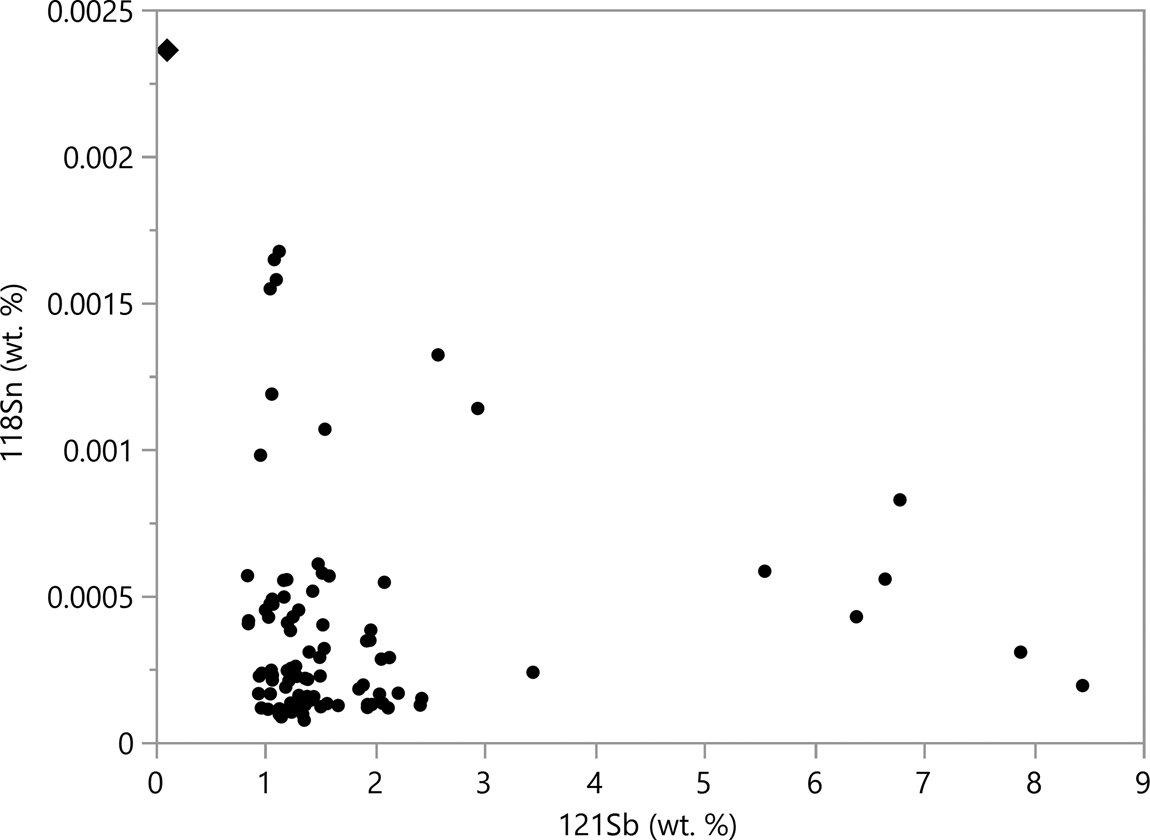
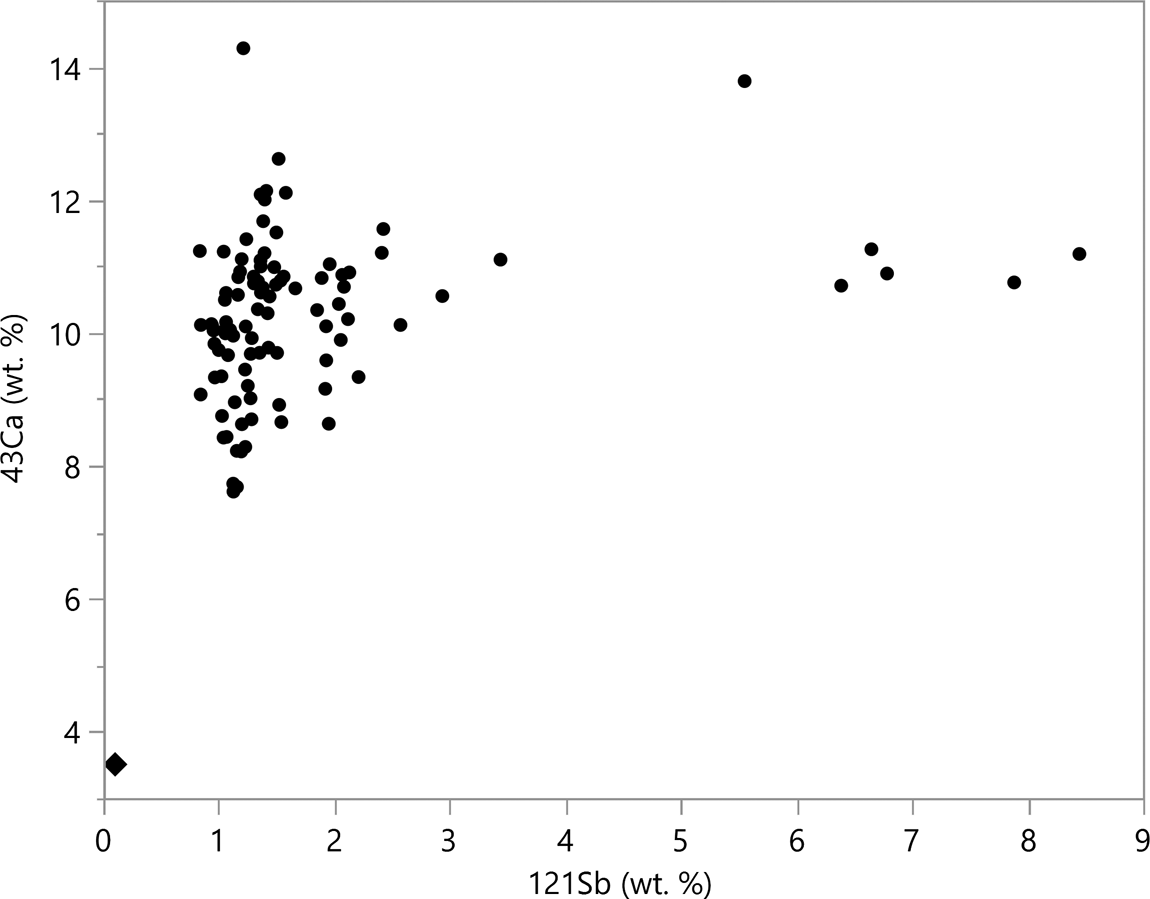
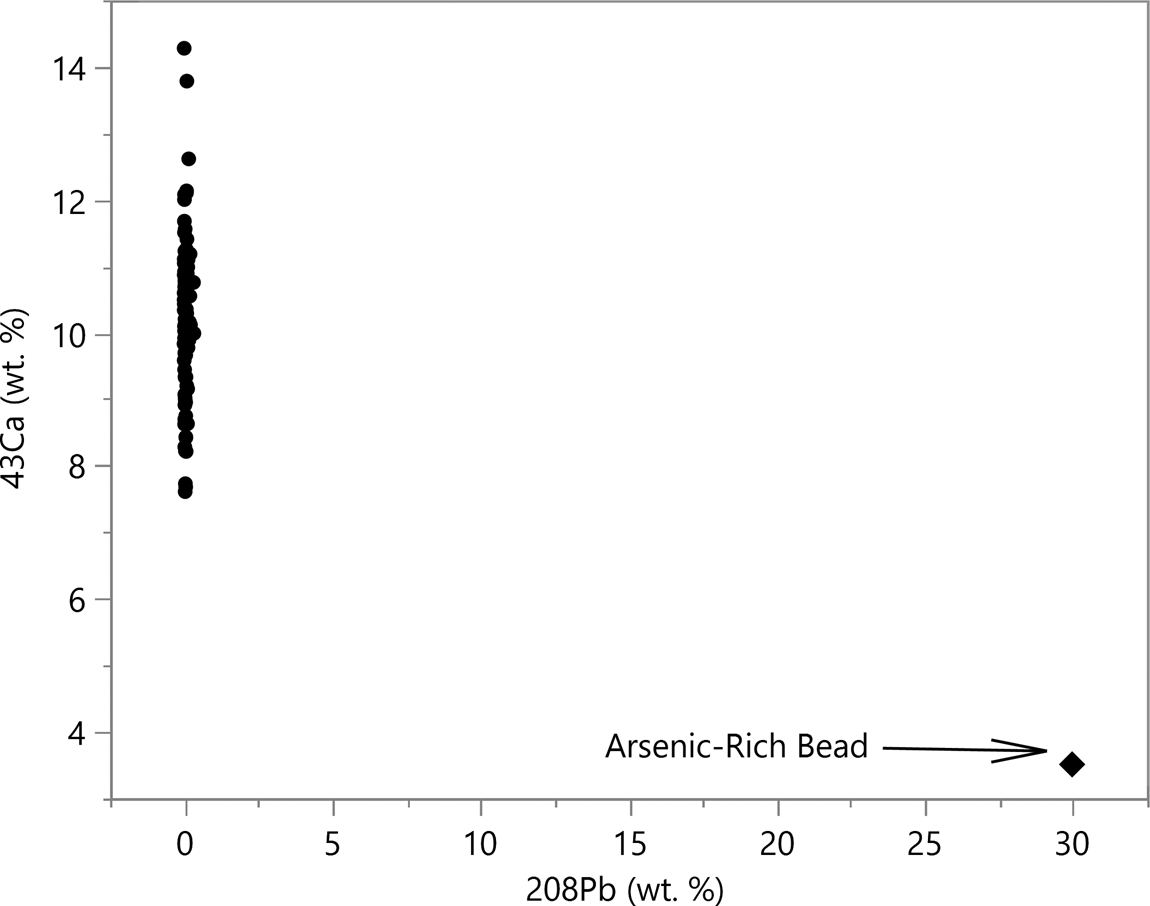
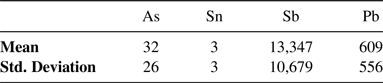
The 100 drawn white glass beads all contain significant concentrations of antimony (Figure 4; Table 3). It is noteworthy that the white beads were almost exclusively opacified using antimony given that arsenic overlaps with antimony use from AD 1800 to 1890. Additionally, all the antimony-rich drawn white beads contain at least 8% calcium and do not contain significant amounts of lead (Figure 5). This suggests that they were opacified with calcium antimonate as opposed to lead antimonate, which places them in the appropriate period for the mission occupation (Blair Reference Blair2017). Only one white bead (Type IVa13), collected just below the collapsed adobe wall at 40–50 cm, contained arsenic as the primary opacifying agent as opposed to antimony. The bead also contains high amounts of lead, which signifies a post-1800 production (Figure 6; Supplemental Table 2).
Biplot of antimony and tin.

Biplot of calcium and antimony.

Biplot of lead and calcium depicting the one glass bead opacified with lead arsenate.

Mean Composition (ppm) of Antimony-Rich White Glass Beads (sample size = 99).

Discussion
As demonstrated by others (e.g., Walder Reference Walder2018), the combination of qualitative and quantitative approaches stands to enhance glass bead studies as well as archaeological research exploring the unique contours of Indigenous-colonial encounters. By “unpacking” the bead, so to speak, chemical data can add critical temporal resolution to a time period marked by upheaval and novel reconfigurations of resilient Indigenous communities (Hull and Douglas Reference Hull and Douglass2018).
Our spatial and qualitative analyses identified a large number of white glass beads recovered primarily from a single 20 cm stratum within Room 2 of the Lost Adobe. The predominant bead type, Kidd and Kidd's (Reference Kidd and Kidd2012) Type IVa13, is associated with a date range of 1771–1860 that subsumes and extends beyond Mission Santa Cruz's period of operation (Ross et al. Reference Ross, Kremkau, Cannon, Douglass, Reddy and Douglass2016:336, 347). Gibson (Reference Gibson and Greenwood1975:71) assigned a date range of late 1700s–early 1800s for the remaining bead types (i.e., IIa12, IIa14, and IIIa8). Ross and coauthors’ (Reference Ross, Kremkau, Cannon, Douglass, Reddy and Douglass2016:347) estimated date range of 1829–1860 for Type IIIa beads greatly shortens Gibson's bead chronology; however, we also note Allen's (Reference Allen1998:71) argument that white IIa and IVa glass beads “are not reliable time markers” since they appear throughout the mission period and after. Working from just one sample of 100 white beads, it becomes clear that diagnostic artifacts and written records could help resolve some of the issues associated with glass bead chronologies. Yet, without a clear date of construction recorded in mission-era documents, and with questions remaining about the disturbed context of time-sensitive buttons and a coin, chemical composition analysis offers an alternative technique for resolving chronological uncertainty at the Lost Adobe.
Temporal resolution offered by LA-ICP-MS analysis on glass beads helps augment approximate date ranges for entire sites (e.g., “1790s–1830s”) and for specific bead types (e.g., “1771–1860”). Chemical composition analysis indicates that drawn white glass beads from Mission Santa Cruz's Lost Adobe were opacified predominantly with calcium antimonate, which suggests mid-seventeenth to early nineteenth-century dates for this bead assemblage. Our data correlate with findings from other studies (e.g., Blair Reference Blair2017), but we also note that only one white bead was opacified with arsenic and lead. Moreover, there is no overlap of opacifying metal oxides within the white bead assemblage, signifying either that the transition from antimony and arsenic happened quickly or that the shipments of beads were far enough apart in time that they would have discrete opacifiers. Although antimony and arsenic were used for long periods of time, the fact that all but one drawn white glass bead was opacified with antimony suggests that the mission was probably provisioned before the turn of the nineteenth century, an observation supported by bead resupply at nearby Mission Santa Clara (Panich Reference Panich2014). Founded in 1791 by colonists arriving from the neighboring Mission Santa Clara (est. 1777), Mission Santa Cruz was initially outfitted with livestock, furnishings, glass beads, and other supplies removed from the “older” mission—an economizing strategy characteristic of New Spain's remote northern frontier. Arsenic generally becomes more common in nineteenth-century glass recipes, but it was used as an opacifying agent in combination with lead at approximately AD 1800 or shortly thereafter (e.g., Hancock et al. Reference Hancock, Aufreiter, Kenyon, Vandiver, Druzik, Merkel and Stewart1997). If the mission operated from 1791 to the 1830s, this leaves a small window for when the beads would have entered the archaeological record. It also appears to be the case that white beads were most likely first brought to Mission Santa Cruz by Ohlone peoples who acquired them before 1800. This interpretation is partly supported by twentieth-century ethnographic descriptions of Yokuts peoples, who accorded special value to blue faceted and polychrome (red-on-white and red-on-green) glass beads rather than white beads (see Arkush Reference Arkush1993:625). Future work on the other bead types analyzed with LA-ICP-MS could advance this argument and utilize previous typological (Francis Reference Francis1988) and chemical work (Billeck Reference Billeck2008).
Conclusion
In conclusion, we combined conventional bead typology with chemical composition analysis to refine the occupational history of a California mission. As more archaeologists turn to specialized analytical techniques to better understand aspects of Indigenous-colonial encounters, we suggest that LA-ICP-MS offers an inexpensive and minimally destructive option for elucidating and refining postcontact chronologies using glass beads. Historical archaeologists rely on diagnostic artifacts to pinpoint distinct periods of occupation within larger time spans often informed by the written record (e.g., 1791–1830s). In the case of the Lost Adobe at Mission Santa Cruz, however, the presence of three phoenix buttons (TPQ 1820) and a 1790 coin complicates our understanding of site stratigraphy. By extension, this also casts doubt on the site's chronology and occupants. Were they Indigenous Ohlone peoples who, by 1791, when Mission Santa Cruz was founded, carried firsthand knowledge of the devastation wrought by missions and also expertise in accommodating missions as sources of beads and other resources for their persistent economies (Panich Reference Panich2014; Panich and Schneider Reference Panich and Schneider2015)? Or, does the Lost Adobe represent one node in a far-reaching Yokuts network that took shape beginning in the early 1800s and eventually transected the modern state of California from the Pacific Coast to the Sierra Nevada mountains and beyond (Arkush Reference Arkush1993; Rizzo Reference Rizzo2016)?
A large and diverse assemblage of glass beads helped narrow the focus of our analysis of the Lost Adobe chronology. Specifically, chemical composition analysis of 100 white glass beads using LA-ICP-MS suggests mid-seventeenth- to early nineteenth-century dates for this bead assemblage based on the presence of antimony—a finding supported by written accounts of the initial provisioning of Mission Santa Cruz in 1791 with supplies from the older Mission Santa Clara. The beads were most likely the original possessions of Indigenous Ohlone residents. We also found that a single bead contains arsenic, which was commonly used as an opacifying agent in nineteenth-century glass recipes. As the three phoenix buttons did, this bead probably arrived on-site later in time, perhaps with Yokuts individuals who gradually populated the coastal mission beginning in the early nineteenth century. As with any colonial-era pluralistic community in which diverse cultures and social identities intersected, we also acknowledge that the occupational history of this mission structure cannot be summarized as an either-or case. To this end, as the Lost Adobe reanalysis continues, chemical composition data collected from still other glass bead colors (e.g., blue, green, and red-on-green) may provide added temporal detail. We see strong potential for LA-ICP-MS to enhance chronologies associated with colonial missions and other postcontact sites where diverse cultures and social identities intersected, often in ways rendered imperceptible by standard decadal time frames.
Acknowledgments
We thank Rob Edwards, Charr Simpson-Smith, and Casey Tefertiller for their enthusiastic support and generous help facilitating our reanalysis of the Lost Adobe collection. This report benefited from the constructive feedback and guidance of four peer reviewers and Lynn Gamble. Rob Franks (of the UCSC Plasma Analytical Lab) offered guidance and support during the chemical analysis, Lee Panich provided helpful glass bead references, and Guillermo Delgado-P. helped with our Spanish abstract. Funding for LA-ICP-MS analysis was made possible by a Hellman Fellowship awarded to Schneider.
Data Availability Statement
The Lost Adobe glass beads are in a private collection with restricted access. Morphological and chemical data, however, are available upon request.
Supplemental Materials
For supplemental material accompanying this article, visit https://doi.org/10.1017/aaq.2020.110.
Supplemental Table 1. LA-ICP-MS Analysis Methods.
Supplemental Table 2. Composition of the lead arsenate-opacified white glass bead (#1635, Iva13) analyzed with LA-ICP-MS.