Introduction
Alcohol use is common in the USA, with over 70% of Americans between the ages of 18 and 24 years reporting alcohol use within the past year (Chen et al. Reference Chen, Dufour and Yi2004). Alcohol use typically begins in adolescence, with 33% of US 8th graders (∼ages 13–14) reporting a history of alcohol use in 2011; by the 10th grade (∼ages 15–16) this figure increases to 56%, and by the 12th grade (∼ages 17–18) 70% of adolescents have used alcohol (Johnston et al. Reference Johnston, O'Malley, Bachman and Schulenberg2011). Excessive alcohol consumption is related to an increased probability of alcohol-use disorders (Dawson et al. Reference Dawson, Grant and Li2005; McCambridge et al. Reference McCambridge, McAlaney and Rowe2011), as well as to a myriad of other negative health-related outcomes, including hypertension, liver disease and some types of cancer (Giacosa et al. Reference Giacosa, Adam-Blondon, Baer-Sinnott, Barale, Bavaresco, Di Gaspero, Dugo, Ellison, Gerbi, Gifford, Janssens, La Vecchia, Negri, Pezzotti, Santi, Santi and Rondanelli2012). Among adolescents, alcohol use is related to leading causes of death (e.g. motor vehicle accidents, homicides) and risky behaviors such as physical fighting and sexual activities (Boekeloo & Novik, Reference Boekeloo and Novik2011). Furthermore, the economic cost of excessive alcohol use in the USA, taking into consideration alcohol-related crime, medical consequences, lost productivity, etc, was estimated at $224 billion in 2006 (Bouchery et al. Reference Bouchery, Harwood, Sacks, Simon and Brewer2011). Clearly, alcohol use affects the majority of the population directly or indirectly.
Alcohol consumption is influenced in part by genetic factors: heritability (h2) estimates for alcohol consumption in adults range from about 0.2 to 0.6 (Kendler et al. Reference Kendler, Schmitt, Aggen and Prescott2008b, Reference Kendler, Myers, Dick and Prescott2010; Grant et al. Reference Grant, Agrawal, Bucholz, Madden, Pergadia, Nelson, Lynskey, Todd, Todorov, Hansell, Whitfield, Martin and Heath2009; Dick et al. Reference Dick, Meyers, Rose, Kaprio and Kendler2011; Geels et al. Reference Geels, Bartels, van Beijsterveldt, Willemsen, van der Aa, Boomsma and Vink2012). For adolescents, heritability estimates for alcohol-related phenotypes vary considerably. Some studies have found that the h2 of alcohol use is quite low (0.1 or lower) (Rhee et al. Reference Rhee, Hewitt, Young, Corley, Crowley and Stallings2003), while others have reported moderate estimates (0.3–0.5) for frequency of use (Viken et al. Reference Viken, Kaprio, Koskenvuo and Rose1999; Pagan et al. Reference Pagan, Rose, Viken, Pulkkinen, Kaprio and Dick2006), frequency of intoxication (0.4–0.7) (Edwards et al. Reference Edwards, Larsson, Lichtenstein and Kendler2011a) and quantity of use (0.6) (Fowler et al. Reference Fowler, Lifford, Shelton, Rice, Thapar, Neale, McBride and van den Bree2007). High levels of alcohol consumption can be a key predictor of alcohol problems (Dawson, Reference Dawson1994; Whitfield et al. Reference Whitfield, Zhu, Madden, Neale, Heath and Martin2004; Dawson et al. Reference Dawson, Grant and Li2005), and these phenotypes are highly genetically correlated (Whitfield et al. Reference Whitfield, Zhu, Madden, Neale, Heath and Martin2004; Grant et al. Reference Grant, Agrawal, Bucholz, Madden, Pergadia, Nelson, Lynskey, Todd, Todorov, Hansell, Whitfield, Martin and Heath2009; Kendler et al. Reference Kendler, Myers, Dick and Prescott2010; Dick et al. Reference Dick, Meyers, Rose, Kaprio and Kendler2011). Thus, though alcohol use per se does not necessarily predict the development of problems, excessive consumption can be an indicator of genetic liability to problems.
While the heritable nature of alcohol use is well established, there is less information available regarding the continuity of genetic factors between adolescence and adulthood. Generally, genetic influences on alcohol use increase from adolescence into young adulthood before stabilizing (Bergen et al. Reference Bergen, Gardner and Kendler2007; Hicks et al. Reference Hicks, Blonigen, Kramer, Krueger, Patrick, Iacono and McGue2007; Kendler et al. Reference Kendler, Schmitt, Aggen and Prescott2008b; Sartor et al. Reference Sartor, Xian, Scherrer, Lynskey, Duncan, Haber, Grant, Bucholz and Jacob2008; Edwards et al. Reference Edwards, Larsson, Lichtenstein and Kendler2011a; Geels et al. Reference Geels, Bartels, van Beijsterveldt, Willemsen, van der Aa, Boomsma and Vink2012), though some studies suggest the opposite (Malone et al. Reference Malone, Taylor, Marmorstein, McGue and Iacono2004; Hicks et al. Reference Hicks, Blonigen, Kramer, Krueger, Patrick, Iacono and McGue2007; van Beek et al. Reference van Beek, Kendler, de Moor, Geels, Bartels, Vink, van den Berg, Willemsen and Boomsma2012). However, the extant literature largely focuses on total heritability, without exploring whether there are qualitative changes underlying total heritability over time. That is, it remains unclear whether the genetic influences on alcohol use during adolescence are the same as those that are relevant during adulthood. One study, examining symptoms of alcohol-use disorder in a longitudinally assessed sample of Dutch twins, found that while the total heritability of these symptoms varied from the age of 15–17 years to the age of 30–32 years, this variation was only quantitative in nature: a single genetic factor accounted for heritable influences (van Beek et al. Reference van Beek, Kendler, de Moor, Geels, Bartels, Vink, van den Berg, Willemsen and Boomsma2012). Another study, which used the adult twin sample examined in the current analyses, reported that alcohol consumption in adolescence and adulthood were differentially predicted by genetic risk for externalizing versus for alcohol problems, as indexed by parental and co-twin phenotypes: while a familial liability to externalizing predicted alcohol use in adolescence, the alcohol-specific familial liability predicted later levels of alcohol consumption (Kendler et al. Reference Kendler, Gardner and Dick2011a). This raises the possibility that qualitatively different genetic factors are relevant during different developmental periods, though such a hypothesis was not formally tested in the previous report.
Understanding the biological and environmental etiologies underlying alcohol-use phenotypes is critical for the development of effective prevention programming and treatment strategies. In particular, the use of twin and family studies to delineate dynamic genetic influences on these phenotypes across time can inform gene identification efforts: in the event that a single genetic factor influences an alcohol-related outcome differentially over time, it might be possible to ascertain a sample based on the age range within which those genetic influences are most prominent. Alternatively, if twin studies suggest that qualitatively distinct genetic factors influence the same alcohol phenotype during different time-frames, gene identification studies should be designed that limit the age range of the sample so as to minimize genetic heterogeneity underlying the phenotype of interest. The aim of the current analyses was to use a genetically informative, population-based sample of male twins to determine whether genetic influences on alcohol consumption change, quantitatively (i.e. genetic attenuation) and/or qualitatively (i.e. genetic innovation), from early adolescence into mid-adulthood.
Method
Sample
These analyses use data collected in the third wave of assessment of adult Caucasian male twins participating in the Virginia Adult Twin Study of Psychiatric and Substance Use Disorders (Kendler & Prescott, Reference Kendler and Prescott2006). Subjects (n=1790) were aged 40.27 (s.d. = 9.00) years at the interview. Data were available for 466 complete monozygotic (MZ) twin pairs, 283 complete dizygotic (DZ) twin pairs, and 292 members of incomplete pairs. Zygosity was determined using a combination of self-report measures, photographs and DNA polymorphisms. Most subjects were interviewed over the telephone by interviewers with a Master's degree in a mental health-related field or a Bachelor's degree and at least 2 years of clinical experience. The Committee for the Conduct of Human Research at Virginia Commonwealth University approved the project.
Measures
In wave 3 of data collection, participants were asked to report their average monthly alcohol consumption using a life history calendar interview, which improves the accuracy of retrospective recall (Freedman et al. Reference Freedman, Thornton, Camburn, Alwin and Young-demarco1988). These data were then combined into ages that correspond to meaningful developmental age ranges (as in previous studies of this sample, e.g. Kendler et al. Reference Kendler, Jacobson, Myers and Eaves2008a) and extending into adulthood: ages 12–14, 15–17, 18–21, 22–25, 26–29, and 30–33 years, which will be referred to as epochs 1–6, respectively. Abstainers were assigned values of 0 (see Discussion). To each average consumption score, 1 was added, followed by a natural log-transformation to adjust for non-normality. Thus, the lowest possible log-transformed score was 0, corresponding to abstainers.
Statistical analyses
Descriptive statistics and preliminary analyses were obtained/conducted using SAS 9.2 and JMP 8 (SAS Institute Inc., USA). Twin modeling was conducted in OpenMx (Boker et al. Reference Boker, Neale, Maes, Wilde, Spiegel, Brick, Spies, Estabrook, Kenny, Bates, Mehta and Fox2011) using the raw continuous data option. All twins were included in these analyses, including those who were members of incomplete pairs. In twin modeling, liability to phenotypes such as depression or alcohol use can be attributed to several latent sources of variance: additive genetic factors (A), shared environment (C) and unique environment (E). The C variance component represents environmental exposures and experiences that are shared by both members of a twin pair and contribute to twins' increased similarity, irrespective of zygosity, in a given phenotype. Environmental factors that are unique to one twin are accounted for by the E component; these factors reduce twin similarity for a given phenotype. The E component also includes measurement error. Estimates of each of these variance components are calculated by comparing the phenotypic correlation between MZ twins (who share all their genes) with DZ twins (who share half of their genes, on average, identical by descent).
We used a Cholesky decomposition model (six A factors, six C factors, and six E factors) for these analyses, as this structure allows us to impose a temporal structure on the manifest variables (from left to right as time progresses). This enabled us to evaluate whether new latent A (or C) influences ‘come online’ over time. We compared submodels in which later (epoch 2–6) C and A factor loadings were sequentially removed from the model using the p value of the χ2 and Akaike's Information Criterion (Akaike, Reference Akaike1987) as an indicator of model fit and parsimony. We did not test the significance of E factor loadings, as such tests were peripheral to our research question and could result in over-fitting. Thus, the structure of E factor loadings remained saturated throughout the model-fitting process.
Results
Descriptive statistics
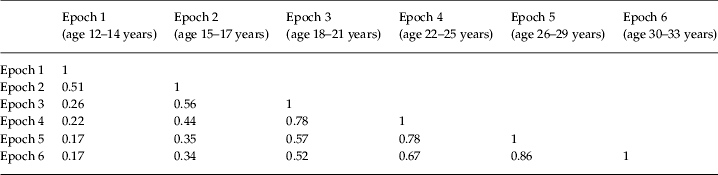
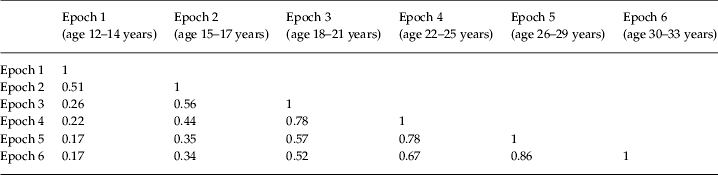
Mean monthly alcohol consumption was quite low in epoch 1 (age 12–14 years) at 0.67 (s.e. = 0.13) drinks per month; it increased rapidly across epoch 2 (mean = 7.24, s.e. = 0.55), epoch 3 (mean = 38.04, s.e. = 1.53) and epoch 4 (mean = 39.55, s.e. = 1.79), after which consumption decreased to a mean of approximately one drink per day in epoch 5 (mean = 30.50, s.e. = 1.50) and epoch 6 (mean = 29.25, s.e. = 1.96). All other statistics and analyses employed natural log-transformed versions of the consumption variables. Phenotypic correlations from one epoch to the immediately subsequent epoch were modest to high (r = 0.51–0.86, see Appendix Table A1), and increased over time as the pattern of alcohol use stabilized.
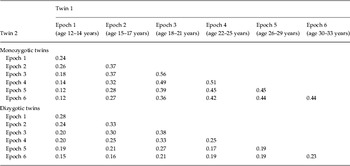
Cross-sectional twin correlations were similar for MZ twins and DZ twins for epochs 1 and 2 (Table 1), suggesting that shared environmental (C) variance contributes to manifestation of these phenotypes, with minimal genetic influence (A). However, from epochs 3–6, the correlation between MZ twins was substantially higher than between DZ twins, suggesting increasing importance of genetic factors and decreasing relevance of C factors.
Twin correlations of log-transformed means of alcohol consumption over time

Twin modeling
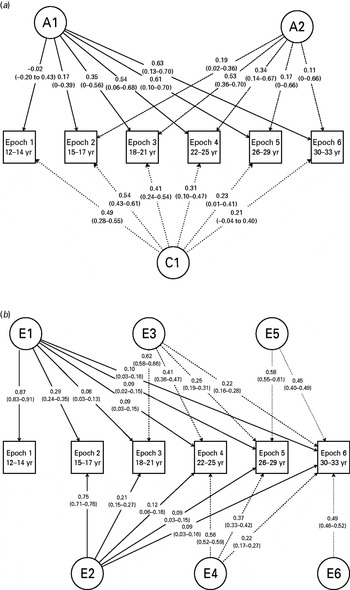
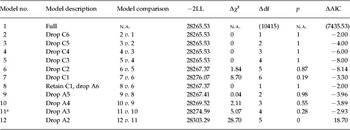
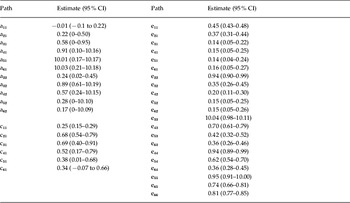
We first tested the significance of C latent factors in the model (Table 2). By setting path estimates to 0, beginning with the C6 factor loadings and working our way back, we found that all of the C factors could be dropped from the model (see Table 2, models 2–7). However, because the phenotypic twin correlations clearly indicated that C influences are relevant in the earlier epochs (see Table 1), we opted to retain a single latent C factor, C1, and all of its factor loadings in the model. We next applied the same approach to A factors, and found that factors A3–A6 could be dropped from the model, but A2 could not. To avoid over-fitting, we did not test the significance of E factor loadings. Therefore, the final model is one in which there are two A factors, one C factor and six E factors. Standardized parameter estimates with confidence intervals (CIs) are provided in Fig. 1. Unstandardized path estimates and CIs are provided in Appendix Table A2.
Final twin model with standardized path estimates (95% confidence intervals). Genetic (A) and shared environmental (C) influences are presented separately (a) from unique environmental (E) influences (b) for readability.

Model-fitting procedure, with stepwise removal of latent factors and their associated paths

−2LL, −2 Log likelihood; df, degrees of freedom; AIC, Akaike's Information Criterion; n.a., not applicable; C, shared environmental factor; A, additive genetic factor.
a Final model.
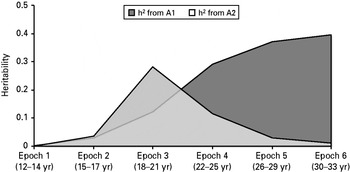
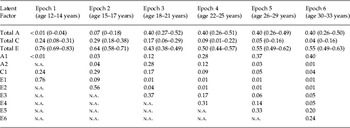
Table 3 provides details on standardized A, C and E contributions to variance, as a whole and as a function of each latent factor. The total h2 of alcohol use was quite low (<0.01) for ages 12–14 years (epoch 1). The h2 increased to 0.07 for ages 15–17 years (epoch 2), then to 0.40 for ages 18–21 years to 30–33 years (epochs 3–6). Due to the structure of the model, only factor A1 contributes to heritability at epoch 1. During epoch 2, factors A1 and A2 contribute equally to the heritability. The relative contributions of A1 and A2 shift during epoch 3, when factor A1 accounts for 30% of the total heritability in alcohol consumption, and A2 for 70%. This relationship is inverted at epoch 4 (i.e. A1 then accounts for 70% of the heritability). During epochs 5 and 6, A1 accounts for over 90% of the heritability in alcohol consumption. Thus, the effects of A2 are largely limited to a period in mid-adolescence to early adulthood, after which genetic influences from A1 are most relevant (Fig. 2).
Heritability (h2) accounted for by additive genetic factors A1 and A2 over time.

Standardized variance attributable to A, C and E overall (with 95% confidence intervals), and as a function of each latent factoa

A, Additive genetic factor; C, shared environmental factor; E, unique environmental factor; n.a., not applicable.
a Totals might differ from 1 due to rounding.
Shared environmental influences are most prominent during the first two epochs, accounting for 24–29% of the total variance. After this, their influence declines to 4% of the variance by epoch 6. Unique environmental factors also decline in significance over time, though less dramatically: in epoch 1, they account for 76% of the variance; 64% during epoch 2; and 43–55% from epochs 3–6. Factor loadings from E1–E3 are primarily time-specific, with little influence on later epochs; however, even these low cross-time loadings differ significantly from 0 (Fig. 1, Appendix Table A2). Beginning with E4, which loads first onto epoch 4 (ages 22–25 years), unique environmental factors are modestly influential over time rather than being nearly completely occasion-specific.
The total unstandardized phenotypic variance in alcohol consumption is quite low during epoch 1 (V P = 0.27). This increases in epochs 2 and 3 (V P = 1.59 and V P = 2.83, respectively). Afterwards, the variance is relatively stable to epoch 6 (V P = 2.85 in epoch 4, V P = 2.75 in epoch 5, and V P = 2.71 in epoch 6). Thus, while the sources of variance change over time (described above), the actual variance being accounted for changes as well.
Discussion
The goal of this analysis was to describe latent genetic influences on alcohol consumption from early adolescence into adulthood in terms of the number of relevant factors and their relative influence over time. We found that two distinct latent genetic factors account for genetic variance from the ages of 12–14 years through to the ages of 30–33 years. The influence of one of these factors is largely limited to mid-adolescence and early adulthood, declining in significance beyond epoch 3 (ages 18–21 years). Thereafter, the influence of the other latent genetic factor is more pronounced. The total heritability of alcohol consumption – combining that contributed by both latent genetic factors – increases from h2 of about 0 at ages 12–14 years to h2 of about 0.40 from the age of 18–21 years to the age of 30–33 years. These estimates are consistent with those reported previously (Kendler et al. Reference Kendler, Schmitt, Aggen and Prescott2008b). Shared environmental influences decline over time, from 24% of the variance to 4%. Likewise, unique environmental influences account for more of the total variance at the age of 12–14 years (76%) than at the age of 30–33 years (55%).
The identification of one genetic factor whose effects decline steadily into young adulthood and another whose effects increase during this time corresponds with some prior evidence of developmentally specific genetic effects. A study using the current sample (Kendler et al. Reference Kendler, Gardner and Dick2011a) examined the genetic risk for externalizing disorders and alcohol-use disorders, which were derived based on co-twin and parental phenotypes, and their respective relationships to alcohol intake. Results indicated that genetic risk for externalizing is more strongly related to intake during adolescence, while genetic risk for alcohol problems is more strongly related to intake beginning in early adulthood. Other studies have found that externalizing disorders and alcohol problems are genetically correlated during adolescence (Button et al. Reference Button, Rhee, Hewitt, Young, Corley and Stallings2007; Hicks et al. Reference Hicks, Blonigen, Kramer, Krueger, Patrick, Iacono and McGue2007; Legrand et al. Reference Legrand, Keyes, McGue, Iacono and Krueger2008), though the covariance in phenotypes might also be due to environmental factors (Rose et al. Reference Rose, Dick, Viken, Pulkkinen and Kaprio2004). Such findings raise the possibility that the adolescent-limited genetic factor identified in the current report is actually capturing liability to general externalizing behaviors (which would encompass alcohol use) during that period, rather than liability to alcohol use per se. Additional analyses would be necessary to confirm this, and to examine whether the adult-onset genetic factor is largely specific to alcohol consumption.
Our estimates of the heritability of alcohol consumption in early adolescents are comparable with that of a previous study of adolescent alcohol use (Rhee et al. Reference Rhee, Hewitt, Young, Corley, Crowley and Stallings2003) and another of adolescent alcohol problems (Rose et al. Reference Rose, Dick, Viken, Pulkkinen and Kaprio2004). However, they are considerably lower than other reports, which range from 0.25 to 0.67 for a variety of alcohol-related phenotypes (Edwards et al. Reference Edwards, Larsson, Lichtenstein and Kendler2011a,b; Geels et al. Reference Geels, Bartels, van Beijsterveldt, Willemsen, van der Aa, Boomsma and Vink2012). Our use of retrospective reports could contribute to discrepancies, though genuine population and cohort differences probably also contribute. Generally, the heritability of alcohol use increases from adolescence into adulthood (Bergen et al. Reference Bergen, Gardner and Kendler2007), consistent with the estimates reported here. This increase in heritability is typically accompanied by corresponding decreases in shared environmental influences (Edwards et al. Reference Edwards, Larsson, Lichtenstein and Kendler2011a,b; Geels et al. Reference Geels, Bartels, van Beijsterveldt, Willemsen, van der Aa, Boomsma and Vink2012).
Our findings have implications for gene identification efforts. In recent years, numerous genome-wide association studies have attempted to identify specific genes or variants that are associated with alcohol-related phenotypes (Treutlein et al. Reference Treutlein, Cichon, Ridinger, Wodarz, Soyka, Zill, Maier, Moessner, Gaebel, Dahmen, Fehr, Scherbaum, Steffens, Ludwig, Frank, Wichmann, Schreiber, Dragano, Sommer, Leonardi-Essmann, Lourdusamy, Gebicke-Haerter, Wienker, Sullivan, Nothen, Kiefer, Spanagel, Mann and Rietschel2009; Bierut et al. Reference Bierut, Agrawal, Bucholz, Doheny, Laurie, Pugh, Fisher, Fox, Howells, Bertelsen, Hinrichs, Almasy, Breslau, Culverhouse, Dick, Edenberg, Foroud, Grucza, Hatsukami, Hesselbrock, Johnson, Kramer, Krueger, Kuperman, Lynskey, Mann, Neuman, Nothen, Nurnberger, Porjesz, Ridinger, Saccone, Saccone, Schuckit, Tischfield, Wang, Rietschel, Goate and Rice2010; Edenberg et al. Reference Edenberg, Koller, Xuei, Wetherill, McClintick, Almasy, Bierut, Bucholz, Goate, Aliev, Dick, Hesselbrock, Hinrichs, Kramer, Kuperman, Nurnberger, Rice, Schuckit, Taylor, Todd Webb, Tischfield, Porjesz and Foroud2010; Lind et al. Reference Lind, Macgregor, Vink, Pergadia, Hansell, de Moor, Smit, Hottenga, Richter, Heath, Martin, Willemsen, de Geus, Vogelzangs, Penninx, Whitfield, Montgomery, Boomsma and Madden2010; Baik et al. Reference Baik, Cho, Kim, Han and Shin2011; Heath et al. Reference Heath, Whitfield, Martin, Pergadia, Goate, Lind, McEvoy, Schrage, Grant, Chou, Zhu, Henders, Medland, Gordon, Nelson, Agrawal, Nyholt, Bucholz, Madden and Montgomery2011; Kendler et al. Reference Kendler, Kalsi, Holmans, Sanders, Aggen, Dick, Aliev, Shi, Levinson and Gejman2011b; Schumann et al. Reference Schumann, Coin, Lourdusamy, Charoen, Berger, Stacey, Desrivieres, Aliev, Khan, Amin, Aulchenko, Bakalkin, Bakker, Balkau, Beulens, Bilbao, de Boer, Beury, Bots, Breetvelt, Cauchi, Cavalcanti-Proenca, Chambers, Clarke, Dahmen, de Geus, Dick, Ducci, Easton, Edenberg, Esko, Fernandez-Medarde, Foroud, Freimer, Girault, Grobbee, Guarrera, Gudbjartsson, Hartikainen, Heath, Hesselbrock, Hofman, Hottenga, Isohanni, Kaprio, Khaw, Kuehnel, Laitinen, Lobbens, Luan, Mangino, Maroteaux, Matullo, McCarthy, Mueller, Navis, Numans, Nunez, Nyholt, Onland-Moret, Oostra, O'Reilly, Palkovits, Penninx, Polidoro, Pouta, Prokopenko, Ricceri, Santos, Smit, Soranzo, Song, Sovio, Stumvoll, Surakk, Thorgeirsson, Thorsteinsdottir, Troakes, Tyrfingsson, Tonjes, Uiterwaal, Uitterlinden, van der Harst, van der Schouw, Staehlin, Vogelzangs, Vollenweider, Waeber, Wareham, Waterworth, Whitfield, Wichmann, Willemsen, Witteman, Yuan, Zhai, Zhao, Zhang, Martin, Metspalu, Doering, Scott, Spector, Loos, Boomsma, Mooser, Peltonen, Stefansson, van Duijn, Vineis, Sommer, Kooner, Spanagel, Heberlein, Jarvelin and Elliott2011; Zuo et al. Reference Zuo, Zhang, Wang, Li, Zhao, Lu, Zhang, Lu, Zhang, Zhang, Krystal and Luo2011, Reference Zuo, Gelernter, Zhang, Zhao, Lu, Kranzler, Malison, Li, Wang, Zhang, Deng, Krystal, Zhang and Luo2012; Agrawal et al. Reference Agrawal, Wetherill, Bucholz, Kramer, Kuperman, Lynskey, Nurnberger, Schuckit, Tischfield, Edenberg, Foroud and Bierut2012; Frank et al. Reference Frank, Cichon, Treutlein, Ridinger, Mattheisen, Hoffmann, Herms, Wodarz, Soyka, Zill, Maier, Mossner, Gaebel, Dahmen, Scherbaum, Schmal, Steffens, Lucae, Ising, Muller-Myhsok, Nothen, Mann, Kiefer and Rietschel2012; Wang et al. Reference Wang, Liu, Zhang, Wu and Zeng2012), two of which specifically focused on alcohol consumption (Baik et al. Reference Baik, Cho, Kim, Han and Shin2011; Schumann et al. Reference Schumann, Coin, Lourdusamy, Charoen, Berger, Stacey, Desrivieres, Aliev, Khan, Amin, Aulchenko, Bakalkin, Bakker, Balkau, Beulens, Bilbao, de Boer, Beury, Bots, Breetvelt, Cauchi, Cavalcanti-Proenca, Chambers, Clarke, Dahmen, de Geus, Dick, Ducci, Easton, Edenberg, Esko, Fernandez-Medarde, Foroud, Freimer, Girault, Grobbee, Guarrera, Gudbjartsson, Hartikainen, Heath, Hesselbrock, Hofman, Hottenga, Isohanni, Kaprio, Khaw, Kuehnel, Laitinen, Lobbens, Luan, Mangino, Maroteaux, Matullo, McCarthy, Mueller, Navis, Numans, Nunez, Nyholt, Onland-Moret, Oostra, O'Reilly, Palkovits, Penninx, Polidoro, Pouta, Prokopenko, Ricceri, Santos, Smit, Soranzo, Song, Sovio, Stumvoll, Surakk, Thorgeirsson, Thorsteinsdottir, Troakes, Tyrfingsson, Tonjes, Uiterwaal, Uitterlinden, van der Harst, van der Schouw, Staehlin, Vogelzangs, Vollenweider, Waeber, Wareham, Waterworth, Whitfield, Wichmann, Willemsen, Witteman, Yuan, Zhai, Zhao, Zhang, Martin, Metspalu, Doering, Scott, Spector, Loos, Boomsma, Mooser, Peltonen, Stefansson, van Duijn, Vineis, Sommer, Kooner, Spanagel, Heberlein, Jarvelin and Elliott2011). The results reported here indicate that the use of a sample population with a wide age range is more likely to result in high levels of genetic heterogeneity underlying liability to alcohol consumption, relative to a sample consisting entirely of mature adults (e.g. age 25 years or older), or a sample consisting entirely of late adolescents. In other words, including both mature adults and late adolescents/young adults in a sample could complicate gene-finding efforts due to the fact that different genetic factors are influential in different subgroups of the sample, a concern previously articulated by Hansell et al. (Reference Hansell, Agrawal, Whitfield, Morley, Gordon, Lind, Pergadia, Montgomery, Madden, Todd, Heath and Martin2009). One potential implication of this possibility is that the use of a phenotype based on a period of highest use – rather than age-specific use – should be carefully considered, as relevant genetic variants could differ depending on whether that period corresponds to adolescence versus adulthood. Furthermore, while the current study is limited to men, researchers should also be cognizant of the possibility that genetic differences in alcohol consumption exist across genders, and make an effort to account for such differences in gene identification studies.
A recent study of Dutch twins (van Beek et al. Reference van Beek, Kendler, de Moor, Geels, Bartels, Vink, van den Berg, Willemsen and Boomsma2012) is similar to the current report in that it aimed to clarify genetic influences on alcohol problems over time. The sample included individuals assessed from the age of 15 through to 32 years (ages were collapsed into six categories), who were administered the CAGE inventory (Dhalla & Kopec, Reference Dhalla and Kopec2007) to examine alcohol problems. As in the current study, van Beek et al. (Reference van Beek, Kendler, de Moor, Geels, Bartels, Vink, van den Berg, Willemsen and Boomsma2012) found that unique environmental influences were both stable and dynamic; that is, E factors remained relevant over time and were complemented by novel E influences coming ‘online’ at each subsequent age range. They also found that a single C factor, with forward transmission, influenced CAGE scores over time. However, in contrast to our identification of two significant genetic factors, van Beek et al. (Reference van Beek, Kendler, de Moor, Geels, Bartels, Vink, van den Berg, Willemsen and Boomsma2012) found that a single genetic factor, with no innovation over time, accounted for genetic influences on CAGE scores. Previous studies have indicated that alcohol consumption and problems are modestly to strongly genetically correlated in adulthood (Grant et al. Reference Grant, Agrawal, Bucholz, Madden, Pergadia, Nelson, Lynskey, Todd, Todorov, Hansell, Whitfield, Martin and Heath2009; Kendler et al. Reference Kendler, Myers, Dick and Prescott2010; Dick et al. Reference Dick, Meyers, Rose, Kaprio and Kendler2011); additional analyses would be necessary to determine whether the adolescent-limited or adult-onset genetic factors identified in the current study are more strongly related to alcohol problems. Previous research (described above) suggests that the latter is a more likely candidate. However, other studies have found little to no evidence of genetic influences on alcohol problems in adolescence (Rose et al. Reference Rose, Dick, Viken, Pulkkinen and Kaprio2004; Knopik et al. Reference Knopik, Heath, Bucholz, Madden and Waldron2009), raising the possibility that the genetic factors loading onto the CAGE score in late adolescence are atypical.
The presence of an adolescent-limited genetic factor and an adult-onset genetic factor bears some resemblance to previously observed patterns of antisocial behavior across development. Moffitt (Reference Moffitt1993) characterized adolescent-limited and life-course-persistent patterns of antisocial behavior. As discussed in that work, problem behavior can begin quite early in life and proceed along a persistently high trajectory, or a trajectory that peaks in adolescence and diminishes thereafter. Although those distinctions were originally made in the context of an effort to discriminate between classes of juvenile delinquents and inform theories of antisocial behavior, the current findings could have applications for related research. In the present study, a subset of individuals might carry a high ‘genetic load’ from both the adolescent-limited genetic factor identified in these analyses (A2) and the adult-onset factor (A1); this would increase one's liability to sustained high alcohol consumption from adolescence into adulthood. Others might harbor multiple risk variants that underlie only the adolescent-limited genetic factor, leading to temporally limited genetic risk to excessive consumption. Still others could carry genetic risk primarily from variants underlying the adult-onset factor, thus leading to a relatively late onset of high consumption. Similar genetic and/or environmental liabilities could account for the phenotypic subtypes of antisocial behavior described by Moffitt (Reference Moffitt1993). One study of persistent antisocial behavior in a prospectively assessed twin sample reported support for Moffitt's theory from a genetic perspective: a common latent factor, largely genetic in nature, accounted for continuity of antisocial behavior from mid-childhood through to early adulthood (Tuvblad et al. Reference Tuvblad, Narusyte, Grann, Sarnecki and Lichtenstein2011). This persistent latent liability was supplemented by significant time-specific genetic influences at ages 8–9 years (in both genders) and 13–14 years (females only), indicating that even individuals who were not genetically liable to persistent antisocial behavior might still be genetically liable to such behavior at early ages. Those findings and the current results are complementary to the concept of ‘heterotypic continuity’: rather than a single latent liability manifesting differently across development, we observe here a consistent phenotype (alcohol consumption) that is influenced by distinct latent liabilities during different developmental periods. The similarities between the current results and those aimed at characterizing risk of antisocial behavior could have a substantive foundation: a broad literature exists examining relationships between antisocial behavior and alcohol problems, including research suggesting that the risk to children of alcoholics developing their own problems could proceed along an antisocial pathway, with executive functioning deficits representing an alternative pathway (Nigg et al. Reference Nigg, Glass, Wong, Poon, Jester, Fitzgerald, Puttler, Adams and Zucker2004, Reference Nigg, Wong, Martel, Jester, Puttler, Glass, Adams, Fitzgerald and Zucker2006).
Our results could potentially have differed had abstainers been coded as missing rather than as ‘0’. Addressing this possibility is not entirely straightforward, as participants reporting an average consumption of no drinks for an epoch were not necessarily abstaining entirely: their consumption could simply have been too low to differ substantially from 0 from their perspective. However, we made an effort to explore the possibility by recoding potential abstainers as missing. Model-fitting procedures produced a qualitatively similar final model, with two A factors and one C factor, though model fit statistics were far less satisfactory (results available upon request). The relative contributions of each A factor to total heritability were also similar, with one factor primarily influencing very early drinking and the other influencing consumption in early to mid-adulthood. The most pronounced difference under the recoding scheme is that the total h2 of consumption in epochs 1 and 2 was higher than reported here, at about 0.20 for each time point. These estimates are based on quite small samples of early adolescents who drink, and the CIs are wide and span the estimates reported for the original coding scheme (95% CI 1.64 × 10⁻¹² to 0.44 for epoch 1; 95% CI 6.38 × 10⁻¹² to 0.40). Thus, while the true heritability of very early alcohol consumption might be underestimated in the current report, it is difficult to establish a precise estimate for this age range. Importantly, the overall structure of genetic influences is accurately captured by the original coding scheme.
In summary, these analyses explore the dynamic nature of genetic effects on alcohol consumption from adolescence to adulthood in a population-based sample of male twins. We report evidence of two latent genetic factors: one that is influential during mid-adolescence to early adulthood, but whose effects decline thereafter; and a second whose effects are modest during adolescence and increase gradually into adulthood. Consistent with previous reports, shared environmental influences decrease over time. While early unique environmental factors are largely time-specific in their influence, by early adulthood, these factors' effects are influential across epochs. These findings have important implications in gene identification efforts for alcohol related phenotypes, and could also inform research on the continuity or discontinuity of behavioral phenotypes across development, as they indicate that different genetic factors can underlie the same phenotype from adolescence into adulthood.
Limitations
The results reported here should be considered in the context of several limitations. Data were only available for white men, and the generalizability of these results to women and other ethnicities is not clear. Additionally, alcohol consumption was reported retrospectively, raising the possibility of errors in recall. We were unable to examine changes in A, C and E influences beyond the early 30 s; examination of later age ranges would have resulted in abundant missing data as fewer members of the sample had reached later ages. Finally, we opted to retain shared environmental influences in the model based on theoretical and previous empirical evidence of their relevance to early drinking behaviors; however, this resulted in a final model that was less parsimonious than was possible. These findings warrant replication in a sample of twins that is prospectively assessed and includes both genders and other ethnicities, if possible.
Phenotypic correlations of logged means of alcohol consumption over timea
Unstandardized path estimates

Acknowledgements
This study was supported in part by National Institutes of Health (NIH) grants AA19849 (to A.C.E.) and UL1RR031990 (Virginia Commonwealth University Center for Clinical and Translational Research). S. Aggen assisted with data management.
Declaration of Interest
None.