In the United States, approximately 9–13% of all infants are admitted to neonatal intensive care units (NICUs) due to preterm birth or medical complexities.Reference Pineda 1 Many NICU families encounter social, economic, and legal challenges as they adapt to and cope with their infant’s critical medical needs. Social determinants of health, or conditions that shape individual and population health, are interrelated, compounding, and contributory to maternal and infant health outcomes. In the perinatal and neonatal context, unfavorable social determinants are associated with socioeconomic inequities, preterm birth, unfavorable breastfeeding rates, perinatal mood and anxiety disorders, and other mental health concerns.Reference Adappa and Barr 2 Harmful social determinants of health disproportionally affect neonates and their families who identify as Black, American Indian or Alaska Native, Asian, Native Hawaiian or Pacific Islander, Hispanic or Latino, or multiple races and ethnicities.Reference Richardson 3 Further, unfavorable social determinants of health negatively affect NICU families’ income and employment stability, education and literacy, stable housing, and access to safe childcare, all of which are essential for families.Reference Richardson 4 Often, social determinants of health have legal implications, referred to as health-harming legal needs. Unfortunately, prolonged hospitalization may exacerbate NICU families’ unfavorable social determinants and health-harming legal needs.Reference Richardson 5
Over the past thirty years, a collaborative, interdisciplinary movement has evolved to recognize, treat, and prevent health-harming legal needs through Medical-Legal Partnerships (MLPs). Medical-Legal Partnerships integrate attorneys within health care teams, offering low-income patients and families direct access to free legal care that addresses harmful social determinants of health and health-harming legal needs.Reference Kamody 6 Medical-Legal Partnerships are considered the gold standard for treating health-harming legal needs in medical settings and have been shown to improve patient, community, and population health.Reference Murillo 7 Common MLP actions include enforcing health-related work accommodations; addressing access to safe, affordable housing; facilitating awareness of people’s legal rights to personal safety, stable income, and education; training health care staff to recognize health-harming legal needs; and advocating for policy changes that improve health.Reference Murphy 8
Research demonstrates the abilities of MLPs to address health-harming legal needs in pediatric care settings. In outpatient pediatric settings, numerous studies reflect associations between the presence of MLPs and improved health outcomes, as well as more favorable health care utilization patterns. One recent study found that among children diagnosed with asthma, those with access to MLP services were nearly 70% less likely to be hospitalized and had 44% fewer health care encounters.Reference Mainardi 9 Another study examined a sample of low-income children one year after initial referral to an MLP and found a 37.9% decrease in hospitalization rates compared to children without referral to an MLP.Reference Beck 10
While limited, existing research on MLPs in perinatal settings also shows promise in their ability to address health-harming legal needs and improve health outcomes among infants and their families. The Perinatal LAW Project at Georgetown University, a perinatal MLP, found that social determinants of health and health-harming legal needs often drive poor health outcomes among their predominantly Black and African American clients.Reference Richardson 4 Prior to the establishment of the Perinatal LAW Project’s MLP, health care providers screened for social determinants of health, but their responses were limited to placing referrals and encouraging families to advocate for themselves. After implementation of the Perinatal LAW Project, MLP attorneys advocated on behalf of and alongside 117 patients, leading to 150 resolved legal issues related to employment, housing, public benefits, and family law.Reference Richardson 5
Despite evidence demonstrating the disproportionate burden of unfavorable social determinants of health among NICU families and the effectiveness of MLPs in providing social and legal care in outpatient pediatric and perinatal settings, MLPs have not yet been widely integrated into NICUs. In October 2020, a children’s academic medical center launched the first neonatal MLP aimed at providing free civil legal and social care for low-income NICU and fetal care program families (referred to hereafter as “clients”).Reference Gievers 11 This manuscript describes results from a qualitative study conducted to explore clients’ perspectives on the legal and social care this innovative neonatal MLP provided, as well as their experiences of working with the program and their ideas for improvement.
Methods
We conducted this study using a qualitative descriptive inquiry methodological approach. Qualitative descriptive inquiry describes a broad qualitative approach designed to obtain participants’ straightforward accounts of their experiences and insights around an event or phenomenon.Reference Colorafi, Evans, Kim and Sandelowski 12 Compared to other qualitative approaches (e.g., phenomenology, grounded theory), qualitative descriptive inquiry relies less on theoretical frameworks and allows researchers to flexibly attune and respond to the information participants share. It is commonly used in health care research when researchers hope to improve health care interventions, practices, and programs.Reference Colorafi, Evans and Kim 13 Qualitative descriptive inquiry was particularly appropriate for this study given its health care context and aim to understand experiences, barriers, and facilitators to neonatal MLP services to ultimately improve them.
Our study team consisted of a neonatologist, pediatric hospitalist, social work researcher, medical student, and three trained research assistants. Six members identify as white non-Hispanic and speak English; one identifies as Hispanic and speaks English and Spanish. Four members are parents.
Setting and Sample
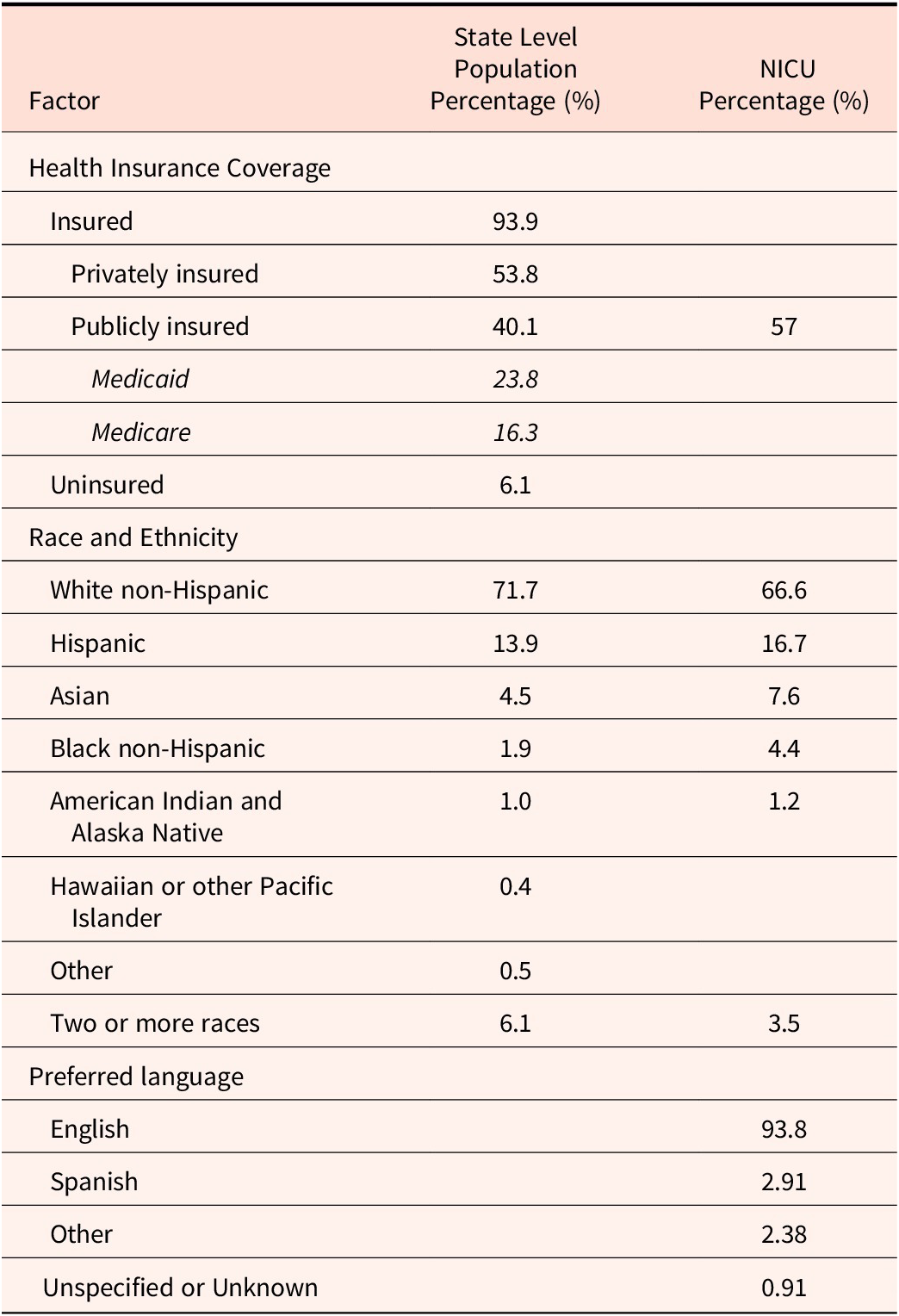
We conducted this study at a children’s academic medical center in the Pacific Northwest. The academic medical center supports a NICU and fetal care program, both of which share the neonatal MLP. The NICU is a level 4, 45-bed, pod-style unit with approximately 700 annual admissions. Approximately 57% of NICU patients are publicly insured. The fetal care program serves approximately 450 pregnant people annually, offering care for rare and complex fetal conditions.
In Oregon, approximately 6.1% of the population lacks health care coverage. Of the 93.9% of the population with health insurance, more than a third (40.1%) are publicly insured, with 16.3% of those covered by Medicaid and 23.8% by Medicare. 14 Oregon has minimal racial and ethnic diversity, with a large majority identifying as white and non-Hispanic (Table 1). According to the 2020 Census data, approximately 15% of Oregon households reported speaking a non-English language at home as their primary shared language. 15
State level population characteristics (based on 2020–2021 Current Population Survey data) compared to NICU-specific population data (based on 2022 hospital census data)

Table 1. Long description
Beginning at the top, the table lists health insurance coverage factors. State-level insured is 93.9 percent, privately insured 53.8 percent, publicly insured 40.1 percent, Medicaid 23.8 percent, Medicare 16.3 percent, uninsured 6.1 percent. NICU-specific data is only provided for publicly insured at 57 percent. Next, race and ethnicity factors are detailed. State-level percentages: White non-Hispanic 71.7 percent, Hispanic 13.9 percent, Asian 4.5 percent, Black non-Hispanic 1.9 percent, American Indian and Alaska Native 1.0 percent, Hawaiian or other Pacific Islander 0.4 percent, Other 0.5 percent, Two or more races 6.1 percent. NICU-specific percentages: White non-Hispanic 66.6 percent, Hispanic 16.7 percent, Asian 7.6 percent, Black non-Hispanic 4.4 percent, American Indian and Alaska Native 1.2 percent, Two or more races 3.5 percent. No NICU data for Hawaiian or other Pacific Islander or Other. The final section covers preferred language. NICU-specific percentages: English 93.8 percent, Spanish 2.91 percent, Other 2.38 percent, Unspecified or Unknown 0.91 percent. No state-level data for preferred language.
The neonatal MLP is funded through the Department of Pediatrics and is staffed by attorneys who are contracted through the Medical Legal Partnership of Oregon, a statewide nonprofit 501(c)(3) organization that supports community-based MLPs in Oregon.Reference Gievers 11 The MLP includes two part-time attorneys who provide free legal care to low-income families with civil legal needs. Eligible families include those with household incomes at or below 200% of the federal poverty level who receive services through the NICU or fetal care program. Because NICU and fetal care program families are typically engaged with their health care teams for extended periods of time (i.e., weeks to months), health care team members such as social workers and nurses often initially identify legal needs in conversations with families. NICU families also complete a social determinants screener, called the Patient and Family Support Survey, based off the I-HELP framework, which categorizes social determinants of health in the following categories: Income, Housing and utilities, Education and employment, Legal status, and Personal and family stability.Reference Marple 16 The Patient and Family Support Survey asks questions related to childcare, food insecurity, utilities, safe and stable housing, transportation, employment, discrimination, and family violence.
Once potential legal needs are identified, social workers explain and offer MLP services to eligible families. If clients wish to engage services, neonatal MLP attorneys meet with them (virtually or in person) to conduct an in-depth legal intake and make plans to address legal concerns. The neonatal MLP addresses civil rather than criminal matters; however, MLP attorneys do mitigate the downstream impacts of entanglement in the criminal justice system (e.g., barriers to housing or employment). The neonatal MLP also does not address medical malpractice claims or immigration cases, though MLP attorneys can provide civil legal care and referrals to immigration specialists when needed. Examples of civil legal needs the neonatal MLP addresses include navigating custody agreements, child support, family violence, social security benefit denials, criminal record expungement, and housing eviction and habitability.
For this study, we used a purposive sampling approach to identify potential participants through the neonatal MLP database housed in REDCap, a secure, HIPAA-compliant web-based application. Eligible participants included English- or Spanish-speaking clients who completed MLP services through the NICU and/or fetal care program from October 2020–March 2023. Any client with an open MLP case, whose infant was still in the NICU, who did not speak English or Spanish, whose infant had died, or whose infant was not in their legal custody was not invited to participate. All participants provided verbal consent and received a gift card in appreciation for their contributions. This study was approved by the Oregon Health and Science University Institutional Review Board #24452.
Data Collection
From October 2022–May 2023, paid research assistant not involved in clinical care or delivery of the neonatal MLP services conducted qualitative interviews via telephone using a structured interview guide. The interview guide included questions about: (1) motivations to participate in and accessibility of MLP services; (2) experiences of working with MLP staff; (3) satisfaction with and helpfulness of MLP services; (4) perceived impact of the MLP on the family’s NICU and/or fetal care program experience; (5) perceived impact of the MLP on family health and well-being; and (6) suggestions for improvement. Participants also answered demographic questions about parent(s) and infant race and ethnicity, parent education, and parent preferred language. All interviews were audio recorded, transcribed, and checked for accuracy. The study team maintained an audit trail and met regularly throughout data collection to identify and address barriers to study completion.
Data Analysis
We conducted a reflexive thematic analysis using an inductive approach at a semantic level.Reference Braun and Clarke 17 Study transcripts were uploaded to the Dedoose web application to assist with data management. Three members of the study team independently open coded two transcripts, then met to develop a shared coding scheme. We then applied codes to the remainder of the transcripts, ensuring that each transcript was double coded. We met regularly to discuss and reconcile codes, which occasionally resulted in the addition of codes. Once all transcripts were coded, we collapsed codes into preliminary themes, prioritizing those with resonance to our research questions. We then met as a team to finalize the results.
Results
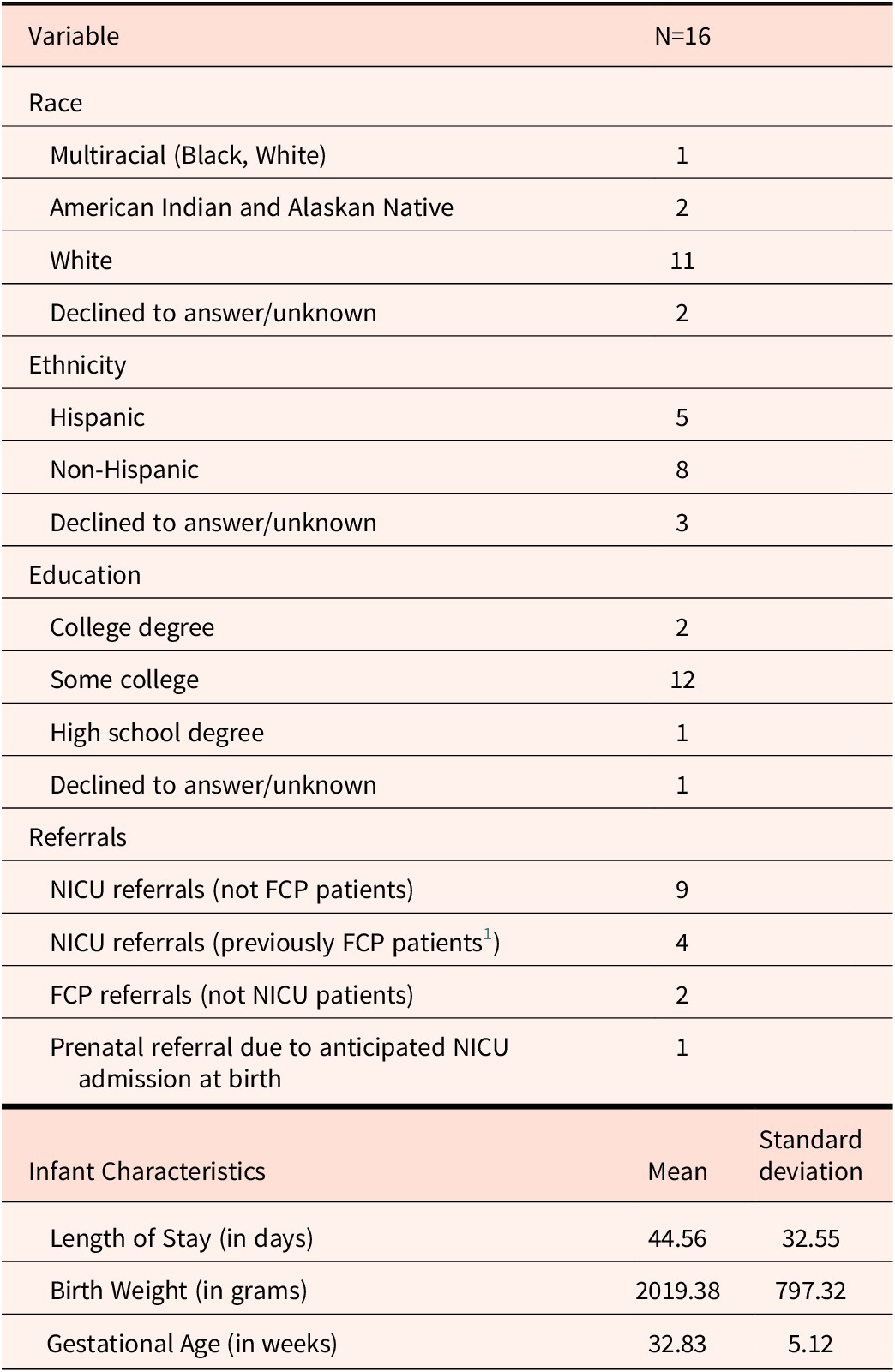
Sixteen of thirty-one eligible clients who had completed the neonatal MLP agreed to participate in this study. Thirteen were referred to the neonatal MLP through the NICU, two through the fetal care program, and one through regular prenatal care. Regardless of referral source, fourteen were ultimately NICU patient families. Among participants, eleven identified as white, two as American Indian or Alaska Native, one as multiracial (Black, white), and two unknown/declined to answer. Half identified as non-Hispanic, five as Hispanic, and three unknown/declined to answer. All participants preferred to participate in English and 88% had attended at least some college. Per neonatal MLP eligibility requirements, all participants received public health insurance and/or had a household income at or below 200% of the federal poverty level (Table 2).
Characteristics of Parent-Infant Dyads

Table 2. Long description
Starting from the top, the first table lists parent-infant dyad variables. Race is divided into Multiracial (Black, White) with 1, American Indian and Alaskan Native with 2, White with 11, and Declined to answer or unknown with 2. Ethnicity includes Hispanic with 5, Non-Hispanic with 8, and Declined to answer or unknown with 3. Education is grouped as College degree with 2, Some college with 12, High school degree with 1, and Declined to answer or unknown with 1. Referral types are NICU referrals (not F C P patients) with 9, NICU referrals (previously F C P patients) with 4, F C P referrals (not NICU patients) with 2, and Prenatal referral due to anticipated NICU admission at birth with 1. The second table presents infant characteristics: Length of stay in days has a mean of 44.56 and standard deviation of 32.55, Birth weight in grams has a mean of 2019.38 and standard deviation of 797.32, Gestational age in weeks has a mean of 32.83 and standard deviation of 5.12. The note at the bottom clarifies that the M L P was expanded to include fetal care program patients in 2021; previously, recruitment was only from the NICU.
Note: We expanded the MLP to include fetal care program patients in 2021. Prior to this, we only recruited from the NICU.
Through our thematic analysis, we identified the following four themes: (1) neonatal MLP facilitates holistic, interdisciplinary health care; (2) therapeutic and supportive legal care mitigates parental distress; (3) neonatal MLP addresses structural barriers to family stability; and (4) neonatal MLP would be improved by increased transparency, capacity, and visibility within the NICU and fetal care program.
Neonatal MLP Facilitates Holistic, Interdisciplinary Health Care
Participants described professional collaboration on their behalf that resulted in comprehensive, connected care across disciplines. Most participants said they learned about the neonatal MLP through NICU social workers, while others were referred by bedside nurses and physicians. Participants appreciated how the attorneys coordinated with the health care team, sometimes even coming to participants’ hospital rooms between medical appointments. One participant described how her infant’s primary nurse coordinated with the MLP around hospital safety and navigating family violence.
I had a weird situation with the child’s father where I had a restraining order against him. Just through talking with … my son’s primary [nurse], while we were in the NICU, I was informed that I could receive some assistance and get some legal guidance about a few orders … [The attorney] was able to look in the court systems … and see if my ex did have the restraining order still or if he had a warrant, how it would all play out if he came to visit. [The attorney] helped facilitate with my primary nurse and charge nurse when he did come up to visit. (Participant 4)
The integration of an MLP into a NICU and fetal care program created an environment within the health care system where participants experienced interconnected care between a team of physicians, nurses, social workers, and attorneys. Participant 6 said, “I just thought that it was neat that they [MLP attorneys] were part of the care team.” Participants sensed that health care providers and attorneys were working together to support them and appreciated the communication that occurred between the health and legal care teams. Another participant described the support she felt through this collaborative approach:
They’re all really supportive. They are all, they’re there for the right reasons. Same thing with every single person who walks through the NICU, whether they’re a volunteer, a nurse, an LPN [Licensed Practical Nurse], whatever they are. They are there to build up the people that are living their worst nightmare. (Participant 10)
Therapeutic and Supportive Legal Care Mitigates Parental Distress
In addition to the distress associated with having an infant requiring extended NICU hospitalization, many participants described the oppressive nature of needs outside the hospital. They described the weight of constant worry about housing, custody disputes and paternity, family violence, and/or the ability to maintain employment. Moreover, they explained that these pervasive worries prevented them from focusing on supporting their infant’s NICU journey. Participants felt that the attorneys’ legal care eased their distress and freed them to focus on their infant’s well-being. One participant said about the neonatal MLP:
It took a lot of stress off our shoulders … They [MLP attorneys] got us to the right resources to be able to assist us to be able to take care of all the things that needed to be taken care of and put our minds at ease that we could figure everything out. We just had to focus on [baby] and getting her better … We didn’t have to worry about anything else because they were there. (Participant 10)
Participants explained that having access to MLP attorneys who could give practical, actionable assistance provided reassurance and comfort. This reassurance seemed to accompany just knowing the neonatal MLP existed and could be accessed even after infant discharge from the NICU. They explained how accessibility directly impacted their mental health and parenting.
[The MLP] gave me that sense of security that everything’s going to be all right. It calmed my nerves. It kept me feeling safe in a place that was so unknown…There was so much good love and kindness and tolerance. No one was judgmental … For me, my anxiety stems from fear … so things like [MLPs] influence a positive reaction. When I have resources, I know how to put them into work and then that’s calming fears, so it’s less stress. You see that in the way I’m parenting and the way that I’m operating just as a member in our society. (Participant 6)
Some participants also described how they felt that the presence of the MLP strengthened the health care team’s ability to respond to them with compassion, respect, and encouragement. They believed that the team was more sensitive to them since they better understood their social and legal needs. For instance, one participant described feeling supported in her sobriety after working with the neonatal MLP:
I said that I was an ex-addict for so many years, and [a team member] was like, “You’re sober and you’re having a kid? We’re so fucking proud of you. Congratulations.” … It made me feel like I actually could come and be like, ‘Hey, I’m actually struggling. Can I get some help?’ (Participant 3)
Neonatal MLP Addresses Structural Barriers to Family Stability
Participants shared numerous stories of how systemic failures and legal entanglements contributed to poor health and family outcomes. Participants were exasperated trying to find stable housing, navigate custody disputes, apply for family leave, establish paternity, understand legal procedures related to divorce and separation, and expunge qualifying criminal records. Participants described how the neonatal MLP attorneys’ legal care effectively targeted some of those structural barriers in meaningful ways. One participant explained that they had difficulty securing housing due to property debt in another state. Through the neonatal MLP assistance, the family of five was able to move from a small trailer to a three-bedroom home.
[The attorneys] set us up with a bunch of resources, so we were able to get help with getting housing up here. We were able to get all of our property debt paid off. We were able to land somewhere solid because of the help they gave us … We had to put a lot of hard work into it. But at the end of the day, they handed us our ability to be stable and our ability to provide a warm environment for [baby] to grow and for the things that the doctors want her to do. We couldn’t have done that without them offering the help that they did. (Participant 10)
In many cases, participants shared difficult family dynamics that made home life unstable and even dangerous at times. Legal care helped some of those families understand their rights to safety and enabled them to protect their families in ways that made sense to them.
I think that [MLP] is excellent…They [MLP attorneys] were able to fill out a letter about getting out of our house and getting into somewhere else and getting us into a program that helped us with our moving fees and things like that so that we were able to flee that domestic violence situation. Because I mean, it was very, very dangerous for my son to go back home at that point. (Participant 16)
Participants also explained the long-term positive impacts of working with the neonatal MLP. The attorneys’ ability to share knowledge about rights and legal processes in accessible ways stayed with participants after their babies left the NICU, and they were able to apply that knowledge to address other structural barriers. Some participants poignantly explained how the MLP helped restore some trust in the health care system and build skills to navigate structural barriers.
To have that trust revived through the care I got at [hospital] and through the help of the attorneys was a big boost and really taught me, “Oh, okay, there are resources and things and just to ask. Ask questions and ask for help when it’s needed. Usually there’s a way for health care workers, or in this case, the attorneys to come through and find resources and help you with what you’re needing.” It really helped me to advocate for myself with my future journey. I’ve been in chemo, radiation, all that kind of stuff … multiple surgeries the past two years or a year and a half since this occurrence. I felt more comfortable talking and asking for resources after this experience. So yeah, definitely helped me far beyond the service provided and far beyond that situation. (Participant 5)
Neonatal MLP Needs More Transparency, Capacity, and Visibility Within the NICU and Fetal Care Program
While participants shared ways that the neonatal MLP supported them, they also gave suggestions for how it could be improved. They expressed the need for more transparency, specifically related to what kinds of legal care the neonatal MLP could provide. Some participants explained that knowing upfront about the types of cases and legal issues the attorneys could help with would help them manage their expectations. For instance, some participants did not initially understand that tending to felony criminal matters, potential malpractice situations, or explicit immigration concerns was beyond the scope and/or expertise of MLP attorneys. This misunderstanding was reflected in one participant’s disappointment that the neonatal MLP could not address a legal conflict she experienced with the hospital:
I think that the hospital could really benefit from having [the MLP] assist people in dealing with the hospital because I think that [my experience] could have gone very differently with the hospital had the hospital been in communication with some of the things that they maybe could have done better legally. (Participant 16)
Additionally, participants believed that the neonatal MLP should be expanded but were mindful of limitations to program capacity. One participant observed how difficult it would be to expand services with only two part-time attorneys but also pointed to the need for more diverse representation.
From a racial standpoint, I think that diversity amongst [the attorneys] is hugely important … they were racially informed as much as a white person can be. But having more people of color involved … for a person of color, it can be difficult to interact with anybody in a legal standpoint because we’re quite literally gun shy in a lot of ways. Not something that’s easy for us to reach out for. Making that more accessible by having conversations and discourse with people of color and having more people of color on their team, I think could be really, really helpful. (Participant 16)
Participants believed significant need existed for the MLP among NICU and fetal care program families and that continuation, and even expansion, of the MLP was important. Participants voiced desires for improved visibility and accessibility of MLP services to all families. Participants understood that income requirements dictated eligibility for MLP services, but they felt the existence of the neonatal MLP and its eligibility criteria should be more apparent to NICU and fetal care program families. One participant said:
Please keep this program going because even if maybe at first glance, you would think, “Oh, this person may not need legal help,” you might be surprised what you uncover when you ask, the stuff that people need help with. My deepest hope is that you keep this going for other NICU parents because it is an incredibly challenging time. Things are very vulnerable. All the NICU parents I knew were absolutely financially devastated by the situation…Having this resource could really make a difference in people’s lives. (Participant 5)
Discussion
This paper describes the qualitative study of a neonatal MLP in the novel settings of a NICU and fetal care program. These settings offer unique opportunities for MLPs due to the extended time families interact and build relationships with health care teams. Further, in NICU and fetal care program settings, a neonatal MLP can intervene in the lives of infants and their families from the earliest of days, thereby potentially mitigating the negative impacts of inadequate social safety nets and ultimately reducing disparities across multiple domains. Our findings suggest that the neonatal MLP alleviated parental distress and improved the health care system’s provision of coordinated and compassionate care. This innovative approach offered practical ways to address unfavorable social determinants of health and health-harming legal needs, thus improving family stability. Participants benefited from the MLP and appreciated the ability to participate in the program. They suggested increasing transparency around eligibility for services and the types of legal care offered, as well as improving visibility and capacity to benefit more diverse families.
Decades of research demonstrate the importance of parental mental health for optimal infant development, health, and well-being.Reference Bernardo 18 However, national data reflect a growing mental health crisis among parents in the perinatal period, risks that are exacerbated among families who receive NICU or fetal therapy care. Parents of NICU-hospitalized infants have high risk for perinatal mood and anxiety disorders,Reference De Magistris, Nguyen and Wyatt 19 post-traumatic stress disorder, and other forms of emotional distress.Reference Kawafha and Pavlyshyn 20 Maternal mental illness, including suicide and substance abuse, is the leading cause of pregnancy-associated mortality in the United States.Reference Campbell and Chin 21
Our study reflected this alarming trend as participants described feeling stressed, afraid, traumatized, and overwhelmed by navigating multiple challenges outside of the hospital while simultaneously wanting and needing to care for their infants. Participants felt the MLP provided relief from emotional distress and freed them to focus on their infants. Participants also described how access to legal and social care helped them feel more secure, including participants experiencing intimate partner and family violence, which research suggests is under discussed among providers despite its presence in NICU settings.Reference Mead and Klawetter 22 Results from a study of civil legal problems among low-income families found that 44% of low-income families with children under age 12 experienced at least one civil legal problem related to family and safety. The most common type of civil legal problem in this category was domestic violence (10%), followed by difficulty with child support payment or collection (9%), and separation or divorce (9%). 23 Our results align with this data and demonstrate that providing legal care and addressing harmful social determinants are important ways to improve parental mental health and mitigate distress among families who receive health care in acute inpatient pediatric settings.
An important finding was that a neonatal MLP may help facilitate more effective interdisciplinary communication and coordinated care. Because the integration of attorneys on health care teams is a relatively new practice, team members cannot rely on historical understandings of each others’ roles and ways of working together. They must learn the practices and perspectives of each discipline, which ultimately helps the whole team see clients more holistically and recognize multiple potential levers of change. Participants experienced the interdisciplinary work of the neonatal MLP as more personalized care that ultimately instilled trust and a perception that competent, caring professionals were working together on their behalf. This finding aligns with recent qualitative work exploring provider and parent perceptions of a pediatric MLP, which found that the MLP helped facilitate improved relationships between providers and parents.Reference Mainardi 9
Extensive literature points to the importance of social determinants to human health and well-being.Reference Galea 24 Medical care, such as that provided in a NICU, is necessary to treat illness. In isolation, however, it neglects social determinants like safe and stable housing, a living wage, accessible transportation, affordable childcare, quality education, and a sense of community and belonging.Reference Galea 24 These factors shape and protect human health over the course of lifetimes and generations. Recently, NICUs have joined other pediatric settings (e.g., outpatient pediatric primary care) to test strategies around recognizing and responding to harmful social determinants among their patients.Reference Parker and Sokol 25 Our study contributes an additional innovative approach to intervening in social determinants in this population. Participants described how the neonatal MLP was able to fortify the social structure holding families together through actions like remediating longstanding debt, securing family leave, and creating safer family environments. Additionally, the MLP may counteract “empty screening”—or screening without the intention and/or ability to meaningfully respond.
As evidence grows to support MLPs in inpatient pediatric settings, our study points to their value and ways to potentially improve implementation. MLPs should be careful to present clear expectations about how to access services and what types of legal care are available. Our findings align with calls for the prioritization of health equity in implementation and service delivery.Reference Moore 26 In the neonatal MLP, legal care was not available to all families due to income ineligibility or case matter outside of MLP attorney expertise. Programs such as this must ensure that all potential clients are aware of resources. They must also contend with how to support families on the threshold of eligibility but whom ultimately do not qualify. Study participants emphatically hoped that MLP services would continue and expand to provide access to more diverse families. As NICUs, fetal care programs, and other health care settings consider integrating and expanding MLPs, they must balance the need for such programs with limitations in capacity and resources.
Strengths of this study are its attention to families often underrepresented in research: families with low socioeconomic position, marginalized families with legal entanglements, and a high-risk pediatric population. While qualitative studies are not intended to produce generalizable results, our study contributes to the evidence base for MLPs and may inform efforts to prioritize social and legal care programs. Because our sample only included clients who had completed their participation with the neonatal MLP, some participants had difficulty recalling specific elements of the MLP experience. For instance, some participants had difficulty distinguishing members of the health care team (e.g., social workers) from the neonatal MLP team (e.g., attorneys) due to the level of integration. Our study sample lacks racial diversity, and although we offered to conduct interviews in Spanish, none of the participants completed interviews in Spanish.
In conclusion, partnerships between health care and legal systems offer a promising approach to address complex, persistent fractures in social systems that negatively impact families, including those with infants requiring intensive or other high acuity care. The integration of an MLP into a NICU and fetal care program is an innovative application of this evidence-based approach. Qualitative methods allowed the gathering of firsthand accounts and perspectives of marginalized and often unheard families. This study underscores the value of strengthening the social environments and systems that impact families through the interventions of MLPs. While NICUs have sophisticated lifesaving medical technology, they must also care holistically for the families and communities that will ultimately nurture these infants as they grow. Neonatal MLPs may allow health care settings to meaningfully intervene in unfavorable social determinants of health and health-harming legal needs by facilitating better health care, improving parental mental health, and mitigating structural barriers to longterm family stability.
Acknowledgements
We wish to acknowledge the NICU/FCP families who participated in the MLP and this study. None of this work is possible without the skill and dedication of our MLP attorneys, Beatrice Roger and Laura Russell.
Funding
This work is supported by the Cambia Health Foundation. This work is also supported in part by the National Institute of Mental Health (#K08MH127519), National Center for Advancing Translational Sciences (#TL1TR00237), German Academic Exchange Service, and Graduate School of the Faculty of Human Sciences at the University of Cologne, Germany. The content is solely the responsibility of the authors and does not necessarily represent the official views of the Cambia Health Foundation, National Institutes of Health, German Academic Exchange Service, or University of Cologne, Germany. The funders played no role in the writing of this manuscript or in the decision to submit the article for publication. The content is solely the responsibility of the authors and does not necessarily represent the official views of the NIH. None of the data have been previously published.