‘If it had been a LEG or something or if it had to be amputated, then people would say, “okay, well YES, that person has a disability”, but you know, you look at me, I'm healthy, [They say] “what's wrong with her?”. . . I think, yeah, the hardest part for me of having the aneurism was. . . .dealing with other people’. (Young stroke survivor cited in Stone, Reference Stone2005, p. 301)
Stroke is one of the most common causes of long-term disability in adults worldwide (Feigin, Lawes, Bennett, & Anderson, Reference Feigin, Lawes, Bennett and Anderson2003; Tyrrell & Smithard, Reference Tyrrell and Smithard2005). In addition to physical symptoms such as muscle weakness, stroke survivors often experience adverse psychological outcomes (Campbell Burton et al., Reference Campbell Burton, Murray, Holmes, Astin, Greenwood and Knapp2013; Carod-Artal, Reference Carod-Artal2010; Knapp, Reference Knapp, Williams, Perry and Watkins2010; Paranthaman & Baldwin, Reference Paranthaman and Baldwin2006; Teasell, McRae, & Finestone, Reference Teasell, McRae and Finestone2000; Tyrrell & Smithard, Reference Tyrrell and Smithard2005).
For instance, depression is the most prevalent psychiatric condition after a stroke (Carod-Artal, Reference Carod-Artal2010; Dam, Reference Dam2001; Hackett, Yapa, Parag, & Anderson, Reference Hackett, Yapa, Parag and Anderson2005) and is associated with many negative outcomes, including reduced engagement in rehabilitation, longer hospital stays, impaired social functioning and inability to return to work (Carod-Artal, Trizotto, Coral, & Moreira, Reference Carod-Artal, Trizotto, Coral and Moreira2009; Mayo et al., Reference Mayo, Anderson, Barclay, Cameron, Desrosiers, Eng and Richards2015; Turner-Stokes & Hassan, Reference Turner-Stokes and Hassan2002). Fatigue is also common in stroke survivors and causes difficulties such as not being able to return to work fulltime or do housework (Duncan et al., Reference Duncan, Greig, Lewis, Dennis, MacLullich, Sharpe and Mead2014; Staub & Bogousslavsky, Reference Staub and Bogousslavsky2001; Tyrrell & Smithard, Reference Tyrrell and Smithard2005; Wu, Mead, Macleod, & Chalder, Reference Wu, Mead, Macleod and Chalder2015). The negative effects of depression and fatigue are augmented when they result from invisible conditions such as stroke, because people often fail to realise that these symptoms result from the stroke (Davis, Reference Davis2005; Murray & Harrison, Reference Murray and Harrison2004; Stone, Reference Stone2005). This issue is a key focus of this paper.
Stroke Incidence in Young People
Stroke has traditionally been regarded as a disease of old age and as an uncommon event in people younger than 45 (Feigin, Lawes, Bennett, Barker-Collo, & Parag, Reference Feigin, Lawes, Bennett, Barker-Collo and Parag2009; Groppo et al., Reference Groppo, De Gennaro, Granieri, Fazio, Cesnik, Granieri and Casetta2012). This belief is not without warrant, as stroke risk increases with age (Feigin et al., Reference Feigin, Lawes, Bennett and Anderson2003). However, stroke incidence is increasing in young adults, reflecting a trend towards an earlier age of onset in stroke (Feigin et al., Reference Feigin, Lawes, Bennett, Barker-Collo and Parag2009; Maaijwee, Rutten-Jacobs, Schaapsmeerders, van Dijk, & de Leeuw, Reference Maaijwee, Rutten-Jacobs, Schaapsmeerders, van Dijk and de Leeuw2014; Röding, Lindström, Malm, & Öhman, Reference Röding, Linderström, Malm and Öhman2003).
Stroke in young survivors occurs at a stage when most people form families and make career decisions, and may lead to loss of home and spouse, family conflict and unemployment (Kim et al., Reference Kim, Choi-Kwon, Kwon, Lee, Park and Seo2005; Morris, Reference Morris2011; Rutten-Jacobs et al., Reference Rutten-Jacobs, Maaijwee, Arntz, van Alebeek, Schaapsmeerders, Schoonderwaldt and de Leeuw2011; Teasell et al., Reference Teasell, McRae and Finestone2000). Young stroke survivors face the challenge of coping with the peculiarity of suffering an ‘older person's disease’ at an early age (Stone, Reference Stone2005; Wolfenden & Grace, Reference Wolfenden and Grace2012). Stroke in young adults often has haemorrhagic origins, and symptoms include invisible effects such as fatigue (Lawrence, Reference Lawrence2010; Maaijwee et al., Reference Maaijwee, Rutten-Jacobs, Schaapsmeerders, van Dijk and de Leeuw2014; Stone, Reference Stone2005).
Misconceptions and Misattributions about Survivors of Stroke and TBI
Several researchers have applied psychological theories to disabilities (Dunn & Elliott, Reference Dunn and Elliott2005, Reference Dunn and Elliott2008; Irwin & Fortune, Reference Irwin and Fortune2014) and to rehabilitation for stroke survivors (Davis, Egan, Dubouloz, Kubina, & Kessler, Reference Davis, Egan, Dubouloz, Kubina and Kessler2013; Grant, Elliott, Weaver, Bartolucci, & Giger, Reference Grant, Elliott, Weaver, Bartolucci and Giger2002; Smith, Egbert, Dellman-Jenkins, Nanna, & Palmieri, Reference Smith, Egbert, Dellman-Jenkins, Nanna and Palmieri2012). Several of these theories have revealed factors that lead people to have misconceptions about persons with TBI and stroke, especially with young survivors (e.g., Lawrence, Reference Lawrence2010; Stone, Reference Stone2005). There are three main factors leading to these misconceptions. First, because young stroke survivors often have no visible markers of their disabilities and people see stroke as a disease of old age, people tend to see young stroke survivors as able rather than disabled and expect too much of them (Lawrence, Reference Lawrence2010). People discount the survivors’ invisible disabilities and judge them as ‘lazy, incompetent or something else equally derogatory’ (Stone, Reference Stone2005, p. 295). In contrast with the stigma that results from visible disabilities (Corrigan, Reference Corrigan2004; Goffman, Reference Goffman1963; Major & O'Brien, Reference Major and O'Brien2005), stigmatising reactions to invisible disabilities such as traumatic brain injury (TBI) and stroke reflect the invisibility of the condition.
A second factor underlying misconceptions about invisible conditions such as stroke is that knowledge about stroke among the public is low (Pontes-Neto et al., Reference Pontes-Neto, Silva, Feitosa, De Figueiredo, Fiorot, Rocha and Leite2008; Rodgers et al., Reference Rodgers, Atkinson, Bond, Suddes, Dobson and Curless1999; Sullivan & Waugh, Reference Sullivan and Waugh2005). Research suggests that the general public hold misconceptions about physical, cognitive and speech disabilities that result from stroke (Sullivan & Waugh, Reference Sullivan and Waugh2005). This includes their understanding of stroke, treatment, risk factors for stroke and post stroke symptoms (Mackenzie et al., Reference Mackenzie, Perry, Lockhart, Cottee, Cloud and Mann2007; Wellwood, Martin, & Warlow, Reference Wellwood, Dennis and Warlow1994). Even stroke survivors and their families often have poor knowledge about stroke (Clark & Smith, Reference Clark and Smith1998). Because people lack this knowledge, they are often unaware that behavioural and psychological symptoms result from these conditions (e.g., tiredness, aggression, lack of motivation) (Farmer & Johnson-Gerard, Reference Farmer and Johnson-Gerard1997; Garcia, Hahn, Magasi, Lai, & Hammel, Reference Garcia, Hahn, Magasi, Lai and Hammel2015; Wolfenden & Grace, Reference Wolfenden and Grace2012). With TBI, this lack of knowledge leads people to misattribute symptoms and behaviours resulting from the injury to other factors such as age-related norms or personality (Block, West, & Goldin, Reference Block, West and Goldin2016; Krahn, Reference Krahn, Clausen and Levy2015; McClure, Reference McClure2011; McClure, Devlin, McDowall, & Wade, Reference McClure, Devlin, McDowall and Wade2006; McClure, Buchanan, McDowall, & Wade, Reference McClure, Buchanan, McDowall and Wade2008; McClure & Abbott, Reference McClure and Abbott2009; McClure, Patel, & Wade, Reference McClure, Patel and Wade2011; Swift & Wilson, Reference Swift and Wilson2001). People thus fail to allow for the TBI as a reason for the person's undesirable symptoms (McClure, Reference McClure2011). A similar process may apply with stroke.
A third reason why people misattribute behaviours and symptoms resulting from invisible conditions such as TBI and stroke is that these symptoms (e.g., depression, fatigue) are ambiguous and may result from other factors such as personality and age (Farmer & Johnson-Gerard, Reference Farmer and Johnson-Gerard1997). People's attributions for ambiguous symptoms often reflect information that is accessible (Tversky & Kahneman, Reference Tversky and Kahneman1974) and salient (Fiske, Kenny, & Taylor, Reference Fiske, Kenny and Taylor1982). Most people experience persons with negative personalities more than persons with TBI, so the salience of these personalities lead people to attribute negative behaviours and symptoms to personality rather than TBI (McClure et al., Reference McClure, Devlin, McDowall and Wade2006). For example, when a male adolescent with TBI had no visible signs of the injury, people attributed his undesirable behaviours to adolescence, whereas when he had markers of the injury (e.g., a head scar), people attributed these behaviours more to the injury (e.g., McClure et al., Reference McClure, Devlin, McDowall and Wade2006). This attribution pattern is strongest when people are unfamiliar with TBI (Foster, McClure, McDowall, & Crawford, Reference Foster, McClure, McDowall and Crawford2013; Linden & McClure, Reference Linden and McClure2012).
Consequences of Misconceptions about Survivors of Stroke and TBI
The consequences of this failure to allow for the effects of the injury with invisible conditions such as TBI contrasts with visible disabilities, where stigma occurs because people infer that persons with these disabilities lack many abilities and discriminate against them (Corrigan, Reference Corrigan2004; Goffman, Reference Goffman1963; Major & O'Brien, Reference Major and O'Brien2005). For example, employers are less likely to appoint these persons to a position (Gouvier, Steiner, Jackson, Schlater, & Rain, Reference Gouvier, Steiner, Jackson, Schlater and Rain1991; Ravaud, Madiot, & Ville, Reference Ravaud, Madiot and Ville1992). In contrast, with invisible disabilities, people's ignorance of the invisible cause of problem symptoms and behaviours leads to the negative outcomes (McClure, Reference McClure2011).
This pattern of attributing the effects of invisible conditions to other causes has other negative consequences for survivors and their caregivers, including frustration and feeling misunderstood, unrealistic hopes and strategies for rehabilitation and poorer family functioning (Chamberlain, Reference Chamberlain2006; Guilmette & Paglia, Reference Guilmette and Paglia2004; McClure, Reference McClure2011; Swift & Wilson, Reference Swift and Wilson2001). Young stroke survivors experience frustration and fear as a result of people's failure to misunderstand the cause of their stroke symptoms (Lawrence, Reference Lawrence2010; Lingsom, Reference Lingsom2008; Röding et al., Reference Röding, Linderström, Malm and Öhman2003; Stone, Reference Stone2005). These young stroke survivors describe how this misunderstanding reflects the invisibility of their disability along with people's belief that stroke is a disease of old age. This discounting of the real cause of their symptoms leads survivors to experience frustration (Lingsom, Reference Lingsom2008; Stone, Reference Stone2005). It also hinders them in establishing social relationships and reintegration into society.
There is little research on what underlies these misconceptions about stroke and its consequences and symptoms (Lawrence, Reference Lawrence2010; Lingsom, Reference Lingsom2008; Röding et al., Reference Röding, Linderström, Malm and Öhman2003; Stone, Reference Stone2005). In particular, few studies have examined the attributional basis for people's misconceptions about psychological outcomes of stroke such as depression, irritability and loss of social networks. This is the focus of the current study. As with TBI, the ambiguity of stroke symptoms may lead people to misattribute the causes of the negative symptoms. People who lack knowledge about stroke may thus attribute the outcomes of stroke to more available causes (age and personality) rather than to the unfamiliar stroke. We propose that these misattributions result from the invisibility of the cause of the symptoms, in contrast to effects resulting with visible disabilities.
The Current Study
The present study extends the research on misconceptions about invisible disorders by applying an attributional model to people's perceptions of the symptoms resulting from stroke. Specifically, the study examines whether a similar maladaptive pattern of attributions to that shown with TBI occurs with stroke, particularly with young survivors. Although research has shown people's lack of knowledge about stroke and their perception of stroke as an ‘old age’ disease, no research has examined whether people attribute stroke symptoms to other causes or whether the age of the stroke survivor affects these attributions. To address this important issue, we investigated people's attributions for symptoms that can result from stroke with survivors in different age groups.
This study used scenarios that described symptoms that often result from a stroke (an increase in depression, fatigue, irritability and loss of social networks) and examined attributions made by the general public for these symptoms. We deliberately made no mention of the stroke itself in the scenario, lest this information swamp other attributions. Based on the finding that knowledge of stroke is low amongst the general public, we predicted that participants would attribute the four symptoms more to age and/or personality more than to stroke. We further predicted that these attributions would differ depending on the age of the person showing the symptoms. Specifically, we predicted that participants would attribute symptoms of a young male (22 year old) stroke survivor to personality more than to his age or to a stroke, whereas they would attribute the same symptoms of an older (72 year old) stroke survivor more to his age than to his personality or a stroke. For the ‘age unstated’ control condition, we predicted that participants would attribute symptoms more to age than to personality or to stroke.
Method
Participants
The researcher approached participants (N = 120) at public locations such as parks around Wellington and busy street areas (e.g., Courtenay Place, Willis Street and Lambton Quay), and invited them to complete the study. About half the participants (57) reported experience of persons with stroke (47.5%). The participants’ age was as follows: 75 were 25 and under, 62%; 27 were 26–40, 22%; 16 were 41–55, 13%; two were 56 or older, 2% and 64 (52%) were female and 56 male (48%). Participants under 18 were excluded.
Design
The current study used a cross-sectional design which examined participants’ attributions for changes in four symptoms of a hypothetical stroke survivor in three conditions varying the survivor's age (22 years old, 72 years old and age unstated). We chose these ages as they clearly indicated a younger and older person and were specific. There were 40 participants in each of these three age conditions (i.e., 22 years, etc.). In order to avoid potential confounding variables (e.g., effects of weather and day of the week on mood), surveys were distributed in a sequence that allowed all three conditions to be completed at the same time.
Materials
Instructions explained that the research was about attributions for a male who has experienced four changes in behaviour. These instructions were followed by a scenario describing a stroke survivor who showed four of the more common stroke symptoms noted above (e.g., Mauo et al., Reference Mayo, Anderson, Barclay, Cameron, Desrosiers, Eng and Richards2015). For consistency with previous research on misattributions of TBI symptoms (e.g., McClure et al., Reference McClure, Devlin, McDowall and Wade2006) and reflecting recent reports of young males experiencing a stroke (Appendix 1), we described the stroke survivor as a male (Michael). The four changes displayed by Michael were symptoms that are typical after a stroke: depression, fatigue, reduced social network and irritability. These symptoms were also selected because they are ambiguous and can be attributed to other causes such as personality and age-related norms (Paranthaman & Baldwin, Reference Paranthaman and Baldwin2006; Snyder et al., Reference Snyder, Kleck, Strenta and Mentzer1979). The age of Michael was altered across the three vignettes (22 year old/72 year old/age unstated), which were otherwise identical. The scenario read:
Michael is a (22 year old/72 year old/age unstated) New Zealand citizen. He had a job with an architectural firm where he had been very successful. He had a real passion for competitive sport and had represented New Zealand in swimming. Daily he had spent several hours exercising. His hobbies included reading, spending time with friends, listening to music and travelling.
Michael now tires very quickly and has to sleep for a few hours each day. He finds exercising difficult as it increases his fatigue levels. He spends very little time with friends and his social group has diminished significantly. Michael has been diagnosed with depression. He often experiences feelings of sadness and no longer finds pleasure in activities that he previously enjoyed. A lower level of tolerance towards other people is now evident and Michael becomes irritable quickly.
The scenario was followed by a questionnaire. First, participants rated how good “age”, “personality” and “stroke” were as explanations for each of the four symptoms. Instructions read, e.g., ‘Please rate all of the following explanations for Michael's increase in depression’ followed by the three attributions: ‘It is likely to be a result of Michael's age’ (or personality or stroke). Participants rated each attribution on a seven-point Likert scale ranging from 1 ‘very poor explanation’ to 7 ‘very good explanation’. Subsequent demographic questions assessed age (25 and under, 26–40, 41–55, 56 or older) gender, and familiarity with stroke (yes or no).
Procedure and Statistical Methodology
Ethics approval was granted by the Victoria University of Wellington Ethics Committee in 2013. All participants gave informed consent. Participants read an information sheet, followed by the vignette before completing the questionnaire. At completion, participants were debriefed, given a chocolate bar and told that the vignette was fictional although based on actual case studies. The information sheet did not mention stroke but the debriefing sheet provided after completing the questionnaire did do this.
Participants were randomly assigned to an age condition in a 3 (age: 22, 72, not stated) × 3 (attribution: age, personality, stroke) × 4 (behaviour: e.g., depression) mixed design analysis of variance run on SPSS software.
Results
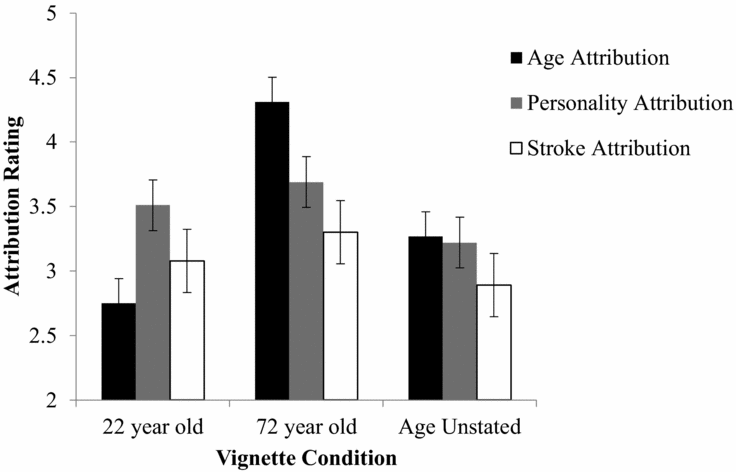
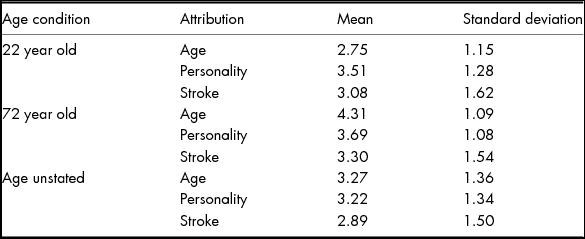
The mean ratings across age conditions are shown in Figure 1 and Table 1. A preliminary mixed design analysis of variance was performed to see if familiarity had an effect: 3 (survivor age: 22, 72, not stated) × 3 (attribution: age, personality, stroke) × 4 (symptom: fatigue, social network, depression, irritability) × familiarity. Survivor age and familiarity are between subjects variables whereas attribution and behaviour are within subjects variables. There were no missing data. Familiarity did not interact with survivor age and attribution, F (4, 228) = 0.25, ns, so the data for familiar and unfamiliar participants were combined in a mixed design analysis of variance: 3 (age: 22, 72, not stated) × 3 (attribution: age, personality, stroke) × 4 (symptom: fatigue, social network, depression, irritability). Analyses of variance also showed no interactions between survivor age, attributions and participant age, F (4, 228) = 0.41, ns or gender, F (4, 228) = 1.35, ns.
Mean ratings of attributions for symptoms of stroke survivor.

Average Ratings of Symptom Attributions for Each Age Condition

As predicted, there was a significant interaction between the age of the survivor in the scenario and participants’ attributions for the symptoms, F (2, 117) = 6.30, p < .01, η 2 = .10. Paired-samples t-tests compared the attributions for each age condition. As shown in Figure 1, when the stroke survivor in the scenario was 22, participants attributed his symptoms to personality more than age; t (39) = −4.03, p < .001, or stroke; t (39) = 2.03, p = < .05, whereas when the stroke survivor was 72, they attributed the symptoms to age more than personality, t (39) = 2.90, p < .01, or stroke, t (39) = 4.12, p > .001, which did not differ from each other, t (39) = 1.43, p > .05. For the ‘age unstated’ survivor, participants attributed symptoms equally to age and personality; t (39) = .31, p > .05 and equally to personality and stroke; t (39) = 1.71, p > .05.
Discussion
This research shows that people attribute symptoms that often result from a stroke more to personality and age than to stroke. This is consistent with previous research showing that people attribute symptoms resulting from TBI to other factors such as age or personality, particularly when the injured individual has no visible symptoms of the injury (McClure et al., Reference McClure, Devlin, McDowall and Wade2006; Reference McClure, Buchanan, McDowall and Wade2008; Reference McClure, Patel and Wade2011). Other research has shown that people misunderstand the symptoms of stroke survivors (Stone, Reference Stone2005; Lingson, Reference Lingsom2008), but has not shown that this misunderstanding reflects an attribution process. The present findings bridge these two lines of research by showing that people attribute several ambiguous symptoms (fatigue, depression, social isolation and irritability) displayed by stroke survivors to other factors.
As predicted, when the scenario described a young stroke survivor (22 years), participants attributed his symptoms more to personality than to age or stroke, whereas when the scenario described the same person as older (72 years), they attributed his symptoms more to age than to personality or stroke. This finding is novel in showing that an individual's age affects people's attributions for symptoms that can result from stroke. This pattern of attributions suggests that when a young person displays an increase in the negative symptoms that often result from stroke, people are likely to attribute these symptoms more to personality than to a stroke. In contrast, when an older person displays these same symptoms, people are likely to attribute these symptoms more to the person's age than a stroke.
Previous qualitative research showed that people failed to link the negative symptoms of young stroke survivors to their stroke and instead linked them to negative personality traits such as laziness or incompetence (Lingsom, Reference Lingsom2008; Stone, Reference Stone2005). The present finding that participants attributed the young person's symptoms more to personality than to stroke is consistent with this previous research and shows that the misunderstanding of stroke symptoms observed in previous studies reflect an attribution process.
The present research is also consistent with findings that people lack knowledge about stroke and its symptoms (Sullivan & Waugh, Reference Sullivan and Waugh2005). The participants did not attribute the described symptoms primarily to a stroke but were more likely to attribute them to other factors, even when the survivor was older (72). It is likely that these attributions reflect the availability of different explanations (Tversky & Kahneman, Reference Tversky and Kahneman1974). Participants are likely to have experienced age-related and personality norms and drawn on this knowledge to explain the symptoms. The result could also reflect participants’ experiences with younger or older adults. However, this is not likely to be a major determinant as participants’ familiarity with stroke survivors had no effect on their attributions. We note that the question on familiarity was deliberately asked at the end of the questionnaire, so is unlikely to have affected responses.
Implications for Rehabilitation and Treatment
Targeting Attributions in Therapy after Stroke
The findings here have clear implications for treatment and rehabilitation of stroke survivors and could have clinically significant positive effects. Research on disorders such as depression has shown that people's maladaptive attributions for events contribute to these disorders and that changing these attributions is one effective strategy for rehabilitation (Dunn & Elliott, Reference Dunn and Elliott2005; Reference Dunn and Elliott2008). For example, if people attribute negative events to specific changeable causes, they cope better with these events (Gibb & Alloy, Reference Gibb and Alloy2006). The present results suggest that people attribute symptoms resulting from stroke to other causes, such as personality in young survivors and age in older persons. Because stroke survivors are likely to encounter these misattributions for their symptoms, rehabilitation should prepare stroke survivors for these situations and develop strategies to deal with them. One strategy is encouraging the stroke survivor (or their therapist) to inform others of their stroke where it would be helpful. People who are familiar with TBI attribute an injured person's symptoms more to the TBI than those who are less familiar (Foster et al., Reference Foster, McClure, McDowall and Crawford2013). The same principle can apply to stroke rehabilitation.
A risk for persons with stroke disclosing their condition is that they may encounter stigma (Corrigan, Reference Corrigan2004; Joachim & Acorn, Reference Joachim and Acorn2000) or people may think they are seeking sympathy (Lingsom, Reference Lingsom2008; Stone, Reference Stone2005). However, in certain situations, it is beneficial for survivors of stroke to disclose their condition so that people know that the problematic symptoms reflect the stroke and can be reduced by rehabilitation, rather than viewing the symptoms as inherent personality traits (Joachim & Acorn, Reference Joachim and Acorn2000; Lingsom, Reference Lingsom2008; Stone, Reference Stone2005). Stroke survivors would then avoid the consequences of people misattributing their symptoms and making no allowance for the stroke as a cause of the symptoms (Irwin & Fortune, Reference Irwin and Fortune2014; McClure, Reference McClure2011). However, the onus for correcting misconceptions should not fall solely on the stroke survivor – public awareness campaigns could also target lack of knowledge about stroke effects.
Different Strategies for Older and Younger Stroke Survivors
The difference in the attributions for younger and older stroke survivors highlights the need for age-specific treatment plans to educate stroke survivors on the misattributions that they are likely to encounter in their daily lives. Rehabilitation plans with younger stroke survivors can inform clients that people may attribute symptoms resulting from the stroke to their personality rather than the stroke. Rehabilitation with these persons often aims to assist them into paid employment (McClure, Reference McClure2011). In this setting, their employer (or colleagues) may attribute symptoms resulting from their stroke to personality traits such as laziness. Therapists can prepare stroke survivors with strategies to deal with these misattributions. For example, they could inform their employer that they have suffered from a stroke and are taking therapy for the relevant symptoms. This may prevent the employer from attributing their low productivity (due to fatigue) to the stroke survivor's personality and penalising them for laziness.
With older stroke survivors, rehabilitation could inform clients that people may attribute symptoms resulting from their stroke to their age, resulting in frustration. As a result of this misattribution, older survivors may not receive the care and assistance that they need. For example, an older individual who has suffered a stroke may have a care giver who is ill-informed about stroke and who sees the stroke survivor's fatigue as a result of their age, thus discounting the stroke survivor's potential for recovery. Therapy can encourage older stroke survivors to inform their carers of the symptoms relating to their stroke so that the carers can respond better to their needs. This strategy may also lessen the burden for caregivers (McClure, Reference McClure2011; Anderson, Linto, & Stewart-Lynne, Reference Anderson, Linto and Stewart-Wynne1995).
Future Research and Limitations
This study has limitations, including the young average age of the sample and the sampling locations. These features may limit the generalisability of the findings. Interestingly, research has shown that older individuals have poorer knowledge regarding stroke symptoms (Jones, Jenkinson, Leathley, & Watkins, Reference Jones, Jenkinson, Leathley and Watkins2009), so they may make more misattributions regarding symptoms of stroke. Regardless, future studies could examine a wider age range of participants. Collecting the data in the Wellington Central Business District area is also a limitation, as individuals with higher levels of education and socio-economic status have greater knowledge of stroke symptoms (Jones et al., Reference Jones, Jenkinson, Leathley and Watkins2009). Future research could canvas a wider range of locations where participants’ education and socio-economic status are more representative of the general population.
The use of a male in the vignette is also a possible limitation, as male and female behaviours are perceived differently due to sex role expectancies (Eagly, Wood, & Diekman, Reference Eagly, Wood, Diekman, Eckes and Trautner2000). The behaviours in the vignettes may be more consistent with perceptions of the personality of a male, and stereotypical gender expectations may have influenced participants’ attributions. This may have led to higher attributions to ‘normal’ factors such as personality or age. For example, irritability may be expected of a male's personality, so the reader would be less likely to attribute it to a stroke, an outcome that is seen as abnormal in younger people (Feigin et al., Reference Feigin, Lawes, Bennett, Barker-Collo and Parag2009; Groppo et al., Reference Groppo, De Gennaro, Granieri, Fazio, Cesnik, Granieri and Casetta2012). In addition, the design offered participants a limited choice of attributions; results may differ if other attributions such as drugs or a relationship break-up are offered as options. The choice of attributions offered here was based on previous findings of misconceptions about stroke (e.g., Stone, Reference Stone2005).
The design is cross-sectional and does not show longitudinal effects and there was no control scenario that did not specify problematic symptoms. A further issue is that visible symptoms (e.g., facial droop and one-sided paralysis) in young stroke survivors are uncommon (Stone, Reference Stone2005), but research could examine participants’ attributions when some stroke symptoms are visible. The present study deliberately avoided stating that the target person had suffered a stroke because such information could swamp other attributions for the symptoms. This design with no mention of stroke posed the risk that participants could completely discount stroke as an explanation for these symptoms. However, in the ‘age unstated’ condition, stroke was rated as high as the other two attributions, suggesting that participants saw stroke as a plausible explanation even though the scenario did not mention it. It is possible that in this condition, participants may have imagined a particular age (e.g., an older person). Future research could add a middle age range or ask age-unstated participants if they projected an age on to the person in the scenario. Furthermore, the scenario did imply that a significant change had taken place that resulted in the four symptoms, which lends credence to an event such as stroke as an explanation. However, future research could examine whether people make the same pattern of attributions when they are explicitly told that the person has had a stroke or when the person in the scenario has visible symptoms consistent with stroke, such as a paralysed limb (Gallagher, McClure, & McDowall, Reference Gallagher, McClure and McDowall2017). There is also a need for more research on the effects of misconceptions and misattributions with older survivors of stroke, as this issue has been examined mostly with younger survivors (Lawrence, Reference Lawrence2010, Röding, et al., Reference Röding, Linderström, Malm and Öhman2003; Stone, Reference Stone2005).
Conclusions
Previous research has applied psychological theories to disabilities (Dunn & Elliott, Reference Dunn and Elliott2005, Reference Dunn and Elliott2008; Irwin & Fortune, Reference Irwin and Fortune2014) and to rehabilitation for stroke survivors (e.g., Davis et al, Reference Davis, Egan, Dubouloz, Kubina and Kessler2013; Smith, et al., Reference Smith, Egbert, Dellman-Jenkins, Nanna and Palmieri2012). The present findings extend an attributional model to stroke and show that people attribute behaviours that can result from a stroke to other factors. As with TBI, the invisible source of the symptoms leads to a different pattern of stigma to that experienced by person with visible disabilities. With visible disabilities, people exaggerate the person's disability, whereas with individual disabilities such as stroke, people fail to allow for the disability and discount it as an explanation for the survivor's actions.
Importantly, the age of the stroke survivor affects people's attributions for stroke related symptoms. When the stroke survivor is young, people attribute the person's symptomatic symptoms more to personality, whereas when the survivor is older, people attribute the same symptoms more to age. These findings explain misunderstandings commonly experienced by stroke survivors of varying ages and have clear implications for rehabilitation. Treatment plans should be age specific and should educate about the ways people misattribute symptoms resulting from stroke, how this attribution pattern reflects the age of the stroke survivor and how to manage these misunderstandings. Stroke survivors will then be better equipped to deal with these misattributions, leading to enhanced rehabilitation and reintegration into society.
Financial Support
This research received no specific grant from any funding agency, commercial or not-for-profit sectors.
Conflict of Interest
Charlotte Wainwright has no conflicts of interest to disclose, John McClure has no conflicts of interest to disclose, John McDowall has no conflicts of interest to disclose.
Ethical Standards
The authors assert that all procedures contributing to this work comply with the ethical standards of the relevant national and institutional committees on human experimentation and with the Helsinki Declaration of 1975, as revised in 2008.
Appendix 1
In 2014, a well-known New Zealand All Black rugby player, Piri Weepu, suffered a stroke at the age of 30. News media reported that ‘Auckland Blues doctor Stephen Kara announced yesterday that Weepu, 30, suffered the 90-minute episode, followed by a headache and nausea . . . .He described its effect as “an inability to speak – he could understand but couldn't portray language properly, he spoke like he was drunk”. Nonetheless, Weepu was cleared to travel to South Africa and went on to play three games before having a scan on Monday, after which doctors realised he had had a stroke. Dr Kara said yesterday that he had not considered a stroke as a likely diagnosis and Weepu's symptoms were put down to migraines. “If it was a 65-year-old male I was consulting, stroke would be one of the first things I thought of, but given that he was a 30-year-old, that's the least likely diagnosis”, Dr Kara said’. (The Dominion Post).