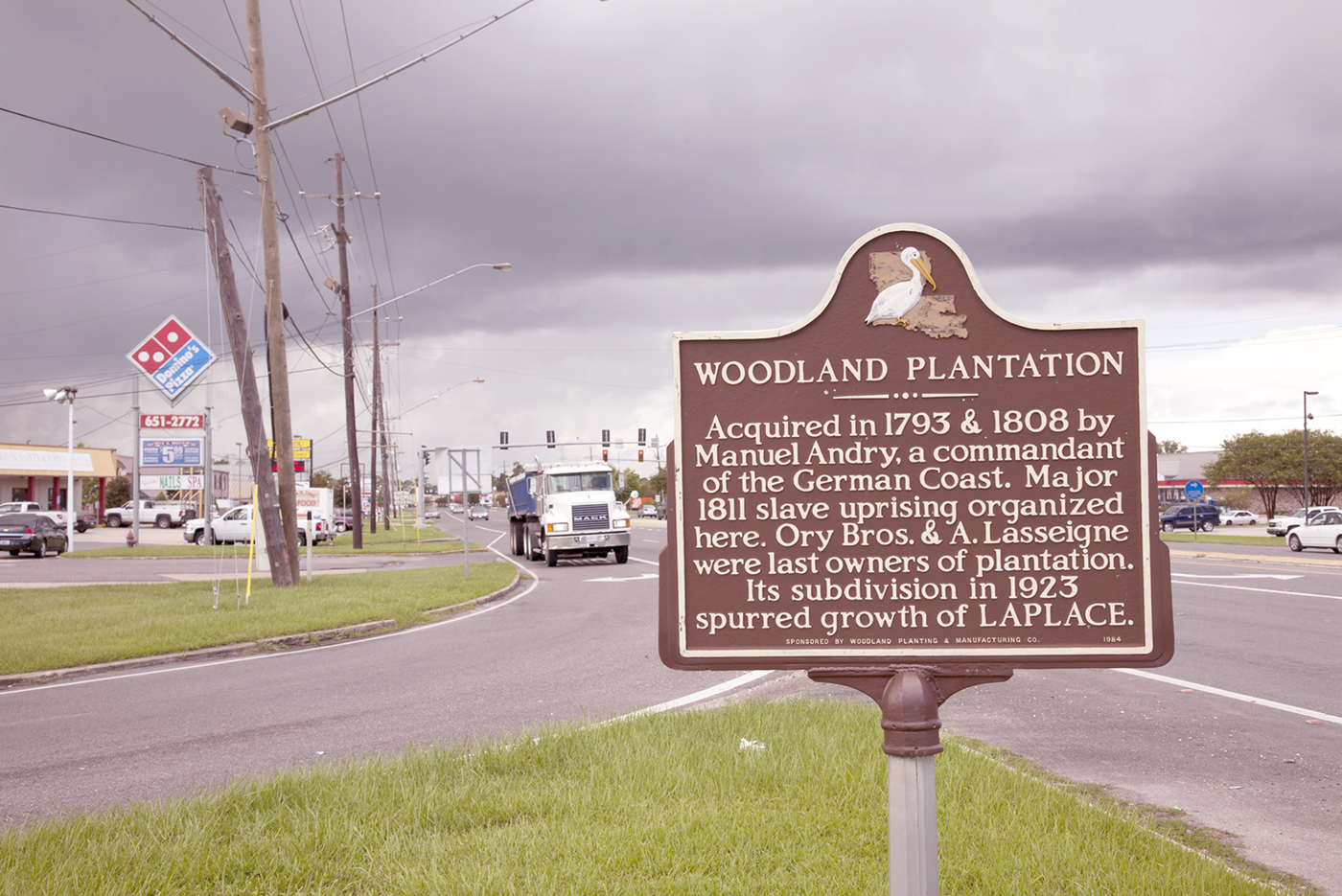
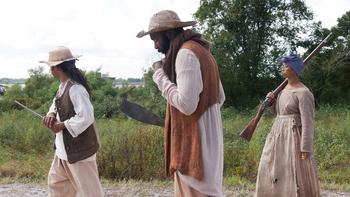
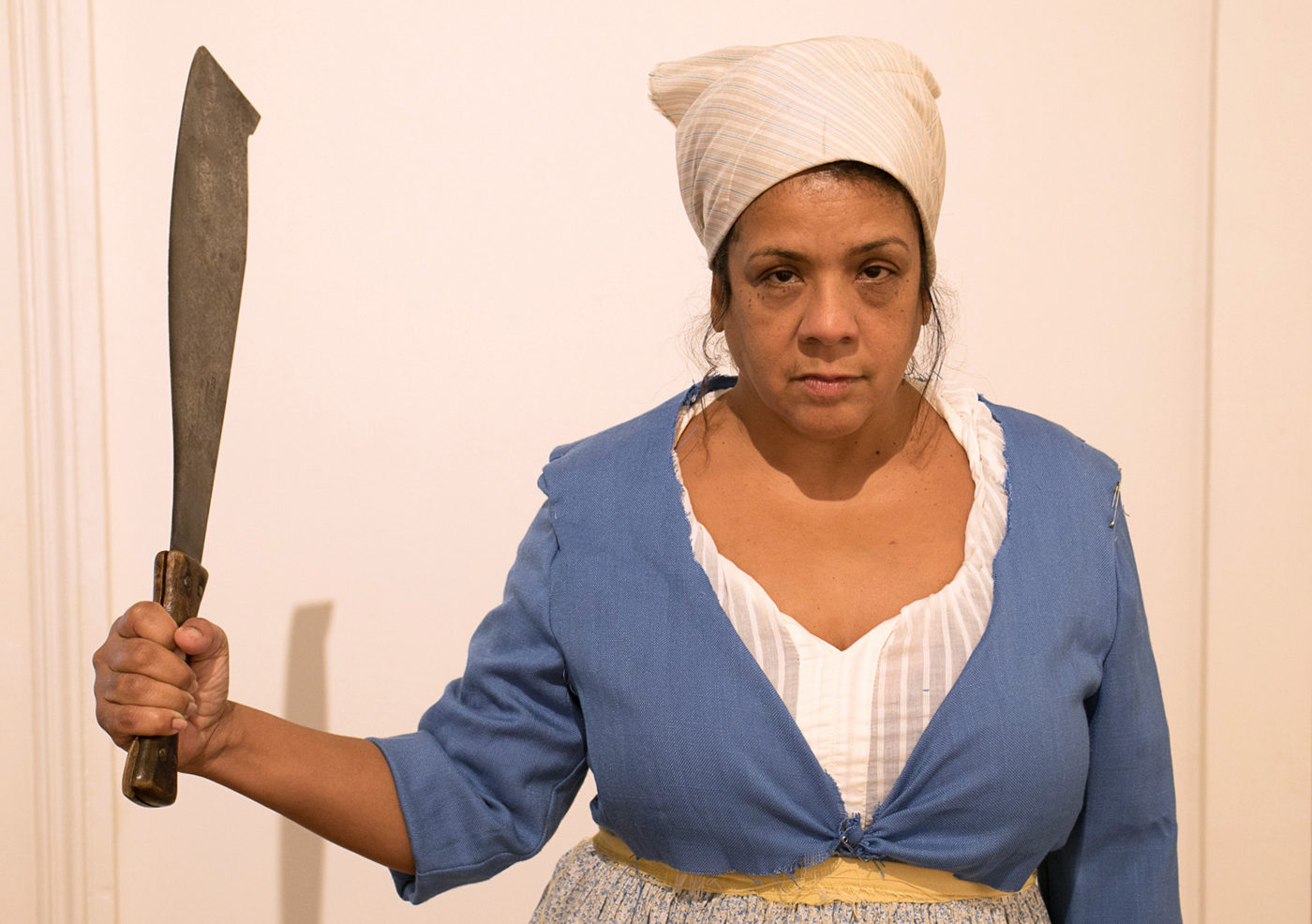
Andry Plantation historic sign. © Dread Scott.

Joey Orr:
What is this history that you've found? Tell me about the very beginnings of your research and your relationship to that research process.
Dread Scott:
I'm doing this project called Slave Rebellion Reenactment. I got invited to do a residency at the McColl Center for Art and Innovation in Charlotte, North Carolina. I'd heard really good things about them. I was excited to be in the residency. They said, “It's project-based. What do you want to do while you're here? You've got to propose something.” I said, “All right, I know what I want to do. I want to do Slave Rebellion Reenactment,” which was an idea I had a year or three years before. As an artist, I think of things and most of them never see the light of day or get developed. Some of them do. This was one of those, “It's kind of a good idea, I'd like to see that.” I told them that, and I thought, “There's no way they'll go for this,” in part because it's unlikely that it would happen during the time of the residency or at the location of the residency, so why is some residency going to bring me down to do that?
They said yes, and the person who was the interim director at the time of the residency, Lori Mertes, said she had recently heard this guy, Daniel Rasmussen, speaking on NPR, talking about this 1811 revolt, and he'd just put out this new book. She said, “You've got to read it.” I was thinking, Slave Rebellion Reenactment, I'll do sort of Nat Turner, or I'll do some sort of mythical rebellion, because I thought the idea would be cool, but I said, “I'll check out this book.” It was really amazing, because there was this history that I didn't know about. I'm not a historian, but I know of Nat Turner. I know of Gabriel Prosser. I know of Denmark Vesey.
I hadn't heard of this, and I'm like, “Well, that's interesting that this history is suppressed.” It was the largest slave revolt in North American history. It's interesting in its own right, but also for an artwork, it allows for greater participation of people … because it was so large. It also was planned for months. It had a long shot, but a shot of success, and success was seizing all of Orlean's territory, which is basically from modern-day Arkansas down to the Gulf of Mexico, and ending slavery. That was huge. That was something that enabled the artwork to not just be about revenge. This was actually about freedom and emancipation. So I said that's what I want to do.
It happened that it's going to be in New Orleans, because I'm going to reenact it there, and it's probably going to take a couple years to do, so it's not going to happen during residency. “Do you still want me to do it?” They're like, “Yeah, yeah, we support that!” So I started going down to New Orleans. One of the things in this book by Daniel Rasmussen – it's called, American Uprising: The Untold Story of America's Largest Slave Revolt – is he mentions, almost in passing, where he got some of the history from. This guy Leon Waters.
So, I go down. One of the things I do is meet Leon Waters. Who is this guy who knows some of this history? Leon Waters and Albert Thrasher basically did the research that American Uprising was based on. They're the reason why anybody in this century knows anything about this history. Leon, when he was young, probably about ten years old, had a much older cousin named Kissy. She told him, “Look, our ancestors fought against slavery.” Leon was like ten, he was like, “Well, okay, that's cool.” He said, “Why? Why did they do that?” And Kissy said, “Well, whenever they had a chance, they struck a blow for freedom.”
About thirty years later, he was talking with his friend Albert Thrasher and some others, relating this story, and they said to him, “Look, Leon, if there's any truth to this, you need to find this out. This is really interesting. What is this?” They did a lot of research, and again these guys are not trained historians, they're people's historians. They wanted to do it because they thought the history was interesting, that it talked about black people, Africans, in the United States. They were revolutionaries, and they thought people who were revolutionaries would benefit from knowing this history, and knowing this history of rebellion.
The research was exhaustive. Apparently they went to eleven different states. They found records of the tribunals, which were conducted after the rebellion was put down, which were in French. They had some of them translated. They looked at newspaper stories. They looked at insurance claims. They looked at all sorts of stuff. They looked at runaway slave ads … It's really exhaustive research. It reveals some of the most important history that existed on this continent and was completely suppressed, and so these guys did that work, and it was really great to meet them.
This is how I knew the history, but the main thing I wanted to do in exploring this was to actually get into a radical view of freedom. Because this actually had a chance for success, and success was actually seizing all of Orlean's territory and ending slavery. It was a very different approach to freedom than existed in the continental US at the time. The US Constitution was a written document that talks about freedom, and the founding fathers meant every word they said, but their vision of freedom was rooted in owning other human beings.
That document was not something the enslaved people were trying to become part of. They weren't like, “Hey, let's become part of America,” and they weren't like, “Hey, this whole French thing is working out great.” They were inspired by liberté, égalité, fraternité, and they were inspired by the Haitian Revolution, which comes out of the clash with the French, but it wasn't that these ideas were at the time nascent within the body politic of French colonial, or American, society. This was something based on some of those ideas but with the contradictions that go with it. These were enslaved people who said, “We need to be free, we need to end slavery,” and set out on a mission to do that. I think that understanding that history tells you a lot about American history. It also tells you that American history could have worked out very, very differently.
If what was important to you to rescue from that past history was a radical notion of emancipation, then why is reenactment the way to do it?
I'm an artist. You have an idea as an artist, and you want to see it in real life. You have an idea, and then it needs to get created. The important thing is that it is a way for hundreds of people to deeply engage this history, beyond the audience that sees it, which is important too, but the people who are participants will be spending months actually immersing themselves in and reenacting the creation of a slave rebellion, including in a quasi-clandestine way, a secret way, and learning that if you were trying to do a slave revolt you had to … It wasn't going to be organized by Facebook. Not only did Facebook not exist, but you couldn't just tack up an ad on a flypost. You would get killed, and you'd get your family and friends killed. I do want people to get some training in organizing in a different way than right now, spontaneously how people do. Somebody, when hearing me talk about it, said, “You're kind of building up muscle memory for an actual revolution.” And I said, “Well, guilty as charged.”
The people that were enslaved, they didn't have a choice but to do this if they wanted to get free. There were a lot of people who I'm sure would have argued, “This is impossible. You can't get free. You can maybe escape. Maybe. But you can't end slavery.” The people who led this rebellion were like, “No, we need to figure this out. We can do this.” Ultimately they were unsuccessful, but the radical break was saying, “This is the only way we can get free, nothing short of this will work.” People nowadays need to actually think like that. The world is a horror and a nightmare for the majority of humanity, including a lot of people in this country, millions of people in this country. How people approach political change often starts with what they think is possible, not what they think is necessary.
That's an entry point for people to rethink that past – really grasp what is precious about it – and the present and the future. I'm sure there would be other ways to talk about these things, but this is the way that I'm doing this. It has the advantage for me of really being able to walk with five hundred other people and to really go through this history and really learn from it. In both the building of the army of the enslaved and the actual two-day reenactment, I think it's going to be a very powerful, transformative thing for the people who participate in it. I don't know how all that's going to go. I think that's something you can't really know. I think people will respond in lots of different ways.
It's going to be kind of weird, because in a lot of Civil War reenactments, it's all about the clothing and the battles. With this, there actually wasn't that much fighting. There was some, but there wasn't that much. So this is, in many ways, going to be a march and in part ways, a run. But we'll sometimes be encountering modern-day people, and we'll be singing in Creole, “Onto New Orleans, Freedom or Death,” and sometimes challenging people, “Hey, we're going to end slavery! We're going to New Orleans to end slavery! Join us!” And modern-day people will be like, “What the fuck?” I think some people will say, “No,” and other people will say, “Well, that's weird as shit, let me walk with you for a while.”
I think there will be times when it'll be just walking in a field. Other times, it will be more contested. I think there will be a lot of ways that the individual participants will be transformed. It is something that I do really feel can reach thousands of people who actually see it, and tens, if not hundreds of thousands, or more, through media coverage, through film that gets made, through photographs and art exhibitions, and through word of mouth, and just the Interwebs. You're going to have five hundred armed black people on horses in colonial garb walking through the outskirts of New Orleans. Somebody's going to tweet that shit, and it will be out of context, but in context. There'll be lots of uncontrollable, uncontrolled conversations, discussions, and imagery that I think will reach people that won't go to the MCA [Museum of Contemporary Art Chicago] and wouldn't take a course on slavery either in high school or college.
Maybe if I were Spike Lee or Quentin Tarantino, I probably wouldn't do a reenactment. I'd probably make a Hollywood narrative feature, and that'd be good, too. I can do this, and I think it'll be kind of epic and awesome. For the people who are directly embodying this history, I think it'll be a very engaged, transformative process – that is my intent – more than an artwork on the wall. I like those too. Most of my work shows in galleries and museums, but this will deeply get into people's tissue, I think.
This whole overlay of past and future and present is really interesting in your work, and when you look at a lot of social-history work in memory studies, for example, they talk about how we form collective memory, and how collective memory gets transferred. Some people make the case that it gets transferred through performance and ritual, and that the decisions you make about what to repeat or about what not to repeat, or what was left out last time that you think needs to be added back in … All those things are about how we know and understand the past so that we can envision something else for the future, which I think is very much at the heart of your project.
It is. There's an actual, fairly big and growing movement of Afro-futurism now, which is interesting. I don't consider myself part of that camp, but I have a lot of friends that are, and do interesting work. I think that in a weird way, I'm doing a sort of Afro-past-ist piece, which is looking at history, but it's also an imagined history. There is a real history there, but it is existing in the present. There will be parts of this reenactment that will be made up in the sense that some of the history is actually not knowable. We know they carried flags as they marched downriver. There's no description of them in anything that the actual historians have found so far. I think it's unlikely that they will find a description, so that's something we're going to make up.
The rhythms that were played, and the songs … we know that they were singing, “On to New Orleans.” We may be able to definitively determine whether or not it was sung in Creole. I think that's likely, but it could have been in any number of other languages. There were, I think, a hundred different languages spoken in the region at the time. Nonetheless, the rhythms we're going to make up based on working with traditional African drummers and their understanding of what might have been played … But it's still going to be imagined. We as artists, unlike historians, can fill in gaps, and I don't feel beholden to the history in this. I want to be as faithful to it as I can, but I will be totally honest: I'm making up a flag. This is what it might have been, but it's imagined. It's not historically accurate, or if it is, fucking good luck, but nobody could prove it one way or the other.
It will also have made-up portions. I'm going to interrupt the historic timeline, the ending of this revolt. It was put down in a tremendous, bloody slaughter. The repression that happened following it was just medieval. When people have looked at this history, they've often tended to focus on the repression. I'm much more interested in the fact that people who were enslaved took up this bold vision and chance for freedom and actually planned to make that happen, and even though they were unsuccessful, that's the story. The story is not that America/France were brutal, savage oppressors. People should know that, but that's not the story. That story has actually been told a lot. People don't understand that, but the story that people really don't get is that people with agency fought for emancipation, and that's the motive force right here. That's the story.
I'm going to interrupt the historic timeline. I'm not going to have a bunch of white people killing a bunch of black people. That's not interesting to me. The ending won't pretend that something different happened, but it will highlight the emancipatory vision. In a certain sense, it was profoundly successful as an idea.
You've already said that you won't be in control of everything that happens. I'm wondering, how much structure are you giving it?
Well, I don't completely know the answer to that, in part because it's an artwork in process. I know what I think some structure will be, but there's both the structure or framework that we will have and will be somewhat enforced a bit, but then, it's live performance. It can go in lots of unexpected directions, but the structure is that it's an actual two-day reenactment. We will have to have a tremendous number of permits, and to get the permits, we'll probably have to have a very specific route that we're going to go on. That hasn't been all worked out yet.
Over the course of those two days, we will stay out overnight at one point. We will have to have logistics for where people will camp that night. Everybody who participates, in advance, will have period-specific costume on. We won't be able to control, and I don't want to exclude, people on the spot seeing it and wanting to participate, so they won't have period-specific costume. They won't be excluded from it. But all the people that are intending to be part of it, nobody's going to show up dressed in twenty-first-century street clothes and be able to do it. People will be in period-specific costume. It will go the duration of this route, and there will be people on horses who are more leading the project. This imagined army of the enslaved will have people who will be more responsible for the vision of it, both in building it, but then in actually carrying it out.
Army of the Enslaved Sighting. © Dread Scott.

I wonder, could you also just say something about how you're building the army? How does that work, and where are you in all of that?
On the one hand, five hundred people in a big landscape is not that big, it's not like fifty thousand people in a huge landscape, but it's still five hundred people, all black, armed, in weird French colonial clothing. It's going to really stand out. That's going to be really epic. But as super cool and awesome as encountering the two-day reenactment will be, in a weird way, the building of the army of the enslaved is the essence of the project.
The project is really about the five hundred people who are the army of the enslaved. It's really embodying this history and deeply engaging the history and thinking about freedom and emancipation. What it meant then, learning from people for whom freedom or death was a real life-and-death issue, and how that applies today. What would be worth living for, and what would be worth dying for? Having people deeply immersed in thinking about freedom, not in just the way people think about it now.
You'd be hard-pressed to find somebody who's opposed to freedom today. But it'd be very easy to find many people who believe that if people break some law, they should be put in jail, including amongst poor and oppressed communities. “Oh yeah, well he stole whatever, he should be doing some time. Maybe not as much as he's doing, but he should be doing some time.” This project is starting from a whole different framework of getting people to think about what freedom actually is. How do you get to the point where you conclude that the social, political, and repressive structures that are oppressing you and your friends, and all people like you, is worthless, and it has to be overthrown? Then what do you do?
Getting people to work within that, and think about that, to really walk in that history, but then also to think about the present. I'm hoping that lots of people that are introduced into new networks with each other go in interesting, different directions with this. In fact, one of the meetings I'm having when I go to New Orleans next time in a couple weeks is with some educators, college and high school, to have curricula developed. I really want that to be one of the spin-offs of this. I hope that people who are activists and educators, and ordinary people, get introduced into new groupings, and some of them take these political ideas and run with them in their own lives in new ways.
I have confidence that having five hundred new ambassadors for freedom – not the, “Oh, everybody's for freedom,” or, “America equals freedom,” but freedom from oppression in a very deep way – I have confidence that, though I don't know where it will go, that people can run with that in very interesting, deep, transformative ways. That's why I'm doing this, in a certain sense. It will be a very beautiful visual thing, but the heart of it is these interactions with people embodying this history.
Since we're talking about your research, can you talk a little bit about Fragments of the Peculiar Institution?
Fragments of the Peculiar Institution is an artist book that is my archive of slavery, and research into slavery. It came about because of Critical Practices Incorporated and 21st Projects, which is this multiheaded beast that is set up by Saul Ostrow who is an art historian and writer. He thought that how meaning was exchanged in discussion of art was limited by art criticism in a certain sense, and by reviews and stuff. Even the way artists exhibited was sometimes problematic, and so he wanted a place where people could show and discuss art where there would be different conversations, and a different format for thinking about that.
So, they had this thing, which is in his loft. The furniture is still there, but you can put up whatever exhibition you want, but the furniture stays, and then there are conversations about it. He asked me, “We want you to put up one of your archives, and why not put up your archive of slavery?” And I'm like, “What are you talking about? I'm an artist. I don't have an archive of anything, really, but sort of … I've got a revolutionary archive because I've got a project with that name that has put my research into sort of the arc of communist revolution, but I don't really have an archive of slavery.” He said, “No, no, we want you to put up your archive.”
The more I really thought about it, it was like, “Oh wait, I do kind of have an archive. I've done all this research.” So it became an exhibition of like eighty inkjet prints that were just mostly 8½ × 11. It included everything from photographs I had taken in New Orleans working on this project, to Internet clippings of slave badges, to images of the US Constitution and its section on three-fifths of a man, to clippings of the Dredd Scott decision, the historic Supreme Court case, images of Django Unchained and other Hollywood movies, images of other artists that are doing work that I really appreciate that look at slavery. It's a visual mish-mosh of stuff, but there is meaning in it.
I put that up, and Saul looked at that. One of the board members of Critical Practices is a publisher of books, and one of the things he specializes in is publishing archives, and he said, “We should put out a book of this.” “Well, yeah, sure, books don't sell, but if you want to put out a book, that'd be cool. Yeah, sure, let's do it!” They said, “No, no, no, this is really good. Look, why don't we do a walk-through, and you tell me what I'm looking at?” That became a way for all of this stuff that made a lot of sense to me to become a little more accessible and knowable to a broader public. That's how the book came about. It wasn't my idea, but it was actually really smart that it did this.
Slave Rebellion Reenactment is a project about emancipation, even though it's rooted in slavery. The archive is about slavery. It really is. There's not an iron wall separating them, but it really is. There are documents of resistance, but it is more. The document as a whole is an analysis, deconstruction, and assemblage of stuff about slavery. It gives people a bit of a history and theoretical foundation for understanding some of what I'm thinking and researching.
One of the quotes in there is from Bob Avakian, who's the leader of the Revolutionary Communist Party. It's a quote from a pamphlet he wrote called Communism in Jeffersonian Democracy. He takes the best arguments of American democracy and says, “Look, this is where it really is still exploitive and oppressive,” and one of the things he starts out with … it's really a simple thing, he said, “Look, there would be no United States as we know it today without slavery. It's a simple and basic truth.” In a certain sense, everybody knows that, but on the other hand, actually most people don't know that.
That's part of why this book helps people walk through some of this. A lot of people talk about how we need more democracy, and how even the tremendous money flowing in the political campaigns is a perversion of democracy. Well, actually, let's start at the US Constitution, and you get four paragraphs in, and they're talking about slavery. It really is a document that was written by slave-owners and friends of slave-owners to define the political and legal structure for an economy that's based in slavery. It's an outmoded view of freedom.
You get into the fourth paragraph, and it talks about three-fifths of a man and giving disproportionate political representation at the federal level to people who owned a particular form of property, and that's other human beings. The money in politics is not anything new. That's what democracy is, actually. It has been since its inception. I think it's really important for people to look at the history and ask if what we need is to return to those roots, or is what we need to sever those roots and to start from the vision that these enslaved people in 1811 had: “We need to get free of French colonialism, but also American democracy. Neither of those are going to be free for us, and we actually need to not try and figure out how to make those systems work for us, but we need to get rid of those systems.”
Can you say just a little bit about why people hadn't heard about this story?
They hadn't heard about this story because the people who write history didn't want the story to be known, particularly in 1811. New Orleanian society was shaken to its very foundation, and the slave-owning class, the planters, were terrified. Any rustling in the trees after that, they looked over their shoulder. They realized they could have lost everything, and that while the rebellion was a long shot at succeeding, it really could have succeeded, and if not for some historic accident, it would have gotten a lot further than it did.
They were also trying, at that time, to become a state. The governor, who was appointed by Jefferson, had a pretty good understanding that it fucks up your application for statehood if you can't control your negroes. He was like, “Nothing to see here. Keep on moving, nothing to see here,” and this is 1811. There was no AP wire service, much less the Internet, and so that was the story that was told. He put a spin on it, it was reported in the papers locally, the papers from far away would base their stories on what the local story was. It's not like they had stringers who were sitting around in New Orleans, reporting for France, “Here's what's going on.” It was just like the Times Picayune, or whatever the local paper was at the time, said such and such, and that's the story that got told. It was spun and suppressed from day one and that continued, until frankly Albert Thrasher and Leon Waters did the big lift in research. There were a couple of fragments of people mentioning something, but nothing substantive at all until their research.
I'm thinking about this accretion that's building now, behind this history. Just thinking about the way you've told this story today. Leon Waters and his cousin had this conversation, and then Leon Waters shares the conversation with Albert Thrasher and some other folks. They realize it needs research. They do the research work, and they publish this book that's pretty hard to get hold of right now, and then Daniel Rasmussen comes along behind, and it becomes a New York Times best seller. Suddenly it's on a bigger radar in some respects, and this is how you originally encountered the history in an artist residency program. Now, to the lineage of the representation of this story, we add, Fragments of a Peculiar Institution. We also add, or will be adding, Slave Rebellion Reenactment. It's also interesting for me to hear you talk about what your hopes are. You say that you hope more historians will know about it, be interested in doing more of the work and filling in more of the gaps, and that educators will be interested in taking this up, and that there will be a whole myriad of things that will happen. I see you responding to this history as a researcher who's working in the visual arts. You have your own set of methods and your own set of concerns. Then it has relationships with different kinds of research and historical work that is going on. I'm just making note that your artistic practice has a really interesting role to play within these other kinds of work, that it accomplishes some things that historical research does, but that it also accomplishes something different. From what I hear from you, you're most interested in that radical notion of emancipation and how it can be present now.
Yeah. Yeah. I'm not a historian. I have tremendous respect for historians, or at least good historians, and when I've spoken onstage with them, I'm very touched when they respect me and allow me to share a platform with them, because those guys do real research. I read some of their stuff, and I feel I'm very good at what I do, and I feel that art is very important and art can do things that historians can't do.
One of the historians that I'm working with a bit is a guy named Vincent Brown, and he is really interesting. He's at Harvard in the Hutchins Institute for African and African American Research, and he set up a thing called the History Design Studio. It's a very cross-disciplinary approach to telling history. You'll get graphic design master's candidates working alongside PhD candidates, working alongside people who already have their doctorate and that are professors, trying to figure out ways to disseminate history other than the academic paper, which only gets read by academics, or the Ken Burns PBS documentary, and trying to think of how can the Internet be used.
Vincent has this interactive map of the Jamaican slave uprising that lasted from, I think, 1760 to 1761. One of the things he shows is that traditional maps, or even traditional battle maps, to the degree that they're made, don't accurately represent guerrilla warfare very well, and the concept of chaos, which is actually a central thing to whether you're going to be successful or not, and so while slaves were of necessity and correctly using guerrilla tactics, it's hard within a traditional medium, cartographic medium, to tell. Doing it traditionally actually doesn't tell their story. In fact, it undermines the capacity to understand that, so he's looking for new methodologies to present that, and using these technologies to do it.
They're thinking of how the visual arts can also interpenetrate with what they do. But they'll get into an actual library that has manuscripts written in French Creole about a tribunal, and research that, or find out, “Oh, I know how to get access to this deed of a house that will then tell me something about that.” I don't have any illusion, and I don't want to promote any illusions, that I can do the scholarship that they do. I'm doing something different. I may serve to popularize some of what they do in ways that they can't. And I do think that as an artist, I can both interpret the history and emphasize certain things without the constraints that they have.
Vincent and a colleague of his, Walter Johnson, who has written a really, really, really interesting book called Soul by Soul, which looks at life inside a slave market – market both in the sense of physical place where bodies were sold, but also market as in Wall Street market, for example. I couldn't do the work that I'm doing with the nuance that it will have without them. Both of them are really radical, but because of how at least most history is told, it's hard for them to directly express the radical nature of some of what they're doing and thinking. Whereas I can say that the whole point of this is to get people to think about emancipation. It's actually not to think about history, even though that's the methodology through which they're thinking about emancipation, and the means by which they're doing it. I can focus on a conceptual and political thing, utilizing history, whereas they actually are responsible for accurately researching and telling history.
Slave Rebellion Costume. © Dread Scott.

Anything you think we should talk about?
As really epic and cool as seeing five hundred black people, men and women, some on horses, dressed in French colonial period-specific costume, armed with kai knives and sabers and sickles and muskets and blunderbusses and flags flying, as cool as that will be, and I think it will really be … If you're driving to work at a chemical refinery thirty-five miles upriver from New Orleans and see this, it'll be like, “What the hell am I seeing?” Even if you kind of know that it's coming, it's going to be very unsettling and jarring, and that will be very important. That's how people will really know about the project. That cognitive dissonance could be told with perhaps a single image.
As much as the public face of the project is that, the heart of the project actually embodies this history in the formation of and the creation of the army of the enslaved. That is going to be done by word of mouth, mirroring the structure of how a slave revolt had to be assembled. That's where a man or woman would talk with a relative handful of people that he or she felt they could trust with their lives. Assuming they gambled right on that, then those people would talk with more people and plan and plot the rebellion. Secrecy would be valued and important and having to keep out of the eyes not only of slave-owners, but also of other enslaved people who might not be sympathetic to your plot.
Mirroring that structure, I'm going to talk with a handful of people, although in this case probably sixty to a hundred, and those people who say, “Yeah, I want to walk rain or shine, warm or cold, twenty-six miles in funny clothing, sometimes not seen at all, sometimes perhaps seen by people who really dig it, sometimes perhaps seen by people who really hate it,” those people, who for whatever good reason want to do this, they get drafted into the army of the enslaved, and then those people will also talk with their friends. It's really going to be conversations with twenty-first-century people about why this nineteenth-century history matters.
That's the means through which talk of emancipation, talk of freedom, really thinking through what is freedom or death, why this history matters, why there's no other choice for the enslaved people if they wanted to end their oppression, other than to do this, but that one of the lessons for today is the willingness and boldness and daring to say, “Well, it will be very hard to figure out how to end slavery, but that's what we need to do. We don't need to start from what seems easier or possible, we really need to start from what's necessary and work out a plan from that.” People living in that spirit, embodying that history, coming together in sort of “clandestine cells,” that's the heart of the project through which lots of other things can happen. There will be tremendous meaning for the people that participate in that way, but that will also be where people think new thoughts.
It's weird that there's this split between the very, very public organizing of this – there's already been a couple articles published online, funds have been raised, it's going to be filmed, there's going to have to be lots of permits, people are talking about it already, which is good and necessary – but the heart of the project actually happens by word of mouth, and out of the eyes of everybody, and that's kind of a weird conceit. It actually is part of learning how enslaved people had to behave, if they wanted to be free. I do think, well, this is just an artwork. The real lessons for people in social change are about how to determine friends from enemies, how to think boldly and figure out how to win other people through a bold vision. All manner of things, including how to stay on message and to stay on point when other people might think, “That's crazy. You're all going to go get killed, or you can't do this.”
If this is 1810, and you're talking with your friend, and you're saying, “I've got an idea to get free,” and they say, “Well, yeah, I had a plan. I know there's a Maroon colony. We could both escape,” and you say, “No, no, no, no. We want to overthrow the slave-owners.” Even this other radical person who's willing to risk his life to free himself, might say, “You're going to get us all killed. That ain't going to work. We can't do that.” That would be the dominant idea. Much like today, the dominant idea is that maybe you can tweak oppressive and horrible systems, but you can't fundamentally change them.
I think in the present that you can fundamentally change things. In the past, people tried to and in some cases were successful, through this clandestine organizing, to really start embodying and living that with the idea, “Yes, we can change the world. Yes, we can emancipate ourselves. Yes, we can not only end our enslavement and that of our friends, but we can do things in a way that nobody else is enslaved anymore.” This structure, of these networks and nonpublic meetings, that's in many ways the heart of the project.
We've talked about this before, and one of the things I thought was so interesting about this whole structure that you're putting forth is that you're organizing this group using a method that is analogous to the historical situation. But something I want to draw out and make a little bit more explicit, if I'm hearing you correctly, when I hear you discuss the historic event, you make it very clear that what's interesting and important to you is that there was a group of people who had a radical idea about emancipation, their own emancipation, and that they didn't feel like the American system was going to serve that, and therefore they wanted to overthrow it.
American or French.
American or French, yes. So I guess what I want to get at here is that your method is mirroring their method. Of course, I also understand that it's a reenactment and an art project, it's not an actual battle that's going to happen. It seems to me, that still, listening to you talk about how you're going to build the army and that it's going to be people who are going to have serious conversations about how to think about emancipation in a way that democracy as a system simply is not going to serve … There is a political hope that's very important, it seems to me, and central to your reason for doing this project. It seems to me that this is also one of the things that you're calling out as being different than other purely historical and research-oriented contributions to this history.
Yeah. Personally, I'm a revolutionary. I think that the whole system we live under is worthless and no basic change for the better can come until it's overthrown. That is what is prompting me to do this historic project. This historic project is just history. It is not a revolution. It's not going to go over to a revolution. It's not going to be like, “Oh, you get five hundred people out doing the reenactment today, and tomorrow we'll get a thousand.” That's not what it is.
What you see is what you get in a certain sense, but I do hope that people deepen their thinking and understanding of how change actually has happened, and how it can and needs to happen. I'm not prescribing how anybody that participates takes that or interprets that. Some of the people I'm working with and have talked to actually very quickly try to bring it back to the present and say, “Oh, we can use it for this political aim,” or whatever, and I think people go with this where they go with it. That's fine, I don't mind that, but I will continually return to that fact that this history was not about improving things under the existing system, which they were enslaved under. It was about getting rid of that system, and it was really about identifying what the problem was, and figuring a solution to end that problem.
While this is not a revolution, and it is not going to go to a revolution, the people that are organized into this are probably not going to have much conversation with me or anybody that has met me about the kind of revolution I think is necessary in the present, but it will enable people to lift their sights using this past to really walk through how change has actually happened, and how it could happen, and how they could be agents of that, should they choose to be.
What's your timeline?
I want to do this as quickly as possible! I want this done yesterday! While I think this would be a good project at any time, I think that particularly given how things are shaking up in the, broadly speaking, Black Lives Matter movement, and I don't mean it just as the political formation that has actual organizations known as Black Lives Matter, but I mean the resistance to murder by police and mass incarceration. There's a moment we're in now, where all of society was and still sort of is looking at the question of the position of black people in society, and so this will really matter. I don't have a crystal ball, but I want to do everything possible to contribute to the unfolding upheaval and so … I hope we can do it, and we're trying to figure it out, but I don't have an answer yet.
Okay, great. Thank you.
You're welcome. Thank you.