1. INTRODUCTION
In the past three decades, intense pulsed ion beam (IPIB) technique has been extensively researched for diverse applications such as surface treatment, film deposition, and nanophase powder synthesis (Rej et al., Reference Rej, Davis, Olson, Remnev, Zakoutaev, Ryzhkov, Struts, Isakov, Shulov, Nochevnaya, Stinnett, Neau, Yatsui and Jiang1997; Zhao et al., Reference Zhao, Remnev, Yan, Opekounov, Le, Matvienko, Han, Xue and Wang2000; Renk et al., Reference Renk, Provencio, Prasad, Shlapakovski, Petrov, Yatsui, Jiang and Suematsu2004; Pushkarev & Isakova, Reference Pushkarev and Isakova2013). IPIB typically with ion energies from tens to hundreds of keV, ion currents from several kA to MA, and pulse durations from tens of ns to μs are usually produced in magnetically insulated diodes (MID) (Pushkarev et al., Reference Pushkarev, Isakova and Khailov2015). In the materials processing applications, IPIB are used primarily as flash-heat sources to rapidly melt or ablate solid targets due to the high compression of energy on time and space.
Ablation effect plays an important role in the process of the interaction between the IPIB and material. Understanding the IPIB ablation mechanism is vital to IPIB applications. Due to the fast interaction process between the beam and material, direct observation of the ablation process by IPIB is still challenging. As a result, numerical simulation is an important tool and means to understand the ablation process. Because ablation is the result of strong thermal effect, it can be analyzed through establishing IPIB energy deposition model and heat transfer model in the target. In previous works, the influences of the temporal structure of the ion beam energy spectrum and the ablated material on the interaction between the IPIB and target were not considered (Wu et al., Reference Wu, Lei, Zhu and Gong2011; Li et al., Reference Li, Xiang, Lei, Liao, Yuan, He, Jiang, Zheng and Zu2013). As emitting time and flying time vary from ion to ion, the energy spectrums of ion beam in different moments are quite diverse during IPIB bombarding target; and the dynamic energy spectrum of IPIB can directly determine the power density distribution of IPIB in the target. In addition, due to the low thermal conductivity of gas, the ablated matter will hardly conduct heat to the target. But they can still absorb energy from ion beam in pulse duration. Therefore, the neglect of these factors will make the calculation of ablation oversimplified, the accuracy of the simulation needs to be improved.
In this work, for acquiring the influence of the IPIB energy density on the ablation process, zinc which can be ablated under low beam energy density were bombard by IPIB; and the ablation masses under the different beam energy densities were acquired. Considered the influences of beam dynamic energy spectrum and the ablated matter, a two-dimensional axisymmetric transient heat conduction model was constructed by a finite element method to describe the ablation process and calculate the ablation mass. The ablation rate distribution in the pulse duration time was obtained; and the experimental and the simulated results of ablation mass were compared.
2. PHYSICS MODEL
2.1. IPIB energy deposition in the target
The deposited energy of IPIB in the target distribution with time and space can be described as power density function P(x, y, z, t). Because the ion stopping time of IPIB in solid target (10−13 s scale) is much shorter than the IPIB pulse duration (10−8–10−7 s), the time spent on ion stopping is negligible in the process of IPIB energy deposition in this model. As the cross-sectional energy density distribution of the ion beams is approximate to radially symmetric distribution, taking p(z, t) as normalized function, then the power density function can be expressed as follows:
 $$P(x,\; y,\; z,\; t) = P(r,\; z,\; t) = E(r) \cdot p(z,\; t).$$
The E(r) is the IPIB energy density distribution function on radius of the beam on the target surface, which can be acquired from the diagnosis result of beam energy density distribution. The p(z, t) is defined by the type, energy and the arriving time of ion, and the characteristics of the material. From the IPIB dynamic energy spectrum, which can be measured by time-of-flight (TOF) method (Yu et al., Reference Yu, Shen, Ivanovna, Zhong, Zhang, Yan, Zhang, Zhang and Le2015a ), the type, energy, and numbers of the incident particle with time can be known; and the deposited energy distribution with the depth of different ion in the target can be calculated by SRIM code (Ziegler et al., Reference Ziegler, Ziegler and Biersack2010).
2.2. Heat transfer model with ablation
The temperature field evolution in the target irradiated by IPIB can be calculated by Eq. (2), which is derived from the Fourier law and the energy conservation law.
 $${\rm \rho} (T)C(T)\displaystyle{{\partial T} \over {\partial t}} = k(T)\nabla ^2 T + P(r,z,t) - \displaystyle{{\partial E_{{\rm ph}}} \over {\partial t}},$$
 $$E_{{\rm ph}} = L_{\rm m} {\rm \rho} (T_{\rm m} )h(T - T_{\rm m} ) + L_{\rm v} {\rm \rho} (T_{\rm b} )h(T - T_{\rm b} ),$$
 $$h(T) = \left\{ {\matrix{ {1,} & {T = 0,} \cr {0,} & {\; T \ne 0,} \cr}} \right.$$
where ρ(T), C(T), and k(T) are the density, specific heat, and thermal conductivity of the target, including the solid and liquid states, respectively. They are temperature-dependent functions taken from Material Property Database (MPDB) of JAHM Software. P(r, z, t) is the source term, that is, the power density distribution of IPIB in the target. Heat absorbed and released by phase change can affect the temperature field evolution in the target. So, E ph is the term related to the latent heat of phase change. L m and L v are the latent heat of fusion and vaporization (L m = 112 and L v = 1755 J/g for the zinc target). T m and T b are the melting point and boiling point of the target. The h(T) function indicates that the E ph only modifies the heat conduction equation at melting point and boiling point. For this two-dimensional axisymmetric heat conduction model, the initial condition is
 $$T(r,\; z,\; 0) = T_0 = 293.15\; \,{\rm K}{\rm.} $$
For boundary condition, in order to evaluate the energy loss by infrared radiation, the Stefan–Boltzmann boundary condition is taken:
 $$j = {\rm \varepsilon \sigma} (T^4 - T_0^4 )$$
where j is the surface-to-ambient radiative heat flux, σ is the Stefan–Boltzmann constant, ε is the emissivity of target.
In this model, when the temperature of element reaches the boiling point of the target, the temperature of this element will keep in the boiling point. And the difference between the absorb heat and heat conduct loss for these elements (at boiling point) is counted in each time step, which is defined as Q ai. In each time step, the volume of vaporization can be calculated as follows:
 $$V_{{\rm ai}} = \displaystyle{{Q_{{\rm ai}}} \over {L_{{\rm v} \cdot} {\rm \rho} (T_{\rm b} )}}.$$
It means that the material with V ai volume will be ablated by IPIB from the target surface in this step. Because IPIB duration time is smaller than the expansion time of the gas and plasma (Jiang et al., Reference Jiang, Hashimoto, Shinkai, Ohtomo and Yatsui1998), all the ablated elements continue to absorb energy from ion beam after vaporized. Due to the extremely low thermal conductivity of gas, the heat conduction from ablated elements to liquid part can be neglected. As a result, in the next step the ablated elements and their absorbing heat from ion beam will be deleted from the heat conduction model in the target. Therefore, the ablation process and depth can be obtained from the computational result using above models.
3. EXPERIMENTS
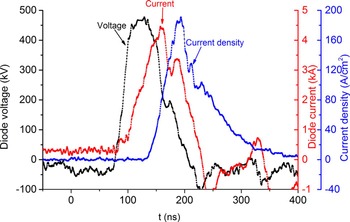
The IPIB irradiations were carried out on the BIPPAB-450 accelerator at Beihang University. The ion beams were produced by a MID and made up of hydrogen and carbon ions. The diode voltage, current, and beam current density profile of BIPPAB-450 accelerator are shown in Figure 1. Typically, the peak value of accelerating voltage and current density, and the pulse duration [full width at half maximum (FWHM)] are 450 kV and 150 A/cm2, and 80 ns, respectively. The energy density distribution of IPIB was obtained by infrared image diagnostic system (Davis, Reference Davis, Bartsch, Olson, Rej and Waganaar1997; Isakova, Reference Isakova2011; Isakova & Pushkarev, Reference Isakova and Pushkarev2013; Yu et al., Reference Yu, Shen, Qu, Liu, Zhong, Zhang, Zhang, Yan, Zhang, Zhang and Le2015b ).
Diode voltage, current, and beam current density of BIPPAB-450 accelerator.

Specimens of high purity (99.99%) zinc were mechanically polished and cut into pieces with the dimension of 15 × 1 × 1 mm3. In order to obtain the distributions of ablation mass versus energy density, nine zinc samples were irradiated for one pulse at the same time by IPIB under different energy densities. Before and after IPIB irradiation, the masses of the samples were measured by a Mettler XP205 analytical balance, which has the precision of 10 µg. The SEM analysis was conducted on FEI Nova NanoSEM 430.
4. RESULT AND DISCUSSION
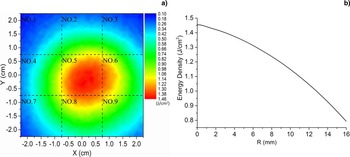
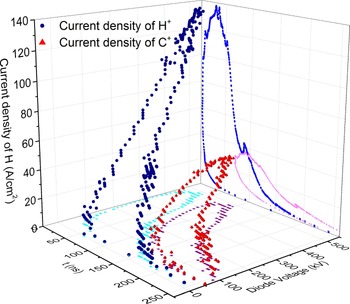
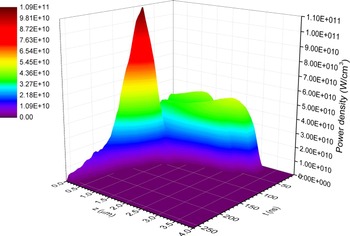
Figure 2 presents the energy density distribution of IPIB in this experiment and the energy density distribution function on radius [E(r)] in the model. The distribution of ion energy and type with time is demonstrated in Figure 3. The dynamic energy spectrum illustrates that the carbon ions reach the target 70 ns later than the hydrogen ions, and current density of hydrogen ions is three to four times as much as carbon ions. After calculation using SRIM code and normalization, the p(z, t) in this model, that is, power density distribution of deposition by 1 J/cm2 IPIB irradiation in the zinc target, can be obtained (in Fig. 4). At the beginning of the pulse, the deposition power density is mainly determined by the hydrogen ion with deeper deposition range; and in the later period, the input power density rises sharply in the surface of the target due to the shorter ion range of carbon ion.
Left: Infrared diagnostic result of IPIB energy density distribution; Right: IPIB energy density distribution function on radius.

IPIB dynamic energy spectrum of BIPPAB-450 accelerator.

Power density distribution of 1 J/cm2 IPIB in zinc.

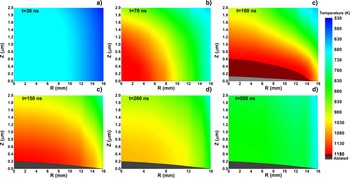
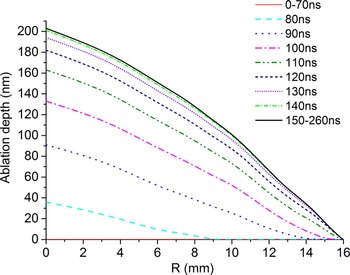
Combined with the above heat source functions, the evolution of the temperature field and ablation process in the zinc target caused by IPIB are described in Figures 5 and 6 via the heat conduction model. During the IPIB irradiation, the zinc in the center position of the target begins to melt at 30 ns (the melting point of zinc is 693 K), and reaches the boiling point (1180 K) at 70 ns. After reaching the boiling point, the zinc needs to absorb a large amount of energy to vaporize and leave the surface of target. As the large temperature gradient along the depth in the surface due to the short ion range in material, the surface material will lose plenty of heat by heat conduction. Moreover, the range of early arriving hydrogen ion is three times that of subsequently arriving carbon ion. Therefore, we can find that the size of ablated area is much less than the area in boiling point, such as Figure 5c. Ablated area continues to expand in the lateral and depth directions after 70 ns. Since the input energy of ion beam is smaller than the energy loss of heat conduction, from 150 ns to the end of the pulse (260 ns), the size of ablated area remain unchanged (Fig. 6). The maximum ablation depth is in the center of the target, and the depth of ablation decreases as radius increases. After 500 ns, the surface of the target begins to solidify.
Temperature distribution at different times in zinc by IPIB irradiation.

Ablation depth of zinc at different times during IPIB irradiation.

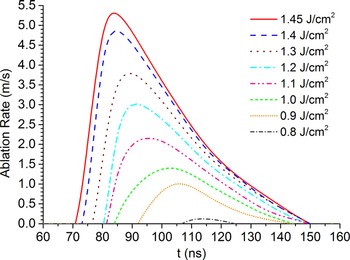
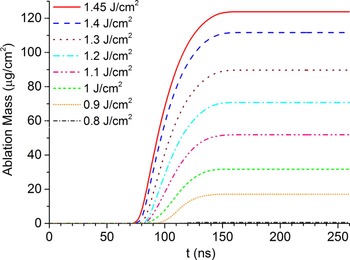
Figures 7 and 8 present the evolution of the zinc ablation rate and mass during different energy densities IPIB irradiation, respectively. The simulated results reveal that the ablation only occurs when the IPIB energy density is higher than 0.8 J/cm2. It means that the ablation energy density threshold of zinc irradiation by IPIB in BIPPAB-450 accelerator is 0.8 J/cm2, which is the same as the experiment result (Zhang et al., Reference Zhang, Yu, Zhong, Wei, Qu, Shen, Zhang, Yan, Zhang, Zhang and Le2015). After ablation occurs, the ablation rate climbs up and then declines with the change of the difference between the input power density and lost power induced by heat conduction. The ablation rate will reach the maximum while the difference is greatest. Irradiated by 1.45 J/cm2 IPIB, the maximum ablation rate of zinc is 5.5 m/s. The ablation process under the different beam energy density will start, and reach to the maximum ablation rate in different moments. The ablation under higher IPIB energy density starts and gets the maximum rate at earlier time due to faster heating process. Because the increasing ablated matter absorbs more and more energy from ion beam in the later stage, the ablation rate caused by higher IPIB energy density reduces faster, and the time difference between terminal moments is shorter than time difference between beginning moments. Since the deposition power density of carbon ions which arrive on the target after 70 ns is higher, the ablation mass will increase rapidly in the middle of the pulse (80–130 ns) for the whole target. The ablation mass and the maximum ablation rate of zinc increase with the energy density increases.
Ablation rate evolution of zinc by different energy densities IPIB irradiation.

Ablation mass of zinc by different energy densities IPIB irradiation.

The corresponding positions of each zinc target in the infrared image have been demonstrated in Figure 2. Combined with the IPIB energy density distribution, the ablation mass of each sample can be calculated. The results of simulation and experiment are shown in Table 1. The simulated ablation masses basically correspond to the experimental data. But, in the high energy density area, the ablation masses of calculation are a little larger than the experiment results. The primary reason is that some of ablation products can drop back to the target surface after IPIB irradiation. After the zinc vaporization and ablation, due to the random motion of zinc gaseous ablation products, the ablation products erupt to different directions; and part of the Zn ablation products will deposit back to the target surface. Figure 9 demonstrates the surface morphology of zinc target after one pulse IPIB irradiation. Some of the small-size particles appeared on the target after IPIB irradiation, and their size is same with the zinc ablation products, which were collected by silicon substrates in a previous work (Zhang et al., Reference Zhang, Zhong, Ye, Shen, Liang, Cui, Yu, Zhang, Zhang, Yan, Remnev and Le2017). Hence, the small-size particles on the targets are considered as the dropping back ablation products. The influence induced by the above cause will be more and more obvious with beam energy density increasing.
SEM image of zinc target after one pulse IPIB irradiation.

Ablation mass of each zinc sample in experiment and calculation

5. CONCLUSION
In this work, a heat conduction model, including the effects of IPIB dynamic energy spectrum and ablation was established to analyze the temperature evolution and ablation process in the zinc target induced by 0.8–1.45 J/cm2 IPIB irradiation. The ablation process is mainly determined by the deposition power density of IPIB and the energy loss induced by heat conduction. And the ablated matter can impact on the subsequent ablation process and ablation rate. The ablation rate firstly increases and then declines in the IPIB duration time, and the ablation mass and the maximum ablation rate of zinc increase with the increasing energy density. The maximum of the ablation rate in this experiment can reach 5.5 m/s. The simulation results of ablation threshold and ablation mass in zinc are basically in good agreement with the experimental results.
ACKNOWLEDGMENTS
This work is supported by National Natural Science Foundation of China (Grant No. 11175012), National Magnetic Confinement Fusion Program (Grant No. 2013GB109004), China Postdoctoral Science Foundation (Grant No. 2016M600897), and Tomsk Polytechnic University Project No. VIU INK 76/2017.