A dazzling display
The Musée de l'Homme is back in business! Great news, after several years’ closure and a 90-million-Euro revamp. In terms of public engagement and enjoyment, the outcome is certainly appealing. The space, the lighting, the displays, the objects, the scenography, the master-narrative (more on which below), all combine to make a very compelling experience, well worth the detour and the entrance fee. As the museum is not dauntingly big, some three solid hours should be sufficient for a thorough appreciation—especially if you do not stop at each and every interactive station, or indeed—a sore point actually—if you have to rely on the English and Spanish translations. The museum's highlight is undoubtedly its permanent ‘Galerie de l'homme’, spread over two floors and structured into three successive sections, entitled ‘Who are we?’, ‘Where do we come from?’ and ‘Where are we headed?’—a sequence that turns out less innocuous than it sounds. Other spaces include the somewhat austere touchscreen-based ‘balcony of science’ and a temporary exhibition venue, now dedicated to the building's architectural and museological renovation. Also in evidence are the Paul Rivet atrium, the Jean Rouch auditorium, the Yvonne Oddon research library, the André Leroi-Gourhan seminar room and the Germaine Tillion documentation centre, all rounded off with the inevitable café, restaurant and book-cum-gift shop, and further expanded worldwide through a dedicated internet site (http://www.museedelhomme.fr/en).
The design and arrangement of the displays at the new Musée de l'Homme (henceforth the MH), especially in its permanent gallery, clearly strive to banish any suspicion of monotony. Through exposure to various levels of texts and commentaries, intermixed with fractal-like sculptured alcoves, video clips, custom-made touch screens, interactive stands, documentary booths, audiotaped messages and suchlike sensory devices, visitors are kept smartly on their toes. These trappings are, for the most part, inviting, playful and also, thus far, in good working order. Special mention is due of the eyebrow-raising ‘wall of languages’: a huge, crimson-coloured, carpet-woven map of the world interspersed with gory plastic tongues that, when pulled-out, activate a taped audio sequence in the exotic and/or endangered language of your choice (Figure 1). Equally enthralling is the Neanderthal morphing station, where bolder visitors queue to observe on screen their own faces, gradually squeezed and stretched into the robust physiognomy of our unjustly maligned cousin species. As a much-needed breather from these head-spinning contraptions, the south-facing windows offer a stunning cityscape. The gardens of the Trocadéro, the Seine flowing by, the imposing yet graceful figure of the Eiffel Tower, the golden dome of the Invalides all unfold before your marvelling gaze—as does, tucked away to the left behind the foliage, the low-lying, dark-coloured edifice of the Musée du quai Branly (MQB), both catalyst and nemesis to our new Musée de l'Homme.
The ‘wall of languages’ (photograph: N. Schlanger).

History of the museum—consensus and decline
The sleek and forward-looking new MH has a past, of which it aims to make the most. Many museums and heritage institutions will, of course, seek nowadays to control, capitalise on and, if need be, jettison the legacies of their foundations. Not unexpectedly, commissioned curatorial histories of this kind—here involving an elaborate ten-station ‘history trail’ spread over the MH's four floors—risk being somewhat selective and prone to amnesia. All the more so when the brief is to ensure a seamless fit, or at least a semblance of compatibility, between the museum's own history and the wider universal story it seeks to promote.
Historically speaking, then, the MH is certainly one of the world's foremost anthropological museums (see recently de L'Estoile Reference de L'Estoile2007; Conklin Reference Conklin2013; Blanckaert Reference Blanckaert2015). Its origins lie with the Musée Ethnographique du Trocadéro (MET), drawing on ethnographic and archaeological collections salvaged from the 1878 Universal Exhibition to display the exotic diversity of pristine civilisations under European domination. Soon enough, apart from the odd visit by Picasso and his avant-garde friends in search of ‘art nègre’ inspiration among the primitivist bric-a-brac, the MET went into decline for lack of investment and interest, its corridors abandoned to their dusty fate. A drastic shake-up began in 1928, with the appointment of medical doctor and anthropologist Paul Rivet to the museum's directorship. Rivet enlisted the budding museographer Georges-Henri Rivière to help him, as well as his Institut d'ethnologie colleague Marcel Mauss, with his cohorts of emerging students, including Marcel Griaule, Jacques Soustelle, Denise Paulme, André Leroi-Gourhan and Claude Lévi-Strauss (the latter two later becoming vice-directors at the MH). Following a decade-long renovation process, involving the constitution of new collections, the endorsement of systematic and didactic principles, and the organisation of highly popular temporary exhibitions and outreach events, the MH opened its doors in 1938 in the Palais de Chaillot—effectively the reconstructed southern wing of the former Trocadéro building, itself now renovated again as an architectural phoenix in 2015.
Resident historiography emphasises the institution's resonance with the left-wing policies of the 1936 Front Populaire, the anti-fascist and anti-racist militancy of (some of) its staff, and the creation in 1940 of the very first Resistance network in Nazi-occupied France, with fateful results for its betrayed and martyred leaders. Less is said about the relations between the MH and the colonial administration that subsidised it, about the muscular collecting practices deployed by the 1931 Dakar-Djibouti mission and other expeditions, about the object-centred ambition to assemble the ‘material archives’ of vanishing humanity, about the diffusionist emphasis on traits and distribution maps, or for that matter about the perpetuation in its walls of raciological display principles well into the 1960s—including the remains of the since-returned Hottentot Venus. Paul Rivet's initial ambition to create a ‘musée-laboratoire’ combining research, conservation and outreach, enhanced by a leading research library, is clearly the subject of universal endorsement today (budget permitting, that is). Less consensual has been Rivet's decision to incorporate the MH into his chair of physical anthropology (renamed ‘ethnology of actual and fossil humans’) at the Muséum national d'histoire naturelle (MNHN), and to transfer the latter's centuries-old prehistoric and anatomical collections from the Jardin des plantes downstream to the Palais de Chaillot. In the hands of his post-war successors, this constrained naturalist synthesis has contributed to the museum's fragmentation into distinct and soon discordant departments, dealing respectively with ‘physical anthropology’, ‘prehistory’ and ‘ethnology’—much like the petering out of Boasian four-field anthropology. And so the MH too went into decline due to lack of investment and interest, its corridors abandoned to their dusty fate—so much so that it proved ripe for dispossession by the late 1990s, when President Jacques Chirac set his heart on the enhancement of exotic ‘arts premiers’. This drawn-out, acrimonious affair need not retain us here, save to confirm that the vast majority of the MH's original ethnographic collections have since crossed the river to the MQB, ‘the museum where cultures meet’. In this respect, the MH is by necessity new, with as many as 90 per cent of the objects currently on display never having been previously shown. Deprived of its ethnographic core holdings, stable-cleaned as it were, is the MH also bereft of its ‘culture’, in the sense so militantly promoted within its walls by Marcel Mauss and his students? With physical anthropology and prehistoric collections filling the vacuum, how does the MH fare now as a self-proclaimed museum of ‘human evolution’? Will the MH's Galerie de l'homme prove to be but an upmarket offshoot of the MNHN's Grande galerie de l’évolution? And how might all of this shape the message it sets out to convey?
History in the museum—series of busts
Let us first examine how the MH deals with history (beyond its own). Museum displays and labels are expected to be alluring and informative, so some latitude is tolerated in the acknowledgement of sources. Still, it is unfortunate that the gallery's three overarching questions are taken to be so self-evident. Granted that their previous use to structure the very same museum during the 1990s is passed over in silence, it is surely puzzling to find no mention (on the labels and in the accompanying booklet) of Paul Gauguin's emblematic painting D'où venons-nous? Que sommes-nous? Où allons-nous? (1897). Recognising the nineteenth-century origins of these interrogations, in betwixt artistic arcadia and modernist angst, might have plucked them from their museological timelessness back into the cultural and historical fray to which they belong.
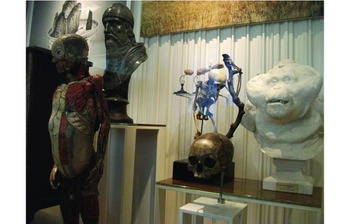
To address its guiding questions, in any case, the MH makes extensive use of its inherited anatomical and (physical) anthropological collections. As could be expected, skulls take pride of place, from the scribbled-on cranium of philosopher René Descartes (d. 1650; Figure 2) to the shell-decorated cranium of the Cavaillon Lady (discovered 1872, as Menton Man). Skeletons aside, a display of anatomical wax models of various organs and orifices, dating from the seventeenth and eighteenth centuries, prove particularly fascinating in their lurid realism. Nearby, a series of plaster busts and ceramic braincases with their cerebral functions clearly mapped illustrates the nineteenth-century fascination with phrenology (Figure 3). No inkling is given however of phrenology's reformist ambitions to free individual propensities from the shackles of ‘natural’ dispositions. Similarly, little is made of the perpetuation of cerebral localisation theories in subsequent brain research, notably through anthropologist Paul Broca, the eponymous discoverer of the aphasia speech area who also crucially contributed to the heyday of anthropometric science.
Descartes’ cranium, with friends (photograph: N. Schlanger).

Phrenology (photograph: N. Schlanger).

Challenges surrounding human objectification and classification feature further down the exhibit, with a stunning assembly of some 90 painted plaster and bronze busts, cast or sculpted, exposed on metal racks gradually curving upwards to the museum's ceiling (Figure 4). Ranging from the mid nineteenth century to the beginning of the twentieth, these heads embody through their features, hairstyle and ornaments a diversity of anthropological and ethnographic types. Information is given on the methods by which they were measured and live-cast in plaster (hence their closed eyes), and their geographic and ethnic origins are recorded, as well as their names: “Worraday, Tasmanian, 35–40 years old, Australia, 1836”, “Zibaioya, South African Zulu, Paris, 1853”. Overall, this whole assembly is undoubtedly a bravado display, enlisting aesthetics and systematics to simultaneously acknowledge, expose and transcend its raciological raison-d’être.
Series of busts: specimens (photograph: N. Schlanger).

This rousing message rather falls flat, however, barely two metres farther on, when we encounter yet another series of head-and-shoulders busts, thoroughly similar in their morphology, date and disposition, and yet so different in conceptual and ethical terms (Figure 5). For these are busts of men (literally) of science, founding figures in ‘the study of human diversity in space and time’, ranging from Buffon and Geoffroy Saint-Hilaire to the aforementioned Broca, Emile Cartaillac and Henri Breuil. Here, no mention is made of the circumstances in which these busts were produced, nor are they to be taken as typical exemplars of, say, Toulousan features (Cartaillac) or Norman stock (Breuil). What we have here are individual actors, achievers and contributors, genuinely unique as intellectual and historical founding figures in a given scientific and cultural milieu—and all of them, rather parochially, French. Casting a glance backward to the previous array of busts, it transpires that we had only been observing there specimens, representatives of human diversity, with their generic, measurable traits—human beings, most emphatically, but hardly human agents; biologically unique and equal no doubt, but without those being-in-history qualities that some others possess.
Series of busts: scientists in the background (photograph: N. Schlanger).

Evolution takes command
This ironic juxtaposition is without doubt unintentional: in the new MH it is above all else ‘evolution’ that rules the day. Let us leave aside the distracting displays and interactive side-shows, and focus at last on the museum's message. The thrust of the story is written on the wall in the entrance hall, in between a beguiling video sequence. “We are all unique”, spell out elegant fonts, “We are all heirs to a genetic and cultural heritage that is specific to us” and, farther on, “Let us get back to us, to you . . . why are we the only ones to study our history, to imagine our future, to visit museums? What have we that is so different?” What, indeed, are we to make of this individualist pageant? Granted that we are all unique, how can our genetic and cultural heritage be “specific to us”, rather than shared, willingly transmitted or deliberately withheld? And how can our ‘genetic’ and our ‘cultural’ heritages be so naively lumped together? Even if it is couched in the singular, as a generic human property, how can ‘culture’ not be understood as a shifting complex that is constructed, contested and invested with significances? As for the notion of ‘heritage’, which might conceivably be straightforward with regard to genetic inheritance (think of Mendel's pea pods, or blue-eyed babies), how can it be permitted to remain so smooth and superficial when applied to culture, so insouciantly omitting (all through the museum) any reference to its strategic, reflexive and situated uses? And when the museum's wall ponders “Why are we the only ones to study our history, to imagine our future, to visit museums?”—who is this “we” so brazenly summoned? Is it an inclusive “we” spanning the whole of humankind as another unique species? Or is it not rather a far more exclusive “we”, restricted to that infinitesimal fleck of it that is led by its uniquely privileged cultural, social, economic and historical conditions to visit the Palais de Chaillot on a Saturday afternoon?
Assuredly, too much poetic license has been granted to the museum's communication consultants. This bewildering prelude is redeemed by rather more nuanced and enlightening narratives across the ‘Who are we?’ section, where humans are said to derive their specificity and uniqueness from being creatures of flesh, of thought, of relationships and of speech. Fair enough. Still, when we are presented as the only species to shroud its reproduction and its demise in symbolic meanings (“we live, we die and death not ends it”, as sang The Doors), when we are told that we need to be situated at the interface of the phylogenetic, the cultural and the individual, and indeed that we are all members of one ‘great family of man’—how can we resist recalling Roland Barthes's still timely critique of that very myth! It was Barthes (Reference Barthes1976 [1957]) who deplored the trite portrayal of an aestheticised common humanity unscathed by historical differentiation, and then swiftly exposed, for what it is worth, this legendary ‘human nature’, resting on supposedly solid and scientifically incontestable natural foundations. In this sense, the language games across the gallery prove to be as beguiling as its audio-visual pageants. In a museum dedicated to ‘human evolution in its biological and cultural dimensions’, an offshoot of the MNHN, the crucial notion of ‘evolution’ (with ‘random mutations’, ‘genes’, ‘natural selection’ and ‘descent with modification’ held in the background) is all too eagerly applied to ‘societies’, ‘identities’ and ‘objects’, which somehow “evolve with globalisation, while remaining specific to a culture”. All the while, no sign is given (not even in the form of italics, or quotation marks) that a shift has occurred from a literal sense to a loose metaphorical derivative, as if the biological and cultural processes involved are essentially similar in their intentionality and their agency, in their unfolding, appropriation, justification, perception and consequences.
‘Humankind evolves—so does its museum’?
Can we really assume such an essential similarity between biological and cultural processes? There is actually an issue on which we seem to have ‘evolved’ since Barthes's analysis. Whereas he had linked the myth of human nature to the reintroduction of religion, the new MH makes it clear that its finality lies in economy, that its Omega Point rests not with God but with globalisation. Throughout the ‘Where do we come from?’ gallery, we learn that humanity was from the onset composed of unique individuals, stone tools in hand, diligently setting out of Africa to reach and inhabit all the nooks and crannies of the planet. As the final ‘Where are we headed?’ section intimates, it is part of our unique birthright to spread out, to overcome distances, to increase the flux of people and goods circulating through world-spanning networks. This, the MH attempts to reassure us, need not necessarily lead to dreary homogenisation. Just as the past provides many examples of local cultures and identities that have been reshuffled and recomposed, so does the present show how standardised elements can serve to generate new differentiations: basketry woven with plastic materials is a case in point, and so are mobile phone covers boasting ‘ethnic’ designs. Notwithstanding the symbolic compensations afforded by these traditional trinkets (‘heritage’ again, but of a more challenging kind), our unique evolutionary trajectory remains on course towards globalisation. Music, need it be said, to the MH's official patrons, benefactors and sponsors. Numbering a telecommunication network, a strategic image consultancy and a recently privatised energy utilities giant (cleaning up its act on fossil fuels, apparently, while still building dams on the Amazon and importing fracked shale oil), these fast expanding multinational corporations will obviously have no quarrel with this portrayal of human nature evolving towards its globalised apex.
Probably less enchanted would have been Marcel Mauss, the museum's culture hero during the interwar years, he who remained wary of imperious internationalism and free trade normalisation, while actively supporting small-scale, self-reliant cooperatives and workers’ welfare rights. “Will our planet”, ponders one of the final displays, “support the generalisation of an industrialised mode of life?” Fair question, but by making its subject “our planet”, rather than society, visitors can only deduce that the issue is essentially technical or environmental, and not political—as if the “generalisation of an industrial mode of life” was itself already agreed on, or beyond discussion. When the question is raised “Will human societies, in their diversity, be able to agree on how to share and preserve resources?”, the reference here to a “diversity” of societies, implying a level playing field in which ‘we are all in it together’, seems a feeble attempt to occlude deep-seated power relations and inequalities. As devised by its strategic consultant, the new MH's slogan is “Humankind evolves. So does its museum” (Figure 6). As it further develops and expands, the MH should perhaps try to make some more room, among the dazzling displays and playful presentations, for those ‘things that present danger’ (as Mauss called them), things that betray friction and resistance, things that encourage debate, highlight costs and point to alternatives, things that can lead us, beyond our evolving human nature, to a better understanding of social realities and historical processes. This will only strengthen the ‘resolutely humanist’ ambitions claimed by the MH, and make a visit to it, already highly recommended, all the more rewarding.
“Humankind evolves. So does its museum”. In the Metro (photograph: N. Schlanger).