


The reputations of media outlets have been caught up in rising public antipathy towards the opposing political party (see Iyengar et al. Reference Iyengar, Lelkes, Levendusky, Malhotra and Westwood2019; Mason Reference Mason2018 for reviews of affective polarization). Partisans hold unfavorable views of media they associate with the other side, considering them biased and untrustworthy (Arceneaux and Johnson Reference Arceneaux and Johnson2013; Baum and Gussin Reference Baum and Gussin2007; Ladd Reference Ladd2012; Stroud, Muddiman, and Lee Reference Stroud, Muddiman and Lee2014). Given the expansive news choice the contemporary media environment provides, these negative reputations are important for public opinion formation because they lead partisans to avoid out-party media, discount messages they encounter from them, and instead rely on information from sources they perceive as neutral or associated with their side (De Benedictis-Kessner et al. Reference De Benedictis-Kessner, Baum, Berinsky and Yamamoto2019; Dorison, Minson, and Rogers Reference Dorison, Minson and Rogers2019; Goldman and Mutz Reference Goldman and Mutz2011; Iyengar and Hahn Reference Iyengar and Hahn2009; Levendusky Reference Levendusky2013a; Stroud Reference Stroud2011).
When focusing on online news, this oppositional media hostility is puzzling. In contrast to cable television (Berry and Sobieraj Reference Berry and Sobieraj2013; Mutz Reference Mutz2015), economic pressure leads online partisan media to bundle political coverage with substantial amounts of nonpolitical news (Hindman Reference Hindman2018; Munger Reference Munger2020) and constrains their ability to inject ideological slant into much of their political coverage (Gentzkow and Shapiro Reference Gentzkow and Shapiro2011). Content analysis of online news finds modest differences in the perceived slant of the typical political story from major partisan outlets, a departure from the “outrage” typically associated with them (Budak, Goel, and Rao Reference Budak, Goel and Rao2016; Peterson, Goel, and Iyengar Reference Peterson, Goel and Iyengar2019).
We resolve this puzzle by arguing that online partisan selective exposure sustains oppositional media hostility. We posit that, absent direct experience, the public assesses out-party media based on negative and inaccurate stereotypes. This means dislike of out-party media occurs despite, not because of, the coverage major online partisan media outlets provide. In turn, our argument implies that cross-cutting exposure that deviates from these stereotypes can improve assessments of out-party media by challenging inaccurate beliefs about their coverage that provide the basis for oppositional media hostility.
To support this argument, we use survey-linked web-browsing data to show that the public holds negative views of out-party news sources they rarely encounter. We then conduct three survey experiments with a combined sample of over 8,000 respondents to assess the effects of cross-cutting exposure. The first experiment assigns exposure to nonpolitical coverage from an out-party or in-party source, which improves views of out-party media, but has limited effects for those encountering an in-party source. The second experiment shows that cross-cutting exposure reduces oppositional media hostility only when it counters stereotypes of out-party news (i.e., when it is not political or offers a neutral portrayal of ongoing political events). In contrast, exposure to reputation-consistent political coverage (i.e., coverage hostile towards the source’s political opponents) from out-party media does not reduce oppositional media hostility. Finally, the third experiment examines how people assess out-party media coverage. Along with others (Baum and Gussin Reference Baum and Gussin2007; Feldman Reference Feldman2011; Turner Reference Turner2007), we find partisans engage in biased processing of news from out-party media, but show this is not powerful enough to completely inhibit responsiveness to the type of news these sources provide.
Our findings reveal the self-sustaining nature of political media reputations in the high-choice online environment. Given that the perception a media outlet is associated with the other side, partisans are unlikely to encounter its content (e.g., Barnidge et al. Reference Barnidge, Gunther, Kim, Hong, Perryman, Tay and Knisely2020; Goldman and Mutz Reference Goldman and Mutz2011; Kaye and Johnson Reference Kaye and Johnson2016; Stroud Reference Stroud2011). This limits opportunities for the moderation experimentally induced in this study to occur when individuals choose the news they see. It also clarifies how oppositional media hostility coexists with content analyses that reveal more modest differences in the slant of the online coverage major partisan media sources provide. Finally, our attention to new types of cross-cutting exposure, representing forms of partisan media coverage widely available online, demonstrates lessons from cable television may not translate to the Internet, showing the benefits of using descriptive studies of media content to motivate experimental treatments.
While our evidence concerns assessments of partisan media, the dynamics we identify have suggestive implications for other studies of out-group hostility. We show that when individuals hold unfavorable views of a group and also avoid encounters with them, inaccurate stereotypes can sustain negative out-group affect. This illustrates that choice over whether out-group encounters occur impedes any ameliorative effects of intergroup contact (e.g., Allport Reference Allport1954; Pettigrew and Tropp Reference Pettigrew and Tropp2011), emphasizing the need to understand polarization in attitudes towards the opposition not only as the product of how people respond when they encounter out-groups but also as based on their choices about whether or not to do so.
Partisan Selective Exposure to Online News
As the media environment has fragmented, the availability of partisan sources has sparked renewed interest in an old concept: selective exposure to political information (Lazarsfeld, Berelson, and Gaudet Reference Lazarsfeld, Berelson and Gaudet1944; Sears and Freedman Reference Sears and Freedman1967). While media in a low-choice environment provided a unifying experience (Mutz and Martin Reference Mutz and Martin2001), the Internet and cable television allow the public to seek news from sources aligned with their party (Barnidge et al. Reference Barnidge, Gunther, Kim, Hong, Perryman, Tay and Knisely2020; Davis and Dunaway Reference Davis and Dunaway2016; De Benedictis-Kessner et al. Reference De Benedictis-Kessner, Baum, Berinsky and Yamamoto2019; Iyengar and Hahn Reference Iyengar and Hahn2009; Levendusky Reference Levendusky2013a; Stroud Reference Stroud2011). However, a desire for party-congenial news is not the only contributor to media choice (Bolsen and Leeper Reference Bolsen and Leeper2013; Hutchings Reference Hutchings2003; Iyengar et al. Reference Iyengar, Hahn, Krosnick and Walker2008; Messing and Westwood Reference Messing and Westwood2014; Mummolo Reference Mummolo2016). Other factors, such as an interest in particular topics or social endorsements, constrain the emergence of complete partisan echo chambers even in high-choice online settings (Bakshy, Messing, and Adamic Reference Bakshy, Messing and Adamic2015; Gentzkow and Shapiro Reference Gentzkow and Shapiro2011).
At the same time, when focusing on the content people encounter online, there is a divide in the sources frequented by members of different parties for political and election-related news (Flaxman, Goel, and Rao Reference Flaxman, Goel and Rao2016; Garrett Reference Garrett2009; Guess Reference GuessForthcoming; Peterson, Goel, and Iyengar Reference Peterson, Goel and Iyengar2019). And, in a finding shared across many studies of online news use, partisans are unlikely to engage in cross-cutting exposure to media outlets they associate with the other party. Instead the vast majority of their news consumption occurs on outlets visited by members of both parties or sources associated with their side (Bakshy, Messing, and Adamic Reference Bakshy, Messing and Adamic2015, 1131; Gentzkow and Shapiro Reference Gentzkow and Shapiro2011, Table II; Peterson, Goel, and Iyengar Reference Peterson, Goel and Iyengar2019, Table 1; Stroud Reference Stroud2011, Ch. 3).
Summary of Experimental Designs

Note: SSI = Survey Sampling International. All studies focus on partisan respondents. Experiments 1 and 2 include a control group with no news exposure.
Oppositional Media Hostility
Like others associated with the opposing political party (e.g., Iyengar et al. Reference Iyengar, Lelkes, Levendusky, Malhotra and Westwood2019; Mason Reference Mason2018), the public perceives out-party media as biased and views them in a negative light (Arceneaux, Johnson, and Murphy Reference Arceneaux, Johnson and Murphy2012; Coe et al. Reference Coe, Tewskbury, Bond, Drogos, Porter, Yahn and Zhang2008; Goidel, Goidel, and Davis Reference Goidel, Goidel and Davis2018; Kaye and Johnson Reference Kaye and Johnson2016; Stroud and Lee Reference Stroud and Lee2013). Partisans consider media associated with the other party to be a homogeneous “out-group” (Stroud, Muddiman, and Lee Reference Stroud, Muddiman and Lee2014).Footnote 1 Because they do not encounter much of this coverage on their own, oppositional media hostility is shaped by rhetoric from politicians (Archer Reference Archer, Bezio and Goethals2020; Ladd Reference Ladd2012) and criticism of out-party media from the copartisan news sources they do frequent (Arceneaux and Johnson Reference Arceneaux and Johnson2013, 146; Goidel, Goidel, and Davis Reference Goidel, Goidel and Davis2018; Ladd Reference Ladd2012). This is part of a broader pattern in which partisan news increases dislike of politicians and groups associated with the other party (Levendusky Reference Levendusky2013b; Smith and Searles Reference Smith and Searles2014; but see Druckman et al. Reference Druckman, Gubitz, Levendusky and Lloyd2019).
The sources of oppositional media hostility are important to understand because of its implications for news exposure and, consequently, public opinion formation. Holding a negative view of news sources they associate with the other party leads partisans to avoid their coverage (Barnidge et al. Reference Barnidge, Gunther, Kim, Hong, Perryman, Tay and Knisely2020; Dorison, Minson, and Rogers Reference Dorison, Minson and Rogers2019; Kaye and Johnson Reference Kaye and Johnson2016). This reduces exposure to the types of cross-cutting news that might lead partisans to hold more moderate opinions on a variety of issues (Conroy-Krutz and Moehler Reference Conroy-Krutz and Moehler2015; De Benedictis-Kessner et al. Reference De Benedictis-Kessner, Baum, Berinsky and Yamamoto2019; Levendusky Reference Levendusky2013a; Levy Reference LevyForthcoming; Mutz and Martin Reference Mutz and Martin2001). Conversely, avoiding out-party media due to their negative reputations renders partisans more reliant on sources they perceive as neutral or associated with their side (Goldman and Mutz Reference Goldman and Mutz2011; Stroud Reference Stroud2011). This has the potential to amplify the extremity of their policy views and negative attitudes towards their political opponents (Davis and Dunaway Reference Davis and Dunaway2016; Levendusky Reference Levendusky2013b; Smith and Searles Reference Smith and Searles2014) while limiting exposure to uncongenial news due to the “partisan filtering” copartisan sources practice (Baum and Groeling Reference Baum and Groeling2008).
When considering the factors that shape this phenomenon, previous research finds that cross-cutting exposure to out-party media exacerbates oppositional media hostility. Arceneaux and Johnson (Reference Arceneaux and Johnson2013) show that forcing individuals to encounter news coverage from out-party media polarizes their view of these outlets (see also Arceneaux and Johnson Reference Arceneaux and Johnson2015; Coe et al. Reference Coe, Tewskbury, Bond, Drogos, Porter, Yahn and Zhang2008). Baum and Gussin (Reference Baum and Gussin2007) demonstrate partisans are more likely to label a neutral piece of political news as biased when it is attributed to an out-party source (Feldman Reference Feldman2011; Turner Reference Turner2007; see also Settle Reference Settle2018, Ch. 6).
A Disconnect Between Media Reputation and Online News Coverage
Studies of partisan media predominantly examine coverage from these sources that contains a clear ideological leaning and uncivil attacks on the opposing party (e.g., Arceneaux and Johnson Reference Arceneaux and Johnson2013; Druckman et al. Reference Druckman, Gubitz, Levendusky and Lloyd2019; Levendusky Reference Levendusky2013a; Mutz Reference Mutz2015; Smith and Searles Reference Smith and Searles2014). There is evidence that such coverage affects aspects of both mass opinion (e.g., Lelkes, Sood, and Iyengar Reference Lelkes, Sood and Iyengar2017; Martin and Yurukoglu Reference Martin and Yurukoglu2017) and elite behavior (e.g., Arceneaux et al. Reference Arceneaux, Dunaway, Johnson and Wielen2020).
Theoretical accounts offer good reasons for this focus. The goals of partisan media are distinct from the legacy sources that previously dominated the media marketplace. Rather than providing centrist coverage to attract the widest possible audience (Hamilton Reference Hamilton2004), partisan media providers instead attempt to cultivate a distinctive reputation to cater to audiences that prefer ideologically congenial political information (Mullainathan and Shleifer Reference Mullainathan and Shleifer2005) or to provide slanted coverage that influences political outcomes in their preferred direction (Martin and McCrain Reference Martin and McCrain2019; Prat Reference Prat2018).
This leads partisan media to produce coverage that departs from what is available from other sources. When considering cable television, content analyses show news from partisan media differs from other sources by discussing politics with phrases that resemble those used by copartisan politicians (Martin and Yurukoglu Reference Martin and Yurukoglu2017) and directing “outrage” at political opponents (Berry and Sobieraj Reference Berry and Sobieraj2013; Jamieson and Capella Reference Jamieson and Cappella2008; Smith and Searles Reference Smith and Searles2013).Footnote 2
While such partisan media coverage exists on the Internet (e.g., Lelkes, Sood, and Iyengar Reference Lelkes, Sood and Iyengar2017), online partisan media face economic considerations that push them away from only providing reputation-consistent political news attacking the other side (Gentzkow and Shapiro Reference Gentzkow and Shapiro2011; Hindman Reference Hindman2018, Ch. 4; Munger Reference Munger2020). This introduces important and understudied variety into online partisan news that contrasts with the reputations of these outlets.
First, the pursuit of a large audience leads major online media, including partisan sources, to bundle political news with substantial amounts of nonpolitical coverage (Hindman Reference Hindman2018; Munger Reference Munger2020). This is clear from the home pages of partisan websites that feature tabs for “entertainment” or “lifestyle” coverage (Fox News) and “culture and arts” or “travel” news (Huffington Post). More systematically, Budak, Goel, and Rao (Reference Budak, Goel and Rao2016, Table 1; see also Peterson, Goel, and Iyengar Reference Peterson, Goel and Iyengar2019) conduct a crowd-sourced content analysis of articles on news websites in the United States and find that only 42% of their stories focus on politics. This extends to partisan sources, including Fox News (46% of stories on politics) and Huffington Post (38% of stories on politics).Footnote 3
Second, based on their limited reporting resources and the volume of coverage they produce, online partisan outlets are unable to introduce a distinct slant into all their political coverage (Gentzkow and Shapiro Reference Gentzkow and Shapiro2011, 1831–1832). As a result, they frequently repurpose wire service stories (Baum and Groeling Reference Baum and Groeling2008). While partisan sources selectively decide which stories to emphasize, this content means that, along with reputationally consistent coverage attacking the other party, partisan websites contain many stories with the neutral tone and point-counterpoint format emphasized in wire coverage.
This difference between cable television and the Internet manifests in large-scale content analyses of online political news. Budak, Goel, and Rao (Reference Budak, Goel and Rao2016, 260) use crowd-sourcing to consider the slant of online news coverage. They find an ordering of news websites consistent with past research (e.g., Fox News is more right-leaning and Huffington Post more left-leaning than other major news websites), but conclude “the vast majority of political articles in most outlets are neutral.”
To assess this for the context of this study, we conducted a content analysis of a random sample of 206 political articles that appeared on Fox News or the Huffington Post in 2018. We had the slant of each article (i.e., how positive or negative it was perceived as treating Democrats and Republicans) assessed by 15 coders on Amazon’s Mechanical Turk. This reveals some reputation-consistent coverage attacking the other party, but we also find 57% of the political articles on these websites were perceived as neutral in their treatment of the out-party. This neutral coverage is similar to wire copy in describing ongoing political events in a civil manner and departs from the ubiquitous attacks on the opposition present on partisan cable news (Berry and Sobieraj Reference Berry and Sobieraj2013).Footnote 4
This discussion reveals substantial amounts of nonpolitical and neutral political stories on partisan media websites.Footnote 5 Experimental studies of news choice, which consider the public’s ability to select these types of stories from partisan outlets, account for this (Iyengar and Hahn Reference Iyengar and Hahn2009; Messing and Westwood Reference Messing and Westwood2014; Mummolo Reference Mummolo2016; Stroud Reference Stroud2011, Ch. 3), but such content has not been used when considering the effects of cross-cutting exposure.
Cross-Cutting Exposure and Oppositional Media Hostility
Although they do not encounter much content from them, the public views out-party media through a negative, politically focused lens.Footnote 6 Yet, much online partisan news contrasts with this reputation. We posit that cross-cutting exposure that runs against these expectations can reduce oppositional media hostility. Such exposure challenges preconceived views of out-party media as biased and uncivil—assessments that provide the basis for oppositional media hostility but are lightly informed by experience with out-party sources—and indicates the partisan, uncivil coverage individuals expect is not as pervasive as they supposed. Ultimately, such cross-cutting exposure portrays out-party media in a favorable light.
We use this perspective to develop three hypotheses. We anticipate two forms of cross-cutting exposure will reduce oppositional media hostility. First, nonpolitical coverage from partisan sources breaks from the politically focused perspective the public uses to assess them. This is a clear departure from political “outrage” and leads to our first hypothesis.Footnote 7
Hypothesis 1: Cross-cutting exposure to nonpolitical coverage will improve views of the out-party media source providing it.
Second, neutral political coverage—for instance, the stories that partisan media outlets produce from wire copy—is not inflected with the harsh critiques of the opposition commonly associated with their political coverage.Footnote 8 While this type of coverage may still be chosen selectively (Baum and Groeling Reference Baum and Groeling2008) and can influence policy opinion (De Benedictis-Kessner et al. Reference De Benedictis-Kessner, Baum, Berinsky and Yamamoto2019; Levendusky Reference Levendusky2013a), it also departs from the stereotypical stories attacking the opposition expected from these outlets. This leads to our second hypothesis.
Hypothesis 2: Cross-cutting exposure to neutral political coverage will improve views of the out-party media source providing it.
Finally, our perspective leads us to expect that cross-cutting exposure that aligns with stereotypes about out-party media sources—encounters with hostile political coverage attacking the opposition in an uncivil manner—will not improve assessments of out-party news sources. In line with earlier research on cross-cutting exposure to such content (e.g., Arceneaux and Johnson Reference Arceneaux and Johnson2015), we expect these encounters to further reduce views of out-party media. This leads to a third hypothesis.
Hypothesis 3: Cross-cutting exposure to hostile political coverage will worsen views of the out-party media source providing it.
Points of Contrast With Extant Research
Before our empirical tests, we emphasize two ways that our account departs from the extant literature. First, there is evidence that the public engages in biased evaluations of political news. Studies of the “hostile media phenomenon” show people interpret neutral political coverage as biased against their side (Giner-Sorolla and Chaiken Reference Giner-Sorolla and Chaiken1994; Gunther and Schmitt Reference Gunther and Schmitt2004; Vallone, Ross, and Lepper Reference Vallone, Ross and Lepper1985). This extends to news with slant, as partisans perceive coverage supporting the out-party as more biased than coverage favoring their side (Coe et al. Reference Coe, Tewskbury, Bond, Drogos, Porter, Yahn and Zhang2008; Feldman Reference Feldman2011). Biased processing is more pronounced when coverage comes from media that is associated with the other party (Baum and Gussin Reference Baum and Gussin2007; Turner Reference Turner2007). This works against our expectations, as partisans may perceive any story as biased when it comes from an out-party source.
Second, there is evidence that cross-cutting exposure increases oppositional media hostility (Arceneaux and Johnson Reference Arceneaux and Johnson2015; Arceneaux, Johnson, and Murphy Reference Arceneaux, Johnson and Murphy2012; Coe et al. Reference Coe, Tewskbury, Bond, Drogos, Porter, Yahn and Zhang2008), the opposite of the pattern we propose. In earlier studies this occurs because those who avoid out-party media are sensitive to hostile coverage. Accordingly, the forced cross-cutting exposure in some of our experiments may exacerbate these divides based on who it exposes to out-party news.
While previous studies do not directly test the effects of the new forms of cross-cutting exposure we consider here, they predict very different responses. Based on this we engage with these important alternatives in a multiexperiment test of our account. We use designs that both allow (Experiment 1) and do not allow (Experiment 2) respondents to choose whether to encounter political news from an out-party source. We ask them to evaluate coverage in a way that can reveal the biased processing of news seen in earlier studies (Experiment 3). This lets us adjudicate between our claims and previous work.
Fox News and Huffington Post as Exemplar Online Partisan Media
We test our theory with an observational study and three survey experiments. For several reasons, these studies focus on Fox News and the Huffington Post. First, both are among the most visited news websites in the United States (Budak, Goel, and Rao Reference Budak, Goel and Rao2016; Peterson, Goel, and Iyengar Reference Peterson, Goel and Iyengar2019; Settle Reference Settle2018, Ch. 6).Footnote 9 Second, both websites have partisan audiences and reputations, allowing us to operationalize definitions of “in-party” and “out-party” media. When asked to evaluate the slant of news outlets on a seven-point scale from “Liberal or pro-Democratic party bias” (1) to “Conservative or pro-Republican party bias” (7) in a 2018 YouGov survey, Huffington Post received an average rating of 2.5 and Fox News a rating of 5.7, placing the outlets at the extremes of major news sources and roughly equivalent distances, in opposing directions, from the midpoint of the scale (see Appendix B.2).
Descriptive Evidence: Cross-Cutting Exposure Is Associated With Less Oppositional Media Hostility
Our theoretical account rests, in part, on the notion that partisans have limited exposure to the out-party news sources they dislike. For this reason, we first consider the association between partisan selective exposure and oppositional media hostility. We use a survey, fielded by YouGov, from March 2018, in which the respondents had all installed a toolbar on their desktop web browser that tracked the websites they visited in the months before the survey (see Peterson, Goel, and Iyengar Reference Peterson, Goel and Iyengar2019 for another study using this approach). This lets us relate a respondent’s online news exposure to their assessments of different media outlets.
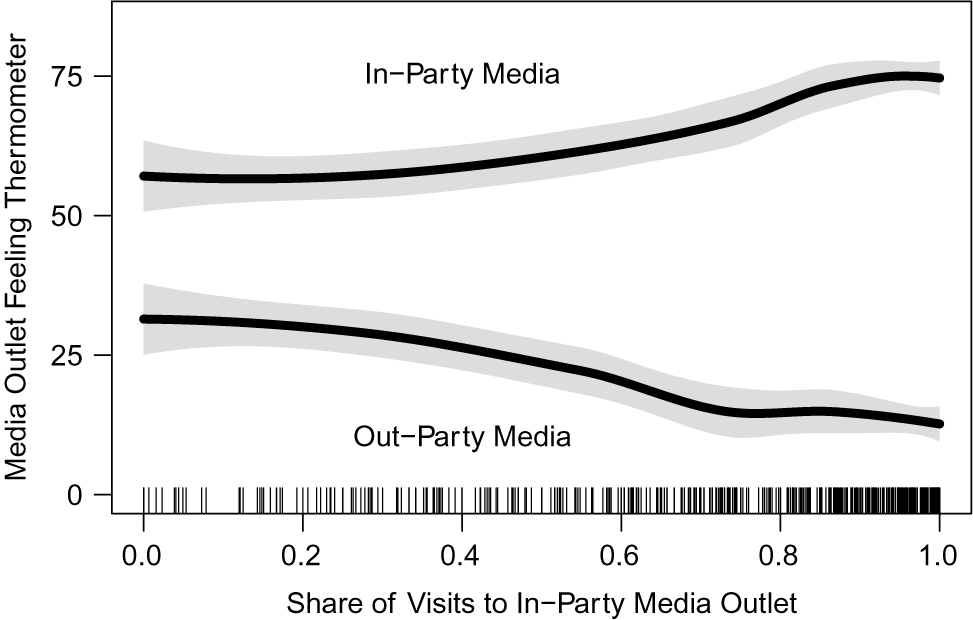
We examine views of Fox News and Huffington Post among 699 partisan survey respondents who visited at least one of the two websites in the browsing data. We consider the share of a respondent’s visits to the two websites that went to the one associated with their party. For Republicans this is a respondent’s number of visits to Fox News divided by their total number of visits to Fox News and Huffington Post. For Democrats it is their number of visits to Huffington Post divided by their total to the two websites. This captures selective exposure specific to this context, with higher values indicating less exposure to the source associated with the other party. We find limited cross-cutting exposure, as 73% of visits went to in-party sources. This divide is more pronounced among the most active quartile of news consumers, with 86% of visits from this group going to their in-party source.
Respondents placed Fox News and Huffington Post on feeling thermometers, with higher values indicating more affinity for the source. For Republicans the in-party outlet is Fox News and the out-party outlet is Huffington Post; the labels are reversed for Democrats. This reveals a large divide in views of partisan media. The in-party source received an average rating of 68.7, while the out-party source received an average rating of 17.8.
Figure 1 displays the smoothed relationship between a respondent’s media exposure and their assessments of the news outlets. It reveals that the greater an individual’s share of visits to their in-party outlet, the more favorable their view of this in-party source and the more unfavorable their view of the out-party outlet. This establishes two points that we build on in the rest of the paper. First, on average, partisans hold highly negative views of out-party sources they rarely encounter. Second, those with the most hostile views of out-party media have the least exposure to them.Footnote 10
Media Outlet Favorability by Use (Fox News and Huffington Post)
Note: Figure displays predicted values from LOESS regressions of partisan survey respondents’ (n = 699) approval of Fox News and Huffington Post on their relative use of the websites. The in-party source for Republicans is Fox News and for Democrats is Huffington Post. In-party visit share is the number of visits to their in-party site divided by their total number of visits to Fox News and Huffington Post.

There is an association between partisan selective exposure and oppositional media hostility or, put otherwise, between cross-cutting exposure and favorable views of out-party media. However, our observational study indicates that cross-cutting exposure is relatively limited, and other studies of partisan media show that those who engage in cross-cutting exposure differ from their copartisans in many ways (e.g., weaker party loyalty) that could explain this association (Levendusky Reference Levendusky2013a; Stroud Reference Stroud2010; see also Appendix Table B5). For this reason, we now use survey experiments to randomly assign news exposure.
Summary of Experimental Designs
We use three survey experiments to consider the effects of partisan news exposure on news source reputation. Table 1 summarizes each experiment by characterizing its sample and the two main treatment arms that vary across the studies, which randomized the type of source and type of coverage respondents saw.
Experiment 1, conducted in March 2017, examines the effects of exposure to nonpolitical news among 1,879 partisan survey respondents recruited by Survey Sampling International.Footnote 11 Respondents were randomly assigned to encounter a nonpolitical story from either an in-party or out-party source. This experiment tests whether counter-reputational coverage from a partisan source improves the public’s view of it and compares the effects of in-party and out-party exposure.
Experiment 2 was conducted in August 2019 on 4,250 partisan respondents from the Lucid panel (see Coppock and McClellan Reference Coppock and McClellan2019). It focused on the effects of exposure to an out-party source and broadened the coverage that was considered to include neutral political coverage (i.e., political stories not perceived as slanted in favor of either political party) and hostile political stories (i.e., political coverage from the source that was perceived as critical of its opposing political party) in addition to nonpolitical coverage. This allows for a full test of the effects of different forms of cross-cutting exposure in line with our hypotheses.
Finally, Experiment 3, also from August 2019, was conducted on 2,263 partisan respondents from Amazon’s Mechanical Turk. The experiment compared the effects of cross-cutting political news (i.e., either neutral or hostile) from out-party sources. It included a wider set of outcomes to assess perceptions of different types of out-party coverage.
Combined, this multistudy approach allows a full test of our theoretical expectations and ensures that key findings replicate in multiple studies. We now consider each study in turn.
Experiment 1: Exposure to Nonpolitical News
In Experiment 1, respondents began by selecting a topic they preferred reading about from a list of nine nonpolitical areas.Footnote 12 At this point some were assigned to a control group with no further news exposure and evaluated the media outlets with a feeling thermometer.Footnote 13 The other respondents read a story on the nonpolitical topic they were interested in and were randomly assigned to see the story attributed to Fox News or Huffington Post. They saw the same nonpolitical story regardless of the outlet to which it was attributed.
After reading the first story, respondents in the news exposure conditions selected a second story to read from the same outlet. Based on viewing the article’s headline and first sentence, they chose between an additional nonpolitical story, drawn from the ones they had not already seen, or a political story. This follow-up political story was randomly assigned to either be neutral coverage from the Associated Press or, in the style emphasized in prior examinations of partisan media (Berry and Sobieraj Reference Berry and Sobieraj2013; Levendusky Reference Levendusky2013b), a piece of hostile coverage criticizing the opposition (e.g., a story attacking Democrats on Fox News). These follow-up stories were selected using a pretest on Amazon’s Mechanical Turk to ensure they were perceived in the intended manner.Footnote 14 After reading both articles, respondents evaluated the media outlets with a feeling thermometer.
The design of Experiment 1 accomplishes three things. First, it offers a chance to observe whether encountering nonpolitical stories on a topic they care about, content particularly likely to induce cross-cutting exposure (Mummolo Reference Mummolo2016), changes the public’s views of out-party media. Second, it examines whether these effects occur when reminding respondents of the political news available from these websites while they are selecting a second article. Third, this offers the same observations for in-party sources, enabling us to consider the malleability of media reputations for outlets with which copartisans have more experience.
We note the treatment effects from this design are a composite of the random assignment to the initial, forced round of nonpolitical exposure and the coverage available when respondents chose a second story. We took this approach to understand whether any positive effects of nonpolitical news exposure can persist given a reminder of the political coverage commonly associated with these outlets when selecting the follow-up story. This somewhat complicates the interpretation of the effects in this study, but we note that later experiments employ a design to more cleanly isolate the effects of nonpolitical coverage on its own.
Experiment 1 Results: Views of In and Out-Party Media
We examine the effects of exposure on feeling thermometer assessments of a respondent’s in-party source (i.e., Fox News for Republicans and Huffington Post for Democrats), their out-party source (i.e., Huffington Post for Republicans and Fox News for Democrats), and the difference in evaluations of the in-party and out-party sources, measuring the divide in their view of these outlets. The design of Experiment 1 creates five conditions. The first is the control condition, those with no news exposure, which is the reference category in our analysis. The second category is those who read nonpolitical coverage from an out-party source and then encountered a neutral political article when selecting a follow-up. The third contains those assigned a nonpolitical article from an out-party source, who saw a partisan political article when selecting another to read. The fourth contains those who read coverage from an in-party news source and had a neutral political article available when selecting a follow-up. Finally, the fifth treatment category includes those who encountered an in-party source and were presented with a partisan follow-up article from that outlet.
Table 2 regresses these outcomes on indicator variables for the treatment categories. We begin with the implications of out-party media exposure. The second column of Table 2 reveals that encountering the nonpolitical coverage from an out-party source substantially improved that outlet’s favorability. Relative to the control group, out-party source ratings improved both in the condition where the follow-up choice set included a neutral political article (8.3 points, 95% CI [3.6, 12.9]) and where a partisan political article was in the subsequent choice set (9.0 points, 95% CI [4.4, 13.6]). This supports our first hypothesis, that emphasizing a nonpolitical dimension along which to evaluate out-party media improves views of them.
Media Outlet Thermometer Ratings by Exposure

Note: Reference category is no news exposure; models control for party; standard errors in parentheses.
* p < 0.05.
Consistent with this pattern, the third column of Table 2 shows that exposure to nonpolitical coverage from an out-party source also reduced the divide in an individual’s views of in-party and out-party media in both conditions: -8.1, 95% CI [-13.5, -2.6] for the “Out-Party (neutral follow-up)” condition and -8.7, 95% CI [-14.1, -3.4] for the “Out-Party (partisan follow-up)” condition. To place these shifts in context, consider how the size of this gap changed across the experimental conditions. In the control group, the divide was 23.7 points. Pooling together the out-party exposure conditions, the divide fell to 15.2 points. In other words, exposure to nonpolitical coverage from an out-party source produced a 35% decline in the divide over views of different media relative to the control.
Table 2 also shows the influence of nonpolitical coverage on an outlet’s reputation is substantially larger for out-party sources than for in-party media. To summarize this, we compare the net improvement in the treated outlet’s rating with the nontreated outlet’s rating for each category (i.e., the pooled effect of the two out-party exposure conditions on the out-party/in-party thermometer difference relative to the pooled effect of the two in-party exposure conditions on the in-party/out-party thermometer difference).Footnote 15 The absolute effect of out-party nonpolitical exposure, compared with in-party nonpolitical exposure, is a 7.6 point improvement (95% CI [2.2, 12.9]) in assessments of the treated source relative to the nontreated outlet. This shows that cross-cutting exposure has distinctive consequences for media outlet approval relative to exposure to in-party outlets with which respondents have more familiarity and a higher baseline level of support.
Beyond these overall effects of in-party and out-party exposure, it is also important to note the nonconsequences of the additional manipulation included in this experiment, the variation in the types of political news coverage that respondents saw while selecting a second story. This manipulation was included to see whether a subsequent reminder of the hostile coverage available from out-party sources undermines any improvement in views towards them brought about by exposure to their nonpolitical coverage.
Table 2 indicates that exposure to out-party coverage, whether followed with a neutral or hostile political article, improved assessments of the out-party source and reduced the feeling thermometer divide between in-party and out-party media. There was no difference based on the follow-up political article that was available. For example, in terms of reducing the divide between in-party and out-party evaluations, the difference between the neutral and hostile follow-up conditions from the out-party source was small and not distinguishable from zero (0.7, 95% CI [-6.0, 7.3]). This shows that the findings are robust to a reminder of the reputation-consistent coverage available from out-party media.
We suspect that this finding is partially due to respondents’ ability to avoid hostile political coverage from the out-party source if they wished. In Appendix C we show respondents more frequently avoided political articles from the out-party source when they were assigned to the hostile condition, limiting the time they spent with this coverage. This avoidance is consistent with earlier work on cross-cutting exposure to partisan media (Arceneaux and Johnson Reference Arceneaux and Johnson2013).
Experiment 2: Effects of Cross-Cutting News Exposure
Experiment 1 shows that encountering nonpolitical coverage from out-party media improves views of these outlets. However, it leaves open whether other types of cross-cutting exposure can accomplish this. Our expectation is that coverage that is inconsistent with the public’s negative stereotypes of out-party media sources should improve views of them. This means, beyond nonpolitical stories, neutral political coverage has this potential. In contrast, political stories that are consistent with the public’s negative notions of out-party media coverage should not improve views of these sources.
Our second experiment considers the effects of different types of cross-cutting exposure. At the beginning of the survey, respondents indicated the type of nonpolitical news they preferred. They were randomly assigned to four conditions.Footnote 16 First, the control group had no news exposure. Second, those in the nonpolitical treatment encountered a story on their preferred topic from the out-party source (e.g., a Fox News story was “Italian church, cops dupe art thieves by swapping out original $3M masterpiece for fake”). Third, those in the neutral out-party condition encountered a political story that was assessed as neutral, in the sense it did not clearly favor or denigrate members of either party, by coders in a pretest (e.g., a Fox News story was “DOJ announces release of 3,100 inmates as part of criminal reform push”). Fourth, those in the hostile out-party condition encountered a highly partisan story in which the news source criticized its opponents, again with a label validated by pretesting (e.g., a Fox News story was “Ingraham: ‘Left’ trying to destroy what it means to be American”).Footnote 17 Like Experiment 1, respondents saw one story randomly selected from a pool of coverage in the assigned category, meaning that our design does not hinge on any individual story.
This design makes several advances. First, unlike the initial experiment, all the coverage originally appeared on the site to which it was attributed. To the extent that a website’s partisan leanings intrude into its nonpolitical coverage or seemingly neutral political stories in a way that is not captured in our pretest, but which confirms the negative reputations of these websites, this offers a more realistic test of the ameliorative effects of cross-cutting exposure. Second, the broader set of out-party exposure conditions includes all forms of coverage relevant to our theory. Third, this forced exposure design provides a tough test of our expectation that neutral political coverage can improve views of out-party media. To the extent those who prefer to avoid out-party sources respond negatively to any political news from them, providing no opportunity to avoid it works against our theoretical expectations.
Experiment 2 Results: Views of Out-Party Media
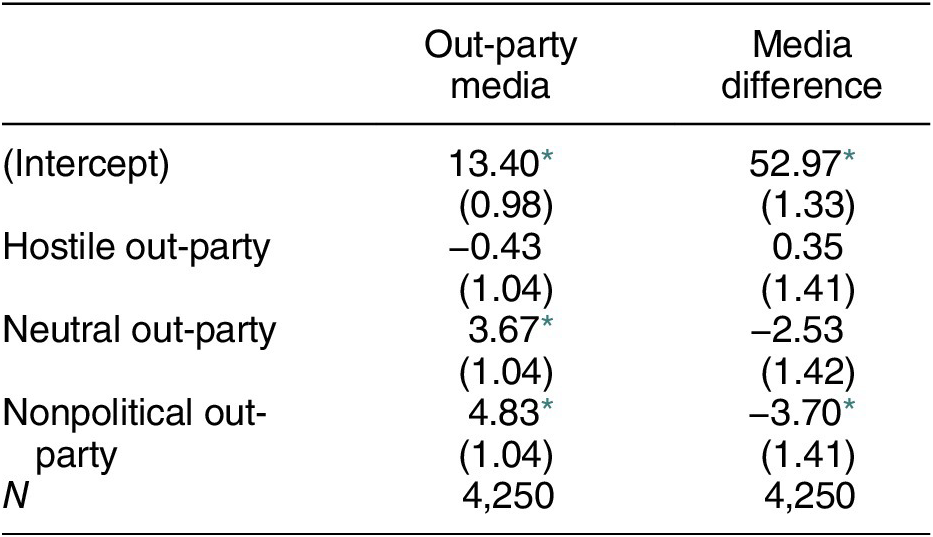
We examine the effects of this exposure on feeling thermometer ratings of the out-party outlet and the difference between their ratings of in-party and out-party media.Footnote 18 Due to the potentially smaller effects of neutral political coverage, relative to nonpolitical stories, we control for pretreatment covariates in the analysis to improve the precision of the treatment effect estimates. Before indicating their nonpolitical news interests, respondents evaluated the partisan bias of several media sources on a seven-point scale. For the regressions in Table 3, we control for a respondent’s party and their view of out-party source bias.
Out-Party Media Ratings by Exposure Condition

Note: Reference category is no news exposure; models control for party and pretreatment views of out-party media bias; standard errors in parentheses.
* p < 0.05.
For the nonpolitical treatments, our results align with Experiment 1. Exposure to a nonpolitical story from the out-party source improved assessments of that source by 4.8 points (95% CI [2.7, 6.9]) on the feeling thermometer scale and reduced the divide in assessments of in-party and out-party media sources by 3.7 points (95% CI [-6.5, -0.9]). This amounts to a 12% reduction in the size of the divide in views of in-party and out-party media compared with the control group. The magnitude of these effects is smaller than Experiment 1, but we observe effects in the same direction when using real-world coverage from these sources. This experiment also did not require individuals to consume multiple stories, so the effect is only for one article.
Encountering neutral political news from an out-party source also improved assessments of it by 3.7 points (95% CI [1.6, 5.8]) relative to the control. This shows that encounters with political news from out-party media need not increase hostility and can improve views of these sources. This is consistent with our second hypothesis. However, this did not produce a detectable decline in the divide between in-party and out-party sources, though it is in the expected direction (-2.5, 95% CI [-5.4, 0.3]).Footnote 19
Finally, we do not find support for our third hypothesis. Relative to the control condition, there is not a detectable drop in evaluations of out-party media for those exposed to hostile coverage from these sources (-0.4, 95% CI [-2.5, 1.7]), even as the direction of this pattern aligns with our expectation that this type of cross-cutting exposure would increase oppositional media hostility. This small treatment effect indicates that the public evaluates out-party media sources similarly in the control group, where they saw no coverage, and the treatment condition where they encountered hostile out-party news. We interpret this as evidence that, when the public evaluates out-party media, they already have such hostile coverage in mind when forming their evaluations.
Experiment 2 Results: Inaccurate Stereotypes of Partisan Media Coverage
These findings are consistent with our theory that neutral and nonpolitical coverage from out-party media departs from the stereotypes of these sources. However, we have not directly measured these reputations. For this reason, after collecting primary outcomes in Experiment 2, we asked respondents in the control group to evaluate six headlines and rate the likelihood they would appear on one of the websites using a five-point scale from “not at all likely” (1) to “extremely likely” (5).Footnote 20
The headlines were randomly selected from stories used in the experiment, meaning we already characterized their topic and perceived slant in a pretest. There are four headline categories: nonpolitical stories, neutral political stories, political stories hostile towards Democrats, and political stories hostile towards Republicans. Table 4 displays the average likelihood respondents perceived headlines in the different categories would appear on a website. For each website, we order the categories from the coverage perceived as having the highest likelihood of appearing on the website to the coverage seen to have the lowest likelihood of appearing on it.
Perceived Likelihood Headline Type Appears on Website

Note: In parentheses the table displays the average perceived likelihood, measured on a five-point scale, that various categories of headlines appear on a website from control group respondents in Study 2 (n = 1,276).
Table 4 reveals that people most prominently think of partisan news sources as providing hostile coverage attacking the other side, with this type of coverage receiving an average rating of 3.9 for Fox News and 3.6 for Huffington Post, a departure from our content analysis in which nonpolitical coverage and neutral political stories are more common than this type of coverage.Footnote 21 In a finding that helps explain the influential effects of nonpolitical exposure, such coverage was seen as the least likely to appear, with an average rating of 2.8 for Fox News and 2.9 for Huffington Post, despite its actual prominence on these websites. The headline classification task affirms our earlier claims about inaccuracies in perceptions of partisan news source reputations.
Experiment 3: Effects of Cross-Cutting Political News
The second experiment shows that, beyond nonpolitical stories, encountering neutral political coverage from an out-party source improves views of it. However, we have not assessed how respondents evaluated these stories. For this reason, we conduct a third experiment, randomly assigning respondents to see hostile or neutral out-party political news.
In this experiment respondents assessed the article in terms of its slant—how favorable or unfavorable it was towards their party on a five-point scale. We then examine whether partisans distinguish different types of political coverage from out-party sources. Prior studies suggest the availability of source labels leads people to perceive neutral coverage from an out-party source as biased (Baum and Gussin Reference Baum and Gussin2007; Feldman Reference Feldman2011; Turner Reference Turner2007). Experiment 3 also allows us to observe whether our finding that neutral coverage improves views of out-party media replicates, and lets us use a multiitem outcome scale, which we describe in more detail later, to measure views of out-party media.
Experiment 3 Results: Perceptions of Article Slant
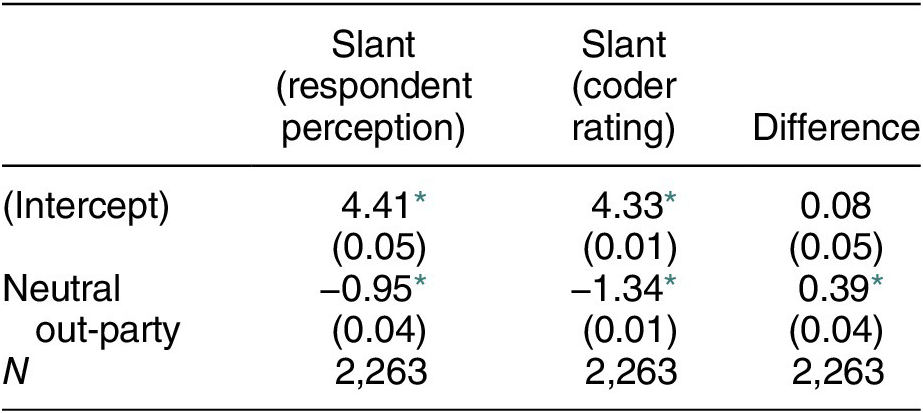
Table 5 displays the effects of this exposure on assessments of article slant. In the first column, we regress the respondent’s slant rating on the treatment, with the outcome coded so higher values indicate a perception that the coverage is negatively slanted against the respondent’s party. To provide a reference for how these changes align with the ratings from the pretest, the second column substitutes the average slant rating the article received in the pretest for a respondent’s own rating. This indicates the difference in how respondents evaluated articles relative to the coders, who assessed them without a source label. Finally, the third column examines the difference between a respondent’s rating of article slant and the average pretest rating the article received. This considers whether the articles were evaluated differently in the pretest, where an outlet’s label was unavailable, and the third experiment, where the media source was prominently featured.
Assessments of Out-Party Coverage Slant By Exposure

Note: Reference category is hostile out-party news exposure; models control for party and pretreatment views of out-party media bias; standard errors in parentheses.
* p < 0.05.
The first column of Table 5 shows that respondents evaluated the neutral coverage as less slanted against their party. Assessments move from the upper bound of the five-point slant scale in the hostile out-party condition (4.4) to near the scale midpoint in the neutral condition (3.5), a difference of -0.95 points (95% CI [-1.03, -0.87]). Even when respondents read the full article with the source label available, they distinguished between different types of coverage. This complements the second experiment, offering an indication of why respondents improved their views of out-party sources when encountering neutral political coverage from them.
However, the second and third columns show our findings are not entirely at odds with earlier evidence of source label bias. While respondents perceived the neutral coverage as less slanted, they are not as responsive to this content as would be implied by the ratings the headlines received from the coders, who assessed them without a source label. Using the coder assessments of article hostility from the pretest, the reputation-consistent articles received an average rating of 4.3 while the neutral articles received a rating of 3.0, a difference of -1.34 points (95% CI [-1.36, -1.32]).
The third columns shows the implications of this bias. While they responded to the difference between the reputation-consistent and neutral articles, respondents in the third experiment still rated the neutral articles as 0.39 points (95% CI [0.31, 0.48]) more negatively slanted than the pretest ratings implied. This reveals the distorted processing that was found in earlier studies, but shows that it is not powerful enough to eliminate responsiveness to the type of content available from out-party media. This links our study to earlier work while explaining why our findings depart from it in important ways.
Experiment 3 Results: Views of Out-Party Media
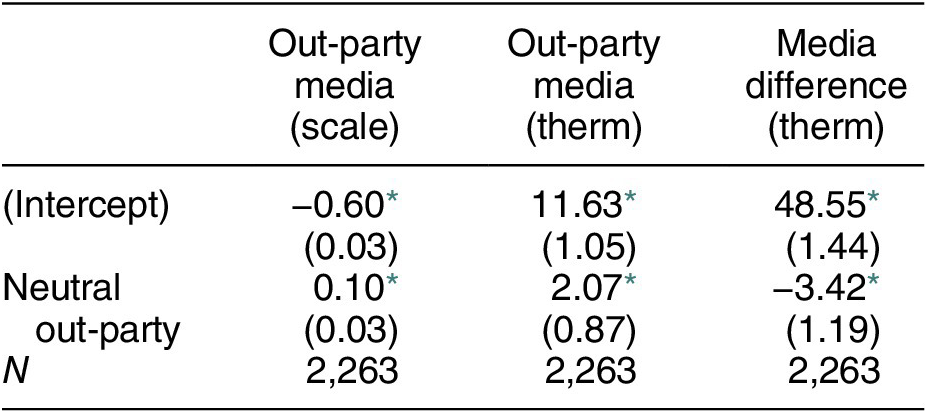
In Table 6 we consider the effects of exposure to neutral out-party coverage, relative to hostile out-party coverage. The table’s first column examines the treatment effect on the out-party media scale created from four survey items taken from previous studies of oppositional media hostility (e.g., Arceneaux and Johnson Reference Arceneaux, Johnson and Murphy2012). This provides a broader assessment of the out-party source then the previous experiments. These four items were the 101-point feeling thermometer capturing overall views of the out-party outlet, a four-point scale evaluating the fairness of the out-party source from “Always tends to favor one side” to “Always deals fairly with all sides,” a seven-point scale where they were asked whether the out-party media outlet provided accurate information about politics and answered on a scale ranging from “Strongly disagree” to “Strongly agree,” and a three-point scale where they were asked about the ideology of the out-party outlet and could answer that it was “mostly liberal,” “mostly conservative,” or “neither in particular.” These items were combined into a scale using principal components analysis, with the final outcome rescaled to have a mean of zero and a standard deviation of one. Higher values on this outcome indicate a more positive view of the out-party outlet.Footnote 22
Out-Party Media Ratings by Exposure Condition

Note: Reference category is hostile out-party news exposure; models control for party and pretreatment views of out-party media bias; standard errors in parentheses.
* p < 0.05.
The second column considers the effects for the out-party media thermometer on its own, corresponding to the analysis in earlier sections. Finally, the third column examines the difference between in-party and out-party media evaluations.
These findings align with Experiment 2. Relative to the hostile coverage, encountering neutral political coverage improved assessments of out-party media. Using the combined scale, displayed in the table’s first column, we find exposure to neutral coverage from out-party media improved assessments of the outlet by 0.1 standard deviations (95% CI [0.04, 0.16]). Using only the feeling thermometer, encountering a neutral article from an out-party source improved evaluations by 2.1 points (95% CI [0.3, 3.8]) relative to a hostile article. As the third column shows, this translated into a 3.4 point reduction (95% CI [-5.8, -1.0]) of the divide in an individual’s assessments of in-party and out-party media. Relative to the condition with hostile out-party coverage, this is a 12% decrease in the size of the divide.Footnote 23
While, as in the second experiment, the magnitude of these effects is relatively small, they occur from a single instance of cross-cutting exposure. This improvement in views of out-party media, due to coverage widely available from partisan media in online settings, is a clear directional departure from earlier findings where out-party media exposure increased oppositional media hostility (Arceneaux and Johnson Reference Arceneaux and Johnson2015).
Discussion and Conclusion
We argue that two forms of cross-cutting exposure, based on coverage widely available from online partisan media, can improve views of out-party news sources. To support this, we use a descriptive analysis of online news choice to show that the public holds hostile views of out-party media they rarely encounter. We use three survey experiments to illustrate that cross-cutting exposure can reduce oppositional media hostility. When focusing on reputationally consistent news from partisan media, the coverage that dominates public perceptions, our results resemble earlier studies. However, when we examine the effects of nonpolitical or neutral coverage, cross-cutting exposure reduces oppositional media hostility.
Our findings have important implications for understanding contemporary political communication. First, they illustrate how partisan selective exposure sustains oppositional media hostility. While much online partisan media coverage deviates from the outrage that is commonly associated with these sources, their reputations among out-partisans are negative enough that cross-cutting exposure is limited, allowing an exaggerated view of their coverage to underpin oppositional media hostility. This demonstrates how polarized media reputations can persist no matter what coverage these outlets provide. It also highlights a need to consider how media reputations are established. We expect messages from copartisan politicians and media contribute, particularly when people do not encounter such media on their own (Archer Reference Archer, Bezio and Goethals2020; Ladd Reference Ladd2012; Peterson and Muñoz Reference Peterson and Muñoz2020). This work should also consider the reputational consequences when media content becomes more extreme in a setting that was not formerly partisan, such as the expansion of Sinclair Media’s ownership of local television stations (Martin and McCrain Reference Martin and McCrain2019).
Second, while the mechanism differs, our findings align with others showing the depolarizing effects of cross-cutting exposure for policy attitudes and views of the opposition (Conroy-Krutz and Moehler Reference Conroy-Krutz and Moehler2015; De Benedictis-Kessner et al. Reference De Benedictis-Kessner, Baum, Berinsky and Yamamoto2019; Levy Reference LevyForthcoming).
Third, we show that findings based on partisan cable television do not always translate to the Internet, where the delivery and content of partisan media may fundamentally differ (Sydnor Reference Syndor2018). It is important for future research to consider aspects of partisan media effects that do, and do not, generalize from cable to the Internet and use descriptive studies of online content to design experiments.
While our theory and evidence are confined to partisan media sources, our theoretical perspective suggests a channel through which inaccurate stereotypes can sustain out-group animus across many settings. When people hold negative views of an out-group and also avoid them, misperceptions can sustain out-group animus that would otherwise be attenuated by such encounters. For instance, there is evidence that misperceptions about the other party inflate affective polarization (Ahler and Sood Reference Ahler and Sood2018; Druckman et al. Reference Druckman, Klar, Krupnikov, Levendusky and RyanForthcoming; Lees and Cikara Reference Lees and Cikara2020; Levendusky and Malhotra Reference Levendusky and Malhotra2016; Moore-Berg et al. Reference Moore-Berg, Ankori-Karlinsky, Hameiri and Bruneau2020). Our perspective suggests that it is worthwhile to examine whether this stems from partisan homophily in an individual’s interpersonal relationships (e.g., Mutz Reference Mutz2006; Rossiter Reference Rossiter2020). In terms of explaining out-group animus, our study points to the importance of considering not only how encounters with an out-group influence opinion (e.g., as in assessments of the “intergroup contact hypothesis”; Allport Reference Allport1954; Pettigrew and Tropp Reference Pettigrew and Tropp2011) but also the choices people make about whether such encounters occur.
In closing, we note some considerations for assessing these findings. One limitation is that the effects of cross-cutting exposure we observe are relatively small. We view this as indicative of the difficulty in moving attitudes towards groups and individuals associated with the out-party, a pattern that manifests in prior studies of affective polarization (Levendusky Reference Levendusky2018). These effects should also be understood in the context of a single encounter with an out-party source. Were individuals to engage in more substantial encounters of this type, the effects of cross-cutting exposure may be larger (for suggestive evidence see Stone, Van Kuiken, and Wallace Reference Stone, Van Kuiken and Wallace2017). While we lack the measures to consider it here, we also suspect there may be heterogeneity in these effects. In particular, cross-cutting exposure may be more influential among those with a dispositional avoidance of conflict, an important personality trait considered in other studies of media incivility (Mutz Reference Mutz2015; Sydnor Reference Sydnor2019) and those with one-sided media diets that leave them with the limited prior exposure to out-party sources.
A second limitation is our focus on two news outlets. The reach and clear partisan reputations of Fox News and Huffington Post makes them important to consider but potentially limits the generalizability of our findings if other partisan media sources do not provide these same types of counter-stereotypical coverage. However, previous content analyses of partisan media show that even highly partisan sources (e.g., Breitbart and Daily Kos) still provide some news coverage that is nonpolitical or neutral, making our findings relevant to these outlets (Budak, Goel, and Rao Reference Budak, Goel and Rao2016, Table 1; Sobieraj and Berry Reference Sobeiraj and Berry2011, 32–33). Moreover, given partisan polarization in views of many mainstream news sources, and the particularly negative views of these outlets held by Republicans (Ladd Reference Ladd2012), our findings also suggest that exposure to coverage from mainstream sources that breaks from negative stereotypes about them could produce similar effects.
Finally, we emphasize that our focus on attitudes towards out-party media neglects other important outcomes that online partisan media may influence (e.g., divides over perceptions of factual evidence, policy opinion). Indeed, we view the study of oppositional media hostility as important due to its implications for the media sources people use and how they are influenced by them. For instance, even as it fails to exacerbate oppositional media hostility, the more neutral political coverage from online partisan media that we consider could affect partisans’ policy views (De Benedictis-Kessner et al. Reference De Benedictis-Kessner, Baum, Berinsky and Yamamoto2019; Levendusky Reference Levendusky2013a; Smith and Searles Reference Smith and Searles2014). We also do not address other channels, such as social media, through which people encounter incivility (Munger Reference Munger2017). Understanding when and how online partisan media influence public opinion formation remains an important topic.
Supplementary Materials
To view supplementary material for this article, please visit http://dx.doi.org/10.1017/S0003055420001124.
Replication materials can be found on Dataverse at: https://doi.org/10.7910/DVN/CCV1NN.







Comments
No Comments have been published for this article.