Introduction
The word ‘Tungus’ refers to the Evenk and Even Siberian peoples, who live in small groups in a vast area of eastern Siberia stretching from the Arctic Ocean to northern China, where the climate is continental (temperatures vary between –50° and +30° C). They are nomadic hunters, reindeer herders or settled salmon fishermen, and share a common cultural and linguistic core. During the Soviet period, the nomadic populations were partly settled in purposely built villages. Some members of the intelligentsia live in towns. For the majority of the population, however, main subsistence and additional resources come from the natural environment (food and fur hunting, reindeer herding, fishing, gathering berries and mushrooms). In 2002, around 70% of the Siberian indigenous minority peoples of the Russian Federation lived in villages or were nomadic (Russian census 2002). Of this 70%, around 30% were nomads, 70% were villagers (Suljandziga and others Reference Sulyandziga, Kudryashova and Sulyandziga2003: 92–93, 142; Megatrends Reference Megatrends2011: 24). This situation has been stable since the 2010 census. Analyses showed that 66% of the Evenk are either villagers or nomads. Since most Siberian villages have an unemployment rate of between 75% and 80% (Vlasova Reference Vlasova2006: 898), the averages of rural populations quoted above imply that around 65–70% of the Siberian indigenous population is totally or partly dependent on the natural environment for survival. This means that the natural environment has a crucial significance both practically and ideologically for Siberian indigenous minority peoples in general and for the Tungus in particular. What kind of changes in the human–environment relationships can be stimulated by the danger to flora and fauna caused by climate change (and by other inter-linked drivers of change)?
The present paper reports on a study built on eight years of fieldwork (conducted between 1994 and 2010) among Tungusic peoples in Yakutia, Kamchatka, and the regions of Amur and Khabarovsk.
The term climate change is used here in a specific way to designate every unusual or unexplained anomaly in the weather observed by the Tungus and the phenomena in the environment that these peoples link with these observed anomalies.
I recently started to study climate change as an anthropologist, analysing the economic, technical and spiritual human–environment relationship among the nomads, villagers and townspeople and this was the focus of my comparative research. In the 1990’s, I did not really pay attention to the remarks of the elders about the changes in climate and the fading of long and cold winters, I simply identified them as an expression of nostalgia for their youth. Returning to the nomadic field in 2006 it was evident that changes in climate and in the environment had indeed become a threat, endangering not only the environment and traditional economics (hunting, reindeer herding), but also the societies and their cultures, and along with this, a risk of modifying the human–environment relationship.
This paper explores how the Tungus perceive climate change and evaluates the importance of climate change as a cause of economic, social and ritual changes among the Siberian peoples. The main argument is that climate change may give rise to major modifications in the perception of people concerning the environment and of their economic and religious relationship with it. To this end, the paper analyses the Tungusic perception of a link between the natural environment and their identity, their notions of adaptation and vulnerability, and some cases of adaptive strategies that either use old techniques, or have triggered mutations. The second argument is that the current changes have also induced changes in religious practices, such as the creation of new rituals, the rebirth of shamanistic legends, the emergence of native predicators and of millenarian narratives. Similarly, the modifications of the perception of the human–natural environment relationship have given rise to changes in other social organisation. Indeed, the comparison of some Tungusic cases shows the emergence of new isolated economic adaptations, in which the notion of reciprocity seems to disappear within society while a new notion of time-space in managing the environment appears.
Despite Ingold's criticism of the human-natural environment opposition in anthropological approach of hunters-gatherers (Ingold Reference Ingold2000) in which he questions the division between humanity and nature, I still use the expression and the research angle of ‘human–environment relationships’ not as a dichotomy separating society and nature, but as a non-exhaustive primary step tool for several reasons, as many others do in Arctic climate change studies (Nuttall Reference Nuttall, Crate and Nuttall2009; Crate Reference Crate2008; Crate and others Reference Crate, Forbes, King, Kruse, John, Schweitzer and Fondahl2010 and others quoted in this paper). Ingold criticises the ‘inherent dualism’ of the approach consisting in the ‘study of the reciprocal interplay between the two kinds of system, social and ecological with its implied dichotomies between person and organism, society and nature’ (Ingold Reference Ingold2000: 3). His theoretical approach aims to ‘build an alternative to the standard anthropological account of environmental perception as a cultural construction of nature, or as the superimposition of layers of “emic” significance upon an independently given, “etic” reality’ (Ingold 200: 20). He argues that science needs to recognise that ‘human beings must simultaneously be constituted both as organisms within systems of ecological relations, and as persons within systems of social relations’ (Ingold Reference Ingold2000: 3). First of all, I do not intend to perform a wide anthropological theoretical comparison of the perception of the environment, but only to understand this hunter-gatherer-herder ‘emic’ perception among two Siberian peoples and how it may change. But I do not use Descola's theoretical construction (Descola Reference Descola2005). He analyses, thanks to reflection based on this artificial distinction, the continuities and discontinuities between humans and their environment. For instance, he compares the perception of the environment among various hunter-gatherers seeing themselves as a part of the environment and assimilating their environment (of which they have a complex and detailed perception) into their culture and industrialised societies’ cosmogony where the autonomy of ‘nature’ (with a broad and vague perception) on the one hand and of ‘culture’ on the other hand is attested (Descola Reference Descola2005: 105–118). Indeed, Tungusic narratives and practices related to the perception of the environment clearly demonstrate that the ‘emic’ worldview does see a set of interrelations between humans and the natural environment (or its elements), even if the Tungus perceive the humans that they are as one of the species inhabiting the environment. And if they do attribute social life to various animal species, and if their perception merges in one concept what scientists (both social and biological) distinguish in ‘biophysical’ elements and ‘emic’ worldview and what I distinguish in economic and ritual relationships (see in the text the description of the Tungusic perception of natural environment). Even if Ingold's theoretical position seems to correspond to the Tungusic perception of the environment (that is merging humans and the natural environment or including humans in the natural environment) the Tungusic perception of relationships between humans and natural environment (and between its elements) must be studied.
Also, even if Tungus merge in one both biophysical and spiritual perceptions of the environment, I still use the artificial distinction between ‘biophysical’ and ‘spiritual’ and between economic and ritual relationship as a scientific analytic tool. Indeed, one of the potential changes in the ‘emic’ perception of the environment linked to global changes can be that Tungus (or other Siberian peoples) will start to make new distinctions (for instance between biophysical and spiritual environments, between economic and ritual relationships).
The topic of ‘climate change’ is quite widely studied by anthropologists and sociologists in the western areas of the Arctic (that is Canada, Alaska, Greenland) (Krupnik and Jolly Reference Krupnik and Jolly2002; Krupnik and Ray Reference Krupnik and Carlton2007; Krupnik and others Reference Krupnik, Aporta, Gearheard, Laidler and Holm2010; Ford and others Reference Ford, Smit and Wandel2006, Reference Ford, Pearce, Smit, Wandel, Allurut, Shappa, Ittusujurat and Qrunnut2007; Huntington and others Reference Huntington, Callaghan, Fox and Krupnik2004; Nuttall and others Reference Nuttall, Berkes, Forbes, Kofinas, Vlasssova and Wenzel2005; ACIA 2005; Berkes and Jolly Reference Berkes and Jolly2001; among many others). However, this does not apply, as far as I know, to Siberia in general, except for some leading studies such as those by Forbes, Stammler, Stammler-Gossmann, and Vlasova carried out among the Yamal Nenets (Forbes and others Reference Forbes, Bolter, Muller–Wille, Hukkinen, Muller, Gunslay and Konstantinov2006; Forbes Reference Forbes2008; Stammler-Gossmann Reference Stammler–Gossmann, Hovelsrud and Smit2010; among others), among Nenets and Sami (Nuttall and others Reference Nuttall, Berkes, Forbes, Kofinas, Vlasssova and Wenzel2005), among Nenets and Ienisseysk Evenk (Vlasova Reference Vlasova2006) and particularly in eastern Siberia, except for Crate among the Yakut (Crate Reference Crate2008), or Sharakhmatova (Sharakhmatova Reference Sharakhmatova2011) among the Even and Itelmen of southern Kamchatka, a little information about the Yukaghir (Shadrin Reference Shadrin2009) and a short report on Chukchi observation (Kavry and Boltunov Reference Kavry and Boltunov2005–2006). Are there common circumpolar features among indigenous peoples in facing ‘climate change’? Western and Siberian Arctic/subarctic societies live in similar kinds of environments, have/had the same kind of relationship with the environment even if there are some notable differences, particularly regarding the chronology of historical political events, the political systems, changing economics and lifestyles, entering a market economy, etc. In this paper, I added some circumpolar comparisons to my own findings on climate change among the Tungus. Some existing comparative studies have been carried out or are still continuing, such as the MEGATRENDS sociological circumpolar comparative study, but most comparative studies focus on reindeer herder groups in Fennoscandia and Russia.
In order to study climate change, I made several methodological choices. I decided to approach climate change as the Tungus perceive it themselves, together with current economic, social, environmental, political and legal changes. Other Arctic researchers also emphasise the importance of studying climate change within the framework of other changes affecting indigenous peoples: for instance, Ford among the Inuit of the Canadian Arctic Bay (Ford Reference Ford, Smit and Wandel2006), Nuttall among the Greenlandic Inuit (Nuttall Reference Nuttall, Crate and Nuttall2009), Forbes and Stammler among the Russian Yamal Nenets (Forbes and others Reference Forbes, Stammler, Kumpula, Meschtyb, Pajunen and Kaarlejärvi2009), Forbes and others among the Sami (Crate and others Reference Crate, Forbes, King, Kruse, John, Schweitzer and Fondahl2010), Vlasova among the Nenets and Kofinas among the Fennoscandian Sami (Nuttall and others Reference Nuttall, Berkes, Forbes, Kofinas, Vlasssova and Wenzel2005). On the fieldwork, I used the methodology of participant observation and formal and of informal interviews without mentioning the expression ‘climate change.’ Indeed, mentioning this during an interview would have risked influencing the indigenous interpretation of the environmental and climate changes they are observing. As we will see, the popular scientific notion of ‘climate change’ does not yet exist in these regions. In Inupiaq villages of Alaska, the anthropologists Marino and Schweitzer suggest a similar field choice, since ‘the words “climate change” affected local discourse and not talking about climate change provided the best method for understanding local conception of change’ (Marino and Schweitzer Reference Marino, Schweitzer, Crate and Nuttall2009: 210). In addition, I studied a broad set of spontaneous discussions (not provoked by the anthropologist) among the Tungus (including nomads, villagers and townspeople).
Changes observed by the Tungus
The Tungus are very well placed to observe shifts in climate and the environment because their diverse economies depend on wild and domestic fauna, flora and the land. They carry out different forms of reindeer herding. In the areas of extensive reindeer herding, the main subsistence comes from this: as to transportation it is ensured by reindeer (in northern Yakutia) or by horse in summer and by snowmobile in winter (in southern Kamchatka) but not by motorcycle or four-wheel drive vehicles as is the case in other Siberian regions. In the case of reindeer herding with small herds, while the main subsistence comes from hunting (food game are wild reindeer, elk, roe-deer, red deer, migrating birds, black grouse, snow partridge and occasionally bear; fur game is sable), and reindeer provide transportation. This kind of reindeer herding is common among the Evenk of Yakutia and the Amur region as well as among the Even in the Khabarovsk region. Among the Even fisherman of Kamchatka, the main subsistence comes from intense salmon fishing for humans and dogs together with hunting; the transportation is performed by dogs during the snow period and by horses in summer.
The Tungus have been noticing climate and environmental changes for several decades, such as a rise in both winter and summer temperatures, but these changes have been increasing more rapidly over the last 5/10 years. A single word sums up the main trend of weather change in narratives: okollen (in Evenk) ukollen (in Even.) – ‘it's getting hotter’, which has a strong connotation of endangerment for the people. Being ‘people of cold weather’ is a part of the identity of the Tungus, who say emphatically: ‘in contrast with other peoples in the world, the Tungus cannot physically stand warmth and can survive only in cold weather, like reindeer’ (Mazin Reference Mazin1984; Nuttall and others Reference Nuttall, Berkes, Forbes, Kofinas, Vlasssova and Wenzel2005). They have noticed that the coldest part of winter is now two months shorter than it was 30 years ago and is also warmer than it was then, and therefore that the snow period is getting much shorter. It is important to point out that there are regional differences in snow cover: it is thin in southeastern Siberia while it is deep in Yakutia (Crate Reference Crate2008) and in Kamchatka. In addition, the Tungus link the warming with an increase in forest fires; a fact that Yamal Nenets also mention (Nuttall and others Reference Nuttall, Berkes, Forbes, Kofinas, Vlasssova and Wenzel2005: 678).
The Tungus also link the changes in climate with various observed changes in flora and wild fauna. They have noticed the extinction of some plant species (larch ivy), of animal species (some fish from the salmon family, some birds), the appearance of new species of birds (originally native to warmer regions such as sparrows, which they only knew about from their school books about central Russia's fauna) and of insects (new species of flies and previously unknown horseflies). The appearance of new insects affecting greenhouse agriculture and forage plants has also been observed in central Yakutia among the Yakut (Crate Reference Crate2008: 578). Some Tungus have also noticed that the sable fur is not as thick as it used to be. They are particularly worried about a general decrease in numbers in the animal population (except predators). Indeed, the populations of wild deer and elk are falling considerably, to a degree where there are no longer enough of them to feed the nomadic population. The nomads have noticed that the wild deer's yearly migration has changed (in northern, southern Yakutia and the Amur region). Among reindeer herders, even though the Tungus worry very much about all these changes, they most immediately concerned about what is happening to the domestic reindeer. They perceive climate changes as a great anomaly, as Orlove suggested for other parts of the world (Roncoli and others Reference Roncoli, Crane, Orlove, Crate and Nuttall2009). Vlasova (Nuttall and others Reference Nuttall, Berkes, Forbes, Kofinas, Vlasssova and Wenzel2005) and other specialists in Siberia (Kavry and Boltunov Reference Kavry and Boltunov2005–2006; Sharakhmatova Reference Sharakhmatova2011; Shadrin Reference Shadrin2009) make similar observations.
Domestic reindeer endangerment
In the narratives I have collected, the Tungus link the major and unexplained changes affecting their domestic reindeer to climate change. To analyze the logic contained in Tungusic narratives regarding this question I distinguish direct and indirect effects of this phenomenon. One direct effect is that some reindeer are suddenly dying during very hot weather. Their metabolism the Tungus explain cannot function correctly in the heat. As to indirect effects, four of the most recurrent examples are. Firstly, the Tungus link the unexpected development of parasitic illnesses among the reindeer with rising temperatures. The autopsies they have carried out show a presence of diverse parasites in the epidermis, the blood, the urine, the brain, the lungs and the digestive system. Secondly, for the Tungus, climate change is the cause of the appearance of new species of flies. These new flies lay larvae in antlers that cause infection and sometimes lead the reindeer to death. Thirdly, climate change provokes an increase in the number of fires, which reduces the amount of pasture available for domestic reindeer and thus endangers their health. Fourthly, the fires reduce the natural space for wild animals which forces them to migrate to other areas (often the same as the lands occupied by the nomads): this then triggers off an increase in the number of predators on herding lands and the killing of the easiest prey, the domestic reindeer. In order to implement the wishes of various hunter-herders groups in Russia and Fennoscandia to study those changes affecting reindeer, an international and multidisciplinary consortium has been assembled which starts in 2013.
Complex identification of climate change and other factors
The Tungus do not really identify these changes as a generalised notion of ‘climate change’ but as a part of an overall change in their immediate environment. In fact, they had been noticing these changes for a long time before the worldwide media coverage of ‘climate change’, which is not as strong in this part of Russia as it is in the west. In contrast to the western areas of the Arctic as mentioned about the Inuit of the Canadian Arctic Bay by Ford (Ford and others Reference Ford, Smit and Wandel2006), the Russian Government does not pay much attention to the damage that is caused by ‘climate change’. In addition, relatively few scientists study the subject in the areas situated close to the Tungus’ lands. Thus, there is among the Tungus no notion of ‘climate change’ as ‘a scientific topical issue’ as Schweitzer and others emphasised among the Inupiaq villages of Alaska (Marino and Schweitzer Reference Marino, Schweitzer, Crate and Nuttall2009) or as ‘responsible for everything’ (as Crate Reference Crate2008 pointed out among the Yakut of central Yakutia and Nuttall (Reference Nuttall, Crate and Nuttall2009) among the Canadian and Greenlandic Inuits), or as ‘an opportunity to obtain something’ from higher political authorities as Nuttall (Reference Nuttall, Crate and Nuttall2009) and Henshaw (Reference Henshaw, Crate and Nuttall2009) stressed regarding the Greenlandic Inuit and the southwest Baffin Island Inuit respectively, both regarding the Inuit Circumpolar Council).
Among other factors of the overall change in their immediate environment, the Tungus note the pollution from local mining companies, nuclear power stations, construction of dams, roads, railways and pipelines, coal power plants and other exploitation of natural resources. All have an adverse effect on the immediate natural environment of the hunters, herders and fishermen. Another important factor, with a more immediate effect, and likely to change significantly not only the human–environment relationship, but also inter-human relations, is the federal land law of 2009. It can prevent Siberian peoples from having free access to their ancestral lands. According to this law, the hunters, herders and fishermen have to pay rent for each hectare they use for traditional economic purposes. The rental fee, fixed by the local government, is so high that people will never be able to pay it. That is why I argue that in Siberia, anthropologists should study climate change together with the other factors affecting the peoples’ environment. This is also the viewpoint of specialists in Siberia and the Russian north and is, for example, the conclusion of the comparative project EALAT among Fennoscandian and Siberian reindeer herders’ groups (Oskal and others Reference Oskal, Turi, Mathiesen and Burgess2009).
Climate change together with the global changes mentioned above is putting a strain on people and threatening the traditional economics. The Tungus clearly identify the sources of these global changes (for example economic interests of the government), while they do not have one single clear explanation for climate change, no clear answer to ‘why?’ Their perception determined by their worldview seems to be more complex than in the western areas of the Arctic, as we are going to see.
Modifying the human–natural environment relationship?
According to Tungusic collective representations, the natural environment is inhabited and controlled by the spirits. Thus, climate and environmental changes are held to be signs from the spiritual entities.
To my knowledge, detailed interpretations of climate change according to the collective spiritual representation are very rarely mentioned in the impressive literature about ‘climate change’ in the Arctic/subarctic (western and Siberian areas), except for Crate among the Yakut (Reference Crate2008). On the contrary, spiritual interpretation of climate change was studied on the Andes in relation to the pantheon of local spirits (Bolin Reference Bolin, Crate and Nuttall2009) or to that of local Buddhism in the Himalaya (Byg and Salick Reference Byg and Salick2009 among others).
The Tungus perceive the natural environment as a system combining the biophysical environment, humans and various spirits. The biophysical environment (fauna and flora, landscape) is thought as a system inhabited and led by spirits, the most holistic of which is called Buga among the Evenk of southern Yakutia and the Amur region, and the Even of northern Yakutia. Buga designates the entire biophysical environment, together with the spirits inhabiting it, and a main spiritual entity which manages the whole environment (lifecycle of fauna and flora, weather and so forth), the relations between its elements and the relationships the humans maintain with it (Lavrillier Reference Lavrillier2005). The Evenk (Amur region and Yakutia) have a common concept of ‘beings’ called iinekir to which humans, wild and domestic animals, trees and rivers belong. However, there are several terms corresponding to ideologically differentiated kinds of ‘beings’: all terms come from roots linked to diverse variants of the notion of ‘life’. Thus, animals and humans are called bideril (the living), while spirits are ichil (with life). While the root i- (found in iinekir and ichil) means ‘to live, living’, ‘to be alive’, the root bide- means ‘to lead a life’, ‘to live somewhere’. All ‘beings’ constituting the taiga and tundra (with the exception of the soil, stones and mountains) are supposed to be able to ‘communicate’ (speak or sing in Evenk) with humans. Each being's life force from the environment (including those of humans) is thought to be eternally reincarnated from one generation to another within the same species or line (Lavrillier Reference Lavrillier, Grotti, Ulturgasheva and Brightman2012). Such a differentiation between beings and spirits contrasts with the works of Bird-David and Arhem about the general homology of beings in animism in southern India, Malaysia, Africa and the Amazon (see Descola Reference Descola2005: 186) and implies a set of complex interrelations between humans and other beings in the environment. Even if humans (here, the Tungus) see themselves as a part of the environment, and consider the environment as a part their culture (see below), they conceive their life in the environment as being based on a relationship of gifting and counter-gifting with the natural environment. For instance, Buga gives them good fortune in hunting and success in reindeer herding, while in return they must give offerings to Buga, and respect a set of prohibitions and proscriptions. These include the rule of ‘not taking too much from the environment during hunting’ as the Tungus explain, or the rule of sharing meat from hunting or herding and other natural products with other humans. The non-respect of these proscriptions and prohibitions would make Buga angry and prone to cease offering good fortune. This idea of a human–environment relationship regulated by an equal exchange of gifts and counter-gifts is so anchored in their beliefs that when a hunter kills an unusually large quantity of game, the Tungus are convinced that he will have to give back his own life and die. According to the same logic, if a hunter does not obtain any game for many years, they think that Buga is not satisfied by his offerings, refuses to offer him any animal's life, and even requires his life as a gift. Thus, the economic relationship and spiritual relationship with the environment are completely interlinked (Vasilevich Reference Vasilevich1969; Mazin Reference Mazin1984; Lavrillier Reference Lavrillier2005, Reference Lavrillier and Jordan2011).
The biophysical environment is so closely interlinked with the domain of spirits which give good fortune in the perception of the Tungus, that they consider that there are no useful spirits, but only spirits of dead humans likely to be detrimental in a landscape where the vegetal cover and fauna is damaged or has disappeared.
Thus, they do not perform rituals to ensure the rebirth of the killed animal they have eaten in the villages or towns, since ‘there are no spirits here’. In the same way, they believe that a shaman cannot be effective in a town, since ‘how can a shaman operate without nature ['s spirits]?’ According to this argument, they consider that urban Buryat, Mongol or Tuva shamans cannot have any effect at all. The sole Evenk shaman performs his most important rituals in the forest, in nomadic areas (a real natural environment) in order to be close to his more powerful spirits (Lavrillier Reference Lavrillier2005, Reference Lavrillier and Jordan2011). All this helps us understand the way the Tungus react faced with an environment damaged by climate change and other factors. If the environment becomes dysfunctional, will they think that their main partner (the biophysical and spiritual environment) disappears? Will their worldview be changed? Will they think that Buga is reducing its offerings to humans? Will their economic and spiritual relationship of humans with the natural environment change, and therefore also their identity and culture?
Human identity and the environment
The perception the Tungus have of the natural environment as the basis of their culture and an important component of their identity varies depending on whether they are hunters, herders or fishermen, villagers or townspeople (Lavrillier Reference Lavrillier2005). I heard them often say: ‘we are the people of the taiga/tundra’, ‘the tundra/taiga is our home’, ‘if the taiga/tundra no longer exists, the Tungus no longer exist’, ‘when I am in the taiga/tundra I feel strong, my soul is singing, I am happy, it is my homeland’. Such sentences are not only expressed both by nomad and rural Tungus, but also by townspeople, even by those who have never lived a nomadic lifestyle. They reflect reality for the nomads who are materially dependent on the environment for subsistence. For settled Tungus who have salary incomes, this perception is but symbolic, although still important and recurrent.
The perception of the Arctic environment as being a home for humans is also mentioned by some Greenlandic Inuit (Nuttall Reference Nuttall, Crate and Nuttall2009). We can find the same ideas, but at a political level, among the Canadian and Greenlandic Inuit where the association between environment, identity, and culture also exists. The idea that the destruction of the natural environment due to climate change damages ethnic identity and culture was proposed in a political context by Watt-Cloutier (Reference Nuttall, Berkes, Forbes, Kofinas, Vlasssova and Wenzel2005), notably quoted by Nuttall (Reference Nuttall, Crate and Nuttall2009).
Many events and policies over the last three centuries have put the adaptability to change of Siberian cultures to severe test, but climate change and other current factors seem to be leading to an unprecedented phenomenon: the impossibility for traditional economies to exploit the environment. This was the conclusion of the ArcticNet programme expressed by L. Fortier at the International Polar Year conference in April 2012. The environment risks being damaged beyond repair. Is this the end of their resilience? A first possibility is that the Tungus still perceive the natural environment as the basis of their identity and culture at a symbolical level, even though they cannot exploit the environment by traditional economics any longer.
Adaptation, vulnerability?
In literature on ‘climate change’ in the Arctic/subarctic in general, three concepts are omnipresent as a basis for research, namely ‘adaptation’, ‘resilience’ and ‘vulnerability’ (Berkes and Jolly Reference Berkes and Jolly2001; Ford and others Reference Ford, Smit and Wandel2006; Oskal and others Reference Oskal, Turi, Mathiesen and Burgess2009, among many others). With respect to these concepts, Tungusic narratives and rituals offer contradictory perspectives of these concepts ranging from optimistic beliefs to millenarian predictions, while economic practices prove that the Tungus are highly adaptable.
The Tungus like to say ‘For ages we have been adapting and coping, and we will continue to do so as long as possible’. I witnessed a nomad answering a journalist about the uncertain future of indigenous peoples in Russia, saying ‘We are perhaps dying, but we won't die’. In 2004, at the end of The International Decade of Indigenous Peoples (a United Nations programme also run in Russia), villagers said ‘They gave us ten years in order to die, but we are still alive’. Another oft-heard sentiment is ‘Each day of our life is a challenge; risk is a part of our everyday nomadic life; today I am alive, but who knows about tomorrow? We must live for today!’ The same trust in their own ability to adapt was expressed by northern Yakutian Even (Vitebsky Reference Vitebsky2006: 10). So, in the Tungusic culture (as no doubt in other Siberian cultures) the idea of an individual dying is a part of life, and the idea of a people's culture vanishing is a part of history. When Tungus gathered at a festival, such as the ‘day of the reindeer herders’, they would often tell: ‘we must enjoy seeing each other today, because who knows if we will be alive next year? Our life is like that!’
Climate change and other factors are endangering the environment and the peoples, but my data seem both to show that the Tungus accept the risk of disappearing, and at the same time, also illustrate their active and strong desire to survive despite this danger. Such a fight is not new for them, who have always had to adapt to the historical pressures they have been subject to as if every day of their lives were about adapting. Nuttall also stated that the Arctic peoples grow up always ‘to be prepared for change, to see the world as one of constant surprise’, etc. (Nuttall Reference Nuttall, Crate and Nuttall2009: 298; Nuttall and others Reference Nuttall, Berkes, Forbes, Kofinas, Vlasssova and Wenzel2005). And the Nenets seem to have somewhat similar risk management behaviour and understanding of ‘adaptation’ (Stammler-Gossmann Reference Stammler–Gossmann, Hovelsrud and Smit2010).
Adaptations: old techniques, innovation and mutation
I will now expound diverse economic and political adaptive reactions. Since the natural environment can be exploited less and less by the traditional economies the Tungusic hunters and herders are adapting their ways of hunting and herding, which leads to shifts in other domains as also widely observed in the western part of the Arctic/subarctic (among the Inuit of the Arctic Bay, Ford and others Reference Ford, Smit and Wandel2006, among Greenlandic Inuit, Nuttall Reference Nuttall, Crate and Nuttall2009). Thus, among the Evenk of the Amur region, hunting wild reindeer, which used to be an individual and daily task, has become a group activity and is no longer as frequent due to the decrease in game. Consequently, the social organisation, the hunting techniques and the nomadic use of space had to be changed. Whereas previously hunters always moved with the whole family, the men now often leave the women and children at the main camp for several weeks. They look for wild reindeer herds over a much larger area than before and follow them for several days, killing several reindeer during one foray in order to bring enough meat back to camp to last until their next hunting trip. Previously, they would have killed a single reindeer that they came across on their daily forays from the camp. I discovered that, even though these are major changes, these adaptive strategies do not represent real innovation or mutation, but are rather reuses of some ancestral techniques of adaptation in situations of scarcity, known from ethnographic literature or older informants. Bolin (Reference Bolin, Crate and Nuttall2009) mentions similar cases of adaptation to climate change with the help of ancestral techniques in the Andes.
However, some changes seem to convey a process of major transformation of the kind of natural environment use and to lead to a transformation of the spiritual relationship between human and nature. Thus, the traditional rules of game sharing are also altering. Over the last five years, among the Evenk and Even due to the decrease in wildlife populations (amongst other reasons), game has tended to be shared only among the members of the nuclear family and not among all the neighbours in the camp or with relatives, good friends and neighbours in the village, as was the case previously. Some of the hunters, herders and fishermen have even stopped sharing in order to sell the game and make money to be able to buy small electrical household appliances, new prestigious electronic devices, or to reimburse loans. A similar phenomenon was also observed in Canada (Ford and others Reference Ford, Smit and Wandel2006: 154–155). A new tendency of over-killing at hunting is emerging among the Tungusic youth, though this is still very rare. Here we have the combined effects of climate change (decrease in wildlife) and the effect of the market economy logic that starts to be applied within the indigenous society (desire for over-consumption among others).
Consequently, new values are appearing in the relationship between humans and the natural environment. The environment is being symbolically definitively turned into money in the mind of some Tungus. Of course the aim of fur hunting for several centuries had already been to make money, but these incomes were often shared with poor relatives and were used for buying basic need goods. In addition, the meat from hunting was very rarely sold privately and was always shared.
Since relationship among humans and between them and the environment (more particularly with the animal species they depend on) are seen as being similarly based on gifting and counter-gifting exchanges (Lavrillier Reference Lavrillier, Grotti, Ulturgasheva and Brightman2012), we may apply the typology of reciprocity in societies’ economics of Sahlins (Reference Sahlins1972) to the present change. As a consequence of the notion of financial profit now attached to the environment, the notion of ‘generalised reciprocity’ is disappearing in the human–environment relationship as well as in relationships within human societies. Thus, the practices of sharing resources from nature is decreasing; some individuals carry out large-scale hunting in order to sell the meat without performing offerings to the spirits, that is these new hunters take a lot from the environment and give nothing to the game-giving spirits: here, the relation of ‘generalised reciprocity’ is changed to ‘negative reciprocity’.
Second, faced with the potential impossibility of exploiting the natural environment by traditional economies in the future, some Tungus have also found some unexpected solutions for their survival. I argue that some of them are symbolically important shifts: they can be divided into two radically different directions.
One direction is a shift away from using the natural environment for its material resources to using it for its immaterial resources. Thus, some Kamchatkan Even informants consider ethno-tourism to be the ideal modern mode of exploitation of the natural environment for the future, because in contrast to hunting, herding, fishing or mining, ethno-tourism uses only the immaterial resources of the environment and does not exhaust the material ones. Let me point out that in this case, the perception of the environment has been changed toward a space that humans must not exploit either by extractive industries or by traditional economics; in other words a space from which humans must not directly take material resources (money from tourism is an indirect income from the environment).
The other direction is the complete opposite: a symbolically important shift in adaptation that entails a new kind of use of the environment's material resources involving a third partner (allochtonous humans). Among the Tungus I observed a trend to sell the right to destroy their own environment to others. Some people organised family cooperatives (indigenous mini-companies, recognised by the Russian government) and to whom land was lent temporarily for traditional economic purposes. Some of the Evenk and Even leaders of these cooperatives sold their agreements for exploitation to mining companies. In 2005, some urban Evenk of Yakutia attempted to create a kind of stock exchange in which cooperatives could register their land lent by the government in order to increase its value when mining companies looked for land to exploit. Thus, the Tungus would sell the exploitation rights at a higher price. This is somehow reminiscent of the development of mining companies or intensive industrial fishing by Inuits in Greenland and in Canada (Nuttall Reference Nuttall, Crate and Nuttall2009; Henshaw Reference Henshaw, Crate and Nuttall2009). The Tungus actors explain that the natural environment will in any case, sooner or later, be destroyed by the mining companies and the current changes, and that they cannot do anything to stop it, because they have no power. Consequently, they have decided to take what they can from their natural environment once and for all in this way while they still can do it, because, as with every citizen in the world, they need money and want a prosperous life. Even if these Tungusic strategies are no longer possible because of the recent change in land laws, they reveal a major tendency likely to change the human–natural relationship. The idea of using the environment ‘once and for all’ is very new indeed for these peoples, who have traditionally practiced an exploitation of the environment based on a long-term planned and moderate use of the environment in order to leave natural resources for future generations, that is a sustainable economic use of the environment. This new trend allows people to take everything from the environment and to suck it dry. Here the notion of time-space in the management of the environment or that of passing it down to future generations have disappeared.
I have noticed that in all these adaptive strategies (even in the case of returning to old practices), the decision-making is always based on one individual's initiative, which is then adopted independently by others. This is a normal way of working among the Tungus. Climate change and other factors have not transformed this aspect of the traditional society.
Third, in some big towns’ intellectual indigenous diasporas, I observed a new kind of use of the environment that is a political use. Damage from climate change has become one of the new political arguments, mostly to take place in international political debates or take part in international circumpolar programmes. So, whereas the hunters, herders or fishermen do not yet clearly associate changes in the environment to the generalised notion of ‘climate change’, it is now one of the focuses of the Russian Association of the Indigenous Peoples of the North (RAIPON) (notably Nuttall and others Reference Nuttall, Berkes, Forbes, Kofinas, Vlasssova and Wenzel2005) and other indigenous organisations in Russia, such as the Ethno-Ecologic Information Center ‘Lach’ of Kamchatka, funded by a UN programme. I argue that here, the perception of space linked to this new use of the environment is completely different from that of traditional economies (where the space involved is the taiga/tundra and villages or towns nearby). Here the space involved is the realm of international politics and sciences.
Interpretations according to the spiritual worldview
We have seen several kinds of modifications of the economic uses of material and immaterial resources of the natural environment; let us explore some shifts related to the spiritual worldview. Some of them are the direct consequences of climate change, while others are indirect consequences. These destructive shifts observed in the environment have triggered several types of narratives that express the feeling of being endangered. The narratives can be divided into two parts. The first brings together optimistic narratives which dream about or imagine a ‘happy ending’. The second, with many more narratives, is pessimistic and envisages the end of nomads and nomadic culture. Thus, climate change raises millenarian reactions among the nomads, such as predictions made by nomads who could be seen to be a kind of future shaman. These narratives combine elements from the Tungusic worldview with a vague understanding of some elements of what they see in the media, from Christian rudiments memorised from TV documentaries or from documentation brought by the rare visits of missionaries, who tried unsuccessfully to convert the Tungus, and from science fiction films.
For instance, climate change has brought with it the rebirth of a historical shamanic legend that appeared during the epidemics of the 19th century. This legend relates the victory of a shaman over the smallpox spirit that was decimating the population. During the battle, the shaman takes on the form of a bear, while the smallpox spirit takes on that of a bull. These two animals allude to two different environments: the bear is a symbol of the wildlife of the Evenk, while the bull is a symbol of the domesticated animals of the Russians. The bad spirit of the smallpox, supposed to have been sleeping for a century and to be suddenly woken by ‘noises’ caused by the development of industry in the region, is now seen as responsible for the current problems of the natural environment. One optimistic version of this legend predicts that the shaman will come to life again and fight against the spirit responsible for environmental problems (the same as the smallpox spirit). After the victory, the shaman will call all the Evenk to a specific place located in the real landscape. Together, they will wait for the arrival of a new planet approaching the earth in order for all the Evenk to move to this new planet blessed with a deep taiga, food game and healthy domestic reindeer. Then this new planet will fly away from the Earth together with the Evenk. Of course few people really believe in the happy ending of this legend, but they like to tell it as a collective dream maintaining some hope. The ideological importance of such narratives is demonstrated by the fact that this narrative has been very popular and has been spontaneously circulated through nomadic camps and villages over an area of 2,000 km2. Here again, the effects of climate change and industrialisation are perceived as being interlinked and as being a whole (noises from industrial development and the dysfunctioning of the environment).
Among other nomads, the changes of the environment and the dramatic increase in predators are considered to be the revenge of some spirits. According to the collective representation, the aggressive predators (wolves, bears) attacking people and reindeer are supposed to be lead by the spirit of some dead humans wishing to take revenge on living beings. Yet this belief causes problems for nomads because they cannot understand why some spirits of dead human beings would want to take revenge on them. According to other narratives, the revenge comes from the natural environment itself (together with its spirits), in return for bad treatment in the past, such as the Soviet brigades that wiped out entire herds to the last wild reindeer or elk to support communist policies or the reduction of ritual offerings during the 70 years of communism. These questions are cause of much discussion among the Tungus.
All these narratives reveal a strong feeling among the Tungus of being seriously endangered and facing disaster. Indeed, a very similar trend of interpretation of signs of adversity appeared in the same regions during the three years before the transition to the 21st century when the Tungus were afraid the end of the world was nigh. This fear of the end of the world was taken from the Russian TV media coverage. While the Tungus traditional oral literature explains the beginning of the world and Tungusic society and economics, there is no mention of the end of the world, in contrast to many other worldviews and religions. The sole Evenk shaman now inserts an indication of the date of the end of the world (last predicted for 2016) to its traditional prediction of yearly hunting and herding, based on observations of local rock painting. So, this recent appropriation of the notion of the end of the world by Tungusic narratives shows an important shift in their worldview and perception of the environment. The environment is no longer seen (even in the optimistic legend) as an eternally rebirthing system as it used to be, but rather a system that could disappear.
Shifts in rituals
Directly or indirectly, climate change triggers the transformation of some ritual gestures and the appearance of new ritual practices. Sometimes the combined indirect effects of climate change create major changes even in some ritual gestures. For instance, we can follow the reasons behind the transformation of one gesture in a hunting ritual (from depositing animals’ remains on a platform in the camp, to depositing these remains in a river) among the Evenk of southern Yakutia and the Amur region. First, climate change provoked fires that destroyed a large part of the forest. Consequently, large number of predators migrated away to other regions. Thus the remaining forests no longer had enough animals to feed the predators and they started to attack domestic reindeer herds and human camps daily and increasingly violently. A hunting ritual, depositing the killed animals’ remains on a platform in the camp, had to be changed, because it was attracting the predators and was becoming an additional danger for humans. It was decided to change this ritual gesture in order not to leave the animals’ remains in the camps any longer. From this time the remains have been thrown into a river instead. I argue that according to the worldview, the new gesture has the same effect, allowing the rebirth of the killed animal, as the former gesture. I discovered after the observation of this important shift, that, here again (compare the changes in hunting techniques mentioned above), the ‘new’ gesture was in fact another old way of performing this ritual. Thus, it is not a real innovation or mutation but the revival of an old technique (Lavrillier Reference Lavrillier2008). Within the framework of Arctic climate change studies, the importance of studying the decision-making processes within the adaptive strategies is often emphasised (Roncoli and others Reference Roncoli, Crane, Orlove, Crate and Nuttall2009). This shift in ritual was firstly initiated by one individual and repeated by the other neighbouring nomads.
Sometimes, climate change results in the creation of specific shamanic rituals that merge traditional shamanism and modern folkloric cultural practices (developed during Soviet propaganda processes) together with political features. In 2009, the sole Tungusic shaman, a hunter-herder, who began to shamanize in the 1960–70's (and who has been since then regularly visited and asked for by the nomads, villagers and townspeople) was invited by Evenk leaders involved in private reindeer herding and in village institutions (schools, cultural centers, indigenous associations, etc.) to perform a collective ritual. The aim was to ask the spirits to help all the Evenk to understand the reasons behind climate change and to find a solution to the warming and the environmental changes. The regional governor was invited to this theatricalised ritual. This event raised much discourse among both settled and nomadic Evenk in a vast area including several villages and many nomadic camps. The news and description of this event was passed on through various communication media, such as telephones, e-mails and the nomadic bush telegraph. The local town's Russian stage team from the cultural centre put on an impressive light show while the shaman was performing his ritual and the shaman himself felt lost with all these bright lights and loud noises. Normally, a shamanic ritual has to be performed in half-darkness and except for the sounds of singing, drums and people's voices, no sounds should disturb the ritual. People who saw the ritual found the reason behind the event to be very important and relevant but were shocked by the over-theatricalisation of it. They said that this ritual was disrupted by this show business dazzle. In this event, several phenomena overlap each other. First, the Tungus were making new demands on their shaman, to fight against the effects of climate change. Since this is a problem that concerns all the Tungus, they invited numerous peoples from various regions. In addition, they wanted the governor to sit up and pay attention to their environmental problems and so invited him. The other reason for this invitation was that this event was partly funded by the local Russian government at the request of the Tungus diaspora. The governor probably wanted to express his support for this event, for the cause or perhaps he wanted to use this event to his benefit and so brought his impressive light show team. It resulted in the creation of a new kind of hybrid collective ritual linked by various goals and very different actors to climate change. The Tungusic appreciation of this event was various: most of them did believe in the effectiveness of this shaman, and hoped that the ritual would be effective, but were questioning this effectiveness because of its aspect of a massive show. Most of the people interviewed told me that because of this aspect, the shaman could probably not enter into contact with the spirits of the environment. Not long before, on July 2009, this same shaman was convinced by the Even ethnographer A. Alekseev and the Russian writer on shamanism V. Fedorov to come to an international conference on climate change, environmental and indigenous issues in Greenland, where he took part in a predicative ritual with other shamans from Asia, Africa, America and Australia. This event probably influenced the Evenk leaders’ willingness to organise a similar ritual at home.
Conclusion
Due to the variety of cases, and to the differences between nomadic and settled lifestyles, it is impossible to give one single answer to the question raised in this article: does climate change modify the perception of the environment and the human–natural environment relationship. To sum up, the Tungus see climate change as creating a major dysfunction of the environment that may lead to the impossibility of exploiting it with traditional economics.
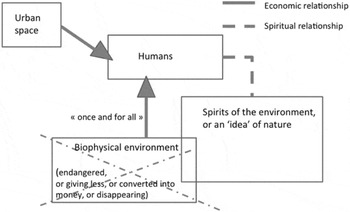
Facing adversity, the Tungus developed opposite behaviours and thoughts according to the time scale they are dealing with: the present or the future. For the present time, they are adopting optimistic behaviours by rapidly finding successful strategies and expressing the strong confidence they have in their ability to adapt. On the contrary, for the future, their narratives and rituals express a dread at the thought of being endangered and a mutation in some perceptions of the environment. Previously held to be eternally renewable, the environment is now seen as likely to disappear. In relation with this, the Tungus maintain some symbolic relationships with the environment even though they no longer have an economic relationship with it (compare urban Tungus cases), whether because of climate change or because they belong to the urbanised part of the population. This contrasts with the nomadic perception in which the economic and spiritual relationship with the environment are so interlinked that most ritual practices take place during economic activities (see Fig. 1; Lavrillier Reference Lavrillier2005: 169–334, 417–444). Thus according to this trend, the practical relation with the biophysical environment and its spiritual perception are becoming separated (see Fig. 2). We can identify the same persistence of a symbolic link when Arctic urban indigenous populations state that the natural environment is their culture and identity while they have no (or very little) economic relation with biophysical environment.
Natural environment (Tungusic hunter-gatherer-herder worldview.

Trends of changes in the perception of the environment and in human-environment relationships.

In the frame of political discussion among the rural and urban intelligentsia, the environment tends to be considered in a much broader spatial scale (circumpolar Arctic, national or regional scales) than in traditional economics where space is conceived on the scale of the network of local rivers.
The new adaptive strategies analysed above demonstrate other trends of changes. Climate change causes some transformations to the way the environment is exploited, with two main directions. The first tendency can be expressed as ‘finding a new ecological way of exploiting nature’ (ethno-tourism for instance). The second can be expressed as ‘accepting the destruction of the environment by climate change (or by allochtonous humans) and trying to take advantage of it’ (for instance by selling agreement for mining exploitation). In both cases, the environment is still providing people with a living, as it was in traditional economies (hunting, herding and fishing), even if in other ways. In fact, in these two new forms of economies, people can still survive or live thanks to the natural environment. Consequently, a link of dependence for subsistence between humans and the environment is still being maintained here, at least for some time.
However, there is an important shift both in perception and in the relationship in the case of selling mining agreement. The time-space in this new management of the environment is much narrowly defined, while the management of the environment extends to an unlimited time-space in traditional economies. By selling so to speak the destruction of the environment to others, nature is managed ‘once and for all’ indeed and then it is no longer possible to pass down nature in the same way as before.
Another important trend of change is the appearance of new values in the relationship between humans and the natural environment, such as financial profit and the definitive transformation of the environment into money. This and the cases of over-killing at hunting or the decrease in sharing practices show that the logic of gifting and counter-gifting between humans and the natural environment and within human society can disappear (see Fig. 2).
Regarding the domain of rituals, changes caused by climate change are less profound. Indeed, climate change is explained by modernised old shamanic legends, by ancient explanatory narratives involving spirits; ritual gestures have been adapted according to old ways of doing things. Only one example of a new ritual shows a kind of ‘transplant’ of a political monstrance on a collective shamanic ritual.
Thus, except for the perception of the environment as likely to disappear, climate change does not, for the moment, cause a loss of spiritual worldview knowledge. Climate change is still perceived within the framework of the Tungusic worldview. In addition, climate change has not affected traditional decision-making, which means that the responsiveness of society is still functioning. Finally, I would argue that among the Tungus, climate change has for now only triggered a few isolated major trends of transformations of the human–environment relationship, while some relationships still remain ideologically.
In contrast to the western areas of the Arctic/subarctic, our study shows that there is no loss of hunting/herding knowledge. Forbes made an identical conclusion concerning the Nenets (Forbes and others Reference Forbes, Stammler, Kumpula, Meschtyb, Pajunen and Kaarlejärvi2009). This Tungusic case also shows that modern technology (GPS, satellite phones for instance) is not used to counteract the effects of climate change as seen among the Inuit of the Arctic Bay and Baffin Island (Ford and others Reference Ford, Smit and Wandel2006; Henshaw Reference Henshaw, Crate and Nuttall2009: 157). The Russian administration ignores the damage suffered by indigenous peoples from climate change, and the latter do not refer to it to account for almost everything that seems unusual in the environment or people's actions as was seen among the Greenlandic Inuit (Nuttal Reference Nuttall, Crate and Nuttall2009) or among the Siberian Yakut (an increase in the crime rate for instance) (Crate Reference Crate2008). At the same time, the Tungus do not think of themselves as ‘victims’ of modernity; this contrasts with the petition sent by Watt-Cloutier to the inter-American Commission on Human Rights, stating that ‘the subsistence culture central to Inuit cultural identity has been damaged by climate change’ raised by greenhouse gas emissions from heavily industrialised countries (Nuttall Reference Nuttall, Crate and Nuttall2009: 305). In Siberia, ‘climate change’ is not as politicised as it is among the Greenlandic Inuit or southwest Baffin Island Inuit. And finally, climate change does not open any economic opportunities for the Tungus in contrast with some situations observed among the Inuit in Greenland and Canada (enhancing for instance the development of agriculture, extractive industries and cruise tourism) (Henshaw Reference Henshaw, Crate and Nuttall2009; Nuttall Reference Nuttall, Crate and Nuttall2009).
The circumpolar differences with the Tungusic case study presented here concern the loss of traditional knowledge, political and economic exploitation of the warming, and a generalisation of the concept of climate change.
Acknowledgments
I thank all the Tungusic communities with which I have worked for their reliance and knowledge sharing, as well as the funding institutions that allowed this field work: L. Dumont Fund for Social Anthropology, the Polar Institute IPEV, the Russian Academy of Sciences, Groupe Sociologie Religion Laïcité–Centre National de la Recherche Scientifique, Fyssen Foundation, DoBeS–Max Planck Research Group Max Planck Institute for Evolutionary Anthropology, International Research Group ‘Nomadisme, sociétés, religions dans l'espace Turco-Mongole et Sibérien’-Centre National de la Recherche Scientifique. The consortium referred to in the text starts work in 2013 and was assembled under the CEARC's coordination and thanks to funding from the French Agence Nationale de la Recherche.