Introduction
Purple nutsedge (Cyperus rotundus L.) is a C4 plant described as one of the world’s most noxious and persistent colony-forming weeds. It poses a significant threat to more than 50 agronomic and horticultural crops and is extensively disseminated over 90 tropical and subtropical countries, leading to economic losses (Bendixen and Nandihalli Reference Bendixen and Nandihalli1987; Larridon et al. Reference Larridon, Bauters, Reynders, Huygh, Muthama Muasya, Simpson and Paul2013; Peerzada Reference Peerzada2017). The most prominent biological feature of C. rotundus is its extensive subterranean chain system consisting of rhizomes, bulbs, and tubers (Horowitz Reference Horowitz1972; Wills Reference Wills1987). Importantly, the tubers act as primary dispersal units and reproductive organs that can extend as new rhizomes and develop into new tubers. This kind of vegetative propagation eventually produces a chain net from a single tuber under the ground (Bendixen and Nandihalli Reference Bendixen and Nandihalli1987; Horowitz Reference Horowitz1972; Peerzada Reference Peerzada2017), which results in fast and impressive propagation of C. rotundus. Without intervention, tubers could grow from 0.66 tubers m−2 to 1,260 tubers m−2 over two seasons (Wang et al. Reference Wang, Mcgiffen and Ogbuchiekwe2008). In addition, the tubers have a strong tolerance for conventional control strategies; they can survive tillage, pierce plastic mulch, and so on (Peerzada Reference Peerzada2017). Herbicides such as glyphosate and halosulfuron have been used to control C. rotundus, but herbicide options are limited, especially in crop fields, and there are still too many tubers that have escaped herbicides that can resprout and compete for resources with crops, which makes long-term control challenging (Peerzada Reference Peerzada2017; Webster and Grey Reference Webster and Grey2014). Therefore, given that tuber is important for successful propagation and the key to controlling C. rotundus, understanding the mechanism of tuber development is crucial in controlling tuber number and chain development and ultimately reducing losses caused by C. rotundus infestations.
In tuberous plants, plant hormones play an essential role in regulating tuber development. One of the plant hormones, gibberellin (GA), has more than 130 forms, and bioactive forms like gibberellic acid (GA3) have been implicated in multiple developmental processes, including cell elongation, cell division, seed germination, stem elongation, flower development, and fruit growth (Hedden and Thomas Reference Hedden and Thomas2012). However, GA is a negative regulator in tuber development (Chen et al. Reference Chen, Yang, Bartels, Dong and Duan2022; Zierer et al. Reference Zierer, Rüscher, Sonnewald and Sonnewald2021), and exogenous GA3 has been found to inhibit tuberization, resulting in reduced tuber volume and numbers (Cheng et al. Reference Cheng, Wang, Liu, Zhang, Gao and Zhang2018; Xu et al. Reference Xu, van Lammeren, Vermeer and Vreugdenhil1998). Enzymes of GA 20-oxidase (GA20ox) and GA 3-oxidase (GA3ox) are involved in the biosynthesis of bioactive GAs, while GA 2-oxidase (GA2ox) is involved in the catabolic process (Hedden and Thomas Reference Hedden and Thomas2012). So far, genes encoding these enzymes have proven to influence tuber development by regulating GA (Bou-Torrent et al. Reference Bou-Torrent, Martínez-García, García-Martínez, Prat and Blazquez2011; Carrera et al. Reference Carrera, Bou, García Martínez and Prat2000; Chen et al. Reference Chen, Yang, Bartels, Dong and Duan2022; Kloosterman et al. Reference Kloosterman, Navarro, Bijsterbosch, Lange, Prat, Visser and Bachem2007; Roumeliotis et al. Reference Roumeliotis, Kloosterman, Oortwijn, Lange, Visser and Bachem2013). For instance, the ectopic expression of AtGA20ox1 in potato (Solanum tuberosum L.) resulted in slower and weakened tuberization along with lower tuber yield, while AtGA2ox1 exhibited the opposite results (Kolachevskaya et al. Reference Kolachevskaya, Lomin, Kojima, Getman, Sergeeva, Sakakibara and Romanov2019). Overexpressed StGA3ox2 delayed tuber induction, while its downregulation increased tuber number (Kolachevskaya et al. Reference Kolachevskaya, Lomin, Kojima, Getman, Sergeeva, Sakakibara and Romanov2019). Additionally, StGA2ox1 degraded bioactive GAs to induce tuberization (Kloosterman et al. Reference Kloosterman, Navarro, Bijsterbosch, Lange, Prat, Visser and Bachem2007). Moreover, the effect of bioactive GAs relies on the GA signaling pathway, which centers on the DELLA protein. The protein acts as an inhibitor of GA-dependent biological processes, and GA signaling is realized by removing its inhibition (Davière and Achard Reference Davière and Achard2013; Hedden and Thomas Reference Hedden and Thomas2012). In the GA signaling pathway, the soluble nuclear GA receptor gibberellin-insensitive dwarf 1 (GID1) binds to bioactive GAs, triggering a conformational change. This change facilitates the formation of the GA-GID1-DELLA complex, which in turn initiates a series of downstream reactions leading to the degradation of DELLA by the 26S proteasome (Davière and Achard Reference Davière and Achard2013; Hedden and Sponsel Reference Hedden and Sponsel2015). This signaling pathway has been identified in a GA3-mediated manner in Chinese yam (Dioscorea oppositifolia L.) tuber growth (Zhou et al. Reference Zhou, Li, Gong, Qin, Xiao, Zhan, Wang and He2021). Nevertheless, it should be noted that the DELLA-dependent signaling pathway is not the only GA signaling pathway; others like cytosolic-Ca2+–involved signaling also exist (Takeshi et al. Reference Takeshi, Kanako, Fukazawa and Takahashi2018). In summary, these studies indicated that GAs, including GA3, play a negative role in tuber development; GA synthesis or deactivation genes could negatively or positively regulate tuber development; GA3 signaling pathway could be DELLA-dependent. It remains unclear whether there is a similar pattern of GA3 regulation in C. rotundus tuber development.
In this study, we sought to investigate the potential regulatory role of GA3 on tuber development in C. rotundus. To this end, the GA3 content and expression patterns of 11 GA-related genes during tuber development at three distinct stages were determined and examined to explore the relationship between GA3 and tuber development, as well as the interaction between CrDELLA proteins and GID1 to explore whether the GA signaling pathway is DELLA-dependent. Moreover, we tried to further explore the effect of exogenously applied GA3 on tuber development and proliferation, using a detailed classification method for the underground chain net. Collectively, the results of this study could better inform us of GA3 regulation of and its impact on tuber development in C. rotundus.
Materials and Methods
Plant Materials
Cyperus rotundus tubers were collected from sugarcane (Saccharum officinarum L.) fields in Fushui (22.544°N, 107.838°E), Guangxi, China, in 2020. The collected tubers were transported and planted in the fields of Guangxi University to obtain more tubers for research.
Pot Experiment Design and Sampling
Hand-separated and washed tubers, with fresh biomass of 0.8 to 1.3g, were selected and subjected to a 7-d-long accelerating germination process using a wet paper towel at the bottom of a lightproof plastic box in the greenhouse. After germination, 10 sprouted tubers were transplanted at a depth of 10 cm into one pot (height: 23 cm; diameter: 36 cm) outdoors. The pots were filled with steam-sterilized loam consisting of equal proportions of nutrient soil, sand, and clay. The nutrient soil, sourced from the local flower market in Nanning, is composed of natural peat with more than 55% organic matter and humic acid, a pH ranging from 5 to 8, and a total nutrient content of approximately 3% to 4%. The sand and clay used in the mixture were sourced from a local gravel pit and local fields where no herbicides were used ever. Each pot was considered an individual unit, and each plot comprised 20 of these units.
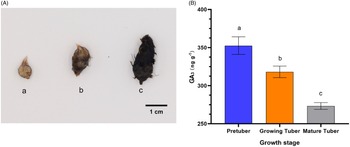
During the course of tuber development, tubers were categorized into three distinct stages: pretuber, growing tuber, and mature tuber. Pretubers were identified as small, nearly round tubers with white and fragile coats that grew from rhizomes. Growing tubers were relatively larger and nearly oval-shaped, with a browning and harder coat that could be pared by hand. Mature tubers were completely developed tubers with irregular shapes and hard brown surfaces that were difficult to pare without tools (Figure 1A).
(A) Three growth stages of Cyperus rotundus tubers: (a) pretuber, (b) growing tuber, (c) mature tuber. (B) gibberellic acid (GA3) content of in three growth stages of C. rotundus tubers. Error bars indicate the mean ± SD of the mean (SD; N = 3), and the lowercase letters indicate a significant difference within each tuber stage.

In the experiment for GA3 content determination of tubers at three different growth stages, tubers were collected from a random unit in three plots and the experiment was conducted three times. After a 2-mo growth period, all the underground tubers were collected and then classified into three stages: pretuber, growing tuber, and mature tuber. They were then flash-frozen in liquid nitrogen and stored at −80 C until GA3 content determination.
In the GA3 application experiment, 20% soluble powder of GA3 (Nufarm Chemical (Shanghai), Shanghai, China) was sprayed once at an effective concentration of 2 g L−1 and a rate of 45 L ha−1 on the leaves after 2 wk of growth at the 4- to 5-leaf stage, and water was used as the control (CK). The herbicides were applied using an automatic sprayer (Guangxi Tianyuan Biochemistry, Nanning, Guangxi, China). Each treatment consisted of three plots, with each plot comprising 20 units. The experiment was arranged in a completely randomized design. Units were collected 10, 20, and 30 d after treatment (DAT). For each treatment, each plot represented a biological replicate. One unit was selected randomly from one plot each time to observe the development of the underground system, and the experiment was conducted three times. Throughout the sampling procedure, thorough excavation of the complete C. rotundus plants of each unit was conducted by meticulously rinsing away the surrounding soil to ensure the preservation of the underground system’s structural integrity. Additionally, the widths of each tuber were meticulously gauged employing a vernier caliper. The development of the underground tuber system was then assessed using a classification system, which was designed specifically for evaluating underground chain tubers.
Preliminary experiments were conducted during both the summer and autumn of 2021. Comprehensive experiments were subsequently conducted during the summer from April to July 2022, and the data obtained from the experiments were then thoroughly processed and analyzed.
Determination of Endogenous GA3 Content during Tuber Development
The GA3 quantities were determined by enzyme-linked immunosorbent assays (ELISA). Three tubers were randomly selected from collected samples, constituting one biological replicate, and the experiment was repeated three times; tubers at pretuber, growing tuber, and mature tuber stages were sampled. Then, they were ground in liquid nitrogen, and 100 mg of the resulting powder was mixed with 900 µl of phosphate-buffered saline (pH 7.4) in a 1.5-ml centrifuge tube and centrifuged at 3,000 rpm for 20 min. Subsequently, the GA3 content was measured using the GA3 ELISA Kit (Shanghai Enzyme-linked Biotechnology, Shanghai, China) (Wu et al. Reference Wu, Lan, Xiang, Xiang, Jin, Khan and Liu2020). Each treatment was performed with three replicates.
Classification System for Underground Chain Tubers of Cyperus rotundus
Considering the complex underground system consisting of rhizomes, bulbs, and tubers, Horowitz counted all swollen subterranean organs at the base of an aerial shoot or in the rhizome network as tubers. The tuber closest to the shoot was termed as “shoot-tuber,” while the others, in the middle of or at the extremity of the rhizomes, were classified as “chain-tubers” (Horowitz Reference Horowitz1972). However, “chain tubers” contain various tubers in their own respective positions in the chain structure, and the term itself cannot indicate the underground system development.
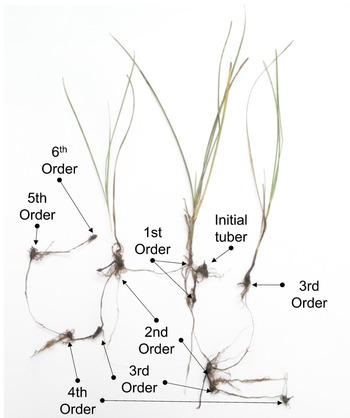
In a study by Webster et al. (Reference Webster, Grey, Davis and Culpepper2008), chain tubers were numbered by their growth order from the initial tuber. Based on former studies, we tried to define the position of the swollen organs in the chain based on their relative proximity to the initial tuber and termed them in the pattern of “Organ–Order No.” “Organ” represents the organ name, and “Order No.” represents the organ’s position in the underground chain structure of C. rotundus classified from the initial tuber (Figure 2). For example, the initial tuber is the origin of the chain structure. Tubers that develop from the initial tuber will be classified as “Tuber-1st,” from which tubers develop that are named “Tuber-2nd,” and so on. In this system, the value of “order” can clearly indicate the individual tuber’s position and illustrate the relationship between tubers and the underground chain system’s degree of development.
Classification system of underground chain net of Cyperus rotundus based on position in the tuber chain.

Gene Cloning and Bioinformatics Analysis
A total of 11 genes involved in the GA3 synthesis and signaling pathway were cloned. Total RNA was extracted from tuber samples using the FastPure® Plant Total RNA Isolation Kit (Vazyme, Nanjing, Jiangsu, China), and cDNA for PCR was synthesized from RNA using HiScript® III 1st Strand cDNA Synthesis Kit (+gDNA wiper) (Vazyme), from which the open reading frames (ORFs) of these genes were amplified by specific primers (Supplementary Table S1). The resulting PCR products then were purified and cloned into separate pCE2 vectors (Vazyme), which were then transformed into Escherichia coli and verified by sequencing. The sequences of these genes were analyzed by BLASTx, and their predicted complete ORFs were submitted to the National Center for Biotechnology Information (NCBI) GenBank database (Supplementary Table S1). Multiple alignments of the deduced amino acid sequence were performed with the sequences from different species including potato, Arabidopsis thaliana, corn (Zea mays L.), Carex littledalei (C.B. Clarke) S.R. Zhang, and rice (Oryza sativa L.), using DNAMAN software (Woffelman Reference Woffelman2004). Phylogenetic trees were then constructed using the neighbor-joining method and 1,000 bootstraps by MEGA 11.0 (Tamura et al. Reference Tamura, Stecher and Kumar2021). The conserved domains of the proteins were then predicted through the Pfam database using HMMER (Potter et al. Reference Potter, Luciani, Eddy, Park, Lopez and Finn2018) and visualized by Evolview (He et al. Reference He, Zhang, Gao, Lercher, Chen and Hu2016). Accession numbers and information for proteins for other organisms are shown in Supplementary Table S2.
Quantitative Real-Time PCR Analyses
The cDNA for RT-qPCR was obtained by reverse translation using HiScript III RT SuperMix for qPCR (+gDNA wiper) Kit (Vazyme) from RNA samples of pretubers, growing tubers, and mature tubers. The amplifications were carried out on a Quant Studio TM 6 Flex Real-Time PCR System (Thermo Fisher Scientific, Waltham, MA, USA) using ChamQ Universal SYBR qPCR Master Mix kit (Vazyme) according to the manufacturer’s protocol. The relative expression levels of GA-related genes were normalized to CrActin using the 2−ΔΔCTmethod (Livak and Schmittgen Reference Livak and Schmittgen2001). All primers are listed in Supplementary Table S3; each gene expression had three biological replicates.
Yeast Two-Hybrid Assays
Yeast two-hybrid assays (Y2H) assays were performed to investigate the interactions between CrDELLA proteins and CrGID1 according to the Matchmaker Gold Yeast Two-Hybrid System (Clontech, Mountain View, CA, USA). The full-length ORFs of CrDELLA1 and CrGID1 were cloned into pCE2 vectors using specific forward and reverse primers containing an NdeI-SfiI site, while CrDELLA2 was cloned using a different restriction site, NdeI-EcoRI (Supplementary Table S4). After double digestion with matched restriction enzymes, CrDELLA genes were inserted into the pGADT7 prey vector (GAL4 activation domain) and CrGID1 was inserted into the pGBKT7 bait vector (GAL4 binding domain) using T4 DNA Ligase enzyme (New England Biolabs). Then the bait and prey vectors were co-transformed into Y2H Gold yeast strains using the Yeastmaker yeast transformation system kit (Huayueyang, Beijing, China). Subsequently, 10 μl of the transformed yeast were dripped into 36-check square petri dishes filled with SD/-Trp/-Leu/-His/-Ade quadruple media supplemented with or without 100 μM GA3. All assays had three replicates.
Statistical Analyses
GraphPad Prism 9 (GraphPad Software, San Diego, CA, USA) was used to display the data graphically. Statistical analyses were performed with SPSS v. 19.0 (SPSS, Chicago, IL, USA) using a one-way ANOVA followed by Duncan’s multiple-range test and independent-sample t-test (P < 0.05). All results are presented as the mean with standard deviation.
Results and Discussion
Variations in GA3 Content during Tuber Development
The GA3 content in tubers at three developmental stages was determined (Figure 1). The results showed a significant reduction of 9.77% and 22.49% in growing and mature tubers, respectively, compared with the pretuber stage. A similar trend of GA3 content of decreasing with tuber development was observed in Chinese yam (Zhou et al. Reference Zhou, Li, Gong, Qin, Xiao, Zhan, Wang and He2021), and exogenous GA3 has been found to inhibit tuberization, resulting in reduced tuber volume and numbers in potato (Cheng et al. Reference Cheng, Wang, Liu, Zhang, Gao and Zhang2018; Xu et al. Reference Xu, van Lammeren, Vermeer and Vreugdenhil1998). Thus, the trend of declining GA3 content during three tuber growth stages suggested that GA3 may function in a negative role in tuber development.
Isolation and Characterization of Key Enzyme Genes in GA3 Synthesis, Metabolism, and Signaling
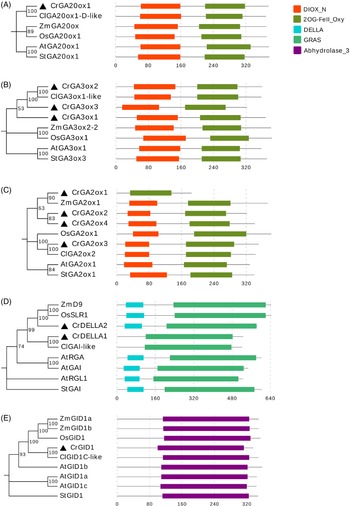
A total of 11 genes related to GA were isolated and characterized, including CrGA20ox1, CrGA3ox1, CrGA3ox2, and CrGA3ox3, which were involved in bioactive GA synthesis, as well as CrGA2ox1, CrGA2ox2, CrGA2ox4, and CrGA2ox6, which were involved bioactive GA catabolism. Additionally, the GA signaling genes CrDELLA1, CrDELLA2, and CrGID1 were isolated. All these genes were obtained with ORFs. Conserved domain and amino acid sequence alignment analysis results are provided in Figure 3 and Supplementary Figure S1.
Phylogenetic trees of the amino acid sequence alignment and conserved domains of gibberellin (GA) metabolism and signaling pathway of Cyperus rotundus tuber. (A) CrGA20ox1; (B) CrGA3ox1, CrGA3ox2, CrGA3ox3; (C) CrGA2ox1, CrGA2ox2, CrGA2ox4, CrGA2ox6; (D) CrDELLA1, CrDELLA2; (E) CrGID1. Phylogenetic trees were conducted using the neighbor-joining method and 1,000 bootstraps.

CrGA20ox1 consisted of an 1,131-bp ORF encoding a protein of 376 amino acids. As shown in the analysis of conserved domains, CrGA20ox1 belonged to the 2-oxoglutarate–dependent dioxygenases family with two domains of the DIOX_N and the 2OG-FeII_Oxy. Phylogenetic tree analysis showed that CrGA20ox1 clustered into the same group with C. littledalei and had a close relationship with rice and corn, and all of them were monocots (Figure 3A).
CrGA3ox1, CrGA3ox2, and CrGA3ox3 were 1,110, 1,083, and 969 bp in ORFs, encoding proteins of 369, 360, and 322 amino acids, respectively. Conserved domain analysis indicated that the three genes belonged to the 2-oxoglutarate–dependent deoxygenates family, consisting of the 2OG-FeII_Oxy domain. Similarly, the three genes clustered into a monocot group showing a closer relationship with C. littledalei, rice, and corn in phylogenetic tree analysis (Figure 3B).
CrGA2ox1, CrGA2ox2, CrGA2ox4, and CrGA2ox6 were 558, 966, 1,056, and 1,026 bp in ORFs encoding proteins of 185, 321, 351, and 341 amino acids, respectively. These CrGA2ox genes all contained the 2OG-FeII_Oxy domain, making them members of the 2-oxoglutarate–dependent dioxygenases family. Phylogenetic tree analysis indicated that the four genes clustered into a monocot group showing a closer relationship with C. littledalei. Interestingly, CrGA2ox2 and CrGA2ox6 clustered into the same group (Figure 3C).
CrDELLA1 and CrDELLA2 were 1,587 and 1,764 bp encoding 528 and 587 amino acids, CrDELLA1 contained only the GRAS domain, while CrDELLA2 had both the DELLA domain and the GRAS domain. Also, phylogenetic tree analysis indicated that both clustered into a monocot group; CrDELLA1 had a closer relationship with DELLA of C. littledalei, while CrDELLA2 was closer to rice and corn (Figure 3D).
CrGID1 had an ORF of 1,011 bp encoding 336 amino acids. It had the Abhydrolase_3 domain and belongs to the hormone-sensitive lipase family with motifs for HGG and GDSSG, which can bind to GA (Figure 3E; Supplementary Figure S1E) (Gazara et al. Reference Gazara, Moharana, Bellieny-Rabelo and Venancio2018). Also, in phylogenetic tree analysis, CrGID1 showed high homology with ClGID1 and had a close relationship with corn and rice simultaneously, and they all clustered into the monocot group (Figure 3E).
Expression Patterns of GA3 Biosynthesis, Catabolism, and Signaling Genes during Tuber Growth
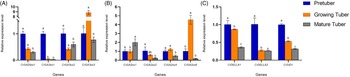
The expression profiles of the 11 genes were assessed in the three stages of tuber development (Figure 4). Among the GA3 synthesis genes, CrGA20o1, CrGA3ox1, and CrGA3ox2 showed a significantly decreasing trend during tuber development. CrGA20ox1 and CrGA3ox1 had the lowest relative expression at the mature tuber stage, 69.46% and 97.38% lower than that at the pretuber stage, respectively. Simultaneously, the overall trend of inactive genes of CrGA2ox genes increased first and then fell. Notably, CrGA2ox1 showed an increasing trend and was highly expressed in mature tuber with a 1.99-fold higher level than in the pretuber. CrGA2ox4 and CrGA2ox6 achieved the highest relative expression level at the growing tuber stage; the latter was markedly elevated at the growing tuber stage by 4.49-fold and then declined. The down- or upregulation CrGA20ox1, CrGA3ox1, and CrGA3ox2 or CrGA2ox1, CrGA2ox4, and CrGA2ox6 expression corresponded with the decline in GA3, similar to the patterns observed in Chinese yam, where GA3 contents were regulated by DoGA20ox1, DoGA2ox3, and DoGA2ox4 (Zhou et al. Reference Zhou, Li, Gong, Qin, Xiao, Zhan, Wang and He2021). Therefore, the reduction of GA3 could be explained by the combined action of CrGA20ox1, CrGA3ox1, CrGA3ox2, CrGA2ox1, CrGA2ox4, and CrGA2ox6 during tuber development.
The expressions of genes related to gibberellic acid (GA3) of Cyperus rotundus tubers during three growth stages: (A) bioactive GA3 synthesis genes CrGA20ox1, CrGA3ox1, and CrGA3ox2; (B) bioactive GA3 catabolism genes; (C) GA3 signaling genes. The lowercase letters represent the significant difference among various treatments (P < 0.05, ANOVA).

Nevertheless, CrGA3ox3 and CrGA2ox2 exhibited opposite expression profiles, and this may be the result of the feedback mechanism or regulation of other hormones (Gong et al. Reference Gong, Luo, Wang, Zhou, Huang, Zhu and He2017; Hedden and Thomas Reference Hedden and Thomas2012). Moreover, the expression levels of CrDELLA1, CrDELLA2, and CrGID1 declined significantly stage by stage during tuber development.
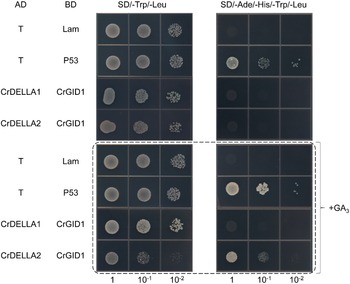
The Interaction between CrDELLA Proteins and CrGID1 in Y2H Assays
The DELLA and GID1 proteins are key components of the DELLA-dependent GA signaling pathway, where DELLA acts as an inhibitor and GID1 serves as a bioactive GA receptor (Davière and Achard Reference Davière and Achard2013; Takeshi et al. Reference Takeshi, Kanako, Fukazawa and Takahashi2018). During tuber development, the relative expression profiles of CrDELLA1, CrDELLA2, and CrGID1 showed the same trend, with the decreased GA3. Therefore, the biochemical properties of CrDELLA proteins and CrGID1 in C. rotundus were characterized in Y2H assays, and we found CrDELLA2 effectively interacted with CrGID1 in the presence of GA3, whereas CrDELLA1 did not. This indicated that the essential GA3-induced assembly of the GA3-CrGID1-CrDELLA2 complex was confirmed in yeast (Figure 5). The DELLA-dependent response observed in tuber was consistent with that in Chinese yam (Zhou et al. Reference Zhou, Li, Gong, Qin, Xiao, Zhan, Wang and He2021). The reason that CrDELLA1 did not interact with CrGID1 may be the incomplete DELLA motif and VHYNP motif in its N-terminal domain of the DELLA domain (Figure 3D; Supplementary Figure S1D), which are crucial for binding to the GA-GID1 complex (Murase et al. Reference Murase, Hirano, Sun and Hakoshima2008). In summary, the results indicated that CrDELLA2 and CrGID1 genes were involved in GA3 regulation as part of the GA3-GID1-DELLA module in C. rotundus.
Interaction between CrDELLA proteins and CrGID1 proceeding in the gibberellin (GA)-dependent manner. The addition of 100 µM gibberellic acid (GA3) to the medium enhanced GID1-DELLA interactions.

The Impact of Exogenous GA3 on the Growth and Propagation of Tubers
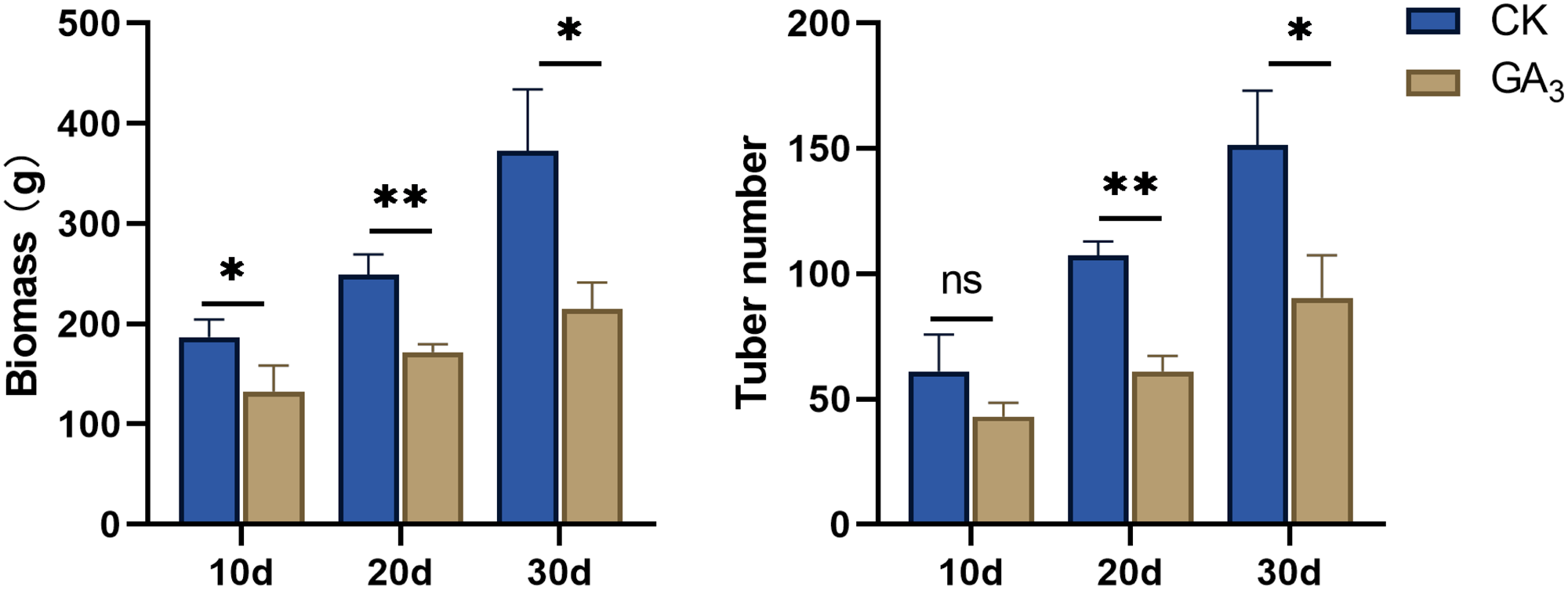
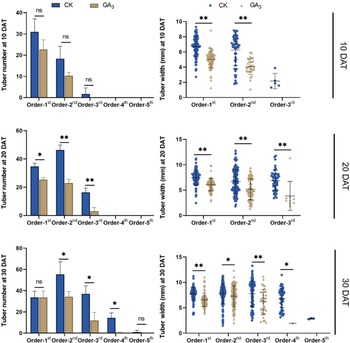
Exogenous GA3 was sprayed on the leaves at the 4- to 5-leaf stage to explore the effects of GA3 on the tuber of C. rotundus. The results revealed that the application of GA3 markedly reduced the biomass and the number of tubers (Figures 6 and 7). Specifically, compared with the CK, the GA3 treatment led to 29.0%, 30.1%, and 42.3% reduction in biomass and 29.5%, 43.2%, and 40.0% reduction in the number of tubers at 10, 20, and 30 DAT, respectively (Figure 6). Furthermore, we found that the number and width of tubers in different orders in the tuber chain were obviously inhibited by the GA3 application. At 10 DAT, the GA3 treatment led to one less order in the tuber chain compared with the CK treatment, and the number of chain tubers was reduced by26.9%, 43.6%, and 100% from the first to the third order, respectively. Additionally, the average width of tubers in the first order and second order were less than that in CK treatment by 25.4% and 34.7% (Figure 7). At 20 DAT, although both the CK and GA3 treatments exhibited the same chain order of three, the GA3 treatment resulted in 27.2%, 50.4%, and 81.6% reduction in the first, second, and third orders, respectively. Also, the width of these three orders was 18.6%, 23.0%, and 44.0% less, respectively, compared with the CK treatment (Figure 7). At 30 DAT, the CK treatment had its fifth-order tubers, one more than that in the GA3 treatment. In the first order, the CK and GA3 treatments had the same number of chain tubers, but the average width of chain tubers in the GA3 treatment was 15.1% less. From the second to the fourth order, the number of GA3 chain tubers was less by 37.9%, 67.6%, and 97.7% with average widths lower by 6.4%, 20.1%, and 71.0% (Figure 7). Taken together, these data indicated that it was GA3 application that inhibited tuber development and propagation. Our results were consistent with a previous study by Chetram and Bendixen (Reference Chetram and Bendixen1974) that found that cytokinins plus GA3 could induce the formation of aboveground basal bulbs and prevent tuber formation, whereas spraying GA3 alone could reduce underground rhizomes. Additionally, exogenous GA3 has been found to inhibit tuberization, resulting in reduced tuber volume and numbers in potato (Cheng et al. Reference Cheng, Wang, Liu, Zhang, Gao and Zhang2018; Xu et al. Reference Xu, van Lammeren, Vermeer and Vreugdenhil1998).
The biomass and total quantities of Cyperus rotundus tubers at 10, 20, and 30 d after gibberellic acid (GA3) application (DAT). Each treatment has three repeats. The results are shown as the means ± SD, Student’s t-test was used, and significance is reported as *P < 0.05, **P < 0.01.

Tuber number and width of each order were compared between control (CK) and gibberellic acid (GA3) treatments at 10, 20, and 30 d after application (DAT). Each treatment has three repeats. The results are shown as the means ± SD, Student’s t-test was used, and significance is reported as *P < 0.05, **P < 0.01.

Based on our findings and previous studies, we believe it is possible to achieve effective control of C. rotundus by combining GA3 and the primary herbicide for Cyperus, halosulfuron, at lower doses than the current recommendation. This approach is similar to the work conducted by Yogev et al. (Reference Yogev, Rubin and Negbi1996), who found that treatment with benzyladenine plus GA3 followed by herbicide application was effective in controlling C. rotundus. While C. rotundus is a perennial with slower resistance evolution, there remains a potential risk of resistance emergence, particularly considering the broader weed community and the propensity for Group 2 resistance. To address this challenge, we propose a strategy of sequential spraying before crop sprouting, using a mixture of GA3 and herbicides to control and eliminate C. rotundus. Precision spraying should be employed during crop growth stages to prevent crop damage while effectively managing C. rotundus. This approach offers the advantages of effectiveness, environmental friendliness, and reduced herbicide-resistance risk. Nevertheless, further research is needed to confirm the feasibility of this method and determine the optimal doses of GA3 and herbicide mixture for effective control of C. rotundus in crop fields.
This study revealed that GA3 could inhibit tuber development and propagation of C. rotundus on the DELLA-dependent pathway and suggested that GA3 has the potential to be developed as a novel strategy for controlling C. rotundus and provided valuable insights into the underlying molecular mechanisms of C. rotundus tuber growth and development, which could inform future studies on this pervasive weed.
Supplementary material
To view supplementary material for this article, please visit https://doi.org/10.1017/wsc.2023.47
Data Availability Statement
The raw data from this study are available upon request from the corresponding author.
Acknowledgments
This work was supported by the Six Special Actions of the Vanguard of Science and Technology to Strengthen Agriculture and Enrich the People (no. GKM202316). The authors declare no conflicts of interest.