I. INTRODUCTION
Silicon nitride (Si3N4) ceramics are widely used as electromagnetic waves transparent materials within a wide range of temperature, primarily due to its high strength, good resistance to thermal shock and corrosion, low dielectric and dielectric loss, and other advantages. Reference Shan, Yang, Gao, Zhang, Jin, Janssen and Ohji1–Reference Shigegaki, Brito, Hirao, Toriyama and Kanzaki5 Porous Si3N4 ceramics are usually fabricated by liquid phase sintering with the addition of densification additives, Reference Yang, Deng and Ohji6–Reference Matovic, Rixecker and Aldinger9 and liquid phase formation from the oxide during sintering at a high temperature promotes the transformation of equiaxed α-Si3N4 to rod-like β-Si3N4. Superior mechanical properties can be obtained due to the elongated β-Si3N4 grains, and oxide grain boundary phases with lower melting temperatures are simultaneously produced. This results in the decrease of high-temperature strength, corrosion resistance, and deterioration of other properties. Reference Hampshire and Pomeroy10–Reference Lange and Davis12 Grain boundary phase is a key factor governing the mechanical properties at high temperatures. Reference Tu, Lange and Evans13 More specifically, the mechanical response of monolithic Si3N4 at high temperatures is mainly dictated by the properties of the intergranular glassy phase, i.e., its chemistry, amount, viscosity, and crystallization behavior. Reference Rendtel, Hubner, Herrmann and Schubert14
Many researchers who have made exhaustive studies on decreasing the amount of grain boundary phases or modifying them to produce more crystalline phases suggested some methods such as vacuum heat treatment Reference Mandal and Thompson15 and devitrification process. Reference Cinibulk and Thomas16–Reference Besson, Billieres, Rouxel, Goursat, Flynnr and Hampshire18 Vacuum heat treatment was a way, which had gathered growing interest in the past decades. The basic method involved sintering the ceramics and heat treatment in vacuum to remove the intergranular glassy phase at 200–300 °C below the original sintering temperature, and this approach requires volatile sintering additives such as MgO and Li2O. Devitrification process at high temperatures could make the intergranular glass phase crystallization and effectively improve the high-temperature properties of ceramics. Reference Ziegler, Cinibulk, Kisielowski and Ritchie19 Meanwhile, the volume change caused by the crystallization was likely to weaken the grain boundaries and the purpose of elongated grain toughening could be achieved. Formation of the SiAlON phase was also an alternative way which could eliminate the grain boundary phase. Reference Jack and Wilson20 Mandal Reference Mandal and Thompson15 devitrified the glassy intergranular phase to a mixture of crystalline phases by the above-eutectic heat-treatment of SiAlON-based ceramics. After heat treatment of α/β-SiAlON ceramics at 1200–1400 °C, the grain boundary phase transformed into Y3Al5O12 (YAG), which improved high-temperature creep and oxidation resistance at temperatures up to 1600 °C. On the other hand, porous SiAlON ceramics exhibited excellent corrosion resistance due to the inexistence of the intergranular phase. Reference Yang, Beppu, Zhang, Ohji and Kanzaki21,Reference Yang, Zhang, She, Ohji and Kanzaki22 Although the crystallization of the intergranular phase was beneficial for the improvement of properties at a high temperature, the improvement was still limited due to the existence of the oxide intergranular phase.
Using rare-earth oxides as the sintering additives promotes the formation of the grain boundary phase with high refractoriness and crystallinity; consequently, properties at high temperatures could be improved. Reference Cheong and Sanders23,Reference Tani, Umebayashi, Kishi, Kobayashi and Nishijima24 A more refractory nature of grain boundary phases is expected for Si3N4 sintered with the rare-earth oxides having a smaller cationic radius due to their strong field strength between cations and anions. Reference Choi, Lee and Kim25 Moreover, refractory disilicate, RE2Si2O7, (RE refers to the rare-earth oxide) can crystallize at grain boundaries, thereby resulting in improved high-temperature properties. Reference Choi, Lee and Kim25 The high-temperature strength of Si3N4 with rare-earth oxide additives tailored to obtain a RE2Si2O7 secondary phase has been previously examined. After the above materials were subjected to a high temperature of 1400 °C for 24 h to crystallize secondary phase RE2Si2O7, the strength retention ratio of these ceramics at 1300 °C was 80–91%. Reference Cinibulk, Thomas and Johnson26 By using Lu2O3 as the sintering additive, which has larger atomic number, the silicon nitride ceramics attained a high temperature at 1500 °C, due to the formation of an intergranular phase (Lu4Si2O7N2) with a high melting point at high temperatures. Reference Guo, Hirosaki, Yamamoto, Nishimura and Mitomo27 In a word, the high-temperature mechanical properties of Si3N4 ceramics depend on the final composition of the grain boundary phase. On the other hand, compared with Y2O3, the high refractory phase from rare-earth oxide at the grain boundary led to the increase in the sintering temperature; as a result, the gas pressure sintering maybe necessary to prohibit the decomposition of Si3N4, which increased the fabrication cost.
Another approach to improve the high-temperature mechanical properties is incorporating a second phase ceramic reinforcement into the microstructure. Reference Tatarko, Kaiarov, Dusza and Sajgalik28 For example, a large advance in improving high-temperature properties of silicon nitride-based ceramics was achieved by incorporating SiC particles and/or nanoparticles into the silicon nitride matrix. Reference Rendtel, Hubner, Herrmann and Schubert14,Reference Kasiarova, Tatarko, Burik, Dusza and Sajgalik29,Reference Koh, Kim and Kim30 The influence of SiC particles is obvious in the change of Si3N4 grain morphology, the impediment of grain-boundary sliding due to particle blocking, the formation of Si3N4/SiC contact points, and the changes in the amount and viscosity of the intergranular glassy phase due to chemical reactions and accelerated crystallization. Reference Rendtel, Hubner, Herrmann and Schubert14 The strength measured at 1400 °C in air which is as high as ∼1000 MPa was reported for the silicon nitride-based composite after the addition of 20 vol% SiC into the Si3N4 matrix. Reference Park, Kim and Niihara31
For the porous Si3N4, it is easy for the infiltration of either liquid or gas, providing such a kind of material a merit of novel replacement processing of intergranular phase with Si3N4 phase, through etching, infiltration, and reaction. This paper describes a novel replacement method to fabricate porous Si3N4 ceramics with no-oxide existence through carbothermal nitridation of SiO2 and carbon, which was introduced through infiltration of a suspension containing silica sols and phenolic resins into porous Si3N4 after etching off the grain boundary phase. The effects of replacement processing on the microstructural evolution and mechanical properties (at room and high temperature) of Si3N4 ceramics are reported.
II. EXPERIMENTAL
A. Material preparation
α-Si3N4 powder (Shanghai Junyu Ceramic-molded Product Co., Ltd., Shanghai, China; α ratio >95%, mean particle size 0.5 μm) was used as starting powder. Y2O3 (99.9%, mean particle size 0.5 μm) was used as a sintering additive. The powder mixture of 95 wt% Si3N4 and 5 wt% Y2O3 was wet-milled, dried, and passed through a 150 μm screen, followed by die pressing to form regular bars with 5 × 5 × 50 mm at 60 MPa. The green bodies were sintered at 1750 °C for 2 h, at a nitrogen-gas pressure of 0.3 MPa.
The obtained samples were soaked in HCl or HF solutions at a varied concentration of 0.1–2 mol/L in a polytetrafluoroethylene container with the solution content of 20 mL/sample. After etching, the samples were taken from the container and washed with water and dried. Eventually, the porous Si3N4 etched by 1 mol/L HCl for 20 h was used for infiltration.
The suspension of infiltration was obtained by mixing the ethanol solution of phenolic resin and silicon sol. The specific preparation method was similar to the one in the previous work. Reference Wang, Jin and Guo32 Subsequently, it was infiltrated into the etched porous Si3N4 in a vacuumed vessel of −0.1 MPa for 2 h. The Si3N4 ceramics containing phenolic resins/silica sols were dried at 70 °C for 12 h to remove the solvents. The procedure of infiltration and drying was repeated for several times, namely cycle of infiltration procedure, to increase the phenolic resin/silica contents in the Si3N4 ceramic matrix. The precursor contents can be obtained according to the weight change before and after the infiltration; Ultimately, carbothermal nitridation of the as-prepared samples was carried out at 1550 °C for 2 h in a nitrogen atmosphere of 0.6 MPa to get the grain boundary phase replacement in the porous Si3N4 ceramics.
B. Characterization
The relative density of the samples was evaluated using the Archimedes method. Crystalline phases in sintered samples were identified by X-ray diffraction (D/MAX-2400X, 40 kV, 40 mA, Cu Kα, Rigaku Co., Tokyo, Japan), using nickel-filtered Cu Kα radiation produced at 35 kV and 20 mA. The microstructures of the ceramics were characterized by scanning electron microscopy (SEM; Hitachi, S-4800, Tokyo, Japan) operated at 20 kV and 20 mA. The samples were machined to bending test bars with a size of 3 × 4 × 50 mm. The tensile surface was ground on an 800-grit diamond wheel, and the edges were beveled to reduce the effect of edge cracks. Three-point bend testing was used to determine the flexural strength using a testing machine (HMOR-1602QP, Sinosteel Iron & Steel Co., Ltd., Beijing, China) with a span of 15 mm at a crosshead speed of 0.5 mm/min.
III. RESULTS AND DISCUSSION
The first step of this technique is to remove the grain boundary phase, which remained in the microstructure after sintering. It is well known that corrosion resistance of the oxide and nonoxide phase is greatly different, which can assure complete removal of the intergranular phase while keeping the rod-like β-Si3N4 from etching.
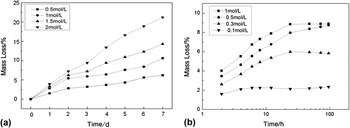
Figure 1 shows the weight loss with the immersing time for the obtained porous Si3N4 ceramics etched by HCl or HF at varied concentrations. As can be seen in Fig. 1(a), with the prolonging time, all samples showed a continuous increase in weight loss, and obvious difference in the etching ability was exhibited for the various HF solutions. For the HF solution of 0.5 mol/L, a weight loss of 6.2% could be reached after 7 days. With increasing the HF concentration, the weight loss also increased continuously and approximately 10% was achieved for HF concentrations of 1, 1.5 and 2 mol/L after 7, 4, and 3 days, respectively. Further extending their immersing time, the weight loss would continue to be higher than 10%. However, from the Fig. 1(b), ultimately, a maximum value equal or less than 9% could be reached. Specifically, for the HCl solution of 1 mol/L concentration, after etching for 20 h, the weight loss attained a maximum of 9%, which was similar to the oxide content of the porous Si3N4 samples, considering 5% Y2O3 and 2% oxygen on the surface of Si3N4 powder (corresponding to about 4% SiO2). Moreover, it was noted that the rate of weight loss was faster for the samples in HCl, because the HCl solution has stronger acidity than that of HF. These results indicated that the HCl solution could not etch Si3N4, while the HF had such a strong corrosion ability that it could etch both the grain boundary phase and Si3N4, when its concentration was equal or greater than 1 M. The different etching behavior was attributed to the different acidity and corrosivity between the HF and HCl solution, so the HCl solution have an advantage of fast corrosion of the intergranular oxide phase with little corrosion of Si3N4 grains. Thus the HCl should be more appropriate for the purpose of eliminating the oxide phase at the grain boundary.
Change of weight loss with the soaking time during etching: (a) HF solution and (b) HCL solution.

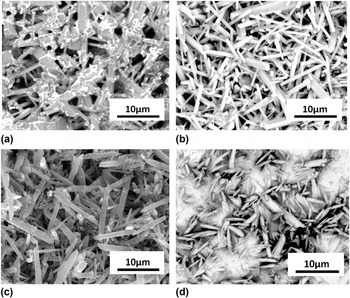
Figure 2 shows SEM micrograph (BSD) of the original Si3N4 and that after etching with a different acid. Figure 2(a) exhibited the microstructure of the original Si3N4 ceramics, and the rod-like β-Si3N4 and uniform white spots existed simultaneously. The rod-like β-Si3N4 was developed with the aid of sintering additives which promoted liquid sintering during the heating, and the white spots were uniformly distributed at the grain boundary, which should be an oxide compound containing a Y atom. Such a grain boundary phase could be softened at high temperatures, so the novel idea of the present manuscript is to remove the grain boundary phase and replace them with Si3N4, which possess a higher refractory ability than the oxide.
SEM micrograph (BSD) of the original Si3N4 and that after etching with different acids: (a) porous Si3N4 matrix, (b) the matrix after etching with 1 M HCl for 20 h, (c) the matrix after etching with 1 M HF for 7 days, and (d) the matrix after etching with 2 M HF for 3 days.

With 1 M HCl solution as the etching agent, after 20 h of corrosion, the oxide which appeared as white spots in Fig. 2(a) completely disappeared due to dissolution, as shown in Fig. 2(b). After the Si3N4 samples were etched with 1 M HF solution for 7 days, the end of Si3N4 grains were corroded mildly simultaneously, and its end became sharp, as shown in Fig. 2(c). Increasing the HF concentration to 2 M resulted in an obvious change in the morphology of the Si3N4 after etching for 3 days, as shown in Fig. 2(d). The edge of Si3N4 grains was etched off severely, which lost the shape of hexagonal prisms and was transformed into spindle shapes. Compared with the HF solution, the HCl solution could only etch the grain boundary phase. As a result, the Si3N4 grains retained the original appearance. Therefore, the 1 M HCl solution was more appropriate as etching agent, and 20 h is the optimal etching time.
Thermal analysis of the 2130# phenolic resin and SiO2 sol indicated that the residual carbon ratio in the phenolic resin was 39 wt%, and the residual SiO2 ratio was 17 wt%. Accordingly, an infiltration suspension with solid contents of 29, 21, and 17 wt% was prepared by mixing the phenolic resins and SiO2 sols at the C/SiO2 mol ratio of 2:1. Porosity of the original Si3N4 ceramics was about 40%. The infiltration process was repeated for enhancing the SiO2–C, namely precursors contents in the porous Si3N4, so that the weight loss could be compensated through the carbothermal nitradation treatment, which contributed to the improvement of mechanical behavior. Samples infiltrated with the suspension with solid contents of 29 wt%, 21 wt%, and 17 wt% were named as SC0, SC1, and SC2, respectively.
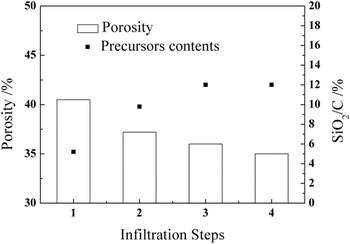
The influence of the infiltration times on porosity and precursors contents using the suspension with 21 wt% solid content is displayed in Fig. 3. With increasing the infiltration times, the porosities were decreased, but precursors contents were increased monotonically. On the other hand, with increasing the infiltration times, the infiltration amount was decreased, which was ascribed to decline of the porosity. Ultimately, after infiltration for four times, the precursors content up to 12% could be reached.
The influence of the infiltration times on porosity and precursors contents while using the suspension with 21 wt% solid content.

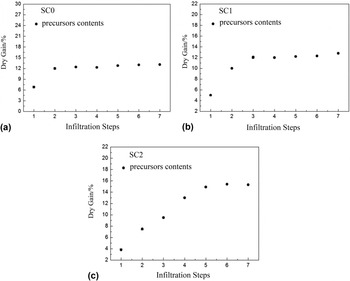
Figure 4 exhibits the weight gain of the porous Si3N4 ceramics as a function of the infiltration times for the three different concentrations of infiltration suspension. While the solid concentration was 29 wt%, a weight gain of 12% was obtained after infiltration for 2 times. However, continuing to increase the infiltration times had hardly any influence on the weight gain. When varying the solid concentration to 21 wt%, similarly, a weight gain of 12.8% was achieved after infiltration for 3 times, and afterward, the weight was not changed. Finally, by decreasing the solid concentration to 17 wt%, the maximum value of the weight gain for the porous Si3N4 attained 15.3% after infiltration for six times. The result demonstrated that the low solid concentration facilitated the infiltration due to the low viscosity.
Weight gain of the porous Si3N4 ceramics with infiltration times for the three different solid concentrations of infiltration suspension: (a) SC0, (b) SC1, and (c) SC2.

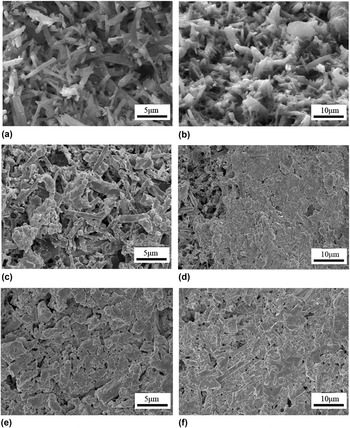
To observe the distribution of precursor after infiltration, the SEM micrographs showing the inner and near the surface morphologies of porous Si3N4 after infiltration for 7 times are compared in Fig. 5. With the solid concentration decreased, the precursor content in the center was increased gradually, and their distribution was almost at the space among the Si3N4 grains. While the solid content was 29 wt%, the precursor was hardly found at the center of the sample; however, as it was 17 wt%, there is no great difference for their distribution between the center and surface, which indicated a uniform infiltration.
SEM micrograph of porous Si3N4 after infiltration for 7 times with three different solid concentrations of infiltration suspension: (a) SC0 at center, (b) SC0 near surface, (c) SC1 at center, (d) SC1 near surface, (e) SC2 at center, and (f) SC2 near surface.

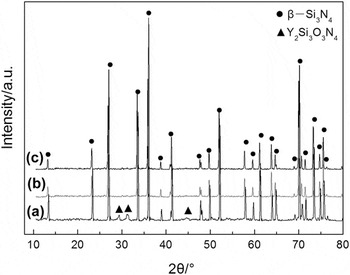
XRD patterns for the starting Si3N4 ceramics, the etched and the carbothermal nitridation ceramics after infiltration for 7 times with the solid concentration of 21 wt% are shown in Fig. 6. For the initial samples [Fig. 6(a)], the main phase was β-Si3N4 and the minor grain boundary phase was identified as a crystalline Y2Si3O3N4, which was apparently formed by the reaction among Y2O3, SiO2, and Si3N4. During liquid phase sintering, the liquid forming from oxide aids at high temperatures promoted the transformation of equiaxed α-Si3N4 to rod-like β-Si3N4, while the grain boundaries phase containing the oxide were obtained simultaneously. It mainly consisted of a glassy phase, subsequently, which partly transformed into a crystalline phase during cooling. It is shown that the main phase in the materials was β-Si3N4, after etching in 1 M HCl solution for 20 h, and the minor Y2Si3O3N4 of the original porous Si3N4 disappeared after the etching treatment [Fig. 6(b)]. EDS analysis also indicated that the main element in the material after etching included Si, O, and N, nevertheless, without Y. These results demonstrated the removal of the grain boundary phase. Although the interlocking structure of the grains in the porous Si3N4 after etching was still reserved, binding among the Si3N4 grains was lost; consequently, their strength was lowered.
XRD patterns of porous Si3N4 ceramics: (a) initial Si3N4 ceramics, (b) Si3N4 matrix after etching with 1 M HCl solution for 20 h, and (c) Si3N4 ceramics after carbothermal nitridation.

After carbothermal nitridation [Fig. 6(c)], only the β-Si3N4 phase was detected for the samples, and the original intergranular phase disappeared. This result indicated that the oxide of grain boundary phase had completely been replaced by the Si3N4 phase. Si3N4 could be formed directly through carbothermal nitridation in N2 atmosphere, due to the reaction between SiO2 and carbon occurring in the ceramic body Reference Weimer, Eisman, Susnitzky, Beaman and Mccoy33 :
 $$3{\rm{Si}}{{\rm{O}}_2}({\rm{s}}) + 6{\rm{C}}({\rm{s}}) + 2{{\rm{N}}_2}({\rm{g}}) \to {\rm{S}}{{\rm{i}}_3}{{\rm{N}}_4}({\rm{s}}) + 6{\rm{CO}}({\rm{g}})\quad .$$
The rod-like β-Si3N4 grains would bond with each other by the newly formed Si3N4 located at the grain boundaries, and the flexural strength would be improved.
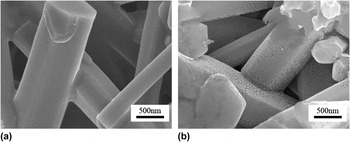
The SEM microstructures of the initial Si3N4 ceramics and the ones after carbothermal nitridation are shown in Fig. 7. It revealed that some new Si3N4 was formed, which was located at the grain boundaries and bonded the rod-like β-Si3N4 grains after carbothermal nitridation. For the initial Si3N4 ceramics samples, the elongated β-Si3N4 grains were connected by the oxide grain boundary phase and unique interlocking microstructures were formed, which could be beneficial for the mechanical strength of ceramics. After infiltration for 7 times with the solid concentration of 21 wt% and carbothermal nitridation, the microstructure was also composed of interlocking β-Si3N4 grains, while the intergranular phase was replaced by the Si3N4 generated. As can be seen from the picture, some flocculent substance was deposited at the grain boundary and adhered to the surface of the β-Si3N4 grains bonding the rod-like β-Si3N4 grains. According to result of the XRD analysis, the flocculent substance was the newly formed Si3N4 phase through carbothermal nitridation. It can be seen that the stacking floccules contained a large number of pores. These pores were attributed to the reaction between carbon and SiO2, which were consumed during the process. Reference Weimer, Eisman, Susnitzky, Beaman and Mccoy33
SEM images of porous Si3N4 ceramics: (a) initial Si3N4 ceramics and (b) Si3N4 ceramics after carbothermal nitridation.

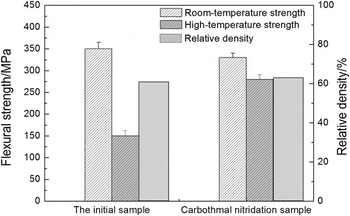
The relative density, room- and high-temperature strength of the initial Si3N4 ceramics before and after carbothermal nitridation are shown in Fig. 8. The relative density was almost unchanged after the replacement. The relative density of the initial Si3N4 ceramics samples was 60.4%, and it became 61.8% after replacement caused by the carbothermal nitridation. Besides, it could be obviously seen in Fig. 8 that both the strength at room temperature of the initial Si3N4 ceramics and that after carbothermal nitridation was higher than 300 MPa, while the value was a little higher for the initial Si3N4 ceramics. When the temperature was increased to 1400 °C, the strength for the initial Si3N4 ceramics decreased by approximately about 50%. However, as the grain boundary phase was replaced by the Si3N4 without oxide existence, 90% of the strength value at room temperature was still retained. The high-temperature strength was strongly influenced by the grain boundary phase. For the initial Si3N4 ceramics, the grain boundary phase containing the oxide was poor in thermal stability and easily softened under high temperature. Consequently, the flexural strength decreased dramatically. On the contrary, when the grain boundary phase of the oxide was etched and then replaced by the newly formed Si3N4 phase, the influence of high temperature on Si3N4 phase was slight, resulting in the improvement of the high-temperature mechanical properties.
Mechanical properties and relative density of the initial Si3N4 ceramics and Si3N4 ceramics after carbothermal nitridation.

IV. CONCLUSION
The grain boundary phase formed from oxide additives in porous Si3N4 was replaced by Si3N4 phase through precursor infiltration and carbothermal nitridation of phenolic resins and silica sols. The conditions of the etching with acid solutions and infiltration with the suspension of phenolic resins and silica sols was optimized. Due to the phase transformation from oxide to Si3N4, and retaining the bonding strength of the elongated β-Si3N4 grains after the treatment, the flexural strength at room temperature of the porous Si3N4 ceramics was recovered and that at high temperatures was obviously improved. When the temperature was 1400 °C, the flexural strength of the as-sintering Si3N4 ceramics after carbothermal nitridation was 50 and 90% of those at room temperature, respectively. This process is considered to be an efficient way to prepare porous Si3N4 ceramics with high mechanical properties.
ACKNOWLEDGMENTS
This work was supported by the National Natural Science Foundation of China (Grant Nos. 51272205 and 51672209), Doctoral Fund of Ministry of Education of China (Grant No. 20130201120003), and the Natural Science Basic Research Plan in Shaanxi Province of China (No. 2016JQ5046).