Introduction
Historically, the expansion of education to girls coincided in time with the expansion of European colonisation in Asia. Some findings from earlier studies in this context may be helpful. Linda Colley’s classic study Britons informs us that in the eighteenth and nineteenth centuries, with growing urbanisation, and female education and employment, many British women were pushing the limits of their legally restricted domestic spheres and socially expected gendered roles.Footnote 1 Margaret Strobel rightly observes that some of them ventured out to the colonies as members of ‘the inferior sex within the superior race’, enjoyed new-found opportunities among the subjugated indigenous peoples, and shared the accompanying ‘racism, paternalism, ethnocentrism, and national chauvinism’.Footnote 2
However, many, as shall be seen in this article, were also pioneering heroes underpinned by missionary zeal and had facilitated the partial removal of oppressive disadvantages, cultural or religious, faced by their Asian sisters. A study on female education by Jill Sperando concludes that the earliest efforts in Asia were almost all made by women missionaries, and to ‘fulfil the civilizing mission of empires’, the early mission schools often introduced Western-styled education imbued with European domestic ideology aimed at preparing their students for ‘feminine’ jobs or roles as wives and mothers of emerging Christian families.Footnote 3 These British women pioneers were socially acceptable even in the conservative Victorian era. Afterall, they were pursuing careers in missions, schools, and charities targeting girls, many of whom were underprivileged.
Pioneering female educators from Europe in Asia and their female students were arguably feminists. When successful, they dismantled barriers—at home and abroad, based on gender, race, class, culture, or religion—which discouraged teachers and pupils from pursuing their ideals, becoming independent, and making a difference. They were feminists making feminist history, unaware of their historical significance, when feminism as we understand it today did not even exist.
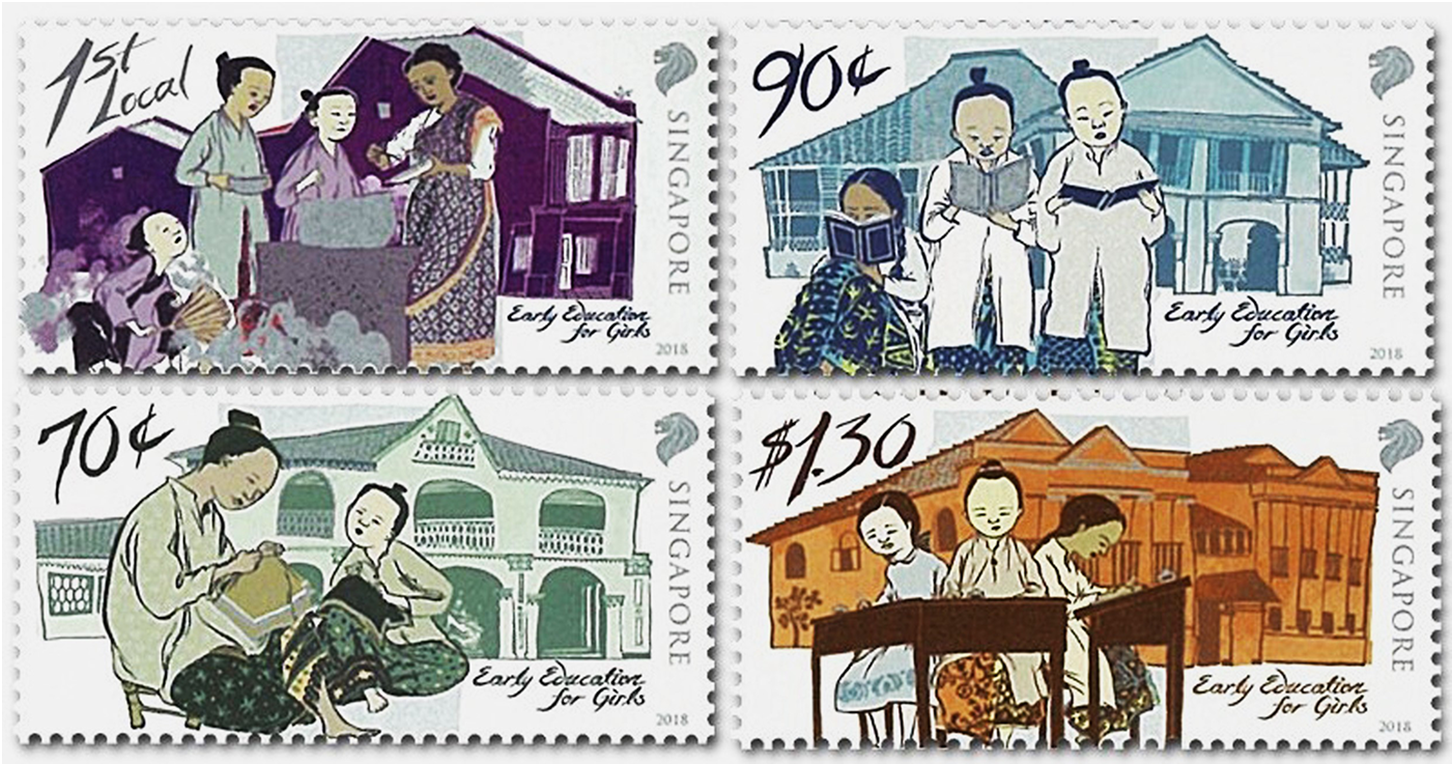
In 2018, Singapore issued four stamps honouring ‘Early Education for Girls’, illustrated with Malay, Indian, and Chinese girls cooking, sewing, reading, and writing, each with a historical school building in the background (Figure 1). Texts on the cover jacket for the postage set explain:
Nineteenth-century Singapore was a vibrant commercial centre … the coming of Christian missionaries from the West … saw the setting up of schools that not only rescued girls from a life of servitude but also inculcated spiritualism and equipped them with … practical skills. At a time when parents considered it pointless to educate girls, it took great efforts … to persuade them to send their daughters to school. The curriculum … reflected the social norm and values of the times. Besides religion, English, and arithmetic, the … skills taught—sewing, knitting, cooking, childcare, cleaning … —supported the traditional view that home-making was the responsibility of women. But these schools provided girls with basic literacy and valuable skills that enabled them to lead better lives through employment or marriage.
Stamps commemorating ‘Early Education for Girls’, 2018.

While the year the schools started, the names of the schools, missionary societies, or pioneering teachers are all absent, this paragraph is an accurate description of early female education in Singapore, appropriately seen in the context of its time rather than judged by modern standards which emerged later. Philately is no longer popular among the young today, but it appears that it could still be an instructive hobby.
It is true that women pioneers rarely feature as subjects in colonial history, and girls’ schools rarely feature as subjects in education history. Nevertheless, a careful reader would be able to find relevant books and articles in the context of Singapore, albeit mostly issued since the 1960s. One might think the missing specifics in the cited texts could easily be found in any decent study on this topic. However, surprisingly, existing narratives are somewhat confusing. Here are some excerpts taken from studies in English dated from 1911 to 2019 which contain a year and an explicit or implied reference to a first or oldest girls’ school (named or unnamed), grouped—in the interest of simplicity—into three time periods:
1) 1850s: Karen Teoh’s article on female education in Malaya and Singapore states that ‘[t]he first and most well-established mission school for girls in these colonies, the French Catholic … Convent of the Holy Infant Jesus (CHIJ), started with two branches in … Penang (1852) and Singapore (1854)’.Footnote 4 H. E. Wilson’s study on education in Singapore claims that in 1852 ‘a small school for Chinese girls was founded by Sophia Cooke of the Society for the Promotion of Female Education in the East (SPFEE)’.Footnote 5 Mary Turnbull’s definitive book on Singapore history notes that ‘Sophia Cooke came … in 1853 and ran a school largely for orphaned girls and reformed prostitutes …. [It] eventually became St Margaret’s, the oldest girls’ school in Singapore to survive into the twenty-first century’.Footnote 6
2) 1840s: Sperando claims that ‘[a] few schools for girls in Singapore were started … and the first … was a Church of England school, the Zenana Mission for Chinese Girls, founded in 1842’.Footnote 7 Yang Wei’s thesis on ‘female emancipation’ notes that, ‘in 1842, Sophia Cooke … founded the Singapore Chinese Girls’ School … the first English-medium girls’ school’.Footnote 8 T. R. Doraisamy notes that ‘Rev. and Mrs Dyer opened in 1842 the St Margaret’s School … the oldest girls’ school in Singapore’.Footnote 9 Song Ong Siang’s book on Singapore Chinese tells us that ‘Miss Grant … had come out in 1843 to take charge of the Girls’ School which had been begun by Mrs. Dyer’.Footnote 10 Kevin Blackburn’s study on education and industrialisation in Singapore names some of the earliest mission schools, including ‘the Anglican Church’s St Margaret’s School for Girls’, which opened in 1842.Footnote 11
3) 1820s: Peter Wicks’s paper on education notes that LMS started its first school in Singapore in 1822 and ‘[b]y 1829 … L. M. S. schools had increased to four, including St Margaret’s School for girls’.Footnote 12 Doraisamy claims that Dyer’s school in 1842 was ‘the oldest girls’ school’, as cited, but also that ‘Mrs. G. H. Thompson [sic]’, elsewhere called ‘G. H. Thomsen [sic]’, came in 1822 and took in ‘a class of six girls instructing them in Malay and in English’.Footnote 13 A book by Audrey Chin and Constance Singam notes that ‘at the corner of Bras Basah Road and North Bridge Road, is the site of Singapore’s first “proper” school for girls … in 1929 [sic, 1829?], Mrs. G. H. Thompson [sic] … taught six Malay girls’.Footnote 14 Margaret Burton claims that ‘[t]he first school for Chinese girls was opened … in 1825 by Miss Grant’.Footnote 15 An article by June Li in The Oxford Handbook of Christianity in Asia informs us that ‘[t]he first Christian school for girls was opened … by Miss Grant in Singapore in 1825’.Footnote 16
This lack of consensus in research in English is unexpected since, except for those related to the Catholic school, almost all relevant primary sources are in English and well-preserved in several accessible archives. To be fair, many studies cited referred to earlier works as supports, and a couple did not specifically state that the school noted was the first (but it could easily be so interpreted as no earlier one is mentioned). At any rate, one who tries to learn about early female education in Singapore through them is left confused as to basic facts such as when Western-style schooling for girls began, the individual(s) involved, and the supporting Christian tradition or missionary society. Was it 1854, 1853, 1843, 1842, 1829, 1825, or 1822? Was it Miss Cooke, Miss Grant, Mrs Dyer, Mrs Thompson, or Mrs Thomsen? Were they Catholics, Anglicans, or non-conformist Protestants? Were they from CHIJ, SPFEE, or LMS? We only know the cited excerpts could not all be right, and it will be shown that they typically contain one or more problematic claims.
The history of female education and the roles of women in colonial Singapore are of increasing interest to scholars and the public alike, as partly demonstrated by the books and articles cited here and the commemorative stamps issued in 2018. This is perhaps part of what Philippa Levine calls a new attention to gender in recent decades, transforming historical scholarship including those dealing with the British colonies, which has often been portrayed in the past as a ‘masculine enterprise … dominated by white men’.Footnote 17 However, to think deeper about gender and empire or women and mission in the context of education in early Singapore, the basic historical records on these aspects of its social history, currently buried in layers of contradictory details, should first be investigated more diligently and hopefully set straight. Given the length limitations of a journal article and the large number of relevant primary sources, this will be the strictly delineated ambition of the current article.
Drawing on primary sources including archival materials from LMS, the ABCFM, SPFEE, EJNB, and Missions Étrangères de Paris (MEP), this article attempts to revisit early girls’ schools in colonial Singapore. First, a few words on what the study will do and what different readers could expect to learn. It will mainly address the basic question of ‘What was done for women’s education?’, and only peripherally the deeper questions of ‘What did education do for women?’ and ‘What did women do with education?’. As already noted, the article has the simple (and arguably ‘old-fashioned’) objective of ascertaining the (sometimes dry) historical facts of these schools, the timelines and the key players, as what is known in current literature seems fraught with inaccuracies or inconsistencies.
For general readers, the article will try to answer the who, what, when, and how of early female education in this Asian colonial outpost, retold in chronological order and often enriched with citations from letters, minutes, and reports of the time. For readers interested in the first girls’ schools in Singapore, such as their generations of alumnae or teachers and family members, it will provide reliable accounts of their early histories, including those of three that still operate today (albeit under different names) and point to historical documents for further reading. For specialist readers, it will supply historical narratives based on primary sources, possibly for theoretical analyses on broader issues such as education, colonialism, mission, conversion, race, gender, and class, etc. in nineteenth-century Asia. This study will not engage in extended analyses of these topics, though it will occasionally touch on some possible areas for further research by others.
Brief attempts
LMS Malay Female School (1822–1827+)
As confirmed by his fellow LMS missionary Walter Henry Medhurst (1796–1857), Claudius Henry Thomsen (1782–?) (hence ‘C. H.’, not ‘G. H.’, nor ‘Thompson’, as cited earlier), sent by LMS to Malacca in 1815, had moved to Singapore in May 1822 to work amongst the Malays.Footnote 18 His wife had taught girls in Malacca from 1820 and soon also did the same in Singapore. In October 1822, the Thomsens had ‘nine Malay girls & 7 Boys’, including ‘4 Girls & 4 Boys … from Malacca’, and ‘several from the Town attended School daily’.Footnote 19
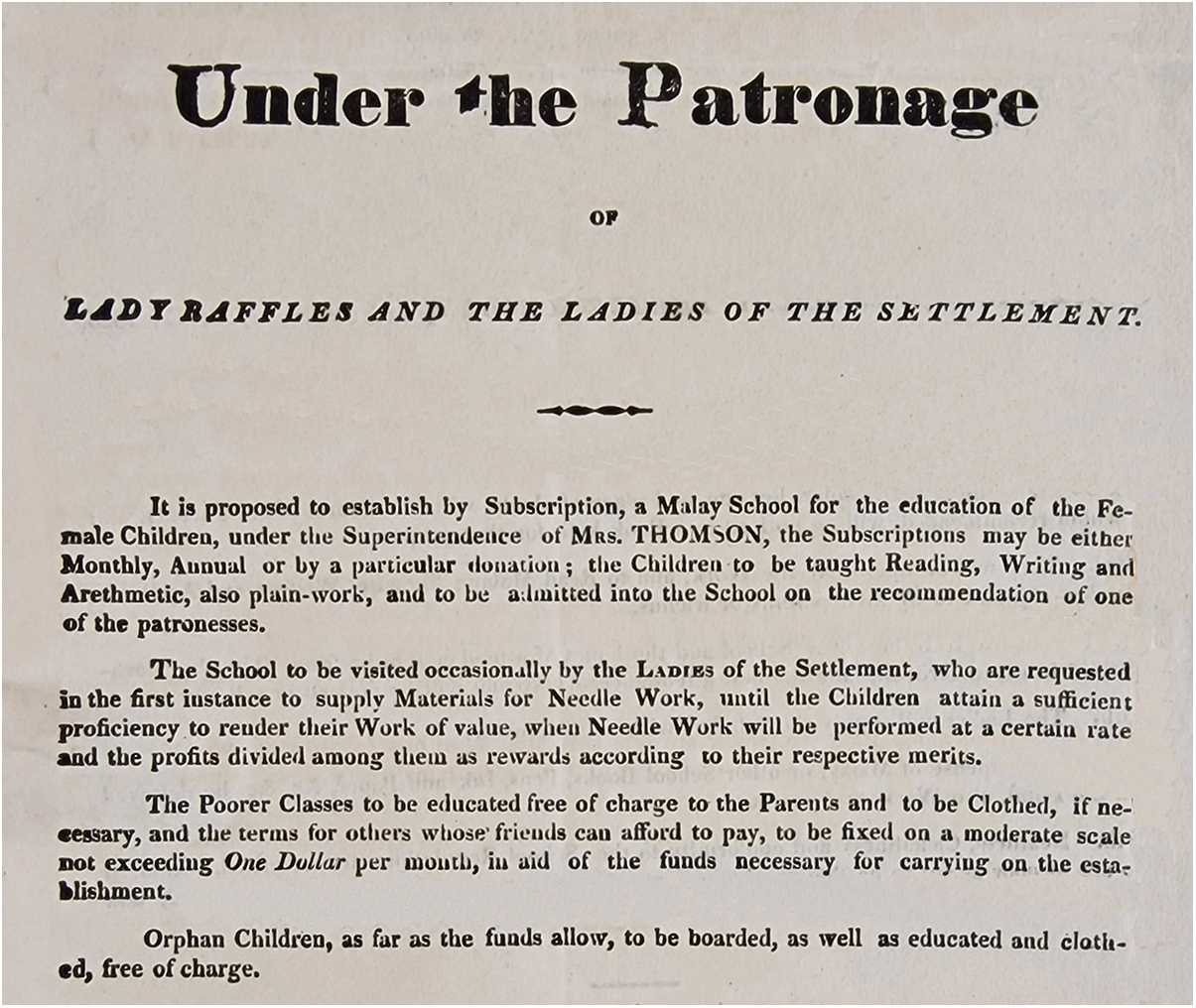
Soon this school attracted the interest of Lady Sophia Raffles (born Sophia Hull, 1786–1858), the second wife of Sir Thomas Stamford Raffles (1781–1826). Thomsen noted in July 1823 that ‘Lady Raffles took Mrs. Thomsen’s Malay Girl School under her patronage & about 1,100 Dlrs were subscribed for its support’.Footnote 20 A two-page circular (Figure 2) dated 1823 declares that:
It is proposed to establish … a Malay School for … Female Children, under the Superintendence of MRS. THOMSON [sic] … to be taught Reading, Writing and Arethmetic [sic], also plain-work … The Poorer Classes to be educated free of charge to the Parents and to be Clothed, if necessary, and the terms for others whose friends can afford to pay, to be fixed on a moderate scale … Orphan Children … to be boarded, as well as educated and clothed, free of charge.Footnote 21
Circular on Malay Female School, 1823. Source: SOAS LMS/14/02/03, 1/2/A.

Mrs Thomsen (Mary Ann Browne, ?–1834) was also Thomsen’s second wife, as his first had died in 1817.Footnote 22 The ‘Malay Female School’ was opened on 1 May 1823 with one-time donations of $780 (Spanish dollars, same hereafter) and subscriptions of $380 per year. The needy entered freely, others paid $1 (day scholars) or $2.50 (boarders) monthly, and boarders whose friends ‘have it in their power amply to provide for them’, $12 (ages 4–10) and $15 (above 10).Footnote 23
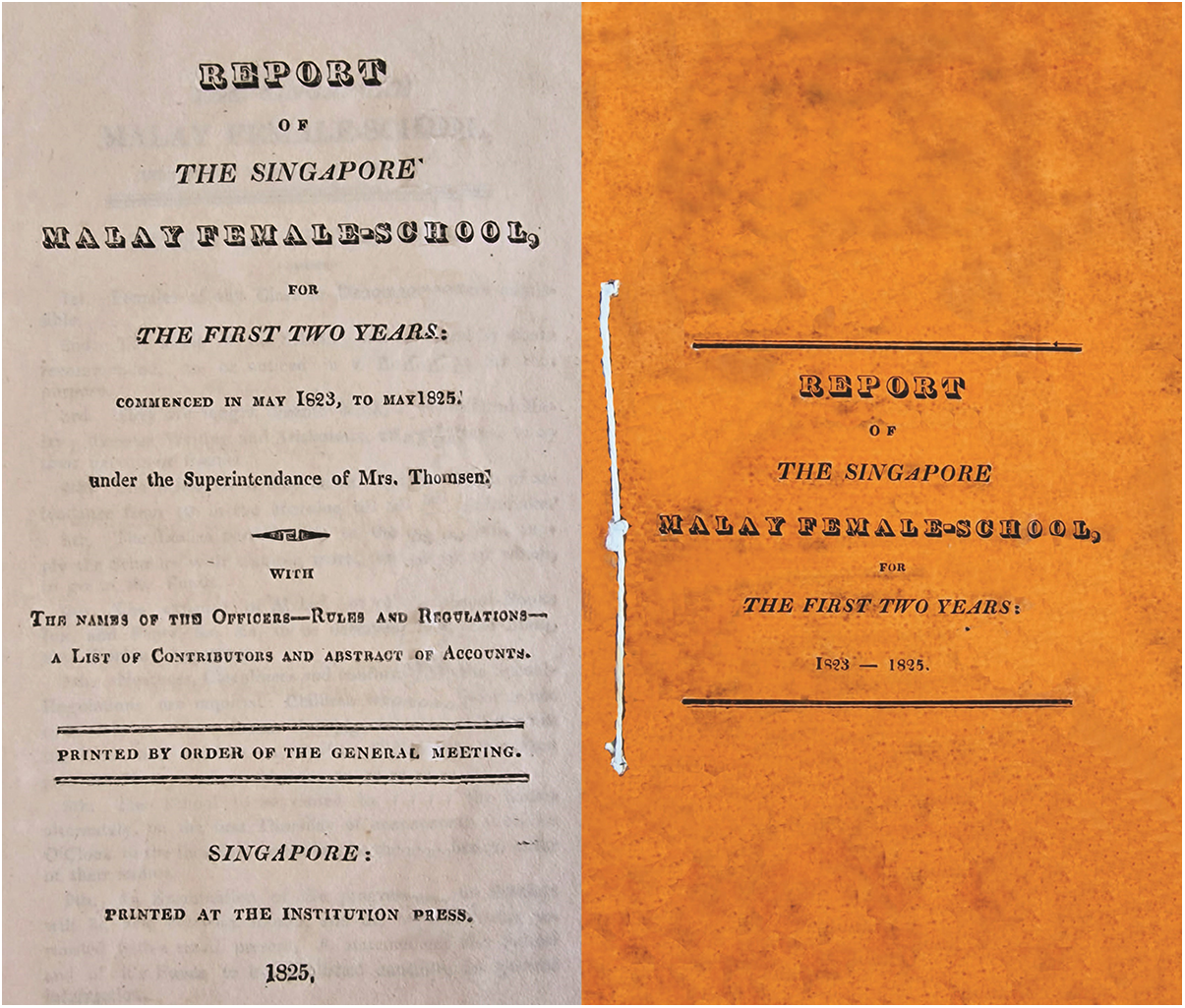
Two annual reports of this school, possibly the only extant copies, are preserved in the archive of the School of Oriental and African Studies (SOAS) in London. The first, issued in 1825 for the first two years (May 1823–April 1824 and May 1824–April 1825) (Figure 3), notes that, after the Raffles left, Mrs Crawfurd (wife of Dr John Crawfurd, the second British Resident of Singapore) became the patroness, Mrs (Anna) Napier the treasurer, and Mrs Thomsen the secretary.Footnote 24 The new patroness’s appointment echoed those in other colonies. In a study on British women in female education, Joyce Goodman concludes that while female education committees in England were typically not hierarchical, ‘the composition of female committees … in the British colonies closely mirrored the male status hierarchies upon which colonial life was built’.Footnote 25
Report of the Singapore Malay Female School, 1825. Source: SOAS LMS/14/02/03, 1/5/A.

School rules and regulations, slightly altered from those in the circular, include the following:
1st. Females of any Class or Denomination will be admissible … 3rd. They are taught Needle Work, and to Read Malay; likewise Writing and Arithmetic, unless objected to by their parents or friends 4th. The School is a Day School … from 10 in the Morning till 2 in the Afternoon … 6th. The expense of … School-Books … to be defrayed … 7th … Children who are … poor … will be supplied from the Fund, and destitute or Orphan Children to be … provided for entirely. 8th. The School to be visited by two of the Ladies … every month … 9th. An Examination of the progress of the Scholars will be held every six month [sic]… A statement of the School and of it’s [sic] Funds to be published annually.Footnote 26
There were only 16 pupils in each of the first two years, those ‘on the funds’ went from nine to ten from the first to the second year, those supported by the ladies remained at four, and day scholars decreased from three to two. Soon, ‘[s]everal [girls could] read parts of the N. T. [New Testament] tolerably well, & repeat Christian Catechisms’, and showed ‘considerable improvement … in their manners’. They worked, ‘making their clothes’ and ‘doing work sent to the school’, but ‘inculcating Christian principles’ formed the main part of their tuition.Footnote 27
Leona O’Sullivan informs us that Thomsen had ‘an excellent talent for composing in both the English and Malay language, hymns, short prayers, lessons and other elementary books well adapted to the capacity of children’.Footnote 28 Textbooks used in the school would likely include his booklets (re)printed in Singapore in 1823: ‘a small selection of English Hymns for Children and ditto Malay Roman Characters, a Malay Spelling Book R. C. [Romanised characters], [and] a small system of arithmetic’.Footnote 29 For the more advanced girls, they might have included the bilingual A Vocabulary of the English and Malay Languages (1820) and The Malay Magazine/Bustan Arifin (1821–1822), compiled or edited by Thomsen and his Malay teacher Munshi Abdullah bin Abdul Kadir (1797–1854), and printed in Malacca. Words in A Vocabulary, reprinted in Singapore in 1827 and 1833, are arranged topically (e.g. under Religion: God (Allah), Jesus (Isa), Holy Spirit (roh olkudus)).Footnote 30 Malay Magazine deals with ‘Universal History, Biography, Natural Philosophy, Religion, Occurrences, &c.’.Footnote 31
The school report describes the students’ routine on a typical weekday: 7 am, prayers; ‘go to their books till about half past eight’; breakfast; 10 am to 12:30/1 pm, sewing; then ‘half an hour … committing to memory the Lord’s Prayer—10 Commandments—Christian Catechisms, Hymns and Scripture’; resume ‘work for a short time, and then take their writing boards’; 6:30/7 pm till 8 pm, reading; finally, ‘singing and prayer’. Activities on the Sabbath differed: a discourse at 8 am in Malay; revision of lessons after breakfast, to be repeated at 1 pm; a public worship at 4 pm; and the evening again concluded with singing and praying. All in all, the curriculum was Christian centred and work oriented.
Chin and Singam lament that ‘[a]side from the location and the reference to Mrs. Thompson [sic], everything else has been lost to time’, and wonder if these first students were ‘children of royalty or orphans taken in by the kindly missionary’.Footnote 32 As most boarders were supported by funds or charged to the ladies, and much of their time was engaged in sewing, we can safely conclude that none were ‘children of royalty’. Most early students were from poor families, orphans, or former slaves, as Kadir records that many Malay girls were declared free by Crawfurd and ‘they betook themselves to different places’.Footnote 33
The school report also tells us that there were ‘suspicion and enmity of the priests and devotees of false religion’ and, as ‘evil communications corrupt good manners’, four girls had to be dismissed (though one, ‘a hopeful girl’ from Malacca, had pleaded to be readmitted).Footnote 34 This is a partially informed if somewhat patronising dialogue with local culture. The label ‘false religion’ has often been slapped on others by followers of Moses, Jesus, Muhammad, and Buddha, and between followers of different sects from the same faith. Hence, within Christianity, this label has been used between Catholics and Protestants, Baptists and Anglicans, Latter-day Saints (Mormons) and mainstream Protestants, etc. The report’s ‘false religion’ is likely referring to the Muslim faith of the Malay natives and possibly also to Buddhism, Taoism, Confucianism, or Chinese syncretic religions, common among Chinese settlers.
Diane Hoffman reminds us that education is formal schooling plus non-formal ‘cultural learning, socialization, and enculturation’. One’s cultural milieu should be used as a lens ‘offering new ways to frame questions’.Footnote 35 This cultural lens would be helpful in gaining insights on these Singaporean girls. In early colonial Singapore, social norms and values of the ruled races and priorities and preferences of the ruling classes were clearly at odds with each other. It was likely difficult for most students having to negotiate between the formal Christian and Western teachings in school and the informal ones at home with their Muslim, Buddhist, and/or Confucian influences. ‘Good manners’ in school implied tacit acceptance if not an enthusiastic embrace of what was being taught, and ideally also conversion to Christianity, something which amounted to cultural rebellion at home. It was to be expected that this had invited negative responses from some non-Christians.
The second report, issued in 1826 for the third year (May 1825–April 1826) and visibly much better printed, starts with a preamble touting instruction as ‘a powerful engine’ for ‘raising many from the lowest walks of Society, to become useful and respectable members of the community’, and pleading for patience as ‘in due time we also shall reap’. The subscribers included ten ladies, contributing over $300. After several dismissals, there were 11 girls, seven ‘on the funds’, two supported by the ladies, one received back, plus a girl who was not funded.Footnote 36 Mrs Thomsen had also taken in ‘two girls & 1 boy, children of Europeans’ for $12 each per month, not included in the 11.Footnote 37
The girls were reported to ‘have improved considerably in their learning’, writing Malay with ‘Roman character [sic]’, and ‘repeating the multiplication Table’.Footnote 38 Retention issues continued—there were efforts to remove two girls by a ‘pretended father’ with a conniving European and by a mother who ‘stipulated with a Buggies man to give him her child’, but both were foiled, one with Crawfurd’s intercession, another with information from the child’s elder sister.Footnote 39
This Malay Female School has largely though not entirely escaped notice. Two articles in the 1980s refer to it in passing. A. C. Milner mentions that ‘Mrs Thomsen … ran a girls’ school under the patronage of Lady Raffles’, with no further comments on it.Footnote 40 O’Sullivan notes that two reports are extant for the ‘Singapore/Malay Female-School’, with no elaboration on their contents.Footnote 41 Su Ching’s book in Chinese issued in 2010, which will be referred to again, provides more details, citing LMS letters and the two reports but not the circular.Footnote 42
In 1825 and again in 1826, an LMS deputation team consisting of Daniel Tyerman and George Bennet visited Singapore (one of many stops over several years). Their published journal notes that they had discussed with Thomsen how to overcome the ‘many hindrances in the way of the gospel’ and predicts that Singapore ‘will ere long be one of the most flourishing marts of commerce in all the east’.Footnote 43 As revealed by Thomsen in October 1829, the unpublished ‘Statement of the Deputation’ sent to LMS has some assertions critical of him, including his supposed neglect of the Chinese department of the mission and the unsatisfactory state of the Malay branch. It also confirms that ‘Mr. & Mrs. Thomsen (of whom we think highly) have under their care eleven children, nine of whom are supported by voluntary subscriptions of the European residents’.Footnote 44
We do not know when this first girls’ school closed. Su suggests that it ‘probably was terminated between mid-1826 to early 1827’, as no later school report is known, and it was not mentioned in later letters.Footnote 45 This is a reasonable conjecture. On the other hand, Thomsen reported in November 1826 that a girl received back was baptised ‘after eight months’ trial’, suggesting that it was still operating in late 1826.Footnote 46 The 1826 report also says that ‘a house now building’ would be used ‘to establish a branch school on the other side of the water’, indicating planned expansion rather than closure.Footnote 47 High-level support possibly declined by late 1826, since the Crawfurds left in August and Anna Napier died in November.Footnote 48 Still, with Mrs Thomsen as the secretary, and a subscription fund which was not depleted as of 1830,Footnote 49 it is possible that the school still existed in 1827 and perhaps even later.
LMS Chinese girls’ schools (1829–1832)
LMS missionaries John Smith and Jacob Tomlin, specialising in Chinese, joined Thomsen in Singapore in 1827, and they formed a committee on education in September, chaired by Thomsen, whose objects included ‘improvement and extension of the Native schools already established’.Footnote 50 The newcomers soon departed, and by late 1828, Thomsen was the only LMS missionary left, so the Chinese mission also fell on his lap. In November 1829, he reported that
[w]e have lately succeeded to establish a Chinese female School, 12 attend. Miss Martin teaches them … Chinese and Mrs. Thomsen … sewing. After the new year we expect to get another girls’ school in the Chinese part of the town, (the present one is at Campong Glam, wh [sic, which] is the chief residence of Malays). The parents seem pleased to see their girls learning to read & work.Footnote 51
Miss Sophia Emma Martin (1799–1879) was the second daughter of Col. George Martin of the Madras Army and younger sister of Elizabeth Martin, later married to the renowned Sinologist Medhurst, noted earlier.Footnote 52 Her father died in 1815, and she had been living with the Medhursts in Batavia, where she learned Chinese and Malay. In May 1829, she left for Singapore, hoping for improved health.Footnote 53 The Chinese girls’ school was likely started in October, when Martin was first paid by LMS.Footnote 54
The school’s name change might not necessarily reflect a change in the girls’ ethnicity, especially since the first ‘Chinese’ girls’ school was in Kampong Glam, where the Malays mainly resided. Contemporary statistics show a serious gender imbalance among the Chinese: 2,956 males and 361 females in 1823; 25,749 males and 2,239 females in 1850.Footnote 55 This imbalance was very pronounced as the island was populated largely by unskilled and lowly paid male migrants.Footnote 56 Only a few could bring a Chinese wife from their homeland, so even the better-off Chinese artisans or businessmen who could afford a family had to marry Malay women and ‘were compelled to communicate in Malay … and their children learned Malay by ear’.Footnote 57 Though some also spoke their father’s native tongue (Chinese dialects of Hokkien, Cantonese, Teochew, or Hakka), many Peranakan children could only converse in Malay.Footnote 58 These ethnically mixed Straits Chinese could be referred to as Chinese or Malay by the Europeans and even the children (and their parents) themselves. After all, as Stuart Hall observes, cultural identification is often based on what we make of our traditions, ‘not a matter of ontology, of being, but of becoming’.Footnote 59
By early 1830, Martin had added another girls’ school as planned. In February 1830, Thomsen predicted that ‘[t]he Chinese Girls’ Schools … will increase’, if teachers could be added. He thought the committee could afford the local masters, if Martin could be ‘on the account of the Society’, ‘superintending the Chinese Female Schools’. Thomsen saw the ‘Chinese Girls’ Schools’ as a continuation of the ‘Malay Female School’, as he then appealed to ‘the good ladies at home’ to send out ‘fancy & useful articles for sale’, as ‘the fund raised … by Lady & Sir Stamford Raffles’ (earmarked for the Malay Female School) he feared ‘will be entirely lost’.Footnote 60 In June 1831, the two girls’ schools continued, one Martin ‘teaches herself in the afternoon, another lately commenced she goes in the mornings’.Footnote 61
In a letter in July 1832, Thomsen informs LMS that Martin ‘has had the assistance of a Teacher in part at 4 Dlrs per month’, and that they were ‘still expecting to obtain the allowance for Schools from Government’, promised earlier. At the bottom of this letter are questions and answers in different hands (suggesting that these were written by someone in the London office of LMS): ‘to what does this refer [?]’ and ‘What were the number of schools & are they not exclusively females [?]’; ‘In 1829—3 Chinese Schools, Boys’ (it appears) with—40 children, a Girls’ School with—12 children (under Miss Martin)’ and ‘1831—3 Chinese Boys’ Schools with—48 children, One Girls’ with—15 children (ditto)’.Footnote 62 It appears that LMS back home did not know that a second girls’ school had been started since 1830.
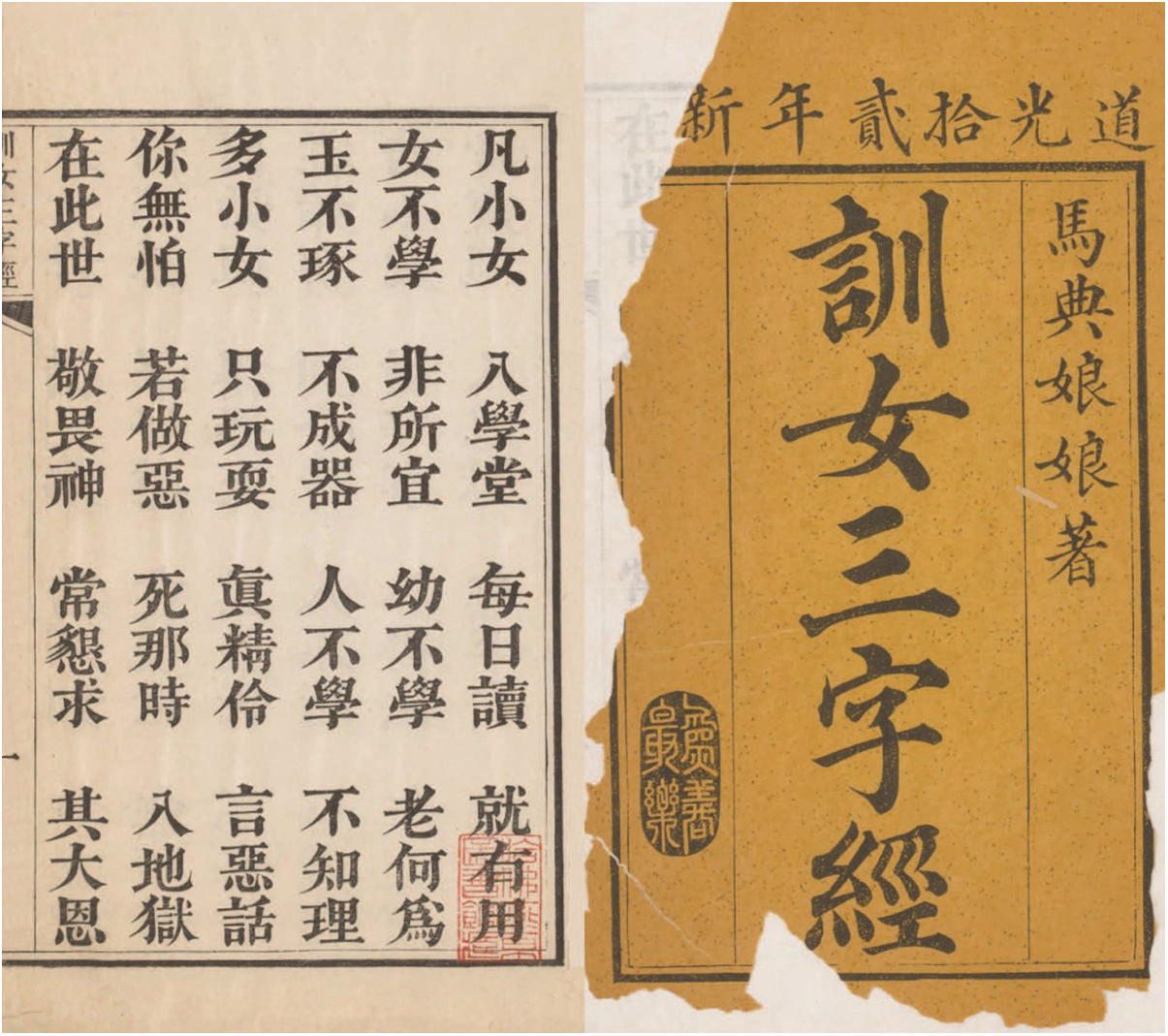
Unlike Mrs Thomsen, Miss Martin also knew Chinese, which was used for the first time in teaching girls in Singapore. She had published a short tract entitled Xunnu sanzijing 訓女三字經, or the Three Character Classic for Girls, in 1832, emulating the Chinese primer Sanzijing 三字經, or the Three Character Classic.Footnote 63 A copy of this book is extant in the Harvard-Yenching Library. It has only nine leaves, with her name (madian niangniang 馬典娘娘, or Lady Martin) on the title page (Figure 4). The texts are easy to understand and incorporate Western and Christian values rather than Confucian ideals. It opens with four phrases declaring that little girls should be schooled and that daily study would make them useful.Footnote 64
Martin’s Three Character Classic for Girls, 1832. Source: Harvard-Yenching Library.

In the Malay Female School, Thomsen taught Malay and English. In the Chinese Girls’ School(s), Martin had added instructions in Chinese. Still, the girls in either school could be Malay or Chinese/Peranakans. The qualifiers ‘Malay’ or ‘Chinese’ attached to the schools in 1822 and 1829 could refer to ethnic origins of the students, but also possibly just the medium of instruction.
In 1834, Thomsen returned to England for his wife to be treated for breast cancer, though she died soon after. The Chinese Girls’ Schools shut down before Thomsen left, in October 1832, just before Martin’s wedding. She and Thomas Wat(t)erman Whittle, a surveyor, were married on 23 November 1832. Sadly, Whittle died ‘on board the Ship Asia, off Lintin’ in October 1834, and she gave birth to their son in December.Footnote 65 Mrs Whittle started a private school for paying girls soon after. In July 1835, SPFEE confirmed that ‘Mrs. Whittle … is willing under the auspices of the Society to resume the Chinese School’, and ‘the sum of £50 was voted for that object’.Footnote 66 This did not materialise, as a lady identified to be her assistant so she could take charge of the Chinese Schools withdrew due to sickness.Footnote 67
Mrs Whittle continued to teach fee-paying students, charging boarders $12 and day scholars $4 monthly. In the 1840s, G. H. Brown’s choir had ‘boys from Raffles School, and the girls from the School in North Bridge Road kept by Mrs. Whittle’.Footnote 68 In 1856, Medhurst’s daughter Eliza visited Singapore and had stayed with ‘Aunt Sophia’,Footnote 69 but we do not know if the school still existed then. In May 1879, an obituary from the local press confirms that ‘Mrs. Sophia Whittle, aged 70’ passed away ‘[a]t Bonnygrass, the residence of Dr. Little, on the 10th instant’.Footnote 70
LMS/ABCFM girls’ schools (1834, 1838, 1839, 1840)
Between 1834 and 1841, there were at least five efforts to educate girls by four missionary wives and a single woman linked to LMS or ABCFM, typically not noted in past studies, including those cited earlier here. As these were all short-lived and hence historically less important, they will only be described briefly.
There is the sad story of Miss Mary Christie Wallace who had studied Chinese in the ‘Language Institution’ in London, set up in 1826 by Dr Robert Morrison (1782–1834), the first LMS missionary to China, in his ‘one and only furlough back in England’.Footnote 71 Miss Wallace, who raised her own support and was loosely linked to LMS, came to Malacca in May 1829. In 1831, she ran a total of eight schools for Chinese girls and one each for Malay and Tamil girls, with 120 students, suggesting greater needs there than in the newly founded Singapore. Her male colleagues judged her services ‘valuable and important’ and recommended LMS support,Footnote 72 but it was reluctant. By late 1832, she still had five Chinese schools with 70 girls, and noted that ‘[t]he number … might be increased had we funds sufficient’, as ‘we have no permanent provision’ except a small sum from the Anglo-Chinese College (ACC) in Malacca, founded by Morrison and LMS in 1818.Footnote 73
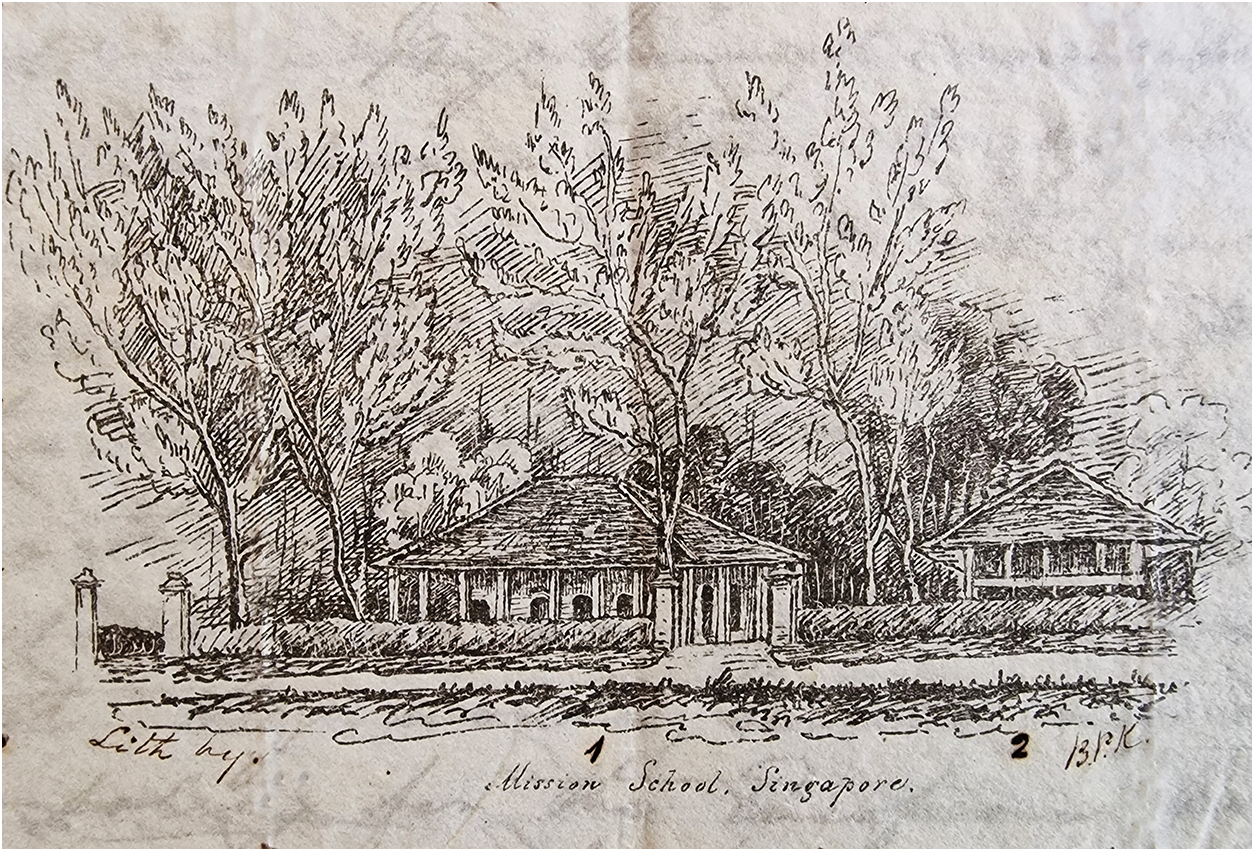
With over-expansion, setbacks, and funding issues, the exhausted Wallace relocated to Singapore in 1834, moved into the LMS mission house vacated by Thomsen, and opened a small girls’ school. LMS missionary Benjamin Peach Keasberry (1805–1875) left us an image of this mission station and school drawn by him a decade later (Figure 5).Footnote 74
LMS mission station and school, Singapore. Source: SOAS LMS/14/02/03, 2/5/A.

The ABCFM had also started a mission in Singapore in 1834. In October, its missionary Ira Tracy observed that ‘Miss Wallace’s girls school contains about 20 Chinese scholars & is prospering’, and that Chinese ‘opinion respecting female education has become more favorable’ due to progress in Malacca and ‘Miss Martin’s efforts here’.Footnote 75
Wallace’s school proved short-lived, lasting only six months. Financial and other difficulties affected her emotionally, and she was sent home in January 1835. In February, Thomas Beighton, an LMS missionary in Penang, wrote that ‘Miss Wallace has arrived here on her way … to Madras, Calcutta, & England’, she ‘appears disordered’, others said ‘she is insane’, and ‘I feel very sorry for her. She ought never to have come out alone.’Footnote 76 We do not know more about her fate, but this was indeed a tragic case among pioneers of female education.
Beighton thought Wallace ‘ought never to have come out alone’, perhaps implying that a married woman might have a better chance of being successful. However, in this era, a married woman in Britain was stripped of a separate legal entity and could not even own property;Footnote 77 so she could not possibly pursue her missionary ambitions other than as a missionary wife at the mercy of her husband’s moves, as witnessed by several married female educators noted here. As far as we can tell, Wallace, not burdened with family responsibilities, seemed effective in promoting education for local girls and could have prospered if she had had more support. On the other hand, at the time LMS seemed reluctant to provide for girls’ schools. Her failure was arguably more due to lack of funding for school facilities and local assistants then the fact that she was single. As shall also be seen, several single women were indeed to become excellent pioneer educators in the colony soon after.
Three years later, in March 1838, LMS missionaries Alexander Stronach (1800–1879) and John Stronach (1810–1888), brothers, came to Singapore with their wives, Mrs A. Stronach (formerly Mrs Eliza Clark Paterson, 1809–1888) and Mrs J. Stronach (Margaret Ralston, 1812–1846).Footnote 78 By later 1838, the ladies had started to teach:
Mrs. John Stronach has commenced taking Malay Girls into her house. These Girls, four in number, are delivered up by their Parents for three four or six years … It is intended that they should be … boarders, & … receive a Christian family education … While instructing them, Mrs. S. has found it but little additional labour to teach 4 other Children (2 … half cast) … in the elementary branches. Both Malay & English are taught … Mrs. Alexander Stronach … [is thinking about] a Day School for Malay Girls, without binding them to stay with her.Footnote 79
In March 1839, Mrs J. Stronach still had only ‘six native female boarders’, due to ‘prejudices against female education’; while Mrs A. Stronach had two boarders (girls of ‘European fathers and Malay mothers’, paid for by the father and the resident councillor) plus five day pupils, learning English and needlework.Footnote 80 LMS had indicated that ‘it is not customary for the Society to support such Institutions [girls’ schools]’, so a subscription list was circulated locally and $125 obtained, exceeding what was needed by Mrs J. Stronach to have ‘eight girls entirely clothed, fed and educated’.Footnote 81
Mrs J. Stronach’s school remained active in 1839, though Mrs A. Stronach’s would have stopped as her husband was transferred to Penang that year. Keasberry noted in September 1839 that Ali, who had taught Mrs. J. Stronach Malay and had been converted, ‘is residing with me & engaged in assisting Mrs. J. Stronach’s school, containing five girls’,Footnote 82 confirming that Malay was taught, besides English and Christianity. By September 1840, Mrs. J. Stronach was preoccupied with her ‘rising family of three children’, and had to ‘dismiss 4 of the girls, retaining only the 2 who were most promising’.Footnote 83 Since an earlier request for a teacher from SPFEE had been sent, she promised that ‘[t]he other 4 Girls will return to her so soon as a Teacher arrives to take charge of the School’.Footnote 84
Meanwhile, ‘the ladies of Huddersfield’ had guaranteed SPFEE ‘the liberal sum of £100 per annum for 10 years for the support of a teacher’ in Singapore.Footnote 85 Two sisters were identified and had set sail in July 1840 (unbeknownst to J. Stronach in September 1840, given the time lag in mail). However, this was not to be, as a few weeks later, ‘the health of the younger having failed, the elder considered it her duty to accompany her sister home’.Footnote 86
There were also two brief attempts to educate girls by ABCFM. In December 1838, a donation of $50 was received from Sir William Norris, then recorder of Penang, Singapore, and Malacca, ‘for a contemplated girls school’.Footnote 87 In January 1839, Mrs Tracy (Adeline White, 1809–?) did ‘form a school of Chinese girls; and several girls did attend before the Chinese holidays’; but soon after, ‘she has been in delicate health, and has not been able to resume’.Footnote 88 In November 1839, following doctor’s advice, the Tracys relocated to ‘the Nillgherry Hills [in India]’.Footnote 89
An ABCFM letter in August 1839 notes that ‘the Committee intend that there shall be a girls school … We are all of opinion that there ought to be one’ and shows a budget for this for 1840–1841 and 1841–1842.Footnote 90 A Chinese boarding-school for girls was started in 1840 by Mrs Ball (Lucy H. Mills, 1807–1844), wife of Dyer James Ball (1796–1866), who had arrived in Singapore in 1838.Footnote 91 Minutes in April 1840 confirm ‘Mr Ball’s connection with the female school’. In September, the Balls were attending ‘almost exclusively to their 10 Chinese girls’.Footnote 92 In October, they were authorised to build ‘a bathing place … for the girls school’.Footnote 93 This was again short-lived, since the couple moved to Macao in June 1841 and ABCFM decided to pull out of Singapore entirely in August 1841.Footnote 94
In short, between 1822 and 1841, there were the Malay female school founded in 1822 for five years or more, then up to two Chinese girls’ schools starting in 1829 for around three years, and other girls’ schools linked to LMS or ABCFM started between 1834 and 1840, all small and for shorter durations of a few months to a couple of years. The schools were labelled ‘Malay’ or ‘Chinese’, but their girls, typically impoverished or orphaned, could be Malay, Chinese, little ‘Nyonyas’ or even Eurasians. All these early schools did not survive the test of time because they were individual efforts without consistent outside support and often dependent on the career moves of missionary husbands, operating in a community which (unlike Malacca) did not yet have a strong demand for female education.
Regardless, for about two decades from 1822, a small number of girls in Singapore had benefited from Western teaching in Malay, Chinese, and/or English in various Protestant mission schools, sometimes with breaks of years in between, though long enough to perhaps allow some to acquire basic literacy (and religious) knowledge and work skills, enabling them to become more independent and useful at home and in the community. As shall be seen in the next section, female education was to become more consistent and broadly based over the next two decades, with Protestant, secular, and Catholic schools that were to nurture more girls to work as teachers and in other fields and to become more effective mothers of a growing (but still small) number of families, including some Christian ones.
Continuous operations
Protestant pioneer: SPFEE Chinese Girls’ School (1842–1862+)
LMS missionary Samuel Dyer (1804–1843) and Mrs Dyer (Maria Tarn, ?–1846) joined Mr and Mrs J. Stronachs in 1842.Footnote 95 In October that year, Dyer reported that ‘a Chinese Female Boarding School’ had been set up on their ‘sufficiently commodious’ premises, with ‘19 children, whose parents have all agreed to let us have them, for different periods of time’. Mrs J. Stronach, Mrs Dyer, and Miss Buckland taught, among other things, ‘a considerable amount of religious knowledge’.Footnote 96 Buckland was a governess engaged by Dyer to teach his children and was encouraged to ‘unite with Mrs. Dyer in labours among the heathen’.Footnote 97 Again, ethnic labels should not be taken too seriously—Stronach called the boarders ‘Malay’, while Dyer called them ‘Chinese’. It is possible that some girls in Dyer’s school included a few whom Mrs J. Stronach had kept and/or promised to take back.
Enrolment, despite cultural resistance, soon rose to 20 as three girls, daughters of a widow ‘engaged to keep the children clean and to teach them to work’, had ‘a happy influence on other parents’. Like Mrs J. Stronach before her, Mrs Dyer also sought SPFEE’s support and was ‘anxiously looking out for a letter respecting the lady who is to come out to take charge’.Footnote 98 This lady was Miss A. Grant (?–1880), identified by SPFEE after renewed efforts, whose ‘piety, devotedness, and other valuable qualities’ were ‘of high standing’.Footnote 99 She sailed in March 1843 and in the morning of 29 July saw from afar the town lights of Singapore, ‘land of my future life—or it may be death’, where she hoped ‘to gather many a rough unhewn stone, to shape and fit it for a place in the spiritual temple above’.Footnote 100
Grant’s arrival signified a new era in female education in Singapore, led by a full-time teacher (unlike the missionary wives who preceded her) supported by a mission organisation committed to educating girls (unlike LMS), and continuity was finally achieved. After settling in briefly, Miss Grant went with Mrs Dyer to the schoolroom. These were her first impressions: ‘The children looked pleased to see me, saluting me with a funny “How do you do, Mees?” A nice, intelligent, pleasing set of girls, that in point of mind and manners would do credit to any English charity-school.’ Whatever the ethnic origin(s) of the girls, their main language was Malay. Still, Miss Grant was faithfully confident, declaring that ‘I shall soon get up Malay enough to make myself understood’; and ‘if great my need, great my strength will be’.Footnote 101
By August, 21 girls were on the roll, ‘the eldest sixteen, the youngest … six or seven’, all ‘in very tolerable order, anxious to please, eager to learn, and very grateful for instruction’. Miss Grant had originally considered Hong Kong, but ‘[a]ll thoughts of proceeding to Hong Kong have been dismissed’. She had also ‘engaged an able and intelligent teacher, named Ab Doolah, to instruct [her] in Malay’ and vowed that ‘I intend to speak, read, and write this language easily before I dismiss him’.Footnote 102 Munshi Abdullah, noted earlier here, was quite well known then and had taught Malay to missionaries William Milne, Thomsen, and many ‘white merchants’ and ‘ladies, English and American, and young girls’.Footnote 103
Emphasis on Christian education continued, as all the girls spoke ‘a little English, and read the New Testament readily’. Though they were ‘idolaters a year ago’, the two elder girls nightly ‘collect the school, and the one reads, and the other prays; frequently their little worship closing with singing a hymn’.Footnote 104 In May 1844, Miss Grant observed that ‘never did teacher and pupils love each other more, and even some of the parents show something like gratitude’. By then she had ‘twenty-six souls looking to me for probably the only instruction they will receive during their lives’.
There were links with another SPFEE school: ‘My girls received, this week, two most sweet letters from Ruth and Christiana, Miss [Ann] Aldersey’s pupils, at Chusan [in China], in reply to theirs’; and Miss Aldersey, another of Morrison’s students of Chinese back in London, ‘begs that the correspondence between our China daughters may be continued’.Footnote 105
By July, Chunneô and her younger sister Haneô, noted for their ‘true piety’, had become ‘regular monitors’. A month later, four more Christian girls besides these two, Jeinnéo, Lexen, Benêo, and Pan Leang were reported to be bringing to their teacher ‘passage after passage of Scripture, which they have voluntarily learnt’ on Sunday afternoons.Footnote 106
Not all girls were impoverished. In 1844, when Haneô returned for a short stay in the small plantation left to her and her sister by their late father, she ‘took the idols which had been stuck up by the labourers … and dashed them to the ground’. Miss Grant opines that this brave act did not get her into trouble since she was ‘a girl of the highest caste, viz. Hokkien, and the men of the lowest, Macao’.Footnote 107
The Chinese did not have a strict caste system, but an informal one based on position, power, and/or property did exist. The comments about the girl’s ‘caste’ and property suggest that ‘gender equality seems to be better served by more material assets than schooling’, as was also the case in a study by Roger Jeffery and Akaja Basu about female education on India.Footnote 108
As might be expected, the school collaborated with a chapel. Keasberry reported in 1844 that his Malay chapel had 15–20 ‘adult Malays’, besides ‘children belong[ing] to Miss Grant’s school & mine’.Footnote 109 Haneô’s letter to her friend Ruth confirmed the closeness between school and church: ‘You ask me how the Holy Ghost first moved my heart. It was by a sermon from Mr Keasbury [sic].’Footnote 110
In September 1845, Miss Grant shared the obstacles Chunneô and Haneô had to overcome to be baptised: ‘[t]heir father has been long dead, so the mother’s consent was the only thing wanting … This they pleaded and pleaded for, but in vain.’ In the end, the girls and their brother told Miss Grant that they wanted to be baptised, with or without permission. When Miss Grant confronted the mother, ‘she had given a species of consent, by telling me if I wished it, she could not oppose me’ and, when invited to the baptism, even replied, ‘[i]f Missis likes to allow me’.Footnote 111
By October 1845, enrolment had grown to 29 and the school was divided into four classes: ‘nine … form my first class [most senior], and all are very pleasing, well-behaved, and intelligent’, though the rest, ‘especially my third and fourth classes, are very wild’.Footnote 112 She mentioned Jimnîo, who had finished a three-year term, but ‘her mother has given her to me for another’. Though she is ‘genuinely pious’, Miss Grant confessed shortly after that Jimnîo might ‘leave school without professing Christ’, again suggesting difficulties with conversion in this cultural milieu.Footnote 113
In April 1846, Miss Grant reported ‘better order’ in the different classes, managed by her through multi-tasking. When ‘instructing one class in religion, another class in the back-ground are engaged in preparing a spelling lesson for me’, often quite loudly, ‘affording me audible proofs of their industry’.Footnote 114
Song’s book informs us that the school was ‘for many years the only institution giving elementary English education, along with religious instruction, to Chinese girls’ and ‘an orphanage where many a Chinese orphan girl was brought up and educated and trained in household duties’;Footnote 115 and hence became an excellent source for wives for many Asian Christians.
In June 1849, the elder of Miss Grant’s two Christian girls was married to a convert from China, and ‘her gentle character shines brightly in domestic life’.Footnote 116 This author’s article on the students of the ACC confirms that the unnamed husband was Song Hoot Kiam, one of three favourite students of James Legge. He had returned to Singapore from Hong Kong to visit his father, who then pressured him to get married.Footnote 117 His son Song Ong Siang tells us that Hoot Kiam’s marriage to Yeo Choon Neo had founded ‘the oldest family of Straits Chinese Christians in Singapore’.Footnote 118 Another girl married Li Kimlin, also Legge’s student, though he sadly passed away in Malacca in 1854.Footnote 119 The bishop of Victoria, George Smith, took with him Chan Tai-kwong, a young man he met in England, to Hong Kong in 1850, hoping to train him to become an evangelist. Likewise, Carl Smith’s study notes that Chan ‘was sent to Singapore to marry Gay Eng … a pupil in the school for Chinese girls conducted by Miss Grant’.Footnote 120
Miss Grant completed her ten-year term, having served longer than all her predecessors (not counting Mrs Whittle, who taught privately later) in female education in Singapore, and returned to England in late 1853.Footnote 121 The first girl she had met a decade ago was the intelligent, energetic but proud Miss K. She had made impressive progress in English and Scriptural knowledge but graduated without becoming a believer, though her elder sisters and favourite brother were all baptised. She then came back to be taught in 1853, and before Miss Grant left asked to convert in a ‘humble, penitent, touching acknowledgement of sin’. Miss Grant arranged for her to be baptised on the Sunday after she left, thus closing an important loop, so to speak.Footnote 122
Miss Sophia Cooke (1814–1895) came to Singapore in 1853 (not 1842, as claimed in a study cited at the start), as noted in Turnbull’s book (but the latter does not mention that she had succeeded Miss Grant, who came a decade earlier).
Health risks continued. In a letter in May 1854, Miss Cooke tells us that Miss Ryan, her assistant, ‘had a sharp attack of fever, and I of influenza, so that we were both silenced … for a little season’.Footnote 123 After the initial setbacks, the school continued to prosper. In 1856, Miss Cooke had ‘33 in the school’, despite several losses. Funding was sometimes lacking. Once Bishop Smith visited and preached for the school in their ‘hour of need’, and ‘the Lord has provided’, as ‘200 dollars were collected, and the following day a friend sent me 100 more’. However, she thought that with more money, she could have taken in ‘50 children’.
Senior girls could ‘read their Bibles fluently, both English and Malay’, answer ‘useful question in geography’, and were also learning ‘Grammar, Writing, Ciphering’, and ‘general history’, etc. By then, she had engaged a Chinese assistant as many girls ‘know no more Malay than will suit common purposes’ and could only communicate through a Chinese interpreter (except for ‘a real Chinese’ girl, who could begin to read the Bible in Chinese).
Occasionally, converted girls ran into difficulties, requiring interventions of the authorities. After Miss G. was baptised, her father took her away for marriage to a non-believer. She wanted to return, and in a court hearing gave her ‘firm and clear answers’ in ‘modest and calm’ manners. This was not easy, as in the Chinese culture, it was considered ‘a disgrace to be seen in court’, especially for a woman; and her father had threatened to disown her.Footnote 124
Even at this later stage, there were some ‘rescued ones’. The Female Missionary Intelligencer of June 1861 reports that five young girls and three young women, all previously ‘bought as slaves’, were saved by the police and sent to the school in 1858 or 1859.Footnote 125 The three young women (two of whom since ‘admitted by baptism into the visible church’) were said to have been bought in China ‘to be sold in Singapore’, and the younger girls could also have come from there. Although not explicitly mentioned in this report, the unsavoury fact is that, if not rescued, these vulnerable ones would likely have grown up in domestic servitude as ‘mui tsai’ in their new masters’ homes or, worse yet, be forced later to work in brothels (unregulated until a Chinese Protectorate was established in the 1870s), catering to the predominantly male military and civilian population, European and Asian.Footnote 126
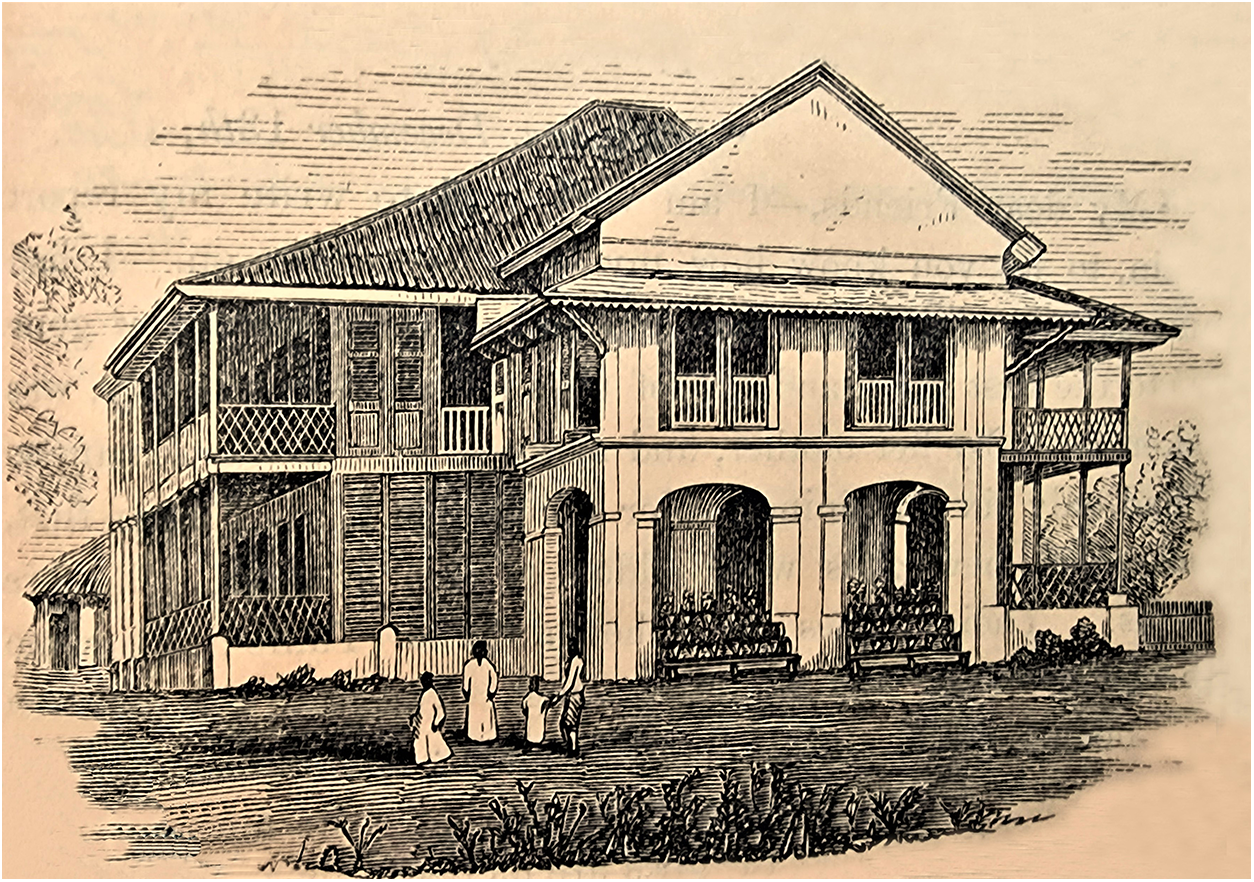
Intakes were limited by the school’s capacity. In July 1857, enrolment remained unchanged, and Miss Cooke notes in a letter that places of six leaving ‘will soon be filled with others’.Footnote 127 On 9 March 1861, the ‘foundation stone of the New Building on Princep’s Hill’ was laid.Footnote 128 By early 1862, Miss Cooke and her girls had moved into the ‘commodious’ new building (Figure 6), funded by ‘[t]he liberality of Christian friends on the spot’, suggesting self-sufficiency of the local Christian community:
We are now settled in our new house, which we find most comfortable, and in every way suited for the school … Christian Chinese will build around us, so that ere long we may have quite a little Christian Chinese village here.Footnote 129
Singapore Chinese Girls’ School, 1862. Source: Female Missionary Intelligencer, 1862.

Miss A— and Miss T—, assistant teachers, and Miss Eng Sahnio, a senior girl, also wrote English letters in early 1862. Miss T— taught a class of nine, two of whom, Jew and Poon, were baptised. Things had come full circle, so to speak, as Miss A—, who also taught a class of nine, had two new girls, Chewnio and Yanio, twins, who were ‘the children of Choonio [Chunneô], the first convert in the school’. Sahnio shared the happy news about her marriage to ‘a good Christian Chinaman’, adding that ‘I shall never forget the school which has done so much for me’. Her husband was Lee Chew Siang, who worked in ‘the go-down of Messrs. Martin, Dyce, and Co.’ and was ‘one of Mr. Keasberry’s congregation’.Footnote 130
Miss Cooke made a cultural accommodation for this wedding. Instead of prescribing the ‘plainest clothes’ which had ‘brought so many unnecessary trials’ for the brides, the school purchased (with a kind friend’s help) ‘a proper Chinese wedding dress’ for Sahnio’s wedding, also ‘to be worn by any who may marry from the school’.Footnote 131
In a letter in December 1862, Miss A—, or Anleang, originally from Sumatra, who ‘had a very happy home in this school for fourteen years’ and had studied under Miss Grant and Miss Cooke before she became a teacher, also announced that ‘this will be my last report, as I am to be married soon’.Footnote 132
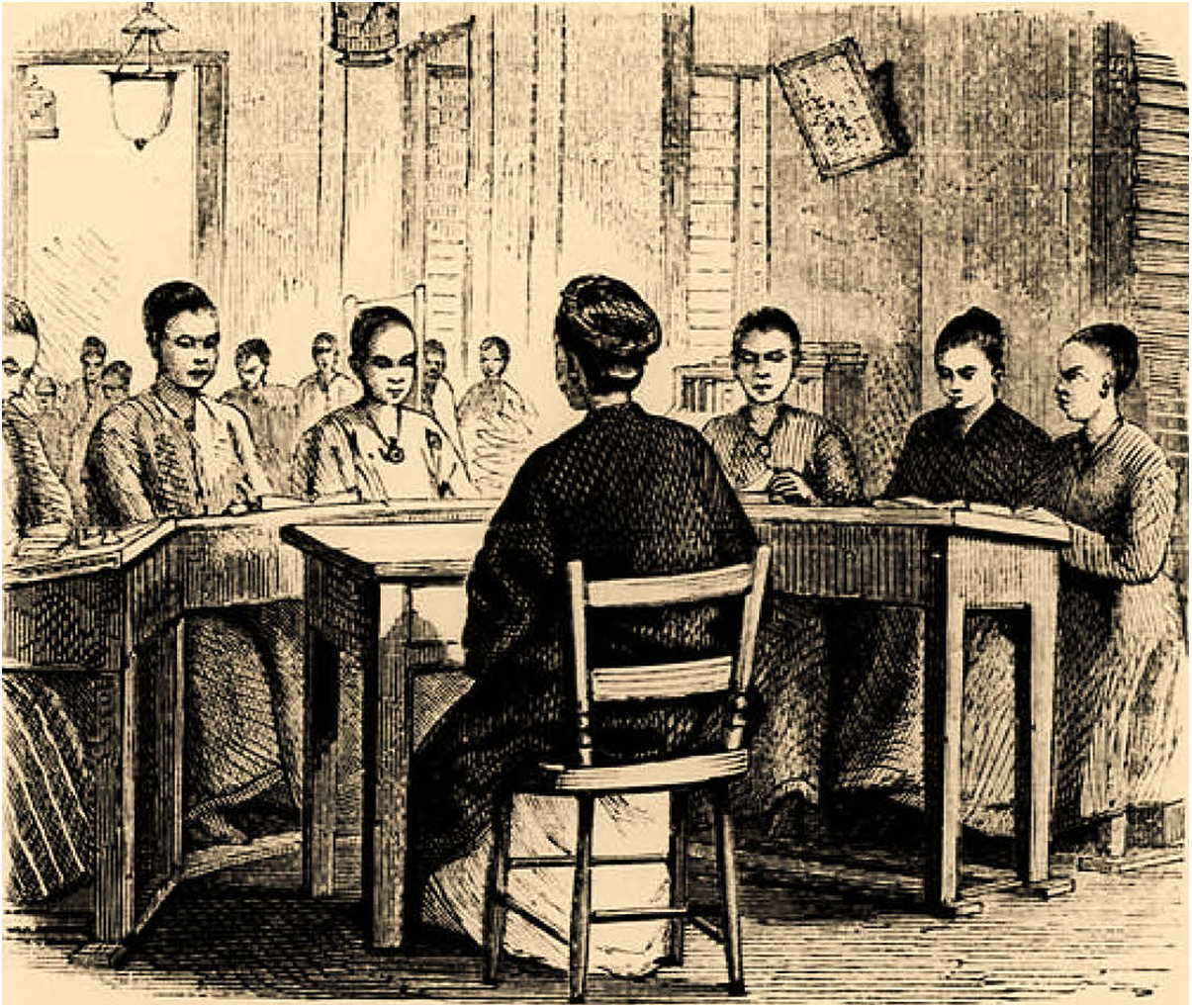
The Female Missionary Intelligencer’s issues in 1862 and 1863 contain engravings of the new school, three students, and a classroom scene (Figure 7) but no enrolment number. Given the facts that Miss Cooke had Miss Ryan and at least two older girls as assistant teachers (Anleang and Tempang and later O Kim after Tempang was married) as well as an unknown number of monitors, and that the school had moved into a bigger new campus in early 1862, an educated guess would suggest that there were, say, 50 to 70 girls by the early 1860s.
Chinese Girls’ School classroom, 1863. Source: Female Missionary Intelligencer, 1863.

Miss Grant and Miss Cooke both had close personal and mutually loving relationships with many students. The girls were ethnically mixed, religiously diverse, and mostly (though not all) from poor families, orphans, or freed slaves. In her paper Beyond White and Other, Susan Friedman contends that ‘feminist discourses about race and ethnicity are too often caught up in repetitive cultural narratives structured around the white/other binary: victims and victimizers, colonized and colonizers, slaves and masters’. While such binary modes of reconstructing history are useful, narratives of Western female education in early Singapore should arguably be supplemented by what Friedman terms ‘relational narratives in which the agonistic struggle between victim and victimizer is significantly complicated’.
As witnessed by experiences in the girls’ school led by Miss Grant and Miss Cooke, such ‘scripts of relational positionality’ are useful, encompassing complexities beyond ‘the white/other binary’. The relationships between the Asian students and their European teachers exemplify arguably ‘better’ types of interactions between ‘one kind of other to (an)other’, and the substitution of plain attire with a proper Chinese wedding dress which the locals much preferred is perhaps a good example of what Friedman might consider ‘cultural syncretism’.Footnote 133
Miss Cooke remained in charge for decades after 1862, the cut-off year for this study. By the 1870s, the school had a branch ‘Ragged School … for day pupils … in a shop house at Middle Road, and later in a lane off North Bridge Road’.Footnote 134 In 1877, Wee Inn, a young girl ‘brought to Singapore … to be sold again’ but released to the school where she had stayed for 20 years, was sent back to Fuzhou in her native Fujian Province as a teacher.Footnote 135 This would be another good example of how the school had transformed the life of an otherwise unfortunate girl.
Miss Cooke died in Singapore in 1895; Miss Ryan continued the work until Miss Gage-Brown was appointed in 1897.Footnote 136 SPFEE was closed in 1899, and the school was transferred soon after to the Church of England Zenana Mission, which was in turn absorbed later by the Church Missionary Society (CMS).Footnote 137 In the 1920s, the school was still in its campus built in 1861, and independent of the government-aided scheme, with ‘about 100 children … mostly boarders’ taught ‘on strictly missionary lines’.Footnote 138 It was renamed St Margaret’s in 1949.
In short, supported by SPFEE and Christians in Singapore and Britain, the Chinese Girls’ School started by Mrs Dyer in 1842, led by Miss Grant from 1843 and Miss Cooke from 1853, provided education and boarding for a growing number of Chinese, Malay, and/or Peranakan girls. In its first decades, it had nurtured many underprivileged girls to become literate and useful members of society, many gainfully employed, and some as teachers and/or as wives and mothers of early Chinese Christian families. While today’s St Margaret’s, with a separate primary school and secondary school, did not start as the earliest girls’ school in Singapore, it is indeed the oldest that still exists today. However, contrary to claims made in the studies cited, this was not started by the Anglican Church, nor was it even called St Margaret’s until more than a century after its founding.
Secular entrant: Singapore Institution girls’ school (1844–1862+)
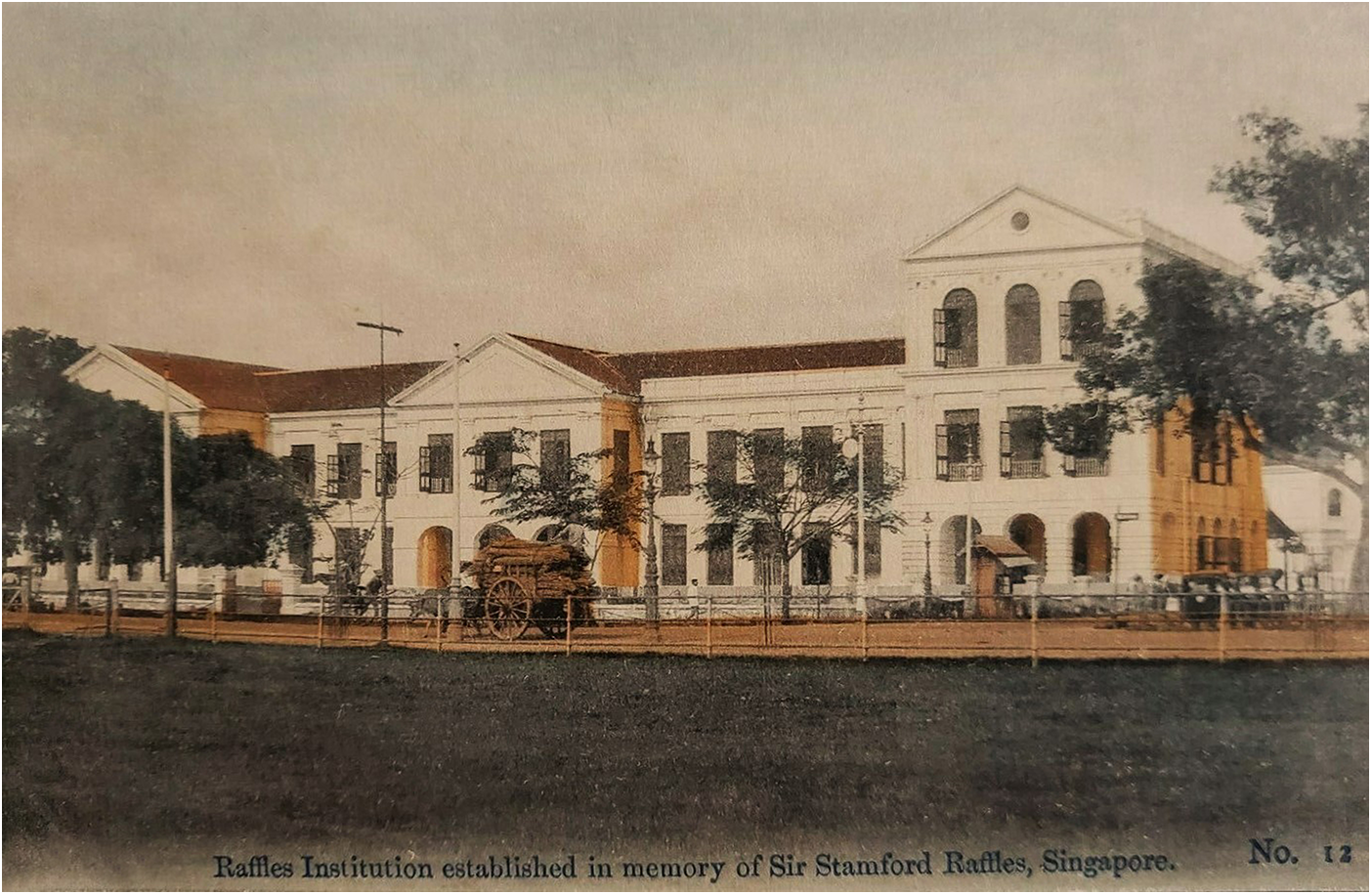
The Singapore Institution was founded in 1823 by Sir Stamford Raffles to comprise of Morrison’s ACC, a Malay college, and a science college. This ambitious scheme, possibly ahead of its time, did not take off (and ACC would move to the new British colony of Hong Kong in 1843 instead). It was relaunched on a more modest scale in the late 1830s in the form of the Singapore Institution Free School(s) (SIFS or ‘Institution’), providing preparatory and secondary education for boys. John Henry Moor (a.k.a. Moore, 1803–1843), a graduate of Trinity College Dublin and ACC in Malacca, was its first schoolmaster until he passed away in May 1843.Footnote 139
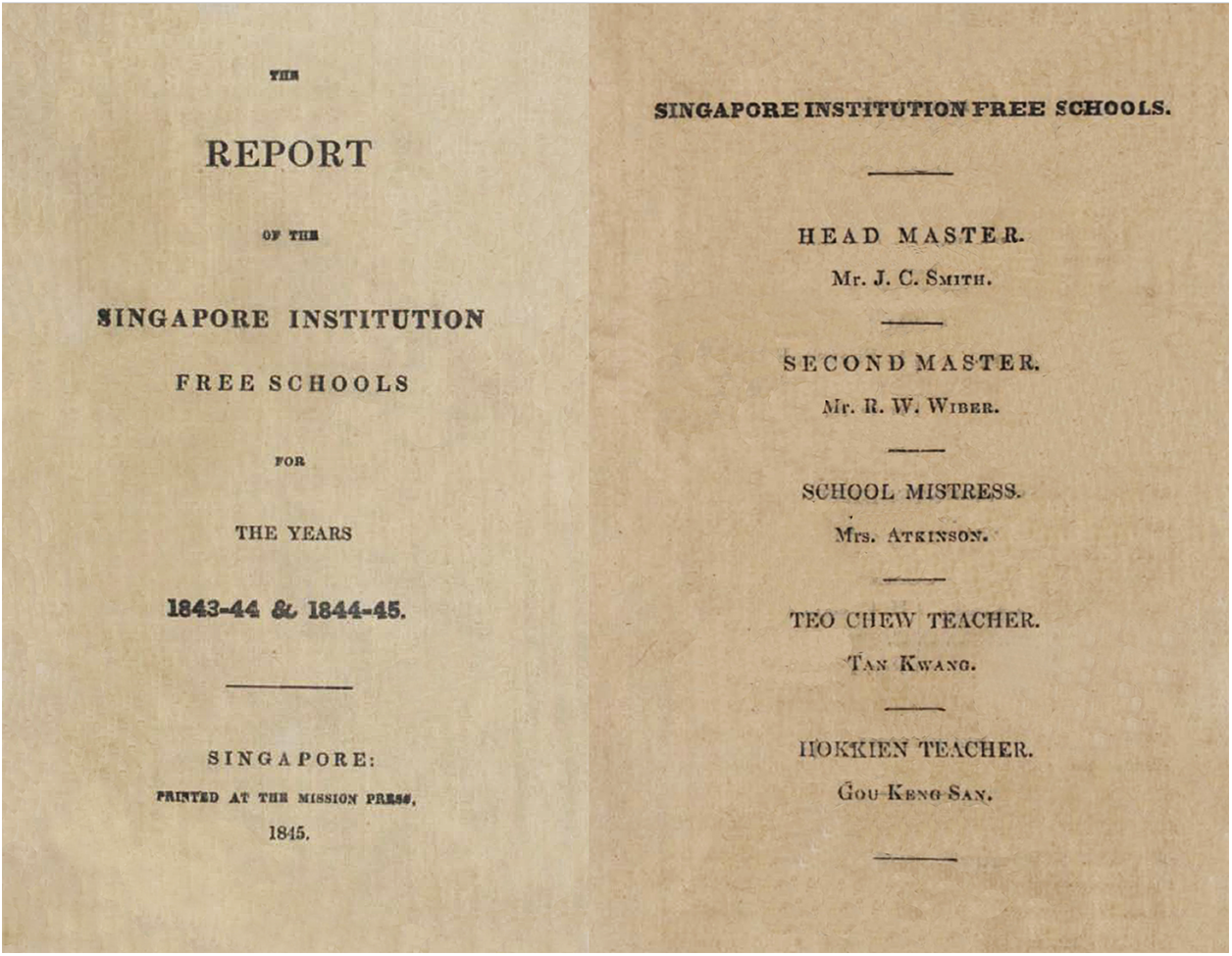
An annual report of SIFS in 1845 confirms that ‘[t]he Girls’ School was opened on the 4th March 1844’. It was taught by Mrs Atkinson (school mistress), while the boys’ schools were taught by J. C. Smith (headmaster), his assistant, and Teochew and Hokkien teachers (Figure 8). Eighteen girls were admitted, though only 11 (six boarders and five day scholars) remained by June 1845, and several applications for ‘free boarders’ had to be turned down due to lack of funds.Footnote 140 This enrolment paled in comparison to that of the main school in English with 142 boys or the Chinese classes with 44 boys. Though a secular school, it had a Bible class for children of parents ‘who do not object’. Boys were examined on many subjects and awarded prizes, but there was no mention of girls being tested.Footnote 141
The Report of the Singapore Institution Free Schools, 1843–1845.

The next report in 1849 (for 1845–1849) reveals that after Mrs Atkinson had resigned due to poor health, the Singapore Institution had asked for a teacher from SPFEE; and, with Miss Grant’s help, Miss Hadrick (‘a pious and talented young lady’) was engaged in 1847. By then, both Chinese and Malay classes for boys were terminated (as ‘there is no want of educational means amongst the Chinese themselves’; and Malay parents saw no need of any instruction ‘but the Koran’). The saved resources had ‘been very usefully employed in the … Girls’ School’, moved ‘from the centre to the eastern wing of the Institution’, with accommodation for the schoolmistress and a wall separating playgrounds for girls and boys built, in anticipation of the arrival of the new teacher (Figure 9).
Singapore Institution, later renamed Raffles Institution.

Unfortunately, Miss Hadrick got sick on her way and was sent back. Mrs Clunis was hired locally in 1848, and, after she left, Mrs Bell from early 1849. By then, 21 girls were enrolled, versus 130 boys in four classes. There was a Ladies Committee with Mrs Butterworth, wife of William J. Butterworth (1801–1856), governor of the Straits Settlements, as the patroness, with strengthened governance, including rules for visits by committee members, regulations for funded boarders, student registration, monitor selection, etc. The object was ‘the education of indigent girls, and the education, and training for service, of orphan girls … as boarders, on the foundation’. Besides being taught ‘English reading, writing, spelling, grammar, accounts, and plain needle work’, the girls ‘shall be brought up in the principles of the Church of England’, though ‘religious instruction’ would not be given if parents ‘avowedly object’ to it.Footnote 142
While most boarders were likely Chinese or Malay orphans, there were some boarders and/or day scholars who were from better-off European/Eurasian families. Some girls were examined in 1849 and 1850, in the presence of Miss Grant as a guest, and all prizes were claimed by European/Eurasian girls (e.g. Susan Chambers, Maria Wilson, Jane Newbold, Charlotte King).Footnote 143
Mrs Kennedy taught with Mrs Agar as her assistant in 1853. Many boarders were funded, including eight orphans; and needy day pupils were admitted ‘free of charge’.Footnote 144 By 1855, there were 16 boarders and only three day scholars. ‘The Girls read and write and cypher very creditably, and work extremely well.’ They came from mixed circumstances, three became domestic servants, one was ‘most respectably married at Sarawak’, and another, in school for eight years, was to move to Shanghai where she ‘promises to reflect the utmost credit on her training’.Footnote 145
By 1856, there were still 16 boarders, ‘10 indigent children were clothed, fed and instructed’ freely (but some applicants were ‘refused from want of Funds’), and six girls paid $2½ or $5 each month. Mr Whampoa (Hoo Ah Kay, 1816–1880) took over boarding at a reduced rate of $4 a month from Mrs Augustin, who was charging $5, enabling the hiring of an extra daily teacher. Miss Coleman became the superintendent and stayed for two years. The girls attended a public examination, though it ‘was not satisfactory from the Girls not speaking out’.Footnote 146
Miss Coleman resigned in late 1857 and was replaced by Miss O’Hallaran. Enrolment decreased and the school was able to add ‘orphans or children without friends’.Footnote 147 In 1858–1859, the single Miss O’Hallaran’s ‘zeal and attention’ pushed enrolment back to ‘13 Boarders and 7 Day Scholars’, and in the examination they exhibited ‘marked improvement’ in speaking out and ‘highly creditable’ ‘attainments in Reading, Writing and Arithmetic’.Footnote 148 Miss O’Hallaran left in April 1859, and Mrs Taylor was engaged. Funded boarders dropped to 12, but there were more day scholars. A prize of $10 was awarded for the first time to girls in their own public examination.Footnote 149
In September 1860, Mrs Taylor resigned for health reasons and, as a replacement could not be identified, members of the Ladies Committee took up the duty, knowing that due to lack of funds, the school could not hire a full-time teacher ‘from Calcutta or England’.Footnote 150
In April 1861, Mrs Anderson joined, and the school started to register pleasing progress, reflecting perhaps both her abilities and a growing perceived need for female education among middle class families. Enrolment rose from 30 at the start of 1862 (‘on the Foundation 10; paying Boarders 4; Day Scholars 16’) to 49 at the end (‘on the Foundation 16; paying Boarders 6; Day Scholars 27’), with no increase in subsidy from the Institution, as there were more paying students.Footnote 151 By 1863, there were 60 girls, and an assistant teacher was added in early 1864.Footnote 152 The following year, enrolment grew again, with many ‘daughters of the well-to-do’.Footnote 153
Charles Burton Buckley informs us that school reports changed their name from ‘Singapore Institution’ to ‘Raffles Institution’ in 1868 ‘for some reason’.Footnote 154 Since then, studies have generally adopted 1868 as the year of the name change.Footnote 155 On the other hand, press reports suggest that the two names were used in parallel earlier, from 1861 onwards. Several examples would suffice. In 1861, Singapore Library, which occupied the centre rooms of the Institution, advertised that it was in ‘Raffles’ Institution Buildings’. It was reported in 1865 that ‘[t]he Institution Silver Medal has on one side “Raffles Institution Singapore”’; and Tan Seng Poh had raised $500 for a Chinese scholarship at ‘the Raffles Institution’. In 1866, the governor noted that ‘the Raffles Institution … is no longer allowed to carry off all the scholarships’.Footnote 156
In 1871, the girls’ school moved to a rented house on the opposite side of Bras Basah Road (owned by Dr Charles Emmerson, where Raffles Hotel is now located); then in 1877, to ‘the last house in Beach Road’ (built by Dr D’Almeida). In 1875, the Institution had resumed some land sold earlier, behind the boys’ school. New facilities for Raffles Girls’ School (RGS), independent from 1879, were built on this lot in 1881, which opened in July 1883.Footnote 157 Enrolment ‘increased about eighty per cent’ in 1884. Financial burden became excessive, and boarding stopped in 1893. The school, seen as ‘an admirably managed establishment’, was taken over by the government and has been supported by public funds since 1903.Footnote 158
In short, between 1844 and 1862, increasingly more funded and fee-paying girls, both boarders and day pupils, attended the girls’ school of the Singapore Institution, which offered a secular curriculum (Bible classes were optional), typically taught by locally recruited European teachers, mostly married except for Miss Coleman and Miss O’Hallaran in 1856–1859, often with short tenures of one to two years. Nevertheless, after a slow start, it continued to flourish, especially after it gained independence in 1879. Today, RGS, in its new campus at Braddell since 2019, remains a top historic girls’ school in Singapore.
Catholic alternative: CHIJ girls’ school and orphanage (1854–1862+)
In 1839, Father Jean-Marie Beurel (1813–1872) of the MEP came to Singapore. He soon set up a boys’ school on land granted by the government. Operated by the Christian Brothers, it opened in July 1852 as St John’s School (renamed St Joseph’s Institution in 1855). After having failed to secure more land from two governors for ‘females of all classes and conditions’, the visionary and indefatigable Beurel bought the house on the corner of Victoria and Bras Basah Road (built by Mr Coleman for Mr Caldwell) in August 1852, an adjoining house in 1853, and later four lots from the Singapore Institution, with the intention to start a convent and girls’ school.Footnote 159
Beurel then went to Paris and appealed to l’Institut des Ecoles Charitables du Saint Enfant Jésus de Saint Maur, which had up to then only served in France, for sisters ‘to found a first mission in these distant regions’.Footnote 160 In an agreement signed in 1851, the latter committed to provide ‘four nuns of its congregation suitable to run the girls’ school’.Footnote 161 Not unlike other pioneer female educators noted here, the first sisters sent out later that year failed as their leader died on the way.
Such sudden setbacks due to losses of personnel were common then. A recent study by this author on ACC in nearby Malacca notes that poor hygiene and hot weather meant frequent deaths of missionaries and/or their wives and children. Still, mission work typically remained viable and resilient, as the pioneers, buttressed by their faith, often persevered and/or were quickly followed by others. Morrison and Milne, the founder and first principal of this college, both suffered losses of their wives and children, and though, as Milne’s biographer puts it, ‘[b]oth “wept much before the Lord” … neither sorrowed as they who have no hope, nor allowed weeping to stop working’, and simply redoubled their efforts.Footnote 162
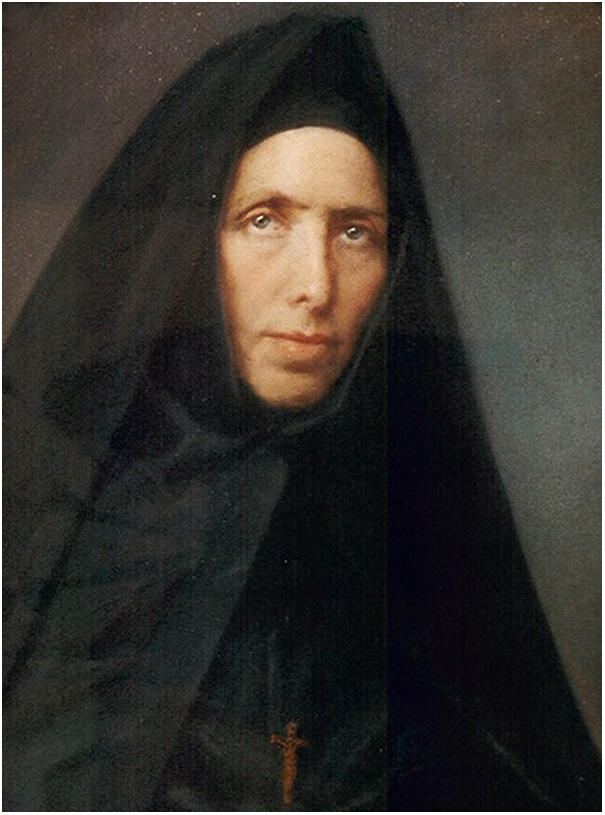
Likewise in the case of this proposed convent school. A second batch of four sisters led by Mother Mathilde (Marie-Justine Raclot, 1814–1911) (Figure 10) came out in February 1854. They soon started a girls’ school (later known as the Convent of the Holy Infant Jesus (CHIJ)), which Maxime Pilon and Danièle Weiler tell us, ‘opened its door to 14 European and Eurasian students under the disapproving eye of the Protestant community’.Footnote 163 As shall be seen, at least in these early years, the students were more often Native Asian orphans and girls from needy families.
Mother Mathilde. Source: Archives des Sœurs de l'Enfant Jésus-Nicolas Barré.

A report on education in May 1855 notes that public funds had been granted to several schools in Penang and Singapore, including Rs. 700 to the ‘R. Catholic Female Orphanage’ in Singapore, which then had ‘16 boarders, and about 20 Day Scholars’. This grant was stopped the following year, as the British East India Company then would only approve such aid ‘to schools in which some fee … is paid by the scholars’; and felt that ‘purely charity schools should be left to pure charity’.Footnote 164
Since then, the school had to rely on donations and funding from home. Mother Mathilde indicates in a letter in March 1858 that 1,500 Francs allocated were used to cover the food and maintenance of 54 orphans ‘mostly too young to earn their living’.Footnote 165 She reports in July 1859 that help from home had enabled her to take in more orphans and others abandoned or entrusted by needy parents.
Intakes were ethnically even more diverse than those of the two existing schools. Five natives were sent from Borneo by Italian fathers to be nurtured until 15, then returned ‘to form Christian villages’. Another five Cochin-Chinese girls were sent by the bishop to be raised as ‘models of gentleness, humility, obedience’ and to be ‘excellent teachers for the children of their poor and unhappy homeland’.Footnote 166 A Muslim girl taken away the year before ‘in fear that she would become a Christian’ was returned with her younger sister by their sick mother, prompting Mother Mathilde to lament that ‘[i]f all the children in our house were entirely orphans, our work would be much easier’.Footnote 167 There were also three little Chinese girls who were baptised, several Protestant English girls, and even seven Malabar Indian girls.
Colonial Singapore was multicultural from the start, and Indians were among its earliest settlers. Naraina Pillai came with Raffles in 1819, became a successful businessman, and built the first Hindu temple on the island in 1827, catering to the growing Indian immigrant community. While there were likely some Indian girls in the Singapore Institution due to its secular nature, this was one of the rare occasions in which ethnic Indian girls were specifically noted in the earliest sources.
Public help came again soon. A report in 1863 says that ‘grants in aid have been made to … the Sisters’ School’, in which ‘eighty-two out of the one hundred and forty-five pupils’ were orphans. By then, there were many European, Eurasian, and Asian fee-paying girls, attracted by the school’s growing reputation. It formed two departments, one ‘for the children of the wealthy’, and another ‘for those of the poorer classes’, each ‘receiving the education suitable to their position in life’.Footnote 168 Separate departments with curriculum tailored to ‘position in life’, politically incorrect and even unacceptable by today’s standards, was arguably practical in the hierarchical colonial society in those days.
Lynn Lees claims that new urban institutions in nineteenth-century British Malaya created networks and allegiances which cut across racial and social boundaries to produce ‘multi-cultural alliances and overlapping social worlds’.Footnote 169 The Catholic school’s diverse student body of different ethnic and social backgrounds drawn from Singapore and elsewhere in Asia with their common faith as the unifying dimension is perhaps illustrative of such an institution, as girls of the two departments would mingle and interact at least in some school-wide activities.
A consistent stream of teachers was evident. A handwritten list shows 12 sisters had served in the school up to 1862, starting with Sisters Mathilde, Apollinaire, and Gaëtan from France and Sister Gregory (Grégoire) from Ireland.Footnote 170
The convent school continued to grow after 1862 under the steady hands of Mother Mathilde. In 1872, she went to Yokohama to start a new mission in Japan, a project which had been in her heart since as early as 1860, though her superior, while ‘fully entered into her views’, had ‘waited for God’s timing’.Footnote 171 In a letter in July 1872, she declares that ‘money will be found, money will be found. Singapore will support this … for as long as it takes’ and that she was eagerly learning Japanese so she could ‘start this language in Singapore for those sisters who could later be sent to Japan’.Footnote 172
In the same year, Miss Grandpré, a French alumna, returned to assist.Footnote 173 Mathilde journeyed back and forth until Sister Gaëten (Célestine Dorothée Eugénie Gervais, 1827–1892) became the superior in Singapore in 1875. The former then settled down in 1876 to serve in Japan, where she died in January 1911.Footnote 174
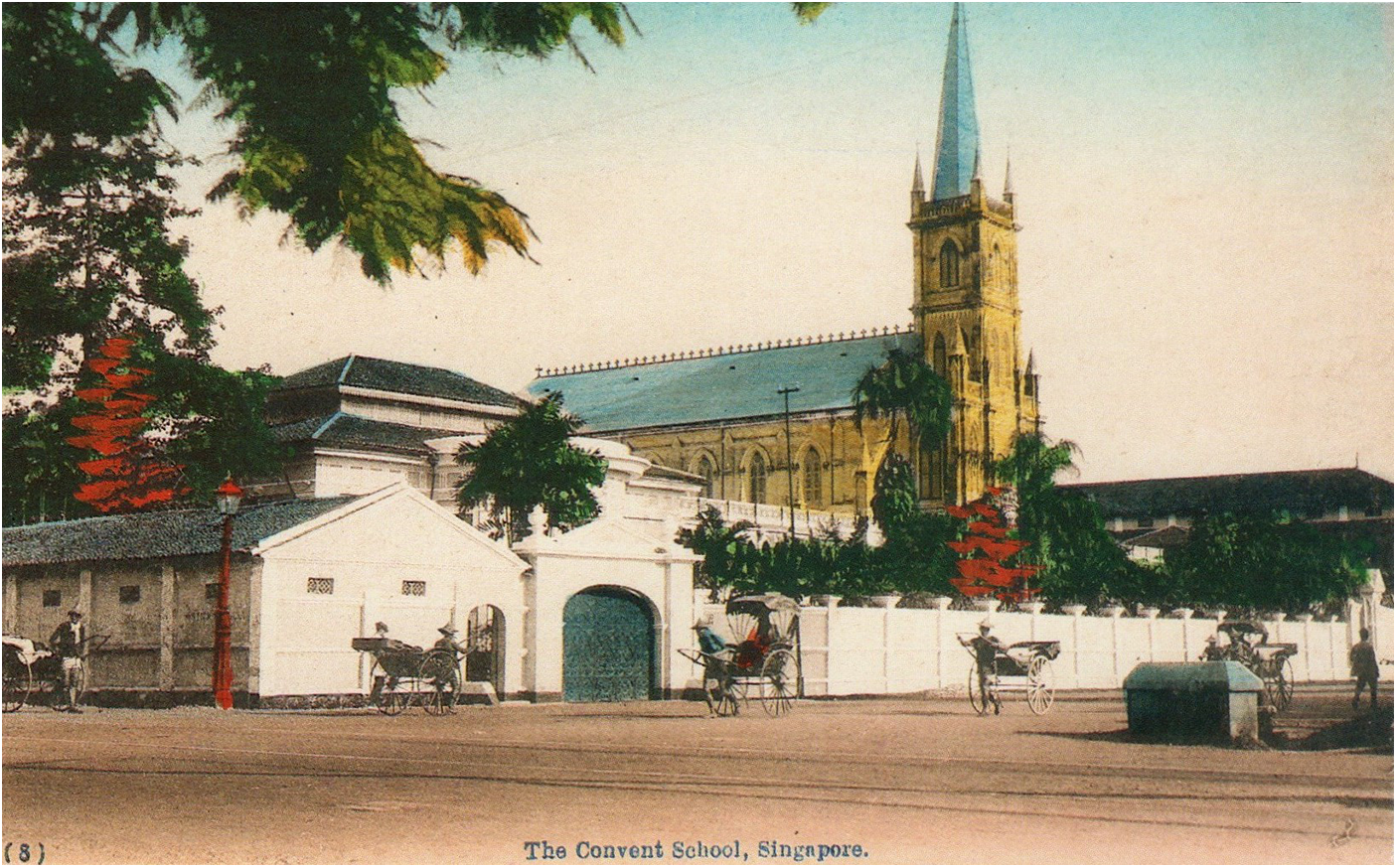
Revenue grew with sales of pupils’ needlework and donated French goods so that by the early 1870s, aside from the orphanage, the school was ‘almost … self-supporting’. By then, the girls were taught both French and English. In 1894, its enrolment was 253, in 1900, 263, and in 1914, 621.Footnote 175 It added a building on its southern border in 1892, a Gothic chapel in 1904, another wing in 1913, and branch schools in the 1930s (Figure 11).
Convent Girls’ School with the Gothic chapel.

In short, under the care of its sisters led by Mother Mathilde, the convent girls’ school started in 1854, the last (not ‘[t]he first … mission school for girls’ as cited earlier) of the three early female schools that still operates today, quickly grew to become the leading player with over 100 girls (including many orphans from different parts of Asia) by the early 1860s. Today, CHIJ remains an important Catholic educator, with at least nine primary or secondary schools, all under its motto ‘Simple in Virtue, Steadfast in Duty’.
Concluding remarks
Even after the SPFEE and Singapore Institution girls’ schools were launched in the early 1840s, there were isolated efforts by others. These would include Mrs Whittle’s private school, already described; a small Malay school run by Rev. Wright, his wife and sister (which in May 1855 taught five girls ‘to read, write and to sew’);Footnote 176 the Malay boarding school operated by Keasberry (mainly for boys, but by the 1860s had girls ‘instructed in plain needle work, embroidery’);Footnote 177 and Rev. Edward S. Venn’s ‘Chinese Girls’ Day-School, founded in November, 1862’ on Chinchew Street and the ‘Tamil and Eurasian Girls’ Day School’ at Victoria Street (both small),Footnote 178 none of which survived the test of time.
There are at least two other important early girls’ schools which had started after 1862 and still operate today. The Methodist Episcopal mission entered female education after Miss Sophia Blackmore came to Singapore in 1887 to ‘labour among the native women’.Footnote 179 By 1889, 35 girls had enrolled, including ‘8 Chinese girls’ presented in the government inspection.Footnote 180 A later ‘Singapore Chinese Girls’ School’, not to be confused with the SPFEE Chinese Girls’ School,Footnote 181 was started in 1899 by the Chinese community on Hill Street with seven Straits Chinese, likely Peranakan, girls. Today, both the Fairfield Methodist Schools (now co-educational) and the Singapore Chinese Girls’ School are prominent educational institutions which can boast of their historic past.
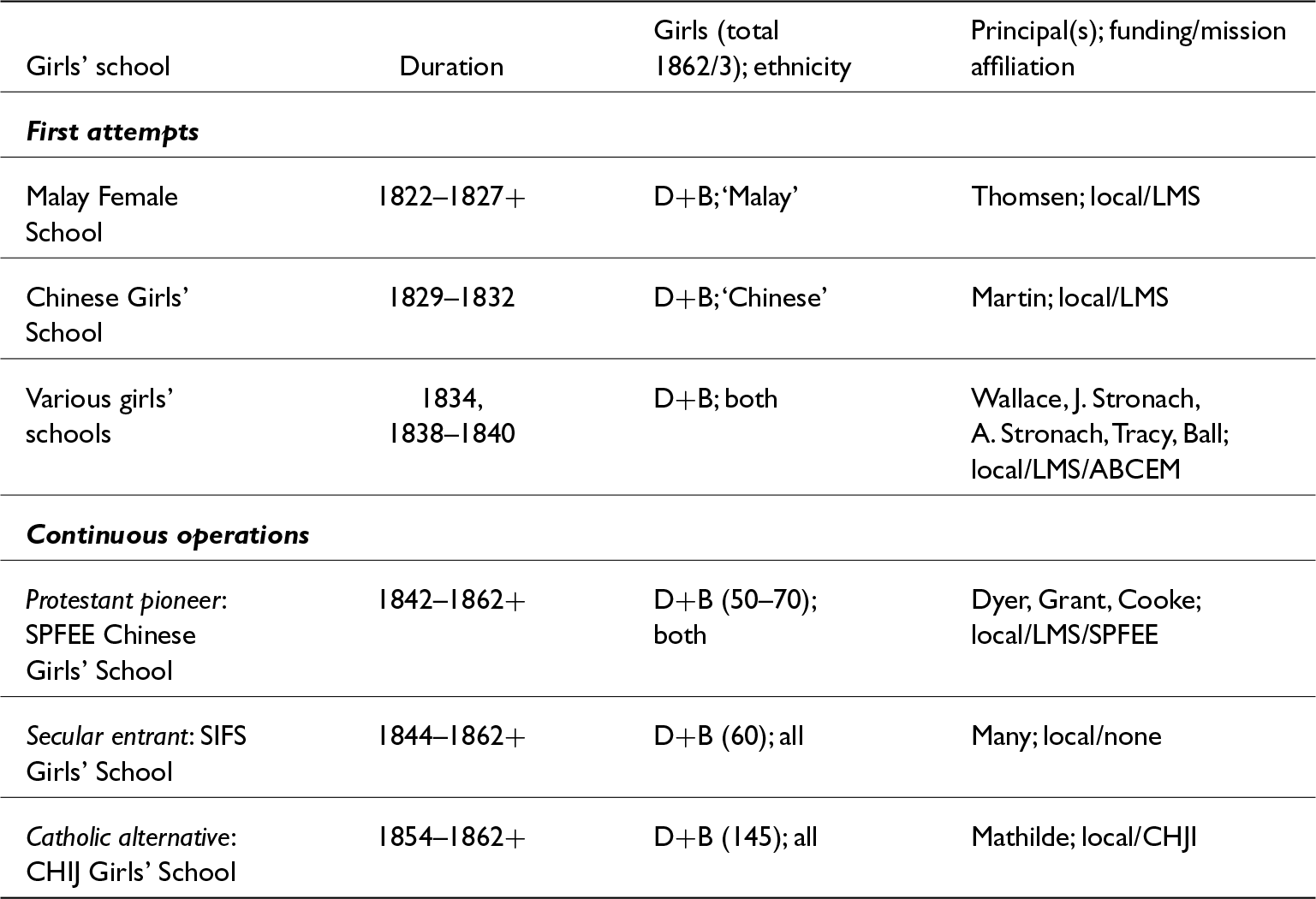
When reconstructing the history of early girls’ schools in Singapore, authors influenced by easily available sources on well-publicised schools or well-known persons could unintentionally take their later efforts to be the first ones. For example, the SPFEE and its agents, Miss Cooke or Miss Grant, are often cited as the pioneers of female education, whether in the 1850s, 1840s, or 1820s. Hence, the claims related to the first girls’ schools cited at the start of this article all contain inaccuracies, and some are totally incorrect. The schools discussed in this study are summarised in Table 1, which is compiled from information provided in this article.
Early female education, 1822–1862

Notes: For girls, ‘D’=day scholars, ‘B’=boarders; for ethnicity, ‘both’ = Malay, Chinese, and/or Peranakan; ‘all’ = both + Europeans, Eurasians, Indians, etc.
Western-style girls’ schools had an early start in Singapore despite a lack of demand from the local community because they were founded by zealous missionaries, sometimes supported by visionary sponsors. These include the first school under Mrs Thomsen in 1822 for ‘Malay’ pupils, two Chinese girls’ school(s) taught by Miss Martin from 1829 for ‘Chinese’ scholars and, from 1834 to 1841, five LMS and ABCEM mission schools of shorter durations for ‘Chinese’, ‘Malay’, ‘Half-cast’, and ‘Eurasian’ girls.
To overcome cultural and religious resistance, they targeted mostly the underprivileged (including the needy, abandoned, orphans, or freed slaves) and offered free tuition and boarding. These first attempts failed when the teachers or sponsors departed and/or the funds were exhausted.
Still, early attempts increased awareness and acceptance of female education in the colonial outpost. From the 1840s onward, three girls’ schools with more committed institutional (mission or secular) sponsors emerged. The Protestant Chinese Girls’ School opened in 1842 and, handed over to SPFEE, became the first girls’ school to continuously operate in Singapore up to now. It is known today as St Margaret’s School. Then a secular girls’ school of the Singapore Institution was started in 1844, and it still operates today as Raffles Girls’ School. This was followed by a Catholic girls’ school founded in 1854 under the care of CHIJ, which now has a network of primary and secondary schools on the island republic.
With a constant supply of teachers from Europe or Singapore, consistent support from their missionary or secular sponsors, generous donations from an increasingly prosperous community, and more fee-paying girls from a growing middle class, these later efforts were more successful. In particular, the SPFEE and CHIJ schools had benefited from having dedicated European missionaries without family responsibilities who stayed for many years and could rely on their own bilingual graduates as native assistants and, in the case of CHIJ, even a fresh supply of new sisters from home.
Enrolments of fewer than 300 girls over the three schools in 1862–1863 amounted to a mere 2.6 per cent or 1.3 per cent of the female population, based on the 1860 or 1871 censuses,Footnote 182 suggesting a low penetration of female education, especially since many students were orphans or freed slaves from outside who should strictly speaking not be considered local enrolees. Nonetheless, these schools had made impressive progress from the 1820s to the 1860s, overcoming many cultural, social, and religious obstacles preventing girls from being educated in schools taught by European teachers, permeated with Western values and Christian ‘biases’.
The pivotal role of missionary women in the early years was not unique to Singapore. Caroline Lewis’s study on India concludes that by setting up schools and orphanages, women missionaries were able to engage ‘with mainstream discourses of colonial and missionary education’, pursued by ‘denominational societies with husband and wife teams’ and ‘an interdenominational society (the SPFEE) sending out single women’.Footnote 183 These findings likewise apply to Singapore, at least in the case of the first Protestant girls’ schools from the 1820s to the 1840s, before options in female education were enriched by the secular girls’ school linked to Singapore Institution and then the Catholic girls’ school operated by the French sisters.
Acknowledgements
I thank the custodians of the archives/libraries of the School of Oriental and African Studies, the University of Birmingham, the Harvard University, the Institut de recherche France-Asie, and the Service d’archives des Soeurs de l’EJNB for access to the LMS, SPFEE, ABCFM, MEP, and CHIJ/EJNB archival materials, consulted on-site and/or online. I also thank the two anonymous reviewers for their helpful and insightful comments.
Conflicts of interest
None.