INTRODUCTION
India will need 27·29 million tonnes (t) of refined sugar by 2020 for its growing population (Anonymous 1997) as well as 20·69 million t of jaggery (a non-centrifugal form of sugar mainly produced in the Indian sub-continent) to fulfil its domestic demand. In order to achieve these targets, 415 million t of sugarcane would be required as raw material (Singh & Singh Reference Singh and Singh2004). However, the present production level is only 290 million t. Since the probability of increasing the area under sugarcane in the country is remote, one option to help meet the requirement is through increasing ratoon-crop productivity. Various studies have highlighted the benefits of appropriate agronomic procedures such as mulching, green manuring, use of crop residues, fallowing and agro-forestry as economical and efficient methods of increasing crop productivity and maintaining sustainability of important farming systems in tropical and sub-tropical climatic condition (Yadav & Yaduvanshi Reference Yadav and Yaduvanshi2001; de Resende et al. Reference de Resende, Xavier, de Oliveira, Urquiaga, Alves and Boddey2006). Such procedures should include ecologically sound methods of crop husbandry while using and conserving available resources (Yadav & Yaduvanshi Reference Yadav and Yaduvanshi2001; De Costa & Sangakkara Reference De Costa and Sangakkara2006) for enhancing and sustaining the productivity of sugarcane ratoon crops.
Ratooning is the practice of growing sugarcane crop from sprouts of underground stubble left in the field after harvest of the main crop. In sugarcane systems, ratoon cropping is an established practice contributing significantly to the overall profitability. Ratooning is an important practice: it is 25–30% cheaper to grow (Sundara Reference Sundara1998) because there is no cost for planting material and land preparation, and additional savings are accrued in irrigation and crop maintenance through reduced crop duration. In the tropical belt of India, ratoon-crop cultivation has been reported to be 45% cheaper, with double the net return, than the plant crop (Pawar et al. Reference Pawar, Shinde and Sale2000). Ratoon crops generally yield less than the first harvest. The ratoon crop occupies more than 0·50 of India's sugarcane acreage but contributes only 0·30 to the total production (Sundara Reference Sundara, Mohan Naidu, Sreenivasan and Premachandran1987).
In many sugarcane growing countries, raising several ratoons is a common practice, and the number of ratoons ranges from 1 to 20 (Hunsigi Reference Hunsigi1989). Two ratoons are usually the limit in India, as beyond this yield declines due to soil compaction (Verma Reference Verma2002), decreased soil fertility (Hunsigi Reference Hunsigi2001) and inefficient use of applied fertilizers (Sundara & Tripathi Reference Sundara and Tripathi1989). However, the productivity of sugarcane ratoon crops can be enhanced by following proper management practices, such as dismantling of ridges, stubble shaving and sub-soiling along stubble rows to reduce soil compaction for root development and growth of cane plants. In recent years, the yields of sugarcane ratoon crops in India have reached a plateau and productivity has decreased due to a decline in soil organic matter (SOM) content (Singh et al. Reference Singh, Suman, Singh and Srivastava2007) and deterioration of other physico-chemical and biological properties of soil (Garside Reference Garside1997; Speir et al. Reference Speir, Horswell, van schaik, MacLaren and Fietje2004). Sugarcane produces 10–12 t of dry leaves/ha/yr. The importance of recycling stripped dry cane leaves (often called trash) in ratoon sugarcane to conserve SOM and water, thereby improving soil structure and stimulating sugarcane yield has been recognized (Yadav & Prasad Reference Yadav and Prasad1992).
There have been a number of recent reports highlighting the negative impacts of soil compaction on productivity and sustainability of sugarcane mono-cropping systems. Soil compaction is one of the main problems in sugarcane ratoon crops, leading to yield decline in successive ratoons. Compaction occurs due to in-field transport and labour movement for various field operations and irrigation. The effects of compaction include reduced soil aeration and infiltration of rainfall and irrigation (Bell et al. Reference Bell, Halpin, Orange and Haines2001), poor soil structure and an increase in soil strength and resistance to root penetration (MacGarry & Bristow Reference MacGarry and Bristow2001). Incorporation of sugarcane dry trash into the soil can reduce its susceptibility to compaction by reducing soil bulk density (Barzegar et al. Reference Barzegar, Asoodar and Ansari2000). This also results in increased water infiltration, better soil–water relationships, and reduced surface sealing and erosion, all of which should lead to increased sugarcane crop yield (Blair Reference Blair2000). The improvement and maintenance of soil carbon (C) and soil structure are necessary for sustainable agricultural systems and protection of the soil resource base. Ricaud (Reference Ricaud1977) reported that cane roots have the genetic capacity to penetrate very deep into the soil when there are no physico-chemical limitations. It is a common belief that deep tillage is essential for good cane production; consequently, sub-soiling by means of cultural operations is a widespread practice. The intensive use of machinery for land preparation, cultivation and harvesting results in sub-soil compaction; however, growers expect to re-establish optimum soil physical condition at the time of land preparation and ratooning by using sub-soiling (de Beer et al. Reference de Beer, Hudson, Meyer and Torres1993).
Rate of root growth is affected by soil properties such as temperature, aeration, pore size, pore continuity and mechanical impedance. Roots grow readily in well-drained soils where the pore diameter is larger than the growing root; otherwise, the root tips need extra energy to push soil particles aside and overcome penetration resistance (Vepraskas & Miner Reference Vepraskas and Miner1986). Roots are unable to grow through hard layers such as pans, which are characterized by high mechanical impedance (Trouse Reference Trouse1983).
In Colombia, after harvesting in wet periods, sugarcane yield reduction due to compaction and/or stool damage was found to be up to 42% (Torres & Villegas Reference Torres and Villegas1993). Conservation of trash and its application by way of mulching or incorporation has been reported to improve the fertility and productivity of soils, in addition to reducing weed infestation and moderating soil temperature, while burning trash results in losses of valuable soil organic carbon (SOC) and nitrogen (Ball-Coelho et al. Reference Ball-Coelho, Tiessen, Stewart, Salcedo and Sampaio1993). Mitchel et al. (Reference Mitchel, Thorburn and Larsen2000) measured losses of 70–95% for dry matter (DM), nitrogen, potassium, phosphorus, magnesium, calcium and sulphur. Conversely, with retention of trash, nutrients and organic matter may accumulate. It is important to quantify this in order to manage fertilizer inputs appropriately to maintain soil fertility and minimize environmental contamination. Chapman et al. (Reference Chapman, Haysom and Saffigna1992) suggested that trash retention may increase total soil N and that cane crops may benefit from this in the long term. Stubble shaving or stubble pruning (also known as ratoon dressing) is an important operation to increase bud sprouting and facilitate a deep root system. Studies have also indicated that this increases cane yield (Sundara Reference Sundara2006).
The purpose of the present study was to evaluate combinations of crop management and trash management features in terms of effects on crop growth, yield and economics of sugarcane as well as weed infestation, SOC status and bulk density through the third ratoon crop.
MATERIALS AND METHODS
The experimental site and soil
A field experiment was conducted for two consecutive crop cycles, each of a main and three subsequent ratoon crops of sugarcane from 1998/99 to 2002/03 at the Sugarcane Research Institute (U.P. Council of Sugarcane Research), Muzaffarnagar, India (29°56′N, 77°44′E, 240·78 m asl) in a semi-arid sub-tropical climate with hot, dry summers and cold winters. The soil of the experimental field was sandy loam (clay: 13·3% by volume, silt: 23·2% and sand: 63·5%) of the Indo-Gangetic alluvial origin, very deep (>2 m), well drained, flat and classified as non-calcareous mixed hyperthermic udic ustochrept. The initial soil pH (determined by a glass electrode pH meter on a 1:2·5 soil/water suspension) was 7·7.
Before planting of the sugarcane crop, soil samples from a depth of 0–150 mm were collected using a core sampler of 8 mm diameter from five random locations in the field. These samples were pooled and the representative homogeneous sample was analysed. Organic C (using Walkley & Black Reference Walkley and Black1934) was 15·90 t/ha. The available N (using KMnO4 method) was 156·8 kg/ha. Extractable P was determined with 0·5 m NaHCO3 at pH 8·5 and was 15·7 kg/ha. Extractable K (using 1 N, NH4OAc following Jackson (Reference Jackson1973)) was 267·2 kg/ha.
Crop culture
Crops of sugarcane cultivar CoS 88216 were planted using 38 000 three-bud cane setts/ha on 13 February 1998 and on 15 February 1999 at 0·9 m row spacing in adjacent fields. Before placing setts in the furrows, half the dose of N (150 kg/ha) and full doses of P and K (60 kg P/ha and 40 kg K/ha) were applied in furrows beneath the cane setts using urea (464 g N/kg), single super phosphate (69·8 g P/kg) and potassium chloride (498 g K/kg). The remaining N dose (75 kg N/ha) applied as urea was top-dressed uniformly on 12 June 1998 and on 19 June 1999. An insecticide, chlorpyriphos 20% EC at 5 litres/ha (1 kg a.i./ha) dissolved in 1600 litres of water, was sprayed over cane setts before covering them. The covering was needed to protect the plants against termites and early shoot borers. During both the years the crop received five pre-monsoon irrigations (20 March, 18 April, 1 May, 18 May and 8 June in 1998; 27 March, 21 April, 9 May, 22 May and 16 June in 1999).
The main crop of the first cycle was harvested on 4 March 1999, to allow the raising of the subsequent ratoon crops: Ratoon I (1999/2000), Ratoon II (2000/01) and Ratoon III (2001/02). Similarly, the main crop of the second cropping season was harvested on 7 March 2000 and the subsequent ratoon crops were Ratoon I (2000/01), Ratoon II (2001/02) and Ratoon III (2002/03). After harvesting of the main and ratoon crops in both cropping seasons, dry cane leaves (trash) left in the field were either spread in between inter-row spaces as mulch or burnt in the field. The field was irrigated to facilitate stubble sprouting for ratoon cropping. Half the amount of N for the ratoon crop (100 kg N/ha) was applied in the inter-row spaces at the time of ratoon initiation and the remaining 100 kg N/ha was top-dressed manually along the rows in the second week of April. Ratoon crops of both the cropping seasons were harvested from 6 to 11 February, leaving border rows, and plot yield was recorded.
Treatments
Experimental plots, each 10×5·4 m, were established. Six treatment combinations comprised combinations of trash management and other agronomic practices. The control treatment (T1), consisted of the standard local farmer practice of trash burning only, T2 comprised trash burning together with dismantling of the crop ridges. T3 consisted of T2 plus stubble shaving; T4 comprised T3 plus sub-soiling along stubble rows. T5 comprised T4 (except trash burning) plus trash mulching at 8 t/ha. Finally, T6 comprised T5 plus earthing-up the young canes in June. These treatments were carried out in each ratoon crop of both the cropping seasons. There were five replicates with plots laid out in randomized blocks. After harvesting the plant crop in both the cropping seasons, treatments T1 through T6 were applied. Trash mulching at 8 t/ha and burning trash at the same density in between stubble rows were done as per the treatment schedules. Other cultural operations such as sub-soiling, dismantling of ridges by spade and stubble shaving from the ground level by a stubble shaver were done at the time of ratoon initiation. Sugarcane trash (dry leaves) contained 5·2 g N/kg, 0·11 g P/kg and 6·4 g K/kg on dry weight basis.
Data recording, sampling and analyses
The number of shoots and millable canes were counted at various stages. Yields of plant and ratoon canes were recorded at harvest. In June, at the peak tillering phase, leaf area index (LAI) was determined and net assimilation rate (NAR) was calculated using the following formula (Radford Reference Radford1967):

where W 1 is the weight of plant at time T 1, W 2 is the weight of plant at time T 2, A 1 is the total leaf area of plant at time T 1, A 2 is the total leaf area of plant at time T 2, T 1 is the time at first observation (1 July) and T 2 is the time at second observation (31 July) during both the years of experimentation.
DM accumulation in shoots and leaves was determined at the start of the formative phase of sugarcane in July. Ten shoots were taken at random from the separate sample rows of the individual treatments, chopped into small pieces and dried in a hot air oven at a constant temperature of 70°C for 72 h. The density and dry weight of the weed flora in the experimental field were recorded from an area of 1 m2 in each plot, 90 days after planting (DAP).
The concentration of sugar as Brix values was measured directly using a digital Brix Refractometer (CETI, Kontich-Antwerp, Belgium). The brix scale Brix represents the percentage of total soluble solids in sugarcane juice. One degree Brix corresponds to 1 g of soluble solids including sucrose in 100 g of sugarcane juice (w/w) or 10 g/kg (AOAC 1990). Brix values were corrected to 20°C using a standard temperature correction table (Madan et al. Reference Madan, Mishra, Soni and Solomon1997). Commercial cane sugar (CCS) (g/kg of cane juice) was estimated as

where S is the sucrose (g/kg) in juice, B is the corrected brix (g/kg), while constants 0·4 and 0·73 stand for sugar content in bagasse and its moisture, respectively. Bagasse is a fibrous matter that remains after sugarcane stalks are crushed to extract their juice. Sucrose (g/kg) in juice was determined as per the method described by Meade & Chen (Reference Meade and Chen1977). Sugar yield (t/ha) was calculated by multiplying CCS (g/kg) with cane yield.
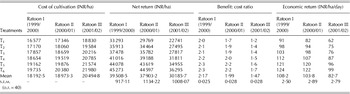
To compare different treatments economically, yield of ratoon crops were valued for net returns and benefit: cost ratio on the basis of prevailing market prices of sugarcane and cost of cultivation (Verma & Modgal Reference Verma and Modgal1983). Economic returns (INR/ha/day) were calculated by dividing the net monetary returns of the cropping system with total duration of the crop in that particular system (Tomar & Tiwari Reference Tomar and Tiwari1990).
In both cropping seasons, soil samples were collected at harvest from depths of 0–150 and 150–300 mm by a core sampler of 80 mm diameter from five random locations in the field and the average bulk density was determined. The content of SOC was determined at the harvest of ratoon crops during both cropping seasons. Soil samples from 0 to 150 mm depth were randomly sampled near root zone of standing crop (80 mm diameter) from each plot. Five samples from five locations and one representative homogeneous sample were prepared for each plot. The content of SOC per hectare was calculated using the following steps:
(1) Area of 1 ha field plot=100 m×100 m or 10 000 m2 or 104 m2
(2) Depth of a representative 1 ha furrow slice soil=150 mm or 0·15 m
(3) Volume of 1 ha field soil=104×0·15 m3
(4) Weight of bulk density based 1 ha furrow slice soil=2·22×106 kg/ha soil volume
(5) SOC (kg/ha furrow slice soil volume)=SOC content (kg/kg soil)×weight of 1 ha soil volume i.e. 2·22×106 kg
where constant 2·22×106 kg is the weight of a 1 ha furrow slice soil volume (Jackson Reference Jackson1973). SOC values in kg/ha were converted into t/ha on the basis of 1 t=1000 kg.
Statistical analysis
The data recorded for first (Plant I, Ratoon I, Ratoon II and Ratoon III) and second (Plant II, Ratoon I, Ratoon II and Ratoon III) crop cycles were statistically analysed separately. The homogeneity of error variance was tested using Bartlett's χ2 test. As the error variance was homogeneous, a pooled analysis was performed following Cochran & Cox (Reference Cochran and Cox1957). Since the two crop cycles had similar results the mean data have been presented.
RESULTS
Plant cane yield and growth attributes of ratoon sugarcane
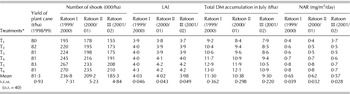
The pooled analysis results of the first and second crop cycles experiment indicated that the cane yield of the plant crop grown under the recommended package of practices of the region did not differ significantly (Table 1). The plant crop of sugarcane was the base for raising subsequent experimental ratoon crops. The same packages of practices were applied to all the plots uniformly; hence, no significant differences in plant cane yield were expected. However, in first, second and third ratoon crops, the treatments led to significantly different numbers of shoots, LAI, DM (plant+leaf) accumulation and NAR. The combination of cultural-package practices viz., dismantling of ridges+stubble shaving+sub-soiling along stubble rows+trash mulching at 8 t/ha (T5) and T6 (same as T5 except with earthing-up in June) produced similar growth. Both T5 and T6 treatments had significantly higher number of shoots, LAI, DM accumulation and NAR compared with other treatments in the first, second and third ratoons of both experiments. Trash burning+dismantling of ridges (T2), trash burning+dismantling of ridges+stubble shaving (T3) and trash burning+dismantling of ridges+stubble shaving+sub-soiling along stubble rows (T4) were all significantly better than farmers’ current practice (T1) with regard to the above growth attributes through to the third ratoon crop.
Effect of different treatments on plant cane yield and growth attributes of ratoon crops of sugarcane (pooled data of two crop seasons)

* T1, farmers’ practice (trash burning only); T2, trash burning+dismantling of ridges; T3, trash burning+dismantling of ridges+stubble shaving; T4, trash burning+dismantling of ridges+stubble shaving+sub-soiling along stubble rows; T5, dismantling of ridges+stubble shaving+sub-soiling along stubble rows+trash mulching at 8 t/ha; T6, dismantling of ridges+stubble shaving+sub-soiling along stubble rows+trash mulching at 8 t/ha+earthing up in June.
Weed density and weed dry weight
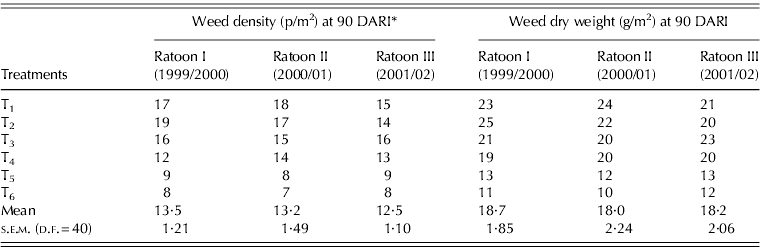
The weed flora of the experimental field mainly comprised Argemone mexicana, Cynodon dactylon (L.), Cyperus rotundus (L.), Panicum spp., Phyllanthus niruri (L.), Portulaca quadrifida (L.), Convolvulus arvensis (L.), Trianthema monogyna, Solanum nigrum and Echinocloa colona. At 90 days after ratoon initiation, T5 and T6 were statistically similar to each other and reduced weed density by 29–55, 46–58 and 35–47% and weed dry weight from 37 to 52, 44 to 54 and 38 to 46% in first, second and third ratoon crops, respectively, compared with other treatments in the study (Table 2).
Effect of different treatments on weed density and weed dry weight in ratoon crops of sugarcane (mean data of two crop seasons)
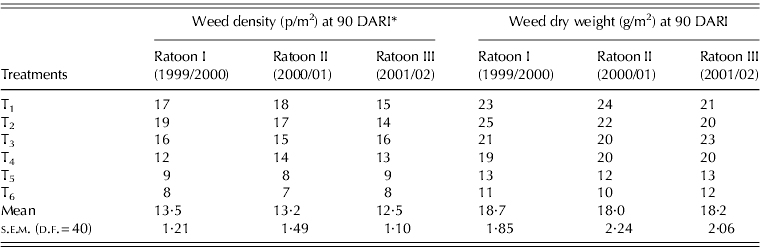
* DARI, days after ratoon initiation.
Cane and sugar productivity
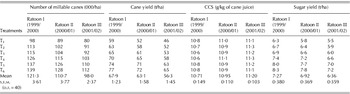
Treatments T5 and T6 produced similar numbers of millable canes and yields of cane and sugar (Table 3), which were significantly higher than those obtained under other treatments. Treatment T6 produced the highest cane yields of 77, 72 and 65 t/ha in first, second and third ratoon crops, respectively which were 23, 27 and 29% more than those obtained in T1. Experimental results further reveal that the combination of dismantling of ridges, stubble shaving and sub-soiling along stubble rows increased the number of millable canes and yields of cane as well as of sugar compared with farmers’ current practice through the third ratoon crop. The mean cane yield obtained of treatments T5 and T6 was 13, 14 and 14% higher during first, second and third ratoon crops, respectively compared with the average ratoon cane yield of treatments T2, T3 and T4. The trend of sugar yield with respect to different treatments was similar to that of cane yield.
Effect of different treatments on number of millable canes and yield of cane and sugar (pooled data of two crop seasons)

Organic C content and bulk density of soil
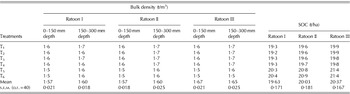
The SOC content, measured at the time of harvesting the first, second and third ratoon crops, was greater in soils that received trash mulch than in soil where trash was burnt (Table 4). In general, SOC content increased in all soils under ratoon cultivation: the greatest increase over initial status was observed in soils with trash mulching and the least in soils where trash was burnt. Treatments T5 and T6, exhibited significantly lower soil bulk density compared with other treatments in first, second and third ratoon crops of sugarcane (Table 4).
Effect of different treatments on bulk density (t/m3) and organic carbon* of soil (mean data for two crop seasons) at harvest

* Initial SOC was 15·90 t/ha.
Economic analysis
Treatments T5 and T6 exhibited significantly higher net returns, benefit: cost ratio and economic returns compared with other treatments (Table 5), through higher yield with little increase in cost of cultivation in first, second and third ratoon crops of sugarcane. As such, treatments T5 and T6 emerged as better performers by producing higher mean net returns, higher benefit: cost ratios and higher economic returns compared with T1 in first, second and third ratoon crops of sugarcane.
Effect of different treatment on economics (mean data of two crop seasons)

Market price of sugarcane: 1999–2000: INR 85/ha; 2000/01: INR 90/ha; 2001/02: INR 90/ha.
DISCUSSION
The plant crop of sugarcane was grown uniformly for subsequent experimental ratoons, using the recommended package of practices for all the treatments. The cultural-package practices undertaken in different treatments had a positive impact on sprouting of the stubble buds by reducing compaction and loosening the soil near the root zone. These operations improved aeration around underground stubble buds, which encouraged fresh root development to support the ratoon crop. This agrees with Sundara (Reference Sundara2006), who reported that these practices encourage underground healthy buds to sprout and give fresh crop by forcing the development of a deeper root system. In addition, trash mulching improved the soil conditions through retention of soil moisture, arresting weed growth and moderating soil temperature and microclimate, besides improving the SOC content (Ball-Coelho et al. Reference Ball-Coelho, Tiessen, Stewart, Salcedo and Sampaio1993; Alvarez et al. Reference Alvarez, Camargo-e-Castro-pr, Nogueira and de-Camargo-e-Castro2000). These operations led to enhanced growth and development of ratoon cane plants. Ahmad & Giridharan (Reference Ahmad and Giridharan2000) also reported the beneficial effect of such agro-techniques on production of higher number of shoots in ratoon cane. The higher values of LAI and NAR under T5 and T6 probably resulted from the higher number of vigorous shoots under the pulverized and improved physical condition of the soil. The dense canopy formed may have improved the interception of solar radiation and resulted in higher CO2 flux, leading to increased LAI and NAR. The other cultural-package treatments (T2 to T4) showed smaller increases in LAI and NAR and lower increases in yield. The low values of the above growth attributes under T1 seem to be mainly due to soil compaction, which is one of the main problems in this multi-ratooning system. Sundara (Reference Sundara2006) reported that compaction occurred due to in-field transport and labour movement for various field operations and irrigation, which increased bulk density, and reduced water infiltration and storage, root growth and activity as well as soil microbial activity. Torres & Villegas (Reference Torres and Villegas1993) also found that compaction reduced sugarcane yield by up to 42%.
The results clearly indicate the importance of trash mulching (at 8 t/ha) in between ratoon cane stubble rows in T5 and T6 in inhibiting the emergence of major weeds and smothering and suppressing the weeds which had already emerged. Trash mulching minimized the competition of weeds with cane plants for soil moisture, nutrients and sunlight during the critical period of sugarcane regrowth, i.e. 30–90 days after ratoon initiation. If weeds are not managed effectively at this stage of sugarcane ratoon growth, then the reduction in ratoon cane yield due to weeds is 40–60% (Srivastava et al. Reference Srivastava, Singh and Srivastava2002). During the initial growth stage of sugarcane ratoon, weed growth is rapid and more vigorous than the sugarcane. The application of fertilizers and irrigation to the sugarcane ratoon crop also provides good conditions for weed growth. Weed control by manual hoeing and weeding is costly and labour-intensive. The present results demonstrate the usefulness of applying cane trash in sugarcane ratoon cropping, also reducing herbicide application and increasing nutrient recycling from the trash blanket (Viator et al. Reference Viator, Johnson and Richard2005; Nunez & Spaans Reference Nunez and Spaans2008).
Although the practice of raising multiple ratoon crops is a potential means of cost reduction in sugarcane production systems, the problem of declining yields in successive ratoons is a major concern. The results of the present experiment reflect those of Sundara (Reference Sundara2006) who suggested trash management is a key agro-technique in multiratooning systems, and should be carried out immediately after harvesting. Burning of trash is environmentally undesirable. Currently, the majority of the crop is harvested without trash burning (Machado Pinheiro et al. Reference Machado Pinheiro, Lima, Ceddia, Urquiaga, Alves and Boddey2010). It is generally assumed that this transition from burning to trash conservation will have benefits for cane productivity and also increase soil C stocks. Ball-Coelho et al. (Reference Ball-Coelho, Tiessen, Stewart, Salcedo and Sampaio1993) found 17 t/ha higher ratoon yield under the mulch compared with the trash burning treatment. Vepraskas & Miner (Reference Vepraskas and Miner1986) suggested that root tips of ratoon crops needed extra energy to push soil particles aside to overcome penetration resistance in compacted soils and so tillage and deep cultivation along the stubble rows can improve the growth and yield of ratoon crops in a multiratooning system (Wagner et al. Reference Wagner, Rincones, Medina and Mujika1995). Earlier results in this context showed that over a 14-year period, trash conservation marginally decreased soil acidity and significantly increased soil C and N stocks in 0–100 mm depth interval (Machado Pinheiro et al. Reference Machado Pinheiro, Lima, Ceddia, Urquiaga, Alves and Boddey2010). Trash conservation increased cane yields over a 16-year period by 25% (de Resende et al. Reference de Resende, Xavier, de Oliveira, Urquiaga, Alves and Boddey2006), while burning at post-dormancy decreased sugar yield by 440 kg/ha (Viator et al. Reference Viator, Johnson, Boykin and Richard2009). Hence, in the Australian sugar industry, there is a trend away from conventional cultivation and burning crop residues to the system of green cane trash blanketing (GCTB), where residues are retained on the soil surface with a view to increasing SOM and nutrient content in sugarcane ratoon cropping. Currently, 0·70 of Australian sugarcane is grown under GCTB (Kingston & Norris Reference Kingston and Norris2001), and this figure is still rising. In the present investigation, the higher ratoon cane yield under T5 and T6 was apparently due to increased SOC content and reduced bulk density and weed growth. These results clearly indicate that sugarcane culture with trash retention is an effective way of arresting the loss of SOM that characteristically develops under conventional sugarcane production where burning is practised prior to harvest. Graham et al. (Reference Graham, Haynes and Meyer2002) reported that alteration of SOM by trash aggregation, soil structural condition, N supply to the crop via mineralization and soil microbial and faunal activity all improve the sustainability of the multiratooning system.. Ball-Coelho et al. (Reference Ball-Coelho, Tiessen, Stewart, Salcedo and Sampaio1993) also reported 17 t/ha higher yield in the first ratoon over the burnt trash treatment.
In addition to other benefits, trash mulch is likely to aid in conserving soil moisture (Patra et al. Reference Patra, Ram and Singh1993), regulating soil temperature (Agarwal & Singh Reference Agarwal and Singh1986) and quickly releasing nutrients (Shukla et al. Reference Shukla, Yadav, Suman and Singh2008). The different treatments applied to ratoon crops of sugarcane indicated that trash-mulched treatments reduce the bulk density and increase organic carbon contents of soil. Razafimbelo et al. (Reference Razafimbelo, Bernard Barthes, Larrey-Larrouy, De Luca, Laurent, Cerri and Feller2006) have calculated that the incorporation of the trash and residues corresponding to 14% of above-ground sugarcane biomass added 0·65 t C/ha/year in the 0–100 mm soil layer. Cerri et al. (Reference Cerri, Bernoux, Cerri and Feller2004) have calculated that trash can add 0·53 million t C/year. Cane ratooning increased soil compaction, but the effect was less severe under trash mulching compared to trash burning. Yadav et al. (Reference Yadav, Shukla, Suman and Singh2009) also reported similar findings.
Multiratooning is potentially useful in sugarcane agriculture because it reduces the cost of cultivation by 25–30% and so it is the most popular form of management in sub-tropical India, comprising more than 0·50 of India's sugarcane acreage. However, ratooning is seldom practised beyond 1–2 ratoons because of lower yields in successive ratoons. In the present investigation, the treatment combination of dismantling ridges+stubble shaving+sub-soiling along stubble rows+trash mulching at 8 t/ha+earthing-up in June produced the highest cane yield. This treatment produced 23, 27 and 29% more in first, second and third ratoon crops than that obtained by trash burning alone. This combination of crop management techniques increased net returns, benefit: cost ratio, economic returns, SOC content as well as reducing the weed population and soil bulk density.
The authors wish to thank the Editor of the Journal of Agricultural Science and Reviewer for their constructive attitude, thoughtful suggestions and valuable comments in improving the merits of the manuscript. In particular, we express our gratitude to Mrs Alison Sage for her excellent copy-editing.