Introduction
Neurocognitive impairment is a common feature of schizophrenia and is already present at the first episode of psychosis (Mesholam-Gately et al. Reference Mesholam-Gately, Giuliano, Goff, Faraone and Seidman2009). Indeed, decrements in neurocognitive performance emerge well before the onset of positive psychotic symptoms. Studies demonstrate that individuals who later develop schizophrenia show reduced academic performance and intellectual ability in early childhood (Cannon et al. Reference Cannon, Caspi, Moffitt, Harrington, Taylor, Murray and Poulton2002) and in adolescence (Reichenberg et al. Reference Reichenberg, Weiser, Rabinowitz, Caspi, Schmeidler, Mark, Kaplan and Davidson2002).
It is now accepted that individuals at ultra-high risk (UHR) for psychosis also perform more poorly than healthy controls (HCs) across a range of neurocognitive domains, with a pattern of impairment similar to, but less severe than, patients who are already psychotic (Keefe et al. Reference Keefe, Perkins, Gu, Zipursky, Christensen and Lieberman2006; Eastvold et al. Reference Eastvold, Heaton and Cadenhead2007; Giuliano et al. Reference Giuliano, Li, Mesholam-Gately, Sorenson, Woodberry and Seidman2012). Cross-sectional comparisons, however, do not take into account whether UHR individuals develop psychosis or not. In fact, most young people identified as UHR will not develop frank psychosis (Yung et al. Reference Yung, Phillips, Yuen and McGorry2004; Cannon et al. Reference Cannon, Cadenhead, Cornblatt, Woods, Addington, Walker, Seidman, Perkins, Tsuang, McGlashan and Heinssen2008; Riecher-Rössler et al. Reference Riecher-Rössler, Pflueger, Aston, Borgwardt, Brewer, Gschwandtner and Stieglitz2009; Nelson et al., in press). Lowered neurocognition may therefore reflect generalized psychopathology and distress, or other psychiatric illnesses common in UHR samples (Velthorst et al. Reference Velthorst, Nieman, Becker, van de Fliert, Dingemans, Klaassen, de Haan, van Amelsvoort and Linszen2009), rather than impairment exclusively associated with an emerging psychotic disorder. Differences in performance between UHR samples and non-UHR psychiatric controls could help to tease out the specificity of impairment for vulnerability to developing psychosis. One such study demonstrated that impairments in the UHR group were most pronounced on visuospatial tasks (Lindgren et al. Reference Lindgren, Manninen, Laajasalo, Mustonen, Kalska, Suvisaari, Moilanen, Cannon, Huttunen and Therman2010). Another study showed that a UHR sample only differed from non-UHR clinical controls on visual form perception and perceptual thinking (Ilonen et al. Reference Ilonen, Heinimaa, Korkeila, Svirskis and Salokangas2010). Although these two samples differ demographically from most UHR groups, the findings suggest that lowered visuospatial ability may be specific to the UHR state.
Baseline neurocognitive predictors of progression from UHR to psychosis have been studied but the exact nature and pattern of impairment remain unclear. Individuals who transition show poorer overall neurocognition than those who do not (Keefe et al. Reference Keefe, Perkins, Gu, Zipursky, Christensen and Lieberman2006; Seidman et al. Reference Seidman, Giuliano, Meyer, Addington, Cadenhead, Cannon, McGlashan, Perkins, Tsuang and Walker2010; Fusar-Poli et al. Reference Fusar-Poli, Deste, Smieskova, Barlati, Yung, Howes, Stieglitz, Vita, McGuire and Borgwardt2012b; Giuliano et al. Reference Giuliano, Li, Mesholam-Gately, Sorenson, Woodberry and Seidman2012). Impairment is primarily in the verbal domain; several studies have identified lower vocabulary or verbal IQ (Eastvold et al. Reference Eastvold, Heaton and Cadenhead2007; Pukrop et al. Reference Pukrop, Ruhrmann, Schultze-Lutter, Bechdolf, Brockhaus-Dumke and Klosterkötter2007; Seidman et al. Reference Seidman, Giuliano, Meyer, Addington, Cadenhead, Cannon, McGlashan, Perkins, Tsuang and Walker2010; Woodberry et al. Reference Woodberry, Seidman, Giuliano, Verdi, Cook and McFarlane2010; Giuliano et al. Reference Giuliano, Li, Mesholam-Gately, Sorenson, Woodberry and Seidman2012) in the group that developed psychosis. Reduced verbal learning and memory (Brewer et al. Reference Brewer, Francey, Wood, Jackson, Pantelis, Phillips, Yung, Anderson and McGorry2005; Lencz et al. Reference Lencz, Smith, McLaughlin, Auther, Nakayama, Hovey and Cornblatt2006; Eastvold et al. Reference Eastvold, Heaton and Cadenhead2007; Pukrop et al. Reference Pukrop, Ruhrmann, Schultze-Lutter, Bechdolf, Brockhaus-Dumke and Klosterkötter2007; Kim et al. Reference Kim, Shin, Jang, Kim, Shim, Park, Hong and Kwon2011; Fusar-Poli et al. Reference Fusar-Poli, Deste, Smieskova, Barlati, Yung, Howes, Stieglitz, Vita, McGuire and Borgwardt2012b; Giuliano et al. Reference Giuliano, Li, Mesholam-Gately, Sorenson, Woodberry and Seidman2012; Simon et al. Reference Simon, Grädel, Cattapan-Ludewig, Gruber, Ballinari, Roth and Umbricht2012) and verbal fluency (Pukrop et al. Reference Pukrop, Ruhrmann, Schultze-Lutter, Bechdolf, Brockhaus-Dumke and Klosterkötter2007; Becker et al. Reference Becker, Nieman, Dingemans, van de Fliert, De Haan and Linszen2010; Kim et al. Reference Kim, Shin, Jang, Kim, Shim, Park, Hong and Kwon2011; Fusar-Poli et al. Reference Fusar-Poli, Deste, Smieskova, Barlati, Yung, Howes, Stieglitz, Vita, McGuire and Borgwardt2012b) have also been associated with transition. Poorer performance in the visual domain is less often reported, with slower processing speed on visual tasks (Pukrop et al. Reference Pukrop, Ruhrmann, Schultze-Lutter, Bechdolf, Brockhaus-Dumke and Klosterkötter2007; Riecher-Rössler et al. Reference Riecher-Rössler, Pflueger, Aston, Borgwardt, Brewer, Gschwandtner and Stieglitz2009) and poorer visual memory performance (Brewer et al. Reference Brewer, Francey, Wood, Jackson, Pantelis, Phillips, Yung, Anderson and McGorry2005; Kim et al. Reference Kim, Shin, Jang, Kim, Shim, Park, Hong and Kwon2011) documented in those who transition in some samples. It is worth noting that for each of these domains there are also negative findings. Additionally, any differences in cognitive performance are likely to be relatively small, and not valuable for the individual clinical evaluation of a patient's risk for transition, particularly because the profile of impairment is still poorly understood.
To date, UHR studies have had relatively short follow-up periods, with few exceptions (Pukrop et al. Reference Pukrop, Ruhrmann, Schultze-Lutter, Bechdolf, Brockhaus-Dumke and Klosterkötter2007; Riecher-Rössler et al. Reference Riecher-Rössler, Pflueger, Aston, Borgwardt, Brewer, Gschwandtner and Stieglitz2009; Seidman et al. Reference Seidman, Giuliano, Meyer, Addington, Cadenhead, Cannon, McGlashan, Perkins, Tsuang and Walker2010; Kim et al. Reference Kim, Shin, Jang, Kim, Shim, Park, Hong and Kwon2011; Simon et al. Reference Simon, Grädel, Cattapan-Ludewig, Gruber, Ballinari, Roth and Umbricht2012). Although transitions mostly occur within the first year, psychosis can develop more than 2 years after identification as UHR (Cannon et al. Reference Cannon, Cadenhead, Cornblatt, Woods, Addington, Walker, Seidman, Perkins, Tsuang, McGlashan and Heinssen2008; Riecher-Rössler et al. Reference Riecher-Rössler, Pflueger, Aston, Borgwardt, Brewer, Gschwandtner and Stieglitz2009; Nelson et al., in press). In this respect, short follow-up periods increase the likelihood of misclassifying true/false positives. A further limitation of the literature to date is small sample sizes. Larger studies with longer follow-up periods are necessary to better characterize the pattern and magnitude of impairments that represent vulnerability for psychosis.
In this study, we followed up all UHR research participants seen at the Personal Assessment and Crisis Evaluation (PACE) Clinic in Melbourne, Australia (median follow-up time = 6.45 years). The aims of the study were: (1) to investigate the difference in baseline neurocognitive performance between UHR participants with (UHR-P) and without later transition to psychosis (UHR-NP) and an HC group; and (2) to assess baseline neurocognitive candidate predictors of transition to psychosis in UHR participants.
Performance on tasks of attention, processing speed, working memory, verbal/visual memory, verbal fluency, reasoning and visuospatial ability was assessed. We hypothesized that UHR participants would demonstrate poorer neurocognitive performance than HC participants across all domains. We expected poorer performance on verbal abilities and verbal and visual memory to predict transition to frank psychosis over the follow-up period.
Method
Sample
The sample consisted of 325 UHR participants (172 females, 153 males) and 66 HCs (27 females, 39 males). UHR participants were identified on presentation to the PACE Clinic between 1993 and 2006 (baseline entry into study), and reassessed between 2007 and 2009 (follow-up).
Current data are from participants with baseline neurocognitive assessment in this large follow-up study aimed to reassess all participants previously involved in research at PACE (n = 416). HCs (age range 14–33 years) were recruited through advertisements in technical colleges and job centres, or through hospital administration staff. All were screened for psychiatric disorders using the SCID-I Screening Questionnaire. If they answered ‘yes’ to any item, that scale of the SCID-I was administered to ensure they did not meet criteria. An additional exclusion criterion for HCs was a family history of psychotic disorder. The performance of a subgroup of these participants (83 UHR and 37 HC participants) at the 1-year follow-up has been reported previously (Brewer et al. Reference Brewer, Francey, Wood, Jackson, Pantelis, Phillips, Yung, Anderson and McGorry2005).
At baseline, UHR participants were aged between 15 and 30 years and met UHR criteria rated on the Comprehensive Assessment of At-Risk Mental States (CAARMS; Yung et al. Reference Yung, Yuen, McGorry, Phillips, Kelly, Dell'Olio, Francey, Cosgrave, Killackey, Stanford, Godfrey and Buckby2005). These are (1) attenuated psychotic symptoms (APS), (2) brief limited intermittent psychotic symptoms (BLIPS) and/or (3) trait vulnerability for psychotic illness (schizotypal personality disorder or a history of psychosis in a first-degree relative) and deterioration in functioning or chronic low functioning. These criteria have been operationalized previously (Yung et al. Reference Yung, Phillips, Yuen and McGorry2004). Exclusion criteria for entry into the PACE Clinic (i.e. at baseline) are a previous psychotic episode (treated or untreated), an organic cause for presentation or past antipsychotic exposure equivalent to a total haloperidol dose of >50 mg.
Inclusion in this study of neurocognition required participants to have normal (or corrected-to-normal) vision and hearing, and to speak adequate English. Exclusion criteria were neurological disorder or a history of significant head injury or seizures. The subsequent development of an exclusion criterion resulted in removal from analysis.
Procedure
A previously developed tracking system (Henry et al. Reference Henry, Harris, Amminger, Yuen, Harrigan, Lambert, Conus, Schwartz, Prosser and Farrelly2007) was used to relocate UHR participants. The sequential algorithm consisted of: (1) PACE research files, to gather contact details; (2) the National Death Index, to check whether any participants had died since last contact with PACE; (3) the state of Victoria's public mental health service records, which document contact with public mental health services; (4) the Australian national electoral roll; (5) Australian telephone directories; (6) internet-based searching, including social networking sites; (7) previous contacts; and (8) psychiatric medical records.
If UHR participants did not consent to face-to-face assessment, they were asked for a brief telephone interview or written assessment. Participants not available for an interview were searched using Victoria's public mental health service records. Documented psychotic disorder in these records was classified as transition to psychosis for the purpose of the study. HC participants were not included in the follow-up assessment. This study was approved by the local Research and Ethics Committee. All participants provided written informed consent.
Measures
Outcome
The main outcome was transition to psychosis, assessed using the CAARMS (Yung et al. Reference Yung, Yuen, McGorry, Phillips, Kelly, Dell'Olio, Francey, Cosgrave, Killackey, Stanford, Godfrey and Buckby2005).
Other psychiatric symptoms and functioning
Current or lifetime psychiatric diagnosis was assessed using SCID-I (First et al. Reference First, Gibbon, Spitzer, Williams and Benjamin1997). Symptoms were assessed using the Brief Psychiatric Rating Scale – psychotic subscale (BPRS; Overall & Gorham, Reference Overall and Gorham1962), the Scale of Assessment for Negative Symptoms (SANS; Andreasen, Reference Andreasen1982) and the Hamilton Depression Rating Scale (HAMD; Hamilton, Reference Hamilton1960). The Global Assessment of Functioning (GAF; APA, 1994) was used to assess functioning at baseline and follow-up. Social and Occupational Functioning Assessment Scale (SOFAS; Goldman et al. Reference Goldman, Skodol and Lave1992) scores also indicated functioning of participants at follow-up.
Candidate neurocognition predictors
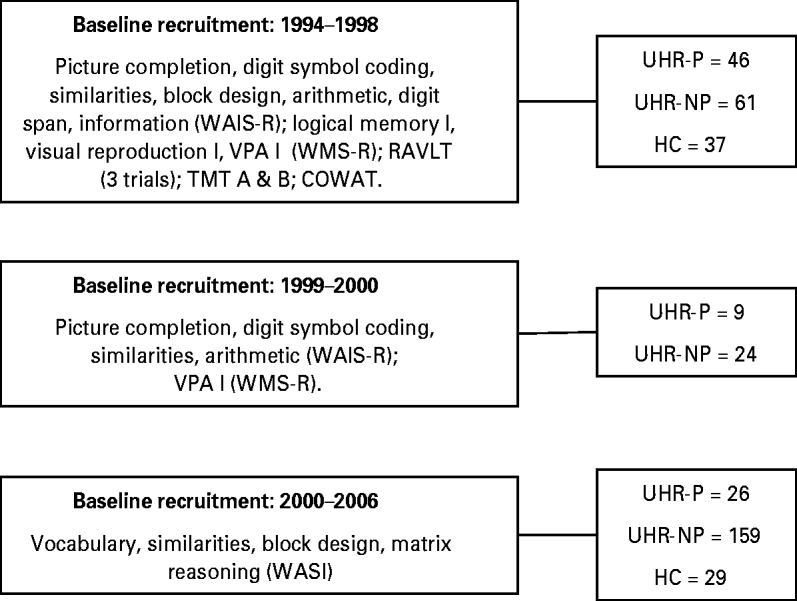
A range of potential predictors of transition to psychosis were investigated. Neurocognitive assessment at baseline varied according to the period during which participants were recruited (Fig. 1). The following subtests of the Wechsler Adult Intelligence Scale – Revised (WAIS-R; Wechsler, Reference Wechsler1981) were administered: information, block design, picture completion, similarities, digit span, digit symbol coding, and arithmetic. Alternatively, participants were administered the full Wechsler Abbreviated Scale of Intelligence (WASI; Wechsler, Reference Wechsler1999).
The sample during each baseline recruitment period. Not all participants consented or completed every neurocognitive task; Tables 2 and 3 show the number of participants assessed on each task. WAIS-R, Wechsler Adult Intelligence Scale – Revised; VPA, verbal paired associates; WMS-R, Wechsler Memory Scale – Revised; RAVLT, Rey Auditory Verbal Learning Test; TMT, Trail Making Test; COWAT, Controlled Oral Word Association Test; WASI, Wechsler Abbreviated Scale of Intelligence; UHR-P, ultra-high risk participants transitioned to psychosis; UHR-NP, ultra-high risk participants not transitioned to psychosis.

Memory was assessed by logical memory I, visual reproduction I and verbal paired associates I (VPA) from the Wechsler Memory Scale – Revised (WMS-R; Wechsler, Reference Wechsler1987). The Rey Auditory Verbal Learning Test (RAVLT; Rey, Reference Rey1941) was used to assess verbal list learning and memory. The total score from a three-trial version of the RAVLT was used in analysis. The Trail Making Test Parts A and B (TMT-A and TMT-B; Army Individual Test Battery, 1944) total times were used to assess psychomotor speed and attention. The total words generated from the letters F, A and S on the Controlled Oral Word Association Test (COWAT; Benton & Hamsher, Reference Benton and Hamsher1983) provided an index of phonemic verbal fluency. These measures led to a total of 19 candidate predictors to be examined. Higher scores on all tasks indicate better performance, except on the TMT where the reverse is true.
Statistical analysis
Statistical analyses were performed using SPSS version 19 (SPSS Inc., USA). Neurocognitive tasks were examined individually rather than grouped into cognitive domains for two reasons. First, it is theoretically incorrect to assume that pencil-and-paper tasks purporting to tap into similar cognitive domains assess a single cognitive process with a common effect size (MacDonald & Carter, Reference MacDonald and Carter2002). Second, grouping tasks would have resulted in the exclusion of participants who did not complete all of the tasks. Examining each task individually allowed for the maximum number of participants to be included. Raw neurocognitive scores were used in analyses because some age-scaled scores have a small variance.
Comparison of baseline neurocognitive performance for UHR and HC participants
To compare neurocognitive performance between the UHR and HC participants, we used linear regression with neurocognitive tasks as the response variable and Group (UHR or HC) as a covariate. Age at baseline, pre-morbid IQ and gender were also entered as covariates. F scores and p values for the Group covariate are reported. Bonferroni correction was used to adjust for multiple testing (19 performance variables), meaning that a p value <0.0026 (=0.05/19) was taken to indicate statistically significant evidence of a difference at the 5% level. Effect sizes show the magnitude of difference and are indicated by Cohen's d, calculated from adjusted scores.
Assessment of candidate predictors of transition to psychosis in UHR participants
Cox proportional hazards regression was used to investigate the association between measures of neurocognitive performance at baseline (i.e. the candidate predictors), baseline psychopathology and rate of transition to known psychosis in the UHR participants. This method of time-to-event analysis models the time until a known transition to psychosis. It includes the follow-up length of each participant until their transition or until their last time seen without psychosis. Participants who did not transition were thus ‘censored’ at their final observed follow-up time, after which they no longer contributed to the analysis. Such participants might subsequently transition to psychosis but this was unknown from their available follow-up data. Cox regression allows the hazard ratio (HR) to be estimated for each candidate predictor, which is the ratio of the rate of transition to psychosis comparing two participants who differ in the predictor by 1 unit, assuming this ratio is a constant over time.
Analysis was conducted using the following steps:
(1) Baseline neurocognitive variables (candidate predictors) were each entered in a separate Cox regression and selected if the −2 log likelihood and Wald statistic were significant at p < 0.1. The same process with repeated with psychopathology variables [BPRS, SANS, HAMD, GAF, and CAARMS subtests].
(2) Backward multivariable Cox regression analyses were conducted for psychopathology variables selected in step 1, and selected again at a significance level of p < 0.15.
(3) The candidate predictors that were retained were entered into multivariable backward regression with psychopathology variables as block 1 and neurocognitive variables as block 2. Age at baseline and pre-morbid IQ were included as covariates with neurocognitive candidate predictors. The process was repeated forwards to exclude blocking effects.
Two models were necessary to account for differences in tasks administered at different recruitment phases. The first (model 1) included participants recruited from 1994 to 2000. Neurocognitive candidate predictors included in this model were logical memory I, RAVLT, VPA, visual reproduction I, COWAT, TMT (A and B) and all WAIS-R subtests. The second model (model 2) included all WASI subtests, which were completed by participants recruited from 2000 to 2006 (see Fig. 1).
Results
Sample characteristics
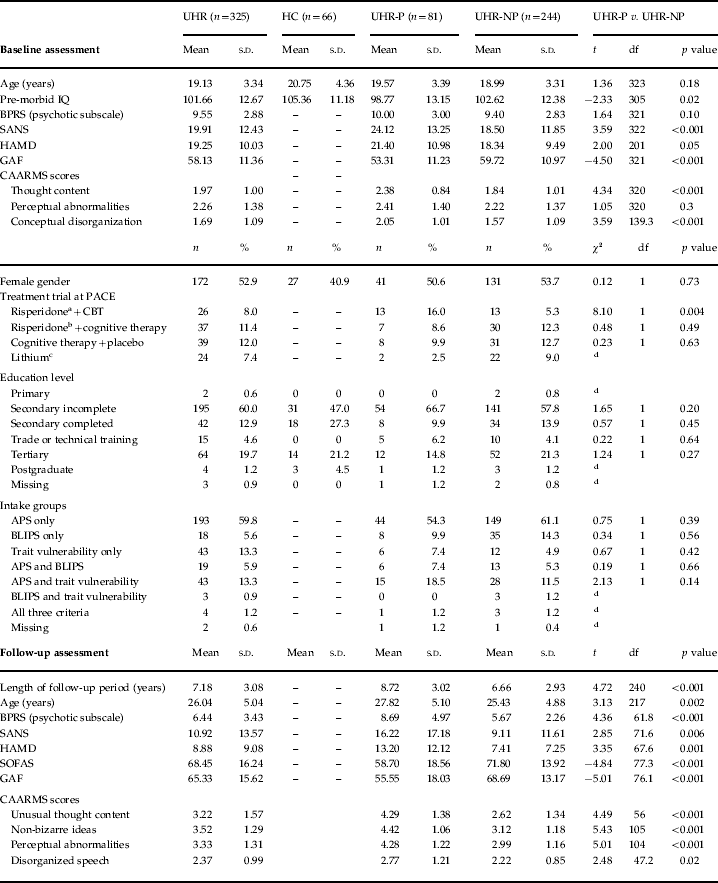
The demographic characteristics of the UHR (n = 325) and HC (n = 66) groups are presented in Table 1. At follow-up, 246 of the 325 UHR participants (75.7%) were available for interview [217 (66.7%) face-to-face, 26 (8.0%) telephone, three (0.9%) written]. Thirty-nine (12%) refused follow-up and 32 (9.8%) could not be located. Eight participants (2.5%) had died. The mean age of the UHR cohort at follow-up was 26.04 (s.d. = 5.04) years. The follow-up period ranged from 2.39 to 14.86 (mean = 7.18, median = 6.45) years.
Baseline and follow-up characteristics of the ultra-high risk (UHR) and healthy control (HC) groups
UHR-P, UHR participants who transitioned to psychosis; UHR-NP, UHR participants who did not transition to psychosis; BPRS, Brief Psychiatric Rating Scale (psychotic subscale); SANS, Scale of Assessment for Negative Symptoms; HAMD, Hamilton Depression Rating Scale; GAF, Global Assessment of Functioning; CAARMS, Comprehensive Assessment of the At-risk Mental State; PACE, Personal Assessment and Crisis Evaluation; CBT, cognitive behaviour therapy; APS, attenuated psychotic symptoms; BLIPS, brief limited intermittent psychotic symptoms; SOFAS, Social and Occupational Functioning Assessment Scale; s.d., standard deviation; df, degrees of freedom.
a 1–2 mg daily risperidone for 6 months.
b Up to 2 mg risperidone for 12 months.
c One slow release 450-g tablet of lithium carbonate each night for 3 months.
d χ2 was not calculated if the expected cell count was <5.
The UHR group were younger (t 81 = − 2.85, p = 0.006) and had lower pre-morbid IQ (t 369 = − 2.17, p = 0.03) than the HCs. Subsequent group analyses were controlled for age, gender and pre-morbid IQ.
Eighty-one participants (24.9%) were known to have transitioned to psychosis. The mean time to transition was 541.07 days (s.d. = 660.28 days, median = 1428.00 days). Specific DSM-IV diagnoses were: schizophrenia, 28 (8.6%); psychotic disorder not otherwise specified (NOS), 11 (3.4%); major depressive disorder with psychotic features, four (1.2%); bipolar disorder with psychotic features, four (1.2%); substance-induced psychotic disorder, four (1.2%); delusional disorder, one (0.3%); brief psychotic disorder one (0.3%). Here we report current/lifetime diagnosis as reported at follow-up assessment (last known diagnosis) because of known diagnostic variability early in the illness course (Schwartz et al. Reference Schwartz, Fennig, Tanenberg-Karant, Carlson, Craig, Galambos, Lavelle and Bromet2000). Participants were asked to report on experiences since they were last seen at the PACE Clinic, so those in full remission who had not experienced any psychotic symptoms since PACE would not rate for specific diagnosis (even though they had previously transitioned to frank psychosis).
Demographic characteristics for the UHR-P and UHR-NP groups and statistics for group comparisons are presented in Table 1. At baseline, the UHR-P group demonstrated significantly higher scores than UHR-NP on the SANS and the Thought content and Conceptual disorganization subtests of the CAARMS, and had lower GAF scores. UHR-P had lower pre-morbid IQ; subsequent analyses are controlled for pre-morbid IQ. At the follow-up assessment, UHR-P showed significantly higher scores than UHR-NP on all measures of psychopathology and lower scores on measures of functioning.. They were also significantly older and followed up for a longer period of time.
Comparison of baseline neurocognitive performance for UHR and HC participants
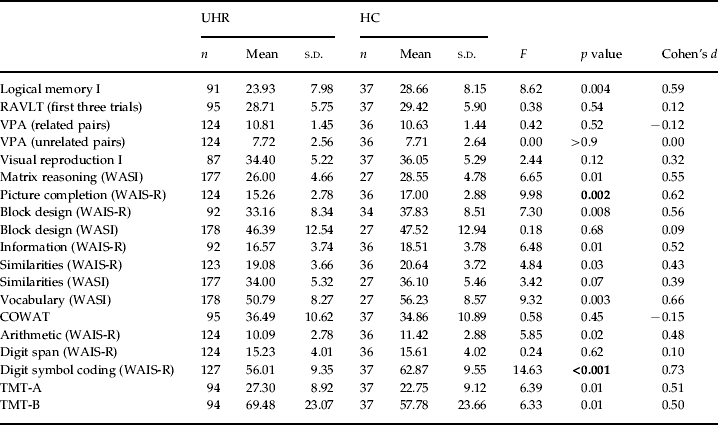
Baseline neurocognitive test scores for UHR and HC participants are presented in Table 2. On every task except VPA and COWAT, UHR performed more poorly than HCs. Medium effect sizes (⩾0.5) were evident for (in descending order of size): digit symbol coding; vocabulary; picture completion; logical memory; block design (WAIS-R); matrix reasoning; TMT-A; TMT-B. After Bonferroni correction, the difference was statistically significant for picture completion and digit symbol coding only.
Baseline neurocognitive performance of ultra-high risk (UHR) and healthy control (HC) groups
RAVLT, Rey Auditory Verbal Learning Test; VPA, verbal paired associates; WASI, Wechsler Abbreviated Scale of Intelligence; WAIS-R, Wechsler Adult Intelligence Scale – Revised; COWAT, Controlled Oral Word Association Test; TMT-A, Trail Making Test Part A; TMT-B, Trail Making Test Part B; s.d., standard deviation.
Analysis covaried for age, gender and pre-morbid IQ. Adjusted raw scores are reported. Cohen's d is calculated on adjusted scores. Higher scores on the TMT indicate poorer performance. The p values significant after Bonferroni correction are in bold.
Comparison of neurocognitive test performance for UHR-P and UHR-NP groups
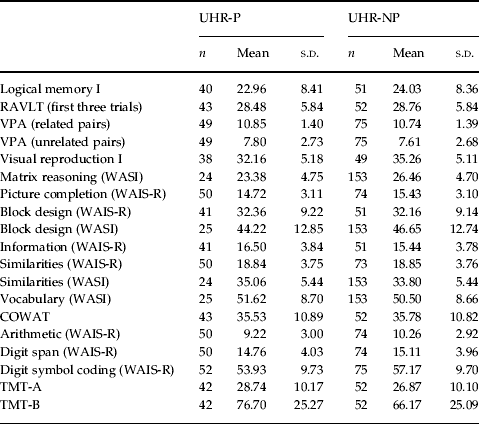
The neurocognitive test scores for the UHR-P and UHR-NP groups are presented in Table 3. After adjusting scores for pre-morbid IQ, age and gender, visual inspection shows that differences between the groups are small. The general pattern is that UHR-P show lower scores than UHR-NP on tasks of visuospatial ability, processing speed and attention, but very similar or higher scores on tasks of verbal ability and verbal memory (with the exception of logical memory).
Baseline neurocognitive performance of ultra-high risk participants transitioned (UHR-P) and not transitioned to psychosis (UHR-NP)
RAVLT, Rey Auditory Verbal Learning Test; VPA, verbal paired associates; WASI, Wechsler Abbreviated Scale of Intelligence; WAIS-R, Wechsler Adult Intelligence Scale – Revised; COWAT, Controlled Oral Word Association Test; TMT-A, Trail Making Test Part A; TMT-B, Trail Making Test Part B; s.d., standard deviation.
Raw scores adjusted for age, gender and pre-morbid IQ are reported. Higher scores on the TMT indicate poorer performance.
Assessment of candidate predictors of transition to psychosis in UHR participants
Model 1
When neurocognitive test scores were entered individually into Cox regressions, only visual reproduction and arithmetic demonstrated −2 log likelihood and Wald statistics with a p value <0.1. BPRS (psychotic subscale), SANS, HAMD, GAF and the Thought content subscale from the CAARMS all showed −2 log likelihood and Wald statistics with a p value <0.1. When these psychopathology variables were entered into a backward multivariable regression, only GAF remained significant at p < 0.15.
Next, GAF was entered as block 1 and visual reproduction, arithmetic, pre-morbid IQ and age at baseline were entered as block 2 into a multivariable backward regression. GAF [hazard ratio (HR) 0.951, 95% confidence interval (CI) 0.927–0.977, p < 0.001] and visual reproduction (HR 0.919, 95% CI 0.876–0.965, p = 0.001) remained significant at p < 0.05. The variables in the final model are presented in Table 4.
Cox proportional hazard model 1

GAF, Global Assessment of Functioning; s.e., standard error; HR, hazard ratio; CI, confidence interval.
Model 2
When scores on the WASI subtest were entered individually into Cox regressions, only matrix reasoning demonstrated −2 log likelihood and Wald statistics with a p value <0.1. BPRS (psychotic subscale), SANS, GAF and the Thought content subscale from the CAARMS all showed −2 log likelihood and Wald statistics with a p value <0.1. When these psychopathology variables were entering into a backward multivariable regression, only GAF and Thought content from the CAARMS remained significant at p value <0.15.
Next, GAF and Thought content were entered as block 1 and matrix reasoning, pre-morbid IQ and age at baseline were entered as block 2 into a multivariable backward regression. Thought content (HR 2.071, 95% CI 1.297–3.308, p = 0.002) and matrix reasoning (HR 0.938, 95% CI 0.883–0.996, p = 0.037) remained significant at p < 0.05. The variables in the final model are presented in Table 5.
Cox proportional hazard model 2

CAARMS, Comprehensive Assessment of the At-risk Mental State; WASI, Wechsler Abbreviated Scale of Intelligence; s.e., standard error; HR, hazard ratio; CI, confidence interval.
Discussion
In this follow-up study, we investigated the neurocognitive performance of UHR and HC groups, and the relationship between neurocognition and transition to psychosis between 2 and 15 years after identification as UHR. At baseline, UHR participants performed more poorly than HCs across a range of measures, with tasks of processing speed and visuospatial ability consistently showing the largest effect sizes. However, only performance on digit symbol coding and picture completion differed significantly between groups. When multivariable analyses were used to predict transition to psychosis, poorer performance on matrix reasoning and visual reproduction were the only significant neurocognitive variables. Although HRs were small, these tasks remained significant predictors of transition to psychosis after accounting for baseline psychopathology.
There is a well-established literature demonstrating that UHR status is associated with impairments across multiple neurocognitive abilities (for meta-analyses see Fusar-Poli et al. Reference Fusar-Poli, Deste, Smieskova, Barlati, Yung, Howes, Stieglitz, Vita, McGuire and Borgwardt2012b; Giuliano et al. Reference Giuliano, Li, Mesholam-Gately, Sorenson, Woodberry and Seidman2012). In the current sample, UHR participants performed more poorly than HCs, although only performance on digit symbol coding and picture completion reached statistical significance after adjusting for multiple comparisons, pre-morbid IQ, age and gender. Medium to large effect sizes were evident on all tasks of processing speed (TMT-A, TMT-B, digit symbol coding), with digit symbol coding showing the largest effect of all tasks administered. Other group differences with effects of medium to large magnitude were detected, although these were not seen consistently across all tasks in any domain. The finding of reduced processing speed is consistent with meta-analytic evidence that performance on digit symbol coding is the best discriminator of UHR from HCs (Fusar-Poli et al. Reference Fusar-Poli, Deste, Smieskova, Barlati, Yung, Howes, Stieglitz, Vita, McGuire and Borgwardt2012b), which is unsurprising given that performance on this task has been shown to best discriminate individuals with schizophrenia from HC participants (Dickinson et al. Reference Dickinson, Ramsey and Gold2007). However, the lack of a consistent difference in processing speed when UHR samples are compared to non-UHR psychiatric controls is noteworthy (Ilonen et al. Reference Ilonen, Heinimaa, Korkeila, Svirskis and Salokangas2010; Lindgren et al. Reference Lindgren, Manninen, Laajasalo, Mustonen, Kalska, Suvisaari, Moilanen, Cannon, Huttunen and Therman2010), suggesting that this impairment may not be specific to the ‘at-risk’ state. Instead, slowed processing might represent a reduction in performance associated with general psychopathology and distress. From a clinical point of view, slower processing speed would be expected in individuals with high levels of depression and general psychological distress, which are common in UHR samples (Velthorst et al. Reference Velthorst, Nieman, Becker, van de Fliert, Dingemans, Klaassen, de Haan, van Amelsvoort and Linszen2009).
Notably, there were no significant differences between the UHR and HC groups on WASI tasks. These tasks were administered to UHR participants recruited more recently (2000–2006; see Fig. 1). Unfortunately, it was not possible to determine whether this lack of group differences was a function of the tests themselves or the subgroup to which they were administered. Given the evidence of a decline in transition rate in recent years (Yung et al. Reference Yung, Yuen, Berger, Francey, Hung, Nelson, Phillips and McGorry2007; Simon et al. Reference Simon, Velthorst, Nieman, Linszen, Umbricht and de Haan2011; Fusar-Poli et al. Reference Fusar-Poli, Bonoldi, Yung, Borgwardt, Kempton, Valmaggia, Barale, Caverzasi and McGuire2012a), and the suggestion that the risk status of the sample at PACE has been ‘diluted’ (Yung et al. Reference Yung, Yuen, Berger, Francey, Hung, Nelson, Phillips and McGorry2007), the latter seems likely. This later-recruited subgroup was also less likely to develop psychosis than their earlier-recruited counterparts (approximately 14% v. 39%), and, as a group, could be less cognitively impaired. These individuals may well be experiencing transient attenuated psychotic symptoms associated with other psychopathology, such as depression. Unfortunately, processing speed was not measured in this group, making it difficult to assess the validity of the hypothesis that slowed speed of processing is related to high levels of distress and general psychopathology.
When neurocognitive variables were entered into Cox regression to predict psychosis onset, the results show that they were not strong predictors of transition. Moreover, against expectations, verbal abilities and verbal memory were not lower in the UHR-P group compared to UHR-NP. In the first model, lower visual reproduction, a task of visual memory and visuospatial ability predicted transition, along with lower functioning indexed on the GAF. In model 2, poorer performance on matrix reasoning of the WASI was associated with increased risk for transition together with higher scores on the Thought content subscale of the CAARMS. Examination of HRs shows that, in real terms, neurocognition was only a weak predictor of the development of psychosis.
To date, the literature on neurocognition and transition to psychosis has been inconsistent. There is evidence that impairment in verbal abilities is associated with transition from UHR to psychosis, particularly general vocabulary or verbal IQ (Eastvold et al. Reference Eastvold, Heaton and Cadenhead2007; Pukrop et al. Reference Pukrop, Ruhrmann, Schultze-Lutter, Bechdolf, Brockhaus-Dumke and Klosterkötter2007; Seidman et al. Reference Seidman, Giuliano, Meyer, Addington, Cadenhead, Cannon, McGlashan, Perkins, Tsuang and Walker2010; Woodberry et al. Reference Woodberry, Seidman, Giuliano, Verdi, Cook and McFarlane2010), verbal learning and memory (Brewer et al. Reference Brewer, Francey, Wood, Jackson, Pantelis, Phillips, Yung, Anderson and McGorry2005; Lencz et al. Reference Lencz, Smith, McLaughlin, Auther, Nakayama, Hovey and Cornblatt2006; Eastvold et al. Reference Eastvold, Heaton and Cadenhead2007; Pukrop et al. Reference Pukrop, Ruhrmann, Schultze-Lutter, Bechdolf, Brockhaus-Dumke and Klosterkötter2007; Kim et al. Reference Kim, Shin, Jang, Kim, Shim, Park, Hong and Kwon2011) and verbal fluency (Pukrop et al. Reference Pukrop, Ruhrmann, Schultze-Lutter, Bechdolf, Brockhaus-Dumke and Klosterkötter2007; Becker et al. Reference Becker, Nieman, Dingemans, van de Fliert, De Haan and Linszen2010; Kim et al. Reference Kim, Shin, Jang, Kim, Shim, Park, Hong and Kwon2011). We have shown previously that poorer performance on visual reproduction is associated with transition (Brewer et al. Reference Brewer, Francey, Wood, Jackson, Pantelis, Phillips, Yung, Anderson and McGorry2005), and here extend that finding with the use of Cox regression analyses and a much longer follow-up period with additional transitioned cases. Importantly, our findings here suggest that only visual reproduction performance is associated with transition. Visual reproduction ability was also shown to predict transition in a more recent study (Kim et al. Reference Kim, Shin, Jang, Kim, Shim, Park, Hong and Kwon2011), and a recent meta-analysis (Fusar-Poli et al. Reference Fusar-Poli, Deste, Smieskova, Barlati, Yung, Howes, Stieglitz, Vita, McGuire and Borgwardt2012b) demonstrated that those who transition do in fact show reduced visual memory. Similarly, another meta-analysis (Giuliano et al. Reference Giuliano, Li, Mesholam-Gately, Sorenson, Woodberry and Seidman2012) found visuospatial ability to be the fourth largest cognitive deficit in those who transition to psychosis. Matrix reasoning, which assesses visual abstract manipulation, has not previously been associated with transition, although others have shown that matrix reasoning (Lindgren et al. Reference Lindgren, Manninen, Laajasalo, Mustonen, Kalska, Suvisaari, Moilanen, Cannon, Huttunen and Therman2010) and visual form perception (Ilonen et al. Reference Ilonen, Heinimaa, Korkeila, Svirskis and Salokangas2010) differentiated UHR subjects from non-UHR psychiatric controls. This suggests that impaired visual manipulation might have some specificity for vulnerability for psychosis, but more investigation is needed. Overall, our findings add little clarity to our understanding of this literature, except confirmation that the predictive validity of neurocognitive performance (as assessed using traditional neuropsychological tasks) is likely to be very weak at this stage of illness.
The major strength of this study lies in the duration of follow-up and large sample size. This study represents the longest follow-up of any UHR sample, providing novel information on neurocognitive predictors of psychosis onset. However, only a subset of participants had comprehensive neurocognitive assessment, which limits the conclusions that can be drawn. Additionally, some neurocognitive domains were not assessed. For example, semantic verbal fluency has been shown to predict psychosis (Becker et al. Reference Becker, Nieman, Dingemans, van de Fliert, De Haan and Linszen2010), but this was not measured. It should be noted that treatment outside the PACE Clinic or since discharge was not controlled. We investigated the proportion of participants who received specific trial intervention treatment at the PACE Clinic (cognitive therapy and placebo; cognitive or cognitive behavioural therapy and low dose antipsychotics; low dose lithium). There was a significant difference between UHR-P and UHR-NP participants in this sample on one therapeutic regime (risperidone and CBT), which may have influenced results.
Future work in this area requires large samples followed up for long periods of time. Neurocognitive decrements at this early stage of psychotic illness are likely to be small. The current findings show that, if impairments do exist, the use of traditional neuropsychological tests is unlikely to detect them. Future studies should include fewer measures of global neurocognition and more computerized tasks that target specific abilities and decompose performance into discrete processes (MacDonald & Carter, Reference MacDonald and Carter2002). These types of experimental paradigms are necessary to tease out the specificity of impairments at this stage of illness and improve our understanding of the trajectory of neurocognitive changes over the development of psychosis.
Acknowledgements
We thank K. Wardenaar for his valuable comments on this manuscript and A. Calvo for her assistance with data entry. This work was supported by National Health and Medical Research Council (NHMRC) Programme Grants (nos 350241 and 566529) and the Colonial Foundation. S.J.W. and W.J.B. were supported by NHMRC Career Development Awards. B.N. was supported by a Ronald Phillip Griffith Fellowship and a National Alliance for Research on Schizophrenia and Depression (NARSAD) Young Investigator Award. C.P. and A.R.Y. are the recipients of NHMRC Senior Principal and Senior Research Fellowships respectively. No funding source played any role in the collection, analysis, interpretation or publication of data.
Declaration of Interest
A. R. Yung has received honoraria and travel support from AstraZeneca, Eli-Lilly, Bristol Meyer Squibb and Janssen-Cilag. C. Pantelis has received research funding from Janssen-Cilag, Eli-Lilly, Hospira (Mayne) and AstraZeneca, and has acted as a consultant for Janssen-Cilag, Eli-Lilly, Hospira (Mayne), AstraZeneca, Pfizer, Schering and Plough.