Introduction
The recent discovery of the tomb of an imperial prince with a cache of finely worked gold ornaments at Dayunshan near Xuyi (Jiangsu) is changing our perspective on gold in China. Excavations at the tomb of Liu Fei, King of Jiangdu and a royal member of the Liu family (died 128 BC), have unearthed a variety of precious metals. It is the most important surviving assemblage of luxury gold from the early Han Empire yet discovered and contains a number of objects with exotic features. In the centuries before the Western Han (206 BC–AD 24), gold was rarely used in central China, where prestigious materials were jade and bronze (Bunker Reference Bunker1993: 27–50). Among the mobile peoples living north and west of China, gold was always much more significant. The pursuit of such politically significant prestige goods was important to nomadic pastoral groups in their quest to maintain social inequality and legitimise political authority (Lattimore Reference Lattimore1962: 481–83; Brumfield & Earle Reference Brumfield and Earle1987; Honeychurch Reference Honeychurch, Amitai and Biran2014: 50–89). The development of sophisticated techniques of gold-making requires craft skills and elite control of precious materials, thereby taking on the identity of a prestige technology (Peregrine Reference Peregrine1991: 1–10; Hayden Reference Hayden1998: 1–55). The Dayunshan material is surprising for its delicacy and the excellence of the craftsmanship in the repoussé combined with granulation and filigree. These techniques originated in Western Asia and reached a high standard in the Mediterranean world as early as the Bronze Age (1600–900 BC), but rarely appeared in central China prior to the second century BC. More strikingly, the iconography of some gold ornaments, such as the rams’ heads, represent a strong degree of contact with the mobile pastoralists in the steppes.
Given this creative encounter with foreign techniques and images, crucial questions arise as to whether these ornaments were exotic intrusions or local replicas. If they were made locally to imitate foreign objects, what inspired the artisans who produced them? To answer these questions, an interpretative approach to exotica is needed, based on the notion of prestige technology. ‘Exotica’ here refers to a specific type of object with technological and ornamental peculiarities from distant regions and foreign cultures (Helms Reference Helms1988). Chinese perceptions of such exotica have long been framed by a very conventional view on diffusion, especially on the exchange of prestige goods in the long-distance trade along the Silk Road following the Han's expansion into Central Asia (Liu Reference Liu2013: 81–86; Pan Reference Pan2015: 95–106).
The growing corpus of research reveals that the influx of knowledge and technology relating to goldsmithing extended along the network of steppe roads that crossed northern China, Siberia, Central Asia and the lands around the Caspian Sea, thousands of years before the rise of the commercial Silk Road (Bunker Reference Bunker1993: 27–50; Rawson Reference Rawson, Wagner and Wang2010: 1–41; Yang & Linduff Reference Yang and Linduff2013: 73–84; Cunliffe Reference Cunliffe2015; Honeychurch 2015). This paper does not attempt to elaborate upon existing theories on proto-Silk Roads. Rather, it focuses on the local adaptation of foreign techniques and images through the study of the luxury gold from the Dayunshan site and other contemporaneous elite tombs, in order to gain a better understanding of specialised craft production in Han society. More specifically, this paper examines the ways in which craft production facilitates the creation of material symbols used to legitimise imperial power, with a focus on the two main characteristics of technological practice: the creative use of exotica, and the high level of standardisation in the production of prestige gold.
The archaeological record
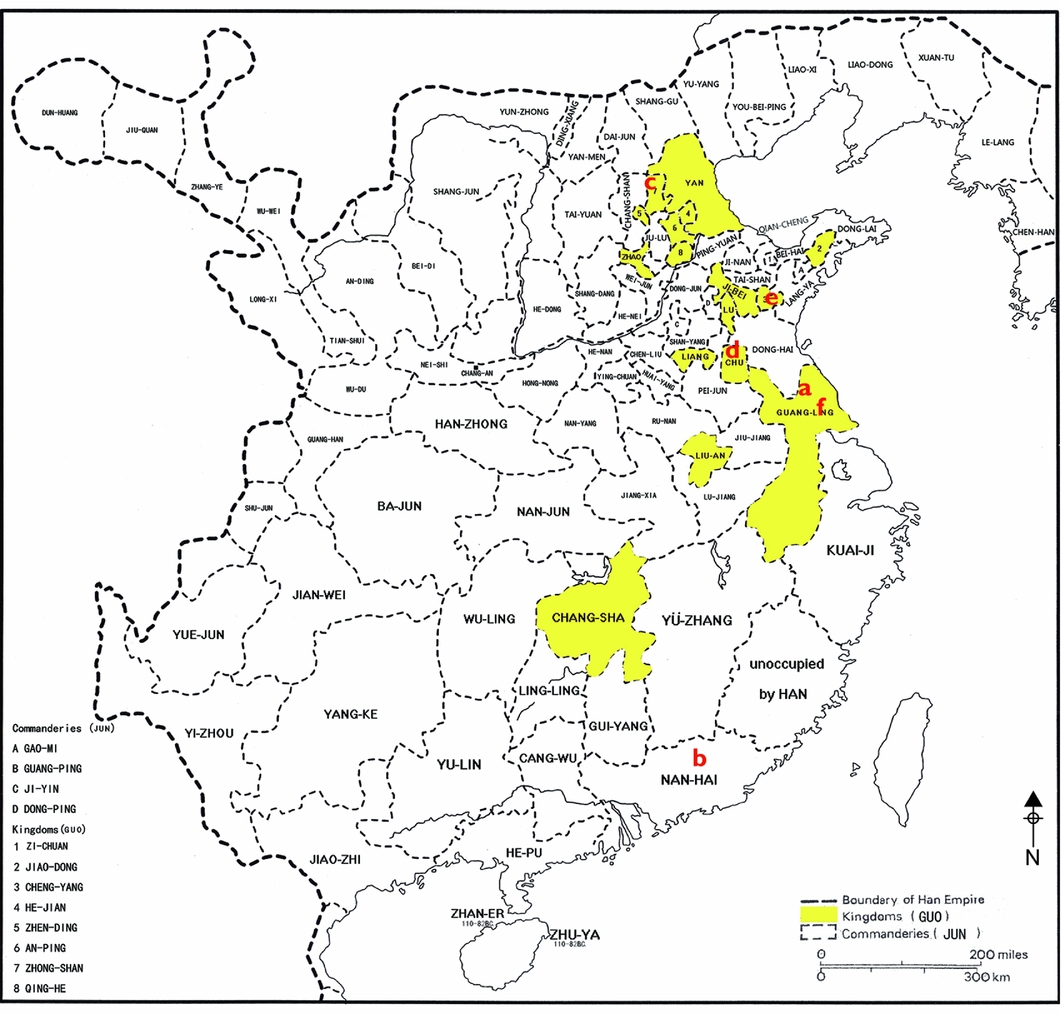
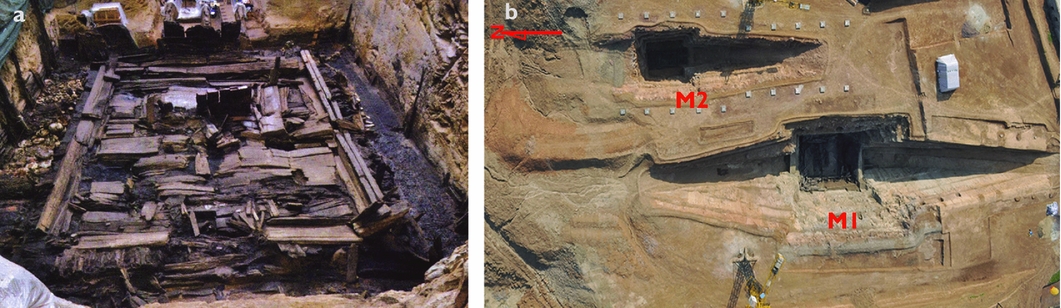
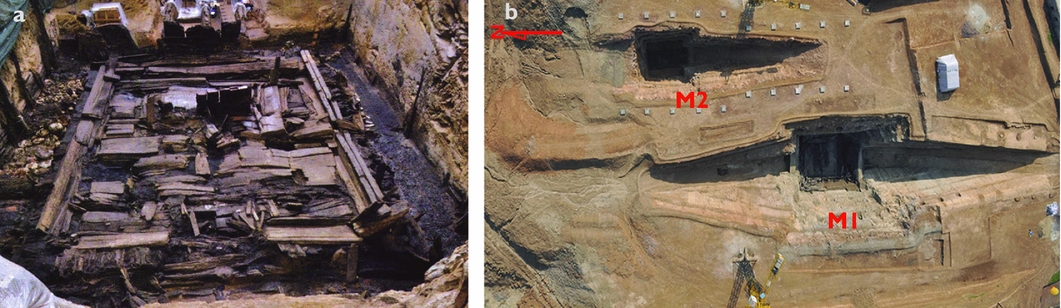
The imperial cemetery was located on the hilltop of Dayunshan, 30km west of Xuyi County, and was excavated by Nanjing Museum from 2009–2012 (Figure 1). The cemetery comprised three main tombs, eleven dependent graves and four burial pits. Tomb 1, located in the south-east of the cemetery, was a large wooden chamber tomb with a massive protecting wall, measuring 15 × 13.9m (Figure 2). It was in this tomb that King Liu Fei was buried. The tomb was heavily looted, and only the outermost gallery of the wooden chambers remained intact, but amazingly, it still yielded 7092 objects, including bronze vessels, horse fittings, weapons, chariot models, gold ornaments, silver wares, fine lacquers, jades and potteries (Nanjing Bowuyuan 2012, 2013a).
Location of elite tombs: a) Dayunshan cemetery; b) Nanyue; c) Mancheng; d) Shizishan; e) Juxian; f) Yangzhou (drawing: Yan Liu, after Lin Reference Lin2012).

a) The timber structure; b) vertical pit, tomb 1 at the Dayunshan cemetery (photograph courtesy of Li Zebin).
One particular group of gold ornaments found in tomb 1 (Nanjing Bowuyuan 2013a: 293–301) merits special attention for the following ornamental items:
-
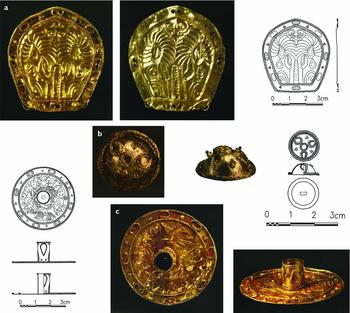
1) Sixteen gold appliqués, each made of thin sheet gold and embossed with a pair of confronted rams’ heads, in two different sizes: 26mm and 44mm long. There are four groups of double pinholes along the edge. These perforations suggest that such objects were originally attached to fabric (Figure 3a).
-
2) Four buttons hammered into a hemispherical shape, and decorated with filigree, granulation and enamel. The surfaces are decorated with four teardrop-shaped cloisonné ornaments, although the enamels are missing. The rims are decorated with twisted wires. A ring-shaped buckle on the reverse side was used for attachment (Figure 3b).
-
3) Two roundels consisting of a round base and a tubular socket. The rims of the bases are decorated with twisted wires and small grains. The surfaces of the sockets had tiny spheres and raised teardrop-shape cloisonné decoration (Figure 3c).
The Dayunshan grave goods assemblage is not an isolated find. The gold appliqués with rams’ heads were very popular among Han elites. Eighteen other examples of gold appliqués were recovered from four Western Han burials (Figure 4), including two princely tombs. Five of these were found in the tomb of Liu Sheng, King of Zhongshan (died 113 BC), at Mancheng (Hebei) (Zhongguo 1978), and eight were unearthed from the tombs of Zhao Mei, King of Nanyue (died 122 BC), and his consort at Guangzhou (Guangzhou 1991: 207–208). The Han elite tomb (189–154 BC) at Yangzhou (Jiangsu) yielded one gold appliqué and was the burial of Liu Wuzhi, a member of the imperial Liu family (Yangzhou 2010: 19–36). The latest find at Juxian (Shandong) included four gold appliqués embossed with rams’ heads, accompanied by four gold buttons (Liu Reference Liu2015: 28–32). It is not clear whether the gold appliqués, buttons and roundels, which sometimes occur together, form a regular set. Apart from Nanyue and Mancheng, most of these tombs have been looted. The entire set comprising all three categories was only found in Dayunshan tomb 1 (Nanjing Bowuyuan 2013a: 293). In the two intact tombs at Mancheng, the gold buttons were absent. The Nanyue tomb contained the largest number of gold buttons; a total of 39 items were recovered in total (Guangzhou 1991: 204–50).
Gold ornaments from Dayunshan: a) gold appliqués with rams’ heads, front and reverse sides, height: 44mm; b) buttons, 13mm diameter; c) roundels, 43mm diameter (drawing: Yan Liu, after Nanjing Bowuyuan 2013a: 293–301).

a) Mancheng gold roundels, height: 14mm and 20mm (after Zhongguo 1978: fig. 79); b) Mancheng gold appliqués, height: 47mm (after Hebei Bowuyuan 2014: fig. 66); c) Nanyue gold appliqué, height: 46mm (after Li Reference Li2007: 63); d) Yangzhou gold appliqué, height: 48mm (after Yangzhou 2010: fig. 39); e) Juxian gold appliqué, height: 47mm (after Liu Reference Liu2015: pl. 2).

The role of the kings was first established by Emperor Gaozu in 202 BC. He divided the more populous east and the Yangzi Valley into ten kingdoms to reward his leading relatives and followers (Hanshu 14.393–94; Gu Reference Gu2006). The seven largest fiefs were kingdoms, mostly in eastern China, governed by members of the Liu clan. These regional powers threatened the authority of the Emperor and a major rebellion took place in 154 BC. After this incident, the kingdoms were reduced in size or absorbed into the imperial domain. The Han court no longer ceded important powers to the regional kings, nor relied on them to support the court against local enemies or outside intruders. The princely tombs under discussion date to the period after the rebellion and were remarkably rich in content, especially the royal burials at Mancheng and Dayunshan. They were either cut into the mountainsides, or built as massive timber structures, and furnished with extravagant artefacts.
In addition to the tiny gold ornaments, the precious metals unearthed from Dayunshan and Nanyue also include silver bowls with lobed decoration, which were derived from Achaemenid or Parthian silvers. These objects have been considered either prestige goods from the far west that entered Han China by sea, or local replicas, especially those from Dayunshan and Nanyue, which are located in coastal regions (Sun Reference Sun1996: 139–55; Qi Reference Qi1999: 248–60; Nickel Reference Nickel2012: 98–107). Likewise, the gold ornaments have been usually discussed as imports through maritime trade (Sun Reference Sun1999: 69–80; Liu Reference Liu2013: 81–86). Similar traditions of craftsmanship relating to the use of pressed sheet and other ornamental techniques point to the possibility of local production but using borrowed foreign techniques. Careful comparisons of techniques and styles have permitted the tentative grouping of ornaments as the outputs of a particular workshop tradition.
Manufacturing techniques: mould-pressing, repoussé, granulation and filigree
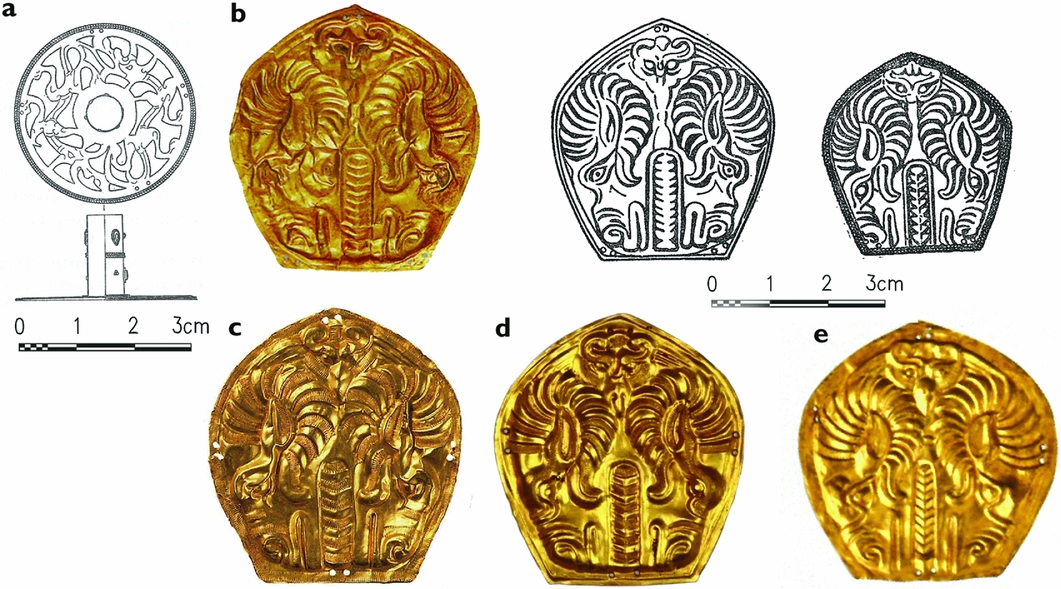
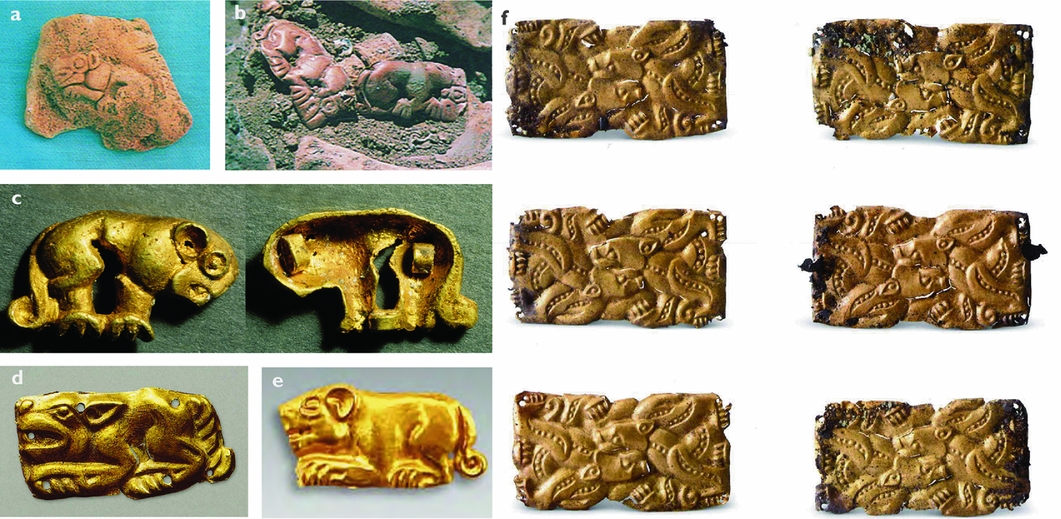
The manufacture of the Dayunshan appliqués and the bases of the round ornaments both employed the mould-pressing technique, which can be recognised immediately: no hammered marks appear on the reverse side, and the identical ornamental details indicate that they were possibly produced using a mould. Using matrices for creating repetitive relief designs was a typical decorative technique in the ancient Near East during the second millennium BC, and was used extensively across the Eurasian steppes until the sixth century BC. To produce a low-relief pattern, a thin gold sheet is pressed into a matrix or a die, or punched over a specific shape-former. This technique differs from free-hand repoussé (Treister Reference Treister2001). A bone model in the shape of a crouching feline (Figure 5a) and two similar gold appliqués (Figure 5b), discovered at the Pokrovka cemetery (sixth to fourth centuries BC) in the southern Urals, provide evidence for mould-pressing in local workshops (So & Bunker Reference So and Bunker1995: 62). Thousands of gold appliqués with similar designs (Figure 5c) were recovered from the Iron Age burial mounds at Arzhan II in Tuva, the Issyk kurgan in south-eastern Kazakhstan and the Fillippovka site in the southern Urals (Cugunov et al. Reference Cugunov, Parzinger and Nagler2010: 33–64; Yablonsky Reference Yablonsky2010, Reference Honeychurch2015; Khazbulatov Reference Khazbulatov2012: 36–39). This indicates their popularity among the mobile pastoralists of the Scytho-Siberian groups of the Altai Mountains and west to the southern Urals, from the seventh century BC onwards. Numerous gold appliqués made of pressed sheet in this animal style have been discovered from the burial sites at Zhangjiachuan (Gansu 2014: 36) and Hami (Xibei 2016: 15–31) in north-west China (Figure 5d–f), dating to the fifth to second centuries BC, and are the easternmost extension of the Scytho-Siberian mould-pressing technique.
a) A bone model of a feline from kurgan 2, burial 5, Pokrovka, Russia; b) two gold appliqués from kurgan 2, burial 1, Pokrovka, dimensions not specified (after So & Bunker Reference So and Bunker1995: 62); c) gold appliqués from Arzhan II, Tuva, length: 20–30mm (after Armbruster Reference Armbruster, Guerra and Rehren2009: 189); d) gold appliqué from Aluchaideng, Inner Mongolia, length: 39mm (after Zhang Reference Zhang2005: pl. 14); e) gold appliqué from Balikun tomb 1, Xinjiang, length: 33mm (after Xibei 2016: pl. 27); f) gold appliqués from Majiayuan tomb 4, Gansu, length: 119mm (after Gansu 2014: pl. 36).

The gold buttons employed techniques of repoussé, granulation and filigree. The earliest evidence of granulated gold appeared around 2700 BC in the Royal Tombs of Ur in Mesopotamia. The grains on Han gold ornaments are sometimes less than 1mm in diameter, but joining them together in a pattern requires extraordinary skill. Fusing of the beads, clearly seen in some badly shaped grains on granulated Dayunshan ornaments, was probably the result of excessive heat during the soldering (Figure 3b). The morphology of the gold buttons found in Dayunshan and other sites seems to be less varied than the gold appliqués, which may suggest that these were produced from a more limited variety of workshops or workshop traditions.
The roundels with tubular sockets from Dayunshan and Mancheng were manufactured by different techniques, indicating that these were probably from different workshops. The two roundels from Dayunshan had identical dimensions and decorative designs. The round base was made of a thin gold sheet with low-relief animal imagery, and the socket was elaborately decorated with granulation and filigree (Figure 3c). On the other hand, the two roundels from Mancheng tomb 1 were of different sizes. The sockets were decorated in the same manner as those at Dayunshan, but the decoration of the round base was distinguished by openwork design in a cutting-carving technique (Figure 4a).
Filigree is a delicate form of ornamentation made with twisted gold or silver wires. It originated in Mesopotamia and Egypt around 2700 BC and spread into parts of Asia around 2000 BC (Ogden Reference Ogden1982). Ancient filigree made of braided wires first appeared in the gold sheath recovered from Xinzhuangtou in northern China no later than the fourth century BC (Hebei Sheng Wenwu Yanjiusuo 1996: pl. 26; Xibei 2016: 15–31). The technique became more sophisticated in the Han period, as exhibited by the different wire components in the Dayunshan ornaments. The gold buttons were decorated with a single twisted wire on the surface and then edged with braided wires for more exquisite decoration (Figure 3b).
The gold appliqués with rams’ heads represent a greater variability of workshop traditions. The similar use of pressed sheet observed at the Dayunshan and other Han tombs has led to the conclusion that they were produced in the same government workshop (Nanjing Bowuyuan 2013a: 293). Variations in both manufacturing techniques and decorative details, however, suggest a degree of regional variation in their production. The most elaborate design appears on the Dayunshan appliqués. The rams’ heads are edged with twisted gold wire and granulation in the form of triangles that fill the rim-band (Figure 3a). Both filigree and granulation were absent in the decoration of other examples, such as those from Nanyue. In the Mancheng Han tomb, the gold appliqués are of two sizes. The smaller one is edged by braided wires with almost identical designs to the Dayunshan appliqués, the larger ones (Figure 4b) resemble those of the Nanyue excavations, indicating a mixture of different workshop productions.
Tool marks provide additional evidence for regional variations. Apart from the Dayunshan objects, the Nanyue gold appliqués are elaborately chased with short parallel lines applied in alternate rows on the horns, ears and faces of the rams’ heads (Figure 4c). The same decorative pattern also appears on the artefacts from Yangzhou and Juxian (Figure 4d–e). Such stylistic affinities point to a shared workshop tradition. We cannot be certain, however, that the gold appliqués from Nanyue, Yangzhou and Juxian came from a single workshop; they may have been produced in several different workshops using the same production model. So far, only the Nanyue examples have been submitted for XRF analysis; all eight appliqués were composed of 99.45 per cent gold and 0.01 per cent silver, similar components to other contemporaneous Han gold (Guangzhou 1991: 208). Further metallurgical analysis is needed to compare metal composition and sources.
The technical and ornamental details outlined above allow us to suggest that several local workshops were in operation. The stylistic uniformity points to a shared craft tradition, but there are also regional variations. The most characteristic feature appears to be serial production in the use of mould-pressing, accompanied by other decorative techniques, such as granulation and filigree, which had clear antecedents in northern China and the Eurasian steppe over the previous 200 years. The consistent use of specific techniques provides evidence for a shared workshop tradition and localised manufacture within the Han Empire. At the same time, the exotic style, creatively revealed by the foreign technical features and iconographic themes, adds to the power and allure of these prestige goods.
Iconographic themes with exotic features
Exotic luxuries were necessities in the political culture of various nomadic elites (Stark Reference Stark, Stark and Rubinson2012: 107–38). From the fourth to first centuries BC, the fashion for the artefacts and styles of the mobile pastoralists generated many Chinese imitations of steppe art. The belt plaques, as well as weapons and harness ornaments found in princely Han tombs, were adorned with Scytho-Siberian animal style. They feature beasts in confrontation, animals in combat and heraldic animals: tropes borrowed from the steppes by local Han artisans (Rawson Reference Rawson, Juliano and Lerner2001, Reference Rawson, Wagner and Wang2012). The Han court married its princesses to leaders of powerful horse-riding nomadic groups such as the Xiongnu and Wusun, and paid tribute in the form of grains, luxury textiles and gold. A large number of gold artefacts were made in the official workshops in present-day Chengdu (Hanshu 72.3070; Gu Reference Gu2006), both for the nomadic herders and for the Chinese (Bunker Reference Bunker2002: 15–37).
The transfer of motifs and images led to local adaptations reflecting local tastes. An excellent example is the pair of gold plaques discovered in the tomb of Chu King at Shizishan, which display a feline attacking an antlered animal. Such themes were borrowed from southern Siberia (Bunker Reference Bunker2002; Rawson Reference Rawson and Lin2012: 23–36), as seen in the material of the Pazyryk burials (Rudenko Reference Rudenko1970). The portrayal on the luxury Han gold is rather static in contrast with the dynamism of the comparable Scytho-Siberian animal combat scenes. Other examples include gold belt plaques found in tomb 9 at Dayunshan and at Nanyue; the Siberian animal styles were replaced by traditional Chinese motifs such as tortoises and dragons (Figure 9c–d).
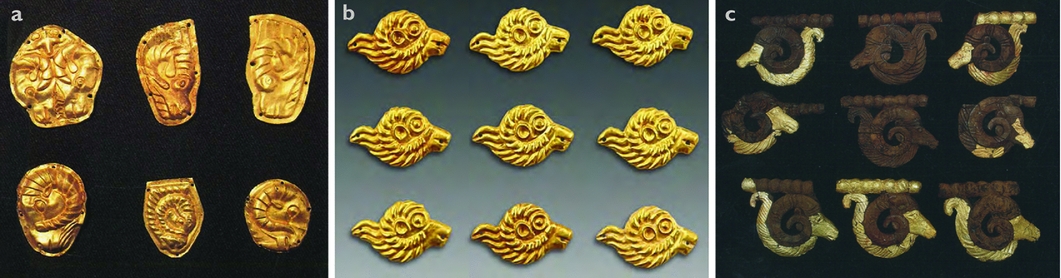
Rams’ heads positioned back to back occur on earlier examples found in aristocratic tombs of the Warring States period in northern China (Figure 6a). Six specimens were discovered in tomb 30 (dated to the fourth century BC) at Xinzhuangtou (Hebei Sheng Wenwu Yanjiusuo 1996). The gold appliqués decorated with stylised rams’ heads were made by means of pressed sheet, although there were variants in design. The images showed the strong influence of the Scytho-Siberian animal style (Figure 6) (Dashkovskiy & Usova Reference Dashkovskiy and Usova2011: 78–84; Samashev Reference Samashev, Stark and Rubinson2012: pls 2–8), but some cast gold inscribed with Chinese characters must have been produced locally. Craftsmen in the northern Chinese states played a critical role in cultural transmission by making prestige goods in the style favoured by peoples of the steppes. This is also indicated by bronze plaques and ceramic models decorated with animal motifs recovered from the tomb of the Qin state metalworker in Shaanxi (Yue Reference Yue2003: 4–14).
a) Gold appliqués from tomb 30 of Xinzhuangtou, length: 23–32mm (after Hebei Sheng Wenwu Yanjiusuo 1996: pl. 33); b) gold appliqués from Balikun tomb 1, Xinjiang, length: 24.2mm (after Xibei 2016: pl. 28); c) wooden plaques with gold foil from kurgan 11 at Berel, eastern Kazakhstan, late fourth to third centuries BC, height: 76–78mm (after Stark Reference Stark, Stark and Rubinson2012: pls 2–8).

Another typical Siberian motif was the reversed hindquarters of winged animals, as seen from the frontal part of a horse bridle from the Western Han princely tombs, and also in examples of gold ornaments from Alagou (third to second centuries BC) in Xinjiang, and Xigoupan (second century BC) in Inner Mongolia. These were used earlier at Pazyryk (fourth to third centuries BC) (Rudenko Reference Rudenko1970; Ma Reference Ma2009: 50–64; Rawson Reference Rawson and Lin2012: 23–26). The twisted beast was also used on Han Chinese artefacts, such as a lacquer box found in a Western Han tomb at Chaohu (Anhui) and the painted coffin of the Lady Dai (168 BC) at Mawangdui near Changsha (HSB & ZKKY 1973: pl. 34; Anhui 2007: 112–13). Many of the metal items decorated with heraldic animals from this period in northern China must have served as status indicators or clan markers, as some were imbued with religious and ritual meanings, but the motifs might have been interpreted in new ways when used on Han luxury gold.
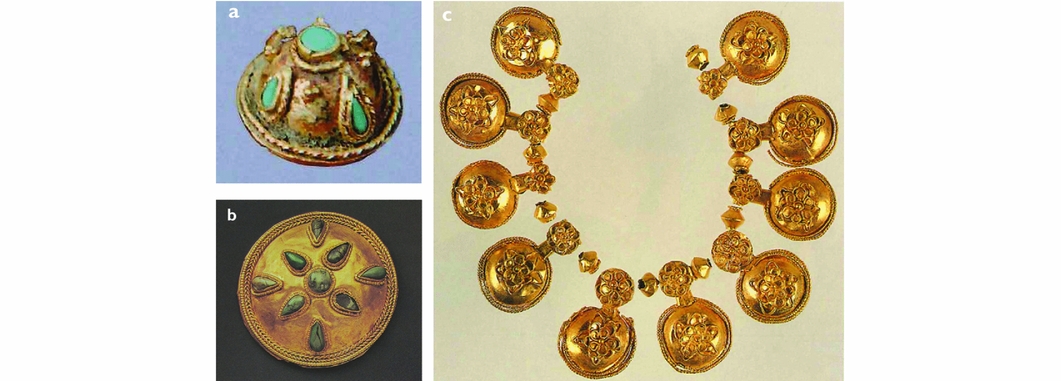
In addition to the animal motifs linked to the Altai Mountains, the designs with polychrome inlay and filigree were clearly influenced by the Achaemenid goldwork of Iran. Similar ornaments are known from Scythian burials in the northern Black Sea area. One close parallel to the Dayunshan gold buttons is a bronze ornament found in a Scythian burial (second century BC to second century AD) at Gorgippia (Musée Cernuschi 2001: 273). Another is a necklace discovered in a fourth-century BC burial in the Kazanluk Valley (Marazov Reference Marazov1998: 94). Each teardrop inlay is highlighted by twisted wire, resonating with the designs found on the gold buttons recovered from Dayunshan and other Han burials (Figure 7). Objects made in the Greek style for Scythians, especially with cloisonné technique and teardrop inlay, were abundant in contemporaneous steppe art from Sayan-Altai to the southern Urals. Along with other Greek designs, including the scroll pattern and eagle griffins (Hayashi Reference Hayashi2012: 49–64; Rawson 2012: 30), these Achaemenid motifs reached northern China via steppe routeways and became one of the primary sources of Han ornamentation.
a) Gold buttons from Shizishan, Xuzhou, 12mm diameter (after Xuzhou 2011: 106); b) bronze ornament, Gorgippia, 38mm diameter (after Musée Cernuschi 2001: fig. 160); c) button-like ornament, Kazanluk, 17mm diameter (after Marazov Reference Marazov1998: 94).

The choice of techniques and imagery suggests an appreciation of prestige attached to foreign styles. The openness of Han rulers to foreign cultures was also represented by the fascinating decoration of luxury objects that passed as diplomatic gifts between the Han Empire and Parthia, Persia and Central Asia (Hanshu 66.3928; Gu Reference Gu2006). In tomb 1 at Dayunshan, a variety of gilt bronzes, including lamps and weights, had adapted decorative motifs of Bactrian camels, deer and a rhinoceros, reflecting the growing taste for exotica among the elites.
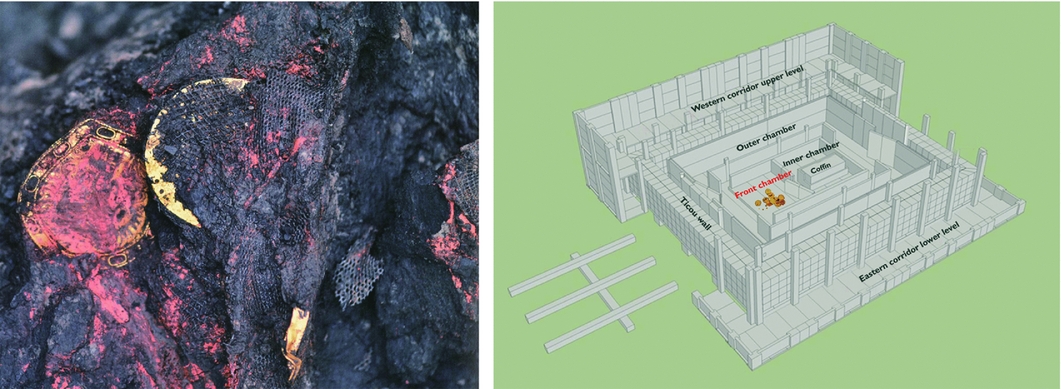
The high concentration of these exotic luxuries alongside other markers of status and power in wealthy tombs suggests that access to these items was socially limited. The gold appliqués with rams’ heads were probably used as ornaments on headgear, as suggested by their size, shape and location. In the Nanyue tomb, six gold appliqués were placed on the head section of jade suits (Guangzhou 1991: 207–208). In tomb 1 at Dayunshan, the gold appliqués were found with buttons and roundels attached to the remains of a red fabric (Figure 8), and were probably a form of body adornment (Nanjing Bowuyuan 2013a: 293). The jade suits, made of thousands of jade plaques stitched together with gold or silver wire, were used to protect royal members in the netherworld. Although found primarily in mortuary contexts, some gold ornaments show evidence of wear, indicating that they were also used in life. As many were used for body adornment, they would have been highly visible, and may have taken on a performative role, especially during ceremonies or rituals. In a funerary context, these symbols would have conferred power and legitimation upon their owners, even after death.
A group of gold ornaments from tomb 1 at Dayunshan during excavation (photograph courtesy of Li Zebin).

Prestige goods production under strict control
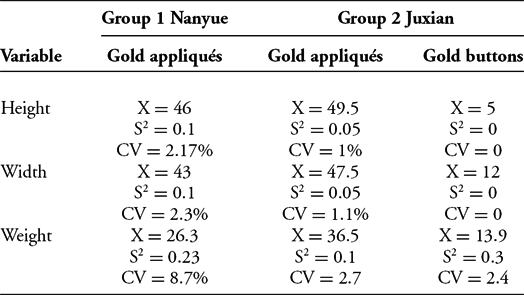
A high level of standardisation is the most striking feature of prestige goods production, as seen across a variety of different media in Han society. A wide range of craft goods was produced in the imperial workshops, ranging from luxury textiles and lacquer to gold ornaments (Hanshu 28.1554; Gu Reference Gu2006). The gold ornaments exhibited standardised designs, indicating specialised and strictly controlled production. Such standardisation can be effective in the analysis of dimensional variables (Berg Reference Berg2004: 74–85). The height, width and weight of gold appliqués and buttons from both Nanyue and Juxian tombs were analysed. The variation was calculated (here expressed as variance: S2), where a lower value indicates less variation and greater standardisation. The coefficient of variation (CV) is expressed as a percentage. The smaller the coefficient, the more standardised the assemblage (Table 1). The CV result demonstrates a high degree of standardisation among the artefact assemblage.
Variability of three attributes of gold ornaments (mm).

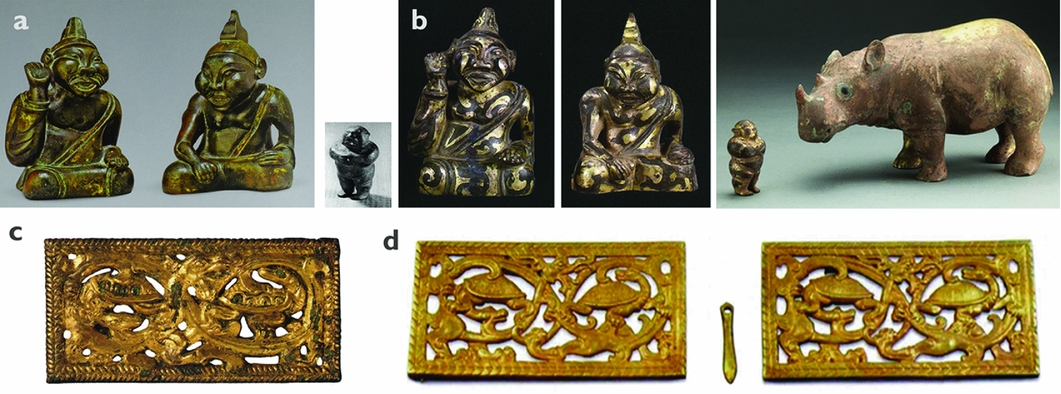
This high degree of standardisation may have been achieved by using the same models and casting moulds. The mould-pressing technique has the advantage that patterns could be accurately repeated with minimum effort. In addition, the continual use of the mould-casting method that originated with the Shang Dynasty in the fifteenth century BC allowed the repetition of identical designs on different series of metalwork. Gilt bronze weights depicting musicians and bald human figures, found in the princely tombs at Dayunshan and Mancheng, had strikingly similar features of decoration and production technique (Zhongguo 1978: pl. 60; Nanjing Bowuyuan 2013b: 36). Their stylistic affinities suggest that they were probably made in imperial workshops where craftsmen learned and transmitted their knowledge through practice. Other examples include gold belt plaques with tortoise and dragon motifs from Dayunshan tomb 9, similar to those found in the Nanyue tomb (Figure 9) (Nanjing Bowuyuan 2013c: pl. 12).
Bronze weights: a) Mancheng: musicians from tomb 1, height: 78mm; standing figure from tomb 2, height: 44mm (after Hebei Bowuyuan 2014: fig. 83); b) Dayunshan tomb 1: musicians, height: 75mm; standing figure, height: 47mm (photograph courtesy of Li Zebin); gold belt plaques: c) Nanyue, length 81mm (after Li Reference Li2007: 101); d) Dayunshan, length: 87mm (after Nanjing Bowuyuan 2013c: pl. 12).

Imperial Chinese workshops employed labour-saving methods, such as modular construction, standardisation and an institutionally managed division during the Qin and Han periods (Ledderose Reference Ledderose2001; Barbieri-Low Reference Barbieri-Low2007: 67–95). Lacquer wares provide further evidence for standardised production under imperial rule. The wine cups with birds depicted opposite one another were widely found in aristocratic tombs throughout the Han Empire, and also appear in the Xiongnu elite burials at Noyon Uul, Mongolia (Polos’mak et al. Reference Polos’mak, Bogdanov, Chistiakova, Kundo, Brosseder and Miller2011: 327–32). The inscriptions on these indicate that they were prestige goods produced in both central and provincial governmental lacquer workshops in present-day Xi'an and Chengdu. The considerable uniformity of design, in shape, dimensions and motifs of the wine cups served to highlight imperial control, regardless of the different workshops behind their production. These prestige lacquers played a crucial role in the communication of ideology and political legitimation through various rituals and ceremonies (Liu Reference Liu2012: 76–77).
Concluding remarks
The archaeological record of Western Han elite tombs at Dayunshan and other sites reveal a world of power and prestige where gold, as portable wealth, was used as a status symbol. The high degree of standardisation attests to strict control of gold production in the Han Dynasty. Some ornaments were probably made in the central governmental workshop and served as imperial gifts, while others were produced in regional workshops. The manufacture of these gold ornaments borrowed foreign techniques, such as mould-pressing, filigree and granulation. The appropriation of these methods began no later than the fourth century BC in north-western China, probably through contact with mobile pastoralists along the north-western frontiers who were continuously interacting with peoples of the steppes in eastern Kazakhstan and the Altai Mountains. The technological novelty represented by the Han luxury gold was not simply an elaboration of existing techniques. Access to distant places, peoples, technologies and objects is frequently used by elite groups in the negotiation of power. In Han society, foreign design was appreciated not just as something foreign, but as something new, rare, different and precious. The adoption of such exotica in goldworking was clearly motivated by the need to create material symbols for newly acquired social and military power.
Acknowledgements
I am grateful to Jessica Rawson of the Institute of Archaeology, University of Oxford; Li Zebin of the Institute of Archaeology, Nanjing Museum; the Chinese University of Hong Kong; and to the Shaanxi Provincial Institute of Cultural Relics Protection for invaluable comments and references. Particular thanks are due to Katheryn M. Linduff and Margarete Prüch for their careful reading of my manuscript and helpful feedback and suggestions.