Since a self-consciously “modern” Chinese literature came into existence at the start of the twentieth century, its theorisers have searched for standards and aims – both international and domestic – by which to evaluate it. Uncertainty and self-doubt have often prevailed through the country's past century of extraordinary political and cultural upheaval. “Pray, where,” Chen Duxiu, a leading light of the May-Fourth-era New Culture Movement, asked in 1917, “is our Chinese Hugo, Zola, Goethe, Hauptmann, Dickens or Wilde?” (Liu Reference Liu1995, 188). Even as a proletarian line took hold through the 1930s and 1940s, Communist Party officials still urged writers to strive for “works of art of a world standard” aimed at “higher” audiences (Holm Reference Holm1991, 57, 65). This quest to define literary norms and ambitions intensified after the death of Mao, as the country's cultural establishment fell prey to a full-blown Nobel Complex: critics asked what was so wrong with Chinese literature that it had apparently failed to join the modern world literary order symbolised by awards such as the Nobel Prize. Concern about Chinese authors' professional commitment has remained a constant through the post-1992, market-dominated decades. Writers have become “desecrated and polluted,” commented a critic in 2007. “They have abandoned their sense of responsibility, for power, profit and desire” (Lei Reference Lei2007). In summer 2010, the Beijing rumour-mill reported that anxiety about China's literary output had even infected the Politburo: the leadership was allegedly concerned that although contemporary China was currently in a “great era” (weida shiqi), the country's writers were failing to produce any commensurately “great works” (weida de zuopin). The nation's literary experts were promptly instructed to debate a solution to the problem.
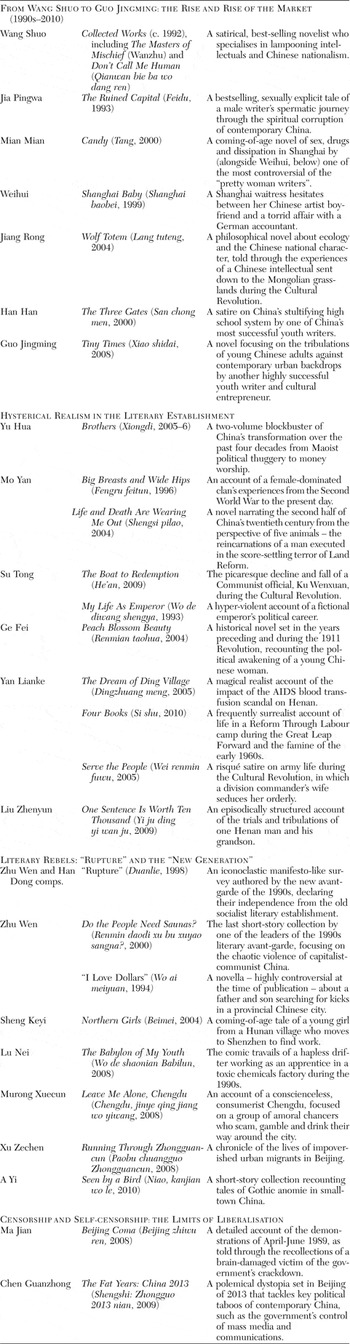
This article will assess the changing landscapes of PRC fiction during the first decade of the new millennium.Footnote 1 It will investigate how writers have coped with key developments in Chinese society and media that have remade publishing and artistic conventions: in particular, the acceleration of commercialisation, the rise of the Internet, and the Communist Party's subtly changing attitude to creative freedom. This tale of transformation will be told through examining the creative responses of three generations of writers: authors born since the late 1970s and 1980s; mainland China's most established, critically acclaimed novelists (born in the 1950s and early 1960s); and the so-called “New Generation” of authors, born in the late 1960s and 1970s, who rose to critical prominence in the 1990s to pose an artistic challenge to the socialist cultural establishment (see appendix 1 for an author index).
From Wang Shuo to Guo Jingming: the Rise and Rise of the Market
One of the great obstacles to surveying recent Chinese fiction is the overhaul of literary values that began at the start of the twentieth century, and that is still ongoing.Footnote 2 Between 1900 and 1920, Chinese intellectuals radically reorganised the hierarchy of genres: fiction, once disreputably popular, replaced poetry as the elite expressive form. Writers discarded classical Chinese – for millennia, the most prestigious language of literary creation – in favour of an increasingly Europeanised vernacular. Over the next five decades, Maoist literary bureaucrats tried to abolish altogether the category of the professional author. As millions of intellectuals – including writers and critics – were banished from the cities to the countryside, the poet-apparatchik Guo Moruo proclaimed that “cultural work must be led by amateurs who have mastered Marxism-Leninism” (Goldman Reference Goldman1967, 241).
Writers made an impressive comeback in the 1980s, dominating public life with a “culture fever”: high-flown debates about China's rightful path to enlightenment and modernisation. But this resurgence of literary elitism was short-lived. As the catchphrase of the market economy-oriented 1990s became wang qian kan (“look towards the future,” which, in Chinese, neatly punned the word for “future” on that for “money”), many writers abandoned the idealistic intellectual stance dominant in the 1980s and joined in the capitalist free-for-all. With the literary market flooded by entertainment products and the government phasing out the iron rice-bowl (the Communist promise of a salary for life to its state-sponsored writers), some serious novelists abandoned literature almost totally and instead took the plunge into business. A number of those determined to live off their writing tried to follow the trails to commercial success blazed by two of their peers: Wang Shuo and Jia Pingwa. Having won national, popular acclaim in the late 1980s with a string of best-selling novels that specialised in lampooning intellectuals, in the early 1990s Wang showed his fellow authors how to squeeze maximum profit out of their words, repackaging his own as songs, screenplays and television shows. He also set a precedent in negotiating for the first time a generous royalty rate for his books; his bestselling and well-marketed Collected Works made him a millionaire. In 1993, Jia – a critically acclaimed nativist chronicler of northwest China in the 1980s – became one of the first, famous cases of a serious writer turning to sensationalism, with the publication of The Ruined Capital (Feidu), a sexually explicit tale of a male writer's spermatic journey through the spiritual corruption of contemporary China for which, rumour had it, Jia was paid an advance of one million yuan.
Two developments in the late 1990s further accelerated this literary commercialisation. The first was the much-noted emergence of the “pretty woman writers” (meinü zuojia): in particular, the two Shanghai authors, Mian Mian (1970-) and Weihui (1973-), who became notorious for their tales of sex, drugs and general dissipation in Shanghai, in novels such as Candy (Tang) and Shanghai Baby (Shanghai baobei) (Mian Reference Mian2000, Weihui [1999] 2002). As these writers began to star in magazine features and book promotions, immaculately dressed and made up for their public appearances, personal image became crucially important to publishing success. They united literature and the market: authors began to sell themselves, as well as their writing.
A new figure in the publishing industry emerged around this time, to assist in whipping up media frenzy around such incidents: the “book-merchant” (shushang) – savvy cultural entrepreneurs acting as private publisher, agent, and publicist rolled into one.Footnote 3 While the country's exclusively state-run publishers remain officially the only organisations permitted to use ISBN numbers, in the market-conscious 1990s these presses began increasing their profit margins by selling numbers to shushang (who used them for their own highly commercial titles). In countries like Britain or America, it is usually publishers (and, to a lesser extent, agents) who are responsible for publicising books. In China, however, such activities are managed by smart, well-connected book-merchants, who orchestrate ingenious publicity campaigns for their books: launches, book-signings and banquets attended by academic and media glitterati; and extensive press and book review coverage (in which the book merchant personally pays the reviewers). Such campaigns reputedly also make use of more dubious techniques: bribing prize judges, starting mendacious rumours to grab media attention (usually about sales or advances), inventing puffs to adorn back covers. The promoter for the Reference Jiang2004Wolf Totem (Lang tuteng) by Jiang Rong (Lü Jiamin) – a surprise bestseller given its densely philosophical disquisitions on ecology and the national character – is said to have fabricated a story that the book (with its message that the Chinese must nurture the ruthless “spirit of the wolf” in order to survive and prosper) inspired the Chinese national basketball team to reverse a string of recent defeats; astronomical sales resulted.
Another crucial event of the late 1990s was the advent of the Internet, which transformed the old, high-to-low writer-reader relationship. Li Jingze, an editor since the 1980s at People's Literature (Renmin wenxue), one of the top literary journals of the socialist cultural establishment created after 1949, experienced this change firsthand.
Before the Internet, modern literature had been an elite activity; writers had to undergo a highly specialised training to be successful. Magazines and publishing houses were all very elite; their judgements ruled, and it was extremely tough for writers to break through without their sponsorship. But the rise of the Internet gave any ordinary person power over production – it did away with unilateral literary values. In the 1980s, if a critic like me said a thing was good, then it was. Now, however, the Internet can trash people like us. And through the Internet, writers can contact readers independently. It's hard to say still what sort of artistic value Internet fiction – which is a massive genre in China today – has or will have. But it has had a great influence in remaking the modes of literary production. Before, everything was decided between literary magazines, publishers and the critics. Now, it's all about the relationship between readers, the market and the Internet. (Li Reference Li2010)
On the one hand, the arrival of the Internet has democratised literature in China, as in other parts of the world. It has benefited aspiring writers, giving them a means of communicating directly with readers (even if the former are not always paid for this). It has also empowered readers, who take ample advantage of the opportunities for interaction offered by literature websites, leaving lengthy comments on particular works of fiction. The tone of these appraisals in turn influences how many readers a particular work will attract. On the other hand, market forces – rather than true artistic pluralism – seem to have been the ultimate beneficiary. With immediate reader appeal the measure of success, fast, cheap, popular literary forms dominate.Footnote 4 (Authors writing specifically for China's most popular literature websites – which were recently taken over into a single, big-business structure by the entertainment company Shanda – are expected to churn out around ten thousand characters a day). Tales of young, affluent urbanites and chick-lit melodrama top the literary hit parades on such websites. Fantasy genres are also enormously popular: in particular, escapist “time-travel” storylines, in which the hero or heroine is reincarnated in different periods of Chinese history (often undergoing sex-change) and embarks upon a series of lurid adventures. The rise of the Internet has completed the merger between literature, entertainment and profit that began in the early 1990s, providing a direct platform for publicising books through adverts, interviews, author blogs and videos.
All this, some believe, has fundamentally remoulded reading habits in a country that historically has apportioned a special prestige and respect to writers of “serious” literature. “Readers have grown impatient with literary language,” observed Li Jingze, speaking again from personal editorial experience.
They want instant gratification. Poetic, metaphorical language seems ridiculous: a waste of time…And the Internet has done terrible things to professional editing standards: websites don't care about the quality or discipline of the writing, as long as their writers are producing their daily ten thousand words. Because of the writing and editing standards set by the Internet, traditional print editors feel less able to force their writers to accept editing. So if writers don't have much innate technical ability, then they're stuck, as their publishers have lost the editing habit, and the demands of the market mean that a book has to come out a month after the manuscript has been submitted. These days, there are too many different literary standards, and many of them are conflicting. For example, writers are judged by the number of hits they get. As a result, public understanding about literature has been destroyed: most readers are educated by the values of the Internet. (Li Reference Li2010)
It is easy to see how web-addiction might erode the concentration required for more serious literary reading. Both the Anglophone and the mainland Chinese Internet seem specifically designed to create attention deficit disorders. On Chinese literature websites, browsers are assaulted by flashing adverts, popularity charts and incidental music, and on any one page are torn between hundreds of alternative clickable links. Although Twitter was quickly banned in China, home-grown microblogging sites have proliferated, habituating readers to gobbets of text no longer than 140 characters.
Writing and publishing of the past ten years have thus been dominated by Internet-driven market forces and the mass media. Many of the best-selling writers in China today have made their millions by writing explicitly for this new reading market's largest demographic: high school and university students. Two of the most famous examples – who belong to the commercially cyber-savvy generation of writers born in the 1980s (“post-1980 authors”, 80 hou zuojia) – are the writers Han Han (1982-) and Guo Jingming (1983-). Han Han surged to national prominence when, after dropping out of high school, he wrote a novel about rebelling against China's stifling education system, entitled The Three Gates (San chong men, 2000). Guo Jingming produces fantasy novels, or stories focusing on the tribulations suffered by young Chinese adults against contemporary urban backdrops. This writing is fast, slick and, in Han Han's case, cleverly satirical. It is expressly designed to appeal to the very local concerns of the urban youth market: the sector of the reading market with the most leisure time and disposable income. Guo and Han have also become remarkable cultural entrepreneurs, promoting and managing their own personality cults in a far more sustainable way than the “Pretty Woman Writers” did at the turn of the millennium. Women like Weihui flaunted their youthful bodies both in their writing and in their promotional activities, and harvested short-lived national and international attention before their sell-by dates caught up with them. Guo and Han have been similarly careful to trade on their images: Guo never appears in public without enough (at least several hours') notice in which to do his hair and make-up; a part-time race car driver, Han cultivates a spiky coiffeur and a rock-star persona. But the two authors have also sought to build larger business empires to promote their creative brand. Both have founded magazines (Zui xiaoshuo and Hechangtuan) featuring their own writing, and that of writers they have chosen to sponsor. Through his own entertainment company, Guo Jingming runs an annual literary contest to select and publish younger writers who, like him, tend to focus on the lives of young Chinese urbanites. Both Guo and Han have profited enormously from the new publicity opportunities offered by the Internet, littering the web with text and video links to their activities. Han Han has attracted huge national and international attention through his topical, provocative blog, while Guo publishes extracts of his work and his magazine on the web, as a taster to draw in readers.
In a slightly more stable publishing and reading community, the line between “literary” and “popular” writing (including most genre fiction – romance, detective, thriller and so on) might be a little more clearly drawn, with some discerning reviewers and academics usually ready to take a stand if they feel that low-brow authors are getting taken too seriously. In China, the speed at which literary and publishing practice has changed makes this distinction almost impossible. “Genre fiction has completely taken over in the past ten years,” remarked Bai Ye, a seasoned chronicler of contemporary Chinese writing. “Serious literature used to be everything that was published; now, it's only a third” (Bai Reference Bai2010).
Many pillars of the literary establishment have contributed to this blurring of standards, robbing the profession of important quality-control mechanisms. As market hype threatens to drown out reasoned literary judgement, nationally renowned professors of Chinese (for a fee, of course) have taken to puffing work of uncertain literary value either in public talks or in reviews. At a book launch held at Beijing University in 2010, one of the literature department's most senior professors produced the following rhapsody for the author whom he had been paid to promote: “This book is like a balloon: let it float high over its readers, so they can see how beautiful it is…It will fly a long way, higher and higher and higher and higher, into a splendid future.” Another of China's most respected scholars of contemporary Chinese literature introduced a bestselling chick-lit novelist as “one of our country's finest authors born in the 1970s”.Footnote 5 (It is hard to imagine – for example – Terry Eagleton or Stephen Greenblatt saying something similar about doyennes of contemporary Anglophone chick-lit such as Sophie Kinsella or Lauren Weisberger.) Most Chinese writers readily acknowledge that their country's reviewing system is corrupted. “In the West,” the novelist Han Dong (1961-) remarked, “I understand that something called ‘conflict of interest’ tends to prevent people writing reviews of their friends' books. In China, it is the other way round. You only write a review if the author is your friend. And it's usually the publisher or the book-merchant, not the newspaper or magazine, who pays for the review” (Han Reference Han2009).
Hysterical Realism in the Literary Establishment
Yet some values have persisted through this transformation of literary practice and taste. First of all, despite the growing dominance of the Internet, authors remain conventionally fixated on getting into print and into bookstores. The Chinese media periodically pronounces that the book is doomed; that the country has more writers than readers of poetry; that young people are forgetting how to read and write Chinese characters, because they have grown up with character-input software that emphasises fluency in pinyin Romanisation. But the aisles of Beijing's multi-floor bookstores are crowded with readers. True enough, the most popular sections tend to be business, textbooks and self-help. But fiction departments are also congested, and about half the bookshelf space is filled with “Internet Literature” – novels that were published first on the Internet, before being reissued in print form. As in other national writing communities, most new-style Chinese Internet authors aspire to seeing their book in traditional hard copy.
Moreover, although younger authors such as Han Han or Guo Jingming might possess the most economic capital, older authors enjoy far more cultural capital. The list of the most famous writers in China today has arguably not changed much since the 1980s, and remains dominated by figures like Mo Yan (1955-), Yu Hua (1960-) and Su Tong (1963-), who rose to prominence during that decade. There are several plausible explanations for this. First, theirs is the most mature generation to have begun writing during the explosion of literary innovation and cosmopolitanism made possible after the death of Mao. Currently in their late forties or fifties, they are at the height of their creative and intellectual powers. Institutional factors could also have contributed. Theirs is more or less the last generation to benefit from a Writers' Association iron rice-bowl. In the economic restructuring of the 1990s, the government stopped offering this source of guaranteed income to new writers, meaning that younger generations had to rely more heavily on commercial gimmickry to earn a living. Older authors, such as Mo Yan, perhaps enjoyed more financial security in the early stages of their career, giving them the confidence to experiment with themes and language while they developed their voices and reputations amid the exceptional burst of creativity that followed the Cultural Revolution. Li Jingze, who began to publish some of these writers in the 1980s, thought there was another reason for these writers' fame.
Their celebrity is more down to when they got famous – in the 1980s. Back then, the circulation of People's Literature was 1.4 million. You could write a few short stories and a couple of novellas and become a celebrity. Mo Yan and others like him are still living off the symbolic capital they won thanks to this decade's unusually intense response to literature. Let's consider, by contrast, authors who began writing in the late 1990s or afterwards. Maybe they write better than Mo Yan or Yu Hua, but whatever happens their early material – if they start out getting published in one of the literary magazines – will reach no more than 40,000 readers (People's Literature now has a circulation of 60,000, and that's pretty good-going). And if you acquired readers in the 1980s, they're more likely to stick with you – people who go to Yu Hua's book talks these days tell him they started reading his fiction in the 1980s, and have kept with him since. (Li Reference Li2010)
This generation of authors can enhance their fame through savvy use of the well-developed book markets and media in China. In order to publicise the novel Brothers (Xiongdi, [2005–6] 2008a), Yu Hua's book-merchant arranged an enormously successful nationwide publicity tour; the book became one of the runaway bestsellers of China's early twenty-first century. In the eyes of many literary journalists, critics and other writers, these authors' tremendous prestige derives also from the rather dubious perception that they enjoy equal fame in the West. In the 1980s, the possession of an “international” (in reality, a Western or Anglophone) profile through translation was essential to making a literary reputation in China. Despite the much-reported rise of Chinese nationalism since the 1990s, this preoccupation with Western recognition seems barely to have lessened.
The fame of this group of authors attests again to the persistence of traditional literary values among China's reading and writing community. And since they have won national and international acclaim as the most artistically assured representatives of contemporary Chinese writing, it is worth subjecting to critical scrutiny some of the preoccupations and techniques that unify their oeuvres. Since at least the 1920s, the dominant form in Chinese literature has been realist fiction, generally in the sweeping, Tolstoyan style, focused on “big” political events – War, Revolution, Nation and so on. Mo Yan and his peers have directly inherited this fondness for grand narratives, turning the historical novel into the pre-eminent serious fictional genre of the last fifteen years: consider Mo Yan's Big Breasts and Wide Hips (Fengru feitun, [1996] Reference Mo2010) and Life and Death Are Wearing Me Out (Shengsi pilao, [2004] Reference Mo2006); Su Tong's The Boat to Redemption (He'an, [2009], 2010a); Ge Fei's (1964-) Peach Blossom Beauty (Renmian taohua, Reference Ge2004) and its sequels; Yu Hua's Brothers. Although Su Tong has reached deep into imperial history, to create surreal, mythical narratives such as My Life As Emperor (Wo de diwang shengya, Reference Yu, Wang and Zhao1993), for the most part his peers have concentrated on recounting the twentieth century, and particularly the Communist decades through which they themselves lived.
Mo Yan has searched for provocative retellings of the familiar, traumatic narratives of modern Chinese history in his novels of the last decade and a half. In Big Breasts and Wide Hips, he tried to give a feminised account of the recent Chinese past, from the Second World War to the present day. By filling his novel with feisty women (and their breasts), and by replacing the patriarchy with a bosomy matriarchy, Mo Yan mounted a protest against China's oppressive, male-dominated political establishment and its sanitised account of the recent past. His obsession with breasts and the impulsive female characters to which they are attached was clearly designed to give bumps and curves to the smooth, authoritarian façade of Communist Chinese history: to recount the chaotic lives of Chinese individuals during decades of war and revolution. Full of brutality, injustice and sex, Life and Death are Wearing Me Out rollicked in epic style from 1950 to 2000, narrating a half century of Chinese experience from the perspective of five animals – the reincarnations of a man executed in the score-settling terror of Land Reform. Su Tong's The Boat to Redemption described the arbitrary tragicomedies of Maoist class designations, tracing the decline and fall of a Communist official, Ku Wenxuan, during the Cultural Revolution. In Brothers, Yu Hua created a two-volume blockbuster of China's last four decades: a portrait of the country's transformation from Maoist political thuggery to money worship.
Yet although this preoccupation with China's recent past lends an aura of intellectual seriousness to the works of authors such as Mo Yan and Yu Hua (in contrast with the lighter, here-and-now concerns of young, popular writers), it can at the same time erode their literary discipline. In both Big Breasts and Wide Hips and Life and Death are Wearing Me Out, Mo Yan's initial ambition to create challenging counter-narratives (by featuring voices some way outside the political mainstream, such as those of women or animals) risks becoming lost in a scramble through a checklist of the monumental landmarks of Maoism: Land Reform, the Great Leap Forward, the Cultural Revolution, and so on. This obsession with modern history has also started to have an arguably negative impact on the sophistication of these writers' novelistic language. Authors who choose to write realist fiction about the Maoist era must tussle with a technical dilemma: how to write about events of exceptional crudity and violence without their writing becoming itself crude and violent. Su Tong, Yu Hua and others seem to have decided that verisimilitude can be achieved only through a style of similar coarseness. Their narratives are dominated by excessive descriptions of violence, toilet humour, bodily fluids and noisy sex. A sample from The Boat to Redemption – evoking the piercing voice of a broadcaster – is representative of a general predilection for overstatement:
The slogans thundering from her… actually caused the historical counter-revolutionary Yu Wensun to lose control of his bladder up on the platform. On another occasion, a corrupt bookkeeper… fainted dead away…her shouts were full of noble aspirations and daring; they pierced the heavens and crackled like magnificent yet graceful thunderclaps in the sky above Milltown, sending chickens flying and ducks leaping, and striking cats and dogs dumb. (Su Reference Su and Goldblatt2010b, 46)
Su Tong has argued back that “these were violent, vulgar times; you have to use violent, vulgar language to describe them.”Footnote 6 Yu Hua has used similar logic to justify the extreme crassness of Brothers: his country, he has argued, is now “so sick that a writer can't pretend to be a doctor. Instead, the best one can do is admit that one is ill and try to describe the symptoms” (Johnson Reference Johnson2009). However, this style of writing becomes (if over-used) a rather blunt literary device – a mimetic fallacy. Successful realist fiction inevitably requires an author to process the raw materials of everyday life, and through the second volume of Brothers, Yu Hua's refusal to do this weakens the novel. Much of the text is heavy with exaggeration (a black eye is “the size of an apple”; the sexual excitement of the book's anti-hero, Baldy Li, generates “two streams of blood gushing from his nose into his mouth”) or facetious use of cliché (the novel is peppered with adverbs and formulaic fortune-cookie proverbs). The novel rarely achieves the humour that it is attempting, largely because its tone and plot are so hyperbolic that few punchlines can properly stand out.
Convincing character development suffers at the hands of this exaggeration. In 2000, the British literary critic James Wood coined an infectious new term, “Hysterical Realism”, to describe bulky, zany contemporary Anglophone novels written by authors such as Thomas Pynchon, Don Delillo, Zadie Smith or David Foster Wallace: “books that know a thousand things but do not know a single human being.” By vandalising plausibility through their perpetual chaotic motion, Wood felt, these novels destroy the possibility of meaningful ethical utterance. He pleaded instead “for novels that tell us not ‘how the world works’ but ‘how somebody felt about something’ – indeed, how a lot of different people felt about a lot of different things (these are commonly called novels about human beings)” (Wood Reference Wood2001). Although Wood was referring to British and American writers, his criticisms could equally be applied to the style of fiction favoured by China's most acclaimed novelists, who abandon themselves to the riotous tragicomedy of modern China's transformations, piling (at great length) outrageous event upon outrageous event, picaresque character upon picaresque character, without deepening our knowledge of any one individual.
To apply to Chinese writing literary standards from the Western novelistic tradition is, it could well be countered, blatant cultural imperialism. The norms of the Chinese fictional tradition have inevitably differed from those of the West. Canonical works such as Journey to the West (Xi you ji) or The Scholars (Rulin waishi) are episodic collages of set-pieces, rather than plots unified around highly developed characters and the consequences of their actions (Wu 1973, Wu 1977–83). Indeed, Mo Yan's recent fiction has self-consciously made use of forms associated with traditional vernacular fiction and drama, such as the linked chapter format (zhanghuiti). But it's worth pointing out also that the brand of hysterical realism recently practised by contemporary China's most prestigious novelists has been a far from ubiquitous narrative strategy, hardwired into them by a centuries-old fictional tradition. It breaks conspicuously with the tonal discipline of Lu Xun's (1881–1936) short stories; or Shen Congwen's (1902–88) brief, intimate snapshots of rural life in war and revolution. Alternatives have thrived in the post-Mao era, too, and the literary past of a leading hysterical realist such as Yu Hua forms a striking contrast with the stylistic excess of Brothers. Until he published Brothers, Yu Hua owed his immense literary fame in Mainland China to a series of highly controlled, often surreal narratives about the moral disintegration of post-1949 society.Footnote 7 But in Brothers, he abruptly discarded the cool, sparing voice that made his name as a serious avant-garde novelist between the 1980s and 1990s, in favour of a style that was crude in almost every respect: in its freakish protagonists and plot twists; in its fondness for repetitions and expletives; in its fountains of body fluids.
The relatively recent vintage of contemporary China's hysterical realism, then, suggests that it is less a venerable literary tradition, and more a pretext for failing to find subtler ways of chronicling the traumas of modern China – a symptom, perhaps, of the slapdash impatience that runs rife through China's marketised literary economy, and that affects professionalism in both writing and editing. (Mo Yan, one rumour goes, is supposed to have written the 500,000-plus characters of Life and Death Are Wearing Me Out in forty-three days.) Mo Yan, Su Tong and Yu Hua are authors with proven creative track records in the novel and short story, whose long fiction of the past decade has perhaps lost its focus amid the confusion of literary and critical standards that China's transformations have introduced.
A couple of recent novels by Yan Lianke (another renowned author of Mo Yan's generation, b. 1958), The Dream of Ding Village (Dingzhuang meng, Reference Mo and Goldblatt2005a) and Four Books (Si shu, 2010), have sought more disciplined literary idioms for retelling Communist history. Like Life and Death Are Wearing Me Out and Brothers, both Yan's books take as their backdrop key events from the recent past. The former focuses on the AIDS epidemic caused by corruption and negligence in blood-selling in 1990s Henan; the latter on the 1960s famine generated by forced collectivisation. But Yan avoids the facetious burlesque of Mo Yan and Yu Hua by framing these events within more carefully crafted structures and language. Alternating between dream sequences (describing how the government exploits the profiteering potential of the AIDS epidemic) and a realist account of the sufferings of rural AIDS victims, The Dream of Ding Village offers both a powerful allegory of the moral vacuum at China's heart, and a chronicle of how one manifestation of this lack of conscience – the blood contamination scandal – destroys a community. Yan maintains an impressively detached, laconic tone through much of the novel, and even inserts the occasional touch of (extremely) black humour, intensifying – through artful use of contrast – the tragic quality of his subject matter.
In Four Books, Yan's subject is the apogee of Maoist extremism: the Great Leap Forward as experienced by political prisoners in a Labour Reform camp. Here, the narration alternates between four voices: between that of a child who has – as an emblem of the absurdist times, in which intellectuals and technical experts were ousted by fanatical Communist ideologues – been appointed prison-guard over a camp of intellectuals; and between those of three inmates. Through its unconventional use of language (Yan often resorts to a consciously mythical style, directly inspired by the Chinese translation of the Old Testament), its multiple narrators, and its surreal descriptions of political theatre, the book frequently achieves a surprising lyricism that contrasts sharply with the literary coarseness of some of Yan's peers.
Yan's narratives do not always successfully steer clear of melodrama, nor maintain perfect technical control. His writing is sometimes implausible and overwrought, while the pastiche of biblical language in Four Books is periodically over-used, resulting in a book that is too slow and lacking in psychological drama. Neither is Yan averse to using sensationalism to sell his books. He won national and international notoriety with Serve the People (Wei renmin fuwu Reference Yan2005b): a racy account of an army orderly's affair with his division commander's wife. But at its best, Yan's fiction searches for challenging, creative ways to narrate some of the most significant taboos of post-1949 history, the corrosive effects of Maoist repression on ordinarily decent individuals, and the price that contemporary China's urban economic miracle has exacted from rural populations.
For all their stylistic differences, authors such as Mo Yan, Yan Lianke and Yu Hua are united by their obsession with Chinese politics, a creative preoccupation that risks subordinating individual, emotional experience to the big, collective story of modern nation-building. In its attempt to construct a novel of twentieth-century China that transcends a state-defined chronology, Liu Zhenyun's (b. 1958) recent novel, One Sentence Is Worth Ten Thousand (Yi ju ding yi wan ju, Reference Liu2009), is a notable literary experiment. Liu made his name in the 1980s and 1990s as a sympathetic, humorous chronicler of the trivial infuriations of everyday socialist life: as a member of the so-called neo-realist group of writers who, after the forays into modernism and magical realism of the 1980s, sought a return to the quotidian, focusing on the details of petit-bourgeois urban existence.
The plot of One Sentence Is Worth Ten Thousand can be simply described. It traces the efforts of two men – Yang Baishun, and his grandson, Niu Aiguo – to forge meaningful relationships over the course of their lives. The first half of the book is entitled “Leaving Yanjin”, the small town in northern Henan in which Yang grows up and marries. Although his marriage is a humiliating failure, it also generates a genuine attachment for his step-daughter, Qiao Ling. This, however, ends in tragedy when Qiao Ling is kidnapped by a human-trafficker and is spirited away to Shanxi. A heartbroken Yang leaves Yanjin to make a new life elsewhere; he never sees Qiao Ling again. The second half is entitled “Returning to Yanjin”, and narrates the eventual return to Yanjin of Qiao Ling's son, Niu Aiguo, through the disappointments of broken friendships and a disastrous marriage. Formally, the book is reminiscent of traditional vernacular fiction: the narrative seems to be a chain of linked episodes, briefly introducing then abandoning a large cast of characters. But Yang Baishun's and Niu Aiguo's quests for emotional understanding bring cohesion to this sprawl of protagonists and events, while Liu Zhenyun's low-key approach to presenting action and dialogue enables a handful of personalities and a few moments of entente to stand out.
Although One Sentence is a novel set in the recent Chinese past (roughly from the 1920s to the present day), Liu determinedly omits all mention of the significant political events (the 1911 Revolution; the Civil War; the Communist Revolution, and so on) that sometimes dominate the work of his peers. At most, he suggests a period through occasional slogans or commodities: the phrase “Save the Nation, Save the People” mouthed by a local educationalist evokes a vaguely May-Fourth ambience; an “East Is Red” brand tractor locates part of the second half of the book in the Mao era. In the novel, chance plays a far more important role than politics: accidental encounters periodically defuse murderous rage; careless, angry indiscretions ruin reputations. Liu's focus is individual, rather than collective and political: he has set himself the challenge of exploring the inner lives of the least articulate and least educated members of rural society. This dictates a cautious approach: an intensely interior account of his characters would foist upon them an inauthentically intellectualised self-awareness. Here, Liu demonstrates fine self-restraint, communicating emotional anguish through descriptions of external action. Readers accustomed to the more immediate psychological portraits of Western realism may initially find the book puzzling and frustrating; but once they have habituated themselves to its episodic rhythms, it becomes a surprisingly effective and humane book.
Literary Rebels: “Rupture” and the “New Generation”
Another ambitious literary generation is sandwiched between the grand narrative-preoccupied novelists born in the 1950s–60s, and the more commercialised “post-1980” authors. Throughout the 1990s, a so-called “New Generation” of writers began to receive increasing critical attention. This loose classification referred, at its vaguest application, to novelists born in the late 1960s and 1970s who began publishing after 1989, but also, more usefully, implied certain shared literary characteristics: a strongly individualistic and, particularly in the case of its female representatives, private voice, often focused on the cadences and banalities of contemporary everyday life. As much as anything, this generation defined itself by what it vehemently believed it was not, dismissing many of the themes and concerns espoused by their literary predecessors. In 1998, Zhu Wen – one of the leaders of the young 1990s avant-garde – published “Rupture” (Duanlie), a manifesto-like survey polling the iconoclastic opinions of his New Generation on the Chinese literary scene, past and present. Its respondents dismissed canonical establishment authors, contemporary critics and literary magazines as utterly irrelevant. Questions such as “what assistance does the Writers' Association offer you?” garnered the response “public washroom.” “Dressed-up piles of shit,” someone else commented on state literary prizes (Zhu Reference Zhu1998).
These younger writers have left the fictionalisation of recent history to those who can meaningfully remember it: to authors born in the 1940s, 1950s or, at the latest, the early 1960s. Members of the “new generation” have concentrated far more on the here-and-now: crafting tales of dislocation and disappointed romance among urban women (Sheng Keyi, Dai Lai, Wei Wei); capturing the socialist Gothic of collective life in an increasingly unplanned economy (Zhu Wen, Lu Nei). The artistic significance of this generation lies in its ambitions to produce writing that illuminates the complexity of the feverishly capitalist society that the Chinese Communist Party has been building since 1992, without uncritically mirroring its consumerist individualism (in the style of more populist authors). These writers – led by the compilers of “Rupture”, Han Dong and Zhu Wen – have attempted to carve out a space for writing incisively about contemporary China outside the Communist cultural establishment. (With the collapse of the iron rice-bowl in the 1990s, many of the New Generation were obliged to become “free writers” (ziyou zuojia), existing outside the old-style socialist literary system, in contrast with members of Mo Yan's generation, who still draw a modest salary from the Writers' Association).
In career moves emblematic of the bewildering fluidity of contemporary Chinese culture, some of the most promising voices of this generation have abandoned writing for other creative forms. Arguably, one of the greatest losses is Zhu Wen's defection to film-making in 2000. The five short-story collections that he published in the 1990s established him as a writer of rare talent, able to combine a fearless grasp of the chaotic violence of capitalist-communist China with a sense of humour. His gift for evoking the brutal comedy of post-Tiananmen China turned him into a cult anti-Establishmentarian for his own and for succeeding literary generations. While much recent Chinese fiction by younger authors has reflected the country's commercialism without plumbing its shallowness, Zhu Wen's dark writing evoked the inhumanity of a country in meltdown between communism and capitalism. Yet despite its touches of brilliance, Zhu Wen's fiction of the 1990s also had the rawness of an angry young man's vision: it sometimes reproduced too faithfully the vulgar anomie of life in the contemporary People's Republic (Zhu 2007). In the three full-length feature films Zhu Wen has completed since 2000, he has demonstrated increasing control, as well as human sympathy, in his handling of characterisation and plot. But the literary world has not felt much of the benefit of this matured perspective – he has only written one short story since 2000.
Nonetheless, other writers have persisted in writing Zhu Wen's tough, contrarian style of fiction, narrating the harshness of life in contemporary China in an easy, sometimes playful vernacular. One of these authors is Murong Xuecun (b. 1974), whose novel, Leave Me Alone, Chengdu (Chengdu, jinye qing jiang wo yiwang, Reference Murong2008), painted a fast and nasty picture of life in Sichuan's provincial capital. Its protagonists are a coterie of amoral chancers who scam, gamble, drink, grope, brawl and impregnate their way around a variety of venues in Chengdu. The narrator himself is an individual who prides himself on having his “hands drenched in the blood of virgins” and who encourages his own wife to have affairs, with only one stipulation: If she manages to swindle her lovers out of money, he wants half. “I knew,” he writes, “that behind Chengdu's prosperous façade, the city was slowly rotting. A steaming hot tidal wave of material desire surged destructively through the city, corroding every block of stone, every soul like uric acid…Yesterday, God died/ Heaven is full of maggots.” In a country that, it should be remembered, has been officially building a “spiritual socialist civilisation” since at least 1996, this scandalous portrait of life in the contemporary People's Republic offers an important counter-vision to the government's ongoing attempts to reassert Communist orthodoxy. Back in August 2010, Propaganda Chief Li Changchun emphasised that “strengthening the Party's leadership, with socialism as the key value, over cultural production and construction is the key task and basis for developing a flourishing culture…Artistic production must have its basis in the practice of building socialism with Chinese characteristics, and fix its eyes on the vanguard of scientific cultural development in the world…it must create a progressive, nationally cohesive culture” (Anon., Reference Anon2010b). The accounts of a conscienceless, consumerist society penned by authors such as Murong Xuecun are implicitly critical of the status quo, expressing a negative vision of China today and, by logical extension, of the political architects of this society.
Yet for all its documentary power, Murong Xuecun's fictional work (which first found a following on the Internet) remains proudly amateurish: he sees himself only as a part-time novelist, tasked with the job of exposing, in journalistic style, the iniquities of contemporary China. He writes “for fun…has never had any ambition to make it big in Chinese literary circles, and doesn't have any interest in dealing with ‘profound’ social issues” (Anon., Reference Anon2004). In his rough, naturalistic approach, the line between novel-writing and exposé blogging is becoming increasingly smudged. He refuses to see the point of some aspects – for example, character development – of the novel's more traditional mandate: “Some of the books which have won the Mao Dun Literary Prize tend to spend a lot of words on a family's history or things like that. It's really a waste of time” (Anon. Reference Anon2010a).
But among the writers born in the 1970s who have published steadily through the 2000s, a few names stand out, for their ambition to move beyond the solipsistic boundaries of youth fiction and for their disciplined approach to psychological realism. One is Xu Zechen (b. 1978), who has dedicated himself to chronicling the drifting lives of a major new underclass in Chinese society: impoverished urban migrants. The narrative perspective of a book like Leave Me Alone, Chengdu remained an elite one: the narrator and his friends were poetry-writing graduates, confident masters of their own destinies. The city's migrant population appeared as bit-parts, usually to be sexually exploited then thrown off. Xu, by contrast, has struggled to give these individuals a convincingly human literary voice. He is particularly good at evoking their material discomforts: the constant threat of expulsion and imprisonment; the social and economic structures that confine them; the chance errors that can determine their fate (Xu 2008). A second author of interest is A Yi (b. 1976), a policeman-turned-novelist. His short stories focus – with a fine, laconic tonal control – on the heartlessness of contemporary China, on the ignorance and desperation that trap the exploited rural poor, and on the violent rage lurking behind the complaisant front of the downtrodden and humiliated [Seen by a Bird (Niao, kanjian wo le, Reference A2010)]. At present, it is unclear whether such writers have the professional persistence necessary to produce oeuvres to rival those of mature authors such as Mo Yan and Yu Hua; but the creativity and discipline that they have so far brought to chronicling China today mark them out as talents to watch.
Censorship and Self-censorship: the Limits of Liberalisation
Freedom of expression for Chinese writers has significantly broadened over the past three decades, as once no-go zones have opened up: sex, drugs, violence, even aspects of Communist history. Assuredly, there have still been high-profile examples of literary censorship: the banning of Shanghai Baby and Candy; and of Yan Lianke's two novels, Serve the People and The Dream of Ding Village. Nonetheless, much of the fight has gone out of attempts to censor literature, with the government concentrating its efforts instead on the mass media (newspapers, broadcasting and film). Fiction seems to enjoy considerably more freedom than television or film, particularly when discussing the recent past. Contrast, for example, the saccharine patriotic messages advertised by the War of Resistance dramas ubiquitously available on Chinese television, with the scurrilous portrayals of modern history in books such as Life and Death Are Wearing Me Out. Since the 1990s, moreover, authors overstepping the censor's line have rarely felt direct pressure themselves; instead, it is the publisher that has been punished (after the banning of Shanghai Baby in 2000, for example, the book's publisher was shut down for several months). Authors, by contrast, have often been able to use the “banned in China” label to enhance their own celebrity: since Shanghai Baby at least, a state-ban has frequently led to books becoming viral bestsellers in pirate editions, and to lucrative international publishing deals.
Literary opinion about the nature, extent and effects of censorship in China today is very divided. By 2000, according to many critics, Chinese writers could write about anything they wanted without fear of severe reprisal, and even with the prospect of financial gain – if they did not write directly about politics. Ask Chinese writers how much freedom that they enjoy, and the answers will vary hugely, according to how controversial their own writing is. The London-based author Ma Jian – celebrated for his 2008 novel of the Tiananmen protests, Beijing Coma (Beijing zhiwu ren, Reference Ma and Drew2008, Reference Ma2009) – has described his entire generation as “brainwashed”; he has railed against contemporary Chinese writers for acquiescing in a government-enforced political amnesia about events such as the 1989 crackdown. The former Minister of Culture Wang Meng, by contrast, argued in 2007 that writers were completely free to write about social problems, as long as they steered clear of politics – although he did not clarify where, exactly, the line between “social” and “political” criticism lay. In 2005, a chronicler of the trials and tribulations of the white-collar tribe felt that he was 90% free to write what he wanted; an angry young poet chose 40%; another non-establishment writer in his late thirties felt that writers theoretically had 60% freedom, but only used 20%.Footnote 8 The seasoned reader and editor Li Jingze, similarly, wondered if readers and writers actually wanted more liberty. “Are they really interested in politics? Of course, there's a lack of political freedom in Chinese literature today, but also a lack of enthusiasm for political subjects” (Li Reference Li2010). Xu Zechen agreed: “The last thing you want to do is try to make your readers think hard about anything,” he sighed. “It'll hurt your sales” (Xu Reference Xu2010).
But although the influence of Party orthodoxy might be far less crudely visible in contemporary Chinese culture than it was during the 1950s–80s, it is no less present, and certain topics (such as the massacre of 1989; or probing and questioning the overarching structures of CCP power and control) are clearly out-of-bounds. Richard McGregor's recent study of the CCP, The Party, described a society in which Party control remains quietly ubiquitous: through public and private businesses, local politics, media and culture (McGregor Reference McGregor2010). The Communist literary system of authority has adapted skilfully to the changing cultural and political environment of the 1990s and beyond. The Writers' Association now portrays itself as a politically neutral organisation (that offers services such as contract advice and forums for bringing together writers, critics and publishers), drawing in previously contrarian writers such as Mo Yan (who officially represented Chinese literature at the 2009 Frankfurt Book Fair). It was, Zhu Wen has declared, the government's suppression of “Rupture” that made him decide to stop writing and turn to film. He observed, in wryly admiring tones, that the Communist Party became far more “scientific” in its censorship techniques through the 1990s. In 1993, the official media widely excoriated his novella, “I Love Dollars” (Wo ai meiyuan), about a father and son searching for sexual kicks in a provincial Chinese city, as “hooligan writing”; the scandalous attention caused an immediate sensation on the mainland literary scene. When “Rupture”, with its powerful anti-establishment message, was published, someone in the Propaganda Department simply told the press not to discuss it. “With ‘Rupture’, our generation was saying: We won't become creatures of the system. But the system wouldn't tolerate me; so I gave up, I couldn't change it…If writers can't be troublemakers, we shouldn't exist. Especially in China, where there's no freedom of speech. Literature should intervene in life; and if it can't do that, I'm not interested” (Zhu Reference Zhu2010).
In a 2011 speech that was itself censored in China, Murong Xuecun also protested against the stifling censorship rife through contemporary writing, recounting weeks spent wrangling with an editor anxious to remove the merest whisper of political contention from Murong's latest book.
The only speakable truth is that we cannot speak the truth. The only acceptable viewpoint is that we cannot express a viewpoint. We cannot criticise the system, we cannot discuss current affairs…We have not only lost the right to criticise, but the courage to do so. Why is modern China lacking in great writers? Because great writers are castrated while still in the nursery. (Murong Reference Murong2011)
Yu Hua – a regular participant in Writers' Association activities and highly successful commercial author – proclaimed his dissident status in Reference Yu2010: “I stipulate in all my contracts that my manuscripts can't be touched editorially; not a word can be taken out. That's because there's a lot of politically sensitive material in there” (Yu Reference Yu2010). But although the highly negative portrayals of modern China in Yu Hua's Brothers contradict the Writers' Association exhortation in 2000 that writers should “make positive contributions” to sounding an “elevated main note in literary creation,” the book (relative to his earlier novels, such as To Live) ultimately pulls its punches when it comes to seeking the origins of modern China's sickness (Chinese Institute of Modern Literature 2009). The horrific violence of the Cultural Revolution, for example, is portrayed as an irrational explosion of mass thuggery, without any attempt to search for deeper causes (in, say, Communism's institutionalisation of violence and in its caste-like system of class designations). What has arguably resulted from ongoing Communist literary censorship is a body of fiction often rich in commercial shock value – in its explicit descriptions of sex and violence – but weak in its grasp of the political roots of China's problems.
The audacious plain-speaking of a Chinese-language dystopia of 2009, entitled The Fat Years: China 2013 (Shengshi: Zhongguo 2013 nian, 2009), illuminated the political limits within which most contemporary Chinese fiction still operates. Here is a brief plot summary. In 2011, two years before the novel begins, the world has been rocked by a second financial crisis, following which China immediately enters what its Communist Government has officially named the “Fat Years” of prosperity and contentment, avoiding the West's economic Armageddon. No-one in an eerily placid Beijing (where the novel is predominantly set) seems to have anything negative to say about the country; all unhappy memories have been erased and once-available critiques of Communism have disappeared from bookshops and libraries. It is eventually revealed that, since taking control of the country through martial law in 2011, the government has been pumping an ecstasy-derivative into the drinking water and all bottled beverages, to ensure that the population enjoys a constant, artificial high. It has withdrawn all trace of critical political writing (past and present, literary and journalistic) from circulation; the only place that oppositional views can briefly appear, before being deleted, is the Internet. The majority of urban Chinese, meanwhile, have tacitly agreed to forget past political violence, and concentrate on enjoying the bread and circuses of the present day.
In high Orwellian/Huxleyan style – and with laudable narrative restraint – the novel tackled the great political taboos of contemporary China: mass acquiescence in erasing public memory of events such as 1989; the willingness of once dissident figures to participate in the brave new commercial, consuming world of the 1990s and beyond; the government's control of mass media and communications. And there was a simple reason why this Sinophone novel could come into existence: although illicitly distributed in mainland China, it was written by a Hong Kong national, Chen Guanzhong, and published in Hong Kong.
The Fat Years is not a perfectly executed work of fiction: its final third is more a political and economic lecture than a novelistic denouement. But by highlighting so clearly where most mainland novelists fear to tread, it became a major talking point among liberal intellectuals in the People's Republic. “Now we know what China's near future will be like,” observed one blogger, while chic party-hostesses handed out copies of the book as a take-home gift.Footnote 9 One writer did not wholly identify with Chen's vision of China's near-future, but “at least he's willing to point out some of the holes in our fancy tapestry. He's the only Sinophone author to make the attempt, unfortunately. And it's we Chinese writers who are to blame for that.”Footnote 10
Conclusion: A Profession in Flux
Contemporary Chinese fiction is often an unfinished project, bearing the scars of the political and cultural ruptures of China's past century, and of recent changes in global culture. Over the past ten years alone, literary writing has contended with an international revolution of the reader-writer-market relationship through the advent of the Internet. It has been enriched by new expressive and publishing opportunities offered by the growth of new digital media, impoverished by the premature exodus of young, gifted writers from fiction, to film, blogging, journalism and celebrity culture, and limited by ongoing political constrictions on literary freedom. Many promising, independent-minded talents have set about chronicling one of the biggest cultural stories of the century: the resurgence of China. What we have perhaps not yet seen is sufficient professional commitment – from writers, reviewers and editors – to create a body of fictional work linguistically and stylistically sophisticated enough to express the vast human complexity of this transformation. At present, it remains predominantly a story in fragments: of occasionally brilliant short fiction, and of ambitious premises not sustained throughout the duration of the long novel. Talents have burned bright, then faded. Some of the most critically acclaimed post-Mao writers have not so far maintained their initial creativity and technical discipline over the course of decades-long careers, while younger authors have switched professions or have yet to produce the oeuvres that their gifts seem to promise. “But it's the era that's to blame,” long-term observer Li Jingze has concluded. “And you can't do anything about that. Every three years, China changes completely; it's no wonder that writers can't get a handle on it” (Li Reference Li2010).
Acknowledgements
I would like to thank Mark Leenhouts and the Journal of Asian Studies' anonymous reviewers for their acute comments on an early draft of this article.
Table of Authors Discussed in Text