Introduction
The term ‘black medicine’ is used to describe the worldwide phenomenon of informal payments for health care (Gaal et al., Reference Gaal and McKee2006; Cohen, Reference Cohen and Mizrahi2012). This term includes both illegal activities, such as bribing a doctor, and actions that may be considered marginal in terms of the law, such as giving a gift to a doctor or making a contribution to his or her department so as to obtain better treatment. A variety of explanations – that can be classified as cultural, economic and/or institutional (structural) – for the phenomenon of informal payments for health care may be found in the literature. However, due to the complexity of the phenomenon and its various configurations, it is difficult to suggest a systematic framework that integrates all these explanations into one model.
Economic explanations for informal payments for health care, in general, and for ‘black’ payments, in particular, argue that when the public system does not offer sufficient scope and choice of services and there are no private alternatives, the motivation of consumers and suppliers of health care services to use black medicine increases. However, recent indications from studies conducted in Israel, for example, imply that the economic model is not always applicable or relevant (Cohen and Mizrahi, Reference Cohen, Mizrahi and Yuval2012; Cohen et al., Reference Eilifsen and Willekens2012). That research, notwithstanding, until the present study there were no comprehensive qualitative and quantitative data on the phenomenon: the last systematic survey exploring black medicine in Israel was published more than 15 years ago (Lachman and Noy, Reference Lewis1998).
The present research studies the scope of the phenomenon in Israel, challenging the claim that the existence of private channels within a public system will, by the very nature of such a situation, prevent the possibility of black medicine. Through the examination of the variables linked to the use of black medicine, we put forward an alternative explanation, arguing that the blurring of the boundaries between public and private health care services may contribute to the emergence of black medicine, because it erodes patients’ trust in the public health care system, while – as Gaal and McKee (Reference Gordeev, Pavlova and Groot2004) argued – informal payments are a function of general distrust in the public system. We start by discussing the common explanations for black medicine and for informal payments for health care, while stressing the phenomenon and its context in the Israeli case. Then, we test the validity of the common explanations and present insights on the Israeli case.
Current explanations for the emergence of black medicine
Black medicine, possibly the most problematic form of informal payments, represents a phenomenon that is quite common in former communist, Asian, South-American and African countries (Allin et al., Reference Allin, Davaki and Mossialos2006; Lewis Reference Liaropoulos and Tragakes2007; Stringhini et al., Reference Tatar, Ozgen, Sahin, Belli and Berman2009; Cohen, Reference Cohen and Mizrahi2012; Gordeev et al., Reference Graeff and Svendsen2013). The term ‘black medicine’ refers to a variety of illegal and semi-legal actions taken by individuals to obtain health care services. Such actions include, among others, direct payments to physicians so as to move up on the waiting list (especially for surgeries); payments to physicians to guarantee personal treatment; donations to research funds of the hospital department where the patient is being treated with the aim to receive better treatment; payments for treatment that is supposed to be given free of charge in the framework of the regular health care insurance in the hope of improved care; and the use, without permission, by physicians of hospital instruments and public facilities to treat their private patients (Cohen et al., Reference Eilifsen and Willekens2012). These payments interfere with resource allocation, represent a form of regressive tax with negative consequences on equity of access, contribute to the de-motivation of health care workers, have negative effects on access to and quality of services, impede efficiency, produce ‘cream-skimming’ and affect the solidarity principle that grounds public health care systems (Stringhini et al., Reference Tatar, Ozgen, Sahin, Belli and Berman2009; Chereches et al., 2013).
The literature offers a wide variety of explanations for the existence of black medicine. While most studies focus on low-income and non-developed countries (Ensor, Reference Gaal, Belli, McKee and Szocska2004; Gaal and McKee, Reference Gordeev, Pavlova and Groot2004: 164), the phenomenon also exists even in more prosperous countries, including member countries of the OECD and developed countries such as Mexico (Liaropoulos and Tragakes, Reference Mizrahi, Vigoda-Gadot and Cohen1998; Hofbauer, Reference Lachman and Noy2006: 43–45; Tatar et al., Reference Toper and Barzilai2007; Cohen, Reference Cohen and Mizrahi2012). Reports in the literature claim that the frequency of informal payments ranges from ‘3% in Peru, 20% in Bulgaria and 21% in Albania, to 87% in Georgia, 91% in Armenia, and 96% in Pakistan’ (Chereches et al., 2013: 106).
There are several leading explanations for the emergence and expansion of informal payments in health care (Cohen, Reference Cohen and Mizrahi2012). Cultural explanations depict informal payments as a custom rooted in society (Gaal and McKee, Reference Gordeev, Pavlova and Groot2004). Economic explanations attribute informal payments to the fact that services are free at the point of entry; to the excess of demand vis-à-vis the availability of providers; to excess supply of capital and human resources; to low salaries; or to an underdeveloped private sector. Institutional explanations point to the lack of accountability and government supervision, the lack of transparency and the lack of information.
Gaal and McKee prefer the term legal-ethical to refer to causes related to the lack of accountability or poor regulation (Gaal and McKee, Reference Gordeev, Pavlova and Groot2004; Allin et al., Reference Allin, Davaki and Mossialos2006). These authors (Gaal and McKee, Reference Gordeev, Pavlova and Groot2004) made a significant effort to develop a behavioral, cognitive model that is based on the economic approach. In extending the exit/voice/loyalty model of Hirschman (Reference Hofbauer1970) with the aim to analyze informal payments, they argued that when the internal and external channels of influence are blocked, the individual will not work through the formal channels, for instance, by lodging a complaint, but will resort to informal channels, such as payments or personal connections. Nevertheless, this activity cannot be considered as an exit strategy because it is performed within the organization itself. They called this strategy inxit and argued that informal payments somehow resemble voice, since the dissatisfied patients do not abandon the organization but use payments as a means to cause the organization to improve its services. However, informal payments mostly resemble exit, since they do not, in fact, contribute to the improvement of the organization as a whole (Gaal and McKee, Reference Gordeev, Pavlova and Groot2004: 167). Gaal and McKee, Reference Gordeev, Pavlova and Groot2004: 171) argued that inxit emerges in health care systems where exit and voice are not readily available options.
Gaal and McKee (Reference Gordeev, Pavlova and Groot2004) further suggest that even though the research and the model are based on the reality in Hungary (and are hence easily applicable to former communist countries), it is possible that the model may fit other countries with the same characteristics. Indeed, the rationale for this model does provide a very good framework for the analysis of the phenomenon. However, according to this economic explanation, in a system with a developed private service, where physicians can increase their earnings by working privately and where patients (those who can afford it) can choose between private medicine or for a legal form of inxit (legal private channels within a public system), we would not expect to find black medicine.
Cultural explanations consider informal payments, in general, and black medicine in specific, as a form of political behavior that is rooted in all layers of society. The cultural explanations were developed to explain the emergence of black medicine in former communist countries, all sharing similar patterns of relationship between the individual and the public sphere. Thus, it is difficult to apply cultural explanations to non-communist countries, which are characterized by very different patterns and attitudes toward the public sphere.
Institutional or legal–ethical explanations consider black medicine to be the result of a lack of regulation and/or enforcement. Another factor included in institutional or legal–ethical explanations is the existence of ‘greedy physicians’. However, given the same institutional constrains it is not clear at all why physicians should be greedier in certain countries than in others, and current legal–ethical explanatory frameworks do not detail what are the institutional or legal frameworks that explain the emergence of particularly greedy physicians.
Economic explanations and the behavioral model developed by Gaal and McKee (Reference Gordeev, Pavlova and Groot2004) regard the phenomenon to be the result of the way certain health care systems are designed, i.e., systems that embody shortage, excess demand due to ‘freeness’, restriction of consumers’ sovereignty and lack of choice, poorly paid physicians and the lack of a developed private alternative that provides an exit for those dissatisfied with the public health care service (Gaal and McKee, Reference Gordeev, Pavlova and Groot2004; Allin et al., Reference Allin, Davaki and Mossialos2006; Cohen, Reference Cohen and Mizrahi2012). While those explanations are indeed able to account for the prevalence of black medicine in former communist countries, they are not able to explain the fact that Nordic countries have been known to offer limited exit from the public system while corruption is very low and there is no evidence of the existence of black medicine. In a different way, the Israeli case also challenges their main assumptions. As we will show below, black medicine is relatively significant in Israel, even though, as we will discuss in the following section, Israel’s health care system does not embody the characteristics inherent in the economic causes for the emergence of black medicine.
The Israeli case: blurring the boundaries between public and private
In the Israeli health care system, financing is both public and private (through private insurance schemes and as ‘out-of-pocket’ expenditure). Provision of health care services is also both public and private, as the state, the city, the non-profit sector and the private sector all own health care facilities.
The Israel Ministry of Health is responsible for planning and supervision of health care and for preventive medicine, but it also runs hospitals and psychiatric services. The sick funds administer and provide almost all primary and secondary care, and they finance (and sometimes provide) hospitalization services. Voluntary non-profit organizations also run hospitals and provide emergency care. City councils are responsible for preventive care and public health services, and some even run hospitals. The private sector provides out-patient treatment, laboratory testing and medical imaging, and hospitalization (mostly following elective surgical procedures).
Since 1995, the public health care system has been financed by an ear-marked ‘health tax’ and by the government (from the general budget). The government covers the gap between the health tax monies and the defined cost of the health basket, but not the gap with the sick funds actual expenditure. The government also finances public health and preventive services.
Since 1998, the government’s share of the national health expenditure has declined every year, thereby shifting health care costs to the public in the form of ‘out-of-pocket’ payments or private insurance. By 2012, public financing of the national health expenditure had fallen to an unprecedented low of 61.3%, while private spending represented 36.8% of national health expenditure (OECD, 2011).Footnote 1 The process of partial privatization is not limited to the increase in private financing but also in private provision of services. Between 1995 and 1997, the services provided by the private sector represented 23% of the national health expenditure. Following the 1998 Budget Reconciliation Law there was a sustained increase in the private sector share, which reached 27% in 2003.
The increase in the private sector is reflected in the increase in the share of the national health expenditure currently provided by ‘market producers’, which has currently reached 55.6%. It should be noted, however, that part of this increase results from the fact that in 2003 the Central Bureau of Statistics adopted the System of National Accounts, which considers as ‘market producers’ all those institutions that sell their products at full market price (including government-owned facilities). The significant increase in the share of market producers in 2003 reflects the blurring of the division between public and private.
In an ongoing process that began in the late 1990s, public hospitals run private services, such as institutes for plastic surgery, and public sick funds sell private insurance and run private diagnostic facilities. Government-owned public hospitals are required to behave as business firms and to ‘sell’ their ‘products’ at full market price (Shirom and Amit, Reference Shirom and Amit1996). The transformation of government-owned public hospitals into ‘market producers’ has been a gradual process that has taken place over the last 15 years. As estimated by Professor Gabi Bin Nun (former Deputy General Director of the Ministry of Health), by the late 1990s, 90% of hospital activities were determined by the health basket and 10% were activities ‘sold’ by hospitals (Bin Nun, Reference Bin Nun1999). Between 1994 and 1996, the Ministry of Health allowed public hospitals to sell private services of up to 20% of their income (Shirom and Amit, Reference Shirom and Amit1996). Government-owned hospitals developed new services and increased profitable activities, such as coronary by-pass surgery and cardiac catheterization, and financially rewarded physicians involved in those activities.
The hospitals incorporated these private and semi-private initiatives into their routine activities via three main instruments: Sharap (acronym for Private Medical Services), Sharan (acronym for Additional Medical Services) and private facilities within the public hospitals. Sharap is a system by which patients may choose their physician in a public hospital by paying an additional fee. Sharan is a system by which public hospitals sell services not included in the public health basket to the health funds, to private insurers or to individuals. As yet another source of income, public hospitals and the sick funds have opened private services – and even private hospitals – that provide profit-making services (among them, plastic surgery clinics, private obstetric wards and private surgery for tourists).
Not only public hospitals sell private services, the sick funds also sell services that are not included in the public health basket, such as alternative medicine and cosmetic medicine. In addition, all the sick funds have developed private health insurance schemes (though, not as the schemes sold by private insurance companies, those are schemes without underwriting and community rated) that cover procedures and drugs not included in the public health basket. In a complete blurring of the differences between the private and public sectors, public sick funds sell private insurance for procedures peformed in private hospitals by physicians who are paid on a fee-for-service basis but who are also salaried employees at public hospitals. In addition, two of the sick funds (known as Kupat Holim Clalit and Maccabi Healthcare Services) provide private dental care and own for-profit hospitals that specialize in elective surgical procedures. This complicated and sinuous relationship between the sick funds and the private system considerably blurs the differences between the public and private sectors.
According to the accepted economic explanations, or even to the model of McKee and Gaal, in Israel we should not expect to find black medicine, in the same way that there is no evidence of black medicine in Western European countries such as the United Kingdom, Germany, France, Spain or the Scandinavian countries. In a system with a developed private service, where physicians can increase their earnings by working privately and where patients (those who can afford it) can choose between private medicine or a legal form of ‘inxit’ (Sharap in the public hospitals and the private insurance sold by the public sick funds), there is no reason for the existence of black medicine. To estimate the current scope of black medicine and to search for possible explanations for the phenomenon, we conducted a study that combined quantitative and qualitative methodologies. As we show in the following section, the phenomenon is more widespread than the extent expected in a society with a well-developed private system. This finding requires an explanation that differs from the dominant economic explanations offered to date.
Methodology and results
The research was based on a questionnaire with both closed and open questions. The questionnaire was administered in the spring of 2013 in Hebrew and Arabic, as relevant, via a national telephone survey, to a proportional stratified sample of 1105 adults (all over 30 years). The demographic characteristics of the sample matched the population distribution and were representative of the general Israeli population (Central Bureau of Statistics, Reference Cohen2013). The sample included 494 men (45%) and 611 women (55%), with most participants (85%) being married. The age of the youngest interviewee was 30, and that of the oldest was 90. The average age of the respondents was 52.5 years (SD 13.3). Among the respondents, 882 (80%) were Jewish and 223 (20%) were Arab. Among the Arab respondents, 76% were Muslims, 12% Christians and 12% Druze. Most respondents in the Jewish sector (64%) indicated the definition of ‘Israeli’ as their identity. The response rate was 0.67. The questionnaire, which was administered anonymously, received the approval of the ethics committee of the University of Haifa. Data analysis was performed using SPSS software.
Measures
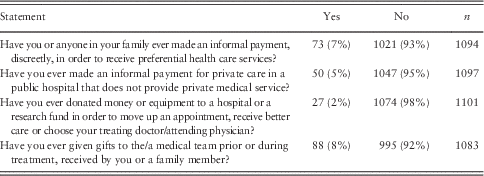
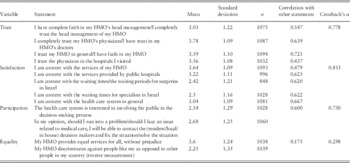
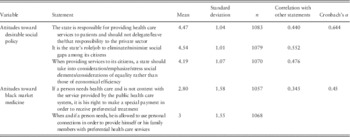
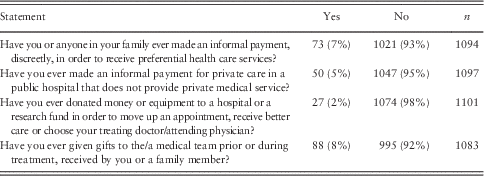
To evaluate the extent of black medicine in Israel, we asked respondents to answer the four questions listed in Table 1, and we considered that respondents answering positively to any one of these questions used black medicine. To measure variables that we believed to be associated with black medicine, we used a Likert scale (1=strongly disagree, 5=strongly agree) to build our main complex undepended variable trust. The statements in this index were based on theoretical logic and on the literature discussed above (content validity). Reliability tests (Cronbach’s α) were conducted to verify the suitability of the measures. Details of statements of these variables and their Cronbach’s α values are listed in Table 2. In addition, we examined whether there is a relationship between black medicine and attitudes toward the phenomenon. Measures of public attitudes toward black medicine and toward desirable social policy are detailed in Table 3.
The use or non-use of black market medicine
Independent variables

Attitudes toward black market medicine and the desirable social policy in Israel

The use of black medicine requires not only motivation but also ability. It is possible that there will be those who are willing to pay informal ‘black’ payments, but for various reasons (e.g., lack of financial capability) they will not be able to do so. Therefore, we sought to examine the relationship between Israeli attitudes toward the phenomenon of black medicine and trust in the health care system (Mizrahi et al., Reference Morone2010). We also sought to examine whether feelings of inequality are associated with attitudes toward black medicine. We expected to find positive relationship between perceived inequality and attitudes toward black medicine.
Finally, we examined the relationship between various socio-demographic variables (gender, age, education, religion, religiosity, level of health, income, economic status and geographic region) and black medicine.
Research findings
The findings presented in Table 1 indicate that for the year of the survey, black medicine did indeed exist in the Israeli health system. For example, 12% of all respondents in the sample paid black payments for health care services. Among them, more than half (7% of the total) indicated that they or one of their family members had paid an informal payment to discreetly receive improved health services. The remaining 5% answered yes to the question: “Have you paid an informal payment for private care in a public hospital outside of private health services?”
To evaluate the scope of the phenomenon in Israel, we asked the question: “Were you requested – explicitly or implicitly – by a doctor in a public hospital to pay him/her or to contribute to a research fund to ensure that s/he would take care of you or to move up in the queue?” Out of all the respondents who answered this question (1091), only 6% said ‘yes’.
Our research results indicate that the main reasons for black payments were by-passing the queue, choosing a particular doctor and/or a desire to receive preferential treatment. From the answers of the respondents who paid black payments, it was possible also to learn that most of the payments were for procedures related to surgery (50%) and others were for ‘other medical treatments’ (24%). The rest of the respondents preferred not to specify for what medical procedure they had paid black payments. We also found that out of all the interviewees who declared that they paid black payments, 64% did so in hospitals in central Israel, 27% in hospitals in the north of the country and 8% in hospitals in the south of the country. One percent of respondents reported that they had paid black payments in a hospital abroad.
Our findings showed that the majority of Israeli citizens do not believe that those who pay black fees are treated better. For example, 47% did not agree at all and 14% disagreed with the statement: “I think the medical care we received was not as good as we would have received if we would have contributed money to the department or hospital”, 11% agreed with the statement and only 12% strongly agreed. Half of the respondents did not agree at all and 16% disagree with the statement: “I think the medical care we got is not as good as we could get if we paid money discreetly to see a doctor or nurse”; 9% agreed with the statement and only 11% strongly agreed. Similar findings were also obtained regarding the effect of black payment on by-passing the queue. Forty percent did not agree at all and 15% disagreed with the statement: “I think we waited for the procedure longer than we would have waited if we had paid”; 12% agreed with this statement and 18% strongly agreed with it.Footnote 2
We asked the respondents whether they thought other citizens paid illegally to obtain health care services (projection questions) and whether they knew of an acquaintance or relative who had paid for black medicine. From the responses, it was possible to learn that with regard to ‘other people’ the size of the phenomenon grew significantly. For example, 28% of respondents agreed or strongly agreed with the statement: “I think most people in Israel will pay a doctor a discreet informal payment to improve their condition and the condition of their families”,Footnote 3 and 59% agreed or strongly agreed with the statement: “In my opinion, those who can do so, will use personal connections (favoritism) to receive preferred healthcare”. In addition, 14% of the respondents stated that they knew of an acquaintance or a relative who had offered or had been asked to pay an informal payment discreetly to a doctor to receive preferential health services or to jump a queue, and 41% noted that an acquaintance or a relative had used close personal connections to obtain preferential health services or to move to the head of the queue.
Personal connections, of course, are not considered as black medicine. According to Cohen’s (Reference Cohen and Mizrahi2012: 290) typology of informal payments for health care, this behavior may characterize in most cases as ‘gray payments’. In this case the payments are paid in indirect and circuitous ways. The supplier of public health care services may not be paid directly or immediately. However, as the literature already suggested, it is very difficult to create a dichotomy between black and gray informal payments – both in and out of health care systems; wherever the existing political culture sanctions the supply of public goods and services through the black and gray market, one should expect the phenomenon of informal payments for health care as black and gray payments (Cohen, Reference Cohen and Mizrahi2012: 303).
Paradoxically, the vast majority of respondents (74%) considered black medicine to be morally wrong. Only 2% viewed the phenomenon positively; 18% found both positive and negative sides to the phenomenon; and an additional 6% were indifferent to the phenomenon or had no opinion in the matter.
Trust and black medicine
The primary dependent variable was the use of black medicine, as defined above, and the secondary dependent variable was the attitude toward the use of black medicine. The main independent variables in our study were, as stated above, trust in the health care system. The associations between the independent variable were examined using the χ 2-test. For this examination, we grouped the independent variable into two levels (high=above the median; low=below the median).
The statistical analysis of the results suggested that trust in the health care system was significantly associated with the use of black medicine (χ 2 (1)=6.32, p=0.012). Our findings showed that as trust decreases, the use of black medicine increases.
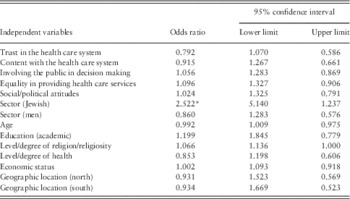
Socio-demographic characteristics (specified above) were also examined. The associations between each of these characteristics and each of the dependent variables were analyzed using the χ 2-test. To perform the analysis, we aggregated some of the demographic variables levels. Of the overall variables, the only variable that had a significant association with the use of black medicine was the respondent’s ethnicity. Primary analyses are presented in Table 4.
Logistic regression results for the use of black market medicine (complete model)

*p<0.05, n=964.
We found that the higher the respondents’ level of trust toward the health care system, the lower the rate of black medicine use, i.e., there is a negative correlation between trust and black medicine. Yet – given our research design we are not able to determine casual order between black medicine (a clear configuration of corruption) and trust.
Testing the effect of corruption on trust is theoretically important and empirically challenging. As Uslaner (Reference Uslaner2008) explains, the causal order is important because both trust (or social capital) and corruption have consequences. Scholars disagree about the causal order between the two variables. Some found that people who have faith in others are more likely to endorse strong standards of moral and legal behavior (Uslaner, Reference Shirom and Amit1999, Reference Uslaner2008). Others suggest that people who believe that the legal system is fair and impartial are more likely to trust their fellow citizens (Rothstein, Reference Rothstein and Stolle2000). Effective regulation has also been linked to enhanced trust in the system (Eilifsen and Willekens, Reference Ensor2008). Others claim that low trust may indeed lead to high levels of corruption, but there is no ‘reverse’ causality of corruption on trust (Graeff and Svendsen, Reference Hirschman2013; Uslaner, Reference Uslaner2013). Our findings support the inverse relation between trust and levels of corruption, but our study did not test the inverse relation.
Qualitative analysis of the survey findings
To strengthen the qualitative significance that the research subjects ascribe to their views as reported above in the quantitative findings, we analyzed the text in the respondents’ answers to the open question: “Would you agree to tell us about an experience in which you were required to or felt that you or one of your family was required to pay a ‘black’ payment in order to receive better treatment than others”? Although this textual analysis can provide only a general impression rather than systematic conclusions, it reveals significant findings and insights regarding mixed public/private channels and black medicine.
The qualitative analysis raises several interesting, yet disturbing, findings. In essence, we found that private care in the public system (Sharap) takes on the characteristics of black medicine. We found that many doctors ‘lead’ their patients in the public hospitals to the private options within the hospital instead of to the ‘regular’ public channels. Given the long-waiting times and given that not all procedures in public hospitals are performed by the leading experts, many patients implied, and sometimes explicitly stated, that they were told that a (legal) payment for private care (e.g., consulting the doctor via Sharap) would improve their situation vis-à-vis others. Moreover, given the asymmetry of information in favor of doctors, many respondents reported having been told by the doctor that the next available appointment would be a few months away and therefore having been advised to resort to private care to speed up the procedure. Among the many similar stories, one of the participants reported: “…when he was hospitalized one of the doctors suggested that if he wanted better care he should come to his [the physician’s] private clinic”. Another respondent stated: “the specialist said that if I wait in the [public] waiting list it will take a long time… but if I so request he can perform this surgery privately…”.
Our findings also indicate that physicians often refer patients from public hospitals to their private clinics. Among the many examples, one respondent reported: “[we came to the] physician who works in a public institution and also has a private clinic; after we paid $600 for the visit, the physician moved us forward in the queue for treatment in the public hospital [where this physician works]”. A different interviewee stated: “[I]…needed surgery and they told me that if I pay 50 thousand [shekels] I will be operated on immediately… the doctor referred me to the private clinic where he was working…” A third interviewee explained: “…the doctor led me to understand that if we will pay him more, then he will recommend that there is an urgent need for treatment…”.
The interviews also showed that there were patients who were referred from public hospitals to private institutions. For example, one of the interviewees reported: “A doctor suggested that the treatment would be speeded up by [my] coming to his private laboratory… [He] was a doctor in a public hospital…”. Another respondent described what may be considered as ‘aggressive marketing’: “Dr. […] tried to convince my mother to do the operation in… which is a private hospital… where he was getting a lot of money… His secretary called her to see where things are standing…”.
Discussion
Our findings show that black medicine is a significant phenomenon in Israel, even though the private system is a viable option for patients who can afford it and even though a substantial percentage of the Israeli population (between 70% and 80%) has insurance schemes sold by the public sick funds, i.e., insurance that allows them a legal form of ‘inxit’. Our research also shows that the lower the trust in the health care system, the higher the chances that an individual will resort to black medicine. In Israel, black medicine cannot be explained by the accepted economic explanations presented above or by the ‘inxit’ model for the following reasons: the private system is rich in resources and is growing rapidly; physicians may increase their earnings significantly by combining work in the public and private systems;Footnote 4 and patients who can afford it (as ‘out-of-pocket’ expenditure or through private insurance) enjoy relatively free choice. Both users and providers have the alternative to ‘go private’ if not satisfied with the public supply. Why, then, is black medicine still relatively significant?
The answer to this question is complex. Cultural characteristics and poor regulation partly explain the persistence of the phenomenon. The phenomenon of ‘alternative politics’ proposed by one of us partly explains black medicine in Israel (Cohen, Reference Cohen and Mizrahi2012, Reference Cohen2013).Footnote 5 Alternative politics refers to specific strategies adopted by individuals and groups in response to their dissatisfaction with the declining availability of government services. More specifically, alternative politics is based on a ‘do-it-yourself’ approach in which citizens adopt extra-legal or often illegal strategies to improve the services provided by the government. In many cases, such strategies are adopted by individuals who want to solve immediate problems, such as obtaining more responsive and better-quality services from the government. These actions are described as alternative, because this informal behavior becomes an integral part of the political culture and political behavior processes. As the literature demonstrates (Ben-Porat and Mizrahi, Reference Horev and Keidar2005), a variety of structural factors and social processes cause many members of Israeli society to adopt an activity pattern that can be described as creating faits accomplis. Such actions arise when the government fails to provide public goods and services in the quantity and quality that satisfy the public. Citizens, therefore, take matters into their own hands and find other means of satisfying their needs.
Poor regulation also contributes to the persistence of the phenomenon. As Cohen (Reference Cohen and Mizrahi2012: 304) claims “…[C]ountries with strong institutions enforcing effective regulations against such phenomena, will probably suffer from it less than others…”. Indeed, our qualitative and quantitative findings led us to believe that regulation, indeed, is a key factor for reducing the phenomena of black medicine. But our research throws light to a complementary explanation of the persistence of black medicine. We claim that the development of a legal form of ‘inxit’ (Sharap and the private insurance schemes sold by the public sick funds) has eroded trust in the public health care system. As our research shows, lack of trust in the public system is statistically related to black medicine. The flowering of private providers erodes solidarity with, loyalty to, and trust in a shared public system. When public health care providers behave as businessmen, patients do not see themselves as members of a shared community but as ‘shoppers looking for their own best deal’ (Morone, Reference Rothstein2000: 960). The erosion of trust thus may increase the tendency to resort to black medicine. As Rothstein and Stolle (2002: 16) argue: “…government institutions generate social trust only if citizens consider the political institutions to be trustworthy…”.
In Israel, this situation becomes even more exaggerated, since the referral to the private sector is largely in the hands of health care suppliers within the public health care system. As the state comptroller revealed, physicians in the public health care system and the public sick funds refer members to the private facilities or to semi-private ones within the public health care system (State Comptroller, Reference Stringhini, Thomas, Bidwell, Mtui and Mwisongo2012). The fact that physicians working in the public health system are the ones who refer patients to private options means that they themselves (providers within the public system) consider the private system as the best alternative. The quotes given above show that the behavior of physicians who refer patients to Sharap or to their own private practice to obtain benefits (choosing a specific physician or bypassing the queue) is similar to that of physicians who ask for (or are ready to accept) black payments. It is therefore not a surprise that the general public’s trust in the public system has diminished, opening the way for black medicine.
When regulation is weak and the political culture is based on ‘do it yourself’ strategies, which meant to solve immediate problems by passing formal rules or the laws; blurring the boundaries between public and private health care services may further reduce public trust, and in turn contribute to the emergence of black medicine.
Summing up, the fact that black medicine exists in countries with a relatively significant private health care systems means that there are cases of black medicine that cannot be explained by traditional economic accounts or by the more ambitious ‘inxit’ model. In the Israeli case, we argue that it is the blurring of the boundaries between private and public medicine accompanied by the existence of a legal form of ‘inxit’ that, by eroding trust in the system, explains (at least partially) the increase in black medicine and indeed legitimizes its practice.