Elder financial abuse involves the financial exploitation of older adults, typically occurring in a domestic setting. Although elder financial abuse is among the fastest-growing and most pervasive forms of elder abuse internationally (Lachs and Berman, Reference Lachs and Berman2011; Jackson and Hafemeister, Reference Jackson and Hafemeister2012; Mihaljcic and Lowndes, Reference Mihaljcic and Lowndes2013), it remains under-reported (Acierno et al., Reference Acierno2010; Lachs and Berman, Reference Lachs and Berman2011; MetLife Mature Market Institute, 2011; Mysyuk et al., Reference Mysyuk, Westendorp and Lindenberg2013). Under-reporting is thought to be due in part to failure of those around the victim to perceive the financial mistreatment as abuse; therefore, it is important to understand what the array of factors influence the perception of elder financial abuse.
The understanding of financial abuse has been advancing in the past several years with helpful theoretical frameworks emerging. In terms of planning for the prevention of financial abuse of older adults, Setterlund et al. (Reference Setterlund, Tilse, Wilson, McCawley and Rosenman2007) apply the RAT developed in criminology to understanding financial elder abuse. The three components for financial elder abuse are: the ability to carry out the crime, a suitable target, and the absence of a capable guardian. Their work suggested that family members helping frail older adults virtually always have the ability to commit financial abuse, but they may not have a suitable target, or there may be a capable guardian on hand, including potentially the caregivers themselves.
While our basic thinking about factors influencing the perception of financial abuse of older adults is rooted in RAT, we have also used Rabiner et al. (Reference Rabiner, OʹKeefe and Brown2004) applied ecological framework, which organized the variables thought to influence elder abuse into levels of conceptualization from the individual microlevel (victim and abuser factors) to the sociocultural and policy macrolevel, to organize our thinking about the victim and perceiver factors at the microlevel and the influence of culture at the macrolevel.
One aspect of understanding the perception and reporting of elder abuse is the extent to which perception of risk and of abuse follows what is known concerning risk factors for abuse. This attention to victim factors is helpful in identifying the typical suitable target in RAT terms. In general, women are at higher risk than men, (Rabiner et al., Reference Rabiner, OʹKeefe and Brown2004; MetLife Mature Market Institute, 2011). Rabiner et al. noted that almost all victims were women. In some studies, the risk for elder financial abuse increased with age, with those over 80 being at especially high risk (Rabiner et al., Reference Rabiner, OʹKeefe and Brown2004; Jackson and Hafemeister, Reference Jackson and Hafemeister2011; MetLife Mature Market Institute, 2011). Victims tend to have mild functional and/or cognitive impairment (Choi and Mayer, Reference Choi and Mayer2000; Rabiner et al., Reference Rabiner, OʹKeefe and Brown2004; Acierno et al., Reference Acierno2010).
Moreover, the relationship between victim and perpetrator affects perception of elder financial abuse. Jackson and Hafemeister reported that just over 50% of simple financial abuse involves a relative while all of the perpetrators of mixed financial and other types of elder abuse in their study were relatives (Table 1 in Jackson and Hafemeister, Reference Jackson and Hafemeister2012). Given the tendency to perceive the old–old as more frail, we wanted to explore the impact of victim age on perception of financial abuse. We also examined whether older adults would be more likely to perceive abuse when the victim was cognitively impaired rather than having a functional impairment. The influences of family connection and of the nearness of the family relationship were also considered in this study.
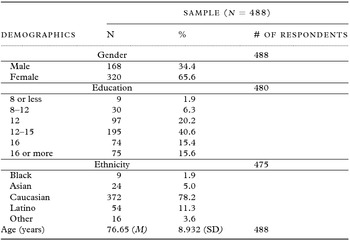
Demographics of respondents

Perceiver factors can be related to the absence of a capable guardian in the RAT. For instance, perceptions of severity of the financial abuse (e.g. the amount taken) by Adult Protective Services (APS) caseworkers (Jackson and Hafemeister, Reference Jackson and Hafemeister2012) were a factor in the under-reporting and follow-up of financial abuse. In part, the under-reporting of elder financial abuse and the resultant lack of protection for the abused are due to varying perceptions of abuse by those in a position to know of the financial action involved. Those who do not perceive questionable financial activity as abuse are not capable guardians in the RAT sense. In terms of perceiver factors, we wanted to explore the impact of age, gender, and education at the microlevel on perception of financial abuse.
At the macrolevel, culture has been considered an important perceiver factor in the perception of elder financial abuse. For example, Moon and Williams (Reference Moon and Williams1993) found that culture affected perceptions of abuse, reporting, and help-seeking behavior. In general, African-Americans were more likely to see the vignette situations as being abuse whereas Korean-Americans were less likely to perceive abuse, with Caucasians in the middle. The differences were less pronounced with financial abuse vignettes with only one showing statistically significant ethnic differences. Lee and Eaton (Reference Lee and Eaton2009) found that almost all Korean-American elders (92%) perceived mistreatment, yet less than half (48%) identified it as financial abuse, with many seeing it as psychological abuse instead, since the mother would be upset by the son's misuse of her money. Given the limited information available, and the mixed findings on actual risk factors, we considered the role of ethnicity of the perceiver in recognizing financial abuse as a research question.
In sum, based on RAT and Rabiner et al. (Reference Rabiner, OʹKeefe and Brown2004) applied ecological framework, this study explored the influence of victim and perceiver factors on the perception of elder financial abuse. We used the vignette method to test our hypothesis. The use of vignettes in elder abuse research allows participants to reflect objectively on this difficult topic without implicating one's personal experiences (Selwood, Cooper, and Livingston, Reference Selwood, Cooper and Livingston2007; Lee and Eaton, Reference Lee and Eaton2009). A strength of the vignette methodology also is that it allows for the manipulation of victim factors and of severity of abuse experimentally and for exploration of ways these factors interact with factors of the perceiver. We tested the hypotheses that the amount of money taken would influence the perception of financial mistreatment as abuse, that an old–old victim would be more likely to be perceived as having been abused than a young–old victim, and that a cognitively impaired person would be more likely to be perceived as a victim of abuse than one who is physically frail but cognitively intact. Finally, we hypothesized that child caregivers would be less likely to be perceived as financially abusing a parent than would a paid caregiver or a less closely related family member, although in RAT they would be seen as always having the opportunity for financial abuse. Given the limited literature on cultural differences and other perceiver characteristics such as gender and educational level, we saw these as research questions to be explored.
Method
Procedure
As part of a survey of older adults by Ventura County (CA) Area Agency on Aging and the Ventura County Superior Court on financial elder abuse and attitudes toward the legal system, we mailed a survey questionnaire to approximately 3,000 people aged over 60 years living in the Ventura County Area who were on the county's Area Agency on Aging mailing list. Participants were asked to read two vignettes in the questionnaire.
Two vignettes describing different types of financial mistreatment of older adults were used to test the influence of victim factors on the perception of abuse. We included vignettes that explored variations in amounts of money involved, age of the victim, type of disability, and the relationship between victim and perpetrator. In the first vignette, an older woman's money ($1,000, 5,000, 10,000) had been withdrawn by a child or a paid caregiver. The health condition of the victim (Alzheimer's disease, physically frail but mentally alert) also varied. In the second vignette, an older woman signed over ownership of the house to a family member. The vignette varied age (70, 90) and type of relationship (child, grandchild, niece, nephew). See the Appendix for the full text of the vignettes. After reading each vignette, participants judged whether the hypothetical situation was financial abuse or not. We collected information on the respondent's age, gender, education level, and ethnicity.
Coding of the variables
In the first vignette, we included variables of amount of money, type of disease, relationship, information of respondents (age, gender, education level, and ethnicity), and interaction terms between variables. Money was coded categorically as $1,000 (referent) = 1, $5,000 = 2, and $ 10,000 = 3. Type of disease was coded dichotomously, with Alzheimer's disease coded as 1 and physical frailty = 2. Relationship was also coded dichotomously, with child coded as 1 and caregiver = 2. Gender of respondents was coded dichotomously, with male coded as 1 and female = 2. Education level was coded categorically as 8 or less (referent) = 1, 8–12 years = 2, 12 years = 3, 12–15 years = 4, 16 years = 5, and 16 or more = 6. Ethnicity was coded dichotomously, with Caucasian/White coded as 1 and others as 2. In the second vignette, we included variables of age level, relationship, information of respondents (age, gender, education level, and ethnicity), and interaction terms between variables. Age level was coded dichotomously, with 70 coded as 1 and 90 = 2. Relationship was coded categorically as child (referent) = 1, grandchild = 2, niece and nephew combined into one category and coded as 3.
Analysis
Because we were interested in influences on perception of abuse which was a dichotomous variable and were interested in the effects of categorical independent variables (age, disability types, etc. within the vignettes), we conducted logistic regressions on the two vignettes to examine influences on perceptions of financial elder abuse. Specifically, we used Hayes and Mattes’ (Reference Hayes and Matthes2009) MODPROBE macro for SPSS to assess the potential interaction influences between independent variables on reporting financial mistreatment. Β, SE, odds ratio (OR), 95% confidence interval (CI), and p-values were reported for logistic regression models.
Results
A total of 488 participants responded to the questionnaire. The median age was 76 and 65.6% of the sample were female. 31% of participants reported college or higher levels of education; 40.6% of participants reported 12–15 years of education, 20.2% reported 12 years of education, 6.3% reported 8 to 12 years of education, and 1.9% reported 8 or less years of education. Regarding ethnicity, 78.2% were Caucasian/White, 11.3% were Latino/Hispanic, 5.0% were Asian/Pacific Islander, 1.9% African American/Black, and 3.6% were from other ethnic backgrounds (see Table 1).
Based on the American Community Survey, 2009–2011, the 60+ population of Ventura County at the time of our study was 54.6% female, had a median age of 68.9, was 83.2% White, with 30.3% indicating college or higher and 17.5% reporting less than high school education. Thus, our sample had somewhat more women, an older age range, and was somewhat more likely to have high school or some college than the Ventura County population of all seniors, as might be expected for a group drawn from an aging network mailing list. The ethnic makeup and the proportion of college education or higher were roughly comparable to the Ventura County population of older adults.
We would note that while the participation rate of 16% is unimpressive if the survey were intended to estimate true population rates of abuse, the purpose of this study is the test of perceptions of financial abuse of older adults using the vignette methodology. To our knowledge, in that domain of research this is an unusually large sample size, is ethnically diverse, and focuses on the perceptions of community dwelling older adults who are connected with the aging network and so may be potential capable guardians in the RAT sense.
Perception of elder abuse
In terms of perception of financial abuse in the first vignette, of those who responded, 311 participants (78.9%) identified the mistreatment as financial abuse. 94 respondents (19.3%) did not answer. A similar proportion of the sample said that they would report it if they were in her situation (82.5%). Of those who did not perceive the taking of the money a financial abuse, 39% endorsed the response that she was being taken care of and there was no problem, with the rest saying that she was being taken advantage of, but it was not abuse.
For the second vignette, of those who responded, 263 (65.4%) perceived financial abuse. 86 respondents (17.6%) did not answer. A slightly higher proportion of the sample said that they would report it if they were in this situation (79%). In this vignette, of those who did not think that it was abuse, 52.5% felt that she was being taken care of and there was no problem. Although direct statistical contrasts are not feasible, it is of interest that signing over property was perceived as less of a problem than the taking of money from a bank account, even though the property would be worth considerably more.
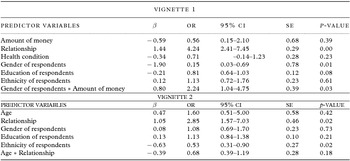
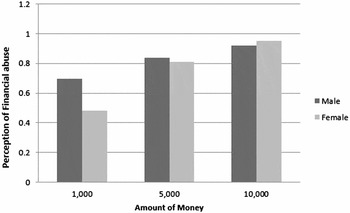
Logistic regressions showed a significant main effect of relationship in the first vignette on perceiving financial mistreatment, with the paid caregiver being four times as likely to be seen as engaging in financial abuse (see Table 2). Gender of the perceiver was significant with women less likely to perceive abuse; however, the significant interaction of gender and amount of money taken shows that this effect was due to women being less likely to perceive the taking of $1,000 as being abusive whereas there were no gender differences at higher amounts of money (see Figure 1). Amount of money, health condition of care receiver, and other respondent variables (education, ethnicity, age) did not influence the perception of financial abuse.
Logistic regression on Vignette 1 and Vignette 2

Interaction effect (gender X amount of money) in Vignette 1.

In the second vignette, being a more distal family member made the person almost three times more likely to be seen as engaging in financial abuse (see Table 2). Ethnicity of the respondent was also significant with non-Whites being about half as likely to perceive the situation as abuse. The other factors were not statistically significant influences on the perception of financial abuse.
Respondents were asked if they would be “more likely to report elder financial crimes if the Ventura Superior Court had an EAC, in which judges and lawyers had significant experience dealing with financial crimes and the elder victims.” Over 90% of respondents said yes, and there was very little variation based on their identification of the vignette situations as abusive: 92.8% and 93.4% of those saying the vignettes were abuse endorsed, the elder court question as did 91.1% and 87.9% of those who did not see the vignettes as abuse. In a question that asked if they would be more likely to report elder financial abuse if the EAC focused on one or more strategies to respond to abuse (participants could endorse as many as they wished), 356 endorsed reimbursement of the victim, 229 indicated they would be more likely to report if the court focused on No Contact Orders, 205 endorsed criminal penalties, and 186 endorsed rehabilitation of the perpetrator as an option.
Discussion
A key finding of this study is that older adults in the sample were more likely to perceive a paid caregiver as more abusive than a family member, given the same set of facts in the vignette and were also more likely to see distal family as more abusive than a child of the care recipient. While common feelings and perceptions about family solidarity and trust within families certainly play a role, this finding is of concern given the literature showing that family members are the most common perpetrators of financial abuse, both simple and hybrid types (Rabiner et al., Reference Rabiner, OʹKeefe and Brown2004; Jackson and Haefmeister, Reference Jackson and Hafemeister2012). This reluctance to see family, and especially close family, as taking financial advantage of the older adult reduces the potential for older adults in the community to be capable guardians and makes prevention and reporting of financial abuse of older adults less likely.
The interaction of gender and amount of money taken in Vignette 1 was unexpected and requires replication and further exploration. We speculate that women may be more reluctant than men to make accusations and disrupt the relationship with family or care providers. To the extent that recognizing and reporting financial abuse is seen as risky, the tendency of women to be somewhat risk averse (e.g. Garrison and Gutter, Reference Garrison and Gutter2010) may play a role and so require a higher level of loss to justify the risk.
We found that the non-Whites in our survey, who were mainly Latinos and Asian-Americans, were less likely to perceive the signing over of the house as financial abuse than the Whites. This is consistent with some other findings that persons of East-Asian heritage are less likely to perceive mistreatment as abuse (Moon and Williams, Reference Moon and Williams1993; Lee and Eaton, Reference Lee and Eaton2009). Our study suggests that Latinos may also fit that pattern. A question for future research is whether these ethnic differences are generalizable, the reasons for them, and why they appeared with the house sign over but not for money withdrawals from the bank. Rabiner et al. (Reference Rabiner, OʹKeefe and Brown2004) in their applied ecological model note that social and cultural norms are an important macrolevel influence on understanding and responding to financial abuse of older adults. Clearly, much more research on this topic is needed to understand how cultural norms affect the perception of abuse so that programs can be tailored to the needs of specific cultural groups.
We had also hypothesized that the amount taken, age of the victim, and the type of frailty would be important influences on the perception of financial abuse of older adults. The amount taken was only a factor for women and then only at the lowest amount that we listed. Also, in this sample of older adults pulled from an aging network mailing list, these victim factors did not influence their judgement. In this study, the relationship between the victim and perpetrator was the only victim factor that influenced the perception of financial abuse.
In terms of possible future directions at the macro, social policy level to encourage reporting of financial abuse, the respondents overwhelmingly said they would be more likely to report if there were a court specializing in elder abuse. They strongly favored the special court focusing on reimbursement of the victim.
Limitations
While the vignette methodology has a number of strengths and allows for experimental manipulation of factors influencing decisions, the method is artificial and the relationship to respondents’ perceptions of financial abuse in real world situations is not known. Due to the relatively small numbers of non-Whites in the sample, the analysis grouped ethnicities that are distinct from one another culturally. In future research on this topic, a more diverse sample of older adults and information on levels of acculturation for those who immigrated from other countries would be important additions to this line of research. Finally, the respondents in this study were all volunteer survey responders from Ventura County, California, and may differ from older adults in other parts of the world.
Conclusion
In this vignette survey of older adults in an urban Southern California county, financial abuse was less likely to be recognized when the perpetrator was a child of the victim as compared to a paid caregiver or to more distal family members. This effect was strong and not influenced by other vignette or respondent characteristics. This finding suggests a mismatch between perceptions of abuse and the typical pattern of financial abuse and suggests that many potential capable guardians against financial abuse of frail older adults are lost due to their misperception of financial abuse perpetrators. Future efforts should address this mismatch of perception and reality regarding financial abuse and explore in more detail the reluctance to recognize and report it.
Conflict of interest
None.
Description of authors’ role
Knight: Involved in the conceptualization of the study, and directed all aspects of the study including questionnaire design, data analysis, and writing. Participated actively in the writing of the paper.
Kim: Performed data analysis and was actively involved in the writing of the paper.
Rastegar: Contributed to the design of the questionnaire, data collection, data entry.
Jones: Involved in the conceptualization of the study and the design of the questionnaire.
Jump: Involved in the conceptualization of the study, the distribution of the questionnaire to agency lists, and to evaluation of the comparison of respondents to Ventura County older adults.
Wong: Involved in data entry, literature review, preliminary data analysis and writing.
Appendix
Vignette 1
Mrs Irving is a 78 year old woman who lives with her (child/paid caregiver). Her (child/paid caregiver) helps take care of Mrs Irving who (has Alzheimer's disease and is moderately confused/is physically frail but cognitively alert). While visiting Mrs Irving one day, you learn that her (child/paid caregiver) has been added as a joint-holder on Mrs Irving's bank account. In the last month, a total of ($1,000/$5,000/$10,000) has been withdrawn from the account. When you ask Mrs Irving about her finances, she cannot recall the specific purpose of the withdrawals, but says she is happy with her living situation and her (child/paid caregiver) takes good care of her.
Vignette 2
Mrs Smith is a (70/90) year old woman, whose husband has recently passed away from a chronic illness. A few months prior to her husband's death, Mrs Smith's (child/grandchild/niece/nephew) moved in to help around the home. Soon after her husband's death, Mrs Smith handed ownership of the house over to her (child/grandchild/niece/nephew). Mrs Smith tells you she signed the notarized quitclaim deed papers because her (child/grandchild/niece/nephew) told her it would make handling things simpler in the future. Mrs Smith says that her (child’s/grandchild’s/niece’s/nephew’s) presence in the home is a source of comfort to her, though Mrs Smith worries since her other three (children/grandchildren/nieces and nephews) have expressed anger with her over this decision.