Introduction
In an international study, the known country of origin (COO) of a product has proved to be one of the more important factors in product distinction and selection of consumers and by that of the competitiveness as well. Investigation into the impact that COO has on consumer behaviour in the buying decision-making process has become especially topical in the second half of the twentieth century and has been studied by various authors (Bilkey and Nes, Reference BILKEY and NES1982; Han and Terpstra, Reference HAN and TERPSTRA1988; Kaynak et al., Reference KAYNAK, KUCUKEMIROGLU and HYDER2000; Papadopoulos and Heslop, Reference PAPADOPOULOS and HESLOP2002; Balabanis and Diamantopoulos, Reference BALABANIS and DIAMANTOPOULOS2004; Vukasovič, Reference VUKASOVIČ2009a; Reference VUKASOVIČ2010; Strašek, Reference STRAŠEK2010; and Vukasovič, Reference VUKASOVIČ2011a). Reasons why the COO influences the buying decision are diverse and require knowledge of the product group as well as the certain country. Modern consumers choose among many products, produced in different countries around the world. Consumers' responses to this are different and depend upon their personal experience and opinion as well as other external factors (Strašek, Reference STRAŠEK2011).
Country of origin effects can be defined as any influence that the country of manufacture has on a consumer's positive or negative perception of a product (Cateora and Graham, Reference CATEORA and GRAHAM1999). With increasing availability of foreign goods in most national markets, the country of origin has become more important as consumers often evaluate imported goods differently than they do competing domestic products (Bilkey and Nes, Reference BILKEY and NES1982). Nowadays, more companies are competing on the global market, and these companies manufacture their products worldwide and the location where they manufacture the products can affect the perception of the consumer on the quality of the product. Consumer perceptions on the COO effect play a major role in influencing a consumer's choice of a product. The impact of the consumer‘s perception on country of origin may influence a multinational in deciding which foreign country should be its manufacturing base, apart from considerations of cheap labour costs, tax incentives, access to resources and other considerations (Ghazali et al., Reference GHAZALI, OTHMAN, YAHYA and IBRAHIM2008).
Results of research and surveys (Papadopoulos and Heslop, Reference PAPADOPOULOS and HESLOP1989; Yoo et al., Reference YOO, DONTHU and LEE2000) prove that a product's COO influences consumer's perception of brands and their value. The extent to which this impact is reflected in an individual consumer depends largely on his socio-demographic and psychological characteristics and on the group of products which a brand falls under. So, companies are facing a dilemma whether to underline product origin in their brands and, if yes, to which extent it is sensible to do so. It can be concluded that an image of a country in which product is manufactured is important, because it can be a vital in the customers' buying decision-making process (Strašek, Reference STRAŠEK2011).
This paper details the ongoing results of quantitative research into Croatian consumers choices. The main aim of this study was to create an original model of correlations between the COO, marketing elements of the poultry product and the brand name value from an external point of view of perception of the Croatian consumers.
Market research
State-of-the-art market research guidelines emphasise the use of certain methods for determining key variables, the use of multi-item measurement scales and various research plans were considered in analysing the research results. Only the selected method used for the research is presented, because this paper does not focus on the technical details of available methods. Details of other research methods can be found in Gacula and Singh (Reference GACULA and SINGH1984), Malhotra et al. (Reference MALHOTRA, PETERSON and KLEISER1999), Vukasovič (Reference VUKASOVIČ2009b; Reference VUKASOVIČ2011b).
The central aim of the study was to determine relations between the COO, marketing mix elements and the brand name value of poultry product. Tasted product is classified into the poultry sausage category. The objectives used were aimed to check the main thesis (H1) that was developed throughout the research hypotheses to evaluate a conceptual structural model of relationships between the COO, marketing brand name value of the poultry product. Methods and the contribution of latent variable relations in the model were studied.
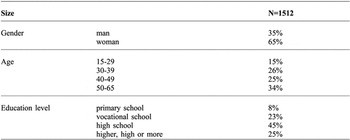
A stratified sample of the quantitative research, N=1512, is represented by the inhabitants of a Croatian population, aged 18 to 65, and who ate the tested poultry product at least once a week and are familiar with the brand name (Table 1).
Structure of the sample.

The sample was stratified the place of residence, gender and age. At the 95% reliability level the standard error of the N = 1512 sample was +/- 2.2 percentage points at the most.
Questionnaire
The introduction letter, reminder and draft questionnaire were developed for purpose of the research. Established guidelines were used in order to make the questionnaire appealing and easy to complete. All questionnaires carried a stamped number in order to be able to add factual consumers’ data.
The questionnaire was divided into the following research thematic areas:
• perception marketing mix element for poultry product
• perception COO for poultry product
• brand name value of the selected poultry product
• demographic data at the end of the questionnaire.
The questionnaire which was used in interviewing the respondents, was selected regarding the method of implementation. The respondents were interviewed in person within their household. The questions were selected by the Likert scale. A respondent is asked to select one of the seven answers that specify his level of agreement to a statement, where a score of one indicates strong disagreement and a score of seven indicates strong agreement with the statement.
The conceptual model
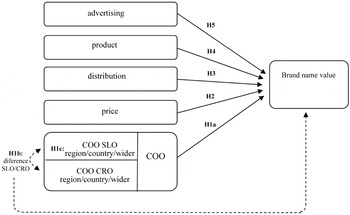
Based on the literature overview, the conceptual model of relationships is schematically shown in Figure 1.
The schematic drawing of the hypothesis and the conceptual model.

The main thesis
The main thesis of the research was that a product origin, along with an increasing cautiousness of consumers' own national and cultural identity, has a statistically significant impact on the brand name value. It was determined that, in general, the effect of COO is effective in connection with input variables, such as knowledge of the product, consumer's characteristics, country's characteristics, nationality and patriotism (Vukasovič, Reference VUKASOVIČ2010). The stated input variables impact the perception of a product's brand name value and customer's buying decision. A positive image of COO in customer's eyes influences his buying decision and raises the value of a brand. Typically the customer is in favour of products from countries with a positive image, while averse to products manufactured in countries with an unfavourable image.
Hypotheses
The main aim was to test the basic hypotheses of the study allowing them to be tested in practice. These hypotheses express relations among the variables and were empirically scrutinised by the methods of multivariate statistical analysis.
Hypothesis H1A, which is based upon the main thesis of the research, is that consumers presume a positive correlation between the domestic COO and the perceived brand name value of the selected poultry product.
It has previously been determined that COO impacts a customer's evaluation of products and their brands (Vukasovič, Reference VUKASOVIČ2009b). In the brand and product evaluation process a customer uses all the available information. This information is first selected, then the available information regarding a product is processed and finally the buying decision regarding a product of the selected brand follows. Results from customers' behaviour show that they are often prejudiced against foreign products and brands, because they are concerned with domestic economic prosperity. Brands and products from their own country are evaluated as better than those manufactured in foreign countries (Strašek, Reference STRAŠEK2011). It was assumed that, in this case, there also existed a positive correlation between the domestic COO and the perceived brand name value. The first hypothesis (H1A) was formed based upon the stated correlations. A second hypothesis (H1B) was also postulated. This hypothesis presumed that the perceived value of poultry products from local production is statistically higher than the perceived value of the same brand, but of foreign.
A third hypothesis (H1C) was included which, given the different geographical origin, such as region/country/wider geographical entities, how do consumers evaluate products. In many cases, the perception of different product attributes was defined by the origin - the country of brand, as stated by Nagashima (Reference NAGASHIMA1977) and Wall and Heslop (Reference WALL and HESLOP1986) who linked perceived product value to COO. In this study, a hypothesis was formed for each element of the marketing mix of a product, all of them relating to COO and a selected product brand.
H2: The quality promotion has a positive impact on the perceived brand name value
Results from groups who studied correlations between promotions and the perceived brand name value, showed a positive impact of promotion on the brand (Yoo et al., Reference YOO, DONTHU and LEE2000, Aaker and Jacobson, Reference AAKER and JACOBSON1994). Promotion influences the brand value by strong positive and unique associations that establish it within the customer's memory (Keller Reference KELLER1998, 195-214). Promotion is an important source of external information that a customer gets in connection with the selected product and that can be used to signal product quality. A direct correlation between promotion and the perceived value of a product's brand was checked. The hypothesis H2 was formed by the stated reflection and the research results obtained from selected authors.
H3: Sensory perception and other beneficial properties of a poultry product have a positive impact on the perceived value of the brand
The basic instrument of the marketing mix is a product that, in the market, represents a tangible presence, together with quality, shape, properties, branding and product packaging. Product is the main source of the perceived brand name value. Through selecting a product customers come across a brand and the company communicates the brand through a product. A prerequisite for a successful marketing is to offer a product that totally meets customer's needs and desires. In this study, the impact of a product's properties on the brand value of the selected product has been determined. The term ‘product properties’ directly relates to appearance, taste, shape, practicability and quality of raw materials. In the context of the presented model the impact of product properties on the perceived value of its brand was checked by hypothesis H3.
H4: There exists a positive correlation between quality distribution of a product and the perceived value of a brand
Numerous studies show that the regular presence of a product on retail shelves impacts customer satisfaction, as this means that, in retail stores, the consumers saves time in finding a selected product (Ferris et al., Reference FERRIS, OLIVER and DE KLUYVER1989, Smith, Reference SMITH1992, Yoo et al., Reference YOO, DONTHU and LEE2000). Quality distribution or regular presence on the shelves can include promotion, which can positively influence the perceived brand name value. In cases when a product is poorly distributed or a product is not widely available to customers, this can increase dissatisfaction and reduce sales. If poor product availability is systematically repeated, this will have a negative mid- and long-term impact on the perceived value of a product brand. Based on the stated facts the hypothesis H4 was formed.
H5: The more favourable a ratio between a price and quality of a poultry product, the higher its perceived value
In studying relationships between the perceived price and value, it has been stated (Monroe, Reference MONROE1990, Teas and Agarwal, Reference TEAS and AGARWAL2000) that price influences the perceived value in two directions: on the one hand it signals product quality and on the other, it represents potential financial sacrifices when the consumer buys and uses a product. If a price is too low, it can send a message that a product is not high quality, while on the other hand, if a price is too high, it can make the product unaffordable. In both cases the impact of such a price on the perceived value of a brand can be unfavourable. When price and quality are balanced, it can be presumed that this positively influences the perceived value of a product brand. Based on the latter the hypothesis H5 was formed.
Models and methods of analysis
The key data properties are expressed by descriptive statistics. In the case of interval data, parametric statistics was used for analysis, including the average, standard deviation and variance. Any linear relationships between the selected variables were determined by a correlation coefficient. The main thesis was tested by the structural models in the statistical programme LISREL. The conceptual model and correlations in the model were tested by a linear structural equation modelling. By doing so, conformity of the theoretical conceptual model using empirical data was tested, again using the statistical program LISREL.
Testing the relationship between country of origin and the brand name value
Consumers believe that the origin of the product refers to the perceived status of the country, thus we accept the hypothesis H1c. Users argue that the European Union level is too wide for a regional concept. They have a different attitude to consumers in the wealthier and established European Union countries (e.g. Austria) in comparison with, for example, Romania and Hungary.
The results of the study established that the poultry brands produced in Croatia has a higher perceived value compared to those produced in Slovenia. This is the result of allegedly higher quality standards in Croatian manufacturing, better hygiene standards and greater control over the manufacturing process, a positive perception of the brand image of Croatian consumers.
Hypothesis H1b shown in the conceptual model on Figure 1 was confirmed. In the structural model the following latent variables were identified as independent variables: good advertisements (promotion), good product (product), wide assortment on retail shelves (distribution), good price (price) and importance of the COO (origin). The value of the brand was identified as a dependent variable.
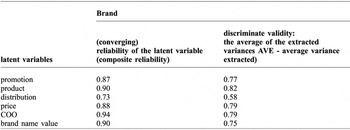
Quantitative methods were used to determine how strong and the manner in which (indirect and direct correlation) individual factors in the model of the brand name value are connected among themselves. The reliability of the latent variables was tested by structural modelling, using the Fornell-Larcker rule that, together with the composite or the converging reliability of latent variables respectively, measures the discriminatory validity of latent variables by using average variance extracted (AVE). The calculations for the both statistical analyses are presented (Table 2), but it must be emphasised that the converging reliability of the latent variable is larger than 0.6 and the average of the eliminated variances is larger than 0.5. The estimated statistics are larger than the recommended values, so it can be concluded that the measuring instrument used for the latent variables measuring is reliable, convergent and valid.
Reliability and discriminate validity of the latent variables for the tested product .

Based on the calculations presented in the Table 1 it can be concluded that the structural model is reliable regarding the presented statistical criteria (in the case of multiple measuring) and valid regarding the theory or regarding which indicators measure the selected latent variables, respectively.
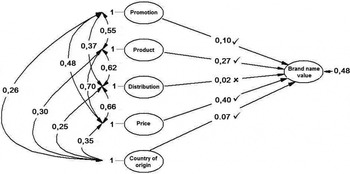
Relationships in the structural model for the product of the selected brand are presented, where latent variables are presented by ellipses, in Figure 2. The correlation strength is presented by arrows between the ellipses. One exception is the arrow on the on the far right, with a value of 0.48, which does not show any relationship strength, but is an unexplained variance of the variables of the brand name value. The independent latent variables of promotion, product, distribution, price and origin explain 52 % of the variability of the value of the brand.
Beside evaluation by explained variance, the structural models can also be used with respect to other statistical criteria, such as RMSEA (Root mean square error of approximation), NFI (Normed fix index), CN (Critical N), RMR (Root Mean Square Residual), GFI (Goodness of fit index). There are many evaluation criteria, but it is hard to say which one is the best or the most suitable. Therefore the selected criteria were based on the all presented criteria, so that it was possible to determine that the model fitted the data to a satisfactory level. That is to say: RMSEA=0.068 (if <0.080, the model is relatively good), NFI=0.98 (if it is close to 1, then the model fits the data), CN=228 (this value should be above 200 to fit well, but it is relatively close to 200), std. RMR=0.034 (it should be below 0.050 to fit well), GFI=0.94 (it should be above 0.90 to fit well).
Because the presented structural model for the tested brand on Figure 2 fitted the data well, the content of the structural model or relations between the latent variables can be analysed. The left part of Figure 2 shows that the elements of the marketing mix are very connected among themselves (promotion, product, distribution and price), the smallest connection strength is 0.37. Among all the mentioned elements of the marketing mix, the connection with COO is the strongest for the price (0.35) and the product (0.30) and slightly less strong for promotion (0.26) and distribution (0.25).
The structural model of the relations for the tested brand.
Source: Own calculations, 2011

The right hand of Figure 2 shows that price (0.40) and product (0.27) have the largest impact on the value of a brand. The other marketing mix elements have a smaller impact, whereby COO has a larger impact (0.07) than distribution (0.02).
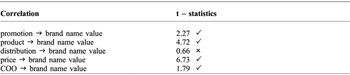
Based on the presented results for the studied brand it can be determined that, although COO does not have the strongest impact on the brand value, it is still not negligible and is even slightly stronger than the impact of the distribution. It is important to mention that all the relationships in the structural model for the brand were statistically significant at t>1.65, only the correlation between distribution and the brand name value was not statistically significant (Table 3).
Statistical calculations of the t-test for the tested brand.

Note: if t>1.65, then the correlation is statistically significant ( P).
Results of the hypotheses and main thesis testing
Based on the results presented in the structural model of the relationships within the studied brand, it was determined that the COO significantly influences the brand name value. In the studied brand, the impact of the COO on the brand name value was less important than the product, promotion and price. In spite of that, the impact of the brand's origin on the value of this brand is stronger that distribution. Based on the stated facts the main hypothesis of the research can be confirmed, because the impact of the COO on the brand name value is at least equally statistically significant as the impact of the selected elements of the product marketing mix.
The performed statistical analyses confirmed the majority of the hypotheses. Hypothesis H4 cannot be confirmed as a population cannot be made based on the sample available.
Conclusions
The survey results confirm previous research which examined the impact COO on consumer behaviour in the buying decision-making process (Strašek, Reference STRAŠEK2011), but in another country (Croatia). The results of this survey contribute to the knowledge base gleaned from studying the relations among the marketing mix elements, COO and perceived brand name value.
One limitation of this type of study is it is limited to only one food product, namely a poultry sausage product, and so the results cannot be generally applied on all food products. In future it would be interesting to include a larger number of products of the same kind and to determine whether generally accepted rules of the perceived value hold for all products.
The research was limited to studying correlations of the selected elements of the product marketing mix. Only the simplified 4P concept was chosen: product, promotion, distribution (place) and price. Other elements of the product, especially quality, should be included in future research.
In the times of congested markets, companies are increasingly aware of the importance of familiarity with consumers, their motives for purchases and their standpoints on traded objects. Companies devote more attention to market and consumer research, which represent the important factors that determine the success in terms of sales. In the process of choosing a product, a consumer collects information of product properties, environment, use and origin. The information of product origin provides added value for a consumer and depends upon both objective and subjective attitudes.
More companies now recognise the importance that a product value and brand have for customers, hence why they try to determine, as precisely as possible, the position of their own products. By doing so, they can create an important competitive advantage over other companies. From the results of this study, it is recommended that COO is equally carefully considered when developing new products, planning of marketing routes (distribution), promotion and determining price. Naturally, specificity of consumables should be considered at the same time. The survey results confirms previous published data in this field (Vukasovič, Reference VUKASOVIČ2009a; Strašek, Reference STRAŠEK2011) who studied the impact of COO on consumer behaviour in the buying decision-making process in other regions. In conclusion, COO is the fifth marketing element for poultry products in Croatia.