


As noted by Seymour M. Lipset over 50 years ago, development and democracy have been strongly correlated in the contemporary world. Today, even after the prolonged democratization wave that started in the 1970s and accelerated in the 1990s, the distribution of democracies remains highly skewed by level of per capita income. Whereas 94% of the countries with a per capita income above $10,000 (in constant $ of 1996) held free and competitive elections in 1999, only 18% with a per capita income below $2,000 did so. This empirical relationship between income and democracy was even tighter earlier in history. Just looking at per capita income, we can successfully predict 76% of the annual observations of political regimes in sovereign countries after World War Two. The proportion of cases that are predicted correctly is 85% for the interwar period and 91% before World War One.Footnote 1
The statistical association between democracy and income has generated prolonged debate over the causal impact of economic development on political institutions. Most of the literature has found that higher levels of development (measured mainly by per capita income) increase the likelihood of democratic transitions, the stability of democracies, or both (Barro Reference Barro1999; Boix and Stokes Reference Boix and Stokes2003; Dahl Reference Dahl1971, chap. 5; Huntington Reference Huntington1990, 39, 45; Przeworski and Limongi Reference Przeworski, Cheibub and Limongi1997). However, some researchers have interpreted them as simple covariates, attributing the joint processes of democratization and development to specific historical conjunctures in early modern Europe (partly Moore Reference Mokyr1966, xi, 12–20, 417–40; more directly, Acemoglu et al. Reference Acemoglu, Johnson, Robinson and Yared2008; North and Weingast Reference North1989).
In this article I reexamine the relationship between development and democracy and offer a “conditional” theory of political modernization in two steps. First, I argue that development both spurs democratic transitions and stabilizes democracies. Second, I show that its impact on democracy is a “conditional” one; that is, that the magnitude of its effect varies due to two factors. On one hand, growth has a declining marginal effect on democracy because political actors have full incentives to comply with the rules of democracy beyond a certain threshold of development. On the other hand, the effects of development are mediated by the structure of the international system. The support that great powers, whose political strategies shift with the structure of the international order, grant to particular domestic actors shapes the balance of power among the latter and therefore their incentive and capacity to sustain a democratic regime.
The organization and intellectual contributions of this article are as follows. The first section discusses broad descriptive data on economic growth and democratization, bringing to light the time-varying correlation of income and democracy. The second section develops a “conditional modernization” theory of democratic transitions that attempts to reconcile seemingly contradictory findings on the political effects of development in the current literature. The third section estimates the relationship between income and democracy, using panel data on all sovereign states from the early nineteenth century to the end of the twentieth century and including fixed country and year effects. To deal with the potential question of endogeneity, it carries out two main tests: It employs a battery of instrumental variables and conducts a Granger causality test. The exercise yields three main findings: that development matters for democratization; that this relation seems to be causal; and that the size (and statistical significance) of the income effect partly varies over time and is particularly weaker during the postwar period. This last result matches, in principle, the estimates of several recent studies that, employing data for the post-WWII era, find no causal effect of development (proxied by income per capita) on democratization (Acemoglu et al. Reference Acemoglu, Johnson, Robinson and Yared2008, Reference Acemoglu, Johnson, Robinson and Yared2010; Przeworski and Limongi Reference Przeworski, Cheibub and Limongi1997).Footnote 2 At the same time, however, the estimates of this section indicate that those postwar findings cannot be applied mechanically to other historical periods—what Huntington (Reference Huntington1990) referred to as the first and second waves of democratization (13–21). Indeed, the third section shows that, using the full universe of sovereign countries since the early nineteenth century, income level matters for democracy—contradicting recent work on the causes of democracy (Acemoglu et al. Reference Acemoglu, Johnson, Robinson and Yared2008, Reference Acemoglu, Johnson, Robinson and Yared2010). Given the results of the third section, the following two sections investigate the domestic variables (mainly the decreasing marginal effects of growth in already developed economies) and international factors (the particular structure of the international order and the strategies of great powers toward small countries) behind the varying effects of income on democracy over time. A final section concludes.
DEVELOPMENT AND DEMOCRACY IN THE LONG RUN
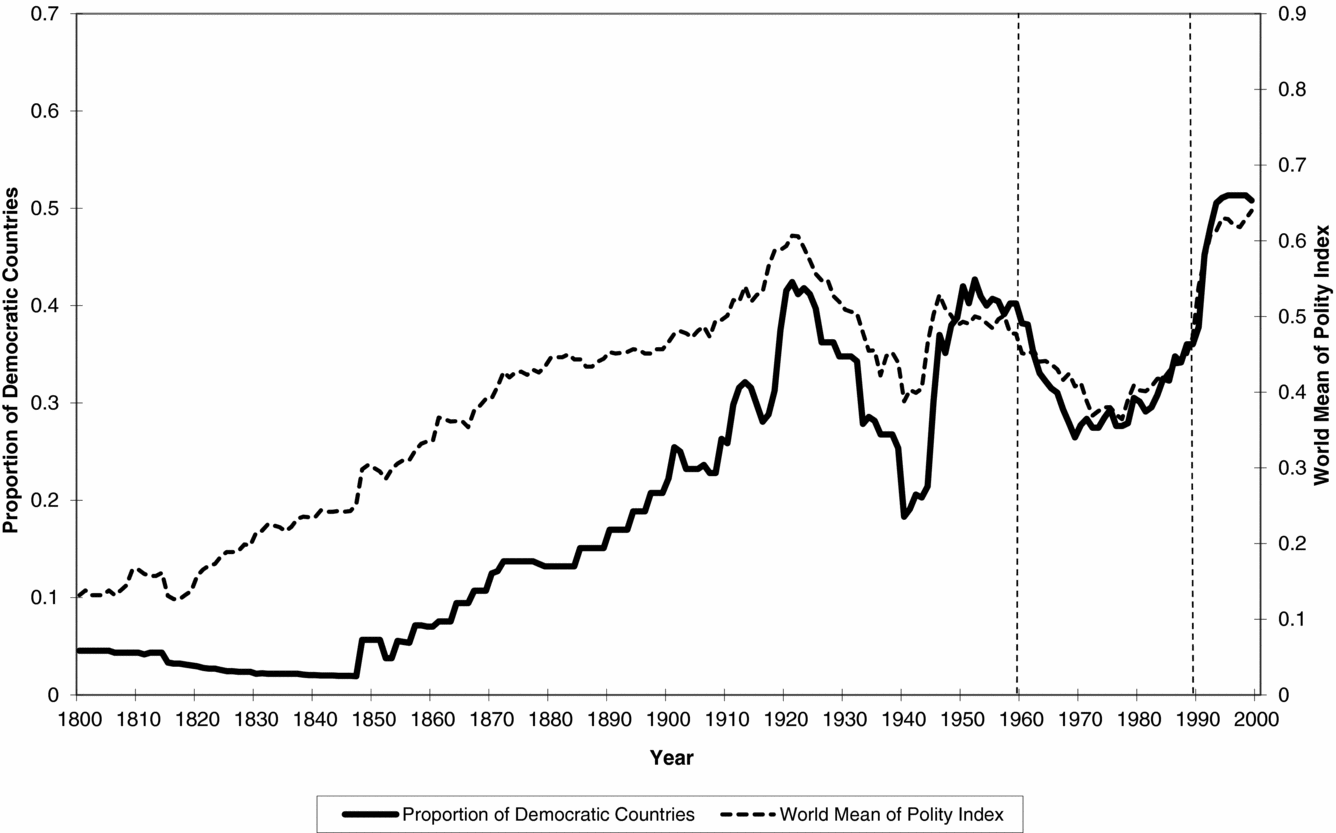
Figure 1 reports the evolution of democracy among sovereign countries from 1800 to 2000 using two measures: First, the annual proportion of democracies, where a country is defined as democratic if it has a government elected through competitive elections and liberal franchise requirements, as coded in Boix and Rosato (Reference Boix and Rosato2001);Footnote 3 second, the cross-national average of the polity index taken from Polity IV and normalized into a continuous variable from 0 (no democracy) to 1 (full democracy).
The Evolution of Democracies, 1800–2000

In the first half of the nineteenth century, democracy was limited to a few Swiss cantons and several northeastern states in the United States. The United States as a whole still excluded a significant fraction of its male population from voting. The fleeting introduction of universal male suffrage in France in 1792 came to an abrupt end with the fall of the National Convention. Even after the electoral reform of 1833, only slightly over 10% of men had the right to vote in the United Kingdom. It was only the liberal revolutions of 1848 that set off a major and prolonged democratization wave that would peak in 1920 with over two-fifths of all sovereign countries being democratic. A second, shorter wave happened right after 1945. Between 1960 and 1990 the proportion of countries with democratic institutions stabilized sharply, however, fluctuating between 30% and 40%. In fact, the vast majority of nations (45 out of 53) that were democratic in 1960 remained democratic three decades later. Among the remaining eight cases where democracy broke down, five countries (four African states and Singapore) became authoritarian within the first four years following independence and an additional two within the eight years after they became independent. Similarly, authoritarian institutions were remarkably stable: 54 of the 70 countries that were not democratic at the beginning of the period were still under authoritarian rule in 1990. Among those 16 that shifted to democracy, five did so directly after the collapse of the Soviet Union. It was only after this latter event that the proportion of democracies rose to almost two-thirds by the end of the twentieth century.
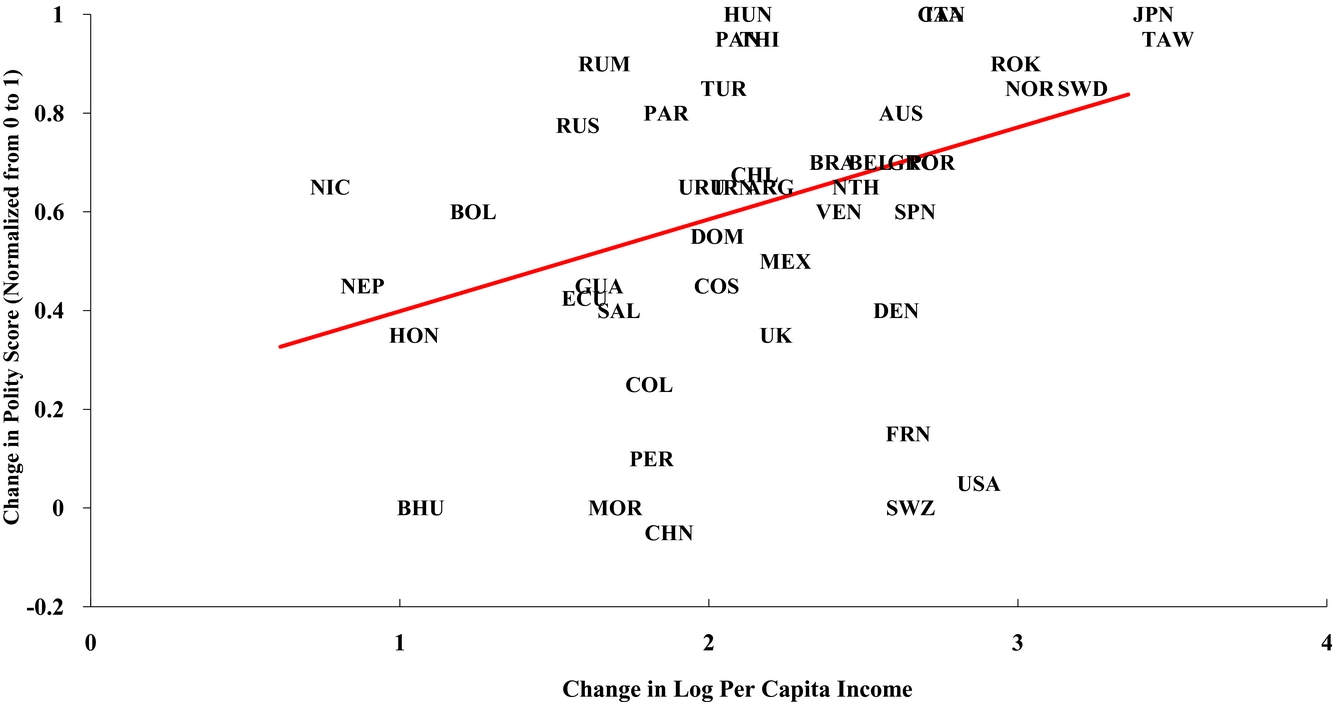
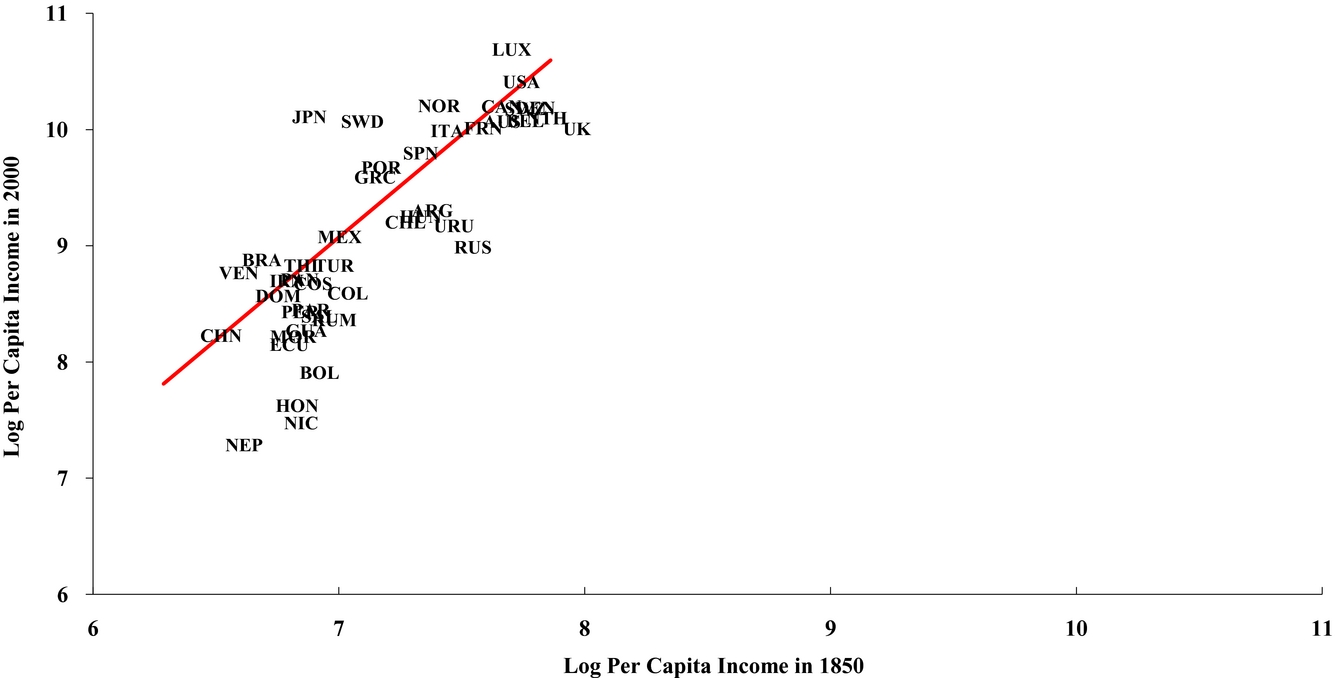
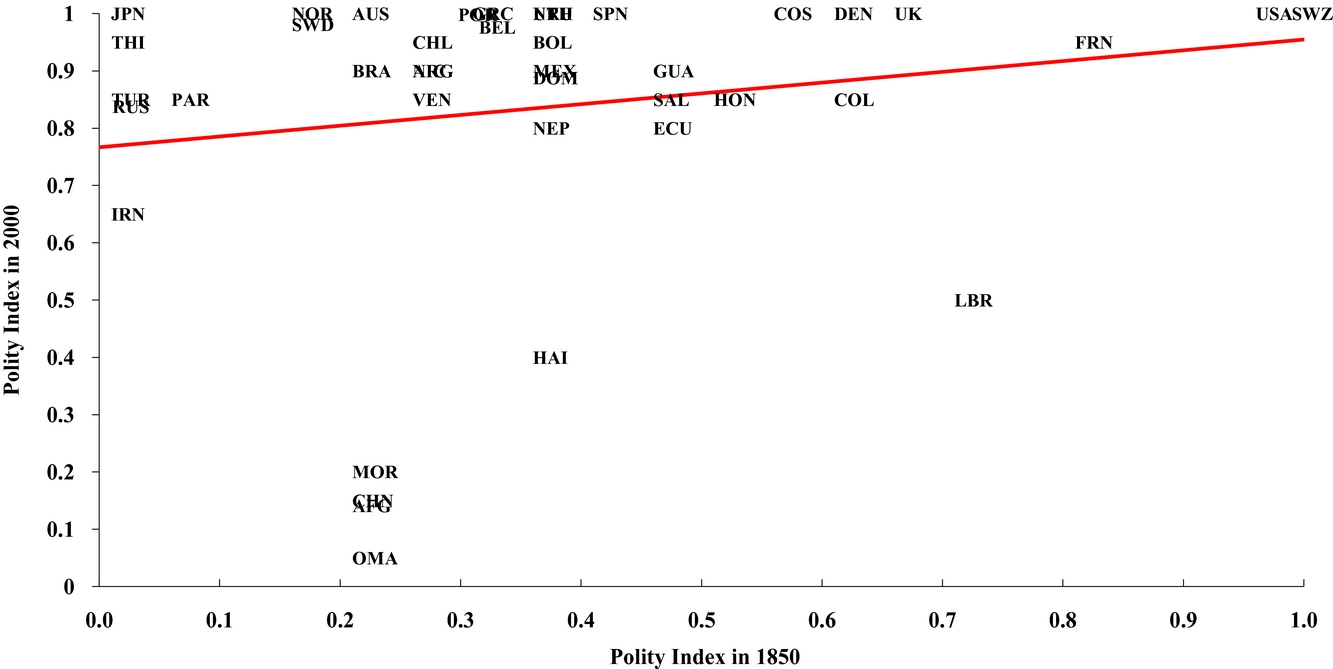
The so-called modernization theory of democratization claims that the rise of democracy followed, or, at least, coincided with, an unprecedented process of economic development (often proxied by the national level of per capita income) (Lipset Reference Levitsky and Way1959).Footnote 4 Indeed, Figure 2 plots the change in the normalized polity index between 1850 and 1999 against the change in the log value of income per capita over the same period of time. The correlation is positive and relatively strong, with a correlation coefficient of 0.38 and, excluding France, Switzerland, and the United States, which had values very close or equal to 1 before 1850, of 0.58. Although determining the statistical significance and causal status of this relationship is the task of the section “Retesting the Modernization Hypothesis,” Figures 3 and 4 probe a bit further into the structure of the association between income and democracy. Figure 3 plots the relationship between income in 1850 and income in 2000 across countries (per capita income is expressed in constant $ of 1996).Footnote 5 Figure 4 does the same thing for the level of democracy (using the polity index). Figure 3 shows a strong relationship between levels of development across time—the correlation coefficient is 0.78. Countries that were already wealthier by the middle of the nineteenth century continued to be ahead 150 years later. If anything, their economies had grown exponentially over time—leaving the poorest nations well behind (in relative terms). By contrast, Figure 4 reveals no such relationship for politics—the correlation coefficient is 0.17.Footnote 6 Democracy was either absent or weak in almost all countries in the first half of the nineteenth century. In line with those results, democracy and income were hardly correlated before the first democratization wave: The adjusted r 2 for regressing democracy on income in 1870 was 0.10 (0.01 in 1850).
Changes in Level of Income and Level of Democracy, 1850–1999

Level of Economic Development, 1850–2000

Polity Index of Democracy, 1850–2000

The graphical evidence produced so far appears to point to the following relationship between democracy and development. As emphasized by several political economists and economic historians (Engermann and Sokoloff Reference Engerman and Sokoloff2002; North Reference Muller1990, 107–30; North and Weingast Reference North1989; Putnam Reference Przeworski and Limongi1993, 121–62), it is likely that certain historical junctures probably happening in the early modern era resulted in different constellations of legal and economic institutions across countries.Footnote 7 Those different institutional configurations led to divergent levels of economic and social development by 1850 after the scientific revolution became fully embedded in the economy in the previous two centuries (Mokyr Reference Mitchell2002, 28–77). Nonetheless, the institutional factors that shaped the level of development by 1850 (and that continue to affect income 150 years later) did not affect the level of democracy directly at that time. Instead, democracy only came into being after economic growth, underpinned by a particular set of institutions, triggered key social transformations such as declining inequality, an educated labor force, and more diversified economies. Those changes then reshaped the incentives of political actors, making them more willing to accept democracy. As a result, income and democracy became substantially correlated over time: The adjusted r 2 rose to 0.47 by 1930.
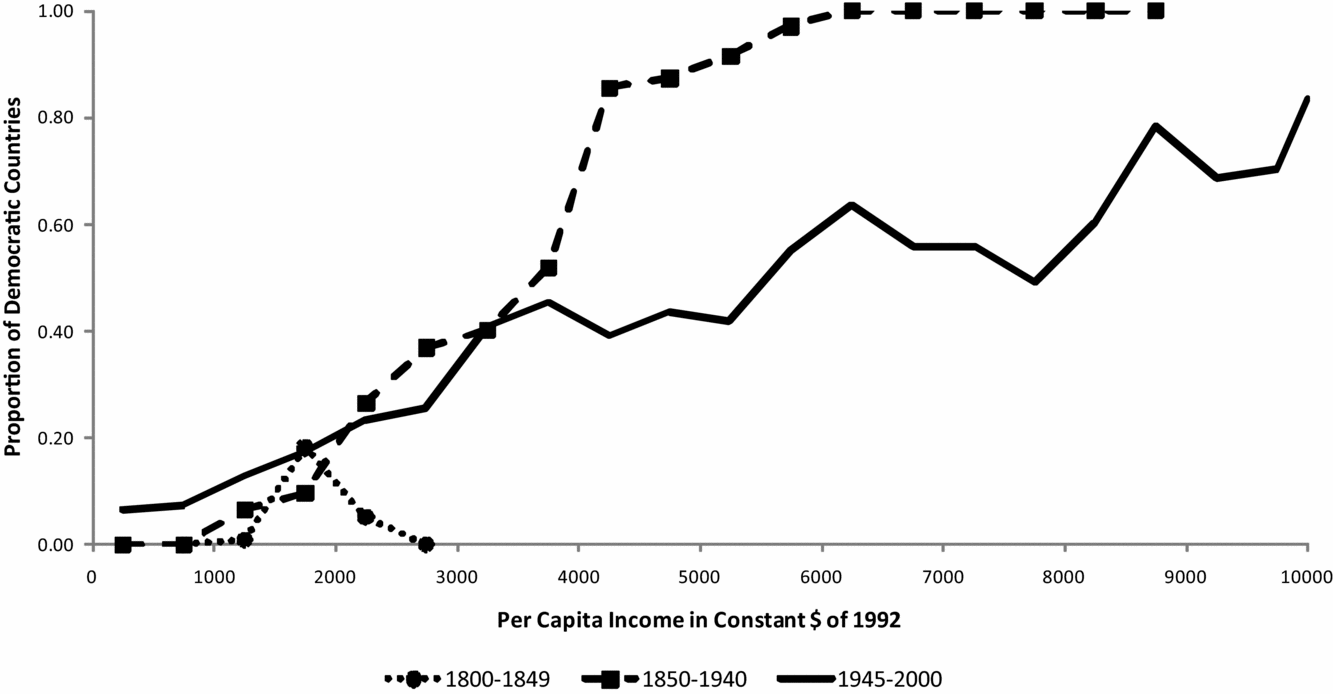
Even though the likelihood with which countries would become democratic seems to have risen with development, the specific threshold at which income is associated with democracy has varied historically. Figure 5 displays the proportion of country-years under democracy for each level of per capita income (divided by $500 segments) grouped into three main periods: before 1850; from the mid-nineteenth century to World War Two; and after 1945. Two main things stand out. First, all lines trend upward after 1850. In other words, democracy was more common among relatively wealthier countries from the mid-nineteenth century onward. Second, the slope of the lines has differed across periods. After 1850 and before 1940, 52% of those countries with a per capita income over $3,500 were democratic. Among those with an income above $4,000, the proportion was 86% or higher. In contrast, after World War Two, democracy took place among more than half the sample of sovereign countries only at an income higher than $5500 and the proportion of democratic countries only reached 80% for those cases with an income of $10,000 or higher. In sum, certain time-varying conditions, probably linked to specific global historical events (such as the Cold War) and unrelated to income, have altered the effect of development on political institutions.
Proportion of Democracies by Level of Income, 1800–2000

CONDITIONAL EFFECTS OF DEVELOPMENT
To see how development may affect the type of political regime, assume, following the literature of democracy as an equilibrium, that democracy is only possible if all political players accept it (and the related possibility of losing elections) over any other political regime. Under the assumption that, in the absence of constraints, political actors prefer to control the state permanently (i.e., as dictators) and impose their preferred policies, they only accept democracy if it leaves them better off than a dictatorship because the expected policy losses from shifting to democracy (and losing control over government with some nonnegative probability) are smaller than the repression costs incurred to maintain a dictatorship (Dahl Reference Dahl1971, 14–16; Przeworski Reference Pomeranz1991, 26–33; Weingast Reference Weinert1997).Footnote 8 Next, consider, in line with the standard literature on political transitions, a political economy where there are two main parties, representing high-income and low-income voters respectively, and where elections determine the policymaker, the tax rate, and the level of redistribution (Boix Reference Boix2003, 21–46). The high-income party chooses between democracy and authoritarianism. In the former, taxes are set by the median voter (generally a low-income voter). In the latter, the high-income party pays some costs to exclude low-income voters from voting and redistributes nothing to them. That authoritarian outcome may trigger, however, a low-income rebellion that may sometimes result in a regime where low-income voters expropriate high-income voters’ wealth and establish a populist-radical regime (à la Nasser) or a communist dictatorship (such as the Soviet Union or Vietnam).
The political effects of development then work through several channels. First, following a standard assumption in economic theory that the marginal utility of additional income declines with income, the disutility of transferring income to low-income voters will fall with income. Hence, at higher levels of development, high-income voters will be more willing to accept democracy, especially if the costs of repression are fixed.Footnote 9 Second, development has generally been correlated with lower levels of inequality, at least in the long run (Atkinson, Piketty, and Saez Reference Atkinson, Piketty and Saez2009; Davies and Shorrocks Reference Davies, Shorrocks, Atkinson and Bourguignon2000; Morrisson Reference Moore2000). As inequality declines, the redistributive demands of low-income voters fall and high-income voters are more likely to support democracy. Third, development is correlated with a shift in the nature of wealth—from fixed assets (land) to mobile capital. As the latter increases, taxes decline, because capital holders can credibly threaten exit and, as a result, the costs of democracy become sufficiently low to convince wealthier voters to accept democratic institutions. By contrast, in unequal economies (with immobile assets), the threat of high taxes under democracy compels high-income individuals to support authoritarian regimes.
In this political-economic framework, the level of development has a varying impact on democracy for reasons that are purely “endogenous” to the process of development. After the introduction of full democracy at some given level of development, any additional income growth becomes irrelevant to explaining democratic transitions (even though it may still have some positive effect on democratic stability). Similarly, after development compresses the distribution of income across individuals (and equalizes the political resources available to all parties) sufficiently and countries democratize, any increase in equality only matters to stabilize democratic institutions. In other words, the effect of development on democratic transitions (but not on democratic consolidations) should follows a nonlinear pattern: stronger as income grows but then weak or even nonexistent above a given income threshold.
The relationship between income and democracy varies also with factors that are “exogenous” to development. In particular, great powers tend to deal with (and interfere in) the domestic politics of their allies (and, if possible, of the allies of their enemies) as a further means of advancing their interests in the international arena. The Peloponnesian War was ignited by the disputes of opposing factions in Corcyra and the involvement of Athens and Sparta. After the Napoleonic wars, the members of the Holy Alliance suffocated any liberal revolution across Europe. During the Cold War, the Soviet Union and the United States maneuvered, either directly or by proxy, to secure friendly administrations across the world (Boschini and Olofsgård Reference Boschini and Olofsgård2007; Muller Reference Morrisson, Atkinson and Bourguignon1985; Schmidt Reference Rutherford2006; Westad Reference Welzel, Inglehart, Boix and Stokes2005). After the collapse of the Soviet Union, Europeans and Americans supported democratization movements in several regions of the world (Dunning Reference Dunning2004; Gleditsch and Ward Reference Gleditsch and Ward2006; Levitsky and Way Reference Levitsky and Way2005; Meernik, Krueger, and Poe Reference Meernik, Krueger and Poe1998; Whitehead 1996).Footnote 10 In fact, a look at Figure 1 reveals that democratic institutions haven often spread quickly and in rather short periods of time: the early 1920s, the late 1940s, and the 1990s. Similarly, many of their reversals were clustered in the 1930s and the 1950s. All these transitions to and from democracy coincided with key shifts in the international system: the defeat of the Central Empires in 1918, the rearmament of Germany under Hitler, the beginning of the Cold War, and the collapse of the Soviet Union. However, whereas there has been an important literature on the impact of the international economy on national institutions and policy outcomes (Frieden and Rogowski Reference Frieden, Rogowski, Keohane and Milner1996; Gourevitch Reference Gourevitch1978; Lake Reference Lake, Weingast and Witman2006) and on war and its impact on the territorial size of the state (Spruyt Reference Spolaore and Wacziarg2007; Tilly Reference Taylor1990), the impact of the international order on constitutional outcomes and the expansion of democracy has received little theoretical attention. I tackle this question in the remainder of this section.
International systems share two main characteristics. First, military and economic resources are distributed unequally, with one or a few great powers on the one hand and, on the other hand, a number of middle-sized or small countries. Second, they are defined by a condition of anarchy that forces states to accumulate power to secure their survival (Mearsheimer Reference Mearsheimer2001, 29–54). In that context, states (especially great powers) rely, as one of their instruments of foreign policy, on the development of alliances and the construction of networks of clients. Within that relationship, great powers (acting as patrons) provide their allies (or clients) with some military guarantees (from financial aid to troops) in exchange for political and strategic allegiance as well as access to the client's resources and markets (Bercovitch Reference Bercovitch, Efrat and Bercovitch1991). Great powers may decide to intervene in the domestic politics of small countries with two goals in mind: to shore up an alliance, which could collapse if there was some regime or government change in the client's state; and to avoid the emergence of domestic actors within the small state that could threaten the domestic institutions of the great power.
The extent and direction of foreign intervention varies as a function of two factors: the political institutions, authoritarian or democratic, of great powers; and the structure of the international system, which, depending on how many great powers are in place, may be broadly divided between unconstrained and constrained. In an unconstrained system there is a single hegemon (such as the United States after 1990) or a concert of great powers operating under a common security regime, such as the Holy Alliance after the Congress of Vienna (Jervis Reference Jervis1982). In a constrained system, instead, several great powers (from two to many) compete for hegemony and check each other. With these distinctions in mind, I first describe the foreign policy preferences of each type of great power and show how they will play out in an unconstrained world. I then discuss how great powers will behave in a constrained international system.
In an unconstrained world, where the hegemon is autonomous to follow its most preferred policy, an authoritarian great power supports authoritarianism among its clients for two reasons. First, dictators (who often owe their positions to the aid of the great power) guarantee the status quo (i.e., the patron–client relationship) better than democracies because the electoral victory of the opposition under free elections may result on the client reneging from a pact with the great power. Second, a democratic regime in a small country may be used as a base to spread democratic ideas and to support a democratic movement within the authoritarian great power.Footnote 11 The period from 1815 to the Crimean War provides a contemporary instance of authoritarian hegemony. Whereas England took a neutral, noninterventionist stance, the members of the Holy Alliance acted as a de facto unified great power in Europe from 1815 to 1848 and, following the Troppau protocol of 1820, where they agreed “to bind themselves, by peaceful means, or if need be, by arms, to bring back the guilty state into the bosom of the Great Alliance,” intervened systematically to suffocate liberal rebellions across the continent: in Naples (1821), Piedmont (1821), Spain (1822–23), Italy (1830–32), Poland (1830–32), Cracow (1846), Hungary (1849), and Tuscany, Modena, and Parma (1849–55) (Schroeder Reference Schmidt1976; Taylor Reference Stock, Yogo, Andrews and Stock1954).Footnote 12
In contrast, a democratic hegemon faces the following dilemma. On the one hand, it prefers democracy, due to a relatively strong ideational commitment to human rights and elections among its public opinion—consider, for example, the agitation in nineteenth-century Britain in favor of national minorities in the Balkans (Bass Reference Bass2008) or the current Western support for conditional foreign aid programs (Weinert Reference Treisman2007; Whitehead Reference Westad1986).Footnote 13 On the other hand, it may support a nondemocratic regime, for two reasons. First, democracies may be less reliable allies because, as I pointed out before, international pacts are subject to shifting electoral majorities.Footnote 14 Second, democracies may be rather unstable regimes that can lead to open violence, civil wars, and the introduction of a (communist or populist) revolutionary regime strongly opposed to a democratic great power. Whether they are unstable or not depends, however, on their level of development. As pointed out earlier, in poor countries, with a small middle class and a thin political center, politics oscillates between authoritarianism and revolution—and the chances of consolidating democracy are low. In developed countries, the domestic political game takes place between the authoritarian status quo and democratization.
In an unconstrained world, the democratic hegemon tends to favor the spread of democracy because the costs of a democratic collapse are low: There is no alternative great power that can coopt a revolutionary government. That would explain why the United States supported the expansion of democracy across the world after the collapse of the Soviet Union in 1990–91. Naturally, even in an unconstrained system, a democratic hegemon may resist the process of democratization within countries that are socially polarized (and have a high revolutionary risk) and that have a high strategic value from a geopolitical point of view. The United States's support for most authoritarian regimes in the Middle East after the fall of the Berlin Wall and its recent (and extremely costly) pro-democracy interventions in the area are two sides of the same coin: Washington deemed liberal oppositions in the Arab world too weak to succeed on their own, especially under the shadow of Islamic terrorism and the regional status of Iran (Bellin Reference Bellin2004; Jamal Reference Jamal2011; Quandt Reference Quah1993; Rutherford Reference Quandt, Goldberg, Kasaba and Migdal2008; Wittes Reference Wittes2008).
The structure of incentives changes in a system with several great powers competing for hegemony. In a multipolar order in which great powers are divided into politically homogeneous blocks (with democracies on one side and nondemocracies on the other), the political stakes at play in a small country (and the incentives for great powers to intervene) are higher, because any regime change may lead to a foreign policy realignment. As discussed before, the nature of the intervention will depend on the internal conditions of the small country. In poor countries, where the threat of revolution is high, the democratic great power now has stronger preferences for an authoritarian outcome—especially if the competing great power benefits from and supports a revolutionary movement. That explains the United States's strategy in Latin America and South Asia at the peak of the Cold War (Muller Reference Morrisson, Atkinson and Bourguignon1985; Schmidt Reference Rutherford2006; Westad Reference Welzel, Inglehart, Boix and Stokes2005). In developed countries, where the probability of having a stable democracy is high, the democratic superpower will probably favor democratization. That corresponds to the American strategy toward Southern Europe in the late 1970s and Korea and Taiwan in the late 1980s, right after those areas had experienced long periods of sustained growth.Footnote 15 In turn, authoritarian great powers will continue to support the authoritarian status quo or, if they are left-leaning, will shore up a revolutionary regime (Adelman Reference Adelman1986; Kinzer Reference Kinzer2006).
In a multipolar order where cooperation and alliances among great powers do not follow a political or ideological cleavage (i.e., where there is a mix of authoritarian and democratic great powers within each alliance), no great power invests any extra resources in maintaining the regime type of its clients or changing those of its enemies. Intervening would be tantamount to questioning the legitimacy of the institutions of the great power with which it is allied. That kind of international order prevailed after the breakdown of the European concert during the Crimean War: liberal England and Napoleon III's France allied against Russia in the 1850s; imperial France supported the liberal movement of Italian unification in the 1860s; the French Republic and the Russian czar struck a defensive pact against the central empires in the late nineteenth century (Schroeder Reference Schmidt1976). A similar international order prevailed over the brief period in which the Soviet Union and the United States fought Hitler. Under this kind of international order, we should expect income to be “unconditionally” correlated with democracy.
RETESTING THE MODERNIZATION HYPOTHESIS
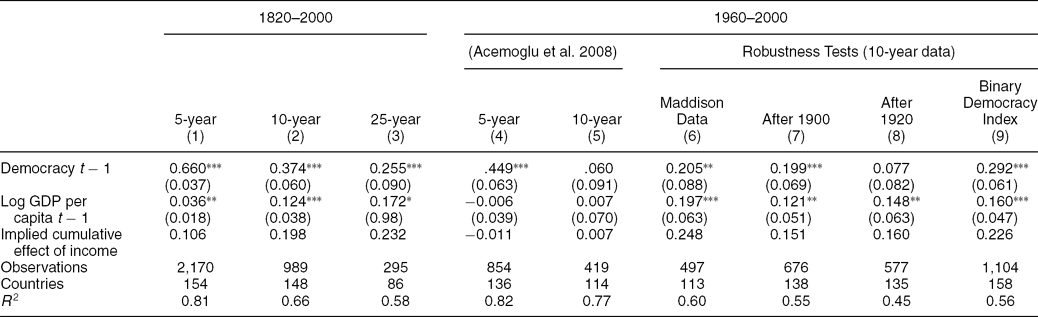
To test the effects of development on democracy, I first regress the level of democracy on income, employing the universe of sovereign countries from 1820 (that is, a time where there were hardly any democracies) to 2000 (Table 1, columns (1) to (3)). The estimation procedure is based on a standard pooled OLS regression in which the value of democracy is regressed on the lagged values of democracy and per capita income and includes a full set of country dummies (to control for country-specific traits) as well as year dummies (to capture any common shocks to all countries).Footnote 16 The Polity IV index of democracy, which ranges from −10 to 10, has been normalized here from 0 to 1. To maximize the number of observations, data on per capita income are based on Bourguignon and Morrisson (Reference Bourguignon and Morrisson2002) and Heston, Summers, and Alden (Reference Heston, Summers and Aten2002).Footnote 17 Column (1) reports the results for observations collected every five years. Column (2) does the same for 10-year intervals. Column (3) looks at 25-year periods. For the purposes of comparison, columns (4) and (5) reproduce the results of Acemoglu et al. (Reference Acemoglu, Johnson, Robinson and Yared2008) for the 5-year and 10-year data for the period 1960–2000.
Development and the Level of Democracy, 1800–2000

Note: Fixed-effects OLS regressions with country dummies, time dummies, and robust standard errors clustered by country in parentheses. The implied cumulative effect of income represents the coefficient estimate of log GDP per capita t − 1/(1 – democracy t − 1).The dependent variable is the Polity index of democracy, normalized from 0 to 1, except in column (7).
*** p < .01; ** p < .05; * p < .10; standard errors in parentheses.
The coefficient of per capita income is statistically significant in the sample that includes all of the country-years of the two first waves of democratization (columns (1) through (3)). Take, for example, column (2), based on 10-year data. From a substantive point of view, its coefficient of 0.124 implies that a 10% increase in per capita income should lead to a short-term increase of about 0.0124 in the democracy index. Because we are controlling for the lagged value of democracy, it is more appropriate to consider the long-run effects of income on democracy (shown in the fifth row): A 10% increase in per capita income translates into an increase of 0.02 in the index of democracy; and doubling per capita income implies a shift of 0.2 points on a scale from 0 to 1.Footnote 18 Because GDP per capita has increased more than 10-fold in developed countries in the last two centuries, development must have been a powerful factor (or, pending some proof of causality, a powerful correlate) in the general process of democratization. As noted before, these results contradict the findings of Acemoglu et al. (Reference Acemoglu, Johnson, Robinson and Yared2008). This is probably because Acemoglu et al. (Reference Acemoglu, Johnson, Robinson and Yared2008) rely on only about 25 countries (even though the number of sovereign countries was over 50 in 1900 and almost 200 by 2000) and data for 1875 to 2000 grouped in 25-year periods. This yields six observations per country and leads to extremely limited within-country temporal variance.
Robustness Tests
Before the relationship between development and democracy is examined in more detail, the last four columns of Table 1 probe the robustness of the results. Column (6) reports the effects of per capita income, employing income data taken from Maddison only. Because income data from the nineteenth century may be more prone to measurement error, the next two estimations limit the analysis to twentieth-century observations: after 1900 in column (7) and after 1920 in column (8). Finally, column (9) employs the Boix–Rosato dichotomous measure of democracy as the dependent variable. In all instances, per capita income is statistically significant. The long-run political effect of doubling per capita income continues to fluctuate around 0.2 points.Footnote 19
Instrumentation of Income
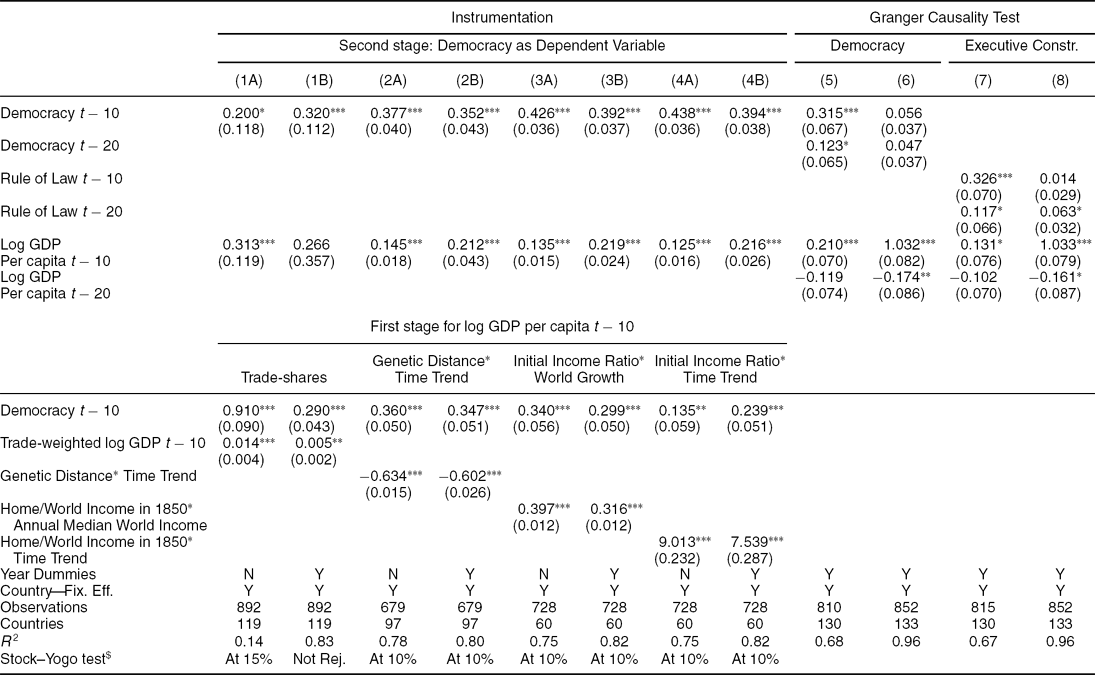
The possibility of simultaneous causation in the relationship between income and democracy calls for an exogenous measure of the variation in levels of development. Because there is probably no single ideal source of exogenous variation, I employ four alternative instruments in Table 2. For each instrument, Table 2 reports two models: The first one (columns (1A), (2A), (3A), and (4A)) includes country fixed effects; the second one (columns (1B), (2B), (3B), and (4B)) adds year dummies. In presenting each instrument I consider whether it meets the two central requirements of instrumental variable estimation: That it is valid, i.e., that it fulfills the exclusion condition and is uncorrelated with the dependent variable; and that it is not a weak instrument, i.e., that it is well correlated with the instrumented variable. To assess the second condition I employ, in addition to the results of the first-stage estimation, a statistical test recently developed by Stock and Yogo (Reference Spruyt, Boix and Stokes2005) to probe the statistical strength of the instrument. Because the two-stage least-squares procedure generally estimates variances with a downward bias in finite samples, it may distort the standard significance tests and lead to too many type II errors. Employing the Cragg–Donald statistic, Stock and Yogo (Reference Spruyt, Boix and Stokes2005) derive a set of critical values to determine whether the nominal 5% two-stage least-squares t-test on the instrumented coefficient in fact exceeds a certain threshold r, such as 10%, and therefore is based on a weak instrument.
Testing Causality between Income and Democracy, 1820–2000

Note: The dependent variable is the Polity index of democracy, normalized from 0 to 1. Standard errors in parentheses.
*** p < .01; ** p < .05; * p < .1.
$ Rejection of null hypothesis that instrument is statistically weak, i.e., the nominal value of the t-test (at 5%) based on IV statistics has an actual size that exceeds a given threshold (with the threshold indicated for each model) (Stock–Yogo Reference Stock, Yogo, Andrews and Stock2005).
Following Acemoglu et al. (Reference Acemoglu, Johnson, Robinson and Yared2008), I first instrument income through trade-shares between countries. The results are presented in columns (1A) and (1B).Footnote 20 The instrument of income, Ŷit −1, is a weighted sum of world income for each country i, with weights varying across countries as a function of their trade-shares with other countries j,

where ω is the share of trade between country i and country j in the GDP of country i. In line with Acemoglu et al. (Reference Acemoglu, Johnson, Robinson and Yared2008), I calculate trade-shares during the postwar period using IMF data on trade-shares between 1980 and 1989. I also calculate separate trade-shares for the period before 1940 with data collected by Oneal and Russett (Reference North and Weingast1999) on export dyads for the period 1900–1930.Footnote 21 According to Acemoglu et al. (Reference Acemoglu, Johnson, Robinson and Yared2008, 824–25), the trade-shares instrument meets the exclusion condition. As for its strength, the coefficient on the instrumental variable is positive and statistically significant in the first-stage estimation. The Stock-Yogo test (last row of Table 2) shows, however, that we cannot reject the null hypothesis that the true significance level of hypothesis tests about the coefficient of the instrumented variable is smaller than 10% when the usually stated significance level is 5%. In Model A1, the null hypothesis can only be rejected at the threshold of 15%. In fact, in Model 1B it cannot even be rejected at a 25% threshold.
The second instrument (columns (2A) and (2B)) employs the index of genetic distance (measuring the time since two populations shared common ancestors) developed by Spolaore and Wacziarg (Reference Schroeder and Knorr2009). As discussed by Spolaore and Wacziarg, the index proxies the costs of technological diffusion, and as such it may be taken as a good predictor of the time it takes a country to experience modern growth rates. Genetic distance may be correlated also with democracy directly, because genetic proximity may facilitate, for example, the diffusion of some cultural patterns, democratic beliefs, and so on. A priori, there is no way to exclude those channels. However, notice that in the first half of the nineteenth century genetic distance was strongly correlated with the level of development (the correlation coefficient is −0.57 for income in 1850) but not with political regime (r = −0.07 in 1850). Exploiting this fact, I build the instrument as the interaction of the genetic distance and a historical trend calculated as “yeart − 1800.” The time trend captures the fact that income levels (but not democracy levels) have been strongly correlated over time across countries—as is apparent in Figures 3 and 4. Nonetheless, I also control for possible direct channels between genetic distance and democracy by introducing two additional variables: first, the level of democracy of all countries j weighted by the genetic proximity of each country j to country i; second, the average level of democracy in the region to which each country i belongs. The instrument is statistically strong: It is significant in the first stage; moreover, according to the Stock–Yogo test, we can reject the null hypothesis of weak instrumentation at the strictest threshold of 10%.
The third and fourth instruments exploit the absence of any correlation between income and political regime before the first wave of democratization more directly. The third instrument is the ratio of each country's income to the world median income in 1850 multiplied by the world median income each year. Once again, the income ratio in 1850 is a strong predictor of income levels over time (as shown in Figure 3 and for the reasons pointed out, for example, in Lucas (Reference Lipson2000)) but not of political regimes (especially at the onset of the period). In turn, the annual world median income approximates the growth trend of the last two centuries. Still, we cannot completely discard the possibility that the growth trend affects directly the introduction of democracy in country i—for example, it may change the proportion of country i's democratic neighbors and, through some diffusion or imitation effect, lead to its democratization. Therefore, I also experiment with the introduction of two additional controls: the average level of democracy both at the world level and at the regional level (for the region of each country i).
Finally, the fourth instrument tries to get closer to satisfying the exclusion requirement by substituting a time trend (calculated as “2000 − yeart”) for the world median income (because the latter may lead to other changes affecting democracy directly). The time trend seems to be a sensible strategy because, excluding the crisis of 1929, growth has been rather steady across the world and, in spite of some income convergence, countries have not changed much in their relative positions (Quah Reference Putnam1996). However, here I also include controls for the average democracy both at the world and at the regional level to deal with the possibility that a general upward trend in development may affect democracy directly (through the channels mentioned before). The third and fourth instruments are statistically significant in the first-stage estimate. The null hypothesis of weak instrumentation is strongly rejected for both.
In all models except column (1B), the coefficient of the instrumented variable is positive and substantial in its size. Again, the long-run effect of doubling income leads to a shift of 0.2 to 0.3 points in the polity index. The inclusion of controls for the level of democracy of genetically similar countries and/or geographically close countries does not affect the variable of interest.Footnote 22 Income may be thought of as having a causal impact on the process of democratization.
Granger Causality Test
Taking advantage of the temporal structure of the data, I perform a direct Granger test between level of income and political regime with a two-lag model in columns (5) and (6) in Table 2.Footnote 23 In column (5), the dependent variable is the continuous index of democracy: The lagged values of income significantly affect the level of democracy in the expected direction. In column (6) the dependent variable is income per capita: In this case the lagged values of democracy are not statistically significant (either individually or in a joint test). In short, income matters for democracy but not vice versa.
As discussed earlier, an important school of economic history claims that institutions matter for development (North Reference Muller1990, 1–64). Columns (7) and (8) explore this claim through a Granger causality test in which the level of democracy is replaced by the level of executive constraints (as measured in Polity IV). More specifically, column (7) regresses executive constraints on income and shows that the level of income explains executive constraints—although the estimate is small in size. In turn, column (8) regresses income on executive constraints, finding that, as claimed by institutionalist theories of growth, the existence of institutional constraints matters to explain development. In other words, whereas columns (5) and (6) imply that the direction of the relationship goes from development to democracy, columns (7) and (8) point to a causal relation in both directions. Put together, these results have two implications that seem to reinforce this article's causal interpretation of the link between income and democracy. They show that, contrary to a strand of research that treats mass democracy and certain liberal institutions (such as the rule of law or a constrained executive) as two interchangeable phenomena, the index of democracy is not picking up a constitutional system of (executive) constraints but rather the existence of competitive elections with a very wide franchise. As a result, these estimates appear to confirm that the process of modernization has generally taken place through the following temporal sequence: A set of pro-growth institutions triggered a sustained period of economic development which in turn reinforced those institutions (columns (7) and (8)); and that growth fostered the social conditions that made democracy feasible (column (5)).
CHANGING IMPACT OF DEVELOPMENT ON DEMOCRACY
The previous section reported two main results. First, the (unconditional) effect of income on the level of democracy is weak or nonexistent after World War Two (columns (4) and (5) in Table 1). Second, once we examine the whole evolution of political institutions since the early nineteenth century, that is, from the time when the vast majority of countries were authoritarian to today, income matters in explaining the process of democratization. I now turn to explore these two (seemingly contradictory) facts in more detail to determine why the impact of income on politics has varied over time.
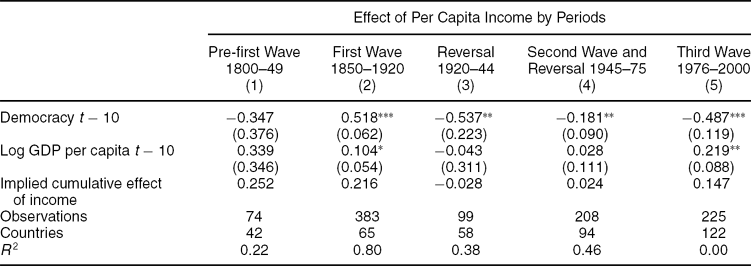
Before I explore the key sources of the varying effect of income on democracy, Table 3 confirms the period-specific effects of development. It does by looking separately at the main democratization periods identified by the literature (Huntington Reference Huntington1990, 19–30): the period up to the liberal revolutions of 1848–49 (column (1)); the first wave of democratization, from 1850 to 1920 (column (2)); the interwar period of democratic reversal (column (3)); the postwar period (including a brief second wave of democratization and its reversal) (column (4)); and the latest wave of democratization, which started in Southern Europe in the late 1970s (column (5)). Income per capita had no effect on political regimes in the first half of the nineteenth century. It had a strong effect, however (with a coefficient of 0.104), from the demise of the Holy Alliance through the post–World War One settlement. It had no impact during the critical decades leading to World War Two and during the peak of the Cold War. Finally, it turned out to have a very substantive effect (with a point estimate of 0.219) during the third wave of democratization.Footnote 24
Development and Democracy by Historical Periods

Note: Fixed-effects OLS regressions with country dummies, time dummies, and robust standard errors clustered by country in parentheses. The dependent variable is the Polity index of democracy, normalized from 0 to 1. The implied cumulative effect of income represents the coefficient estimate of log GDP per capita t − 1/ (1 − democracy t − 1).
*** p < .01; ** p < .05; * p < .10; standard errors in parentheses.
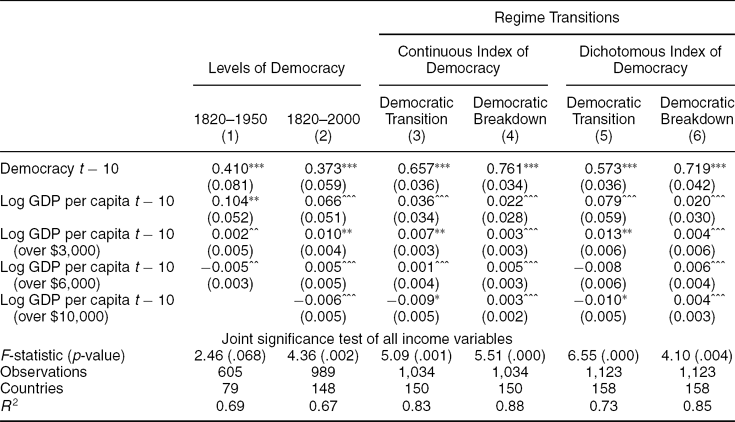
As pointed in the second section, the process of development is likely to have a positive but nonlinear effect on the level of democracy (particularly on the probability of democratic transitions): Beyond a certain level of income and after (or if) a country has become fully democratic, income does not play any further role in promoting democracy. With that in mind, Models 1 and 2 in Table 4 examine the varying effects of income at different stages of development through a spline function—below $3,000, between $3,000 and $6,000, between $6,000 and $10,000, and above $10,000.Footnote 25 Column (1) estimates the spline model for the period before 1950. It shows that development always increases the level of democracy—the coefficient is 0.104. Not surprisingly (given that most countries had a per capita income below $4,000 before World War Two), the coefficients for middle and upper income segments are not statistically significant (although they are in a joint test). Column (2) estimates the spline model for the whole period from 1820 to 2000. Income always matters (here with a coefficient of 0.066) and it is statistically significant in a joint test with the other income variables. For middle levels of development, per capita income accelerates that process: Each dollar, in log terms, over $3,000 adds 0.010 points to the level of democracy. However, the effects of per capita income wear off as development progresses beyond a certain threshold: Above $6,000 the coefficient drops to 0.005; over $10,000, the coefficient becomes negative (−0.006), implying that the impact of development on democracy flattens out. A simulation of column (2) shows that, given an initial (and arbitrarily set) polity index of 0.5, 10 years later the polity index is 0.42 in a country with a per capita income of $1,000, 0.60 for a country with an income of $4,000, and 0.69 for an income of $8,000. Afterward, the polity index hardly grows—for an income of $20,000 it is 0.71.Footnote 26
Declining Marginal Effects of Income on Democracy

Note: Fixed-effects OLS regressions with country dummies, time dummies, and robust standard errors clustered by country in parentheses. The dependent variable is the Polity index of democracy, normalized from 0 to 1.
*** p < .01; ** p < .05; * p < .10; standard errors in parentheses.
In joint test with all per capita income variable: ^^^p < .01; ^^p < .05.
The nonlinear effect of income on democracy shown in Table 4 may be interpreted from a historical point of view as follows. Until the first half of the twentieth century, as (mainly European) countries became more developed, they transitioned to democracy (with a few reversions to authoritarianism). Once almost all wealthy countries became fully democratic after 1945, their continuous growth simply contributed to the consolidation of democratic rule—but it did not result in any change in the polity index. In turn, those countries that had not moved to democracy before 1950 had a hard time doing so because, with a few exceptions in southern Europe and eastern Asia, their growth rates remained anemic (Quah Reference Putnam1996).
The section “The Conditional Effects of Development” distinguished between the marginal effect of development on democratic consolidation (always positive) and its marginal effect on democratic transitions (zero after a certain income threshold). To test those different effects of (especially high) income on regime transitions, columns (3) through (6) in Table 4 estimate the effects of income on democratic transitions and democratic breakdowns separately. Columns (3) and (4) estimate them employing the continuous polity index. In column (3), which estimates the impact of income on transitions to democracy, the value of the dependent variable is the maximum value of democracy at either time t or time t − 1. This effectively restricts the analysis to those cases in which there has been an increase in democracy. In column (4), which estimates the impact of income on transitions away from democracy, the value of the dependent variable is the minimum value of democracy at either time t or time t − 1. This limits the analysis to those cases in which there has been a decline in the level of democracy.Footnote 27 Columns (5) and (6) employ the Boix–Rosato dichotomous index of democracy. Column (5) looks at transitions to democracy (the dependent variable takes the maximum value of democracy at times t and t − 1). Column (6) examines transitions away from democracy (the dependent variable is equated to the minimum value of democracy at times t and t − 1).
Columns (3) and (5) show that higher levels of per capita income result in a higher probability of democratization—the coefficients are 0.036 and 0.079, respectively, even after country and time fixed effects are included. Again, the coefficients become negative in the highest-income segment (−0.009 and −0.010, respectively), making income effects effectively flat as countries go over $10,000. This last result captures the fact that countries tend to transition to democracy as they grow—with the likely exception of a few cases (such as oil countries) that are wealthy yet hard to change.Footnote 28 In turn, columns (4) and (6), which estimate the impact of income on democratic breakdowns, confirm that richer countries are less likely to experience reversals to authoritarian rule: The coefficients are 0.022 and 0.020, respectively (a positive coefficient means a lower probability of democratic breakdown as per capita income increases). However, in contrast to columns (3) and (5), higher levels of income (above $10,000) still have a positive coefficient (0.003 and 0.004), confirming that adding income always makes democracy more stable.
INTERNATIONAL ORDER AND DEMOCRACY
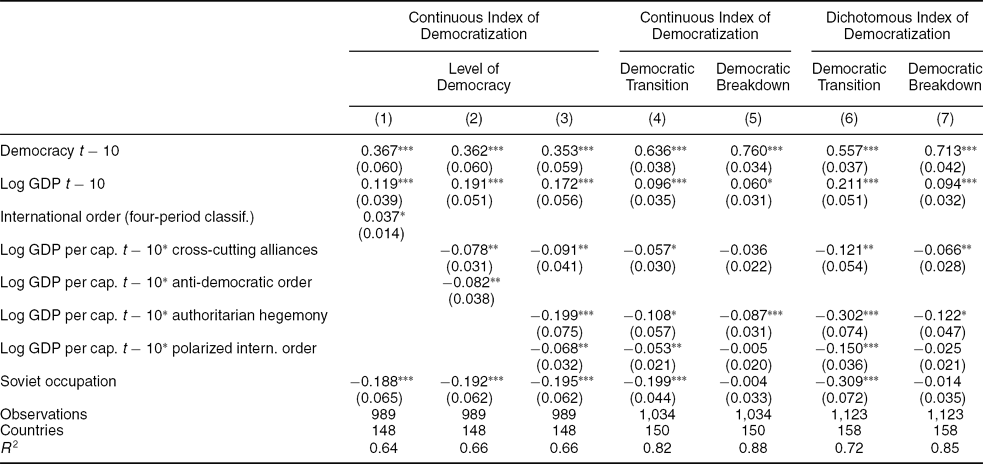
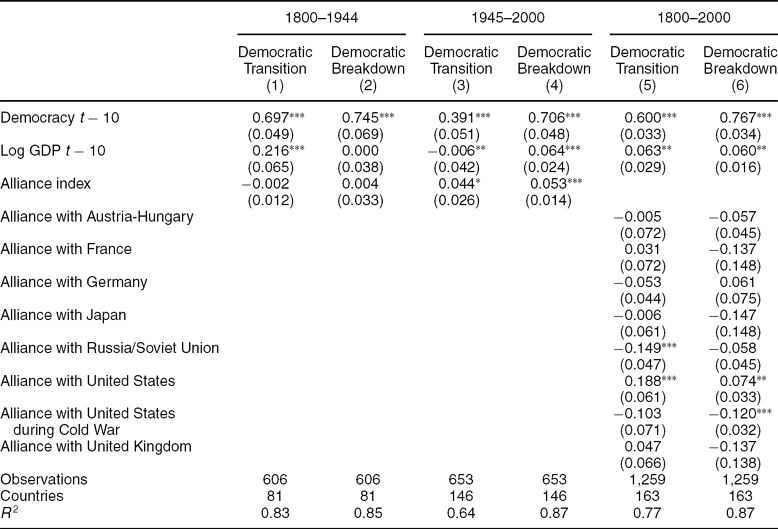
To measure the effects of the international order on political regimes, I follow two main strategies. In Table 5 I employ a set of variables that define the overall structure of the international order yearly as a function of the political leanings and general strategies of the existing great powers, which are defined following Mearsheimer (Reference Mearsheimer2001). In Table 6 I consider the effects of maintaining an (offensive and/or defensive) alliance with a great power on every country's political institutions.
International Order, Development, and Democracy

Note: Fixed-effects OLS regressions with country dummies, time dummies, and robust standard errors clustered by country in parentheses.
*** p < .01; ** p < .05; * p < .10; standard errors in parentheses.
International Alliances, Development, and Democracy

Note: Fixed-effects OLS regressions with country dummies, time dummies, and robust standard errors clustered by country in parentheses.
*** p < .01; ** p < .05; * p < .10; standard errors in parentheses.
Following the theoretical discussion of the second section, I classify the international order into one of the following categories:Footnote 29
1. In an antidemocratic international order, there is at least one authoritarian great power, and great powers structure their alliances along political ideologies, i.e., absolutist monarchies cooperate with each other against liberal democracies or democratic countries are allied against communist regimes. As discussed in the section “The Conditional Effects of Development,” in this context authoritarian governments intervene to block the introduction of democratic institutions. In turn, each liberal great power is likely to support an authoritarian solution if the alternative outcome is not a democracy but a revolutionary regime that may take sides with a competing great power. The international system was “antidemocratic” during three historical periods: in the first half of the nineteenth century when the European central empires established the Holy Alliance to uphold the political and territorial status quo negotiated in the Congress of Vienna; after 1933 as Nazi Germany tried to impose its ideology in the European theater; and under the Cold War, from 1948 to 1990. Among antidemocratic international orders I distinguish between two categories: authoritarian hegemony and polarized order. In the former there is a single authoritarian hegemon or a coalition of authoritarian hegemons with no countervailing liberal superpower: the Holy Alliance period, when Britain was either not liberal (before 1833) or not intervening in the continental theater. In a polarized order, such as the Cold War period, there are authoritarian and democratic powers. Both international orders depress democracy, but the negative effect of authoritarian hegemony on democracy should be stronger.
2. In a neutral or cross-cutting international order, there are both authoritarian and liberal great powers, but international alliances do not follow ideological cleavages. Authoritarian and democratic great powers establish defensive pacts or alliances of mutual assistance among themselves for strict “realpolitik” reasons, unconcerned about the political ideas and institutions of their allies. In this context, democratic (authoritarian) powers do not invest in the expansion of liberal (repressive) institutions. This type of system was in place from 1849 (as soon as the Holy Alliance was unable to quell the revolutionary explosions of that year) until 1918.Footnote 30 Income should affect political regimes unconditionally.
3. In a democratic order all the great powers are democratic. They do not generally intervene in favor of authoritarian regimes. This international system, which prevailed after World War One until the Wilsonian project collapsed and which reappeared after the breakdown of the Soviet Union, should boost the number of democracies across the globe.
The first three columns of Table 5 examine the impact of the international order on the level of democracy. Column (1) regresses democracy on a single variable that takes the following values: −2 for “authoritarian hegemony” (1800–1848), −1 for “polarized order” (1933–1990), 0 for neutral (1848–1917) and 1 for pro-democracy periods (1918–1932, 1991–2000). The model also adds the variable “Soviet Occupation” to measure whether a country was controlled by the Soviet Union or not. Columns (2) and (3) explore the effect of income under separate types of international orders. Column (2) runs the estimation for a three-period classification (where antidemocratic regimes are consolidated into one category), whereas Column (3) uses the full four-period classification. The excluded variable is the pro-democracy period.Footnote 31
The type of international order alters the impact of income significantly. Income has a very strong impact under a democratic international order: In column (3) the coefficient of the log of income is 0.172. It becomes slightly negative under a system of authoritarian hegemony: The sum of the overall coefficient for income (0.172) and the coefficient under authoritarianism (−0.199) is −0.027. Neutral and polarized systems cut the effect of income in half, to 0.081 (0.172 − 0.091) and 0.104, respectively. In other words, a shift in per capita income from $1,000 to $12,000 implies an increase in the index of democratization by 0.5 points under a democratic global order. However, it only leads to an increase of 0.15 points under a cross-cutting or polarized order. The effect of Soviet control is also negative and very substantial: It reduces the level of democracy by almost 0.2 points (in a scale from 0 to 1). These results may explain why, under the unfavorable international climate that prevailed from the mid-1930s until the late 1980s, it took many middle-income countries so long to become democratic even though they enjoyed an income level similar to that of European countries before 1920. Indeed, whereas three-fourths of countries with a per capita income over $3,000 (in constant dollars of 1996) were democratic in the interwar period, less than half above $3,000 were democratic during the Cold War period. However, right after the fall of the Soviet Union, the percentage of democracies increased rapidly to about 60%.
Columns (4) through (7) estimate the impact of the international order on regime transitions. Under a democratic international order, income increases the likelihood of democratic transitions (the point estimate is 0.096) and reduces the probability of democratic breakdowns (the estimate is 0.060—again, a positive coefficient means that there are fewer breakdowns) (columns (4) and (5)). A neutral international order cuts the effect of income to about half to 0.039 (0.096 − 0.057) for democratic transitions and 0.024 (0.060 − 0.036) for democratic breakdowns. Under an authoritarian international system, development has no impact on democratic transitions (−0.012 = 0.096 − 0.108) and a light one on democratic breakdowns (−0.027 = 0.060 − 0.087). Finally, under a polarized order, the effect of income on democratic transitions is similar to that for a period with cross-cutting alliances (0.043 = 0.096 − 0.053). However, its impact on democratic breakdowns (0.055 = 0.060 − 0.005) is the same as that in a democratic international system. These last two results capture two facts about the polarized order that prevailed after World War Two: first, that most of the countries that were democratic in the immediate postwar remained democratic in the following decades; second, that, in the ideologically polarized context of the Cold War, the great powers blocked, either directly or indirectly, many democratic transitions in authoritarian regimes.
Columns (1) through (4) in Table 6 examine the effect of international alliances on political institutions by constructing an alliance index that takes the following values: 1 if the country is allied with a democratic great power during a pro-democracy international order; 0 if it has no alliances or the alliance takes place during a neutral international order; −1 if it is allied with a democratic power in a polarized period; and −2 if it is allied with an authoritarian great power during an anti-democratic period.Footnote 32 The type of alliance has no effects on regime transitions before World War Two (columns (1) and (2)), probably reflecting the overall type of international system and the relative lower number of alliances with lesser powers during that period. By contrast, it strongly affects both the probability of transition to democracy and the likelihood of democratic breakdowns after World War Two (columns (3) and (4)).
Columns (5) and (6) regress regime transitions on each bilateral alliance with a different great power (the excluded category is China). To allow for the different behavior of democratic superpowers when facing the possibility of a revolutionary outcome among its allies, I introduce a specific variable to capture alliances with the United States during the Cold War period. Maintaining alliances with Austria-Hungary, France, Germany, Japan, and the United Kingdom has no political consequences. An alliance with the Soviet Union depresses the probability of a democratic transition (a result similar to that for the variable “Soviet Occupation” in Table 5). Conversely, an alliance with the United States has a positive impact on democratic transitions (column (5)). Democratic breakdowns are less common among American allies (as implied by the positive coefficient of 0.074 in column (6)) with the exception of the Cold War period–the coefficient of −0.120 for the variable capturing an alliance with the United States during that period is higher than the point estimate of 0.074 for the unconditional effect of an alliance with the United States. Overall, these results confirm that the political behavior of a democratic hegemon such as the United States varied as a function of its international environment.Footnote 33
Besides the impact of great powers politics, the international system may affect the likelihood of democratization through at least two additional channels. In the first place, the process of economic globalization may result in more open political regimes—either because trade agreements and economic openness (pushed by regional powers such as the European Union) may be offered conditional on some measure of political liberalization (Hafner-Burton Reference Hafner-Burton2009) or because they increase the degree of asset mobility, which in turn makes states more willing to reduce repression (Boix Reference Boix2003, 38–42; Hirschman Reference Hirschman1981, 246–65). To test for the impact of openness, I have regressed the level and change of democracy on the annual average tariff from 1865 to 2000, both at the world and at the regional level. Due to data constraints, tariffs at the regional level are clustered into three areas: Europe, America, and the rest of the world. Data for tariffs before World War Two (available for 35 countries) come from Clemens and Williamson (Reference Clemens and Williamson2004) and Mitchell (Reference Miller1992). Data for the period after 1950 come from the World Bank. Neither the world average tariff nor the regional average tariffs are statistically significant. Moreover, their inclusion does not affect either the size or the statistical significance of the estimates of per capita income and the structure of the international order.Footnote 34 That result does not mean, however, that economic globalization does not matter. It may still affect the level of democracy through its effects on growth (captured through per capita income in our estimations). It may also be related to more democracy if the great powers offer to (or exact from) their allies higher levels of economic integration in exchange for more liberal institutions—that latter channel would then be captured by the variables of different international orders.Footnote 35
In the second place, the international system has been found to affect the probability of having a democracy through the cross-national diffusion of ideas and the example of neighbors (Gledistch and Ward Reference Gleditsch and Ward2006; Przeworski et al. Reference Przeworski2000). To test this hypothesis, I explore the effect of controlling for the yearly proportion of democratic regimes in the continent to which each country belongs. The variable is statistically significant and increases the probability of transitions to democracy (with a coefficient of around 0.17). It has no effect, however, on democratic breakdowns. Its inclusion does not change the size or statistical significance of the level of development. Although it reduces both the size of the effect (by about one-third) and the statistical significance of the authoritarian and cross-cutting international orders (in the case of democratic transitions), an F-test shows that all the variables remain jointly significant. That result suggests that previous estimates in the literature on diffusion effects may be partially capturing the impact of the international order (and the strategies of great powers) in place at each moment in time.
CONCLUSIONS
In the last fifty years, the research agenda on democratization has been dominated by an important debate over the impact of economic development on political institutions. Employing a data panel of sovereign countries from the early nineteenth century (when there were hardly any democracies) to the end of the twentieth century, this article makes three main claims.
First, it shows that per capita income is statistically associated with the process of democratization, even controlling for country and year effects and subjecting the estimates to several robustness tests.
Second, instrumenting for income and exploiting the temporal dimension of the data through a Granger causality test, it suggests that development has a causal effect on democracy. This result is then interpreted as matching the following process of political and economic modernization. First, the existence of certain institutional structures, such as societywide cooperative norms of behavior or a constitutional system of checks and balances, that were already in place in modern times led, in conjunction with the modern scientific revolution, to a period of industrialization and sustained growth after 1800. Second, that process of economic development triggered or was associated with the spread of a skilled labor force, declining inequality, and a diversified economy. Finally, all these transformations made feasible the transition to and consolidation of democracy as a political equilibrium.
Third, the article shows that the relationship between income and democracy varies across income levels and over time periods. On one hand, income has a declining marginal impact on democratization: In wealthy countries, any additional growth stabilizes democracies but does not increase the likelihood of a transition to democracy. On the other hand, the effect of income is strongly mediated by the structure of the international order and the ways in which great powers shape the resources of political factions in small countries. The Holy Alliance actively suppressed all liberal revolutions in the European continent during the first half of the nineteenth century. After the collapse of the central empires in 1918–19 and the triumph of the Wilsonian doctrine, democracy thrived, especially in Europe. The Cold War opened the door to a worldwide democratic reversal as the Soviet Union occupied Eastern Europe and exported communism to the Third World and Washington responded by supporting many authoritarian allies in poor Latin American, African, and South Asian nations. Finally, the fall of the Berlin wall and the so far uncontested supremacy of the United States in the last two decades spurred a robust wave of democratization.



Comments
No Comments have been published for this article.