INTRODUCTION
This article draws on two bodies of literature to explore how people experience the alternative dispute resolution (ADR) process: procedural justice theory and the empirical legal literature on ADR. The central argument of procedural justice theory is that people who engage with authorities – for example, to resolve a dispute of some kind – care about the process through which decisions are reached as well as whether those decisions are favorable to them (Tyler and Blader Reference Tyler and Blader2003, 747). Research on procedural justice has established that, in many different settings, people who encounter an authority (for example, the courts, tribunals, or the police) pay close attention to how they are treated by that authority and that this treatment is experienced and judged independently from the outcome they receive. Crucially, people who experience fair treatment are more willing to accept an outcome even if it is not in their favor (Tyler Reference Tyler2006). As a consequence, studies on procedural justice have focused heavily on how courts, tribunals, police, and other authorities treat people – or, at least, on the policies intended to govern how they treat people (Myhill and Quinton Reference Myhill and Quinton2011; President’s Task Force on 21st Century Policing 2015).
In everyday practice, the way in which procedures are carried out (for example, being treated with respect, being heard, having a voice in the process, and building trust) makes a difference to people’s justice perceptions (Bies Reference Bies1987; Tyler and Bies Reference Tyler, Bies and Carroll1990). In turn, legitimacy is awarded to an institution as a consequence of people feeling that they have been treated fairly by it (Tyler Reference Tyler2003, Reference Tyler2006; Jackson et al. Reference Jackson, Bradford, Hough, Myhill, Quinton and Tyler2012). It is this legitimacy that, at least in part, makes people more likely to accept outcomes delivered by those authorities and more likely to follow their orders, instructions, and/or decisions (Tyler and Huo Reference Tyler and Huo2002; Tyler Reference Tyler2006; Murphy, Bradford, and Jackson Reference Murphy, Bradford and Jackson2016). All this implies that people’s behaviors are shaped by the perceived fairness of the process that an authority offers to them. While it has been suggested that improving upon the objective performance of legal authorities may not enhance perceptions of fairness and legitimacy (Nagin and Telep Reference Nagin and Telep2017, Reference Nagin and Telep2020), there is strong evidence that the subjective impression of a process influences how people perceive an institution and how they act in relation to it (Tyler Reference Tyler2003, Reference Tyler2017; Mazerolle et al. Reference Mazerolle, Antrobus, Bennett and Tyler2013; Bolger and Walters Reference Bolger and Walters2019; Walters and Bolger Reference Walters and Bolger2019). Moreover, research from a variety of contexts tends to show that procedural justice is a more important predictor of outcomes such as trust, legitimacy, and cooperation than broadly instrumental concerns with effectiveness and outcomes (Tyler and Huo Reference Tyler and Huo2002; Tyler Reference Tyler2006; Jackson et al. Reference Jackson, Bradford, Hough, Myhill, Quinton and Tyler2012), although, of course, this is not universally the case (see, for example, Tankebe Reference Tankebe2009; Cheng, Pushkarna, and Ri Reference Cheng, Pushkarna and Ri2020).
The authority that we are concerned with in this article is the German Federal Ombudsman Scheme (GFOS), which provides ADR for consumers and businesses. The regulatory framework for its establishment can be found in the European consumer ADR directive that was implemented in 2016 into German law by way of the Verbraucherstreitbeilegungsgesetz (Creutzfeldt Reference Creutzfeldt2016).Footnote 1 The directive requires member states to provide ADR bodies for most consumer-to-business disputes (Creutzfeldt Reference Creutzfeldt2016). Part of the success of the ombudsman model is that it is able to operate in different legal settings and perform different roles and functions (Heede Reference Heede2000; Reif Reference Reif2004; Kucsko-Stadlmayer Reference Kucsko-Stadlmayer2009). ADR “is not, an entirely separate legal order, rather it is an enclave within a broader culture in which liberal legal ideology is well institutionalised” (Garth and Sarat Reference Garth and Sarat1998, 17). ADR, as a form of dispute resolution in America, Europe, and the United Kingdom, was introduced to help ease the caseload of the courts and to divert cases into a parallel system to reduce cost and backlog (Burger Reference Burger1990; Menkel-Meadow Reference Menkel-Meadow2015; Creutzfeldt Reference Creutzfeldt2016).
Despite ADR bodies being a permanent feature of justice systems, not much is known about how or why people use their services, judge their processes, or accept their outcomes. It is important to explore these perceptions to be able to improve the ADR process and to provide access to justice. As research on procedural justice effects has expanded into different contexts and settings, studies have started to look at the relevance of this paradigm for ADR (Hollander-Blumhoff and Tyler Reference Hollander-Blumoff and Tyler2008, Reference Hollander-Blumoff and Tyler2011; Creutzfeldt and Bradford Reference Creutzfeldt and Bradford2016). These studies have found that, empirically, procedural justice matters to people in this particular context and that it influences their readiness to accept outcomes offered to them. Yet, in a study on perceptions of ADR procedures in the United Kingdom, Naomi Creutzfeldt and Ben Bradford (Reference Creutzfeldt and Bradford2016, 1013; emphasis added) found that, whilst “outcome favourability and procedural justice are key factors in shaping decision-acceptance.” It may be that, in the ADR context, outcome favorability has a more prominent weighting than it seems to have in other justice contexts.
In this article, we expand consideration of procedural justice in ADR to the question of legitimacy. While previous studies have explored outcomes such as decision acceptance and satisfaction with the process, to our knowledge, none have focused on what is arguably the fundamental question—is the legitimacy of ADR, and, specifically, of the organization “delivering” it, associated with perceptions of procedural justice? In addressing this central question, we also contribute to the wider literature and debate on procedural justice. Procedural justice in justice settings has often been studied in one of two ways: lab-based (and, increasingly, also online) experiments, where people’s perceptions are measured in a context arguably far removed from “real life” (for example, Lind and Tyler Reference Lind and Tyler1988; Lind, Kanfor, and Earley Reference Lind, Kanfer and Earley1990), and large-scale population surveys that probe general experiences and perceptions of the police, for example, which arguably do not attend sufficiently to the specificities of people’s interactions with the authorities (see, for example, the studies included in the recent meta-analyses in Bolger and Walters Reference Bolger and Walters2019; Walters and Bolger Reference Walters and Bolger2019).
This twin focus has a number of implications. These include, first, that the motivations for people engaging with an authority are often obscured or simply not salient. While some studies have considered the experiences of victims of crime, who clearly have a range of often complex motivations for engaging with the police or courts (for example, Van Camp and Wemmers Reference Van Camp and Wemmers2013; Murphy and Barkworth Reference Murphy and Barkworth2014; Koster, Van der Leun, and Kunst Reference Koster, Van der Leun and Kunst2020), few have considered the equally wide set of motivations that others may have for engaging with other legal authorities. At the threshold, this would appear an important omission because, put simply, what one wants and expects from an interaction seems likely to influence how one perceives it.
A second implication arising from the focus of previous research is that we know little about how what actually happens during particular interactions affects the key propositions of procedural justice theory. It has often been hard to tie the ideas and experiences reported by research participants to concrete institutional processes and, in particular, the objective processes involved and the actual outcomes achieved (the recent growth in randomized controlled trials and other field experiments is an important exception here: see, for example, Mazerolle et al. Reference Mazerolle, Antrobus, Bennett and Tyler2013; MacQueen and Bradford Reference MacQueen and Bradford2015; Weisburd et al. Reference Weisburd, Telep, Vovak, Zastrow, Braga and Turchan2022). Frequently, all we have is the perceptions and subjective judgments of those encountering or simply thinking about a particular authority. As Robert Worden and Sarah Maclean (Reference Worden and McLean2017) have argued, the gap between how people experience an interaction with authority and “the facts of the case” can differ substantially. Our study accounts for both the perceptions of the users of the GFOS and the official outcomes that the GFOS awarded in their case. This puts us in the unusual empirical position of being able to explore people’s perceptions of procedural justice and their perceptions of the outcome they received, given knowledge of the actual outcome of their case, which was, moreover, a real case that involved issues of significant importance to them (often financially).
Against this background, this article will be able to inform ongoing debates about dispute system design (Gill et al. Reference Gill, Williams, Brennan and Hirst2016; Blomgren, Martinez, and Smith Reference Blomgren, Martinez and Smith2020), institutional design (Sandefur Reference Sandefur2009; Taylor Poppe Reference Taylor Poppe2021), consumer law (Eidenmueller Reference Eidenmuller and Engel2014; Cortes Reference Cortes2017), and jurisprudential questions (Steffek et al. Reference Steffek, Unberath, Genn, Menkel-Meadow and Greger2013; Menkel-Meadow Reference Menkel-Meadow2000). All of these are vast fields, which we do not have the scope to discuss in this article. However, we return to these themes in the conclusions with recommendations for future research that can build upon our article. Before turning to our conceptual and theoretical contribution, the next part introduces the research context.
Research Context
The examined process is that of the GFOS, an ADR provider situated in the German legal and cultural context (Blankenburg Reference Blankenburg1998; Creutzfeldt Reference Creutzfeldt2016). This article draws from a rich dataset collected for a study commissioned by the federal German government between 2017 and 2020.Footnote 2 The study, through empirical data collection, analyzes how users (individuals and businesses) perceive a specific ADR provider, the GFOS (Universalschlichtungsstelle des Bundes).Footnote 3
The GFOS was established in 2016 as an ADR body responsible for resolving disputes arising from a contractual relationship between a consumer and a business. Its jurisdiction and framework is laid down in the German Act on Alternative Dispute Resolution in Consumer Matters.Footnote 4 Only consumers – and not businesses – are entitled to contact the ADR body with a complaint. The consumer can be the resident of any European Union or European Economic Area member state, but the business complained about has to be located in Germany. The GFOS solves conflicts mainly by way of conciliation. Compared with mediation, this means that ombudsmen assume a stronger leadership role in the process and have more influence on the result of the procedure, particularly by way of a non-binding conciliation decision (Steffek et al. Reference Steffek, Unberath, Genn, Menkel-Meadow and Greger2013).
The GFOS is a federal residual ADR body (European Commission 2019; Greger Reference Greger2019) and is available to consumers who have complaints about goods and services that are not covered by other sector specific ADR providers in Germany.Footnote 5 Some examples of specialized ADR entities are the Ombudsman Scheme for Private Banks (Ombudsmann der Privaten Banken), the Conciliation Body for the Legal Profession (Schlichtungsstelle der Rechtsanwaltschaft), the Conciliation Body for Energy (Schlichtungsstelle Energie), the Conciliation Body for Public Transport (Söp_Schlichtungsstelle für den öffentlichen Personenverkehr), the Insurance Ombudsman Scheme (Versicherungsombudsmann), and the Conciliation Body for Telecoms (Verbraucherschlichtungsstelle Telekommunikation der Bundesnetzagentur).Footnote 6
As specific ADR bodies have priority over the GFOS, it will reject a complaint for which a specific body is competent. However, the GFOS supports the affected consumers by signposting them to the competent ADR body. In some cases, a parallel competence can arise as there are a limited number of competing responsibilities between the GFOS and other ADR providers. In these cases, the consumer can choose which body to turn to (Hirsch Reference Hirsch2020). Considering these restrictions, the competence of the GFOS includes the following areas, according to the Federal Office of Justice: consumer goods (food, cars, information and communication technology products); education (language courses, driving lessons); energy and water (water, other energy sources); financial services (mortgage loans, travel insurance); general consumer services (house building, moving, child care); health (retirement homes and home care, but excluding health services); leisure services (hotels, package tours, services related to sports and hobbies); postal services and electronic communication (postal and courier services, fixed line and mobile phone services); transport services (taxi, sea and inland waterway transport, rental services); and a limited responsibility in the area of insurance (if outside of the remit of the Insurance Ombudsman Scheme). These classifications have received some criticism for a lack of precision and resulting confusion among consumers (Hirsch Reference Hirsch2020).
The GFOS is free to use for the consumer, it is independent of the businesses complained about (including independent funding), and it offers ADR for the consumer and the business. Its decisions are not binding on the business. At the end of 2020, the GFOS had eleven full-time employees (one director, two ombudsmen, four lawyers, two assistants, one office assistance, and one public relations officer) and three freelancers (a journalist, an information technology administrator, and a data protection officer).
A consumer can bring a complaint to the GFOS after they have tried to resolve the matter with the business directly but remain dissatisfied with the outcome. If a consumer approaches the GFOS before attempting to solve the dispute with the counterparty, the application will be rejected. The GFOS is usually contacted by the consumer through an online portal on their website or via email. Once on the website, the consumer finds a generic form to complete and can upload further supporting documents. From the time the GFOS started its work on April 1, 2016, until July 31, 2020, it had received a total of 9,394 applications (Creutzfeldt and Steffek Reference Creutzfeldt and Steffek2021).
A dispute brought to the GFOS can lead to five different types of outcomes for consumers that we explore empirically below: (1) a claim that is inadmissible or discontinued; (2) an amicable solution reached outside of official proceedings (usually by way of settlement); (3) an amicable solution reached within an official proceeding (by way of settlement or by accepting the ombudsman’s non-binding recommendation); (4) proceedings concluded without an amicable solution; and (5) the business has not participated. In the next section, we outline the conceptual and theoretical contribution that this article makes and then move on to the methodology of our study.
CONCEPTUAL AND THEORETICAL CONTRIBUTIONS
Legitimacy
Our primary contribution in this article is threefold. First, we introduce measures of legitimacy to the study of relations between ombudsman schemes and service users (consumers). Within the procedural justice literature, the empirical legitimacy of legal institutions (that is, their legitimacy from the perspective of those governed by them) can be defined as a set of judgments that people make about the moral appropriateness of these institutions and about the reciprocal duties they have toward them—legitimacy involves the recognition of the properly constituted right to command and the resultant right to be obeyed (Tyler and Jackson Reference Tyler and Jackson2014; Jackson Reference Jackson2018). One common measure of legitimacy, therefore, is the extent to which people feel a subjective sense of moral duty to obey authorities; other common measures of legitimacy cover, broadly speaking, perceptions of moral appropriateness—judgments of the extent to which an authority complies with people’s expectations of how it should behave, their sense that its actions align with their own values, and/or their sense that it “plays by the rules” (Tyler Reference Tyler2006; Jackson and Bradford Reference Jackson and Bradford2019).
It is easy to see how such a definition applies to the courts or the police, institutions centrally concerned with wielding state power and obtaining compliance, and, indeed, it is equally easy to see why procedural justice—making decisions in a fair, neutral, unbiased way, respecting legal and substantive rights, allowing people a voice in the interactions that affect them—should be so central in convincing people that power is being used appropriately and that they have a reciprocal duty toward that authority based on a set of commonly shared values (Tyler and Huo Reference Tyler and Huo2002; Sunshine and Tyler Reference Sunshine and Tyler2003; Tyler Reference Tyler2006). On this account, procedural justice is vital to securing and maintaining consent-based relationships between citizens and legal authorities precisely because it generates legitimacy and, thus, deference toward those authorities and compliance with their instructions, orders, and decisions.
However, the relationship between procedural justice and legitimacy has not been tested in the literature on ombudsman schemes. While previous studies have covered issues of trust and confidence (Murphy and Barkworth Reference Murphy and Barkworth2014; Donner et al. Reference Donner, Maskaly, Fridell and Jennings2015), none have included direct measures of legitimacy, as we do here. This may be important, not least because generally ombudsman schemes and, specifically, the GFOS rely on the willing consent of those subject to their decisions.Footnote 7 Indeed, if compliance with such decisions was not widespread—if users frequently rejected outcomes, withdrew from further engagement, and/or turned to alternate authorities (for example, the courts) to seek redress—then the position of the GFOS would, in the long run, be under threat. As John Meyer and Brian Rowan (Reference Meyer and Rowan1977) have argued, all organizations require legitimacy to survive, and those that lack legitimacy “are more vulnerable to claims that they are negligent, irrational or unnecessary” (50).
Motivations to Engage
The second contribution of this article is to consider the motivations of service users for engaging with the GFOS. Most iterations of procedural justice theory—for example, the Group Value Model (GVM) (Lind and Tyler Reference Lind and Tyler1988) and the Group Engagement Model (GEM) (Tyler and Blader Reference Tyler and Blader2003)—rely on the idea that people look for procedural justice in the behavior of authorities because it carries relational information. On these accounts, people value their membership in social groups and look for evidence and affirmation of their status and inclusion within groups in the behavior of group authorities such as legal officials (Blader and Tyler Reference Blader and Tyler2009; Bradford, Murphy, and Jackson Reference Bradford, Murphy and Jackson2014; Kyprianides et al. Reference Kyprianides, Bradford, Jackson, Yesberg, Stott and Radburn2021). Being treated with procedural justice indicates that one is included and has status, and this is an important reason why people value this aspect of interactions with authorities (and respond so strongly to procedural injustice, which they tend to experience as denigrating and exclusionary). While the precise formulation of models such as the GVM and the GEM varies slightly (according to the GVM, procedural justice should be most important to people with a strong affiliation to the group because their membership means more to them, while, according to the GEM, it is those people on the margins of the group who are more “attuned” to procedural justice precisely because their membership is in question), they converge on the idea that the sense of shared group membership, status, and belonging that is generated by procedural justice is one of the “causal mechanisms” linking fairness perceptions to legitimacy. People are more inclined to view group authorities as being aligned with their own values and to feel a sense of obligation toward them—that is, to judge them as legitimate—if they feel a sense of identification with the authority and the group that it represents.
According to the GVM and the GEM, therefore, the value that people ascribe to procedural justice stems from two important and interrelated sources: (1) the extent to which the authority concerned represents, in a general sense, a group with which the individual feels some sense of affiliation or potential affiliation and (2) the fact that the individual interacts with the authority in ways that are attuned to the relational content of its behavior. When one is dealing with legal authorities, the first assumption appears likely to be valid, in many cases at least: the courts and police are important representatives of a variety of social categories in most contexts; categories often associated with ideas of nation, state, and community (Bradford Reference Bradford2014; Bradford, Murphy, and Jackson Reference Bradford, Murphy and Jackson2014). Recent work offers some provisional evidence that people may view ombudsman schemes in a way that is similar to more formal legal institutions (Creutzfeldt Reference Creutzfeldt2018). People ascribe to ombudsman schemes—that is, a certain representativeness—a sense that it is a figure, like the judge, who represents “the law” and the social group whose rules the law encodes.
The second assumption might, on the face of it, be more difficult to meet in the present context. It is almost self-evidently the case that people enter interactions with legal authorities for a wide variety of reasons, and their relationship with the authority and the group may not always be uppermost in their minds. Most obviously, they may be deeply invested in the outcome of the process. In the immediate context of ombudsman schemes, it would appear that the primary motive for engagement is often financial, and, if one is primarily concerned with whether one will get one’s money back, procedural justice is possibly less important relatively because one is less interested in whether the ombudsman’s behavior provides a sense of status or inclusion. Indeed, while many encounters that people have with the police, in particular, do not involve outcomes of direct personal interest to themselves (because they are a witness, attending an event where police are present, and so on), interactions with ombudsman schemes are, from one perspective, almost entirely about outcomes.
This perspective links our research to the distinction between outcome and procedure control in ADR settings (Cohen and Cohen Reference Cohen and Cohen2003; Steffek et al. Reference Steffek, Unberath, Genn, Menkel-Meadow and Greger2013). If the outcome matters most to a party, the fairness of the process may simply be less relevant, and legitimacy judgments may become more instrumental in nature as people view the moral appropriateness of authorities in terms of the goods and benefits that those authorities are able to provide to them. There is some evidence to suggest, for example, that in policing contexts marked by low levels of efficiency and effectiveness, and where concerns about the ability of police to deliver goods of security are correspondingly more salient, judgments of effectiveness outweigh procedural justice in shaping legitimacy (Tankebe Reference Tankebe2009; Bradford, Murphy, and Jackson Reference Bradford, Murphy and Jackson2014). Similarly, policy debates concerning ombudsman schemes are often dominated by the argument that, in cases of lower financial value, parties are most interested in the outcome (compare Civil Justice Council 2022).
Yet procedural justice can be of concern to people for non-relational reasons. Indeed, decades of procedural justice research have suggested that “[a] voice is seen as fair because it increases the probability of either a favourable outcome or an equitable outcome” (Lind, Kanfor, and Earley Reference Lind, Kanfer and Earley1990, 952; citations removed), and Allan Lind and Tom Tyler (Reference Lind and Tyler1988, 240–41) long ago concluded that fairness judgments—and the consequences that flow from them—are likely to be driven by instrumental (self-interested) and non-instrumental (relational) concerns. It is striking, though, how rarely procedural justice research in law-related fields has engaged with people’s motivations for engaging with legal authorities and considered whether procedural justice is more or less important to people with stronger or weaker relational motivations when (or, indeed, for) entering into a procedure. While a wealth of studies that have examined why people choose to voluntarily cooperate with police, and have consistently found procedural justice to be an important antecedent of such cooperation (Bolger and Walters Reference Bolger and Walters2019), there has been little consideration of whether and how the importance of procedural justice is moderated by the motivations for engaging with police.
This may be an important omission. A series of papers by Kristina Murphy and colleagues have adapted Valerie Braithwaite’s (Reference Braithwaite2009) notion of “motivational postures” to show that people’s stances toward authorities—the extent of their social and psychological closeness or distance from them—can shape perceptions of procedural justice (Sergeant, Murphy, and Madon Reference Sargeant, Murphy and Madon2018) and can both moderate and mediate the association between procedural justice and compliance (Murphy Reference Murphy2016; Barkworth and Murphy Reference Barkworth and Murphy2021). On this account, people with “disengaged” stances toward authorities, for example, place less importance on procedural justice because they are motivated to avoid contact and do not look to the authority to provide them with the outcomes that they value (neither identity-relevant information nor solutions to problems they face).
Murphy and colleagues have thus far, however, only been able to infer motivations for engaging with authorities from the various postures they describe, whereas, in the current study, we are able to directly assess respondents’ stated aims for using the GFOS. Specifically, we have been able to distinguish the extent of respondents’ (self-assessed) relational motivations for engaging with the service—their sense that they wanted to repair a broken relationship with the company concerned and, indeed, with wider society (for example, by making sure others would not experience the same problem in the future) and to gain in non-financial ways from engaging with the GFOS. This research has allowed us to provide insight for those interested in designing dispute resolution systems and, in particular, ombudsman schemes on the basis of the interests of the parties to the dispute (Rowe Reference Rowe1991; Poitras and Le Tareau Reference Poitras and Le Tareau2008).
It follows from the above that we draw on a model of relational motivation closely associated with that proposed by the literature on restorative justice, which stresses that victims of crime are often motivated to engage in restorative practices because they look for recognition of their status and the harm done to it by the crime and seek the reinstatement or validation of their inclusion in society (Van Camp and Wemmers Reference Van Camp and Wemmers2013; De Mesmaeker Reference De Mesmaecker2014). Interestingly, Tinneke Van Camp and Jo-Anne Wemmers (Reference Van Camp and Wemmers2013) also note the existence of pro-social motivations among victims—a desire to “make things better” in a general sense by persuading, for example, the offender to refrain from committing more crimes (see also Van Camp Reference Van Camp2017). As we show below, “making things better” was one reason that people had for engaging with the GFOS. In addition, we were able to compare and contrast respondents’ relational motivations for engagement with what might be seen as their primary motivation—financial recompense. This would appear to be a primarily instrumental concern; it would also appear to be fundamental to the motivation of participants in the current study, all of whom contacted the GFOS because they had lost financially in some way.
One reason for the paucity of studies considering people’s motivations for engaging with legal authorities may be that consideration of the relational aspects of procedural justice has predominated in much research and analysis (Heuer et al. Reference Heuer, Penrod, Hafer and Cohn2002; Heuer and Stroessner Reference Heuer and Stroessner2011), resulting in its instrumental or “resource-based” elements being rather downplayed (Heuer et al. Reference Heuer, Penrod, Hafer and Cohn2002). This is again surprising since another important aspect of the theory is that a sense that the process was fair can provide reassurance that subjectively unfavorable decisions were reached in the correct manner, thus making those involved more likely to accept them (Thibaut and Walker 1978; Lind et al. Reference Lind, Kulik, Ambrose and de Vera Park1993; Tyler Reference Tyler2003). One important implication is that procedural justice may be a particularly important predictor of people’s reactions to decisions and decision-makers when they feel those decisions have not been in their favor (Kwong and Leung Reference Kwong and Leung2002; de Cremer and Knippenburg Reference De Cremer and Van Knippenberg2003; Grootelaar and van den Bos Reference Grootelaar and van den Bos2018).
Public acceptance of their decisions is vital for legal authorities if they are to retain legitimacy in the face of their frequent inability to secure positive outcomes for those who engage with them (for example, police usually fail to catch and convict offenders when crimes are reported to them by victims, while the courts, by definition, act against the subjective interests of the party losing the case). This is no different for ombudsman schemes, which are frequently unable to provide the outcomes that consumers desire, and previous research in ombudsman contexts has indeed shown that service users are more likely to be satisfied with, and subsequently accept, unfavorable decisions if they feel that the process was fair (Creutzfeldt and Bradford Reference Creutzfeldt and Bradford2016). But this work was again unable to examine whether the strength of this association varied according to the motivations of the service users involved. Most obviously, if an individual is strongly motivated by the financial aspects of their case (that is, they want their money back), they may place less emphasis on the fairness of the process when judging the quality of the process as a whole or when they assess the legitimacy of the decision-maker. Again, shedding light on these motivations can improve the policy debate on designing dispute resolution systems (Department for Business, Energy and Industrial Strategy 2018; Organisation for Economic Co-operation and Development 2021).
Subjective Experience versus Objective Outcome
Our third contribution in this article is to consider what actually happened in the case. The potential importance for procedural justice theory of a gap between subjective experience and objective “reality” has been highlighted by a number of authors over the years (for example, Vidmar Reference Vidmar1992; Nagin and Telep Reference Nagin and Telep2017, Reference Nagin and Telep2020; Worden and McLean Reference Worden and McLean2017). To be sure, we cannot address the primary concern of many of these authors, which is that judgments of procedural justice may be only relatively weakly correlated with the actual content of the behavior of justice institutions.Footnote 8 But we are able to consider the outcome in the ADR context of consumer’s cases as recorded by the GFOS itself, which means that we can explore the extent of any correlation between the objective outcome and satisfaction with the ADR process and legitimacy and whether any such correlation is mediated by subjective experience. We can consider, that is, the extent to which the facts of the case matter.
Perhaps more importantly, though, knowing what the outcome was means that we can control for this outcome when considering the association between perceived procedural justice and our response variables. Researchers have long stressed that people’s views on the fairness of a process are formed from multiple components and in often complex ways. People draw on what information they have to form specific and general views—for example, that judgments of distributive fairness are often made on the basis of procedural or interactional information (Lind and van den Bos Reference Lind and van den Bos2002; van den Bos Reference Van den Bos2003). The quality—or favorability—of outcomes can also shape judgments of specific aspects of procedural or distributive justice (Nicklin et al. Reference Nicklin, Greenbaum, McNall, Folger and Williams2011; Skikta, Winquist, and Hutchinson Reference Skitka, Winquist and Hutchinson2003). People may judge a process fair if it provides them with a favorable outcome, and, if it is the case that favorable outcomes shape perceptions of procedural justice, then it may be the outcome, not the quality of the process, that accounts for satisfaction, trust in the decision maker, legitimacy, and so on (Doherty and Walak Reference Doherty and Wolak2012; Esaiasson et al. Reference Esaiasson, Persson, Gilljam and Lindholm2019). While a large body of justice research suggests that this is not the case, in fact—it seems that people do distinguish between process and outcome, and judgments of the former do seem to have an effect that is independent of the latter (Brockner Reference Brockner2002; Tyler Reference Tyler2006, Reference Tyler2017)—much of the extant research in justice arenas has been unable to take into account the actual outcomes provided to people acting in real-world situations. Instead, it has relied heavily on perceptions of both process and outcome, leaving open the possibility that it is, in effect, the “real” outcome, and, in particular, its favorability to the individual concerned, that underpins subjective judgments of both procedure and outcome. If this were the case, it might inflate, among other things, the apparent importance of procedural justice as a predictor of the outcomes of interest in this article and, therefore, in the ADR context (compare Vidmar Reference Vidmar1992).
Research Hypotheses
Drawing on the discussion above, we have tested the following six hypotheses in the context of the GFOS in Germany.
Hypothesis 1: When outcomes are not subjectively favorable, greater procedural justice will be associated with greater satisfaction with the decision reached.
Hypothesis 2: Subjective outcome favorability will be associated with the legitimacy afforded to the GFOS.
Hypothesis 3: Procedural justice will be associated with the legitimacy afforded to the GFOS.
Hypothesis 4: Respondents’ motivation for engaging in the process will be associated with the weight they place on procedural justice concerns—specifically:
Hypothesis 4a: Those who entered the process with stronger relational concerns will attend more to procedural justice than those who had weaker relational concerns and
Hypothesis 4b: Those who entered the process with stronger instrumental concerns will attend less to procedural justice than those less interested in instrumental concerns.
Hypothesis 5: Procedural justice will be a more important predictor of satisfaction and legitimacy among those who feel they received less favorable outcomes.
Hypothesis 6: Procedural justice will be correlated with satisfaction and legitimacy even when the objective outcome of the case is taken into account.
METHOD
The data that informs this article was collected in a three-year period between August 2017 and July 2020. As part of a larger research project, data was collected from consumers and businesses engaged with the GFOS via surveys, interviews, and the administrative data of the GFOS. In this article, we focus on the consumer survey results.
The Survey
The consumer survey measured service users’ satisfaction with the outcome they received and their perceptions of its fairness, the ease of process, the neutrality of those administering the process, their competence, trust in the people/process, the transparency of the process, and the acceptability of the cost and duration of the process. After piloting, surveys with thirty-five questions were sent to consumers of the GFOS. The online survey was hosted on a secure server, and a domain was created for the project. The survey was sent out with the last correspondence from the GFOS to the consumer. A short paragraph explaining the purpose of the study and survey, together with a link to the survey was sent. If a consumer communicated with the GFOS by post, a paper-based survey was sent to them. To maximize the response rate, the GFOS sent a reminder that was accompanied by a letter of support from the Federal Ministry of Justice and Consumer Protection, which commissioned the project.
An invitation to complete the survey was sent to all consumers who had started a case with the GFOS. In the relevant three-year project time frame, 5,533 questionnaires were sent to consumers, of whom 1,188 (21.5 percent) made some sort of response. However, many individuals did not come close to completing the entire survey, and the analysis presented below is based on an effective sample size of 660, where cases with missing data on the ordinal and categorical variables described below were excluded (cases with some missing values on items used in the scale construction were retained).
Representativeness
Regarding the representativeness of our sample, we can compare the structure of the sample with the records of all service users retained by the GFOS. Although the GFOS only collects a limited amount of information about its users, we are able to state the following. From August 1, 2017, to July 31, 2020, the gender of consumers engaging with the GFOS was 66 percent male and 34 percent female; the composition of the dataset used here is 67 percent male and 33 percent female. The distribution of service users across the federated states of Germany (Länder) was also nearly identical in the administrative and survey data. For example, 15 percent of all users were from Baden-Württemberg, as were 15 percent of survey respondents; for Bayern these figures were 16 percent and 16 percent, respectively; for Nordrhein-Westfalen 20 percent and 17 percent; and for Berlin 7 percent and 6 percent. The similarity continues in relation to the types of products involved in the case (71 percent services in the administrative data versus 76 percent in the survey data) and the disputed value (on average, 2,106 euros in administrative data and 1,869 euros in the survey data).
Constructs and Measures
Response Variables
There were three response variables in the analysis, all represented by single item measures. Overall satisfaction with the GFOS was represented by a binary variable generated from the survey item (“overall, how satisfied were you with the procedure?”), coded as one if the response was “rather” or “absolutely” satisfied and zero if the response was “rather not” or “not at all” satisfied or “not sure.” We chose to dichotomize this item largely on the conceptual basis that, at some level at least, one is either satisfied overall or one is not.
Two further items measured the legitimacy of the GFOS in the eyes of consumers. Perceived duty to comply with the GFOS’s decision was measured by a single item (“I have a moral obligation to follow the recommendation of the ombudsman”). To represent a respondent’s sense of the moral appropriateness of the GFOS, we used a single item to uncover its perceived lawfulness (“the ombudsman acts according to the law”). Both items were scored on five-point Likert-type scales where higher scores equaled greater legitimacy and were modeled as such on the basis that legitimacy is properly conceptualized on a continuum—one grants more or less legitimacy to an organization, but this is not a binary distinction. Note that these measures were only moderately correlated (r = 0.37), and, in line with other studies, we proceeded on the basis that legitimacy is multidimensional (that is, we treat duty to comply and lawfulness as separate and distinct aspects of the underlying construct) (Tyler and Jackson Reference Tyler and Jackson2014).
Explanatory Variables
There are four key explanatory variables. First, subjective outcome favorability (that is, the favorability of the result of the ombudsman process from the perspective of the respondent) is represented by two binary variables created from the same four-category item (“was the outcome in your favor?”) that are used in separate analyses below. The first measure of outcome favorability is coded as one if it was “yes,” when they felt the outcome was in their favor, and zero if they answered “no,” “partially,” or “not sure.” The second measure excludes those who answered “yes” to the original question and was coded one if the respondent received a “partially” favorable outcome and zero if otherwise. Second, instrumental motivations for engaging with the process were represented by a dummy variable recoded from a single five-category variable (“what were your expectations from the ombudsman?—to get my money back”), coded as one if the respondent “absolutely agreed” or “agreed they wanted compensation from the company involved” and zero if they did not.
The third and fourth explanatory variables were generated via confirmatory factor analysis (CFA) in the statistical package Mplus 8.4 (see Appendix 1 for item wordings, factor loadings, and fit statistics). In the CFA modeling, all indicators were set categories, there were no cross-loadings, and full information maximum likelihood modeling was used, such that cases with partial missing data on the items used were retained in the analysis. Procedural justice was measured by seven items covering the key elements of procedural justice: voice, respect, consistency, neutrality, and unbiased decision making. Relational motivations were measured by five items that referred to the respondents’ motivations for using the GFOS, specifically whether they wanted to have their problem taken seriously, to receive an apology, to change the behavior of the business involved, to prevent something similar happening to someone else, and to gain respect. A two-factor solution fitted the data well; factor loadings were all above 0.5, and item coefficient of determination (R2) values were all above 0.3 (and most over 0.7). We therefore extracted the two factors “procedural justice” (mean = – 0.08; standard deviation = 0.57; minimum = – 02.10; maximum = 0.54) and “relational motivations” (mean = – 0.02; standard deviation = 0.46; minimum = – 1.2; maximum = 0.75) for further analysis.
The final explanatory variable comes not from the survey but, rather, from the records of the GFOS, which we were able to match to the survey respondents. Case outcome was a five-category variable represented by a set of four dummy variables: “inadmissible or discontinued claim” (when a claim is not within the jurisdiction of the ombudsman or withdrawn by the consumer); “amicable solution outside of official proceedings” (when the consumer and the business find a solution private solution even though an official proceeding has been commenced); “amicable solution within an official proceeding” (when the consumer and the business find a solution within the GFOS’s process); and “concluded without amicable solution” (when a case is closed without the parties being able to settle their dispute). The reference category was “business does not participate” (when the business ignores or refuses to take part in the ombudsman procedure). The important distinction here, therefore, is between the two “amicable solution” categories where the consumer received some sort of outcome (usually their money back or another form of compensation) and the others (where they definitively did not).
Control Variables
Included as controls were measures of respondents’ perceptions of the time it took to process the case (a dummy variable coded as one if they felt the time taken was appropriate); respondents’ perceptions of the costs of the case (a dummy variable coded as one if they felt the costs were appropriate); respondents’ previous experience of this service or another consumer ombudsman scheme (a dummy variable coded as one if they had such an experience); and whether they got the outcome they expected (a dummy variable coded as one if this was indeed the case). This latter measure is perhaps particularly necessary as research has shown that expectations can shape perceptions of procedural (and distributive) justice (Tyler 1984), and it seems almost certain that consumers will have entered into their interaction with the ombudsman with a variety of different expectations.
Descriptive Statistics
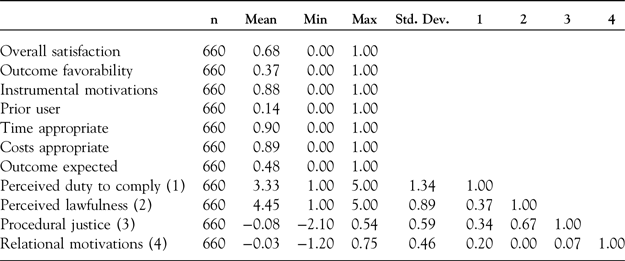
Table 1 shows descriptive statistics for the variables used in this study. Note that perceptions of lawfulness and procedural justice were skewed to the positive, albeit with some variation, while perceived duty to obey and relational motivations were more evenly distributed across the scale ranges. Overall, around two-thirds of respondents (68 percent) were satisfied with the service they received, but only just over a third (37 percent) felt they had received a favorable outcome.
Descriptive statistics

We found a strong correlation between the outcome of the case, as recorded by the GFOS, and respondent’s perceptions of procedural justice. Specifically, mean levels of procedural justice were significantly higher for those whose case reached an amicable solution—either within (mean = 0.14) or outside of (mean = 0.10) the proceedings—than for those who received other less positive outcomes, notably those where a claim was ruled inadmissible or discontinued (mean = – 0.40) or when the business involved did not participate in the GFOS (mean = – 0.21). We also found a strong, although not perfect, correlation between objective and subjective outcomes. For example, 85 percent (203 respondents) of those whose case reached an amicable solution outside of proceedings felt that their outcome was favorable; for amicable solutions within proceedings, this figure was 70 percent (31 respondents). It is notable, though, that other respondents with the same outcomes experienced them as unfavorable; in some cases, presumably because the solution reached involved financial loss. Conversely, among those whose cases were ruled inadmissible or discontinued (91 percent or 34 respondents), or where the business did not participate (98 percent or 317 respondents), there was very consistent agreement that these outcomes were unfavorable.
Results
Overall Satisfaction with the GFOS
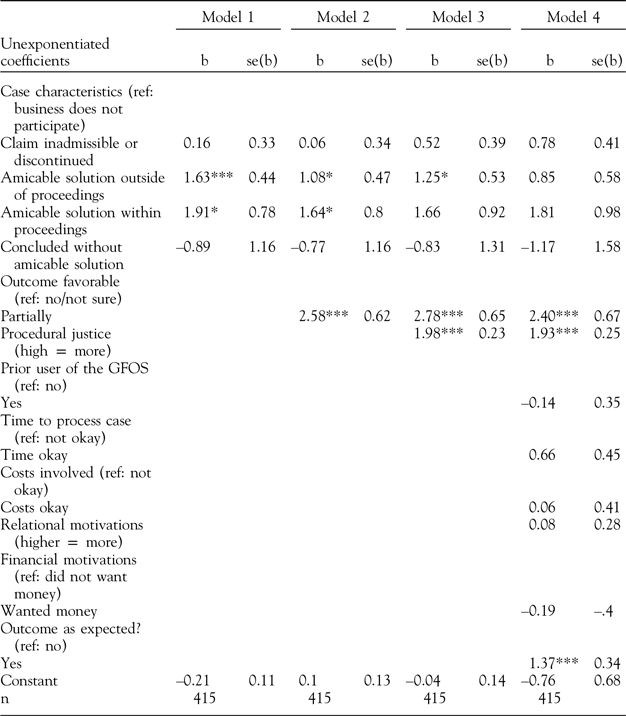
Turning first to the correlates of overall satisfaction with the GFOS, Table 2 shows results from a series of binary logistic regression models predicting the satisfaction measure described above. Since respondents who received a fully favorable outcome were overwhelmingly satisfied, they are excluded from this model, and we are thus looking here at the correlates of satisfaction among those who felt they received a less than fully favorable outcome.
Binary logistic regression models predicting overall satisfaction (cases with subjectively favorable outcomes excluded)

Notes: * p < 0.05; ** p < 0.01; *** p < 0.001.
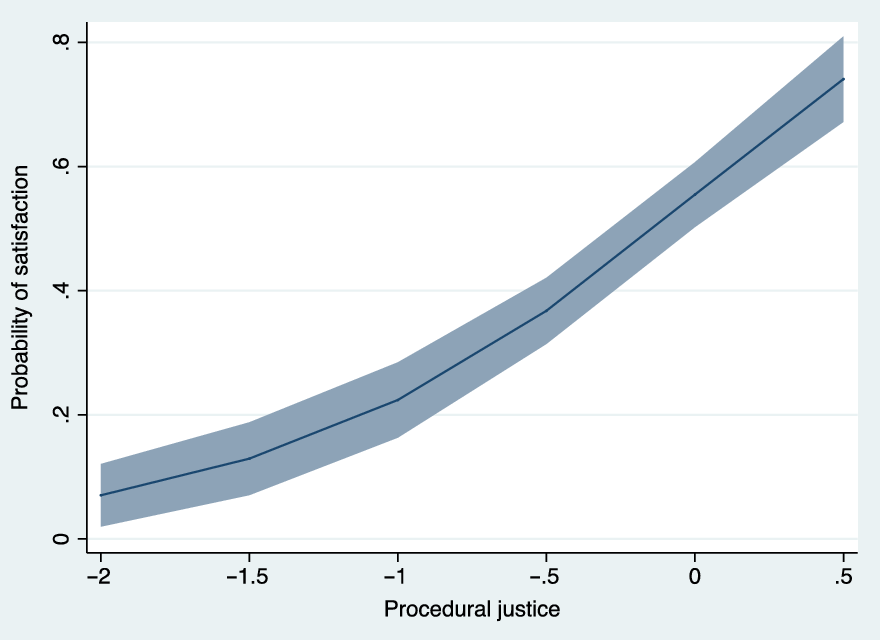
Model 1 in Table 2 includes only the objective outcome of the case as a predictor. We find the respondents involved in a case where an amicable solution was reached—either within or outside of proceedings—were unsurprisingly more likely to be satisfied than those for whom the business they were dealing with did not participate in the scheme. Model 2 adds perceived outcome favorability (measured on a binary basis: “no/not sure” versus “partially”). Respondents who felt the outcome was at least partially in their favor were much more likely to be satisfied than those who felt it was not or were not sure. Note also that the coefficients for the amicable solution dummies shrink in size once subjective favorability is included. Model 3 adds procedural justice; conditioning on both measures of outcomes, procedural justice had a strong, positive association with the probability of satisfaction. Finally, Model 4 adds the motivation and control variables, only one of which—outcome expectation—was significant in the model. All else equal, respondents who got the outcome they expected tended to be more satisfied. Note that in this final model all the dummy variables representing objective case outcomes have lost significance, although many remain relatively large in size.Footnote 9 To illustrate the strength of the association between procedural justice and satisfaction, Figure 1 plots fitted probabilities generated from Model 4 in Table 2. Holding constant the other variables in the model, the probability of satisfaction rises from just 0.07 at the lowest values of procedural justice to 0.74 at the highest values.
Association between procedural justice and overall satisfaction; predicted probabilities generated from Model 4 in Table 2.

We also tested three interactions—between procedural justice and relational motivations; procedural justice and instrumental motivations; and procedural justice and outcome favorability—adding each in turn to Model 4 in Table 2. None of the interaction terms were significant (results are not shown, but p > 0.10 in every case). It seems that when it came to satisfaction with the GFOS, procedural justice concerns were of broadly equal weight to those that individuals who strong (or weak) relational motivations; those who had strong (or weak) instrumental motivations and those who had felt they received a partially favorable or unfavorable outcome.
Legitimacy of the GFOS
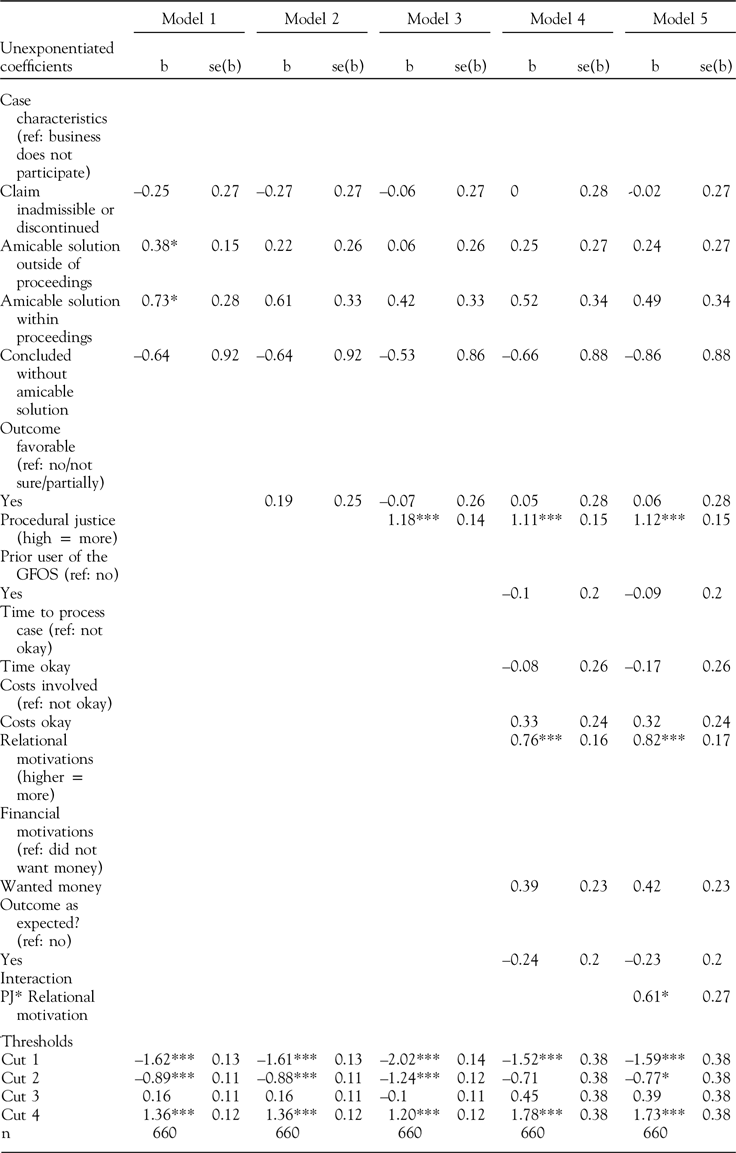
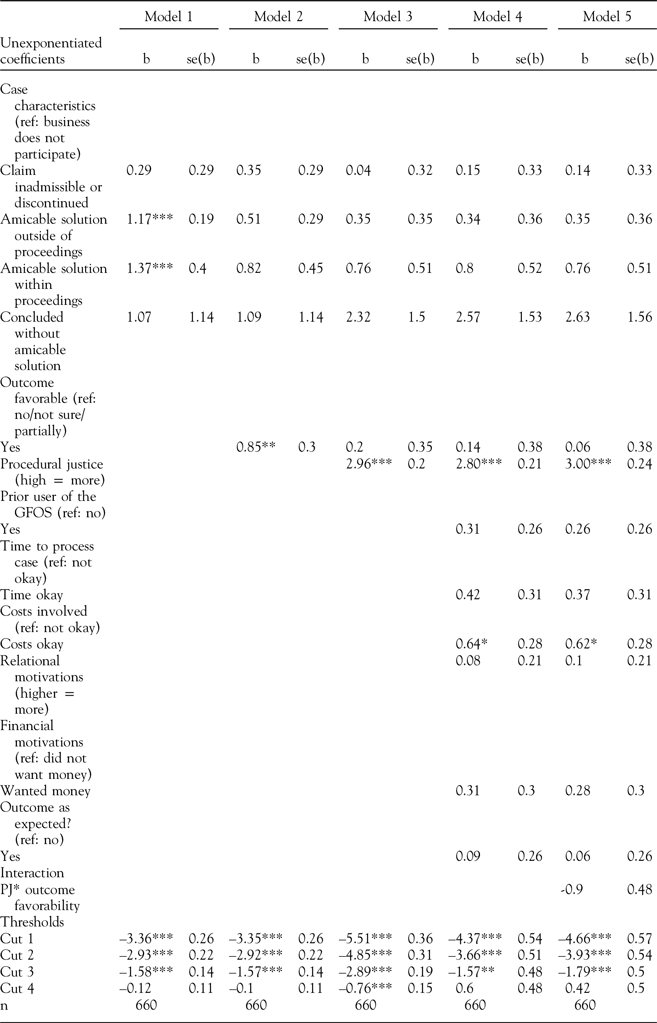
Turning to the legitimacy of the GFOS in the eyes of respondents, Table 3 shows results from a series of ordinal logistic regression models predicting perceived duty to obey the ombudsman’s recommendations.Footnote 10 As before, Model 1 includes just the outcome of the case, and we find that respondents involved in cases where an amicable solution was reached were more likely to feel that they had a duty to obey the ombudsman’s recommendations. Once subjective outcome favorability was added in Model 2, though, the objective indicators lose significance,Footnote 11 and when we add procedural justice in Model 3, we find a strong, positive conditional correlation between procedural justice and duty to obey. Outcome favorability had no independent association with this component of legitimacy. Finally, little changed when controls and motivations were added in Model 4, none of which were significant except for relational motivations, which were quite strongly positively correlated with perceived duty to obey.
Ordinal logistic regression models predicting perceived duty to obey the GFOS

Notes: * p < 0.05; ** p < 0.01; *** p < 0.001.
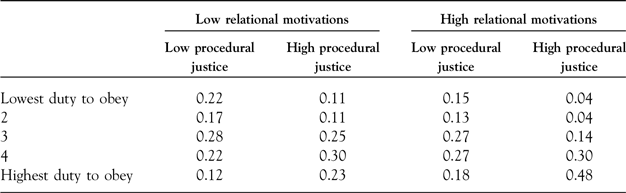
Model 5 in Table 3 also shows that there was a significant, positive, interaction between relational motivations and procedural justice, such that the statistical effect of procedural justice on the duty to obey was stronger when relational motivations were stronger. The nature of the interaction between procedural justice and relational motivations is illustrated by the predicted probabilities shown in Table 4. When relational motivations were low (one standard deviation below the mean), moving from low to high procedural justice (from one standard deviation below to one standard deviation above the mean) was associated with a decreased probability of the lowest score on the duty to obey measure: 0.22 compared with 0.11, and an increased probability of the highest score—0.12—compared with 0.23. But when relational motivations were high (one standard deviation above the mean), these differences increased: here, moving from low to high procedural justice was associated with a slightly greater decrease in the probability of the lowest score on the duty to obey measure (0.15 compared with 0.04) and, in particular, a greater increase in the probability of the highest score (0.18 compared with 0.48).
Predicted probabilities from Model 4 in Table 3

We also tested interactions between procedural justice and instrumental motivations, and between procedural justice and outcome favorability, but neither were significant (results are not shown, but p > 0.1 in both cases). It seems that the association between procedural justice and this component of legitimacy did not vary much according to respondents’ instrumental motivations or according to their assessment of outcome favorability.
Finally, Table 5 shows results from a series of ordinal logistic regression models predicting the second component of legitimacy—lawfulness.Footnote 12 Model 1 includes just the outcome of the case, and we find that respondents involved in cases where an amicable solution was reached tended to rate the GFOS as being more lawful. Once subjective outcome favorability was added in Model 2, though, the objective indicators shrank in size and lose significance, while there was a strong, positive association between subjective outcome and perceived lawfulness. Model 3 adds procedural justice, which is a strong and significant predictor of perceived lawfulness, but note that the coefficient for subjective outcome also shrinks and loses significance. Little changes on addition of the motivation and control variables in Model 4, none of which are significant, with one exception in that there is a positive association between perceptions of the costs involved and perceived lawfulness.
Ordinal logistic regression models predicting perceived lawfulness of the GFOS

Notes: + p < 0.1 * p < 0.05; ** p < 0.01; *** p < 0.001.
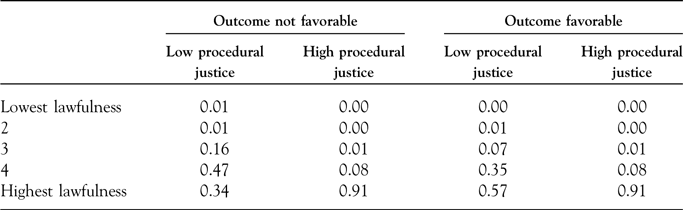
We also tested interactions as before. The interactions between procedural justice and relational motivations and instrumental motivations were non-significant (p < 0.10 in both cases; the results are not shown). The interactions between procedural justice and outcome favorability, however, were significant at the 10 percent level (p = 0.06) (see Model 5 in Table 5). To illustrate, Table 6 shows predicted probabilities estimated from this model. The interaction effect can be interpreted in two ways. First, when the outcome was not subjectively favorable, procedural justice had a bigger effect on lawfulness judgments: the probability of giving the highest score on the lawfulness scale rose from 0.34 when procedural justice was one standard deviation below the mean to 0.91 when it was one standard deviation above the mean (when the outcome was favorable, the equivalent probabilities were 0.57 and 0.91, such that with a positive outcome, procedural justice seems less important). However, there is also a strong suggestion that outcome favorability itself was much less important when procedural justice was high than when it was low. When procedural justice was one standard deviation above the mean, the probability of scoring five on the lawfulness measure was essentially the same regardless of whether the outcome was favorable or not (0.91 in both cases). But when procedural justice was one standard deviation below the mean, outcome favorability made quite a big difference, with the probability of scoring five on the lawfulness measure rising from 0.34 when the outcome was not favorable to 0.57 when it was. As ever with interaction effects, it is difficult to know which of these interpretations is correct (although they are not mutually incompatible).
Predicted probabilities from Model 6 in Table 5

Additional Analysis
The “facts of the case” were therefore quite strongly correlated with respondents’ perceptions of the GFOS. Those who received “amicable solutions” were more satisfied with the process and granted more legitimacy than those who received other (less positive) solutions. In all cases, however, these associations lost significance once perceptual variables were entered into the models, strongly and perhaps unsurprisingly suggesting that the facts are filtered by perceptions: we have some evidence, that is, that perceptions of the process mediated the effect of its actual outcome on satisfaction and legitimacy. In Table 5, for example, objective outcome favorability loses significance when subjective outcome favorability is added. Moreover, subjective outcome favorability loses significance when procedural justice is added, suggesting that procedural justice may mediate the statistical effect of perceptions of outcome favorability.
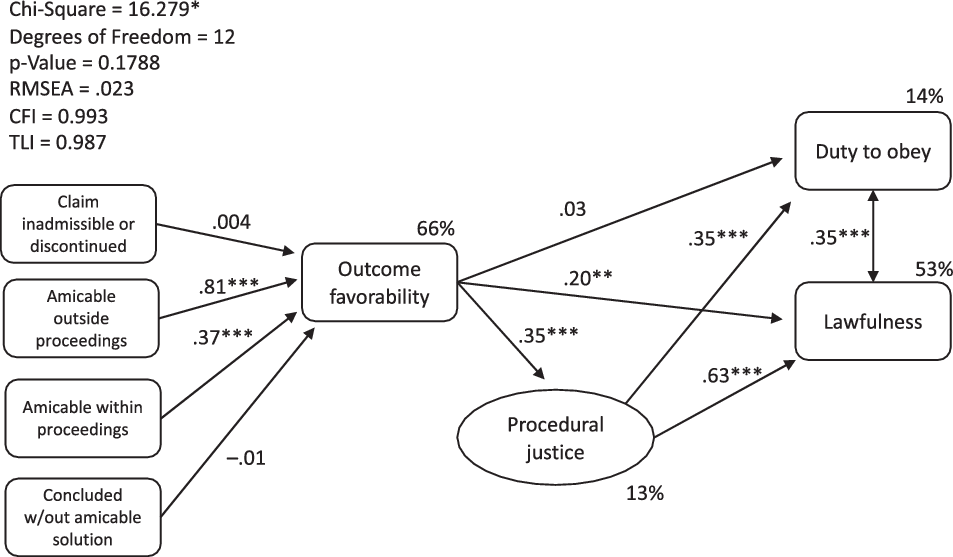
To explore this issue further, we estimated a path model using Mplus 8.4. In this model, subjective outcome favorability was regressed on objective outcome favorability, procedural justice was regressed on subjective outcome favorability, and the two measures of legitimacy were regressed on subjective outcome favorability and procedural justice. Results are shown in Figure 2 and correspond closely with those presented in Tables 4 and 5. First, subjective outcome was strongly predicted by objective outcome favorability; second, procedural justice was moderately strongly predicted by objective outcome favorability; third, duty to obey was predicted by procedural justice but not subjective outcome favorability; and, fourth, lawfulness was predicted by procedural justice and subjective outcome favorability (this is the only difference from the regression analyses presented in Table 5 and likely arises because the relationship between objective and subjective outcomes is better specified in the path model). There are also significant indirect statistical effects of objective outcome favorability on procedural justice via subjective outcome favorability (for example, for the path starting at amicable solution, no proceedings [IE = 0.29, p < 0.0005]) and of subjective outcome on legitimacy via procedural justice (for example, for the path ending at duty to obey [IE = 0.13, p < 0.0005]).
Results from a path model with the measures of legitimacy as the ultimate response variables; standardized coefficients.

These findings support the idea that respondents were indeed inferring the fairness of the process from the outcome they received to at least some extent; however, note that the model only explains 13 percent of the variation in procedural justice, indicating that other sources of information were more important when it came to respondent’s views of procedural justice, including, we assume, the way they felt they were treated by the ombudsman’s staff and how they judged such treatment.
DISCUSSION
Returning to our original hypotheses, Hypothesis 1 proposed that when outcomes are not subjectively favorable, procedural justice will be associated with greater satisfaction. We found strong support for this hypothesis; among respondents who did not feel they received a favorable outcome, procedural justice was strongly and positively associated with satisfaction. By contrast, we found less support for Hypothesis 2; subjective outcome favorability was associated with only one measure of the legitimacy afforded to the GFOS—perceived lawfulness—and only in the path model shown in Figure 2. As expected, though, procedural justice was positively associated with the legitimacy afforded to the GFOS on both measures, which was anticipated in Hypothesis 3.
Hypothesis 4 and Hypothesis 5 received mixed support. On the one hand, procedural justice was a significantly stronger predictor of perceived duty to obey among those with strong relational motivations (Hypothesis 4), and a marginally significantly weaker predictor of the perceived lawfulness of the GFOS among those who felt they received a favorable outcome (Hypothesis 5). On the other hand, the relative weight of procedural justice as a predictor of satisfaction and legitimacy did not significantly vary according to whether a respondent had a broadly instrumental motivation or not, nor did the statistical effect of procedural justice vary by subjective outcome favorability in the satisfaction or duty to obey models. Overall, it would seem that the importance of procedural justice among those using the ombudsman process was broadly similar across different motivations and outcomes, although there was also some variation.
Finally, Hypothesis 6 was supported; controlling for the actual outcome of a case, the association between perceived procedural justice and our response variables persisted. It seems there is indeed an association between procedural justice and legitimacy (and satisfaction) that is independent of the material outcome of a procedure, from which it is reasonable to infer that assessments of the fairness of the process are not determined by its outcome. Indeed, what is perhaps most striking here is the consistency of the “procedural justice effect.” Even in a context often driven by instrumental concerns, legitimacy was very strongly founded in procedural justice, while the outcome had less independent effect (although there seemed to be some association between subjective outcome favorability and perceptions of lawfulness, moreover, that may have been moderated by procedural justice). And while we found some evidence that the association between procedural justice and legitimacy varied by motivation for using the ombudsman procedure, this was hardly overwhelming, and, in most cases, the interaction effects that we tested were not significant.
These findings seem therefore to speak to the idea that procedural justice is important to people for multiple reasons (Heuer et al. Reference Heuer, Penrod, Hafer and Cohn2002). Those who did not get the outcome they desired may well have been using a sense of procedural justice to infer that at least the process was appropriately conducted and likely to have achieved an appropriate outcome (which may explain the consistency of the association between procedural justice and perceived lawfulness, for example). But even when respondents did receive the outcome they desired, procedural justice was still important for legitimacy; it seems procedural justice was equally as important a predictor of duty to obey among those who felt they received a positive outcome and those who did not, for example (Vidmar Reference Vidmar1992). This seems to underline the relational aspects of procedural justice as something that strengthens the bond between an individual and an authority and that operates separately and in distinction from instrumental concerns.
In the context of regulating ADR and, in particular, the GFOS, our findings support the strong emphasis that lawmakers, regulators, and providers of dispute resolution services and research have put on improving the elements that determine procedural justice. Taking a closer look at these building blocks of procedural justice in ADR more generally and in the GFOS specifically reveals a complex web of interrelated aspects. Essential procedural principles and rules of the GFOS are determined by federal law.Footnote 13 These high-level rules empower the GFOS itself to lay down further procedural guidelines that determine the details of the procedure.Footnote 14 These legal procedural rules, however, only constitute a fragment of what the users experience in terms of procedure. What matters is how the GFOS implements the procedure in practice, and key aspects of this are not regulated by law. Examples in this specific context are response times of the GFOS and the frequency with which the users are kept up to date in regard to the progress of the procedure (for details, see Creutzfeldt and Steffek Reference Creutzfeldt and Steffek2021).
Further, it is clear that providing consumers with positive outcomes will not, in and of itself, maintain high levels of legitimacy. While a GFOS that never met the desires of the consumers would seem very likely to suffer a legitimacy crisis, those who do use the service base their legitimacy judgments less on the outcomes of the process than on its quality. As suggested by the “classic” procedural justice treatments of the courts, the police, and dispute resolution, this is good news for an organization that is only sometimes able to provide positive outcomes for those who engage with it (for example, Vidmar Reference Vidmar1992; Tyler and Huo Reference Tyler and Huo2002; Tyler Reference Tyler2006). For services such as the GFOS, treating clients fairly procedurally would seem imperative on this basis, and it seems that those involved in running such schemes are aware of this. The empirical study commissioned to evaluate the GFOS revealed a strong emphasis on procedural fairness in the governance of the scheme (Creutzfeldt and Steffek Reference Creutzfeldt and Steffek2021).
All that said, it was another important finding of this article that the “facts of the case” also mattered. These seemed to be mediated, unsurprisingly, by perceptions of outcome favorability as well as by procedural justice (see Figure 2). There are two potential explanations for these findings, both of which warrant further consideration. The first is that receiving a negative outcome was associated with a sense that there was something wrong with the process: people were indeed inferring the fairness of the process from the favorability of the outcome they received. Further consideration is warranted, in particular, for those situations where the business simply declines to participate in the proceeding, with the consequence of a negative outcome for the complaining consumer.
The second explanation for the association between outcome favorability and perceived procedural justice is that the process involved in reaching an “amicable solution” was itself perceived to be procedurally just. As mentioned above, this process can take two different forms. One is for the parties (consumer and business) to agree upon a settlement after starting the ombudsman proceedings but coming to an agreement privately—that is, outside of the formal proceeding (and, in particular, without a formal recommendation by the GFOS). The other is to go through the formal process of the ombudsman proceeding with the ombudsman recommending or recording the settlement. Both options involve the ombudsman guiding (facilitating/mediating) the process of interaction, communication, and exchange of information between the parties. It may be this process of engagement and feedback that contributes to consumers feeling that they are being treated fairly, thus enhancing their perceptions of procedural justice.
In sum, our findings suggest that procedural justice matters in the ombudsman/ADR context. The data has revealed that, if the ombudsman is seen to provide procedural justice, the outcomes it provides or mediates are more likely to be accepted. We argue further that there are a variety of explanations for perceptions of legitimacy of an ADR body, which we hope might be expanded in further studies of ADR providers.
Limitations
Our study is marked by a number of limitations. First, we have only cross-sectional data. We cannot estimate causal processes, and, equally importantly given the discussion above, we have, for example, the respondent’s assessments of their motivations for engaging with the GFOS captured only after the procedure was completed. Second, while our sample seems to be broadly representative of the population of service users within the study window, survey non-response was plainly an issue, and it is possible that those who chose to respond to the survey varied systematically from those who did not. This raises questions about the generalizability of our results, as does the fact that we deal only with one particular ombudsman’s scheme from one European country. Third, due to the need to keep the survey relatively short, we were restricted to single-item measures of key constructs, such as the different components of legitimacy, meaning that the measurement of these constructs was suboptimal.
CONCLUSION AND OUTLOOK
In this article, we have analyzed consumers’ interactions with the GFOS through data collected in a three-year research project. Building on previous research on ombudsman schemes (namely, that outcome favorability in the ADR context has a more prominent weighting than it seems to in other justice contexts), we expanded on questions of satisfaction and legitimacy. This article has also added methodologically to the consideration of procedural justice theory. We not only have the perceptions of users but also the actual outcomes of the ombudsman’s proceedings. We have thus been able to explore people’s perceptions of procedural justice and their perceptions of the outcome they received, given knowledge of the actual outcome of their case. In short, our research has shown that procedural justice matters in the examined ADR context.
We have found a strong correlation between procedural justice and satisfaction, the experienced duty to obey the GFOS, and perceived lawfulness. As the perceived duty to obey and lawfulness are measures of legitimacy, procedural justice, in other words, is strongly correlated with satisfaction and legitimacy. When the users of the GFOS experienced a just procedure, they were likely to be satisfied with, and grant legitimacy to, the scheme whether or not they had received a positive outcome. Moreover, the association between procedural justice and perceived duty to follow the suggestions of the GFOS was even stronger for those consumers that started the proceeding for relational—as opposed to instrumental—reasons. The subjective perception of the outcome—as opposed to the objective outcome recorded by the GFOS—becomes even irrelevant for satisfaction and legitimacy if the process is just.
However, we also found strong associations between positive outcomes, satisfaction, the experienced duty to obey, and the perceived lawfulness of the GFOS. This is true for both objective results as recorded by the GFOS and subjective results from the perspective of the parties as the objective outcome strongly predicts the subjective perception of the outcome. In other words, it is not only procedural justice that matters but also the outcomes. This raises the question of the relationship between outcome and procedural justice. We found that procedural justice was moderately strongly predicted by the objective outcome. Users of the GFOS were more likely to consider the procedure they had experienced to be just if the outcome they received was in their favor. However, our research has also shown an association between procedural justice and legitimacy as well as satisfaction, which is independent of the outcome of the procedure. We can, therefore, infer that there are relevant aspects of the fairness of the process that are not determined by its outcome.
In addition, where the outcome for the consumer was not positive, procedural justice was still positively correlated with perceived lawfulness. Indeed, it may be that, if the procedure was just, the result was less relevant, at least when it comes to judgments about the lawfulness of the GFOS. This is of significant relevance for institutions of justice, as they are often in a position where they cannot at the same time fulfill the wishes of both parties. We also found that, if there was less procedural justice, then the outcome matters more to the parties. Finally, our analysis shows the relevance of the costs of the procedure for perceived lawfulness. For lawmakers, this means that cost rules matter for the design of conflict resolution mechanisms.
Our findings have practical implications for the GFOS. The collected data shows that its customers, generally speaking, are content with the way in which they are treated, and, overall, they experience the processes as fair—partly as a result of the favorable outcomes they receive but perhaps also as a consequence of the just process they experience. Further, our research suggests that clear communication throughout the process can help build and maintain consumers’ perception of a just process. Ultimately, this will encourage them to accept the outcome reached. This is relevant, in particular, for the larger number of parties that do not receive the outcome they desire from the GFOS.
We close by briefly suggesting further work in relation to the themes that seem to be important in this context but which require greater consideration than we were able to provide here. The importance of procedural justice raises the question what specific aspects of a dispute resolution mechanism create a sense of procedural justice and how they should be “designed in.” While the ADR and dispute resolution design literature provides valuable qualitative guidance for the design of fair dispute resolution, it seems important to gather further empirical evidence on the structures and factors that create the experience of procedural justice. When embarking on such research, care needs to be taken to distinguish the characteristics that constitute a certain type of dispute resolution (for example, whether the parties or a third party neutral controls the procedure) from the way in which procedural aspects are implemented in practice.
In regard to the consumer law perspective, our research supports those lawmakers that have introduced and strengthened ADR and, in particular, ombudsman proceedings as a further way to solve disputes between consumers and businesses. A good example is European consumer legislation, which has added consumer ADR in many regulatory consumer contexts and is currently embarking on further improving key instruments on ADR and online dispute resolution.Footnote 15 While challenging to design, such reform endeavors would tremendously benefit from a better understanding of the relative potential of different dispute resolution mechanisms in regard to procedural justice and, in turn, decision acceptance. Currently, there is little empirical knowledge on the relative strengths of key proceedings such as mediation, conciliation, ombudsman schemes, arbitration, and litigation.
Finally, our research adds relevant insights for the jurisprudence of conflict resolution. Our results can be interpreted to support deontological, as opposed to consequentialist, approaches to dispute resolution as they show that it is not only the outcome that matters but also how this outcome has been achieved. This may be useful for current research projects that aim to define justice principles for the use of emerging technology such as artificial intelligence in dispute resolution. A key question that arises in this context is how to ensure procedural justice in the context of results provided by algorithms. Our results clearly show that a fair process is vital for people to accept decisions and decision-makers that do not provide them with favorable outcomes, and this may be even more so when the decision-maker is effectively a machine.
APPENDIX 1. LATENT CONSTRUCTS AND MEASURES