Introduction
Greece is a country that includes many islands, several of which are large enough to be inhabited year round. Many tourists visit the Greek islands every year, with 17,517,791 foreigners arriving during 2007. 1 Based on the 2001 census, the country's permanent population is 10,934,097; 1,595,542 or approximately 15% live in the Greek islands.
In Greece, the term “hospital” refers to a secondary level of facility where specialist care is available, along with the capacity to perform major surgeries requiring general anesthesia. “Health center” refers to a primary care facility staffed with general practitioners (occasionally also medical specialists), nurses and allied health personnel. Basic laboratory and X-ray equipment often is available, and minor surgery is performed. A “health post” is a primary care clinic run by one or two general practitioners.
On Crete, which has a permanent population of 594,368, there are eight hospitals; Euboea (population 204,594) has three hospitals. The population of islands with a single hospital ranges from 3,532 (Kythira) to 117,007 (Rhodos). The least-populated island with a health center is Ios, with a permanent population of 1,862; the most populated is Salamina with a permanent population of 34,975. Health posts are used for health contact assessment, with the population of islands served by these facilities ranging from 39 inhabitants in Antikythira to 4,282 in Poros. 2
Different parts of the country are prone to different natural disasters such as earthquakes, 3 floods, 4 heat waves,Reference Matzarakis and Mayer 5 wildfires 6 and volcanic eruption.Reference Dominey-Howes and Minos-Minopoulos 7 In Greece, 39.6% of the population lives in areas that are at high risk for seismic activity. These high seismic risk areas include parts of the mainland and the islands in the northeastern and southeastern Aegean Sea. Other island populations are at medium risk of seismic hazard. In all Greek islands, there is a medium risk of wind speed hazard (winds of 10.7-17.1 meters/second) and heat wave hazard (temperatures of 32-41 degrees Celsius). 8
Disruption of power or water supplyReference Tanaka 9 in a hospital during a disaster may have an impact on the provision of health services.Reference Aghababian, Lewis, Gans and Curley 10 In order to have functioning clinical, surgical, and intensive care departments in the aftermath of a disaster, the availability of electrical power is a basic requirement to consider in disaster planning.Reference Norcross, Elliott, Adams and Crawford 11 Water supply is also an important consideration, especially for Greece. The eastern regions of the country, including the islands of the Aegean Sea and Crete, experience permanent shortages of water.Reference Mimikou 12
The water needs of a health facility can be predicted. For emergency situations, 40-60 liters per in-patient per day is the minimum requirement (excluding laundry equipment, and toilet flushing). 13 For surgery and maternity wards, 100 liters per person per day is the minimum. 14 For modern hospitals, 300 liters per bed per day is recommended; a reserve of up to 24 hours is considered low preparedness, over 24 but less than 72 hours is considered average, and 72 hours or more is considered high. 15
The goal of this study was to evaluate backup systems for water and power in state-operated health facilities in the Greek islands. Where water and electrical backup systems exist, an attempt was made to quantify the existing reserve capacity of those facilities.
Methods
This was a descriptive study utilizing a standardized self-administered survey questionnaire (see supplementary material online). Data on the self-sufficiency of health facilities (reserve capacity) for water and power was collected.
On July 6, 2009, the questionnaire, together with an introductory letter and a prepaid return envelope, was sent by mail to the one highest level health care facility (hospital, health center, or health post) on each Greek island (85 facilities total). The letter was addressed to the hospital manager, director of the health center or the health post's medical doctor. Crete and Euboea each have multiple hospitals, and all of these hospitals were included. If no response was received within four weeks, a telephone contact was made in order to resend the questionnaire by post, e-mail, or fax, or to attempt filling in the requested data over the phone. Data collection was completed on December 18, 2009.
Each island was considered an individual community which has to provide for its own needs as a “closed system” during the first days of a disaster.Reference Delladetsima, Dandoulaki and Soulakellis 16 The biggest available health facility in each island (hospital, health center or health post) is expected to provide health care in case of disaster. For this reason, backup systems for water and energy supply should be in place in these facilities which were the focus of this study.
All Greek islands with at least one national health system facility were included in the study. Only state facilities were included. These facilities are listed on the website of the Greek Ministry of Health and Welfare. 17 Eighty-five facilities were included in the study, including three hospitals on Euboia, eight hospitals on Crete and 74 health facilities on 74 smaller islands (the facilities with the highest level of care on each island). In total, 27 hospitals, 17 health centers and 41 health posts were contacted.
A questionnaire was designed for use in the study, taking into consideration the organization of the health system in the country. Data collected included name and type of facility, number of beds (if available), water tank availability and volume, backup power availability and type (generator, solar panels, wind turbines, batteries, other). In one question, an estimate of the percentage of the health facility's power needs which could be covered by the backup systems was requested. This information was collected via a three-option scale (0%-30%, 31%-70%, 71%-100%). 18 In an attempt to quantify how many hours a fuel-run power generator would be able to function, the survey included questions on average generator fuel consumption per hour as well as the current existing fuel stock at the facility (both in liters). Standard definitions of terms common to the study population were used in the survey. The survey was validated by comparing responses of the first 10% of respondents for consistency of survey data and answers. No changes were required for the initial validation phase and therefore, validation data was included in the study analysis after confirming consistency of response answers.
Using raw survey data, the water reserve capacity in days per facility was calculated according to Pan American Health Organization (PAHO) Hospital Safety Index standards (300 liters/bed/day). 15 In a similar manner, the power reserve capacity in hours of autonomous power supply was calculated.
Data were entered into a Microsoft Office Excel 2003 spreadsheet (version 11 for Microsoft Windows, Microsoft Corporation, Redmond, Washington USA) for analysis and calculations. Descriptive statistics were used to analyze the study data. For quantitative measures, margin of error was calculated using 95% confidence intervals and estimates of error for overall outcomes were made for missing responses.
Results
The survey response rate was 64% (54 of 85 facilities). The response rate was 59% for hospitals (16 of 27), 71% for health centers (12 of 17) and 63% for health posts (26 of 41).
Depending on the size of the island and population served, hospital size varied from 18 beds (Naxos Island) to 500 beds (Benizelio General Hospital in Crete). Mean size was 147 beds (SD = 148) and median size was 86 beds. Health center size varied from three to eight beds with a mean of 5.7 beds (SD = 1.7) and a median of six beds. No hospitalization is provided in health posts; but in 13 of the health posts there were one to four beds available for use in short-term monitoring. Monitoring is more common on islands remote from the mainland (eg, Megisti island is located 72 nautical miles east of Rhodes, 328 miles from the port of Pireus, and one mile from the Turkish coastline). 19
Of the facilities responding, a backup water tank was available in 70% (38 out of 54); for 30% (16 out of 54) there was none available. In 39 (72%) a backup power supply system existed in the form of an electrical generator. In 15 cases (28%), there was no backup power supply system. There were no solar panels or wind turbines used in any facility for emergency power supply. In considering the potential variation in results caused by nonresponders to the survey, the percentage of facilities with a backup water tank could have ranged from 45%-81% and the percentage of facilities with power backup could have ranged from 46%-82%.
Regarding power supply needs among those responding to the survey, six facilities (15.5%) indicated that 0%-30% of their needs could be covered by the backup system in place. Nine (23%) estimated that 31%-70% of their needs could be covered, and for 18 cases (46%) the coverage was 71%-100%. In six cases (15.5%) the answer was unknown or could not be estimated.
Hospital Results
All 16 hospitals (100%) responding to the survey had backup water tanks (Table 1); 14 of them provided enough data for the water reserve capacity to be calculated. As a result, seven hospitals (50%) were found with water reserves enough for more than three days which corresponds to a “high enough” level according to PAHO guidelines (the Hospital Safety Index: Evaluation Forms for Safe Hospitals). 15 Five hospitals (36%) had one to three days of water reserves, and thus were graded “average.” Two (14%) had less than 24 hours reserve, and were rated “low.”
Presence of Backup Systems in Island Health Facilities

All 16 hospitals were equipped with backup systems for power supply. In all cases, this consisted of electrical generators. In one case (Lesbos), the generator was adapted in order to run on gas instead of liquid fuels. In addition to the generator, batteries were available in two hospitals (Zakynthos and Lesbos), while a hospital in Crete (Chania) had an Uninterruptable Power Supply system in place. These systems are able to cover 71%-100% of the electricity needs for 11 of the hospitals (69%), 31%-70% for four of them (25%) and 0%-30% for one of them (Chios Hospital).
Health Center Results
Of the 12 responding health centers, 10 (83%) had a backup water tank, while two (17%), Samothraki and Patmos islands, did not. Only in seven of those centers equipped with a tank did the available data allow for calculation of the water reserve capacity. Six health centers (86%) had enough water reserve for more than three days, while only one (14%), on Skiathos Island had a reserve for less than 24 hours.
Eleven health centers (92%) had a power generator; the health center on Paxoi was the only one that did not have a backup power supply system. The Samothraki Health Center also was equipped with batteries. These backup reserves could provide 31%-70% of the electrical energy needs in four health centers and 71%-100% in five. In two cases, no data were available.
Health Post Results
Of the 26 health posts responding, only 12 had a water tank (46%) while the rest 14 (54%) did not. Concerning power supply, 12 (46%) health posts had a backup system, while 14 (54%) did not. Nine health posts (35%) were not equipped with a water tank or with a power generating system.
Emergency Water Reserve
Of the 38 facilities responding that had a water tank, it was possible to calculate water reserve for 27. In the majority of these facilities, especially in hospitals and health centers, there was enough water reserve for more than one day. Fifty percent of the hospitals and 86% of the health centers had a reserve of three days or more (Table 2). Although the mean water reserve for those facilities was high (Mean = 105.36 days; 95% CI, 11.98-198.75), this was not representative of the sample. The results are skewed due to a few outliers. The Median (6.66 days) and the Mode (2.77 days) are more representative of the sample.
Emergency Water Reserve in Island Health Facilities

Autonomous Power Production
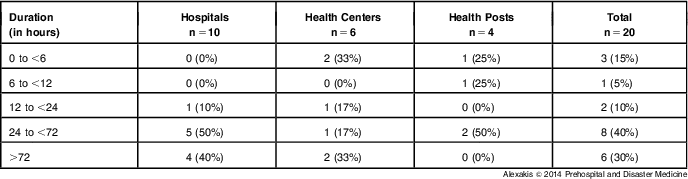
For the 39 facilities with fuel-run power generators responding to the survey, 20 provided enough data on the average fuel consumption per hour and the amount of fuel stocked in liters. Although the mean power supply reserve for these facilities was high (Mean = 72.37 hours; 95% CI, 35.58-109.16) these results also were skewed due to a few outliers. As a result the Median (39 hours) and the Mode (30 hours) are more representative of the sample. Seventy percent of the health facilities which provided the relevant data had a reserve of 24 hours or more (Table 3).
Duration of Power Autonomy in Island Health Facilities

Discussion
In the event of a disaster, the availability of water and power in a hospital is vital in order to continue the delivery of health care. Every health facility should take the necessary measures to preserve power and water supply at all times.Reference Nates 20 , Reference Counts 21
All Greek island hospitals responding to the study survey had water tanks and power generation systems. Of the health centers responding, 83% had water tanks and 92% had backup power generators. In the case of the health posts, these numbers were lower, with 54% having water tanks and 46% generators. Nine health posts (35%) had no backup water or power supply systems available to use in an emergency. Of the health facilities answering the survey, 19% had a water reserve of less than one day, 26% had enough for one to less than three days, while 56% had enough for three or more days. Excluding island hospitals, 20% of island health facilities could run on backup power supply for less than 12 hours, while the remainder (80%) could generate power for more than 12 hours.
This study showed that for emergency water and power backup, hospitals are better prepared than health centers, which in turn are better prepared than the health posts. One might argue that the health posts, being primary care clinics typically run by a single doctor, are too small to possess such backup systems. On the other hand, when a disaster strikes in an isolated island setting, the health post may be the only health facility available to function as a first aid or triage station. Therefore it should not be under-equipped.
Further research is needed on the vulnerabilities and resilience of health facilities in Greek islands and elsewhere. A tool that can be used for this purpose is the Hospital Safety Index created by the Pan American Health Organization.
Limitations
One of the study limitations is the fact that the national health system in Greece comprises many health facilities, each with different designs and logistic resources. Therefore, the study results might not represent the entire Greek health system.
Certain island facilities (where two or more were available) were not included in this survey, as only the biggest one per island was considered as the facility of reference (with the exception of Euboea and Crete, where several hospitals are available on each island and were all included). At a minimum, the highest level of health care available in each island should be self-sufficient in a disaster. Despite this, a limitation of this study is that those secondary facilities that were not included might become the only option for the population if the reference facility is severely damaged.
A questionnaire or survey is often prone to selection bias. A well-prepared hospital may have been more motivated to answer the questionnaire. In addition, nonresponders might not have served a complete island community, because each questionnaire corresponds to one health facility which, except for Crete and Euboea, represents a single island. The number of nonresponders may have biased the results; of the 27 hospitals receiving questionnaires, only 16 responded and only 14 provided enough data to calculate water reserve. Mistakes in measurements, especially in small facilities where a technician might not have been available during the quantitative data collection, may have influenced the validity of the data obtained. Especially prone to mistakes are the calculations of power reserve for health facilities. This calculation is based on data obtained on fuel stock volume and fuel consumption per hour of the generators. The data provided by the responders might have been an estimate or inaccurate.
An assumption of this study was that the backup systems will not be damaged by a disaster, and will be functional and ready to use. Depending on the magnitude, location and type of the event, this might not always be true.
Finally, the data and results provided with this study reflect state supported hospitals in Greece and caution should be used in extrapolating the data to other island locations as the external validity of the study has not been established.
Conclusion
Emergency water and power supply reserves vary among public health facilities located in the Greek islands. Isolated health centers and health posts may be less prepared than hospitals. For the responding health facilities, half had water backup systems and approximately one third had power backup systems with reserves that would last for at least 72 hours. For the health systems studied, the less comprehensive a health facility, the less likely the facility had emergency water and power supplies.