Introduction
Domestic animal diversity is an important component of global biodiversity. About 40 species of domestic animals and poultry contribute to meeting the needs of humankind. Within these species, more than 8 000 breeds and strains constitute the animal genetic resources (AnGR) that are of crucial significance for food and agriculture (FAO, 2011a).
The loss of diversity in domestic species has important economic, ecological and scientific implications as well as social considerations (Shah, Patel and Bhong, Reference Shah, Patel, Bhong, Doiphode, Umrikar, Parmar, Rank, Solanki and Joshi2012). Information on both within- and between-breed diversity is important, as the former provides information for management at the breed level and the latter helps to identify divergent breeds that may harbour distinct genotypes and are therefore worthy of conservation efforts even if their within-breed diversity is relatively high (Shah, Patel and Bhong, Reference Shah, Patel, Bhong, Doiphode, Umrikar, Parmar, Rank, Solanki and Joshi2012). Understanding the diversity, distribution, basic characteristics, comparative performance and the current status of a country's animal genetics resources is essential for their efficient and sustainable use, development and conservation (FAO, 2007). In the recent past, effective breeding has emphasized on a few specialized stocks (Simianer, Marti and Gibson, Reference Simianer, Marti, Gibson, Hanotte and Rege2003); however, breeds that have been less studied have been at risk of population decline because of neglect of their genetic potential, lack of protection of their genetic diversity and uncontrolled crossing (Barker, Reference Barker, Groeneveld and Glodek2002; Mao, Chang and Yang, Reference Mao, Chang, Yang, Xu, Zhang, Chang, Song and Wang2006).
Approximately 70 percent of the world's rural poor depend on livestock as an important component of their livelihoods (Hoffmann, Reference Hoffmann2010). Cattle breeds account 897 and 154 in the world and in Africa, respectively. The African continent is home to over 230 million cattle. These breeds have unique genetic attributes such as adaptation and tolerance to drought, heat, diseases and ability to utilize low-quality indigenous forages (FAO, 2007).
Ethiopia is home to large indigenous cattle populations with diverse breeds, ecotypes and characteristics (Rege, Reference Rege1999; Rege and Tawah, Reference Rege and Tawah1999; Workneh, Ephrem and Markos, Reference Workneh, Ephrem, Markos, Yetnayet and Rege2004). The country ranks sixth in the World and first in Africa in its cattle population (AGP, 2013). The cattle population estimated at 55.03 million are well adapted to the tropical environment producing and reproducing under stresses of high degree of temperature, high disease prevalence and low level of nutritional status (CSA, 2014). Of the total cattle population found in the country, 99.4 percent are indigenous types and about 42 percent are milk cows owned and managed by smallholder farmers and pastoralists (Institute of Biodiversity Conservation, 2004; Workneh, Ephrem and Markos, Reference Workneh, Ephrem, Markos, Yetnayet and Rege2004 and Rowlands, Nieves and Hanotte, Reference Rowlands, Nieves, Hanotte and Workneh2006).
The Fogera cattle is among the 27 recognized indigenous cattle breeds in Ethiopia and it is found distributed around Lake Tana in south Gonder and west Gojjam zone of Northwestern Amhara. There are no clear data confirming their utility, they are called triple use; drought, milk and meat (Addisu, Mengistie and Adebabay, Reference Addisu, Mengistie, Adebabay, Getinet, Asaminew, Tezera and Gebeyehu2010). The population of Fogera cattle was estimated to be around 800 000 in 1980s (Alberro and Haile-Mariam, Reference Alberro and Haile Mariam1982), 636 000 heads in 1998 (Institute of Biodiversity Conservation, 2004) 86 800 heads in the 1999s (Rege, 1999) and 15 000 heads in 2000s (Gebeyehu, Azage and Tezera, Reference Gebeyehu, Azage, Tezera and Aklilu2003). There was no recent, clear, complete and objective data confirming their phenotypic character of this breed on-farm and on-station, population structure, breeding management and breeding strategy. Therefore, this study was initiated with the aim of undertake on-farm and on-station phenotypic character of Fogera cattle in comparison with other two cattle populations, to evaluate the population structure and to identify trait preferences, breeding management and to recommend breeding strategy for Fogera cattle in the selected districts of Northwestern Amhara, Ethiopia.
Materials and methods
Description of the study area
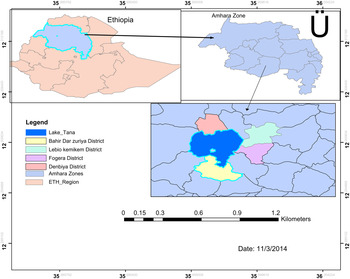
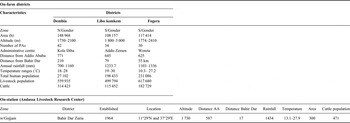
The research was conducted in the selected districts of North Gonder, South Gonder and West Gojjam zones of the Northwestern Amhara (Figure 1). Description of the study sites is presented in Table 1.
Map of study districts.

Description of the study sites.

Sampling technique
Both purposive (for Districts, PAs, Villages/Gotes and interviewers) and random (for herds) sampling techniques were used. First each study districts were selected purposely based on their potential of Fogera cattle. After selection of districts discussions were held with the livestock experts of the rural and agricultural development office of each district to know the specific areas (peasant associations (Pas)) of current concentration of pure-Fogera breed. Based on the outcome of the discussions, a total of nine PAs or three PAs in each district were purposively selected based on the population of Fogera cattle. After selection of each PAs additional discussions were held at the PAs level with selected older or aged farmers, PAs livestock experts and PAs representatives to know the specific Villages/Gotes of historical place or habitat and high concentration of Fogera cattle population and hence 27 Villages or Gotes/three Villages or Gotes in each PA were selected considering the breed historical place or habitat and concentration. In each selected Village, five Fogera cattle owners and three herds were selected for interviewing and morphological measurement, respectively.
Method of data collection
Phenotypic characterization
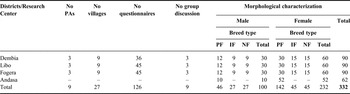
Data were collected by researcher through the designed and pretested semi-structured questionnaires from 126 selected households at purposive selected villages. In each of the selected PA, one focus group discussion was held with few selected (5–8 individuals per group) pure-Fogera cattle owners. Points for discussions were origin and history of the breed, their typical features, cattle breeding practices, concentration of the breed, current status of the breed and broad prospects and constraints on Fogera cattle breed. In each selected Villages/Gotes, five Fogera cattle owners were purposely selected for administration of semi-structured questionnaire. From each selected Villages/Gotes one herd with 158 average populations was selected for linear body measurements and phenotypic characterization of pure-Fogera cattle, interbred with-Fogera and non-Fogera cattle. The Andasa Research Center Fogera breed populations were used as a pure-Fogera breed type. Linear body measurements and body weight were taken using a standard measuring tape. The three types of breeds were identified using special characteristic of Fogera cattle breed (Rege and Tawah, Reference Rege and Tawah1999). Accordingly, the following total samples were used for the study (Table 2).
Sample of phenotypic characterization.

PF, pure-Fogera breed; IF, interbred with- Fogera; NF, non-Fogera breeds.
A total of 17 qualitative and 21 quantitative traits were considered. The sample populations were scored early in the morning, having had no access to feed or water. The weight of the animals was estimated from heart-girth measurement. Perception of cattle owners and dentition were used to determine the age of the animals in the three on-farm districts and in the Andassa Research Center besides the measurement, the record of birthing date of each animals used and calculate the current age. The questionnaires were designed based on the information check lists developed by FAO (2012). Both the qualitative and quantitative traits collected were adapted from the standard breed descriptor list developed by FAO (2012). Both qualitative and quantitative variables were recorded in pre-coded format.
Population structure
In each randomly selected herds (admixture of pure-Fogera, interbred with Fogera and non-Fogera cattle population) in purposive selected villages (expected Fogera cattle population found villages), Peasant Association and Districts the population structure was counted by classifying by breed (Fogera, interbred with Fogera and non-Fogera), sex (male and female) and age (oxen (>4 years and castrated), cow (>4 years and have one and above calve), bull (>2 years and uncastrated), heifer (>2 years and have not calve before) and calves (male and female (0–2 years)).
Methods of estimation of genetic diversity
Effective population sizes per study site and per total population was estimated following Caballero (Reference Caballero1994); Berger and Cunningham (Reference Berger and Cunningham1995); Falconer and Mackay (Reference Falconer and Mackay1996); Hedrick (Reference Hedrick, Young and Clarke2000); Frankham, Ballou and Briscoe (Reference Frankham, Ballou and Briscoe2004) as
 $$N_e = \displaystyle{{4N_m \times N_f} \over {N_m + N_f}},$$
where, N e = the effective population size, N m = the number of breeding males, and N f = the number of breeding females.
The rate of inbreeding (ΔF) for each home range and for the total population will be estimated using the Ne estimated in equation below and by the model suggested by Falconer (Reference Falconer1989); Nomura (Reference Nomura1996); Hedrick and Kalinowski (Reference Hedrick and Kalinowski2000); Nomura, Honda and Mukai (Reference Nomura, Honda and Mukai2001); Frankham, Ballou and Briscoe (Reference Frankham, Ballou and Briscoe2004) and Maiwashe, Nephawe and Van der Westhuizen (Reference Maiwashe, Nephawe, Van der Westhuizen, Mostert and Theron2006) as:
 $\Delta F = \displaystyle{1 \over 2}N_e. $
The expected inbreeding coefficients (IC) and retained heterozygosity (RH) both for will be predicted starting from the exiting population by using the population estimated in equation above and by models following Frankham, Ballou and Briscoe (Reference Frankham, Ballou and Briscoe2004) as IC at:-
 $$F_1 = \displaystyle{1 \over 2}N_e, $$
 $$F_2 = \displaystyle{1 \over 2}N_e + \left(1 - \displaystyle{1 \over 2}N_e \right){\ast}\displaystyle{1 \over 2} = 1 - \left(1 - \displaystyle{1 \over 2}N_e \right)^2.$$
Therefore IC at F t will be estimated as
 $$F_t = 1 - \left[1 - \left(\displaystyle{1 \over 2}N_e \right)\right]^t.$$
Retained/expected heterozygosities at F t were estimated as
 $$RH_t = \left(1 - \left(\displaystyle{1 \over 2}N_e \right)\right)^t.$$
where F 1 = the filial generation for observed inbreeding rates, F t = the expected inbreeding rates IC = the inbreeding coefficients, RH t = the retained/observed heterozygosity for RH1, RH2 = for the expected heterozygosity and t = the generation time (8).
Trait preference and breeding management
Data were collected by researcher through the designed and pretested semi-structured questioners from 126 randomly selected households. Points for questioners were breed preferences, purposes of keeping Fogera cattle, trait preference and special or desirable qualities of Fogera breed, adaptability trait/tolerance levels of Fogera breed, breeding practice, mating system, source of breeding bulls and purpose of keeping them, culling method, heat detection methods and signs of heat, consideration during selecting breeding animals and major breeding problems in the study areas. The data collected from the field through questioners were entered into IBM SPSS statistics 20 was employed to analyse the data. Indices were calculated for ranked variables.
Recommend breeding strategy
Based on the result of trends of the current breeding practice, population structure and population viability analysis the future breeding strategy for Fogera breed was recommended.
Data management and analysis
The data collected from the field through questionnaire and linear body measurements and secondary sources were entered into computer using Excel software. SAS 9.0 (1999) and IBM SPSS statistics 20 (2011) was employed to analyse the data. The SPSS 20 program was used to describe the questioner data. Indices were calculated for ranked variables.
The quantitative and qualitative data were analysed for sexes (male and female), breed types (pure-Fogera, interbred with Fogera and non-Fogera) and districts (Dembia, Libo Kemkem, Fogera and Bahir Dar Zuria/Andassa Research Center) separately as fixed effects. General Linear Model (GLM) procedure of multivariate analyses of SAS (1999) for quantitative traits and SPSS 20 analysis for qualitative traits were used for data to differentiate between districts, breed and sex. Simple descriptive statistics and frequency procedure was used to compile the observed categorical traits and chi-square test was employed to test independence of the categorical variables. To quantify the effect of independent variables (district, breed type and sex) on the linear body measurement (dependent variables) of the sample populations, the GLM procedure of SAS (1999) was employed.
The model fitted for analysis of data on the linear body measurements for both sample populations was
 ${Y_{ijkl}} = \mu + {B_i} + {D_j} + {S_k} + {e_{ijkl}},$
where Y
ijkl
is the measurement on the lth animal of ith breed type (i = pure-Fogera, cross-Fogera or non-Fogera) from jth district (j = Dembia, Libo Kemkem, Fogera or Bahir Dar Zuria/Andassa Research Center) and kth sex (k = male or female) for estimated body weight and linear body measurements;
μ = Overall mean or the general mean common to all animals considered in the study; B i = Fixed effect of the ith breed type (pure-Fogera, interbred with-Fogera and non-Fogera); D j = Fixed effect of the jth districts (Dembia, Libo, Fogera and Bahir Dar Zuria or on-farm and on-station); VSk = Fixed effect of the lth sex of the sample population (male and sex); e ijkl = Residual random effects peculiar to each animal.
Results and discussion
Phenotypic characterization
Origin, distribution and typical features of the pure-Fogera breed
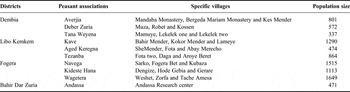
According to the focus discussion and key informants the pure-Fogera breed type is found in some specific villages and monasteries around Lake Tana Districts (Fogera, Libo Kemkem and Dembia). This study also confirmed that pure-Fogera breed is found specific villages and monasteries around Lake Tana Districts (Fogera, Libo Kem kem and Dembia) (Table 3.).
The distribution and population of pure-Fogera cattle.

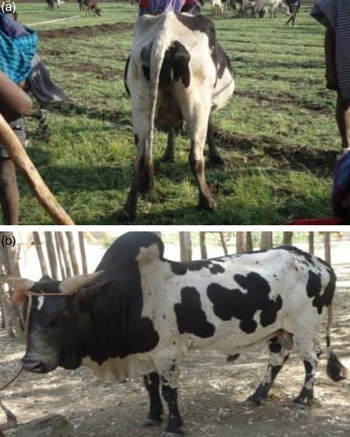
Black and white coat colour is the most features of the pure-Fogera breed was reported and saw. The colours are more white and black (more white with some black) (43.24 percent), black and white (more black with some white) (36.12 percent), white (8.9 percent) and red white (7.89 percent) and also in some cases black (2.49 percent). Physically the breed are large because of this most of their body parts are relatively larger than other indigenous cattle types. Their dewlap is large (78.09 percent), long tail (94.65 percent), large udder (45.8 percent), medium teat size (62.7percent) and large scrotal size (45.65 percent) are among the special features of the Fogera breed. They are docile relative to other cattle types. Some body parts such as horn length and hump of the females relatively small than other cattle types (Figure 2).
Typical pure-Fogera breeding cow (a) and breeding bull (b).

Qualitative characteristics
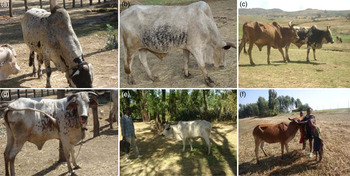
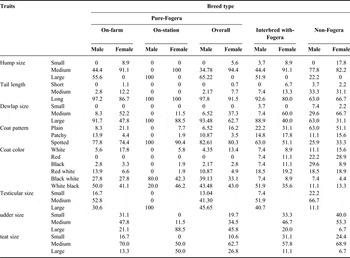
Qualitative characters observed for male and female cattle of the three cattle types are presented in Table 4 (Figure 3).
Physical variations in pure-Fogera (a, d), interbred with-Fogera (b, e) and non-Fogera (c, f) breed type at on-farm.

Qualitative characteristics of male and female cattle population (%).

Quantitative characteristics
Most of the dependent traits (mouth circumference, face length, horn length, neck length, dewlap length, dewlap width, height at wither, hump height, height at rump, body length, heart girth, body weight, heart girth around rump, rump length and tail length) were significant (P ≤ 0.01) affected by sex. While horn space, ear length and pelvic width were not significant (P ≥ 0.05) affected by sex, confirming the widely held notion that male and female populations have markedly different body form as measured in the quantitative variables. As a result, analyses of variance (ANOVAs) on quantitative variables were performed separately for the two sexes.
Effect of districts on linear body measurements of the population
Except horn length all of the quantitative traits (mouth circumference, face length, horn space, neck length, dewlap length, dewlap width, height wither, hump height, height at rump, body length, heart girth, body weight, heart girth at rump, pelvic width, rump length, scrotal length, udder length, teat length and tail length) were highly significantly (P ≤ 0.001) affected by district.
Effect of breed type on linear body measurements of the population
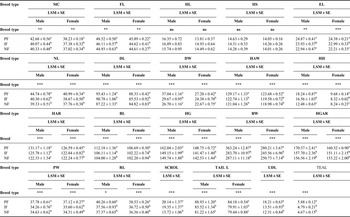
Except some quantitative traits (horn length and horn space) all of quantitative traits (ear length, neck length, dewlap length, dewlap width, height at wither, hump height, height at rump, body length, heart girth, body weight, heart girth at rump, pelvic width, rump length for female, udder length, teat length, scrotal length and tail length) were highly significantly (P ≤ 0.001); mouth circumference and face length (P ≤ 0.01) and rump length for males (P ≤ 0.05) affected by breed type on the population. Pairwise comparisons of the least-squares means between breeds (Table 5) showed that the sample populations of pure-Fogera cattle breed had the largest measurements for all traits except for horn length and horn space. Interbred with-Fogera cattle stood next to pure-Fogera in many measurements.
Least-squares means ± SE and pair wise comparisons between breed types of linear body measurements (cm) for both sexes.

ns, non-significant; *, P ≤ 0.05; **, P ≤ 0.01; ***, P ≤ 0.001; SE, standard error.
MC, Mouth circumference; FL, Face length; HL, Horn length; HS, Horn space; EL, Ear length; NL, Neck length; DL, Dewlap length; DW, Dewlap width; HAW, Height at wither; HH, Hump height; HAR, Height at rump; BL, Body length; HG, Heart girth; BW, Body weight; HGAR, Heart girth around rump; PW, Pelvic width; RL, Rump length; SCROL, Scrotal length; UDL, Udder length; TEAL, Teat length and TAIL, Tail length.
The result of the mean mouth circumference of the male and female pure-Fogera cattle were 42.68 ± 0.56 and 38.23 ± 0.18 cm, respectively. These results were larger than those of Semien (34.18 and 33.41 cm), Wegera (39.60 and 36.80 cm), Dembia (34.14 and 32.64 cm), Fogera (37.60 and 34.95 cm) and Mahibere–Silassie composite (37.52 and 33.80 cm), respectively, breeds reported by Zewdu (Reference Zewdu2004).
The mean face lengths were 48.52 ± 0.50 and 45.89 ± 0.22 cm for males and females. This result was larger than Sheko breed (40.8 and 39.5 cm) reported by Takele (Reference Takele2005). The mean horn length of male and female pure-Fogera cattle were 16.35 ± 0.72 and 13.81 ± 0.37 cm. The mean horn length of male pure-Fogera cattle was shorter than Semien, Wegera, Llowland, Mahibere-Silassie and Gamo Goffa breeds (17.14, 19.84, 18.92, 17.30 and 17.86 ± 0.53 cm) reported by Zewdu (Reference Zewdu2004) and Chencha, Workneh and Zewdu (Reference Chencha, Workneh and Zewdu2013). However, the result was higher than Dembia and Fogera breeds (12.87 and 13.10 cm) reported by Zewdu (Reference Zewdu2004). However, the mean horn length of female was lower than Fogera breed (16.98 and 15.08 cm), Fipa cattle (28.92 ± 1.02 cm) reported by Zewedu (Reference Zewdu2004); Fasil and Workneh (Reference Fasil and Workneh2014) and Mwambene, Katule and Chenyambuga (Reference Mwambene, Katule, Chenyambuga and Mwakilembe2012), respectively.
The mean dewlap length of male and female pure-Fogera cattle were 95.43 ± 1.24 and 88.33 ± 0.42 cm, respectively. The dewlap length of the male was longer than Fogera breed (87 cm) reported by Rege and Tawah (Reference Rege and Tawah1999). But the results dewlap length of the female was lower than Fogera breed (90 cm) reported by the same authors. The mean dewlap width (37.04 ± 1.16 and 27.20 ± 0.42 cm) were wider than Fogera (23.01 20.58 cm) and Mahibere–Silassie composite (25.50 and 24.08 cm) breeds reported by Zewedu (Reference Zewdu2004).
The mean height at wither (129.17 ± 1.33 and 123.68 ± 0.52 cm) of male and female pure-Fogera cattle were higher than Fogera breed (127 and 112 cm) reported by Rege and Tawah (Reference Rege and Tawah1999). The mean body lengths (112.18 ± 1.36 and 106.69 ± 0.50 cm) of the male and female pure-Fogera cattle were lower than Fogera (124.39 and 119.77 cm), respectively, reported by Zewedu (Reference Zewdu2004).
The mean reported heart girths (162.04 ± 2.03 and 148.75 ± 0.72 cm) were shorter than Fipa cattle (164.24 ± 1.20 and 151.93 ± 1.11 cm) reported by Mwambene, Katule and Chenyambuga (Reference Mwambene, Katule, Chenyambuga and Mwakilembe2012). The mean tail length (88.93 ± 1.20 and 84.18 ± 0.54 cm) of the male and female pure-Fogera cattle were longer than Gam Goffa breeds (76.26 ± 0.39 and 72.35 ± 0.27 cm), Gozamen (78.04 and 72.54 cm) reported by Chencha, Workneh and Zewdu (Reference Chencha, Workneh and Zewdu2013) and Fasil and Workneh (Reference Fasil and Workneh2014).
Effect of sites/on-farm and on-station on linear body measurements of the population
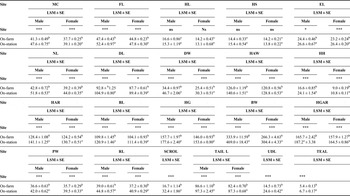
Except horn length and horn space all of measurements for pure-Fogera cattle from on-station were significantly (P ≤ 0.001) larger than those of the on-farm. Imply that the pure-Fogera cattle populations of on-station were much bigger than those of the on-farm. This may be because of genetic and environmental factors (Table 6).
Least-squares means ± SE and pair wise comparisons between on-farm and on-situation of pure-Fogera cattle.

ns, non-significant; *, P ≤ 0.05; ***, P ≤ 0.001; SE, standard error.
a,bLeast-squares means with different superscripts within a row are significantly different at P ≤ 0.001 and P ≤ 0.05.
Population structure and genetic diversity
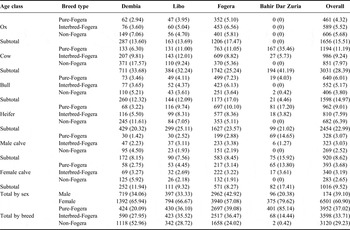
Cattle population structure by age with breed type at the district level
The cattle flock in a purposive sampled herd population by age, breed type and sex in deferent Districts is present in Table 7. The structure of the population based on age and sexes were ox (15.51 percent), cow (28.39 percent), and bull (14.97 percent), heifers (22.99 percent), male calve (8.62 percent) and female calve (9.52 percent). According to this result cows and heifers had highest proportion than oxen, bulls and calves. This high proportion of cow and heifer is used for breeding purpose. Oxen were higher proportion than bulls and male calves. The proportions of female calves were greater than male calves.
Cattle flock structure by age, breed tye and sex groups in different Districts in a sampled open population (%).

Effective population size, inbreeding and heterozygosity of the population
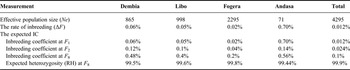
The effective population size, inbreeding and heterozygosity of the Fogera cattle are indicated in Table 8. Effective population size is defined as the number of breeding individuals in an idealized population that would show the same amount of dispersion of allele frequencies under random genetic drift (Wright, Reference Wright1922). A population that undergoes a severe temporary reduction in size (bottleneck) or when a small group of animals within the population establishes a new population (founder effect), the effective population size is closer to the number of animals at the point of maximum contraction than the number of animals at its census maximum. According to this study the effective population size of pure-Fogera cattle varies from district to district; however, the overall of effective population size were 4295. The effective population size in Fogera District was higher, while in Andassa Research Center the effective population size was lower. Falconer (Reference Falconer1989) outlined the effects of inbreeding as: increase homozygosity (animals with a copy of the same allele at one locus); redistribution of genetic variances (decrease of within family genetic variance and increase of between family genetic variance); higher chance of appearance of lethal recessive genes in the homozygous state (BLAD), decrease of homeostasis (inbred animal less adaptive to environmental changes); and, reduction of the animals performance, particularly in terms of reproduction, fertility and health (inbreeding depression). The overall inbreeding level of Fogera cattle at F1, F2 and F8 were lower with 0.012, 0.0024 and 0.1 percent, respectively. Thus, indicated that the average inbreeding level of Fogera cattle populations is low. The retained or expected hetrozygosity at F8 was 99.9 percent.
Effective population size, inbreeding and heterozygosity of the Fogera cattle.

Trait preference, breeding management and recommend breeding strategy
Trait preferences of Fogera breed
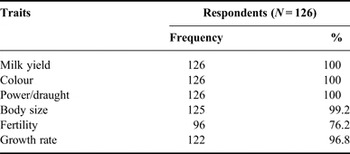
Table 9 shows the perceived evaluation by respondents on the most dominant traits of Fogera cattle. The milk yield (100 percent), colour (100 percent), power (100 percent), body size (99.2) and growth rate (96.8 percent) of Fogera were the most dominant traits perceived to be good by the respondents. While, fertility (76.2 percent) and others remaining traits were more than 50 percent preferred by the respondents.
Trait preferences for Fogera breed by respondents.

Special qualities of Fogera breed
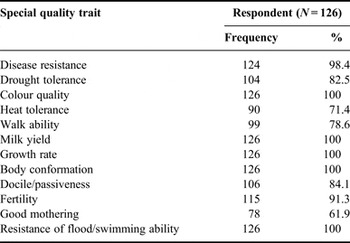
Colour quality (100 percent), milk yield (100 percent), growth rate (100 percent), body conformation (100 percent), swimming ability (100 percent) and disease resistance (98.4 percent) were the most frequently reported special qualities of the Fogera breed type differ from other indigenous breeds in their natural habitat (Table 10).
Special qualities of Fogera breed.

Adaptation levels of Fogera breed
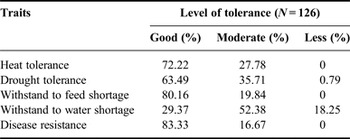
Fogera breed possess unique adaptive traits that enabled them survive, produce and reproduce in that very challenging environment. The special qualification of this breed is to live at high amount of flooding areas. Most of the respondents reported that their cattle had good level of tolerance/resistance for most of the adaptive traits except with stand to water shortage considered in this study that ranges from 29.37 percent for with stand to water shortage tolerance to 100 percent tolerate swampy grazing or ability to tolerate swampy graizing lands of the area (Table 11).
Adaptation levels of Fogera breed.

Breeding management
Breeding practice
In the study districts, all of the respondents were practice pure breeding of Fogera, interbred with Fogera and non-Fogera type of breeds. This is in agreement with the result of Shiferaw (Reference Shiferaw2014) and Alemu, Ayenalem and Tadele (Reference Alemu, Ayenalem, Tadele and Yoseph2012) who are indicated that in Fental district of Oromia region and in Horro District of Western Oromia, 92.7 and 92.7 percent respondents are practiced pure breeding system for Kereyu and Horro cattle types. Most of the respondents reported that the pure-Fogera breed type was more preferable. In some PA such as Wagetera, the pure-Fogera bulls were disseminated by the Andassa Livestock Research Center and those bulls were used for breeding purpose in that PA by group. As reported by the respondent's one breeding Fogera bull mate with up to 100 females of the respondents and then the representative of the bull can use this bull as your either mating or power.
Mating system
All of the respondents reported natural mating with selected bull mating system. This report was related with Alemu, Ayenalem and Tadele (Reference Alemu, Ayenalem, Tadele and Yoseph2012) report in Horro District. All of the respondents preferred pure breeding using Fogera bulls for mating. Additionally, most (97.6 percent) of the respondents had a good perception for pure-Fogera breed dissemination with 54.8 percent female Fogera cattle prefer and 41.3 percent both female and male sex. In addition to these most of (88.9 percent) the respondents had a positive attitude on AI service by pure-Fogera breed.
Source of breeding bulls and purpose of keeping them
Most (95.2 percent) of the respondents were reported use both own herd and neighbouring herd bulls during communal grazing. The remaining (4 percent) respondents depend on their bull from own herd. Some respondents (0.8 percent) were depended on the neighbouring bulls for mating their cows particularly in the communal grazing areas. Most (91.3 percent) of the respondents reported that they kept breeding bulls for mating purpose. While a few (8.7 percent) of them kept bulls both for mating draught purposes. This is in agreement with the result of Alemu, Ayenalem and Tadele (Reference Alemu, Ayenalem, Tadele and Yoseph2012) and Jiregna (Reference Jiregna2007) in Horro District of Western Oromia and Danno District who indicated that farmers in the districts did not keep breeding bull only for mating rather they use both for breeding and draught power. These reports were also related with Fipa cattle in the southwestern highlands of Tanzania (Mwambene, Katule and Chenyambuga, Reference Mwambene, Katule, Chenyambuga and Mwakilembe2012).
Culling method
Cattle owners in the study districts have developed a culling mechanism for maintaining the desired quality of their cattle. Culling of male cattle is generally done when age increase and their power and feeding ability decrease. However, female cattle are culled from the breeding stock after at age of 13 and above. The primary reason for culling animals from herd were old age, reproductive failure, reduction of production performance, health problem, need for some cash for household use and need for slaughter. Both selling and castration, all three types of culling (selling, castration and slaughter), castration and selling account for 35.7, 35.7, 27 and 1.6 percent of culling methods, respectively. These reports were agreed with Alemu, Ayenalem and Tadele (Reference Alemu, Ayenalem, Tadele and Yoseph2012) report in Fental District of Oromia region.
Heat detection methods and signs of heat
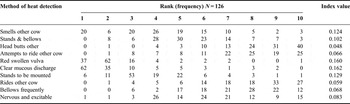
All 100 percent of the respondents were reported to practice heat detection through visual observation. The rank of heat detection method is shown in Table 12. Clear mucus discharge (0.162 index value), red swollen vulva (0.160 index value), stands to be mounted (0.129 index value). Smells other cow (0.124 index value) and stands and bellows (0.102 index value) were among the frequently reported signs of heat in the study areas. According to this result, respondents were identified more their heat cow by observation signs of clear mucus discharge, red swollen vulva, stands to mounted and smells other cow from unheated cow.
Overall method of heat detection of the respondents.

Consideration during selecting breeding animals
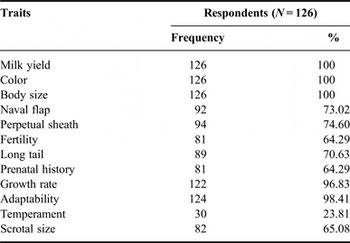
Accordingly, milk production (100 percent), colour (100 percent), body size (100 percent), adaptability (98.41 percent), growth rate (96.83 percent), perpetual sheath (74.60 percent), navel flap (73.02 percent), perpetual sheath (86.8 percent), fertility (83.3 percent) and long tail (70.63 percent) were among the considered traits while selection (Table 13).
Consideration during selecting breeding animals by respondents.

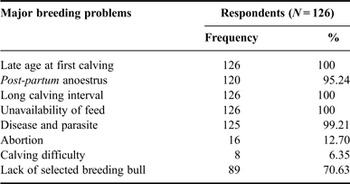
Major breeding problems in the study area: Reported major breeding problems that affect the productivity of the animals are shown in Table 14. Late age at first calving (100 percent), long calving interval (100 percent), unavailability of feed (100 percent) disease and parasite (99.21 percent) and post-partum anoestrus (95.24 percent) were among the listed major breeding problems reported by the respondents.
Major breeding problems in the study area.

Recommend breeding strategy
According to phenotypic characterization of this study mixed farming (livestock–crop) production system is the existing production system in the study areas. The main purposes of keeping Fogera cattle are for milk, draught/power, source of income and manure. In addition to this their reproductive performances is good even many reproductive performance constraints found in the study areas. When we see the production performance, Fogera cattle have high daily milk yield of first, second and third parity of early, mid and late stages. Milk yield, colour, power, large body size and their growth rate are the main trait preference by the respondent. This breed has special qualities in disease resistance, drought tolerance, heat tolerance and resistance of flood/swimming ability. According to the respondents this breed has special qualities that are suitable for production by resisting many environmental problems in the areas. Pure breeding of pure-Fogera, cross-Fogera and non-Fogera types of breeds is practiced in the study areas. Late age at first calving, long calving interval, unavailability of feed and disease and parasite are the major breeding problems in the areas. However, feed shortage and disease and parasites are the main causes for late age at first calving and long calving interval. The main causes of feed shortage and disease and parasite in the areas are rice cultivation and flooding, respectively. Feed shortage in the areas occurs all months of the year. But from May to October the scarcity of feed is high. Feeding conserved feed is the main response by the respondents during feed shortage period. According to morphological characterization, Fogera cattle has special physical character (hump size, dewlap size, coat pattern, coat colour, testicular size, udder size, teat size and tail length) and larger body size.
According to population structure of on-farm cattle population, a non-Fogera, cross-Fogera and pure-Fogera cattle accounts about 35.23, 33.31 and 31.76 percent, respectively. This indicated that how much decrease the population of pure – Fogera cattle in the study area by the admixture with other indigenous cattle breeds and their population is lower than both cross-Fogera and non-Fogera cattle population.
According to the population viability the current phenotypic pure-Fogera breed population was low (9016) and drastically decreasing with highly cross-breeding with other indigenous breeds. The population viability analysis showed that the current population (9016) will decline to 300 animals within 162.7 years with both 0 lower confidence and 162.7 years upper confidence limits. Generally the phenotypic characterization and population viability analysis results indicated that how much Fogera breed is suitable by the farmers by resisting many things and because of many problems the purity is decreasing radically. So in order to sustain this breed for the future generation appropriate breeding strategy is mandatory. When designing a breeding strategy the existing production system and the objective of the operation should be clearly known and defined. According to this the breeding objective of our study is in addition to improving the contribution the breed can make to the livelihood of producers and the economy of the country, to improve the population status of pure-Fogera breed and reduce risk on the breed by avoiding cross-breeding with other indigenous breeds. To fulfil this breeding objective selection within breed strategy and control breeding with in situ conservation strategy at the on-farm level and open-nuclus breeding with ex situ conservation strategy at the Andassa Research Center (on-station) level are the recommended breeding strategy by this study. Open-nucleus breeding scheme (ONBS) is a scheme which allows an in-flow of high potential breeding animals (Philipsson et al., Reference Philipsson, Rege, Okeyo, Ojango, Malmfors and Okeyo2006) from lower-tier herds for pure-breeding to nucleus herds in the ranches as a strategy for genetic improvement of cattle breed in Ethiopia. In order to fulfil this strategy we recommend follow the following steps of breeding tools:
-
1. Selection of the animals
-
2. Test performance of the animal
-
3. Genetic evaluation
-
4. Multiplication or reproduce
-
5. Dissemination of the improved genotypes
-
6. Monitoring
-
7. Evaluation based on the objective.
Conclusion and recommendation
Based on the findings obtained from the study, it was possible to conclude that the Fogera breed is found only at selected villages and PAs of Dembia, Libo and Fogera Districts at on-farm level and in Andassa Livestock Research Center at the on-station level in a pure form and various level of admixture with other indigenous cattle breeds. However the level of admixture, structure of the population and population sizes vary between districts. Generally the population growth trends of pure-Fogera cattle are at highly decreasing trend. Qualitative and quantitative traits study result indicated that high variation between the three cattle populations (pure-Fogera, interbred with-Fogera and non-Fogera) and between on-station and on-farm. Both sexes of pure-Fogera breed had large body size and dominated by the spotted coat pattern with dominated white black or black white coat colour. Both sexes of this breed had higher mean values in the most quantitative traits compared with both Interbred with Fogera and non-Fogera breeds. Similarly, on-station pure-Fogera breed had higher mean values in all quantitative traits except horn length and horn space compared with on-Farm pure-Fogera breed.
The structure of pure Fogera cattle population in the on farm study districts were indicated highly admixture with other indigenous breeds. However, the pure Fogera cattle population statuses were difference from district to district, PA to PA and villages to villages. According to this study Fogera District had high pure-Fogera cattle populations (39.08 percent). However, the population of pure-Fogera population in Dembia District was lower (20.09 percent). According to the age structure of the pure-Fogera cattle population ox, cow, bull, heifer, male and female calves were accounted 4.32, 11.19, 6.01, 9.01, 3.68 and 3.68 percent, respectively. According to this study the population of pure-Fogera cows was higher than the rest age class. This higher breeding cows and heifers used for breeding purpose other than males. In this study, the females were higher than males with 60.90 and 39.10 percent, respectively.
Fogera breed can be used for multipurpose production. Our own results indicate that growth and reproductive performance of the breed are too good compared with some indigenous breeds and this attributes make Fogera cattle very good multipurpose animal.
The preferred performance traits and desirable qualities of Fogera breed in the different study Districts reflected their relative economic value in their respective localities. Milk yield performance, colour, body size, growth rate and fertility were preferred in all districts. Consideration of breeding cattle by the respondents related with the special qualities of Fogera breed. These indicated that Fogera breed is high preferable by the farmers than other indigenous breeds. According to the literature and our result Fogera breed is known by the following special qualities from the other indigenous breed; their colour, milk yield, growth rate, body conformation, disease resistance, fertility and docile/passive. The level tolerance of traits (withstand to feed shortage, disease resistance, parasite tolerance, heat tolerance and drought tolerance) were good. While, tolerance level of withstand to water shortage was less. Additional well designed genetically studies to provide evidence for this is therefore warranted and recommended.
Natural mating with pure-breeding is the essential mating practice in the study districts. Late age at first calving, post-partum anoestrus, long calving interval, unavailability of feed, disease and parasite and lack of selected breeding bull were the major reported breeding problems in the study districts. In addition to this the population structure and the population viability of Fogera breed population indicated highly inter-crossing and radically decrease.
Therefore to minimizing risk factors for conservation and sustainable utilization of the Fogera cattle:
-
• The level of genetic dilution of Fogera cattle type with the other indigenous cattle in the study districts as well as PA and village levels needs further study.
-
• The reported level of pure-Fogera cattle population were higher in some study villages, so to conserve the breed for the future any responsible agents or organizations apply close monitoring in those high pure-Fogera cattle potential villages.
-
• So, the recommended breeding strategy by this study and other appropriate breeding strategy must be apply without delay in order to conserve the breed from the risk.
Acknowledgements
We would like to thank the farmers, Development agents, Agricultural office workers of Denbia, Libo kemkem, Fogera Districts and Andassa livestock research Center for their cooperation during data collection. We would like to thank also Bahir Dar University, Biotechnology Research institute and Ethiopian biodiversity research institute for funding this research.