INTRODUCTION
Cryptosporidium spp. is a protozoan parasite that is responsible for outbreaks of diarrhoeal disease worldwide, usually by routes of waterborne or foodborne transmission (Fayer et al. 2000; Ramirez et al. 2004). To date, the 2 predominant species that are pathogenic to humans are C. hominis, which has almost exclusively been isolated from humans (Ramirez et al. 2004), and C. parvum, which has a wide range of animal hosts and is associated with zoonotic transmission (Ong et al. 2002; Xiao et al. 2001, 2002a). Other species including C. canis (Pedraza-Diaz et al. 2001a; Xiao et al. 2001), C. meleagridis (Pedraza-Diaz et al. 2001b; Xiao et al. 2001), C. felis (Morgan et al. 2000; Pedraza-Diaz et al. 2001a) and C. muris (Gatei et al. 2003; Palmer et al. 2003) have also caused infections in humans, but mostly in individuals that are immunocompromised or in children. The Cryptosporidium cervine genotype has also been reported in human cases of cryptosporidiosis in Canada (Ong et al. 2002; Trotz-Williams et al. 2006), England (Leoni et al. 2006) and Slovenia (Soba et al., unpublished data). In addition, recent reports on the occurrence of this novel genotype by several research groups include different animal species such as sylvatic wildlife (Perz and Le Blancq, 2001), wildlife in zoos (Ryan et al. 2003), laboratory-bred primates (Da Silva et al. 2003) and livestock (Ryan et al. 2005a) as well as environmental specimens such as storm water (Jiang et al. 2005) and sewage effluents (Ryan et al. 2005b) in various geographical locations. The wide host range and ubiquitous nature of the Cryptosporidium cervine genotype suggests that it is a prevalent genotype of Cryptosporidium.
In this study, 4 different gene loci of the Cryptosporidium cervine genotype were sequenced from amplified genomic DNA obtained from the fecal specimens of sporadic cryptosporidiosis cases in British Columbia. These loci included the gene (CP23) which codes for the 27 kDa immunodominant antigen protein that has been shown previously to be a promising vaccine candidate (Jenkins, 2004; Perryman et al. 1996; Shirafuji et al. 2005). Analysis of other housekeeping gene loci such as HSP70, actin and β-tubulin allowed useful phylogenetic comparisons to be made to other known sequences of Cryptosporidium from GenBank. We found that the Cryptosporidium cervine genotype DNA sequences were distinct at every locus tested.
MATERIALS AND METHODS
Genomic DNA extraction and PCR amplification
Human isolates containing Cryptosporidium cervine genotype oocysts were identified previously by homology of their 18S rRNA gene sequences with other published sequences of cervine genotype isolates and their ITS1 Mse I restriction digestion patterns (Ong et al. 2002). None of the specimens were collected from cases that were epidemiologically linked either temporally or geographically. Genomic DNA extracts prepared as described by Ong et al. (1999) were centrifuged at 11000 rpm (11400 g) for 10 min at 4 °C and the supernatant used as template DNA for PCR at a 1[ratio ]25 dilution.
The primary PCR reaction consisted of 25 μl HotStar Taq Master Mix (Qiagen Inc., Mississauga, Canada), 0·2 μM of forward and reverse primers, 10 μl of template DNA, and appropriate amounts of molecular biology-grade water (Qiagen Inc., Mississauga, Canada) to obtain a final reaction volume of 50 μl. PCR reactions were performed for 40 cycles (each cycle is 94 °C for 1 min, 50–55 °C for 1 min, and 72 °C for 1–1·5 min), with an initial hot start at 94 °C for 15 min and a final elongation at 72 °C for 10–12 min. In addition, hemi-nested PCR was performed when the primary PCR reaction failed to produce a detectable PCR band in gel electrophoresis. In hemi-nested PCR, 10–40 μl of primary PCR product was used in addition with a 40 μl PCR mix consisting of 25 μl HotStar Taq Master Mix (Qiagen Inc., Mississauga, Canada), 0·2 μM forward and reverse primers, and appropriate volumes of molecular biology-grade water (Qiagen Inc., Mississauga, Canada). The same range of PCR cycle settings were used to ensure specificity in primer binding.
Specific reaction conditions for the different loci analysed in this study are listed below in the following order – target gene, primer pair(s) used (5′-3′), annealing temperature, product size and other PCR cycle modifications: (a) CP23, CP23-NC5E2 (CATGCATTAAGGATTTGATTGG) and #8167 (GTGTACAACTGCTAAGGC), 50 °C, 575 bp; (b) HSP70, HSP70-NC5E (CAAGTTACCCCATCTCACTAGA) and HSP70-IS1R (CCACCCAAGTGAGTATCACC), 50 °C, 660 bp, 70 s extension, 11 min final elongation; HSP70-IS1F (ACTCATGTGTTGGTGTATGG) and HSP70-IS2R (CAACATCATGTACAGATCTCTT), 50 °C, 855 bp, 80 s extension, 12 min final elongation; HSP70-IS3F (TGTGAGCGTGCAAAGAGAAC) and HSP70-IS3R (TCTTGGTGCTGGTGGAATAC), 55 °C, 575 bp; HSP70-IS4F (GCCATGACTAAGGATAACCA) and HSP70-IS4R (GGACCATTAGATCCTGGCAT), 52 °C, 590 bp; (c) β-tubulin, BTUB-IS1F (ATGGGATCGACCCTGTAAGT) and BTUB-IS1R (CAATCACAAGATTCTGCCTC), 55 °C, 400 bp; BTUB-IS2F (AGTGGAGCTGGCAATATTTGGG) and BTUB-IS3R (TAAGATGAGTTTCTGTTTTGAACC), 50 °C, 590 bp; (d) actin, primary PCR with ACTIN-IS2F (ACAAACTGGGAAGATATGGA) and ACTIN-IS2R (GCAACAACCTTGATCTTCAT), and then hemi-nested PCR with ACTIN-IS2F and ACTIN-IS3R (CGGATATCAAGATCACATTTCAT), 50 °C, 614 bp.
Unless otherwise specified, each PCR cycle consisted of 72 °C extension for 1 min, and a final elongation at 72 °C for 10 min. Bold-type indicates a nucleotide in the primer sequence that was different from the Cryptosporidium cervine genotype based on sequence comparison using different primer sets. Novel primers were designed based on sequences in GenBank for various genotypes of Cryptosporidium in particular the muskrat and deer mouse genotypes as well as the genomic sequence data of C. parvum. The products of all PCR reactions were analysed on a 1·8% agarose gel with ethidium bromide staining.
DNA sequencing and analyses
PCR products were purified using QIA quick PCR Purification kits (Qiagen Inc., Mississauga, Canada), and sequenced in both directions using ABI Prism Big Dye Terminator Cycle Sequencing Kit (v3.1, Applied Biosystems, Foster City, CA, USA). The resulting products were analysed on an ABI 3100XL automated DNA analyzer (Applied Biosystems, Foster City, CA, USA). DNA sequences were assembled using SeqManII (DNA STAR Inc., Madison, WI, USA). Multiple sequence alignment was performed using MegAlign (DNA STAR Inc., Madison WI, USA). Neighbour-joining trees were constructed using ClustalX (Thompson et al. 1997) with 1000 replicates for bootstrap values and displayed visually using TreeView (Page, 1996).
The complete coding sequence of CP23, and partial sequences of HSP70, actin, and β-tubulin gene loci have been submitted to GenBank (Accession numbers DQ389174 to DQ389177).
RESULTS
Sequencing results of CP23 and HSP70
Genomic DNA extracted from Cryptosporidium cervine genotype isolates of 7 sporadic cryptosporidiosis cases in British Columbia, Canada were analysed. The complete coding sequence for CP23 of the cervine genotype and a partial 1·956 kb sequence for HSP70 were obtained. All sequences generated from different human isolates were identical. When comparisons were made between Cryptosporidium cervine genotype sequences and those obtained from other Cryptosporidium species, it was found that there was a greater divergence (22·6–23·6%) in the CP23 gene than the HSP70 gene (8·6–8·7%) to the 2 C. hominis sequences analysed for each locus (GenBank Accession nos. AF306839 and unpublished data for CP23; AF401503, and AF401504 for HSP70).
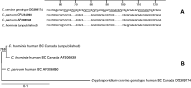
There was a pronounced difference in the CP23 coding sequence of the Cryptosporidium cervine genotype compared to C. hominis and C. parvum, which translated to quite a distinct amino acid sequence (Fig. 1). There was a multiple repeat region consisting of the amino acids proline-alanine-proline-valine (PAPV) present in the Cryptosporidium cervine genotype, which does not appear to have a homologous counterpart in C. hominis or C. parvum (Fig. 1A). Besides this region of heterogeneity at amino acid positions 60–110, there were also 11 other amino acid substitutions between the Cryptosporidium cervine genotype and C. hominis or C. parvum sequences outside of this region.

Fig. 1. (A) Multiple amino acid sequence alignment, showing the presence of a PAPV repeat region in the cervine genotype, which is absent in other species/genotypes. Dashes ‘---’ indicate gaps in the alignment. Amino acid residues which are substitutions or insertions are underlined. (B) Phylogenetic relationship of the cervine genotype to other Cryptosporidium species on the basis of partial and complete CP23 gene sequences. Bar represents 0·1 substitutions per site.
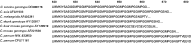
Variation in the HSP70 coding sequence of the Cryptosporidium cervine genotype compared with C. hominis consisted mainly of synonymous single nucleotide polymorphisms for this chaperonin, a protein which assists in the proper folding of newly synthesized polypeptides. However, there were 10 positions that resulted in amino acid changes but 6 of these were conservative substitutions (i.e. E→D, V→I). Near the 3′ end of the HSP70 gene (C terminal of coding protein) is a region that codes for the variable GGMP amino acid repeat motif, and differences in this region were found for a variety of Cryptosporidium species (Fig. 2). We found that the Cryptosporidium cervine genotype had a different number of variable repeats from C. hominis and C. parvum, as well as other known Cryptosporidium genotypes.

Fig. 2. Comparison of the GGMP amino acid repeat motif near the 3′ end of HSP70 locus in different Cryptosporidium species. A dotted line ‘…’ represents a partial sequence.
Sequencing results of actin and β-tubulin
Partial sequences of the actin (597 bp) and β-tubulin (910 bp) genes in the Cryptosporidium cervine genotype were determined. It was necessary to perform hemi-nested PCR in some reactions to generate a visible PCR amplicon, because there were many single nucleotide differences between the Cryptosporidium cervine genotype and other Cryptosporidium species at these two loci, making primer design for PCR extremely challenging. However, most single nucleotide differences in the coding sequence were found to be silent and did not affect the translational sequence of these highly conserved genes. Degenerate primers were not employed in this experiment to ensure specificity in binding to desired sequences, and annealing temperatures below 50 °C were also not used to prevent non-specific amplification.
When the actin locus of the Cryptosporidium cervine genotype and C. hominis were compared, differences found were silent nucleotide polymorphisms, and no substitutions in the amino acid sequence were observed based on the partial sequence obtained. Designing novel primers proved to be especially difficult for the actin gene, because occurrences of single nucleotide polymorphisms were so high that there were few conserved regions among sequences of other Cryptosporidium species to derive suitable new primers for the Cryptosporidium cervine genotype.
The partial sequences of the actin and β-tubulin genes show 9·3% and 13·8% divergence to C. hominis sequences (GenBank Accession no. AF382337 for actin; AF481961 and AF323578 for β-tubulin). The high percentage of divergence in β-tubulin results from the large sequence variation in the intron region of the β-tubulin gene as illustrated in Fig. 3. β-tubulin is one of the relatively few genes in Cryptosporidium known to contain an intron within its coding sequence (Bankier et al. 2003; Cai et al. 2004). The presence of this highly variable region further confirmed that this region was part of the intron and not an artifact from PCR amplification. This new cervine genotype β-tubulin gene sequence included a novel 423 bp region which extended beyond the 3′-ends of all β-tubulin gene sequences deposited in GenBank. This was obtained using primers derived from the whole genome sequence of C. parvum (Chromosome 6, GenBank Accession no. NW_632860, Abrahamsen et al. 2004). There were also numerous single nucleotide differences in the coding regions when compared to the whole genome sequence of C. parvum, but these were all found to be synonymous substitutions that resulted in no amino acid substitutions based on the partial sequence obtained.

Fig. 3. Comparison of β-tubulin intron region with other Cryptosporidium species. The putative intron region of β-tubulin spans from nucleotides 53-152. ‘Y’ indicates a variant pyrimidine and dashes ‘---’, gaps in the alignment.
All locus-specific sequences generated in this study from the 7 isolates resulted in identical sequences, and nucleotide BLAST searches of all generated sequences showed that they most closely matched other sequences in the Cryptosporidium genus. All sequences generated in this study were aligned to available sequences deposited in GenBank representing other Cryptosporidium species/genotypes for comparison.
Phylogenetic analysis
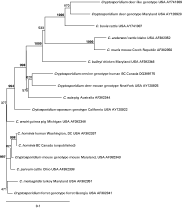
The phylogenetic tree illustrated in Fig. 4 places the Cryptosporidium cervine genotype closest to the C. parvum deer mouse genotype characterized previously (Xiao et al. 2002b) at both the HSP70 (8% divergence) and actin (7·5% divergence) gene loci (GenBank Accession no. AY120919 for HSP70; no. AY120925 for actin). Besides being closely related to the deer mouse genotype, Fig. 4 also shows the Cryptosporidium cervine genotype in the same cluster as C. suis (formerly pig genotype I). The close phylogenetic distance among these genotypes suggests that they may have evolved from a common ancestor and diverged later. Also shown in Fig. 4 are the sequences of the Cryptosporidium deer and deer-like genotype characterized by Fayer et al. (2005). The Cryptosporidium deer genotype that was characterized previously appeared on a completely separate branch (with C. bovis) from the Cryptosporidium cervine genotype, suggesting that the cervine genotype is in a different clade to this other Cryptosporidium deer genotype. Analysis of the phylogenetic trees for CP23 (Fig. 1B) and β-tubulin also suggested that the Cryptosporidium cervine genotype was in a distinct clade and significantly different to other species characterized at these loci. Unfortunately, comparisons using these two genes were hampered because there were fewer sequences available in GenBank. However, it was evident from both the HSP70 and actin (Fig. 4) phylogenetic trees which were very similar, that C. meleagridis, C. hominis, C. parvum were all in different clades to the Cryptosporidium cervine genotype.

Fig. 4. Phylogenetic relationship of the cervine genotype to other Cryptosporidium species by comparison of actin gene sequences. Bootstrap values greater than 900 (of 1000 replicates) are indicated in bold font. The Cryptosporidium species/genotype, natural hosts and location from which isolates were collected as well as corresponding GenBank Accession nos. for sequences used are provided. Bar represents 0·1 substitutions per site.
DISCUSSION
In this study, 4 different loci of Cryptosporidium cervine genotype from 7 different human isolates were studied in order to advance the molecular characterization of the Cryptosporidium. Besides single nucleotide polymorphisms present throughout the coding region of these genes, other differences in specific regions of housekeeping genes such as the repeat motif of HSP70 and the intron region of β-tubulin also demonstrate the uniqueness of the Cryptosporidium cervine genotype DNA sequence. Sequence comparisons of the Cryptosporidium cervine genotype to C. hominis and C. parvum showed that sequence divergence between the species was significantly lower in the housekeeping genes (HSP70, actin, and β-tubulin) than in the 27 kDa surface antigen gene (CP23). Since the housekeeping genes analysed have important biological functions, it is anticipated that their sequences would be more conserved. However, CP23 which encodes an immunodominant antigen present on both merozoite and sporozoite surfaces (Arrowood et al. 1991), is more likely to diverge due to selection pressure exerted by host immune responses or optimization for host-specific infection. The CP23 antigen has been studied quite extensively in animal models (Jenkins, 2004; Perryman et al. 1996) and neutralizing antibodies generated to it have been determined to inhibit Cryptosporidium sporozoite infectivity (Shirafuji et al. 2005). In this study, the CP23 gene sequence of the cervine genotype was determined for the first time. The existence of a multiple PAPV repeat region was unique to the cervine genotype as this was absent in the other 2 Cryptosporidium species (C. hominis and C. parvum) for which CP23 gene sequences have been reported (Sturbaum et al. 2003).
We explored the possibility that the cervine genotype may be a distinct species of its own in the genus Cryptosporidium. The phylogenetic trees constructed based on our new sequences and those of the Cryptosporidium deer mouse genotype available in GenBank, place the Cryptosporidium cervine genotype closest to the deer mouse genotype in the actin and HSP70 loci. Another species closely related to the Cryptosporidium cervine genotype is C. suis, illustrated by the close branching patterns in the phylogenetic trees. C. suis was known previously as the Cryptosporidium pig genotype I and has been designated recently as a new distinct species (Ryan et al. 2004).
Reports by several research groups on the identification and/or detection of Cryptosporidium cervine genotype oocysts, include those found in humans (England, Slovenia, Ontario and British Columbia in Canada) (Leoni et al. 2006; Soba et al., unpublished data; Trotz-Williams et al. 2006; Ong et al. 2002), sheep (Western Australia) (Ryan et al. 2005a), deer (Virginia, USA) (Perz and Le Blanc, 2001), mouflon sheep, nyala and blesbok (Czech Republic) (Ryan et al. 2003), and lemurs (Duke University Primate Center, North Carolina, USA) (Da Silva et al. 2003) demonstrates the broad host range of this genotype. Cervine genotype oocysts were more frequently identified in storm water samples collected from New York watersheds in the USA with higher densities of residential lots (Jiang et al. 2005) and also in a sewage treatment plant effluent sample in the Sydney catchment area in Australia (Ryan et al. 2005b). Although the results of these previous studies suggest that infected humans may be contributing to the Cryptosporidium cervine genotype oocyst load in the environment, this is inconsistent with the low number of sporadic cases reported in humans. One possible explanation for this anomaly could be that most Cryptosporidium cervine genotype infections in humans are asymptomatic and are therefore not detected or diagnosed. The Cryptosporidium cervine genotype has been identified in 9 reported cases of cryptosporidiosis in humans in British Columbia (Ong et al. 2002).
The report of a Cryptosporidium cervine genotype human case in England is interesting as a slight variation in the 18S rRNA gene sequence (DQ116570) was observed (Leoni et al. 2006). Although absent in the sequences of all British Columbian human isolates in the current study, the 2 nucleotide (-TA-) deletion found in the 18S rRNA gene sequence of the English human isolate has been observed previously in a deer (563) isolate. It is most likely that all these isolates belong to the same cervine genotype. In the phylogenetic tree derived from these 18S rRNA gene sequences, both the sequence (AF297512) from this deer and the cervine genotype sequence (AF297511) from another deer (524) clustered together and branched separately (bootstrap value of 97%) from other Cryptosporidium genotypes and species (Perz and Le Blancq, 2001). The 18S rRNA gene is present in multiple copies and previous studies on other Cryptosporidium species such as C. hominis (Xiao et al. 1999) and C. parvum (Le Blancq et al. 1997) have shown that there is slight sequence heterogeneity in some of these copies.
In a recent paper (Fayer et al. 2005), a new genotype of Cryptosporidium was identified with its primary host being deer. Upon sequence comparison of the Cryptosporidium cervine genotype to the deer genotype at the HSP70 and actin loci studied in this experiment, it was found that the 2 genotypes appear completely unrelated. The deer genotype described by Fayer et al. (2005) is much closer in sequence homogeneity to C. bovis, whereas the Cryptosporidium cervine genotype is shown to be closely related to the Cryptosporidium deer mouse genotype in this study on the basis of the HSP70 and actin loci. This type of variation appears to draw parallels with 2 other Cryptosporidium species, C. andersoni and C. bovis, both of which are found in cattle. It is very probable that deer may serve as a reservoir for several species/genotypes of Cryptosporidium, including the Cryptosporidium cervine as well as other deer genotypes.
In a recent study of Australian sheep (Ryan et al. 2005a), the cervine genotype was identified to be by far the most prevalent Cryptosporidium genotype present. This suggests that besides deer, sheep may also serve as an important reservoir for the Cryptosporidium cervine genotype. In more recent studies (Jiang et al. 2005; Ryan et al. 2005a,b), the cervine genotype was repeatedly identified as one of the more prevalent genotypes present. This makes the Cryptosporidium cervine genotype one of the most commonly occurring Cryptosporidium species at present, and future studies are necessary to reveal further information about its host range and transmission cycles.
This research was funded by a Natural Sciences and Engineering Research Council of Canada (NSERC) Discovery Grant (RGPIN 261964-03) to C.O. P.W. was the recipient of an NSERC Undergraduate Student Research Award. We would like to thank the following individuals who have contributed to this study: Victor Law for sequencing the CP23 gene partially; Claudia Sutherland, Merilee Hughes, Vicki Fung, Tracy Kirkham and Diane Eisler for processing stool specimens; Dr Joan Tomblin (BC BioMedical Laboratories) for the clinical specimens; Dr Jeffrey Priest (CDC, Atlanta) for designing primer #8167 to the CP23 gene; the staff of the Molecular Services at the BC Centre for Disease Control for their technical advice and last but not least, Dr Judith Isaac-Renton for provision of bench space, access to equipment and computing facilities at the public health laboratories of the BC Centre for Disease Control where most of this research was carried out.