Introduction
Bowmouth guitarfish Rhina ancylostoma is the only representative species of the genus Rhina (Family Rhinidae). Very little is known about the life history characteristics of this species, which can reach a maximum size of 295 cm total length (LT). Males mature at 150–175 cm LT, while females mature at around 180 cm LT (Compagno and Last Reference Compagno, Last, Carpenter and Niem1999; Last et al. Reference Last, Naylor, Bernard, White, Stehmann and Carvalho2016; Last and Stevens Reference Last and Stevens2009; Purushottama et al. Reference Purushottama, Sujitha, S.j and Zacharia2022). Reproduction is lecithotrophic viviparous with litter sizes of 2–11 pups and a size at birth of 46–48 cm LT (Last et al. Reference Last, Naylor, Bernard, White, Stehmann and Carvalho2016).
Although the rounded snout and mouth lend themselves to the descriptive and most widely used common name ‘bowmouth guitarfish’, it is the prehistoric look of the fish that is most intriguing and easily distinguishes it from other elasmobranchs. Most conspicuously, the dorsal surface over the cephalic region has nine distinct linear ridges of conical thorns that vary in length and prominence. The longest and most conspicuous nape-ridge runs medial and anterior to the first dorsal fin, while subsequent paired ridges run along the head and anterior portion of the dorsal surface. Similar to elasmobranch teeth, individual thorns loosen, fall out, and are slowly replaced by new thorns, which do not appear as sharp as their predecessor. Rhina ancylostoma has countershading consisting of a brownish grey dorsal surface and a white ventral surface. The dorsal surface may be mottled with white spots, the presence and intensity of which differ between individuals and temporally, with younger individuals having more intense patterns. Young individuals have noticeable black bands between their eyes that fade with age (Last and Stevens Reference Last and Stevens2009).
Bowmouth guitarfish is widely distributed in the Indo-West Pacific, ranging from South Africa through the Western Indian Ocean, Arabian Sea, Southeast Asia, and extending north to Japan, south to Australia (where it is found across the north of the continent), and east to New Caledonia (Kipperman et al. Reference Kipperman, Jabado, Haque, Fernando, Anjani, Spaet and Humble2024; Last et al. Reference Last, Naylor, Bernard, White, Stehmann and Carvalho2016; Last and Stevens Reference Last and Stevens2009).
This species usually inhabits areas from close inshore to depths of at least 70 m on the continental shelf (Last et al. Reference Last, Naylor, Bernard, White, Stehmann and Carvalho2016) and it occurs on or close to the seabed, mainly over sandy or muddy substrates, and around coral reefs. Bowmouth guitarfish was most recently assessed by the IUCN Red List of Threatened Species in 2018, where it was listed as Critically Endangered, and the shallow, inshore soft-bottom habitat preferred by the species is threatened by habitat loss and environmental degradation (Jabado et al. Reference Jabado, Kyne, Pollom, Ebert, Simpfendorfer, Ralph and Dulvy2017; Moore, Reference Moore2017; Moore et al. Reference Moore, McCarthy, Carvalho and Peirce2012; Stobutzki et al. Reference Stobutzki, Silvestre, Abu Talib, Krongprom, Supongpan, Khemakorn, Armada and Garces2006; White and Sommerville Reference White, Sommerville, Carrier, Musick and Heithaus2010).
Globally, rays of the family Rhinidae (commonly known as wedgefishes) are subject to intense fishing pressure on their coastal and shelf habitats that is unregulated across the majority of their distribution. Wedgefishes are captured in industrial, artisanal, and subsistence fisheries with multiple fishing gears, including gillnet, trawl, hook and line, trap, and seine net, and are generally retained for their meat and fins (Bonfil and Mohamed Reference Bonfil and Mohamed2003; Jabado, Reference Jabado2018; Moore, Reference Moore2017; White and Sommerville Reference White, Sommerville, Carrier, Musick and Heithaus2010). There is increasing fishing pressure across the range of bowmouth guitarfish, and demersal coastal fisheries resources have been severely depleted in significant areas of the Indo-West Pacific, including India and Southeast Asia (Kipperman et al. Reference Kipperman, Jabado, Haque, Fernando, Anjani, Spaet and Humble2024; Mohamed and Veena Reference Mohamed and Veena2016; Stobutzki et al. Reference Stobutzki, Silvestre, Abu Talib, Krongprom, Supongpan, Khemakorn, Armada and Garces2006). Fishing pressure is, however, lower across northern Australia and in Papua New Guinea, which provides some refuge for this species, since there are no target fisheries for it in Australia, although it is caught as bycatch in numerous non-target fisheries (Stobutzki et al., Reference Stobutzki, Silvestre, Abu Talib, Krongprom, Supongpan, Khemakorn, Armada and Garces2006).
Additionally, anecdotal reports suggest that artisanal longline fishing in southern Mozambique has led to declines in bowmouth guitarfish, as this species was once abundant on reefs before longline fisheries began in the early 2000s and it is now only seen in low numbers (Pierce et al. Reference Pierce, Trerup, Williams, Tilley, Marshall and Raba2008).
Material and methods
The present study was conducted based on the analysis of at-sea observations onboard the Spanish and Seychellois tropical tuna purse seine fleets operating in the Indian Ocean from 2017 to 2023. The observation coverage, as well as the monitoring method, varied throughout this time series.
Traditionally, the minimum observation coverage required by the Indian Ocean Tuna Commission (IOTC) for most fleets has been 5% (IOTC 2025). This percentage of observation has historically been met by the EU and Seychelles through onboard observers under the respective National Sampling Programs. However, starting in 2012, the purse seine fleet voluntarily initiated a Code of Good Practices designed to improve the selectivity of the tropical tuna purse seine fleet and minimize the impact of this fishing method on the marine ecosystem. This same code included, among its adopted measures, the need to progressively increase observation coverage to 100% of the fishing activity.
Alongside human observers, electronic monitoring systems (EMS) have served as a significant data source in the tropical purse seine fleet (Murua et al. Reference Murua, Ruiz, Justel-Rubio and Restrepo2025), and it has been a technology that has complemented the observers’ coverage and served to bring the fleet to higher observation coverage. On these vessels, the data (videos) are routinely analysed by a service provider, and the combined coverage of human observers and EMS has enabled the monitoring of over 85% of fishing activity since 2017 (Ruiz et al. Reference Ruiz, Batty, Chavance, McElderry, Restrepo, Sharples, Santos and Urtizberea2014, Reference Ruiz, Martinez de Lagos, Canive, Grande, Krug and Santos2021). On average, almost 4500 fishing sets were observed per year, during which the following data were recorded: target and non-target species caught, including their estimated size and fate. Additionally, other complementary data were collected, such as position, date and time, set type (free school [FS] sets or Floating Object set [FOB], sea surface temperature [SST] and wind speed). It is important to highlight that in some cases where monitoring has been carried out using EMS, only data on interactions with endangered, threatened, and protected species (ETPs) have been collected, not on target capture.
Results
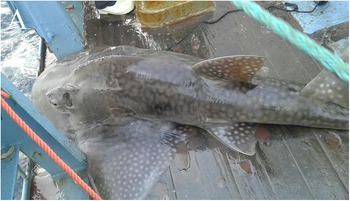
A total of 37 interactions with bowmouth guitarfish were recorded, of which 26 were documented through EMS, 9 by observers and 2 through both sources. Of these records, 33 were in the first half of the year and the remaining 4 in the second half, with interactions predominantly occurring between January and May, and more frequent in the years 2018 and 2021 (Table 1). All records were in equatorial waters between latitudes 7° North and 7° South, and between longitudes 43° and 66° East in open waters associated with tuna schools (Figure 1). Of the recorded specimens (Figure 2), 24 individuals were caught in FS-sets and 13 in FOB sets. The estimated total lengths ranged between 150 and 250 cm. Ten individuals were identified as females and three as males (24 could not be sexed). The SST for capture locations ranged from approximately 27–31°C. Catch status and set type analysis revealed that 15 individuals were released alive, 17 were discarded dead and the status of 5 individuals could not be determined due to observational limitations. When analyzing the data by set type, in FOB sets, eight individuals were released alive and five discarded dead, whereas in FSC sets, seven individuals were released alive, while twelve were discarded dead (Table 1).
Positions of R. ancylostoma records by the purse seine fleet in the Indian Ocean. The positions are shown accumulated by quarter during the period 2017–2022.

Photo taken by an observer on the deck of a purse seine.

Detailed information about the sets with observations of R. ancylostoma in the purse seine fleet in the Indian Ocean

N.A.: data not available.
Based on 22 fishing sets monitored where both target catch, and bycatch, have been monitored, the species composition has been dominated by the target tuna species (skipjack tuna Katsuwonus pelamis, yellowfin tuna Thunnus albacares, and bigeye tuna Thunnus obesus) in both in FS-sets and FOB-sets (Table 2). In contrast, the diversity of accessory species has been more pronounced depending on the type of set. In FS-sets, not much bycatch has been recorded with billfishes appearing five times, and silky shark Carcharhinus falciformis, oceanic whitetip shark Carcharhinus longimanus, Carcharhinus sp. and Mobula sp. each occurring once. In contrast, a higher diversity of accessory species was recorded in FOB-sets, with also a greater number of individuals. In this specific case, silky shark was the most recurrent species.
Associated and by-catch species with R. ancylostoma and their occurrence frequencies in free school and floating object sets

Discussion
Bowmouth guitarfish is a demersal species and that it lives near the coast and on reefs, but its depth distribution is poorly known. Several authors have described this species as a mesopredator exhibiting both benthic and demersal feeding behavior on the seabed, with a preference for teleost fish, crustaceans and molluscs in coastal and offshore reef areas at depths of less than 90 m (Bonfil and Mohamed Reference Bonfil and Mohamed2003; Jabado et al. Reference Jabado, Kyne, Pollom, Ebert, Simpfendorfer, Ralph and Dulvy2017; Last et al. Reference Last, Naylor, Bernard, White, Stehmann and Carvalho2016; Purushottama et al. Reference Purushottama, Sujitha, S.j and Zacharia2022; Raje et al. Reference Raje, Sivakami, Mohan Raj, Manoj Kumar, Raju and Joshi2007). However, in a study on trophic ecology along the northwest coast of India based on 13C values, (Borrell et al. Reference Borrell, Cardona, Kumarran and Aguilar2011), found that the species’ distribution is more pelagic or epipelagic than initially thought. Its distribution in offshore waters may have implications for interactions with fishing fleets operating in open waters.
Although the elasmobranch bycatch species in the European tropical tuna purse-seine fishery in the western Indian Ocean were present in 46.9% of observed sets, catches of bowmouth guitarfish in the open ocean and associated with tuna schools are very rare (Clavareau et al. Reference Clavareau, Sabarros, Escalle, Bach, Abascal, Lopez, Murua, Alayon, Ramos, Ruiz and Mérigot2020; Forget and Muir Reference Forget and Muir2021). Therefore, although these records in tuna vessels are not numerous, they may be of interest to better understand the spatial distribution and the large-scale movements of this species. According to the lengths estimated by observers and the EMS, the captured individuals ranged from 150 to 250 cm. These sizes suggest that all these individuals are mature or are close to reaching sexual maturity (Purushottama et al. Reference Purushottama, Sujitha, S.j and Zacharia2022). Size estimates and sex determination are sometimes challenging due to the quality of the images, especially in cases of individuals monitored by the EMS. Although the majority of the cases the sex could not be determined, of those that were identified there were more females recorded.
Unlike some elasmobranch species with seasonal reproduction cycles, it does not appear that this particular species follows a seasonal pattern. It is mentioned that females prefer coastal habitats for giving birth, but interactions of the fleet with this species in remote coastal areas are still unknown (Purushottama et al. Reference Purushottama, Sujitha, S.j and Zacharia2022).
According to the data presented in this work, most incidental captures of this species occurred during FS-sets. However, in recent years, more than 80% of the sets conducted by the tuna purse seine fleet have been made on FOB (Báez et al. Reference Báez, Marta, María and Santiago2020). As in the case in most of the purse seine sets, the predominant species in sets with R. ancylostoma interactions has been the skipjack tuna. It is noteworthy that there is a frequent association with billfishes which is the most abundant accessory species in FS-sets. Although it is mentioned that sharks are less abundant than billfishes, their presence is also recorded in FS- sets, which is common in this type of fishing. In FOB-sets, where the number of accessory species is higher, silky sharks were the most frequently observed species.
The interactions occurred mainly in the first and second quarters of the year, from January to May, with four additional interactions recorded in August, October, and December. This seasonality can provide valuable information about the species’ seasonal presence or behaviour patterns. Although the tuna fleet mainly concentrates in the SE–NW zone of Seychelles there are several areas, especially within the 200-mile exclusive zones of some countries (Somalia, Chagos, Maldives), where the purse seine fleet does not have access. Therefore, the absence of R. ancylostoma in these areas may be due to limited fishing effort.
The records of this species in open waters demonstrate that R. ancylostoma not only inhabits coastal and nearshore areas, but is also capable of long-distance movements, and migrations could occur between different geographic locations across the northwest Indian Ocean. In summary, it is crucial to gather more information about these catches and analyse them in conjunction with previous research emphasizing the importance of considering the fishing methodology employed, the temporality of interactions, and fishing restrictions in specific areas. This comprehensive approach is fundamental to fully understand the dynamics of the interactions of R. ancylostoma catches in the context of tuna fishing.
Acknowledgements
The authors wish to express their gratitude to the tropical tuna purse seine associations ANABAC and OPAGAC for their dedicated efforts and for providing the data used in this study. We also acknowledge the valuable work of the observers from the Seychelles Fishing Authority (SFA) and extend our thanks to DataFish for their collaboration. This research would not have been possible without their contributions. This paper is contribution no. 1271 from AZTI, Marine Research, Basque Research and Technology Alliance (BRTA).
Author Contributions
Salgado A., Krug I. Ruiz, I., provided and analysed the data, revised literature and completed the first draft of this manuscript, G. Diez revised the manuscript draft, literature, tables and bibliography and prepared the final version.
Financial support
This research received no specific grant from any funding agency, commercial or not-for-profit sectors.
Data availability statement
The data that support the findings of this study are available from Jon Ruiz (jruiz@azti.es), upon reasonable request.
Competing interests
The authors declare none.