Background
Head and neck squamous cell carcinoma (HNSCC) is currently the sixth most common cancer diagnosis globally. Reference Tong, Geng and Yan1 Despite a steady decline in alcohol consumption and tobacco use of individuals since the 1970s, both unequivocally established as aetiological factors in the development of HNSCC, an increase in diagnoses, specifically oropharyngeal squamous cell carcinoma (OPSCC), have been documented. Reference Vázquez-Otero, Vamos and Thompson2 This increase has been in younger people, predominantly male, non-smokers, generally healthy and with no co-morbidities. Reference Gillison, D’Souza and Westra3,Reference Schache, Powell and Cuschieri4 The epidemiological shift has led to growing research focusing on the impact of Human Papillomavirus (HPV), established as the aetiological factor responsible for this epidemic rise. An estimated 55-95% of OPSCC in Europe are HPV positive (HPV+), and rates in the UK, like United States of America, have increased by around 225% in 20 years. Reference Lechner, Vassie and Kavasogullari5 A common yet complex virus, HPV can lie dormant for years; as carriers are often asymptomatic, it is possible that a large proportion of people who are infected at some point within their lifetime will never know. Therefore, when considering the impact of HPV on a cancer diagnosis, common questions from patients regarding the source of infection could be deemed very difficult to answer.
The HPV virus encompasses over 150 DNA strains which predominantly live on the skin, in the genital tract and the oral mucosa. Reference Evans and Powell6 HPV-16 and -18, high risk strains associated with head and neck cancers (HNC), Reference Yang, Yin and Li7 are contracted by sexual contact, with a direct positive correlation established between the numbers of sexual partners and an increased individual risk. Reference Nguyen, Nguyen and Thomas8 Contracting HPV, however, is not limited by sexual orientation or exclusive to those with multiple previous sexual partners. Anecdotal evidence, based on observations in clinical practice, suggests that the sexually transmitted nature of the HPV associated with HNSCC can raise questions between a patient and their partner, including a suggestion of infidelity. This can directly impact personal, emotional and sexual relationships, with patients also making reference to avoiding close contact with loved ones for fear of passing on the infection and associated cancer risk. These are all concerns which could be addressed through patient information and education. A general public awareness of HPV and its association with HNC should be steadily increasing as a result of the introduction of the HPV vaccine for teenage boys, transgender people and homosexual males in 2019.9 This should help to promote more open discussion.
Evidence has shown a positive correlation between a positive HPV status and tumour response to treatment for HNSCC. Reference Neal and Hoskin10 Research is ongoing to optimise treatment regimes, with a focus on maximising efficacy while minimising the debilitating chronic treatment side effects. 11–Reference Mehanna, Robinson and Hartley13 With a positive movement to improve outcomes, and the routine implementation of p16 immunohistochemistry testing for HPV in individuals diagnosed with OPSCC in the UK, 14 it is pertinent to consider the psychological and psychosocial impact of an HPV diagnosis on the patient, as well as the associated information needs, which have potential to be overlooked while managing the cancer. Patients should be aware that there is a possible correlation between HPV and their cancer diagnosis if they have consented to HPV testing. It is, therefore, important that the professionals involved in their subsequent care are equipped to answer the questions that may arise as a result. Patients with HNC often follow complex management pathways, consequently, information needs may be identified by the patient at any point during the pathway, to any of the multiple healthcare professionals (HCPs) involved in their care.
In recent years, a range of resources has been developed by HNC charities and organisations to support oncology clinicians and HCPs in discussing the topic of HPV with individuals diagnosed with HPV-associated cancer. Reference Reich, Licitra and Vermorken15-Reference Baker17 Resources aimed at clinicians include how to respond to questions where there is no definitive answer, such as when and from who the individual contracted HPV. Reference Reich, Licitra and Vermorken15-Reference Baker17 Others are aimed at patients, and are available to hospital trusts on request. Reference Baker18
The aim of this scoping study, undertaken as part of a BSc (Hons) Radiotherapy, was to investigate the availability of information in hospital and clinic settings for patients diagnosed with HPV + HNC, as well as the knowledge and confidence of HCPs involved in the cancer pathway to provide information on HPV.
Ethical approval for the study was granted by the University of Liverpool’s Health and Life Sciences Committee on Research Ethics (human participants, tissues and databases).
Method
The target group for participation in this study was any HCP involved in the management pathway for patients diagnosed and treated for HPV + OPSCC. These individuals were anticipated to have knowledge of patient needs and the clinical experience of current information practice and information availability within their departments.
An online questionnaire was created to include a range of fixed response, multiple option and Likert scale questions around HPV information availability, with an opportunity for an additional free text response to all questions. Question themes were identified from a review of the current literature on HPV HNC and patient information, and clinical knowledge of the patient pathway.
The questionnaire was piloted by an HNC specialist to test its ease of use, and to ensure questions were phrased to obtain relevant responses. Reference Boynton19 The study was advertised to all clinical professionals on the ‘Survey and Questionnaires’ area of the British Association for Head and Neck Oncologists (BAHNO) website, 20 accompanied by a participant information sheet and a link to the questionnaire deployed using Survey MonkeyTM. The remit of BAHNO is to encourage discussion and sharing of knowledge between clinical and research specialties involved in the care and management of patients with HNC. Membership encompasses a diverse range of clinical professions, 20 providing an ideal platform for national dissemination to groups involved across the treatment pathway.
Twenty-five participants representing six UK Cancer Alliances and five health professions completed the questionnaire during the time it was available (29 November 2018–31 December 2018). Table 1 shows participation by profession and UK Cancer Alliance. Responses were collected using Survey Monkey™ and collated in Microsoft Excel. Free text responses were independently coded by two researchers to identify themes and were used to help qualify the closed question responses.
Participants in the study by profession and cancer alliance

All participants provided care to NHS patients with HNC, including 63% who also treated patients receiving privately funded medical care. Where this was the case, participants indicated that the same information was made available to all patients.
Results
Information
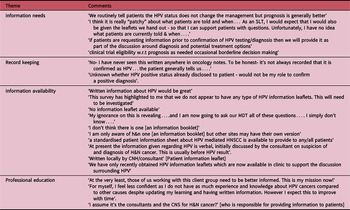
Eleven participants were aware of patients being routinely offered information on HPV related to their HNSCC diagnosis; however, of those who said information wasn’t provided routinely, six subsequently specified instances when HPV information would be given (Figure 1 represents the stages at which participants believed information was given to patients). Open responses (Table 2) support this suggestion of a lack of standardisation with regards to information. At least one participant from each professional group indicated that they either did not provide information routinely, nor did they know if it was provided by others, with one participant stating, ‘My ignorance on this is revealing …. and I am now going to ask our MDT all of these questions…. I simply don’t know….’
Demonstrates at what stage(s) of diagnosis and/or treatment information regarding HPV is given as standard.

Open responses from the questionnaire grouped by theme

The most commonly identified method for providing patients with information about HPV was face to face. Patient information booklets were available in the centres of 12 participants, with 11 of those booklets being specific to HNC. The majority were utilising the information produced by The Throat Cancer Foundation Reference Baker17,Reference Baker18 ; and two indicated that booklets were produced within trusts by the multidisciplinary team. Despite multiple participants indicating that the same leaflet was provided, there was some variation in participant knowledge of the information covered within the booklet (Figure 2 demonstrates which topics participants believed were covered in the patient information leaflets available).
Demonstrates topics covered within patient information leaflets currently provided to patients.

Responsibility
The presumed responsibility of who would provide patients with information about HPV also varied between professionals. All respondents indicated that they believed consultants were responsible for this, while 75 % thought this was also a role of the Clinical Nurse Specialists (CNS). The majority, but not all of CNS respondents saw this as a role responsibility. The correlation between profession and expectation of responsibility is shown in Table 3.
The correlation between profession and expectation of professional responsibility to provide patients with information about HPV

Participants were asked to rate on a scale of 0–100 their confidence in providing information about HPV to patients (0 being no confidence, 100 extremely confident). Mean confidence was 58 (range 0–99), with respondents from the consultant group the most confident.
Fifty percent of participants who indicated that HPV information was routinely provided also believed that this was not routinely recorded in the patient case notes.
The majority of participants agreed with all of the multiple statement options in the questionnaire relating to barriers in providing information, namely time restriction; staff knowledge and information; inadequate resources; inappropriateness of highlighting the issue with friends or family present; and the difficult nature of the subject.
Discussion
Results from previously published studies reviewing information on HPV for patients with HNC, have suggested that there is an unmet need for patient information Reference Dodd, Waller and Marlow21,Reference D’Souza, Zhang and Merritt22 and also highlight a requirement to educate HCPs in delivering this information. Reference Guo, Goldenberg and Fakhry16,Reference Dodd, Forster, Waller and Marlow23–Reference Milbury, Rosenthal, El-Naggar and Badr25 The results from this study indicate that both a lack of information on HPV + HNC, and education of the wider healthcare team involved in patient care in the UK still exist. With a primary objective to understand how information regarding HPV is delivered and identify the resources currently available to both HCPs and patients, three key aspects were identified: information availability with respect to patient and professional need; professional responsibility; and barriers to effective communication.
The primary issue identified was the inconsistency in the information available to patients. There is a strong suggestion that written patient information on HPV for HPV + HNC patients is not always readily accessible, with the results showing that some participants had no knowledge of the availability of a patient information booklet. One participant stated, ‘This survey has highlighted to me that we do not appear to have any type of HPV information leaflets. This will need to be investigated’. The primary method of providing information about an HPV diagnosis to patients is through verbal discussion, with the majority of clinicians and HCPs believing this to be the responsibility of the patient’s consultant. Inglehart et al. Reference Inglehart, Taberna and Pickard26 suggested that doctors were the most trusted source for providing the patient with information, which aligns with the responses of participants in this study; however with a lack of clarity regarding how, when and why cancer has developed as a result of an HPV infection, Reference Chu, Genden, Posner and Sikora27 it has been suggested that clinicians can lack the confidence to provide the patient and possibly their partner with advice and support on the complex social and behavioural questions raised outside the realm of oncology. Reference Dodd, Waller and Marlow21
D’Souza et al. Reference D’Souza, Zhang and Merritt22 analysed patient experience and anxiety during and after treatment for an HPV+-related OPSCC, finding that on completion of treatment, some patients still felt dissatisfied with the information they had received regarding their diagnosis, and were left with unanswered questions. Dodd et al. Reference Dodd, Forster, Marlow and Waller28 interviewed patients and their partners in order to understand the psychosocial impact of an HPV + HNSCC diagnosis, and reported that the HPV status was not always disclosed by the patient’s doctor. As a result, patients sometimes remained uncertain of the connection between HPV and cancer. In some cases, patients were informed by the clinical trial HCP of their HPV status on the basis of its relevance to trial recruitment, while those not eligible for the trial remained unaware of the link. Reference Dodd, Forster, Marlow and Waller28 Patients who could not recall being told their HPV status often used the internet to find answers about it. Reference Baxi, Shuman and Corner29 Participants in this study identified uncertainty around how and when the information given to patients was recorded within their clinical notes. Some participants disclosed to having no knowledge of whether a discussion on HPV status had taken place, or what information the patient had already received prior to being under their care. This can make it more difficult to establish the patient’s baseline understanding if the topic arises in the later phases of care and rehabilitation.
A responsibility identified by The Health and Care Professions Council (HCPC) standards of proficiency is that HCPs should give service users’ and their carers the information they want or need, in a way they can understand; therefore, there is an expectation that HCPs should be prepared with an appropriate level of knowledge to inform or signpost patients as required. Considering the possible treatment pathway for a patient diagnosed with an HNC and the multiple HCPs involved with their care, it may be reasonable to assume that by the time the patient reaches the end of the management pathway, their HPV diagnosis would have been discussed. HCPC Standards of Conduct Performance and Ethics Reference Baxi, Shuman and Corner29 highlight the importance of ‘maintaining full, clear, and accurate records for everyone you care for, treat, or provide other services to’ (HCPC, 2016, p10). 30 Results of this study suggest this is not common practice regarding HPV information, with one participant stating, ‘No- I have never seen this written anywhere in oncology notes. To be honest- it’s not always recorded that it is confirmed as HPV…the patient generally tells us….’ It is, therefore, a recommendation that an appropriate standard for documenting this in clinical notes be addressed by local multidisciplinary teams in order to facilitate the wider healthcare team in supporting the patient.
Ellis et al. Reference Ellis, Ferrer and Klein31 analysed ‘don’t know (DK)’ responses obtained from the National Cancer Institute’s Health Information National Trends Survey of American adults, which included six sections addressing aspects of HPV knowledge. DK responses amounted to 41·8% of the answers obtained. The study identified some knowledge relating to HPV and cervical cancer, while the link between HPV and other cancers such as oral and anal cancer received the most DK responses. Reference Ellis, Ferrer and Klein31 Ellis et al. Reference Ellis, Ferrer and Klein31 concluded that a lack of public education was a key limiting factor for HPV knowledge. With rising numbers of HPV + HNC, in a younger patient group, both males and females, HPV awareness is pivotal to future prevention but also to offer support and information to those diagnosed.
Results of this study highlight some disparity between HCPs within the multidisciplinary team providing care, and their expectation to provide HPV information as part of their role. One participant stating that it is, ‘Unknown whether HPV positive status already disclosed to patient - would not be my role to confirm a positive diagnosis.’ There is a positive correlation in results between the perception of responsibility and self-scoring scoring for knowledge on the subject. Therapeutic radiographers, speech and language therapists and dieticians were among those who did not identify themselves as a source of information to patients when it came to discussing an HPV+ diagnosis. Therapeutic radiographers as an example may see a patient 5 days a week for up to 7 weeks; this frequent interaction is widely acknowledged to facilitate the development of a patient–professional relationship of trust, which in turn enables the patient to discuss their diagnosis including directly and indirectly related questions. Roles of HCP are continuing to diversify, and it seems important that the preparedness to provide relevant information follows.
Baxi et al. Reference Baxi, Shuman and Corner29 highlighted the issue that patients not only felt embarrassed addressing the sexual implication of HPV with their consultant, but also felt that their consultant avoided the topic if they were married or if their spouse was present. The topic of embarrassment is a commonly identified barrier with respect to HPV and was agreed by our study participants to be a barrier to open communication. There is a worldwide need to change this attitude, for the benefit of patients, health professionals and the general public.
Patients commonly identify their consultant as the primary source of information, however, time restrictions are frequently cited as a barrier to communication. Reference Baxi, Shuman and Corner29 With HPV providing an improved oncological prognosis for HNC compared to HPV negative disease, the potential significance of an HPV+ diagnosis to the patient may be overlooked within the time available, with the key focus being the treatment of cancer. Reference Baxi, Shuman and Corner29 It must, however, be acknowledged that the treatment is aimed at the cancer and is not a cure for HPV. Studies have shown that following curative treatment, individuals with HPV are at increased risk of developing a second HPV-related malignancy. Reference Duncan, Wakeham, Langley and Vale32 Reasons for this are still being investigated, but are believed to link to biological susceptibility, intrapatient transmission across anatomical sub-sites and an increased exposure to the high-risk strains of the virus. Reference Duncan, Wakeham, Langley and Vale32 For this reason, it is key for future prevention and early detection that the significance of an HPV+ diagnosis is communicated in patient information and education, during consultations throughout the cancer pathway, and as part of survivorship.
The Throat Cancer Foundation booklet, Reference Baker17,Reference Baker18 referred to by the majority of respondents in this study as their primary source of written information, was not readily available in all clinical review settings, needing to be requested by professionals based on their awareness of its availability. Making this supporting information more widely available may help to facilitate discussion within the given clinic time constraints. One participant stated, ‘I think it is really “patchy” about what patients are told and when… As a SLT (speech and language therapist), I would expect that I would also be given the leaflets we hand out - so that I can support patients with questions. Unfortunately, I have no idea what patients are currently told & when….’
A cross-sectional survey conducted by Dodd et al. Reference Dodd, Forster, Waller and Marlow23 assessed healthcare practitioner participants’ knowledge of HPV; experiences, and attitudes towards discussing HPV with patients; and willingness to discuss HPV with patients in the future. Results identified that the HNC specialist HCPs engaged in the study had a good knowledge of HPV and statistically significant correlations were established between professional knowledge; personal barriers and confidence; and the HCPs’ willingness to discuss the topic. Shukla et al. Reference Shukla, Nyambose and Vanucci24 considered the effectiveness of providing lectures to oral health professionals (OHPs) and the use of specific support tools, such as fact cards to boost confidence. This study concluded that OHPs felt more aware of their role in HPV prevention, and therefore more knowledgeable when providing patients with information. In all studies identified, the education and awareness of HCP involved in patient care appeared pertinent to having open discussions with patients. Professional education on the subject of HPV-related HNC could improve the standard of care being provided to this patient group.
The results of this study have initiated the development of an education package for HCPs. The package includes baseline education on HPV and its relationship to HNC; identifies resources available for staff and patients; and highlights the responsibility and requirement of HCPs to understand and be prepared to discuss an HPV+ diagnosis.
Limitations
The small number of respondents to the questionnaire was impacted by the limited timeframe available to collect data within the remit of the BSc project. It cannot, therefore, be assumed that the responses are generalisable to all individuals from those professions and trusts represented; however, the results identified gaps in knowledge, confidence and education within the professional groups captured.
Conclusion
Guidance for HCPs on discussing HPV + HNC is available Reference Reich, Licitra and Vermorken15,Reference Guo, Goldenberg and Fakhry16,20 and resources have been created for patients by registered charities such as The Throat Cancer Foundation, Reference Baker17,Reference Baker18 however, there is an evident gap in education and a lack of a standardised approach to providing this information to patients. Uncertainty between HCPs regarding responsibilities for providing information and documenting information given is apparent.
With ongoing developments in this area of oncology, the use of education packages to provide CPD updates to clinical staff involved in the treatment of patients with HNC would be beneficial. Further work needs to be undertaken to establish the needs of patients with regards to information and the timeliness of its provision, and this should be used to ensure the relevance of the education given to HCPs.
An accurate and timely record of information provided to patients should be documented in a place and format agreed upon by the multidisciplinary team in order to support continuity of care.
Acknowledgements
The authors would like to thank the British Association of Head and Neck Oncologists (BAHNO) for facilitating the distribution of the questionnaire through their website.
Financial Support
This research received no specific grant from any funding agency, commercial or not-for-profit sectors.
Conflict of Interest
None.
Ethical Standards
This research does not involve human and/or animal experimentation.