For nearly a decade, we have been immersed in an economic crisis which has produced important changes and restructuring in the work environments. One of the sectors most severely affected by this crisis has been the healthcare sector, and specifically, the nursing profession (European Federation of Nurses Association, EFN; 2012). In times of crisis, job resources (i.e., aspects of the job that are functional in achieving work goals) have decreased and job demands (i.e., aspects of the job that require sustained physical or mental effort) have increased within the healthcare context. This imbalance between demands and resources is a risk factor for workers’ health and well-being (Bakker & Demerouti, Reference Bakker and Demerouti2017; Schaufeli & Taris, Reference Schaufeli, Taris, Bauer and Hämmig2014).
In this regard, it is relevant to continue researching which job resources can be helpful to predict high levels of energy and motivation among nursing professionals, not only to guarantee their health and well-being, but also the care quality and a good health system in the long term. Furthermore, it is necessary to take an extra step in the research field to understand why these resources are relevant and helpful (Bakker & Demerouti, Reference Bakker and Demerouti2017; Schaufeli & Taris, Reference Schaufeli, Taris, Bauer and Hämmig2014), that is, to appraise the underlying mechanisms of the relationship between job resources, motivation and well-being.
The aims of this work are twofold: Firstly, to explore the relationships between co-worker and supervisor support (understood as job resources) with the nurses’ levels of energy and motivation (i.e., their levels of vigor, vitality and emotional exhaustion at work); secondly, to determine whether these relationships could be mediated by certain job demands (i.e., role ambiguity) and personal resources (i.e., psychological flexibility) that social support at work could initiate. We believe that this research will contribute to identify which job resources should be optimized within healthcare organizations on the one hand, and the underlying process that would justify this on the other hand. Simultaneously, this work would contribute to one of the most common theories used to explain occupational health and well-being at present: The job demands and resources theory (JD-R theory; Bakker & Demerouti, Reference Bakker and Demerouti2017), the theoretical framework that will guide this presentation of this work.
Theory and hypotheses development
The JD-R theory establishes that workers’ motivation and well-being can be explained by two processes: a) The health and energy impairment process, and b) the motivational process. The first process states that job demands impair workers’ energy, causing emotional exhaustion, and consequently a decrease in their health and performance in the long term. The second process states that workers’ levels of engagement and well-being will be higher when job and personal resources are available, a fact which will also affect their health, performance and commitment with the organization in the long term (Bakker & Demerouti, Reference Bakker and Demerouti2017).
Job demands: Role ambiguity in the nursing field
The authors of the JD-R theory consider job demands as “those physical, social, or organizational aspects of the job that require sustained physical or mental effort and are therefore associated with certain physiological and psychological costs” (Demerouti, Bakker, Nachreiner, & Schaufeli, Reference Demerouti, Bakker, Nachreiner and Schaufeli2001, p. 501). Examples of these demands are overload, time pressure, role stress or emotional job demands, all of them present in the nursing profession.
A highly stressful job demand which nurses have to face is role ambiguity, namely, the lack of appropriate information to perform daily work properly (Rizzo, House, & Lirtzman, Reference Rizzo, House and Lirtzman1970), which makes nurses experience uncertainty or confusion about their own role, their work objectives, and the responsibilities assigned to them (Schmidt, Roesler, Kusserow, & Rau, Reference Schmidt, Roesler, Kusserow and Rau2014). Role ambiguity can occur when, for example, orders, information or plans received from supervisors are vague and ambiguous, piecemeal, and/or unclear (Rizzo et al., Reference Rizzo, House and Lirtzman1970).
Role ambiguity has been shown to have negative effects on employees’ health and well-being (Chang, Rosen, & Levy, Reference Chang, Rosen and Levy2009). In fact, it is one of the job demands most strongly associated with the development of burnout and with lower levels of job commitment and performance (Garrosa, Moreno-Jiménez, Liang, & González, Reference Garrosa, Moreno-Jiménez, Liang and González2008). It has also been noted that role ambiguity is associated with lower levels of job satisfaction and affective commitment to the organization, lower levels of vigor and dedication at work, and with intention to quit (see meta-analyses of Chang et al., Reference Chang, Rosen and Levy2009).
The association between role ambiguity, energy and motivation can be explained by the energetic and motivational depletion caused by the exposure to job demands. As JD-R theory predicts, chronic exposure to job demands has physiological and psychological costs which deplete the organism’s emotional and energy reserves, also preventing workers from achieving their personal and professional goals. Thus, taking into account the previous arguments, and as a prior step to test our final mediational hypothesis, it is hypothesized that:
H 1. Role ambiguity will be significantly and negatively related to (1a) vigor at work and to (1b) subjective vitality, and positively related to (1c) emotional exhaustion at work.
Job resources: Social support in the nursing field
According to the JD-R Theory, job resources can be conceptualized as “those physical, social, or organizational aspects of the job that may do any of the following: (a) Be functional in achieving work goals; (b) reduce job demands and the associated physiological and psychological costs; and (c) stimulate personal growth and development” (Demerouti et al., Reference Demerouti, Bakker, Nachreiner and Schaufeli2001 , p. 501). Examples of job resources are feedback, job control, or social support at work.
A very relevant job resource within the nursing context is social support from co-workers and supervisors, which can be emotional (e.g., perceiving that one’s colleagues and supervisors are concerned for one’s welfare) or instrumental (e.g., perceiving that they collaborate with one in order to achieve common goals).
Empirical evidence shows that social support at work contributes to nurses’ feeling more engaged with their work and experiencing more job satisfaction and emotional health (Othman & Nasurdin, Reference Othman and Nasurdin2013; Sarti, Reference Sarti2014; Vera, Martínez, Lorente, & Chambel, Reference Vera, Martínez, Lorente and Chambel2016). In fact, when workers feel that they lack social job resources, prolonged strain and emotional exhaustion may emerge (Jones, Hocine, Salomon, Dab, & Temime, Reference Jones, Hocine, Salomon, Dab and Temime2015).
The association between social support at work and the increase of workers’ levels of well-being and motivation can be explained through the motivational process of the JD-R theory. Co-worker and supervisor support fulfil the functions of job resources, and therefore, they can help to achieve professional and personal goals, buffer the negative impact of stress, and stimulate growth and personal development, leading as a result to higher states of vigor and dedication at work, and well-being in the long term (Lavoie-Tremblay, Trépanier, Fernet, & Bonneville-Roussy, Reference Lavoie-Tremblay, Trépanier, Fernet and Bonneville-Roussy2014). Thus, taking into account the previous arguments, it is hypothesized that:
H 2. Co-worker support will be significantly and positively related to (2a) vigor at work and to (2b) subjective vitality, and negatively related to (2c) emotional exhaustion at work.
H 3. Supervisor support will be significantly and positively related to (3a) vigor at work and to (3b) subjective vitality, and negatively related to (3c) emotional exhaustion at work.
Personal resources: The case of psychological flexibility
Concerning personal resources, the JD-R theory defines them as psychological characteristics or aspects of the self that are generally associated with resiliency and that refer to the ability to control and impact one’s environment successfully (Schaufeli & Taris, Reference Schaufeli, Taris, Bauer and Hämmig2014). Examples of personal resources are optimism, resilience or self-efficacy. Similar to job resources, personal resources are functional in accomplishing work goals and they stimulate personal growth and development (Schaufeli & Taris, Reference Schaufeli, Taris, Bauer and Hämmig2014).
A personal resource that has been receiving attention lately within the organizational field is psychological flexibility (Onwezen, van Veldhoven, & Biron, Reference Onwezen, van Veldhoven and Biron2014). Psychological flexibility refers to people’s ability to focus on their current situation and, depending upon the opportunities afforded by that situation, take action towards achieving their goals and values, even in the presence of difficult or unwanted psychological events (e.g.: Challenging thoughts, feelings, physiological sensations, images and memories) (Bond et al., Reference Bond, Hayes, Baer, Carpenter, Guenole, Orcutt and Zettle2011). For example, in a situation such as giving bad news to a family, nurses know that emotions and unpleasant sensations may appear, and they might want to avoid the occurrence of this situation. Nevertheless, they could have the professional value of to be close to families. In this sense, nurses with high psychological flexibility will be able to a greater extent to be closed to the family, even with the presence of negative emotions, because they will move more because of their values that for the avoidance of unwanted psychological events. On the contrary, nurses with low psychological flexibility could live this situation in a very stressful way and they could want to avoid this situation.
Empirical evidence shows that psychological flexibility can reduce the risk for experiencing burnout and emotional exhaustion among workers and it can also increase their levels of energy and motivation (Onwezen et al., Reference Onwezen, van Veldhoven and Biron2014). For example, Losa Iglesias, de Bengoa Vallejo and Salvadores Fuentes (2010) showed in a study with nurses belonging to intensive care units that the nurses with higher levels of experiential avoidance (i.e., low levels of psychological flexibility) had an increased risk for developing burnout. However, the study of this psychological construct in the field of nursing is still limited, despite its relevance in explaining individual health (Gloster, Meyer, & Lieb, Reference Gloster, Meyer and Lieb2017).
The association between psychological flexibility, well-being and motivation could again be explained by the motivational process of the JD-R theory. According to this theory, personal resources fulfil the same function of job resources, namely, they help to reduce job stress, achieve goals, and contribute to personal and professional development. People who accept their negative internal events and behave according to their values and goals spend less cognitive and emotional resources on a daily basis (Alberts, Schneider, & Martijn, Reference Alberts, Schneider and Martijn2012), and make contact with what they desire, leading as a result to feeling higher levels of well-being and personal satisfaction. After all, psychological flexibility represents an active coping of life situations that allows to people act in accordance with their own values (Onwezen et al., Reference Onwezen, van Veldhoven and Biron2014). Thus, taking into account these arguments, it is hypothesized that:
H 4. Psychological Flexibility will be significantly and positively related to (4a) vigor at work, and to (4b) subjective vitality, and negatively related to (4c) emotional exhaustion at work.
Indirect effects: A proposal for a mediational model
Finally, the JD-R theory establishes that job demands and job resources can interact to explain the levels of workers’ well-being. Thus, job resources can buffer the negative impact of job demands on emotional exhaustion (buffering effects) (Lavoie-Tremblay et al., Reference Lavoie-Tremblay, Trépanier, Fernet and Bonneville-Roussy2014); they can increase motivation in the presence of high job demands (boosting effects) (de Jonge, Le Blanc, Peeters, & Noordam, Reference de Jonge, Le Blanc, Peeters and Noordam2008); or they can even promote activation of specific personal resources which lead to high states of energy and motivation (mediation effects) (Trépanier, Fernet, Austin, Forest, & Vallerand, Reference Trépanier, Fernet, Austin, Forest and Vallerand2014).
Nevertheless, some recent revisions of the JD-R theory note the need to continue research of some of its premises (Schaufeli & Taris, Reference Schaufeli, Taris, Bauer and Hämmig2014). For example, some authors note the advisability of deepening in the underlying mechanisms that help to understand how specific job and personal resources can increase workers’ levels of well-being and motivation (Bakker & Demerouti, Reference Bakker and Demerouti2017). It is widely acknowledged that resources are associated with motivation and well-being, but sometimes, it is not known precisely how this relationship works, that is, which mechanisms and underlying variables are involved and explain the motivational process described by JD-R theory (Fernet, Austin, & Vallerand, Reference Fernet, Austin and Vallerand2012; Gillet, Fouquereau, Huyghebaert, & Colombat, Reference Gillet, Fouquereau, Huyghebaert and Colombat2015; Trépanier et al., Reference Trépanier, Fernet, Austin, Forest and Vallerand2014). In fact, in the specific case of social support and its relation with well-being and other positive variables, researchers have detected this gap in the scientific literature (Feeney & Collins, Reference Feeney and Collins2015). In this sense, this study aims to contribute to a better understanding of these mechanisms.
Specifically, it is hypothesized that social support at work could be related to nurses’ energy and motivation through role ambiguity. This may be due to the fact that social support generates perceptions and feelings of autonomy and personal control (Fernet et al., Reference Fernet, Austin and Vallerand2012), increases levels of stress tolerance (Coffey & Coleman, Reference Coffey and Coleman2001) and promotes access to information that could reduce such role ambiguity (Brunetto, Farr-Wharton, & Shacklock, Reference Brunetto, Farr-Wharton and Shacklock2011; Zhou, Martínez, Ferreira, & Rodrigues, Reference Zhou, Martinez, Ferreira and Rodrigues2016). As a consequence, nurses could experience higher levels of energy and motivation. This hypothesis would also be in line with the JD-R theory because, as mentioned, this theory notes that job resources help to face and reduce job demands, which could lead to a reduction in emotional exhaustion and an increase in energy. On these bases, it is hypothesized that:
H 5. Role ambiguity will significantly mediate the relationship between co-worker support and (5a) vigor at work, (5b) subjective vitality and (5c) emotional exhaustion at work.
H 6. Role ambiguity will significantly mediate the relationship between supervisor support and (6a) vigor at work, (6b) subjective vitality and (6c) emotional exhaustion at work.
On another hand, social support at work could also promote higher levels of psychological flexibility on workers, which would lead to higher levels energy and motivation. This may be due to the fact that co-workers and supervisors can help employees to focus on their own goals and values, cope with difficult situations and face their negative internal events (Feeney & Collins, Reference Feeney and Collins2015). In the medium and long term, this can lead to a situation in which nurses’ behavior is more guided by their goals and values than by the avoidance of these negative events or situations, and to achieving success by facing such negative events (Feeney & Collins, Reference Feeney and Collins2015). This hypothesis would also be supported by the conservation of resources theory (COR-theory; Hobfoll, Reference Hobfoll2002), which proposes that resources tend to accumulate. For instance, employees working in a resourceful environment are likely to develop feelings of self-confidence and optimism about their lives and their future at work. Taking into account the previous arguments, it is hypothesized that:
H 7. Psychological flexibility will significantly mediate the relationship between co-worker support and (7a) vigor at work, (7b) subjective vitality and (7c) emotional exhaustion at work.
H 8. Psychological flexibility will significantly mediate the relationship between supervisor support and (8a) vigor at work, (8b) subjective vitality and (8c) emotional exhaustion at work.
Method
Sample and Procedure
Of the 249 surveys distributed, 196 were returned (response rate = 78%; 176 women and 15 men) from hospitals (56.2%) and primary care centers (43.8 %). Fourteen participants were supervisors. The power of the sample was calculated using the G-Power 3.1.9.2. The results revealed a statistical power of the current sample of 0.99 to detect medium effect sizes (Cohen, Reference Cohen1988).
The nurses who worked in primary health centers were dedicated to different health specialties (i.e., community, pediatrics, preventive health and family nursing). The hospital nurses also belonged to different care services (i.e., intensive care unit, surgical unit, reanimation unit, cardiology, oncology and emergencies). The mean age was 40.83 years (SD = 10.44). Most employees worked 37 hours per week (SD = 6.69), the average work experience was 17.59 years (SD = 10.20), and the average tenure in their work centers was 8.59 years (SD = 7.72). Concerning the shift, 37.5% had a morning shift, 21.4% had an afternoon shift, and 41.1% a rotation shift (2% missing).
Participants were recruited through a snowball technique, using the social networks of the researchers. The initial contact was obtained with the Occupational Risks Prevention Department of the Hospital Puerta de Hierro of Madrid (Spain) and the Primary Care Management of the Central Area of Madrid. The managers of these departments were disseminating the study in their centers and at the same time if a professional knew of another coworker that could be interested, he put him in contact with the researchers to participate. As nurses have a high overload of work and are subject to work shifts, it is sometimes difficult for them to commit to research-related activities. The use of this sampling technique gains access to samples that are difficult to reach and allows collecting a sample from a fairly diverse population, as is the case of this investigation in which nurses of different health services participated.
The study protocol was approved by the Ethical Committee of the Universidad Autónoma de Madrid and all participants gave informed consent.
Measures
Co-worker and Supervisor Support. These were assessed with nine items from the Job Content Questionnaire (Karasek et al., Reference Karasek, Brisson, Kawakami, Houtman, Bongers and Amick1998). Specifically, co-worker support was measured with 5 items (e.g., “The people I work with take a personal interest in me”) and supervisor support with 4 items (e.g., “My supervisor is helpful in getting the job done”). Both variables were rated on a 4-point scale, ranging from 1 (strongly disagree) to 4 (strongly agree). This questionnaire shows an adequate reliability (internal consistency) and construct validity (Escribà-Agüir, Pons, & Flores Reus, Reference Escribà-Agüir, Más and Flores Reus2001). In our study, Cronbach’s alpha was .83 for coworker support subscale, and .86 for the supervisor support subscale.
Role Ambiguity. This was measured with four items from the subdimension of the Questionnaire of Burnout Syndrome in Nurses (NBS; Garrosa et al., Reference Garrosa, Moreno-Jiménez, Liang and González2008). Participants reported whether they experienced role ambiguity (e.g.,‘‘I have to work under vague directives or orders”) by responding to the items on 4-point Likert scales ranging from 1 (Completely agree) to 4 (Completely disagree). The original scale shows an adequate internal consistency (Moreno-Jiménez, Garrosa Hernández, & González Gutiérrez, 2000). In our study, Cronbach’s alpha was .85 for this scale.
Psychological Flexibility. This was measured with the Acceptance and Action Questionnaire (AAQ–II; Bond et al., Reference Bond, Hayes, Baer, Carpenter, Guenole, Orcutt and Zettle2011). This is a general measure of psychological flexibility or willingness to experience unwanted private experiences, such as bodily sensations, emotions, thoughts and memories, in the pursuit of one’s values and goals (e.g., “It’s OK if I remember something unpleasant”). Each item is scored on a scale ranging from 1 (never true) to 7 (always true). This questionnaire shows an adequate reliability (internal consistency) and construct validity (Ruiz, Langer Herrera, Luciano, Cangas, & Beltrán, 2013). In our study, Cronbach’s alpha was .91 for this scale
Emotional Exhaustion at work. This was measured with four items from the subdimension of the Questionnaire of Burnout Syndrome in Nurses (NBS; Garrosa et al., Reference Garrosa, Moreno-Jiménez, Liang and González2008). This 4-item scale measures the level of emotional exhaustion related to nursing activity (e.g. “I feel that daily work at hospital is wearing me out”), on a response format ranging from 1 (I completely agree) to 4 (I completely disagree). The original scale shows an adequate internal consistency (Moreno-Jiménez et al., Reference Moreno-Jiménez, Garrosa Hernández and González Gutiérrez2000). In our study, Cronbach’s alpha was .84 for this scale
Vigor at work. This was assessed with the subscale from the Utrecht Work Engagement Scale (UWES; Schaufeli, Salanova, González-Romá, & Bakker, Reference Schaufeli, Salanova, González-Romá and Bakker2002). This scale measures with 6 items the levels of energy and mental resilience while working, the willingness to invest effort in one’s work, and the persistence in the face of difficulties (e.g., “During the task, I felt full of energy”). The scale is rated scored on a seven-point Likert scale ranging from 0 (never) to 6 (most of the time). This questionnaire shows an adequate reliability (internal consistency) and construct validity (Schaufeli et al., Reference Schaufeli, Salanova, González-Romá and Bakker2002). In our study, Cronbach’s alpha was .85 for this scale
Subjective Vitality . This was measured with the Vitality Scale (Ryan & Frederick, Reference Ryan and Frederick1997). This scale assesses the degree to which participants feel physically and mentally vigorous and alert in every domain. The measure contains seven items (i.e., “In general, I feel alive and vital”) which participants rate on a seven-point Likert scale, ranging from 1 (not at all) to 7 (very true). This scale have shown an adequate internal consistency in previous studies (Rodríguez-Carvajal, Díaz Méndez, Moreno-Jiménez, Blanco Abarca, & van Dierendonck, 2010). In our study, Cronbach’s alpha was .87 for this scale
Statistical analysis
Data were analyzed using SPSS 23.0 software. A mediation analysis was used to establish whether the relationships between social job resources (i.e., co-worker and supervision support), vigor, vitality and emotional exhaustion were mediated by a reduction of the levels of role ambiguity and by an increase in the levels of nurses’ psychological flexibility. In order to test theses hypotheses, the “PROCESS” macro script developed by Hayes (Reference Hayes2013) was used as a supplement program to SPSS. This macro provides tests of statistical inference of the actual indirect effect. Specifically, the procedure used herein relies on a resampling method known as bootstrapping. Bootstrapping is a nonparametric approach to effect-size estimation and hypothesis testing that is increasingly recommended for mediation analyses (e.g., Preacher & Hayes, Reference Preacher and Hayes2008). Bootstrapping generates an empirical approximation of the sampling distribution of a statistic by repeated random resampling from the available data, and uses this distribution to calculate p-values and construct confidence intervals (5,000 re-samples were taken for these analyses). When the value of zero is not in the 95% confidence interval, then the indirect effect is significantly different from zero. The bootstrap method is considered a more innovative and powerful approach than the classic four-step multiple regression approach.
Results
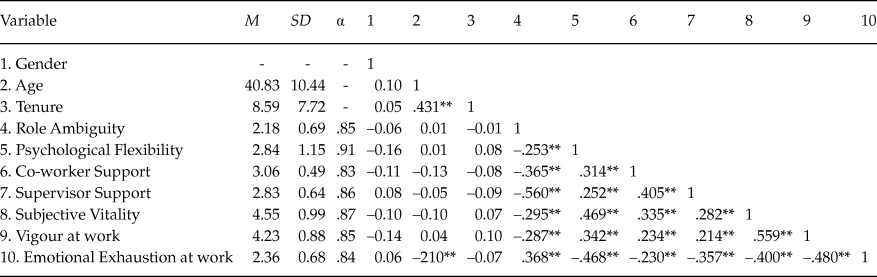
Bivariate correlations among the study variables and their Cronbach’s alphas are reported in Table 1. All measures used in the analyses had very good reliability coefficients (α ≥ .80). Correlations among variables were in the expected direction.
Means, Standard Deviations, Crombach’s Alphas and Bivariate Correlations (N = 196 nurses)

Notes: gender was coded as 1 = male; 2 = female.
** p < .01
Moreover, according to Cohen’s correlation guidelines (Cohen, Reference Cohen1988), these correlations had a small (.10 – .30) and medium size (.30 – .50). On the one hand, role ambiguity was significantly and negatively related to vigor at work (r = –.28, p < .01) and to subjective vitality (r = –.29, p < .01), and positively related to emotional exhaustion at work (r = .36, p < .01). Thus, Hypotheses 1a, 1b and 1c can be confirmed. On the other hand, co-worker and supervisor support were also significantly and positively related to vigor at work (r = .23, p < .01 and r = .21, p < .01, respectively) and to subjective vitality (r = .33, p < .01 and r = .28, p < .01, respectively), and negatively related to emotional exhaustion at work (r = –.23, p < .01 and r = –.35, p < .01, respectively). Therefore, Hypotheses 2a, 2b, 2c, 3a, 3b and 3c can be also confirmed. Finally, as can be seen in Table 1, psychological flexibility was significant and positively related to vigor at work (r = .34, p < .01) and to subjective vitality (r = .46, p < .01), and negatively related to emotional exhaustion at work (r = –.46, p < .01). Thus, Hypotheses 4a, 4b and 4c can be confirmed.
The regression and mediation analyses for each dependent variable are presented below.
Vigor at Work
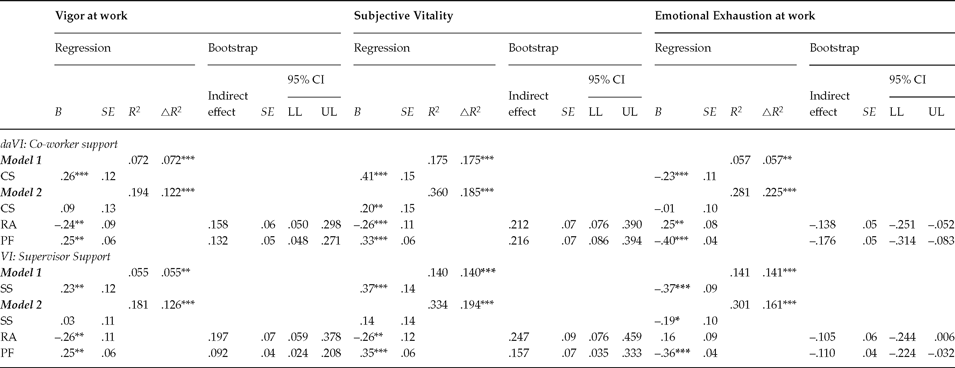
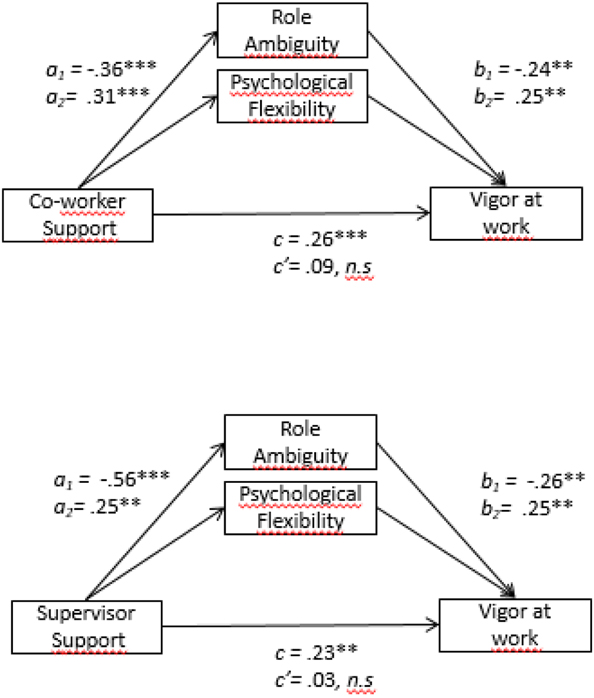
As can be noted in Table 2, in the case of vigor at work, co-worker support and supervisor support were significant variables in Model 1 (β = .26, p < .001 and β = .23, p < .01, respectively). Moreover, on the one hand, when the potential mediating variables were introduced in Model 2 (previously controlling for the variable co-worker support), role ambiguity and psychological flexibility were also shown to be explanatory variables of vigor (β = –.24, p < .01 and β = .25, p < .01, respectively). On the other hand, when these potential mediating variables were introduced, while previously controlling for the variable supervisor support, both of them were also predictor variables (β = –.26, p < .01 for role ambiguity; and β = .25, p < .01, for psychological flexibility). Moreover, note that both co-worker support and supervisor support ceased being explanatory variables when mediating variables were introduced in the regression equation, reflecting these potential mediating effects. The bootstrapping test for indirect effects showed that both role ambiguity and psychological flexibility played a mediating role (full mediation) in the relationships between co-worker and supervisor support and vigor at work (see Figure 1). Specifically, co-worker support was related to higher levels of vigor through role ambiguity (bootstrap mean = .158, 95% CI [.050, .298]), and psychological flexibility (bootstrap mean = .132, 95% CI [.048, .271]). The same could applied to the case of the supervisor support, which explained higher levels of vigor through role ambiguity (bootstrap mean = .197, 95% CI [.059, .378]) and psychological flexibility (bootstrap mean = .092, 95% CI [.024,.208]). Therefore, Hypotheses 5a, 6a, 7a and 8a can be confirmed.
Regression and Bootstrap Results for Vigor at Work, Subjective Vitality and Emotional Exhaustion at Work (N = 196 nurses)

Notes: CS = Co-worker Support; SS = Supervisor Support; RA = Role Ambiguity; PF = Psychological Flexibility; CI = Confidence Intervals.
In the table, the indirect effect indexes are presented for role ambiguity and psychological flexibility as mediating variables.
* p < .05, ** p < .01, *** p < .001.
Standardized Coefficients for the Proposed Mediational Model in the Case of Vigor at Work.
Notes: c is the total direct effect of the predictive variable on the criterion variable; c’ is the direct effect of the predictive variable on the criterion variable after controlling for the mediator.

Subjective Vitality
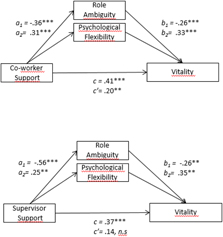
With regard to subjective vitality, as can be seen in Table 2, co-worker support and supervisor support were significant variables in Model 1 (β = .41, p < .001; β = .37, p < .001, respectively). When the potential mediating variables were introduced in Model 2 (previously controlling for co-worker support as above), role ambiguity and psychological flexibility were also significantly related to vitality (β = –.26, p <.001; β = .33, p < .001, respectively). However, in this case, co-worker support only reduced the intensity of its relation with vitality, but the significance of this relationship was not entirely lost. On another hand, when we previously controlled for supervisor support, both role ambiguity and psychological flexibility were predictor variables (β = –.26, p < .01; and β = .35, p < .001, respectively), and the significant effect of supervisor support on vitality was entirely lost. Testing the mediating effects, indirect effect estimators showed that both role ambiguity and psychological flexibility played a mediating role in the relationships between co-worker and supervisor support and subjective vitality (see Figure 2). Specifically, co-worker support was related to a higher level of vitality through role ambiguity (bootstrap mean = .212, 95% CI [.076, .390]), and psychological flexibility (bootstrap mean = .216, 95% CI [.086, .394]), showing a partial mediation. In the case of supervisor support, this could also explain higher levels of vitality through role ambiguity (bootstrap mean = .247, 95% CI [.076, .459]), and psychological flexibility (bootstrap mean = .157, 95% CI [.035, .333]), showing a full mediation. Therefore, Hypotheses 5b, 6b, 7b and 8b can be also confirmed.
Standardized Coefficients for the Proposed Mediational Model in the Case of Subjective Vitality.
Notes: c is the total direct effect of the predictive variable on the criterion variable; c’ is the direct effect of the predictive variable on the criterion variable after controlling for the mediator.

Emotional Exhaustion at Work
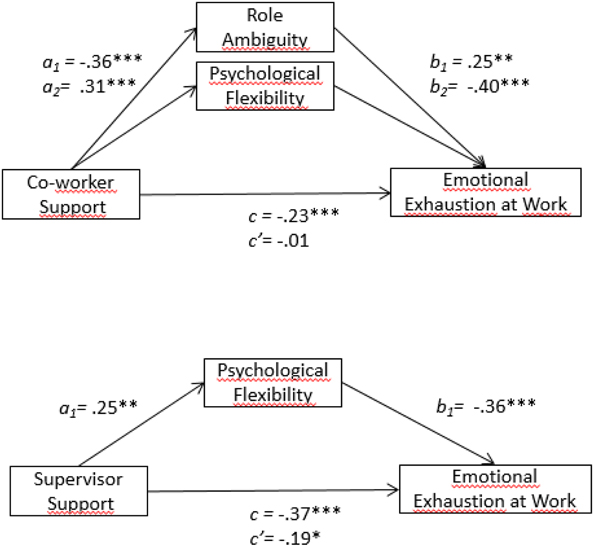
Finally, in the case of emotional exhaustion, co-worker support and supervisor support were also shown be significant variables when introduced in Model 1 (β = –.23, p < .001; β = –.37, p < .001; respectively). Moreover, when the potential mediating variables were introduced in Model 2, previously controlling for co-worker support, role ambiguity and psychological flexibility were significantly related to emotional exhaustion (β = .25, p < .01; β = –.40, p < .001; respectively), and co-worker support completely lost its significant effect.
On the other hand, when we previously controlled supervisor support, only psychological flexibility was predictor variable (β = –.36, p <.001), but not role ambiguity (β = .16, p >.05). Moreover, in this case, supervisor support did not completely lose its effect on emotional exhaustion when the potential mediating variables were entered into the regression equation (although it showed a significant decrease). Testing the mediating effects, indirect effect estimators showed that psychological flexibility played a mediating role in the relationships between co-worker and emotional exhaustion (bootstrap mean = –.176, 95% CI [–.314, –.083]; full mediation), and between supervisor support and emotional exhaustion (bootstrap mean = –.110, 95% CI [–.224, –.032]; partial mediation) (see Figure 3). Namely, co-worker and supervisor support were related to lower level of emotional exhaustion through psychological flexibility. Therefore, Hypotheses 7c and 8c could be confirm. However, role ambiguity showed only a mediating effect in the relationship between co-worker support and emotional exhaustion (full mediation) (bootstrap mean = –.138, 95% CI [–.251, –.052]), in line with Hypothesis 5c, but not in the relationship between supervisor support and exhaustion (bootstrap mean = –.105, 95% CI [–.244, .006]). Therefore, Hypothesis 6c could not be confirmed.
Standardized coefficients for the proposed mediational model in the case of Emotional Exhaustion at Work.
Notes: c is the total direct effect of the predictive variable on the criterion variable; c’ is the direct effect of the predictive variable on the criterion variable after controlling for the mediator.

Discussion
The aim of this study was analyze whether the relationships between social support at work and the nurses’ levels of energy and motivation could be explained through variables such as role ambiguity and psychological flexibility; that is, to determine the mediating effect of these latter two variables. Specifically, this study hypothesized that co-workers and supervisor support could to be associate with lower levels of role ambiguity and higher levels of psychological flexibility among workers, and as consequence, nurses could experience an improvement in their levels of vigor, vitality and emotional exhaustion in relation to their work.
Thus, this study contributes to the literature by exploring the underlying mechanisms that may explain the relationship between social support and energy and motivation within the healthcare organizational field, mechanisms which have not yet been extensively explored (Bakker & Demerouti, Reference Bakker and Demerouti2017). Moreover, this study also contributes to reinforcing the emerging area of research centered on the study of how healthcare work environments can be positive places for workers to grow and develop.
Overall, the results of this study showed that co-worker and supervisor support were related to higher levels of vigor at work and vitality, as well as with lower levels of emotional exhaustion among nurses. Moreover, in most cases, these relationships were completely and partially mediated by role ambiguity and nurses’ psychological flexibility. Thus, these results support and strengthen the conception of social support as a relevant job resource to explain workers’ levels of energy and motivation (de Jonge et al., Reference de Jonge, Le Blanc, Peeters and Noordam2008; Othman & Nasurdin, Reference Othman and Nasurdin2013). This could be due to the buffering effects of job resources, which can help to reduce job demands, and to their positive role in achieving workers’ personal and professional goals, as the JD-R theory points out when observing the functional role of job resources within its model (Bakker & Demerouti, Reference Bakker and Demerouti2017; Demerouti et al., Reference Demerouti, Bakker, Nachreiner and Schaufeli2001).
Specifically, role ambiguity, besides having a direct effect on levels of vigor and vitality, also emerged as a variable that mediated the relationship between co-worker and supervisor support and these levels of energy. However, in the case of emotional exhaustion, these direct and mediating effects were only produced in co-worker support, but not in supervisor support. These results can be explained due to the fact that co-workers and supervisors can offer formal and informal access to essential information to perform the work, reducing uncertainty, clarifying responsibilities, offering control to the workers and, basically, reducing role ambiguity (Brunetto et al., Reference Brunetto, Farr-Wharton and Shacklock2011; Coffey & Coleman, Reference Coffey and Coleman2001; Fernet et al., Reference Fernet, Austin and Vallerand2012; Zhou et al., Reference Zhou, Martinez, Ferreira and Rodrigues2016). If nurses feel supported by their working relations, they are likely to attend to these relations in order to resolve contradictory information, reduce uncertainty, and as a result, continue advancing toward their goals, which will lead to higher levels of engagement, energy and motivation at work. However, in the case of emotional exhaustion, it seems that the reduction of role ambiguity through supervisor support may not be sufficient to significantly reduce emotional exhaustion. This result is very interesting, as it would be in the line of studies that emphasize the need to study separately the effects of co-worker and supervisor support, as they may not have the same effects on energy and motivation (Willemse, de Jonge, Smit, Depla, & Pot, Reference Willemse, de Jonge, Smit, Depla and Pot2012). In this particular case, supervisor support could be associated with a lower role ambiguity, but this was not considered sufficiently significant to decrease nurses’ emotional exhaustion, as this could be explained by other factors present in the work environment, including the type of the relationship between worker and supervisor.
As regards psychological flexibility, it also had a direct effect on nurses’ levels of energy and motivation. Thus, the workers who accept their negative internal events and whose behaviors are guided by their own values and personal goals (rather than by experiential avoidance) may feel higher levels of vigor at work and vitality, as well as lower levels of emotional exhaustion (Losa Iglesias et al., Reference Losa Iglesias, de Bengoa Vallejo and Salvadores Fuentes2010; Onwezen et al., Reference Onwezen, van Veldhoven and Biron2014). This is probably due to the fact that emotional regulation strategies or coping styles based on emotional acceptance (e.g., psychological flexibility) consume less cognitive, emotional and energetic resources than other coping strategies based on emotional control (Alberts et al., Reference Alberts, Schneider and Martijn2012), and also because when professionals behave consistently with their values and goals, they may experience higher well-being, personal agency, and vitality (Ryan & Frederick, Reference Ryan and Frederick1997). Moreover, nurses’ psychological flexibility was shown to mediate all the relationships in this study. Thus, results indicate that both co-worker and supervisor support can be associated with this personal resource and, as a result, to lead to higher levels of energy and motivation among nurses. This may be due to the emotional and instrumental function of social support. Co-workers and supervisors can help workers to develop and increase their ability to carry on despite difficulties (e.g., situations and negative internal events). They can also help to cope with a situation actively, reframe difficult situations, and finally offer alternative perspectives of situations that employees are experiencing (Feeney & Collins, Reference Feeney and Collins2015; Hobfoll, Reference Hobfoll2002). In addition, co-workers and supervisors can offer emotional support that shows that they will be there despite difficulties, and provide opportunities to get in touch with the present moment (Feeney & Collins, Reference Feeney and Collins2015). All this would allow workers to feel more engaged with their work, with higher levels of energy and motivation, because they would ultimately have more successful experiences when facing negative situations, thanks to the presence of job resources that they can find within their own work setting, such as co-worker and supervisor support.
The present study has some limitations. Firstly, it is a cross-sectional study, which precludes the establishment of causal relations. In this sense, the mediation analyses described here are subject to certain biases. Namely, the results achieved should be interpreted only as associations, and therefore, cause-effect relationships cannot be inferred. Moreover, many other unknown factors could be explaining the variations of the criteria variables of this study. Thus, it is recommend future research to examine the causality of such relationships in more detail in order to reach more reliable and firm conclusions. For example, the results of this study will need to be tested by longitudinal studies, such as diary studies, where it could determine whether the relationships observed in this study vary during the week depending on daily variations in social support levels at work. The predictor, mediator and criteria variables should be evaluated at different time points. Secondly, in this study was measured all data with self-report measures, which raise concerns about common-method variance. However, the self-report nature of the study is essential, given that appraisals of affective experiences are fundamental. Finally, participants in this study were predominantly women and they perceived that social resources and their consequences could vary by gender. Nevertheless, the overrepresentation of the female gender in nursing is well known. Future studies should try to replicate the results with a representative sample of males and females and using other occupational samples.
The main conclusion of this study is that social support in nursing is a positive and relevant job resource which is related with higher levels of energy and motivation among workers though its association with lower levels of role ambiguity and higher levels of psychological flexibility. From these results, it can been establish a clear practical implication: Health and well-being promotion campaigns and policies within healthcare organizations should consider proposals aimed at increasing social support among workers (especially among the most vulnerable), fostering group cohesion, team spirit, and a person-centered leadership style that offers emotional and instrumental support to workers and allows them to better deal with daily work difficulties. Thus, this aim would be alignment with the Global Humanization Strategy within healthcare services, which has not only established that care for patients must be redirected towards more humane care, but also that health organizations should also care for their workers, paying attention to their personal and social well-being, exploring and enhancing the variables that can explain this well-being. In addition, the establishment of work relations based on respect, trust, collaboration and help among colleagues and supervisors is not only crucial for the prevention of stress situations or to improve workers’ strengths, but it also contributes to generate healthy medical organizations, free from violence and anti-social behaviors among their members, a growing problem that deserves psychosocial prevention actions.