Western redcedar (Thuja plicata) is known as the “tree of life” to many First Nations on the Northwest Coast of North America (Pojar and Mackinnon Reference Pojar and Mackinnon1994). It was one of the most commonly used plant species in many areas of coastal British Columbia (BC); its wood, bark, branches, and roots were used for a wide variety of purposes ranging from canoes to house posts to textiles (Garibaldi and Turner Reference Garibaldi and Turner2004; Stewart Reference Stewart1984). Each cedar-harvesting event leaves extraction scars, now found throughout the temperate rain forests of the Northwest Coast. These scars persist in the landscape as culturally modified trees (CMTs), representing an enduring and prolific record of peeling, planking, and felling activities. Cedar trees have a remarkable ability to preserve for centuries after modification and, using dendrochronology methods and tree-ring data, can be dated to the resolution of a single calendar year. Yellow cedar (Chamaecyparis nootkatensis), although rarer, was also used and can also be dated using the same dendrochronology methods.
There is a growing archive of dated cedar CMT samples in BC, closely linked to industrial forestry operations occurring in coastal old-growth forests. The majority of the recorded dates associated with tree modification in BC represent the last 300 years of human forest activities, revealing temporally and spatially significant frequencies in harvesting. This range, however, fails to capture the fuller life history of cedar trees found in old-growth stands that commonly live to be 500 years of age or older. Older cultural features are thought to eventually become obscured by natural healing processes and senescence before they reach ages older than 300 years (Mobley and Eldridge Reference Mobley and Eldridge1992; Pegg Reference Pegg2000; Stryd and Eldridge Reference Stryd and Eldridge1993).
In this study, I recover CMT chronologies of cultural-harvesting events from old-growth clear-cuts on the west coast of Vancouver Island. I present the results of post-impact assessments (PIAs) of recently logged industrial cut blocks where bark-harvesting scars are more visible in stump cross sections (rather than on standing trees). Results reflect a larger temporal distribution of bark-harvesting dates in the region—and include one stump with an exposed 1,108-year-old cultural-harvest scar. These findings show that CMTs older than 300 years are significantly underrepresented in BC provincial archaeological assessments, due primarily to a survey bias of assessing standing forests prior to development, which has notable implications for both the protection and conservation of archaeological heritage and old-growth forests. Furthermore, resolving this bias may also bolster First Nations title to traditional territories.
Background on CMTs of the Northwest Coast
Protections
Any tree that has been modified by Indigenous Peoples as part of a traditional way of life is considered a CMT (BC Archaeology Branch 2001 [1998]). Trees altered by non-Indigenous people in historic times may also be considered CMTs; however, Northwest Coast archaeological vernacular suggests Indigenous use. Such features were once found worldwide (Turner et al. Reference Turner, Ari, Berkes, Davidson-Hunt, Fusun Ertug and Miller2009); however, surviving old-growth forests with preserved evidence of use are now rare. Though heavily impacted by industrial logging, the Northwest Coast is still home to ancient forests brimming with CMTs, the majority of which are cedar.
Recording and conservation standards for CMTs in both Canada and the United States began around the early 1980s as awareness of their existence grew. For example, projects in Gifford Pinchot National Forest in Washington (Mack Reference Mack1996) and Tongass National Forest in Alaska helped spread knowledge of CMTs to an American audience (outlined in Mobley and Eldridge Reference Mobley and Eldridge1992). In the United States, they can be registered for protection under the National Register of Historic Places, though only stands with multiple features (often associated with other cultural resources) may be eligible for protection. In both Alaska and Washington, protections are laid out under a variety of state and federal laws that protect archaeological and cultural features in the national registry and similar state registries: the Alaska Heritage Resources Survey (ADNR-OHA 2016) and Washington's Department of Archaeology and Historic Preservation (DAHP 2009). In BC, the logging industry's extensive impact on coastal forests and Indigenous heritage (specifically in Clayoquot Sound, Vancouver Island) drew public concern about CMTs and led to early studies into features distribution and typology (Arcas Associates Reference Associates1986; Bernick Reference Bernick1984; Eldridge and Eldridge Reference Eldridge and Eldridge1988). Standards and guidelines for CMT recording in BC were in place by the 1990s (BC Archaeology Branch 2001 [1998]) and are generally more thorough than in nearby states such as Washington and Alaska, as are the heritage protections of CMTs.
In BC, all archaeological sites predating AD 1846 are protected by the Heritage Conservation Act (HCA; BC Archaeology Branch 1996). This date is perceived by Canadian courts as marking British sovereignty in BC following the Oregon Treaty and establishment of an international border along the 49th parallel between British North America and the United States. The HCA, along with other policies, agreements, and operational procedures from the Ministry of Forests, Lands, Natural Resource Operations and Natural Development also protect CMT features thought to predate AD 1846 (BC Archaeology Branch 1996, 2017; BC Government 1995, 1996). Archaeological impact assessments (AIAs) of CMT features typically involve field inventories of visible cultural scars on standing trees, stumps, and worked-log sections. Site alteration permits (SAPs) are legally required for development to continue in areas assessed to contain archaeological features.
Fueled by the spread of old-growth logging in remote regions along the coast, recorded CMT sites have multiplied and are now the most common archaeological site type in BC. Visible CMT features (often with tool marks) are recorded in standing forests, and those thought to predate 1846 are often excluded from proposed cut-block boundaries in order to protect them from industrial timber-harvesting activities. However, SAPs are commonly granted for CMT sites. In these instances, CMTs are felled and a percentage of the cultural features (or nurse trees growing atop the features) are dated with disk samples (calculated as in Muir and Moon Reference Muir and Moon2000). These salvaged dates are then summarized in associated “site alteration reports” archived in the BC Archaeology Branch Site Registry.
Identification of CMTs
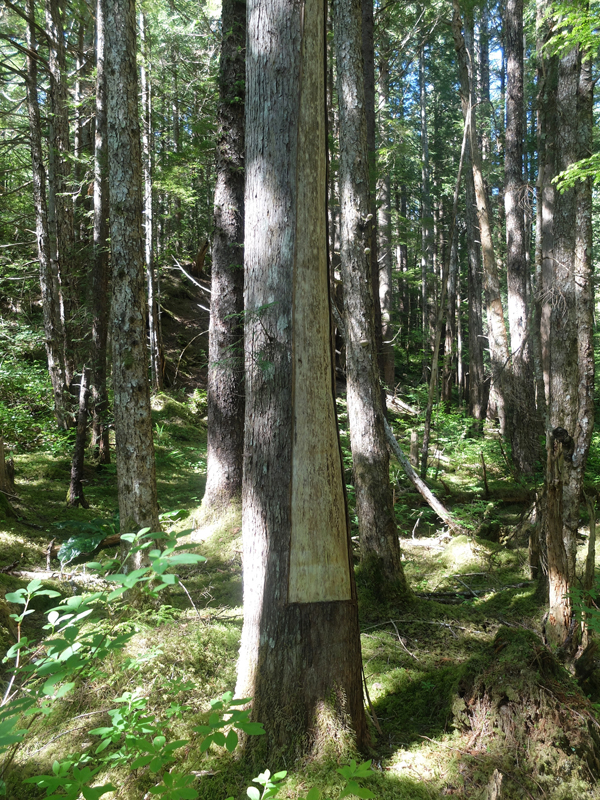
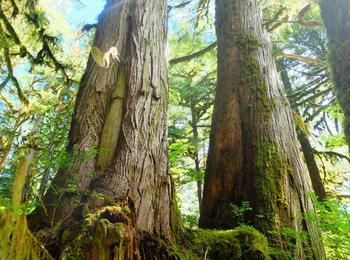
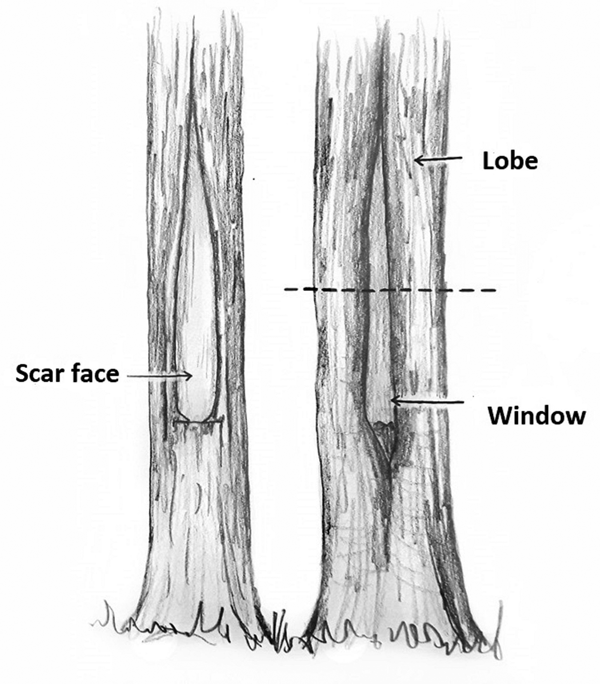
The types of CMTs that appear in coastal forests vary across the Northwest Coast. Traditional Indigenous logging features may cluster in the form of stumps, the remnants of canoe or plank manufacturing, or as standing trees associated with plank removal and “test holes” (incisions made into the trunk to test the quality of a tree) and are commonly associated with shorelines or navigable rivers. Often these features have distinct shapes and clear tool marks. The most common CMT type is the bark-strip scar, which is either tapered (Figure 1) or rectangular (Figure 2), a reflection of the ubiquitous use of cedar bark in almost all aspects of Northwest Coast lifeways. The more common tapered bark strips are cut along a horizontal section of bark at the base of a young tree, then pried off with a stick or digging tool and peeled upward until it narrows to a point at which it may be torn off. The inner bark was separated from the outer bark and often transported to the village for further processing. Rectangular bark strips (cut at the base and top of the extraction area) are most often found on the central and northern Northwest Coast. All cultural bark-strip features may retain the tool marks of chisels and axes used to make the initial cut on the bark. Older, weathered tool marks may disappear or become obscured, though, leaving archaeologists to interpret growth patterns suggestive of cultural origins, such as the height of the base of the scar above the ground, the shape of the healing lobes (vertically swelled trunk, which helps the tree compartmentalize the injury), and symmetrical scar crusts (Arcas Associates Reference Associates1986:188; BC Archaeology Branch 2001 [1998]:28). The scar crust is a flat black scar running the length of the original bark peel, created as the annual rings of the tree advance over the recently exposed cambium layer on the scar face (Figures 3 and 4). In many instances, the extraction of disk or wedge samples from these features allows for better visibility and confirmation of these inner growth patterns, including scar-crust development and expanded ring growth on lobe areas following the year of injury.
A recent western redcedar tapered bark strip, estimated to be about three years old. Photograph by Jacob K. Earnshaw.

Examples of rectangular bark strips (cut at top and bottom of extracted bark). Note open-face scar on the left and embedded to the right. Photograph by Jacob K. Earnshaw.

Illustration of a recent and mature tapered bark-strip healing process in profile (see Figure 4 for dotted line cross section).

Healing process of a tapered bark strip in cross section, redrawn by author from BC CMT handbook (BC Archaeology Branch 2001 [1998]:23–24).

Several natural forces may occasionally mimic the outward appearance of a cultural bark peel. Examples include bear “peeling,” rock and tree falls, broken branches, and ground fires. These noncultural forces, however, rarely re-create convincing features in profile and have very different healing patterns in cross section (see Arcas Associates Reference Associates1986; Earnshaw Reference Earnshaw2016).
CMT recording over the last two decades has grown exponentially within coastal BC due to heightened standards for cultural heritage protections combined with continued old-growth logging. The temporal data retrieved following the sanctioned removal of CMTs, through the “site alteration process,” is gradually growing and largely unanalyzed. Today, the vast majority of research involving CMTs is limited in scope and contained within the gray literature of private consulting projects. Notable exceptions exist (see Angelbeck Reference Angelbeck, O'Faircheallaigh and Ali2008; Mack Reference Mack1996; Mobley and Eldridge Reference Mobley and Eldridge1992; Mobley and Lewis Reference Mobley and Lewis2009; Oliver Reference Oliver2007; Pegg Reference Pegg2000; Stafford and Maxwell Reference Stafford and Maxwell2006; Stryd and Eldridge Reference Stryd and Eldridge1993), but very few CMT studies delve into temporal or spatial questions beyond the immediate scope and budget of proposed developments impacting cultural forests.
Despite this lack of study, there is great potential for developing research foci involving CMTs across all Northwest Coast forests. Without the aid of written documents prior to European arrival, piecing together local prehistories can be difficult. Most archaeological data produce important but relatively coarse chronologies spanning broad periods of time, while the growing use of oral histories relates events that may also be difficult to sequence in time. Martindale (Reference Martindale2006) and McKechnie (Reference McKechnie2015) discuss combining archaeological data and oral histories on the Northwest Coast and provide examples of how these forms of scholarship may complement or complicate each other. The addition of CMT data contributes a prolific, temporally and spatially specific dataset that spans the modern era to generations before European contact. CMT chronologies paired with oral and archaeological data may anchor events in time and provide clarity to larger historical questions. For example, CMT harvesting trends and densities have been tied to demographic changes associated with contact-era epidemics and intertribal wars (Pegg Reference Pegg2000), competitive potlatching events and boundaries of resource ownership (Eldridge and Eldridge Reference Eldridge and Eldridge1988), trail networks and sustainable forest-management practices (Eldridge Reference Eldridge2017), berry-harvesting sites (Mack Reference Mack1996), and culturally important spiritual sites (Stafford and Maxwell Reference Stafford and Maxwell2006).
Though there are a great many CMTs in the landscape, their interpretive value is limited by their recorded distribution. Most CMT sampling strategies are intimately tied to industrial logging, which produces a relatively thin and patchy dispersal of dated CMT samples. Compounding this methodological sampling issue, large areas logged for over a century prior to CMT protections were removed without recording or salvaging data of any kind. Those that are recorded today are largely within proposed cut-block areas, although many archaeologists working on the Northwest Coast attest to the ubiquity of CMTs beyond arbitrary development boundaries. Another interpretive limitation is the dearth of older features in regional CMT chronologies. Therefore, there is obvious analytical value for a deeper chronology on a larger spatial scale.
Degradation of the Record
Shallow time depth is a generally accepted limitation in the use of CMT chronologies derived from externally visible cultural scars on standing trees. As living trees heal over the scars from cultural-harvesting events, the visibility of CMTs is reduced, making identification difficult. This is illustrated in a study by Pegg (Reference Pegg2000), who analyzed CMT chronologies of all recorded dates within two regions of Nuu-chah-nulth territory. Harvesting frequencies suggest discrete trends in the sociopolitical and demographic life of local Nuu-chah-nulth Peoples during and after the contact period (AD 1780–1900). Time periods of disease and conflict had notable troughs in harvesting-event frequencies compared with the more active harvesting associated with the growth in ceremonial activity and wealth of the late eighteenth and nineteenth centuries. Despite these peaks in harvesting, the CMT chronologies document the use of landscapes that were suffering catastrophic demographic decline throughout the contact period (Boyd Reference Boyd, Suttles and Sturtevant1990). When regional populations were at their highest, prior to the contact period, fewer CMTs are visible in the archaeological record (PARL 2018; RAAD 2018). This is not due to a lack of cedar harvesting, but rather is a function of taphonomic degradation over time. As is the general problem in archaeology, older sites are usually poorly preserved and thus generally have less visibility and representation in the archaeological record. This biases practically any existing CMT chronology to underrepresent older cultural features. Based on these biased data, it would appear that CMTs predating the contact period are rare.
Daniels and colleagues (Reference Daniels, Marshall, Carter and Klinka1995) suggest that the average age of western redcedars in old-growth forests near Vancouver Island ranges from 294 to 504 years old. Despite this estimate, CMTs in the nearby study region span only the last three centuries, averaging only about 150 years old. Although cedars will usually be harvested several decades following germination, why is there still no comparable age range of CMT dates? The redcedar forests on the west coast of Washington State's Olympic range (southwest of the study region) have been largely fire free for the last 1,000 years, suggesting potential for a great antiquity of individual trees. In fact, many of these trees date to 1,500 years old (Van Pelt Reference Van Pelt2007:92–93). The oldest previously recorded redcedar in the study area is located in Ditidaht territory and was dated to at least 1,212 years (Stoltmann Reference Stoltmann1993).
While many nursing trees growing atop ancient Indigenous logging features in BC are dated to the fifteenth and sixteenth centuries (RAAD 2018), it is the more ubiquitous bark-peeling features that have the greatest potential for answering questions spanning a greater temporal range. This is because cedars peeled at a relatively young age will continue to grow for many centuries and often preserve their scarred features within inner heartwood. Following death and senescence, and in the right conditions, many cedar snags will continue to persist for centuries more (Daniels et al. Reference Daniels, Dobry, Klinka and Feller1997).
Embedded Scars
A long-standing issue with the identification of older bark-strip scars in archaeological assessments is the presence of embedded bark-harvesting scars. Cedar is an incredibly resilient species, capable of compartmentalizing injuries so effectively as to completely heal over and obscure the scar in a standing tree. In a study of CMTs on Meares Island in Clayoquot Sound, Vancouver Island, consultants working for Arcas Associates (Reference Associates1986) inadvertently noted the appearance of embedded scars. While taking wedge samples from trees for dating purposes, they also observed older scars hidden within more recent healing lobes. The concern of the researchers was that
there must be an undetermined number of other internal scars in the sampled population. Not only could there be additional internal scars in the trees that had wedge samples removed, but there must be hidden scars on trees not even sampled. The result of these hidden scars is that any estimate of total numbers of bark-strip features in a population will be conservative if it is based only on external scars [Arcas Associates Reference Associates1986:99].
These embedded scars are only identifiable in cross section (after logging) and often practically invisible in standing forests (see Figure 2). Many internal scars are only discovered inside disk samples from trees that also had open-faced cultural scars. Others are discovered accidentally following revisits to recorded CMT sites after the stand is felled. PIAs are rare because they are usually not a requirement in a typical AIA process. Occasional PIAs that are conducted produce very old dates from embedded bark-strip features. For example, stump cross sections were assessed during the Newcastle Island CMT study (northeast Vancouver Island) by Eldridge and Eldridge (Reference Eldridge and Eldridge1988:36) and an embedded scar dating to AD 1467 was found. During a post-logging assessment of the Julia Passage site (Barkley Sound, Vancouver Island), Eldridge (Reference Eldridge1997) identified what had been the longest-living CMT recorded at the time in the form of another embedded scar dating to AD 1137.
Methods
Using Post-Impact Assessment Studies to Create Culturally Modified Tree Chronologies
This study utilizes PIAs of clear-cuts to effectively collect CMT dates in cross section for the creation of CMT chronologies within the traditional territories of three central and southern Nuu-chah-nulth nations (Toquaht, Ditidaht, and Pacheedaht).
PIAs are currently rarely undertaken in BC. There is no regular auditing system that actively oversees or monitors provincially registered CMT sites after logging activity. Therefore, the surveys of this study may be considered an informal audit of the effects of logging activities on CMT stands. As such, within particular clear-cut landscapes, I produced a record of almost all bark-strip features visible in cross section, including those overlooked during traditional AIAs.
Study Sites
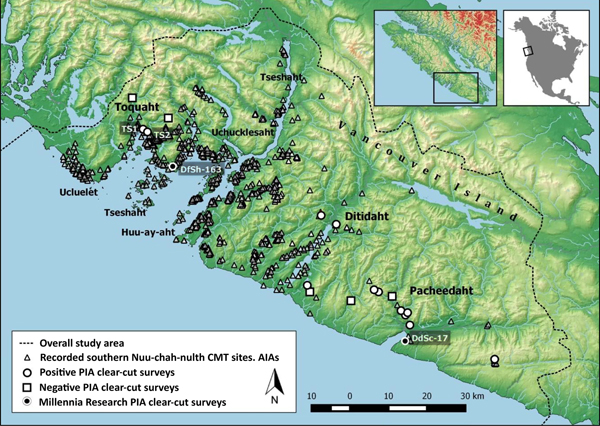
The areas surveyed for this study are located within Nuu-chah-nulth traditional territories on Vancouver Island's west coast (Figure 5). To date, over 2,400 forest utilization sites have been recorded across all Nuu-chah-nulth nations, containing in excess of 53,000 individual CMTs. At least 20% of all recorded features in this area have been impacted by logging activities through the site alteration process, resulting in the collection of about 2,500 dated samples that are available in the BC Archaeology Branch Site Registry (Earnshaw Reference Earnshaw2017:4; RAAD 2018). An empirical assessment was made of the CMT data that had previously been extracted from the central and southern Nuu-chah-nulth First Nations (excluding the Makah of Washington State's Olympic Peninsula): Ucluelet, Toquaht, Uchucklesaht, Tseshaht, Huu-ay-aht, Ditidaht, and Pacheedaht (other “central” Nuu-chah-nulth nations to the northwest of Barkley Sound were not included in this study sample). The region was chosen due to its relative ease of access and abundance of recorded bark-stripping CMT sites. The archive of 610 dates from this sub-region were collected for inclusion in the study. PIA field surveys of clear-cuts to collect additional dates were performed within the Toquaht, Ditidaht, and Pacheedaht nations.
Overall study area with regional CMT sites and PIAs discussed in text. The apparent lack of sites to the east is the result of extensive logging prior to CMT protections.

Sampling Strategy
Seventeen sites were surveyed across these three Nuu-chah-nulth territories between the summers of 2014 and 2015. The sampling strategy involved visiting old-growth cedar cut blocks logged within the last 10 years. Eight surveys were undertaken within 0.5 km of recorded CMT sites (often within or adjacent to sites). Another nine surveys were undertaken in arbitrary clear-cuts at varied distances from the shoreline without any known archaeological associations. This facilitated a sampling of potential bark-stripping scars that might have been overlooked in standing forest archaeological assessments. Due to time restraints, each survey was limited to observations of 100 cedar stumps, though, if CMTs were identified, some surveys would continue past this number. Stumps were inspected, and cultural features, if present, were recorded. Survey transects were roughly 15 m apart, and stumps with cultural features were cleaned with bristle brushes, measured, mapped, and photographed.Footnote 1
Confidence in cultural origins (versus a natural scarring process) was recorded in the field and reassessed in the lab and from photographs. Characteristics measured included presence of scar crust, increased ring growth following a peeling event, scar aspect relative to the terrain, circumference of a scar face around an original tree stem, perpendicular termination of rings at the scar crust, and whether other scars were noted on the same tree or nearby. Confidence was rated on the quantity and quality of these individual traits within each tree.Footnote 2 No low-confidence features were used in subsequent dating and analysis (Earnshaw Reference Earnshaw2016).
Dendrochronology methods were an adaptation of those suggested in the “CMTs of BC Handbook” (BC Archaeology Branch 2001 [1998]). Most cultural scars could be dated by counting the annual rings on stumps in the field rather than taking disk samples, with three crew members each taking independent ring counts and averaging the results. Specimens with ambiguous or microscopic rings were core sampled using a battery-powered circular saw. Samples were then mounted, dried, bisected by sanding, and counted later. All dates are minimum ages with various ranges of error dependent on degree of rot in some samples (e.g., samples with localized rot between scar crust and outer lobe rings), clarity of rings on features, and possibility of missing rings. Other CMT studies (Mack Reference Mack1996; Mobley and Lewis Reference Mobley and Lewis2009) noted that ring deformation and stress compaction caused uneven ring counts between wedge samples of healing lobes. This would suggest that even “exact” counts may be missing rings. As such, only the minimum age of each sample was used for comparisons made in the discussion.
Results
All eight (100%) surveyed clear-cuts near (<0.5 km) previously recorded CMT sites were found to contain additional undocumented and thus recently destroyed pre-1846 CMTs. Among the site surveys not associated (>0.5 km) with known cultural sites, four (45%) contained undocumented and destroyed pre-1846 CMTs. Of all newly identified CMT sites with previously unidentified features, 100% of them have some number of embedded cultural scars. In total, 12 positive CMT sites were located containing a total of 79 previously unrecorded CMTs (e.g., Figure 6). Most stumps were dated, some with multiple cultural scars, returning 85 confident bark-harvesting dates. One undated CMT stump in Pacheedaht territory was found to have a minimum of nine independent harvesting episodes (mostly embedded) from which the tree continually recovered. These findings suggest that the AIA process in BC is severely underprotecting CMT sites, in some areas by more than 50%.
TS1. Note the previous AIA-recorded CMT site (black polygons and triangles) and the unrecorded CMTs identified during PIA (white triangles).

Ancient Culturally Modified Forests
CMT dates were recorded in all the positive clear-cut surveys. Many features were found to date considerably older than those of nearby CMTs recorded during an AIA. The oldest CMT features were found in the traditional territory of the Toquaht Nation, at the northwest end of Barkley Sound. The Toquaht were once the dominant cultural group in the region, thought to have been the group from which all others originated (Sproat Reference Sproat1868:19; St. Claire Reference St. Claire, Arima, St. Claire, Clamhouse, Edgar, Jones and Thomas1991:53). The contact and later colonial periods were particularly devastating for Indigenous peoples in BC. A decline in Toquaht influence following a series of introduced epidemics, territorial disputes, and other conflicts reduced their population to a small but resilient group in a corner of Barkley Sound that has regained importance in recent years (McMillan Reference McMillan1999).
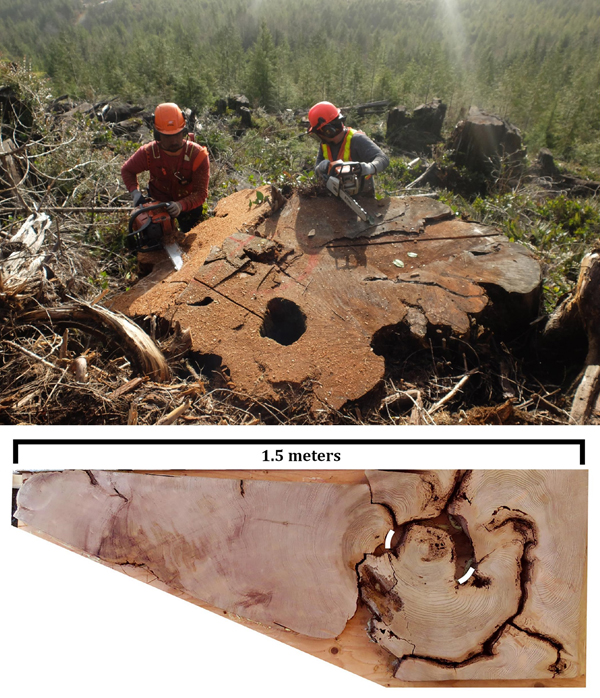
The sites containing the most ancient cultural features, Toquaht Survey 1 (TS1/DgSh-62) and Toquaht Survey 2 (TS2), were accessed on the recommendation of Toquaht foresters working in the area. TS1, 1.3 km inland and at a 200 m elevation on the northeast shore of Toquart Bay in Barkley Sound, was a recorded archaeological site (DgSh-62) containing 18 previously recorded CMTs. Fifteen additional CMTs were discovered during our PIA with features ranging from AD 1415 to AD 1857. A particularly old cultural scar was found at this site within a massive western redcedar stump (3 m diameter) with fully intact heartwood (Figure 7). At its center was a single bark-strip scar dating to AD 903 (1,108 years old). The tree itself was at least 1,165 years old at the time of felling in 2011, meaning it was approximately 57 years old when first bark harvested. This tree is the oldest recorded CMT in the Americas and the longest-living CMT ever recorded.
CMT TS1-17; upper image showing sample extraction of 1,108-year-old CMT. Note white marks positioning intact scar crusts in lower image. Photograph by Jacob K. Earnshaw.

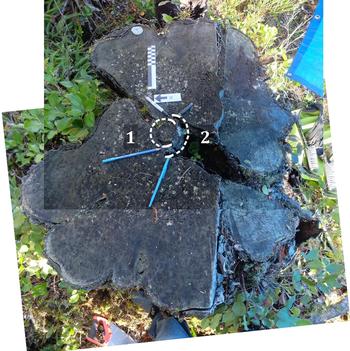
TS2 was near the modern shoreline 1 km downhill and to the south of TS1. The second Toquaht survey contained seven previously unrecorded CMTs dating from AD 1379 to AD 1667. Several of the features contained multiple cultural scars, suggesting that the trees were successively harvested over their lifetimes for bark (e.g., Figure 8). Though the recorded CMTs are now stumps, they are direct evidence of one of the oldest human-managed forests ever recorded.
Pens indicate embedded scar crusts on twice bark-harvested western redcedar in TS2. Note initial bark harvest on left, with backside of young CMT harvested about 40 years later on right (scar faces indicated with white dotted lines). Minimum harvest dates are AD 1649 and AD 1609. Photograph by Jacob K. Earnshaw.

Discussion
PIA versus AIA Chronologies
The 85 post-impact dates, combined with an additional 33 dates (n = 118) from other incidental PIAs of clear-cut CMT sites in the same region (Owens Reference Owens2007; Ramsay Reference Ramsay2013), were compared against the chronologies derived from sites following conventional AIAs in southern Nuu-chah-nulth territories (n = 610 exact or “circa” dates). This comparison group consists exclusively of dated CMTs identified in profile in standing forests during conventional archaeological surveys and then logged following the successful disbursement of an SAP (no dates in this control sample are known to have derived from CMTs first identified during a PIA).
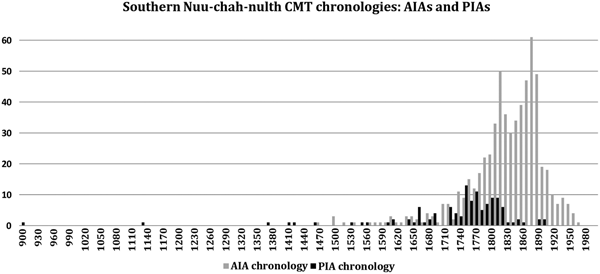
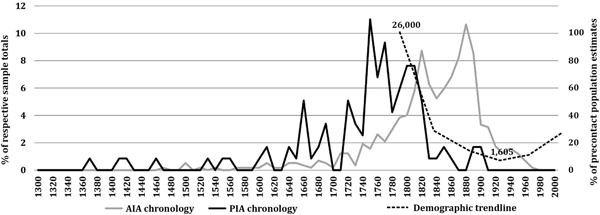
The post-impact derived date distributions of harvest events from embedded and other overlooked cultural scars average about 80 years earlier than those in the AIA sample (Figure 9). Excluding the two oldest and two youngest outliers from both samples, the AIA CMT dates average AD 1849 (SD = 71.54), while PIAs averaged AD 1769 (SD = 132.74). In the context of the local history of the southernmost Nuu-chah-nulth territories, the post-impact dates collected from clear-cuts reveal higher frequencies of bark-harvesting events generations before political upheaval, disease, and war following European contact (Figure 10Footnote 3).
Southern Nuu-chah-nulth AIA and PIA chronologies comparison.

Percentage of each southern Nuu-chah-nulth CMT sample totals (post-AD 1300) shown with Nuu-chah-nulth population estimates.

Previous CMT chronological studies (Mack Reference Mack1996; Pegg Reference Pegg2000) found that the majority of cedar-harvesting dates occurred during a period associated with declines of First Nations populations on the Northwest Coast. This seemingly contradictory pattern suggests a temporal bias that makes interpretations of harvesting trends during the contact period difficult, if not fully distorted. Thus, frequencies of harvesting events in datasets derived only through status quo standing tree AIA methods are partially an artifact of sampling methodology rather than historical fact. This distortion would be particularly true in areas of the chronology experiencing the most bias. At one end of the spectrum is a temporal bias resulting from deterioration and obstruction of older scars. On the other, biases are a mix of acculturation and changing harvesting location (e.g., road access), as well as a lack of protections or incentives for archaeologists to record recent (i.e., contemporary) scars. While clearly not eradicating the forces of mortality and decomposition, the introduction of PIA methods helps to redress the antiquity bias. Post-impact surveys reveal the highest frequencies of harvesting in the study area are clustered in the mid-1700s, aligning with high precontact Nuu-chah-nulth population estimates. Notably, 60% of dates in the PIA dataset predate the year of full European contact in the region (AD 1778, the date of Captain James Cook's arrival and landing on Vancouver Island), compared to only 14% of the AIA dates.
In the context of global CMT studies, the ancient Toquaht cedar (see Figure 7) is the longest-lived CMT ever recorded. It is, however, second in terms of absolute antiquity to a sub-fossil pine CMT found preserved in a Swedish peat bog (Ostlund et al. Reference Ostlund, Bergman and Zachrisson2004), which was harvested in about 2750 BP for its cambium by Sami Peoples of northern Scandinavia. This means western redcedar as a species is not unique in its record of ancient use. However, it does stand out in its unparalleled potential for study due to its long life span, generally good natural preservation, expansive range, and status as a vitally important cultural keystone species (Garibaldi and Turner Reference Garibaldi and Turner2004).
More robust regional sampling of these CMT features could open the door to their use in regional demographic studies, tracking cultural site usage, migrations, and the arrival of European-introduced epidemics. These spatially and temporally anchored observations may be useful in situating trails, understanding uses of interior forests, and leading descendant communities to ancient forest utilization areas. Temporally precise and accurate CMT chronologies are particularly valuable to BC Indigenous communities who may use these data to (re)gain land title to ancestral territories by empirically demonstrating occupation of the land during the precontact period (Earnshaw Reference Earnshaw2017). Based on the findings of this case study, I hypothesize the majority of the existing cedar CMT archive, documenting traditional Indigenous forestry practices for at least the last half millennium, lies hidden and unrecorded within standing old-growth forests or is exposed but overlooked in industrial clear-cuts.
Conclusion
The results of this study suggest that CMT features survive over a great period of time, paralleling the full life span of cedars within many old-growth forests of the Northwest Coast. The discovery of the AD 903 CMT in Toquaht territory along with other ancient features in this study's sample show the effectiveness of PIA surveys in uncovering CMTs, which in many instances may be up to a millennium or more in age. Additionally, these results suggest that CMTs are under-recorded during conventional archaeological assessments due to a systemic survey bias of standing trees. An implication of this is that CMTs and cultural forests are likely far more widespread than currently known or imagined by most. This is particularly notable in BC, where there are already thousands of CMTs added to the provincial archaeological database annually (RAAD 2018) despite a demonstrably biased AIA survey methodology. Moreover, it is also significant on a broader scale. The Northwest Coast states of Alaska and Washington have strangely few recorded CMT sites in comparison to BC, let alone recorded CMTs with embedded scars. Nuu-chah-nulth territories on Vancouver Island's west coast have almost double the number of recorded archaeological sites containing CMTs than are recorded in the state registries of Alaska and Washington combined.Footnote 4 Since both states share considerable temperate rain forest, cedar range, and Indigenous cultures with those found in BC, I hypothesize that the sparse record of CMTs in these neighboring regions is a function of systemic methodological bias and partial heritage protections rather than genuinely different CMT distributions.
By including these now accessible and observable data from embedded and degraded CMT scars exposed in clear-cuts, we may substantially increase the potential for chronological study of CMTs. Additionally, this method creates an exceptional opportunity for historic and archaeological research on the Northwest Coast, because these fine-grained harvesting chronologies are a means of corroborating oral traditions and inferring more accurate historical harvesting trends generations prior to the contact period.
Ironically, it is the destruction of these forests through clear-cut logging that unexpectedly enables a postmortem identification of their heritage value. While the PIA method reveals the most ancient and embedded cultural scars in cross section, persistent logging of old-growth forests on the Northwest Coast continues to be a concern for those interested in the preservation of threatened cultural forests and associated ecosystems. Although some CMT data are recoverable for several years following logging, the long-term effect of industrial forestry in BC and the Northwest Coast more broadly continues as an erasure of cultural forests and thus Indigenous history from the landscape. What remains standing takes on exponentially more cultural and scientific value for the substantiation of First Nations land claims and Indigenous land-use questions.
Post-impact assessment sampling as a sole methodology cannot replace the conventional archaeological assessment process in searching for CMTs in living forests. Rather, it is proposed as a supplemental method in order to salvage data that falls through the cracks. By rescuing this archive from the clear-cut, an opportunity is created for researchers and communities to better understand the full value of the histories hidden in the forests that still stand.
Acknowledgments
I would like to acknowledge the Nuu-chah-nulth nations who trusted me to work with their cultural heritage, especially to the Toquaht, Ditidaht, and Pacheedaht for the opportunity to work within their territories. I thank my master's degree supervisors Peter Stahl and Quentin Mackie at the University of Victoria for help with my thesis, on which this article is based. Also, thanks to my field assistants who worked many unpaid hours: Andrew Sheriff, Keith Holmes, Jenny Cohen, Phoebe Ramsay, Adam Love, Bob Matkin, Jenn Elliot, Lara Baltutis, Maude Coziol-Lavoie, Chelsea Gogal, Sara White, and Callum Abbott (also for reviewing this article), and to Kyle Armstrong who first spotted our oldest identified CMT stump hidden under a slash pile. A final thanks to Lisa Morgan, Noah Plonka, and Juliet Van Vliet of the Toquaht administration office; Kristine Pearson and Kevin Neary of the Pacheedaht administration office; Chelsea Horton of the Ditidaht administration office; Morley Eldridge and Phil Whalen for sharing regional CMT data; Diana Cooper and Eric Forgeng at the BC Archaeology Branch; and those who helped me with this article.
Data Availability Statement
The data collected for this article, including photographs, survey maps, CMT dates, regional chronologies, archaeological site data are held by the author and within the original thesis, found at https://dspace.library.uvic.ca/handle/1828/7291.