Objective
The objective of this article is to present the first stage of the development of a whole-school, strengths-based approach to behaviour from a Māori perspective. Achieving equity of outcomes in education is a global challenge: disparities are reflected in various ways, relative to the particular context. In Aotearoa New Zealand, educational disparities exist between the indigenous Māori and New Zealand Europeans, where the latter's culture dominates the education system (Penetito, Reference Penetito2010). Overall academic achievement levels for Māori students are disproportionately low; their rates of suspension and exclusion from school are three times higher than those for students who are non-Māori (people of European descent; new settlers); they are over-represented in referrals to special education for behavioural issues; they are under-represented in enrolments in pre-school (early childhood) facilities; they are less likely to be identified as being gifted and talented; they are more likely to be found in vocational curriculum streams; they leave school earlier, and with fewer formal qualifications; and they enrol in tertiary education in far lower proportions (Bishop, Berryman, Cavanagh, & Teddy, Reference Bishop, Berryman, Cavanagh and Teddy2009; Hood, Reference Hood2007; Ministry of Education, 2006).
The causes of disparate educational outcomes for Māori are many and multifaceted. Bishop et al. (Reference Bishop, Berryman, Cavanagh and Teddy2009) identified a range of teacher pedagogical constructs that negatively impact on Māori student achievement. These authors contend that deficit theorising by teachers about Māori students negatively impacts on the quality of teacher/student relationships. They also declare that pathologising classroom practices (such as transmission teaching, remedial programs, and behavioural modification approaches) effectively result in cultural dissonance for many Māori students. The denial of cultural difference and distinctiveness (which results in teachers using the same identification and assessment measures for all children regardless of their culture and language) is also an aggravating factor (Bevan-Brown & Bevan-Brown, Reference Bevan-Brown and Bevan-Brown1999; Cullen & Bevan-Brown, Reference Cullen and Bevan-Brown1999). Negative assumptions and stereotypical attitudes held by teachers toward Māori children, their parents and whānau (families) — including disbelieving or ignoring parental concerns — often results in teachers having low expectations of Māori students, which leads to self-fulfilling prophecies about a propensity for failure (Bevan-Brown, Reference Bevan-Brown2002; Bishop et al., Reference Bishop, Berryman, Cavanagh and Teddy2009). According to Bourke et al. (Reference Bourke, Bevan-Brown, Bevan-Brown, Carroll-Lind, Cullen, Grant and Stringer2001), a recurrent theme is the abdication by teachers of their responsibility for cultural input into the curriculum. These authors believe that by relinquishing their accountability in this regard, teachers are effectively demonstrating that Māori culture and Māori learners are irrelevant and inconsequential. Bevan-Brown (Reference Bevan-Brown2002) distilled the notion of fiscally driven decision-making, which results in culturally relevant and responsive services not being provided to Māori because they are not deemed to be economically viable.
In response to ongoing concerns regarding school environments, the Ministry of Education (MOE) embarked on a significant nationwide intervention for behaviour called Positive Behaviour for Learning (PB4L; MOE, 2011). The foundations of the PB4L policy stem from international large-scale, evidence-based programs such as School Wide Positive Behaviour Support, originating from the Sugai and Horner (Reference Sugai and Horner2002) concept, and the Incredible Years (Webster-Stratton, Reference Webster-Stratton2011) program for at-risk families.
The PB4L policy documents acknowledged that solutions needed to be found for Māori. However, the lack of evidence around what works for Māori in this domain has contributed to the general inability to implement a coherent program within schools. While there have been a legacy of initiatives by Māori for Māori in the system, historically these have been poorly funded, lacked the resourcing for integrity of implementation, and have been usurped in favour of international evidence-based programs (Savage, Lewis, & Colless, Reference Savage, Lewis and Colless2011). In response, during the first round of implementation in 2010, the MOE contracted evaluations of two culturally based behaviour intervention programs that had previously been developed by Māori to work with Māori students. The programs were Hui Whakatika (Macfarlane, Reference Macfarlane2007), a restorative intervention for responding to challenging behaviour, and Hei Āwhina Mātua (Glynn, Reference Glynn2001), a social learning program that involves the parent and community. Both programs had a clearly defined model based on kaupapa Māori practices, but had been inadequately funded for ongoing implementation and evaluation. The PB4L evaluations were commissioned to assess evidence on the viability, effectiveness and cultural responsiveness of each program, and the potential for development and upscaling as a culturally responsive initiative for Māori. The evaluations found evidence supporting both programs (Meyer, Tawhati, & Hindle, Reference Meyer, Tawhiti and Hindle2011; Meyer, Savage, & Hindle, Reference Meyer, Savage and Hindle2011) and recommended establishing a comprehensive Māori behavioural intervention framework — Huakina Mai (which literally means ‘opening doorways’) — comprising key aspects from the Hui Whakatika and Hei Āwhina Mātua programs.
These findings provided an implementation pathway for the MOE's policy position regarding a response for Māori (known as ‘Getting it Right for Māori). Consequently, in March 2012, the University of Canterbury in New Zealand was awarded the Huakina Mai contract to develop a comprehensive kaupapa Māori severe behaviour intervention framework based on the recommendations from the two program evaluations. The proposal demanded that the project describe the key elements of a framework and formal criteria for integrity of implementation of a kaupapa Māori culturally based intervention including: a school-wide commitment to Huakina Mai for strength-based behavioural intervention for Māori; a professional development plan; key staffing from community Māori liaison personnel; and the inclusion of Māori cultural protocols. A research team was established, led by established Māori researchers and supported by Māori and non-Māori researchers and assistants.
Theoretical Framework
This project was conceptualised under a Kaupapa Māori theoretical framework. Kaupapa Māori research is collectivistic in its ethos and approach. It is oriented toward benefitting all research participants and their collectively determined agendas, defining and acknowledging Māori aspirations for research, as well as developing and implementing Māori theoretical and methodological preferences and practices for research (G. Smith, Reference Smith1993; L.T. Smith, Reference Smith1999). L.T. Smith (Reference Smith1999) defines Kaupapa Māori research as a social project: one that weaves in and out of Māori cultural beliefs and values, Western ways of knowing, Māori histories and experiences under colonialism, Western forms of education, Māori cultural aspirations and socio-economic needs, and Western economic and global politics.
G. Smith (Reference Smith2000) states that it is both naïve and unrealistic to dismiss the educational underachievement of Māori as a ‘Māori problem’, wherein Māori students simply choose to vote with their feet and opt to leave school early. He contends that it is a far more complex issue: one that must be understood in terms of the structural impediments associated with how dominant interests are reproduced and perpetuated in, and through, schooling (p. 62). Smith proposes a more critical understanding of the impediments that accrue to Māori, asking key questions such as:
• Why are Māori not opting to stay at school?
• Why are retention issues in relation to Māori more concerning than those for other groups?
• Why are Māori aspirations not catered for, or reflected adequately, in the curriculum?
• Whose interests do the present schooling structures and processes serve? (p. 61)
Behaviour programs that are imported from other contexts globally fail to ask these questions, or to seek a solution by way of a critical understanding of a school's capacity, aptitude and willingness to enable Māori students to reach their full potential. Clearly, behaviour policy development in Aotearoa New Zealand needs to be informed by the very group it intends to serve (Bishop, Reference Bishop1997). The ‘gap’ that exists in the current PB4L documentation is the policy's capability for knowing communities from their perspective, and producing policy and interventions that reflect diverse and ever-changing social contexts. The key question therefore is not ‘Do we have enough information?’, but rather ‘Do we really understand the social world for which this policy is being created?’ (Tauri, Reference Tauri2004, p. 5).
Mode of Inquiry
In keeping with the key components of Kaupapa Māori theory, Huakina Mai has drawn on existing research evidence and has also sought to extend an understanding of how Māori might be enabled to support a school-wide potential and strengths-based approach to positive behaviour in schools. To extend current understanding, a collective and collaborative learning community approach was important. This included the involvement of Māori students, whānau (family), whānau whānui (extended family), tumuaki (principals), kaiako (teachers), and kaiāwhina (support professionals).
As the team embarked on the research to establish a culturally responsive framework for evidence-based practice (EBP), a key question arose: ‘What constitutes evidence — and who decides?’ In a Western view, the emphasis of EBP is to ensure that the best evidence is considered through drawing from a combination of three types of evidence: those of research, practitioner judgment (skills and knowledge), and client participation (whānau/family wisdom and values). This is outlined in Figure 1.
Evidence-Based Practice (EBP) Framework (Bourke, Holden, & Curzon, Reference Bourke, Holden and Curzon2005).

There is some concern, however, that the current EBP framework may effectively exclude legitimate Māori knowledge and evidence, particularly if a narrow view is promoted in terms of what constitutes ‘evidence’. Three questions remain relevant and central to this ongoing discourse, namely:
• How does kaupapa Māori theory, knowledge and evidence inform EBP?
• What other sources of knowledge and evidence should guide education practice?
• Is Māori knowledge and research deemed to be of equivalent value to conventional Western knowledge and research?
There is a growing interest in many social sectors regarding the notion of drawing from the evidence that emanates from practice, known as ‘practice-based evidence’ (PBE). PBE has been loosely defined as the use of real-time feedback to develop, guide, and evaluate practice. It is an approach that privileges evidence derived from the lived and actual realities in particular (and oftentimes minority) communities and populations (Barkham & Mellor-Clark, Reference Barkham and Mellor-Clark2003).
A research study focusing on culturally responsive EBP in special education found that there were high levels of frustration about Māori knowledge being undervalued, whānau interactions that were considered to be detached and hasty, and practitioners displaying a fundamental lack of understanding in terms of cultural knowledge and self-awareness (Macfarlane, Reference Macfarlane2012). The participants argued that EBP approaches also need to be culturally responsive to Māori; conversely, they stated that culturally responsive practice (that which is reflective of kaupapa Māori [Māori philosophy/theory] and mātauranga Māori [Māori knowledge]) be deemed ‘evidence-based’ from a Māori perspective. The study indicated that culturally responsive evidence-based special education practice needs to comprise six key components:
1. Mātauranga Māori: The centrality of Māori knowledge;
2. Whanaungatanga: The centrality of relationships;
3. Rangatiratanga: The centrality of professional self-awareness;
4. Research in context: The centrality of relevant research;
5. Honouring the Treaty: The centrality of power-sharing;
6. Cultural competency: The centrality of practice that enables Māori potential.
He Ritenga Whaimōhio: A Culturally Responsive EBP Framework
To that end, He Ritenga Whaimōhio (see Figure 2), which literally means ‘informed practice’, is a culturally responsive EBP framework that is reflective of three concepts that are highly regarded by Māori; tika (right; correct), pono (integrity; fairness) and aroha (care; compassion). This framework demonstrates how the three concepts are able to permeate and broaden the parameters of each of the three current evidence circles, so as to facilitate the inclusion of Māori cultural evidences. Te ao Māori and Te Tiriti o Waitangi (the Treaty of Waitangi) surround all three circles, to remind professionals who are working with Māori of the importance of Māori worldview perspectives, and the three fundamental principles inherent in the Treaty.
He Ritenga Whaimōhio: Culturally Responsive EBP (Macfarlane, Reference Macfarlane2012).
In order to establish a theoretical base for Huakina Mai, He Ritenga Whaimōhio was used to construct an informed model of practice. The first circle (tika) describes the research evidence and literature that forms a foundation upon which to build; the second circle (pono) describes the process of gathering evidence through engaging in He kai mō te hinengaro (a feast for the mind); and finally, the third circle (aroha) describes the process of developing relationships and partnerships with whānau and key people. This article focuses on the concept of Pono: the ways in which evidence was gathered through a collaborative and power-sharing research process, and how this might inform and support a culturally grounded school-wide kaupapa Māori approach to managing behaviour.
He kai mō te hinengaro — A Feast for the Mind
During the research and development phase, the Huakina Mai team needed to build a base of evidence. The team knew that an abundance of knowledge was held by two significant groups, namely: (1) those implementing and those receiving kaupapa Māori approaches with Māori students; and (2) Māori and non-Māori academics working in the field of Māori education. Drawing on the wealth of practice skills and experience to inform, feed and nurture the project was an implicit factor in creating evidence-based practice in schools, both in the conceptual/developmental process and the ongoing contextualisation of a wider whole-school program. Consequently, the project team met with Māori students, whānau, whānau whānui, tumuaki, kaiako, kaiāwhina and academics so as to nourish and enrich the content of Huakina Mai. Part of this process was the importance of synthesising theoretical knowledge with what the community of participants were doing and experiencing in school and whānau settings. Participants’ voices are an important aspect to the construction of the project, which includes their ongoing input into the shaping of Huakina Mai through professional learning and development, and implementation processes.
Method
Knowledge from the community of Māori practitioners, academics and whānau was gathered through focus groups, an educational leaders’ ‘think-tank’, and kanohi-ki-te-kanohi (face-to-face) interviews between July and November 2012. Ethical consent was granted by the University of Canterbury Human Ethics Committee; participants gave their informed consent and were also given the opportunity to withdraw at any time. The research team were overwhelmed by the positive responses of the participants and their willingness to share in the construction of Huakina Mai.
Huakina Mai team members met with kaimahi Māori (Māori staff) from the MOE for a morning in July 2012, where a set of data-gathering questions were used in several focus group workshops. A further workshop was held in Auckland in August 2012 with Kaitakawaenga (Māori cultural brokers) engaging in focus group discussions that were based on the same set of data-gathering questions. A think-tank was facilitated in September 2012 at the University of Canterbury, whereby 12 leaders in Māori education met for a full day with the project team to workshop and critique core concepts for Huakina Mai. The draft framework was emailed to the think-tank group in December 2012, and responses were incorporated into the final document.
Five schools identified by practitioners as being exemplary were visited between October and November 2012, and data-gathering interviews were held with staff. Data from Māori students and whānau were gathered in interviews set up by community-based personnel. A pānui (newsletter) about the project, inviting feedback, was also circulated among Māori networks within the MOE, and this provided further data by way of telephone and email.
A grounded theory analysis of the data that were gathered identified a set of key themes that were significant to the development of Huakina Mai. The consistent and repeated messaging from the range of participant groups enabled a consolidation of these key themes, which were again fed back into focus groups and the think-tank cohort for affirmation so as to ensure cultural validity, collective ownership, and consensus building. This circular process added to the overall integrity (pono) of the collaborative process. The emerging themes will be expanded on in the following section.
Grounding Huakina Mai in Te Ao Māori: The Emerging Practice-Based Evidence
The consolidated knowledge gained through the data-gathering phase fell into four areas:
• essential elements for Huakina Mai to achieve the kaupapa Māori and MOE project imperatives;
• perceived differences between a Western lens, and a te ao Māori (Māori world/worldview) lens on behaviour;
• core Māori understandings of shaping and supporting positive behaviour and development;
• qualities identified as essential to be developed in Māori students.
Identifying foundational issues, such as the core Māori understandings of positive behaviour and the differences between a Western lens and a Māori lens, enhanced the pono of the evidence development. The knowledge from these five areas allowed the Huakina Mai team to then synthesise a set of imperatives for project development. The five areas of consolidated knowledge and resulting imperatives are now discussed below.
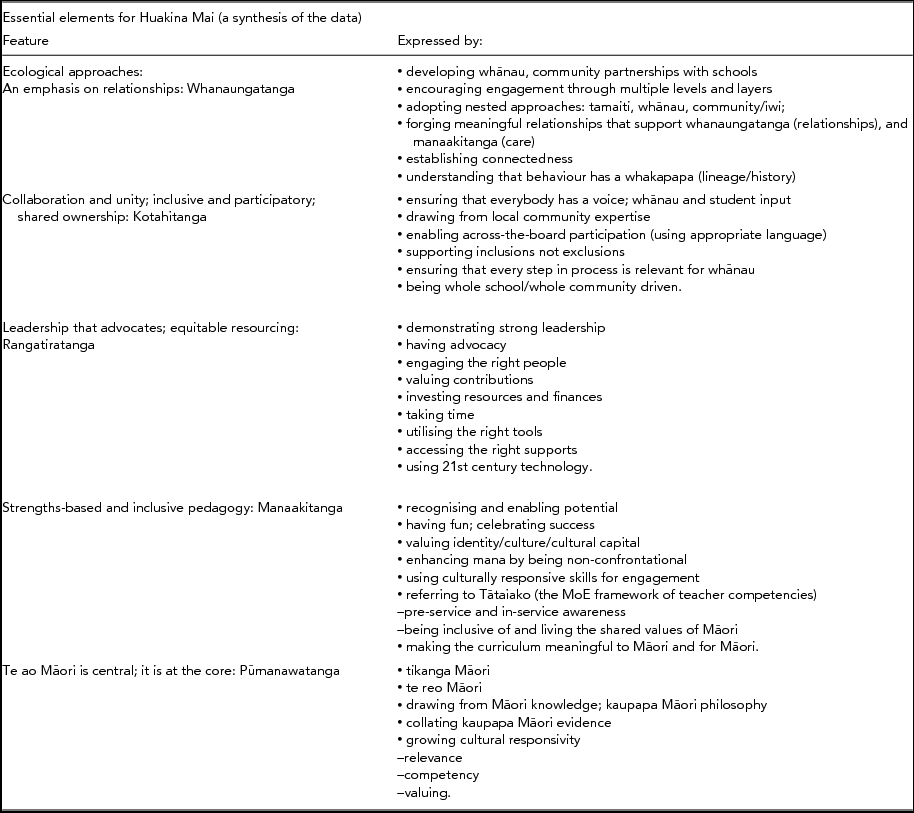
Participants all agreed that Huakina Mai had to be premised on te ao Māori (a Māori worldview) and to ensure that Māori expertise was located at the centre of decision-making. This included ensuring that whānau, hapū (larger kinship groups) and iwi (tribes) are actively enabled to participate in the development of their own school culture, and that Māori cultural concepts be valued as a vehicle for cultural change in schools. There was also agreement among participants that school leaders need to be committed to the process of viewing themselves as learners in the construction process and acknowledge the contributions of ākonga Māori (Māori learners) and whānau, thereby ensuring that any implementation has cultural integrity. Further themes that emerged from the grounded theory analysis of the data reflected five key imperatives: Whanaungatanga (relationships), Kotahitanga (unity), Rangatiratanga (leaderships), Manaakitanga (an ethic of caring), and Pūmanawatanga (the centrality of te ao Māori). Table 1 expands on these themes in greater detail.
Emerging Themes and Elements
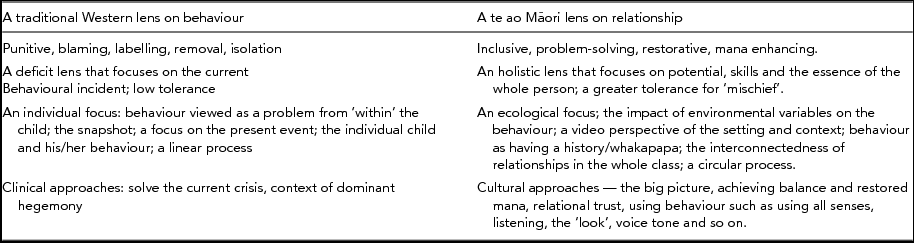
The participants identified that traditional Western understandings of behaviour have tended to be one-dimensional, often reactive and punitive (not necessarily preventative). Moreover, and perhaps most saliently, Western views tend to be descriptive, focus on actions, and therefore result in a view of behaviour as child-centred problems. In contrast, a Māori worldview of behaviour is seen as multidimensional, based on relationships and relational trust, and tends to view behaviour in ecological and holistic ways. For Māori, an ecological perspective includes paying attention to the environmental variables that exist around and have an impact on the child. One group of participants described this different positioning to understanding behaviour as looking at a snapshot or a photo (a Western position) compared to observing a video (a Māori position). They discussed how behaviour is viewed by Māori through a big picture lens where there is a whakapapa (lineage; history); which is not isolated and locked in time, but is rather an ongoing part of the overall development of the child within their whānau, hapū, iwi (social context). Table 2 captures these two differing perspectives as acutely expressed by the participants.
A Lens on Behaviour: Two Opposing Perspectives
The focus groups described the challenges of Western behaviour programs as fundamentally oppositional and assimilative in nature, and saw many of them as marginalising of Māori perspectives and beliefs. They identified this as the reason for a continued low uptake of these programs by Māori whānau. Participants were able to identify schools that they believed were culturally responsive, describing these schools as whānau-based, and privileging respectful and reciprocal relationships with whānau. For some, these schools ensured not only community involvement but encouraged a synergy with the community, which in turn encouraged the development of potential within the community. Participants reported that these schools celebrated the extended concept of whānau for Māori, ensuring that kaumātua and kuia (senior Māori) were included in schooling activities and decision-making. These schools were also described as welcoming and safe places, where cultural identity and belonging were reinforced through caring relationships by teachers and through the instantiation of cultural norms.
The importance of leadership that values, embeds and embraces Māori cultural practices was a consistent theme throughout the participant groups. Further, the groups identified uncompromising quality teachers who were inclusive of Māori students, and embraced a relational pedagogical and interpersonal approach. For many, these schools were seen as positioning Māori in the centre, ensuring a sense of belonging and an appreciation of others. In terms of constructing a learning environment, participants felt it had to be safe and familiar, while reinforcing a strong and positive identity for Māori students. Central to any attempt at developing a Māori framework for behaviour was the inclusion of te reo Māori (Māori language), as this was seen as central to Māori identity and cultural revitalisation (Ka’ai, Reference Ka’ai, Ka’ai, Moorefield, Reilly and Mosely2004).
Core traditional Māori understandings of shaping and supporting positive behaviour and development to be used by teachers were described as:
• Whakamana (to honour): always respecting and uplifting mana; caring for the uniqueness and special qualities of individuals;
• Holistic approaches: respecting and being responsive to all aspects of overall wellbeing;
• Aroha (empathy): showing manaakitanga (care), awhi (to help) and tautoko (to support);
• Ecological relationships: engaging with whānau using face-to-face approaches, seeking unity and partnership;
• Modelling: adopting culturally responsive pedagogical approaches, including tuakana-teina (older-younger) and ako (reciprocal learning); non-hierarchical;
• Listen, look: listening to Māori students by using all of the senses; body language; enabling silences;
• Tikanga (protocols): respecting boundaries, knowledge, re reo Māori, history and values.
The positive and enriching qualities that focus groups identified as essential elements to be developed in Māori students were:
• mana: includes rangatiratanga, pride, confidence, resilience, self-respect, identity, leadership, esteem;
• manaakitanga: includes caring, empathy, looking after people, affirming others;
• whanaungatanga: includes valuing positive relationships with people;
• humarie: includes humility, caring people skills;
• wairua: includes inner wellbeing, happiness, motivation;
• mātauranga: includes developing an inquisitive mind, being motivated, achieving, embracing knowledge;
• bicultural competence: includes the ability to walk in two worlds;
• realising potential: includes taking risks, aspiring, being aspirational and visionary about the future.
The He kai mō te hinengaro evidence is built into the developing frame of Huakina Mai as a whole-schools strengths-based reform, bringing pono (integrity) to the collaborative research process. Participants’ voices, practice examples, successful cultural programs and observations from the schools are used to bring life to Huakina Mai. The process of He kai mō te hinengaro further emphasised the need for whānau to be at the centre of the process of implementing and contextualising Huakina Mai.
As a result, Huakina Mai is a multifaceted intervention that incorporates community immersion, developing systems within the wider school whānau, a teacher pedagogical framework, social skill learning and restorative practices for students and staff. Rather than focusing on controlling students or punishing bad behaviour, Huakina Mai empowers students and teachers to build strong and respectful relationships that support finding solutions to challenges and resolving conflict positively in ways that preserve the mana of all participants. There are seven key imperatives that inform the development of Huakina Mai. These are:
1. Whānau are central to Māori student success in school. Successful behaviour support for Māori students needs to be driven by the community (of which the school is a part) and be supported by whānau. Building positive and respectful relationships between all stakeholders is fundamental to successful teaching and learning in schools.
2. Te reo Māori is crucial to enabling Māori potential. The development of identity, culturally responsive pedagogy and cultural revival within schools can be significantly enhanced through te reo Māori (Ka’ai, Reference Ka’ai, Ka’ai, Moorefield, Reilly and Mosely2004). School leaders must proactively advocate, promote and ensure that a comprehensive te reo Māori program is implemented with passion and integrity in the school that they lead.
3. Interactions with ākonga Māori should be mana enhancing: mana (prestige; dignity; status) is pivotal to positive relational and social development. Huakina Mai insists that all interactions should uplift and enhance the mana of Māori students and their whānau.
4. Behaviour is a social interaction that takes place within a specific environment; behavioural interactions should be viewed as a video (part of a bigger and ongoing picture) rather than a snapshot (a static, disconnected, stand-alone event). Behaviour should not be isolated, analysed and/or used as a label for an individual. Rather, behaviour needs to be understood as part of the whole person within a wider context.
5. Teachers are champions and agents of change; through culturally responsive pedagogy and strong relationships, teachers are able to successfully mediate positive behaviour.
6. Ways of behavior are often normalised through dominant discourse; appropriate behaviour for Māori students is likely to ensue when tikanga (culturally congruent protocols and rituals) is incorporated, embedded and normalised within school-wide and classroom practices. ‘Normalising’ practice that is reflective of tikanga enables Māori students to feel more aligned to and included in the school ecology.
7. Huakina Mai is culturally and contextually compatible; Huakina Mai is designed to ‘fit’ within and be reflective of communities by being adaptable according to a particular community and cultural context (iwitanga; Savage, Macfarlane, Macfarlane, Fickel, & Te Hēmi, Reference Savage, Macfarlane, Macfarlane, Fickel and Te Hēmi2012, pp. 15–16).
Huakina Mai is to be implemented in two New Zealand schools in partnership with local iwi and the school whānau in 2014. An action-research project has been designed to sit alongside this implementation in order to learn from the initial implementation and provide ongoing refinement in response to the evidence-based practice that emerges. The purpose of the research is to co-construct aspects of the framework that require contextualisation to fit schools, whānau, hapū and iwi aspirations and tikanga, and to understand the barriers and enablers of implementation.
Conclusion
Historically, Aotearoa New Zealand has demonstrated that Māori advancement was acceptable as long as it was not at the expense of non-Māori dominance and superiority. The past 20 years, however, have seen Māori openly resisting these dominant constructs and responding actively to the entrenched position of the colonial education system. As a result, Māori have gained significant traction in education and have been able to achieve small victories where self-determination (tino rangatiratanga) has redefined the notion of Māori success — one that seeks to better reflect Māori needs and aspirations.
This article described the process of building practice-based evidence to support a whole-school approach that supports strengths-based behaviour from a Māori world view. The process of collecting the evidence, He kai mō te hinengaro, demonstrated the centrality of Māori world view in understanding Māori student behaviour and the importance of whānau and hapū in developing a strengths-based mana enhancing process to arrive at a solution. The next phase of the project is an action-research implementation phase, beginning in 2014.
About the Authors
Catherine Savage (Ngāi Tahu) is the Kaihautū, Chief Executive at Te Tapuae o Rehua, a partnership between shareholders Christchurch Polytechnic Institute of Technology, Lincoln University, Otago Polytechnic, Te Rūnanga o Ngāi Tahu, the University of Canterbury and the University of Otago. She is a registered psychologist and has worked as a classroom teacher, resource teacher of learning and behaviour (RTLB), educational psychologist and university lecturer. Her research has been focused primarily on culturally responsive pedagogy and behaviour intervention. Catherine was part of the Victoria University research team that evaluated the Te Kotahitanga and delivered the professional development program, Effective Intervention for Challenging Behaviour (EICB).
Sonja Macfarlane (Ngai Tahu, Ngāti Waewae) has a history in education and special education. Sonja has taught in primary schools and as a Resource Teacher: Learning and Behaviour (RTLB), before moving into the Ministry of Education: Special Education as a Special Education Advisor and national Practice Leader: Services to Māori. She is currently Senior Lecturer in Health Sciences and Specialist Teaching (Māori) at the University of Canterbury. Sonja's research is focused on culturally responsive services for Māori students and whānau within special education.
Angus Macfarlane (Te Arawa) is an experienced educator, practitioner and researcher. His research is concerned with the exploration of cultural concepts and strategies that affect positively on professional practice. In 2003, he was awarded the inaugural Research Fellowship by the New Zealand Council for Educational Research. In 2004, he was a recipient of a Tohu Kairangi award, a citation for academic excellence in Māori education. In 2010, he was awarded the New Zealand Association for Research in Education's Te Tohu Pae Tawhiti Award, and most recently he was the recipient of the University of Canterbury's research medal. Dr Macfarlane coordinates postgraduate courses at the University of Canterbury where he is Professor of Māori Research.
Letitia Hochstrasser Fickel is currently the Head of the School of Teacher Education. She is an experienced academic, researcher and program evaluator in the area of teacher professional development, teacher learning, educational innovation and culturally responsive practice. She is currently serving as the evaluator for the EdPlus South Island Consortium's blended PLD approach to literacy and English Language Learners. Before moving to New Zealand in July 2010, Professor Fickel spent 12 years in Alaska. During that time she served as principal investigator or project director for four large-scale, US government-funded projects focused on the development and evaluation of innovative educational programs.
Hemi Te Hemi (Ngāti Maniapoto, Ngāti Rōra and Ngāti Kōroki) is the Programme Manager for He Toki ki te Rika on behalf of Te Rūnanga o Ngāi Tahu through its subsidiary Te Tapuae o Rehua. Prior to this, Hēmi was employed by the Canterbury Youth Workers Collective as its Coordinator and before that spent 8 years with Skill New Zealand and the Tertiary Education Commission, employed in a range of senior roles. Through various employment opportunities Hēmi has accumulated over 20 years’ experience working with a range of diverse groups in the community and not-for-profit sector, training and employment, social services and central government.