Introduction
Mineral extraction has been conducted in Greenland since the 1840s and a substantial profit from mining has been possible, e.g. the Ivittuut kryolit mine (1854–1987) and the Qullissat coal mine (1924–1972), and the idea that extraction of natural resources could make Greenland (more) independent was already introduced during WWII (Rosing, Reference Rosing2014). The inconvenient truth is that mining in Greenland never really kicked off after delegating the primary responsibility for developing the sector to Nuuk. Since the Greenland Self-Government Act was introduced in 2009, and the Greenland Self-Government authorities took over the responsibility for the mineral resource area, the discourses of nation-building and development (promoted by the Government of Greenland) have led to a positive discourse concerning a future based on extractive industries (Nuttall, Reference Nuttall2017). Furthermore, Greenlandic authorities have implemented a number of legislative policies and plans to encourage and support mining (e.g. Naalakkersuisut, 2009, 2014; Grønlands Selvstyre, 2012). Even though a massive development is not taking place, the planning of it and future-making in itself can have a societal and emotional impact. As a guiding post for the reader, I will enquire why Greenland is still not a mining country? And the article has the following research question: What emotional labour comes with the stories related to future partnership in mining?
In 2014, the Government of Greenland launched a new mineral strategy with the optimistic title “Our raw materials have to create prosperity” (Government of Greenland, 2014). At the time of writing, the strategy expired and a new strategy is on the drawing board. Retrospectively, the strategy was preparing Greenland for something that did not really happen. With the strategy and new approaches to mining in Greenland, politicians and industry representatives have advocated for a discursive shift from mining in Greenland to mining for Greenland (Bjørst, Reference Bjørst2016a). In effect, potential mining futures and partnerships are openly and widely discussed and anticipated by the public (Sejersen, Reference Sejersen2015). In these discussions, it is often ignored that mining will become more than an industrial and technical activity but will also become socially and highly affective for actors (and communities) living within, and outside, the Arctic. Nevertheless, to the disappointment of all the advocators for mining, Greenland already lost the grip in 2012 when the market was booming and the venture capital was hereafter out of Greenland. A resent status report issued by Greenland’s Economic Council shows that there is no much mining activity in Greenland at present (or within the immediate future) (Økonomisk Råd, 2018, p. 10–11). So, that leads us back to the question of why Greenland is still not a mining country. Economic models of the development of extractive industries’ boom and bust circles can explain it partially. However, the argument in this article is that stories, emotions, and former relationships influence the current development of extractive industries and Greenland’s possibility to become an interesting partner (for building a long-term relationship). Envisioning future relationships (in debates about mining in Greenland) also set the framework for reinterpretation and redefinition of the past, to legitimise and give meaning to promised new development; hence, this kind of future-making tends to be contested. This article intends to study the emotional labour with a special focus on partnership, emotions and filtration, while visiting affective scenes and sites related to the mining of Greenland’s minerals. The literature on extractivism is extensive (Kirsch, Reference Kirsch2014; Veltmeyer & Petras, Reference Veltmeyer and Petras2014) and yet, it sometimes overlooks the Arctic region (Kadenic, Reference Kadenic2015; Kröger, Reference Kröger, Finger and Heininen2019; Keeling & Sandlos, Reference Keeling and Sandlos2015) (and, most of all Greenland). Just recently, academic work has been published on the tensions and societal aspects of Greenlandic mining (see Ackrén, Reference Ackrén2016; Jørgensen Reference Jørgensen2017; Hansen, Vanclay, Croal & Skjervedal, Reference Hansen, Vanclay, Croal and Skjervedal2016; Nuttall, Reference Nuttall, Jensen and Hønneland2015; Thisted, Reference Thisted2019; Tiainen, Reference Tiainen2016; Sejersen Reference Sejersen2019). In the newly published Arctic Council Assessment (AACA, 2017, p. XI), the global demand for resources is identified as an important driver of change in the Arctic. As of today, little mining – and no large-scale mining – is taking place. In this delicate process of global entanglement, Greenland illustrates the general dilemma of being open for business while still discussing whether this course is suitable for a country aspiring to become its own state.
Partnership and the “difficult tango”
Since Home Rule was introduced in Greenland in 1979, the rhetoric of Denmark and Greenland as partners has been well known in discussions. The former Greenlandic MP Finn Lynge (Greenlandic member of the European Parliament from 1979 to 1984) described it as a “difficult tango” (in Kalaallisut “tango nalunartoq”) which refers to difficulties in keeping the balance, learning the steps and letting the dance flow while remaining attentive to your partner (Lynge, Reference Lynge2002, p. 120). Finn Lynge used the word “peqatigiinneq” for partnership (Lynge, Reference Lynge2002, p. 121) which means “to work together” or “to unite” (as in an organisation or community). However, the notion of partnership is now introduced to other areas and used in establishing new relationships, such as in mining. But as the present study will demonstrate, the quest for stable relationships in the mining sector can create conflict and tension between the future partners. Additionally, a movement of resistance in Greenland and Denmark identifies “objects of fear” in relation to mining. Not everybody enjoys the new partnerships in mining, and the experiences of partnering with Denmark over the past 300 years have not helped to smoothen the process. Wilson and Stammler (Reference Wilson and Stammler2016) have analysed various extractive projects in the Arctic and have found that even before extractive projects start up, the very prospect of a mine can transform the way a local community thinks about its future and overshadow alternative options (Wilson & Stammler, Reference Wilson and Stammler2016, p. 1). Stories, including expressed hopes and regrets, about potential partnerships will be one of the focal points for this analysis with the empirical data centring on heterogeneous multi-sites and stories of what could be (if Greenland really was a place of mining).
The phenomena “mining in Greenland” is not only discussed in Greenland. During my studies of Greenland and extractive industries, more and more sites and venues have been entangled and made relevant for the debate. For this analysis, articles and communicative events in Copenhagen, Toronto and Nuuk from 2013 to 2019 have been the main focus. To analyse the phenomena “mining in Greenland”, the following multi-sites and related stories have been analysed: first, the response from the artist Bolatta Silis-Høegh to the lift of the uranium ban in Greenland; second, the language used around relationships and partnerships at the Greenlandic Day at the mining convention Prospectors and Developers Association of Canada (PDAC) (2016, 2018, 2019) in Toronto; and third, the hearing in the Danish Parliament (2016) and an emotional reading of the speech by the chairman of the Narsaq division of the NGO Urani Naamik and the speech by the mayor of Kommune Kujalleq. Each of the sites offers a specific understanding of mining in Greenland and the related societal implications and emotional labour of potential new partnerships.
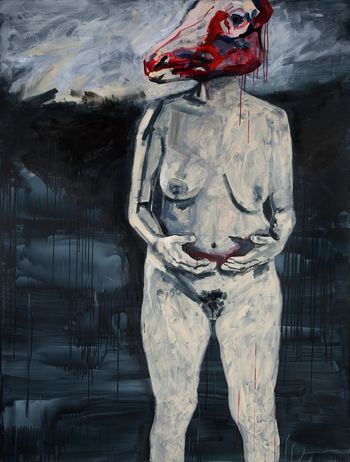
A photograph of the painting “Outside”, 200x150 by Bolatta Silis-Høeg. From the exhibition “Lights On Lights Off,” used with permission from the artist herself.

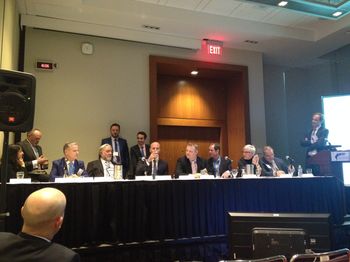
The Greenland Day at the 2016 PDAC Convention. On the panel from the right: Greg Barnes, John Mair and Thomas “Tyt” Mogensen. Photographer: Lill Rastad Bjørst.

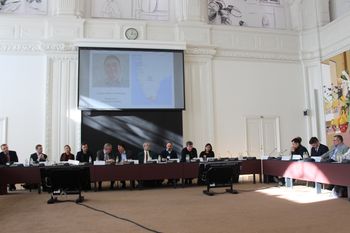
The panel at the hearing Grønlandsudvalgets høring om udvinding og eksport af uran i Grønland, Landstingssalen 16 March 2016. Photographer: Lill Rastad Bjørst.

Method
In 2013, I started to follow the debate about mining in Greenland. I am pursuing a multi-sited ethnography, which means that the analysis relies not only on data from Greenland, but also on material from other sites where Greenlandic and Arctic mining are discussed (e.g. mining conferences, hearings, parliamentary debates, academic workshops, art exhibitions, and demonstrations). Additionally, I conducted ethnographic fieldwork in Greenland (Narsaq and Nuuk, 2012 and 2013) related to the Greenlandic Parliament, Inatsisartut, who lifted a decade-long moratorium on mining radioactive elements. As part of this research, I interviewed 15 people living in Greenland at the time and followed the public debates and the civil society demonstration around Greenland and in Copenhagen. The findings from this work are already published in books and journals (Bjørst, Reference Bjørst2016a, Reference Bjørst, Fondahl and Wilson2016b,Reference Bjørst, Thomsen and Bjørst2017; Ren, Bjørst & Dredge, Reference Ren, Bjørst, Dredge, Mostafanezhad, Norum, Shelton and Thompson-Carr2016).
Multi-sited ethnography is a method of data collection that follows a topic or a social problem through different geographic or social field sites. Also emerging in multi-sited ethnography are greater interdisciplinary approaches to fieldwork (e.g. bringing in methods from cultural studies, media studies, science and technology studies and other fields) (Marcus, Reference Marcus1995). In multi-sited ethnography, a researcher tracks something across spatial and temporal boundaries. For example, a multi-sited ethnography may follow a “thing,” such as a particular commodity, phenomenon or object as it is transported through the networks of global capitalism (Marcus, Reference Marcus1995). Inspired by this approach, I will follow mining in Greenland as a phenomenon and the related stories, affects and partnering. Hence, the empirical data centre on stories of what could be (if Greenland really was a place of mining). Studying affective stories is one of the ways a researcher methodologically can make sense of things that seem embodied, affective and sometimes more than representational. Stories, according to Emilie Cameron, are “complex assemblages of people, places and things; some may be narratively performed by humans, but they must be understood as relational networks performed by humans and non-humans, not as representations that somehow sit apart from the materials they represent” (Cameron, Reference Cameron2015, p. 25). However, as this study mostly focuses on stories, the approaches to research in this study still come out with a discursive research focus with language as the central object of study. We use stories to order our relations with each other and with a place (e.g. the land), and thus, stories function as ordering strategies (Law in Cameron, Reference Cameron2015, p. 25). In this study, the stories told are part of the empirical data, and through the reading of stories I will be able to reach a deeper understanding of the relational networks in mining discussions and futuring. As researchers, we need to question what kinds of futures are being planned through the stories that are being told and circulated. This matters because imaginative geographies of places and investment are determinants in the future-making of Greenland. Envisioning the future is far from an innocent or apolitical endeavour but may have a major impact (Ren, Bjørst & Dredge, Reference Ren, Bjørst, Dredge, Mostafanezhad, Norum, Shelton and Thompson-Carr2016). Mining stories (about the future) often clash with, contradict, silence or promote certain emotions, logics and feelings. This study will analyse and discuss these mining stories and the related expectations of future relationships as well as the emotions present among potential partners.
The point of departure in developing my research is that mining involves a variety of actors from extractive industries, subcontractors, investors, prospectors, NGOs and environmentalists to nation states, transnational companies, local governments, municipalities and local citizens and others who relate and take part in the debate about mining in Greenland. In the present context, however, I will only focus on a few of these potential actors.

The argument for the choice of “sites” of inquiry is based on their ability to reflect affective practices and encounters. It this way each of the sites offers a specific understanding and response to mining in Greenland and illustrates related societal implications and emotional labour. First, the debates in the Greenlandic and Danish Parliament tell the reader about the political discussions around mining Greenland and the encounters with the Greenlandic NGOs. Second, the interview with Boletta Silis-Høegh from the Danish newspaper Information exemplified one out of many emotional responses to the changed policy towards uranium and radioactive materials in Greenland, which is important to include in the analysis to understand the contrast of the debate. Third, the Greenland Day at PDAC and visit to the Royal Danish consulate has a rather prominent place in this article. The argument for this is that to be present at PDAC is a massive investment for the Government of Greenland and the Greenlandic business community. It comes with an expectation of investments and new partnerships, hence includes emotional investments and telling of affective stories, which speaks to the scope of my research.
A critical approach to partnership, emotions and flirtation
Partnerships in mining are widely praised but without great accuracy about their actual content. “Partnership” is mostly used as a loose metaphor which leaves it open for the actors to inscribe whatever meaning is convenient to them. However, it should not be underestimated that the language and stories (about partnerships) are part of a delicate process when a transformation is taking place and partnerships are becoming a binding concept in contracts (e.g. in Impact Benefit Agreements). The present study looks at the communication that occurs around partnerships and at what is made possible by the language of partnerships. Invested in partnerships are various ideas about modes of cooperation (Andersen, Reference Andersen2008, p. 38) and exchange (Sahlins, Reference Sahlins1972). An ideal partnership according to Andersen (Reference Andersen2008) is “not established from one day to the next. It requires time, patience, and a shared vision to strengthen the inadequately resourced partner” (Andersen, Reference Andersen2008, p. 43). He characterises the formation of a partnership as “an effort to unite two dilemmas in one form” – thus, in effect, it involves a multitude of social phenomena (Andersen, Reference Andersen2008, p. 1). So, what does it really take to become, find and keep a good partner? To open the concept of partnership and tease out its related metaphorical meanings, the present study applies analytical tools from the affective turn in social sciences because relationships can be hard and involve a wide range of emotions and affects. In the present context, affect is used to mean embodied meaning-making and something which can be understood as emotions (Wetherell, Reference Wetherell2012, p. 3–4). The advantage of focusing on affect is that it brings the dramatic and the everyday back into social analysis. Affect can be strange and extreme but also ordinary and “through this ordinary affect, people engage with the momentous and the global political,” according to Wetherell (Reference Wetherell2012, p.7). In Ahmed (Reference Ahmed2014), she encourages researchers to question what emotions do (rather than what they are) and understand them as relational – moving between bodies – accumulating over time (pp. 5-11). The word “emotion” comes from Latin, emovere, referring to “to move, to move out.” It means that as humans we are not alone with our emotions, we are often moved by others and what is considered individual emotions (or feelings) can easily become collective and political (Hutchison & Bleiker Reference Hutchison and Bleiker2014, p. 491). The tendency is that “the more people associate with common beliefs or identities the more they may share emotions” (Hutchison & Bleiker, Reference Hutchison and Bleiker2014, p. 500). Hutchison and Bleiker (Reference Hutchison and Bleiker2014, p. 503) mention how “affective phenomena are historical and contextually conditioned to act upon both individual and collectives”. In privileging affect and emotions in this approach, future-making (or futuring) tends to become central as humans have feelings towards not only the past and present but also unknown futures. Stories are used to order experiences and emotions and try to accept and understand new things to come (Cooren, Reference Cooren2001).
In effect, this study will visit multiple sites, exemplifying seemingly individual and collective emotions. Thus, in the present study, the ambitions are to pay attention to all kinds of emotional labour; the aim is neither to judge nor to verify feelings. Studying the political debate reveals how affective subject positions are often endorsed and encouraged by politicians. The attention is on affective performances, affective scenes and affective events. Politicians frequently communicate who “we” and “us” are in a pursuit of what is understood to be a “good” or “right” project and what to feel. There is a comfort in being part of an articulated “we” that sticks together (Wetherell, Reference Wetherell2012, p. 8), and there is a comfort in being invited into partnerships through flirting and courting events though the relationships might never materialise. Flirtation according to Hoffman-Schwartz, Nagel and Stone (Reference Hoffman-Schwartz, Nagel and Stone2015) is “a game in which no one seems to gain the upper hand and no one seems to surrender “(p. 1). In their work, they refer to Simmel’s characterisation of flirtation (die Koketterie) as a “paradigmatic theoretical topos for modernity itself,” (Hoffman-Schwartz et al., Reference Hoffman-Schwartz, Nagel and Stone2015, 2) which comes with a desire to get carried away and seduced. Flirting is a practice which requires “almost –nothing, almost everything” (Hoffman-Schwartz et al., Reference Hoffman-Schwartz, Nagel and Stone2015, 9) where the flirting partners engage themselves in a sort of dialogue, a “game” playing with suspense, dispensing with “formalities” and being performative in the space of ambiguity. Flirtation stands at the boundary between imagined and realised desire. In other words, “almost nothing; almost everything” (Hoffman-Schwartz, Nagel & Stone, Reference Hoffman-Schwartz, Nagel and Stone2015, 1). In Flemming (Reference Fleming2015), it is described as “action in distance” and he continues: “the one flirting plays with the other person as both an instrument and as a partner, an object and a playmate” (24). Flirting can be characterised as game playing and has affective, discursive and representational implications. This article takes a critical approach towards flirtation and partnerships as they play out in the mining sector, as the political seduction involved works best when it pretends to turn away from the political and focus on future relationships. The delicate question of whom to become when discussing (hyper-) industrialisation in Greenland turns out to be pivotal (Sejersen, Reference Sejersen2015) or, to phrase it differently, whom to become with? In the telling of stories (about mining), positions and narratives are often available and in the analytical work subjects and citizens are repeatedly materialised and described. That may be seen as a battle amongst actors in terms of taking up either the somewhat “privileged” positions of winners and losers of the potential development. In other words, it is more than a tango between two partners (e.g. Denmark and Greenland) – the dance floor is open and additional partners might be interested in dancing, courting, flirting and taking a chance with Greenland. Some might even be looking for a long-term relationship, but for the time being Greenland is still cast as the “benchwarmer” trying out different strategies to attract the interest of a potential partner. It is worth mentioning that Denmark (Greenland’s primary partner for the past 300 years) has no extensive mining industry, and the mineral resources in Denmark are limited to sand, gravel, chalk, limestone and different kinds of clay. To stay with the metaphor, Greenland is not only discontent with the partnership because of postcolonialism, but Denmark might not have the relevant skills for Greenland to reach its full potential (Gad, Reference Gad2017).
I do not claim to be comprehensive in my analysis of relationship building and partnerships in mining. However, the quest for stable relationships in the Greenlandic mining sector revealed how stories and emotions play out in particular, interesting and extreme ways in the Arctic. The Greenlandic uranium predicament stands out as an important affective event in this study. Ergo, this is where my analysis begins.
Liberating cries and uncertainties
In October 2013, the Greenlandic Parliament, Inatsisartut, lifted a decade-long moratorium on mining radioactive elements. The Parliament had previously pursued a zero-tolerance policy with regard to uranium. From one day to the next, uranium now became part of future-making in Greenland (Sejersen, Reference Sejersen2015). The same day, Bolatta Silis-Høegh, an artist born and raised in South Greenland, woke up with a giant headache. It lasted for two days … and then she began to paint as if in a frenzy. In the creative process, she used the body to convey all the newly evoked feelings and emotions she was unable to put into words. Emotions related to her past experiences from Greenland, accumulated in her body over the years, were expressed in the following months. Feelings about Greenlandic society and its repression of emotions and social problems, such as violence against women and violence against nature, were unleashed. When she was interviewed by the Danish newspaper Information she described the feeling as very intense and said, “I cannot put it into words. I have to scream it out via my paintings instead” (Scherrebeck, Reference Scherrebeck2014, pp. 12–13). Her screams (and emotional labour) were heard and acknowledged in both Greenland and Denmark, and the exhibition has been touring ever since her story echoed in newspaper articles and presentations. Her work, stories and feelings resonated with many who were against mining and use of uranium both in Denmark and Greenland. She was not alone with her emotions – they were political and collective. As part of her story, she expresses the new feeling of uncertainty and she confesses that, “like a lot of people in Greenland, I do not have any knowledge about it [uranium]. The big companies promise that nothing is going to happen, but I cannot believe that it won’t have consequences for nature, animals and the ocean when you open a big mountain up to mining, as it is planned in Narsaq” (Scherrebeck, Reference Scherrebeck2014, pp. 12–13). A concern that is also voiced by the local NGO Avataq (Grønlands Natur og Miljøforening) and the movements Urani Naamik and Naamik Qujaanarpunga” (in Kalaallisut “Uranium No” or “No Thanks”). The interview with Silis-Høegh as well as the responses to her art speaks to a feeling of injustice, a feeling of injustice that links up with other kinds of experienced injustice. As this is a very bodily experience to Silis-Høegh, she used her naked body as a motif in her paintings (Fig. 1). Silis-Høegh’s emotional response was one of many responses to the changed policy towards uranium and radioactive materials in Greenland. She had a specific perception of uranium (and mining) as something to be feared which stands in contrast to the position of the mining industry. Sticking with the metaphor of partnering, not everyone enjoys “flirting” with the mining industry or can imagine any future “love affair” coming out of this courtship. Silis-Høegh’s encounter with mining exemplifies (among other things) what we learn from reading Ahmed (Reference Ahmed2014): that all actions are reactions (p. 4) and that emotions are bound up with stories of justice and injustice (Ahmed, Reference Ahmed2014, p. 192). Emotions are relational and not simply situated in the individual but exist between bodies (Ahmed, Reference Ahmed2014, p. 10) – in paintings, in headaches, in screams – and are circulated, for example, with the people listening, promoting and seeing the paintings or reading newspaper interviews with the artist. Create an emotional community and trigger charred feelings. The paintings contain blood that signifies that somebody was hurt and that there is a need to heal. In telling stories about this pain, the artist was striving to comprehend evoked feelings and stories. Interestingly in this context, the stories told are not only about mining. Many stories come alive, also ones that were not consciously remembered but accumulated in her body and now suddenly become part of her present. According to Hutchison and Bleiker (Reference Hutchison and Bleiker2014) emotions are socially embedded and with Silis-Høegh’s art, they were made collective as her paintings and stories were displayed and discussed in and outside Greenland (p. 499). Something changed with the Greenlandic Parliament’s decision to lift a decade-long moratorium on mining radioactive elements that created a break (or a new temporality) for Silis-Høegh and many other Greenlanders. She was moved, hurt and provoked, but as this study will show, she was not the only one who had an emotional response to the prospect of mining Greenland’s minerals.
PDAC and experiences from Canada
One of my fieldwork sites for the multi-sited study was the Prospectors & Developers Association of Canada (PDAC) mining conference. I visited the PDAC Convention in 2016 and 2018 while I was an affiliated researcher at the Centre of Excellence for Resources, Extractive Industries and Sustainable Arctic Communities (REXSAC) and livestreamed the “Greenland Day” at PDAC in 2019. The unfolding debates about Arctic mining reveal that “partnership” is a contested concept containing divergent meanings and expectations in both Canada and Greenland. In Canada, the development of extractive industries has led to friction. The Canadian scholar Emilie Cameron has described how business partnerships have been the practical solution to the sometimes unresolved Indigenous territorial claims (Hutchison and Bleiker, 2014, p. 39). Cameron’s research shows how the historically defined relationship between the state and the Indigenous peoples has today (partly) been delegated to the private sector (Cameron & Levitan, Reference Cameron and Levitan2014, p. 38). She argues against market-based solutions for complex, historically rooted structural and emotional problems – like the ones she has identified in Canada. Moreover, partnerships are difficult to manage, as different partners usually command highly unequal resources (Gad, Reference Gad2012). This is often the case in Arctic mining where companies may have more employees than the total number of people living in the region or country where they do business. That in itself creates power relations and potential dominants in the relationship. It is a trend in the Arctic that local communities and governments try to “unlock” their own potential by making their land available for mining. When I visited the Trade Show and Investors Exchange at the PDAC Convention (in 2016 and 2018) and looked at the hundreds of booths with slogans, pictures and maps, I found that the narratives of mining resembled old storylines from travel writing: “more to discover,” “half of Nevada remains unexplored,” “look north” and the more market-based storylines, such as “the Northwest Territories is open for business,” “follow the money” and “are you mining ready?”. Many of them made “exciting” promises for future relationships and use of land. The mining projects in Nunavut and the Northwest Territory used pictures of children, elders and young people (mostly Inuit) as background images and, of course, maps to show the mining sites and geological reserves. The stories presented gave a rather upbeat version of the future prospect for these regions but overlooked that most Indigenous peoples living on these lands have experienced colonialism and continue to experience the effects of (neo) colonialism (which the storylines’ echoing intertextuality from travel writing underscored). The unfinished business with the “old” partners was painted over by an even bigger narrative about growth and business opportunities – now to some extent co-produced by the local communities as well.
PDAC also had an Aboriginal Program which focused mainly on “strategies for generating partnerships building relationships and maximizing benefits” (PDAC program, 2016, p. 21). What was asked for by panellists in these sessions was meaningful consultation, training and capacity building. A take-home message from these sessions was that it takes time to build relationships and foster mutual partnerships. When I attended the Inuvialuit Regional Corporation presentation, they characterised themselves as “… a well-established respected and business-friendly aboriginal partner.” They went on to tell the audience that “the mineral industry is all about trust and stable relationships” and closed the session by showing a mineral map and declaring that “the territory is open for business” (PDAC, 2016). These observations are relevant to include in the present analysis, as representatives from Greenland have been looking primarily to Canada for experiences with mining and partnerships. The Aboriginal Program showed a mix of experts, mining lawyers and representatives from mining companies, testimonies from local people working with the mining companies and political statements. They could all speak the language of mining, but the stories told showed ambivalence, as they presented miming as a necessary means for development in Canadas North. They needed partners and networks to make mining possible, and for that they were open for business with welcoming (flirting) gestures to attract potential partners.
Like any other relationship
The day before PDAC 2018, the Royal Danish Consulate hosted a kick-off for the Danish-Greenlandic delegation. I was invited to participate together with my colleague from the University of Copenhagen, Frank Sejersen. The general theme of the day was experiences from Canada and Nunavut. One of the first keynote speakers, Bjarne Graven Larsen, executive vice president and CEO, Ontario’s Teachers’ Pension Plan, took his place at the podium. He asked the rhetorical question “What are we looking for when we invest?” Among other conditions, he called for a stable political system and assurance that “the rules of the game are not changed”. He described how the process in Canada had involved working closely with First Nations, and regarding partnerships he said, “We do not want to be tied up with partners who do not take a social responsibility”. His organisation was looking for partners who aspired to be “best in class” and that it was generally important that partners agree. One of the following speakers was Shehzad Bharmal, vice president of Planning & Development, Teck Resources Limited. His presentation, titled “The Opportunity – Securing a Social License,” dealt with Indigenous relationships and the mining industry. One of his slides explicitly laid out Teck’s approach to relationships and agreements with Indigenous peoples: “Build trust and mutual respect; Openly communicating interests and concerns; Improving community well-being; Being innovative and collaborative – this help to reduce business risks.” The next slide had the following bullet points: “Agreements have to be designed with the future in mind; Open, honest relationships and commitment required to make the agreement work; Have to be integrated and involved in the communities – cannot be manage from head office.” He summed up his presentation by underlining how this was “required for every stage of a mine’s life cycle.” In the Q&A section, the speakers all emphasised how important it is to engage in the difficult conversations. One of the speakers said, “it’s like any other relationship,” which led to laughs in the room. Sticking with the metaphor Bharmal said, “Who hasn’t been in a relationship where there have been tensions?” and underlined that this was all about understanding local values and pursuing a fruitful and long-term relationship. In other words, the industry was used to tension and acknowledged that stable partnerships and relationships were not a given but required a continuous effort and emotional engagement. The emotional labour entailed must demonstrate trust, understanding of local values and show commitment. His body language was open and welcoming, as he explained how things could not be managed from head office. He needed to go there in person. Without explaining what the tension was about, his focus was on the emotional labour and how best to cope and close the gap between the tension and how they should feel in order to enjoy the partnership and potential long-term relationship. To understand this within Ahmed’s (Reference Ahmed2014) framework, the local people (community) were legitimised as objects of emotion.
At the PDAC Convention the stories told about mining were pragmatic. The industry was still trying to get back on its feet after the financial crises, and I was told numerous times that the PDAC, 2016 Convention was much smaller than it used to be. The message was that regions that had not yet taken up mining needed to be open for business. Accordingly, the lesson learned at the convention was that the vision of a good partnership requires the local community to speak with one voice and have a “stable political system.” In other words, no one wants to marry someone who cannot make up their mind, saying one thing in one forum and the opposite in another a few days later. Simply put, partnerships come with benefits but also with obligations and expectations which call for emotional labour, most of all, to avoid tension in the relationship. The visit to the PDAC Convention showed me that the potential of mining as a tool for modernisation and development is often mentioned in the arguments for Arctic mining. However, according to Wilson and Stammler (Reference Wilson and Stammler2016), we need to question the understanding of extractive industries as a foundation for development. Experiences from Arctic Canada show, for instance, that social issues embedded in the rhetoric of “employment” and growth are often ignored (Tester & Blangy, Reference Tester and Blangy2013). Research into the construction of social licences to operate concludes that it is no longer enough for mining companies simply to meet with the formal obligations of a licence to mine and attract investors (Moffat & Zhang, Reference Moffat and Zhang2014, p. 69). Avango, Nilsson and Roberts (Reference Avango, Nilsson and Roberts2013) argue that the task of defining mining as desirable and as a value for society is part of the endeavour of building a network that can make extraction occur (Avango et al., Reference Avango, Nilsson and Roberts2013, p. 433). Arguments and stories about how the extractive industry brings employment, security and tax revenue have been a central component of developing extractive projects in the Arctic. In an analysis of various extractive projects in the Arctic, Wilson and Stammler (Reference Wilson and Stammler2016) found that even before extractive projects start up, the very prospect of a mine can transform the way a local community thinks about its future and overshadow alternative options (Wilson & Stammler, Reference Wilson and Stammler2016, p.1). The development in Greenland since 2009 is an example of this exact tendency. For the past 10 years, discussions about mining have fuelled the political project of gaining independence from Denmark. Following the decision of the Greenlandic Parliament to lift the moratorium on mining radioactive materials (Bjørst, Reference Bjørst2016a, p. 38), mineral prices took a dramatic downward turn. In effect, the branding and storytelling about Greenland as a place of mining became significant in the discussions about growth and becoming more independent (as numbers were revealing the opposite). There has been a growing tendency to focus on mining and tourism as new growth sectors, and Greenlandic politicians have come to see mining as one of the important ways to strengthen the Greenlandic economy that ensures what the government calls “economic self-sustainability for Greenland” (Coalition Agreement, 2014–2018, p. 3). The concept of sustainability in this context has been used primarily to imply that Greenlandic society would be able to sustain itself economically (Gad, Jakobsen & Strandsbjerg, Reference Gad, Jakobsen, Strandsbjerg, Fondahl and Wilson2017). That makes sense (see Gad et al., Reference Gad, Jakobsen, Strandsbjerg, Fondahl and Wilson2017) within a national logic according to which it is neither nature nor Aboriginal culture, but a particular community – in this case the modern, post-colonial Greenlandic one – that finally needs to be sustained in the (perfect) future to come. In effect, these expectations and extractivist logics tend to spill over into politics and lead to a focus on stability, not only in economic politics but also in the political landscape and public debate overall. Greenland is a state in formation, but its way to independence creates temporary instability which means that Greenland could be a difficult partner to marry! This situation is difficult for the mining industry to accept as expressed by the director from ACRM when he advocated against “political hickups” in November 2016, when the Copenhagen-based Arctic Cluster of Raw Materials (ACRM) hosted the Greenland Conference in collaboration with the Confederation of Danish Industry (DI). In the conference handouts, Niels Tanderup Kristensen, director of ACRM, summed up the disappointments of the last few years and the current situation in the Greenlandic mining industry. In conclusion, he wrote, “In the Arctic Cluster of Raw Materials, we stand ready to grasp this new brighter window of business opportunities. But the government in Greenland also needs to be ready. We cannot afford any bottle necks in the administration process or any political hiccups” (Kristensen, Reference Kristensen2016). The quote illustrates the perception of the Government of Greenland as not ready to “grasp this new brighter window of business opportunities,” meaning that something seems to be in the way for desired relationships to evolve in the Greenlandic mining sector.
Stories of what could be
At the PDAC Conventions and in other multi-sites (outside of Greenland), Greenland has for some time been “courting” the global mining industry and in doing so has been looking for partners. Courting (or flirting) involves stories, lust and delicate fantasies about what could be “if we were together.” Such stories and embedded emotions do things, according to Ahmed (Reference Ahmed2014). They align individuals with communities and “mediate the relationship between the psychic and social and between the individual and collective” (Ahmed, Reference Ahmed2014, p. 119). In other words, they bind subjects together. The partners meet, date and may at some point enter a relationship – as the speakers at the Danish consulate said about what occurs in the mining sector: “It is like in any other relationship.” In the debates at the PDAC Convention, the wish to build relationships with local communities and Indigenous peoples was mentioned repeatedly. In Canada, the “aboriginal component” was often mentioned, as was the wish for becoming a “treaty partner.” A regional chief, Shane Gottfredson, even mentioned that he was fighting for the “right to investment for first nation’s communities” and that they wanted an “equal and innovative partnership” where investments include investments in “our people.” Of course, the situation in Canada is different than that in Greenland, in part because in Greenland the companies do not have “problems” with land claim agreements (as in Arctic Canada). “No problems with land claims” in Greenland was a phrase that was mentioned repeatedly at the 2016 PDAC Convention as one of the advantages of doing business in Greenland. The Self-Government authorities have assumed the right to utilise the mineral resources found in the subsoil, and the citizens of Greenland share common property rights. When it comes to mining rights and title to land, ownership to land cannot be obtained in Greenland. However, persons or companies may apply to obtain a right to use a piece of land for a defined purpose (Schriver, Reference Schriver2017, p. 3). A central point is that metallic minerals in the Greenlandic subsoil belong to the Government of Greenland (Schriver, Reference Schriver2017, p.1). Hence, as mentioned repeatedly as an advantage at the 2016 and 2018 PDAC Conventions, there are “no aboriginal issues” in Greenland. However, what Canada and Greenland have in common from the investors’ point of view is that a relationship with the local community is important for getting the social licence to extract and, thus, government. So again, there are many interesting lessons to be learned from following the Arctic mining activities in Canada, as Greenland is still not really a place of mining in a commercial sense.
The Greenlandic day at PDAC
For the past few years the PDAC Convention programme has included a Greenland Day, and in 2016 and 2018, it was followed by a Business and Investment Session hosted by the Danish Consulate, the Greenland Association and Arctic Cluster of Raw Materials. The session in 2016 was opened by Greenland’s Minister of Mineral Resources Randi Vestergaard Evaldsen and chaired by Julie Hollis, head of Geology in the Greenlandic Ministry of Mineral Resources. In the session, the managing directors of various mining companies with prospect licences in Greenland presented their projects. In the closing part of the session, they all participated in a panel debate on the future of mining in Greenland. John Mair, managing director of Greenland Minerals and Energy (GME), who is responsible for developing a mining project at Kvanefjeld (in Kalaallisut “Kuannersuit”) in South Greenland, said about the collaboration with the local communities, “It is all about navigating and finding a common path.” He was surprised by the lack of knowledge about mining locally in Greenland and said further,
“It is an evolving program … developing the Greenland brand for people outside [the country], especially the investment communities. To understand [in Greenland] that it requires clarity around timelines, clarity around the regulatory framework.”
The moderator asked John Mair how he saw the development opportunities for extractive industries in Greenland compared to other places where he had operated. In his reply Mair repeated,
“It is still about developing the brand. A lot of us come from the Canadian industry or the Australian industry and experience where mining is part of a common vocabulary. There is an understanding, and mining is such a part of the economy. An awareness that really isn’t present in Greenland, anyway not to that extent. There is a much bigger accruement for that engagement. You start talking at stakeholder meetings [and] you really have to explain a lot of context.”
The industry, represented by GME, sees itself as a legitimate (and necessary) partner for creating a brand story that can be used in targeting not only investors but also locals in Greenland (Ren, Gad & Bjørst, Reference Ren, Gad, Bjørst, Gyimóthy, Cassinger and Lucarelli2019). Although, he saw many challenges, he said,
“But again, you have a government that’s focused on getting an outcome. They want to see an industry being developed that is stable. I think that provides confidence.”
Greg Barnes of the mining prospecting company Tanbreez concurred, saying,
“One of our [the mining sector’s] weaknesses is that we haven’t told the locals what mining can do … We haven’t been teaching the locals – or somebody hasn’t been teaching the locals – what a mine can do. We get locals saying that they think mining companies will rip them off and disappear over the horizon and leave a big polluting mess. That’s what mining companies used to be like years ago. When, today, when you go and raise finance, the finance people are very keen on the local environment. So the problem is also the local mining companies … So, that message isn’t getting across to the locals.”
He further underlined that
“The companies have to understand themselves that they are coming to a place where people don’t understand what mines are …”
John Mair mentioned that Greenland was going through a process of “transition” and that “mining can be misconstrued … maybe sometimes rightly so.” However, addressing the audience, he said,
“You have to make a heavy investment in presenting an opportunity. That’s one of the key things that’s often misunderstood … that you are taking something? … Really, when you state that it’s about building a relationship among stakeholders and present what the opportunities are … there is money involved. That’s just the skeleton.”
What was suggested in the debate at the PDAC Convention was that the discursively created subject positions also intended for people in Greenland (as beneficiaries of mining) posited by the industry and by politicians who were not wholeheartedly embraced by civil society groups (e.g. Urani Naamik, Avataq and Silis-Høegh). The sense of emotional involvement presented by the two industry representatives is linked to a horizon of expectation, a logic where mining can merely “present opportunities” and an imagining of a “better society.” Greg Barnes from the Tanbreez company legitimised this with a promise: “It is our intention to bring awareness to Greenland” and as an inviting gesture he assured the audience that “There are going to be benefits for everybody.”
Thomas “Tyt” Mogensen of the Greenlandic Business Association, who was also part of the panel that afternoon, (Fig. 2) commented on these local “misunderstandings,” which were mentioned by John Mair and Greg Barnes. He said,
“Yes, it’s important that we get the message out. I think that there is a perception of being a little afraid of foreigners coming in. It’s because we were a colony, and we’re a fairly new country. We got home rule in 1979, and we got extended home rule in 2009 – and there has been a history, even though the Danish people did not molest the Greenlanders (laugh) … but there are always bad stories when it’s colonization. It is still something that people can remember, that they ‘were less’ than Danish people. It is only around 25 years ago … that perception is still present in the population. It is definitely our possibility to come out and say that a mining industry is not bad, and it’s normal to get a profit, but what we will get is employment, new jobs, development and, hopefully, an infrastructure that we really need in other areas too.”
Emotions were present at the Greenlandic Day at PDAC. Although they were not directly performed, the panel nevertheless felt it necessary to address emotions and explain how they were blocking the process by spreading the fear that it was not only the mineral that the mining companies would “exploit” but also the local communities. In other words, the emotions were doing things, and the companies were not happy about it. According to the panel, relationship-building was not easy. There was a lack of trust; “bad stories” from the colonial era, and, according to the industry, misunderstandings about the industry’s motives. At the same time, their feelings about mining were questioned and not always mutual. Through positive stories and flirtatious promises, the industry tries to plan and open up futures. However, their feelings and ways of building legitimacy for their plans were not necessarily creating a “we” that stuck together. The stories and argumentation occasionally overlapped with the ways the colonial powers once legitimised their presence in Greenland, for example, by presenting themselves as “donors” of modernity and progress (Thisted, Reference Thisted, Hansson and Ryall2018, p. 317) as they echoed narratives from travel writing. A tendency which the government themselves partakes in with catch phrases like “Greenland. Be an explorer” and “Be a pioneer,” which were presented on the roll-ups at the Government of Greenland’s official exhibition at PDAC. In effect, in their reading of the debate in Greenland, they have a hard time understanding the lack of gratitude among some Greenlanders – surely, it must be a lack of awareness? What’s not to like? There will, after all, “be benefits for everybody.” Mogensen tried to explain that perceptions, feelings and “bad stories” from the past were preventing people from comprehending the future prospects presented by the industry. He would prefer a different stance, one with less fear and a greater focus on the possibilities (profit, employment, new jobs, development and new infrastructure) and playing the game – with less focus on politics and history and more emphasis on future relationships. Mogensen tried to explain some of the local perceptions, resistance and feelings (evoked by the presence of extractive industries) that he experienced – however, along with the industry, he called for them to be erased (thus confirming their existence). He seemed concerned about what actually sticks when it comes to mining in Greenland. The emotions, accumulated over time, truly stick to the postcolonial experience in these statements – and Mogensen and the mining industry regret this. Likewise, the feelings of inequality and injustice evolve, as Mogensen described it as the feeling of “being less.” In doing this, he illustrated that the stories told at PDAC revealed hierarchical structures and that extractive industries can provoke and trigger past colonial experiences. The feeling of being positioned as “observers” to development has been mentioned several times in civil society debates. This was also echoed by Mogensen, but it was only one of many emotions being circulated in the public domain. As mentioned before, Ahmed describes emotions as “doing things” which means that emotions involve movements towards and away from others (p. 209). The study of emotions can show us how stories stay alive even when they are not consciously remembered. They are not always about the past, but they can open up or close down futures. Ahmed characterises emotions as follows: “The objects of emotions slide and stick and they join the intimate histories of bodies, with the public domain of justice and injustice” (Ahmed, Reference Ahmed2014, p. 202). What Ahmed conveys here is the importance of studying not just emotions as objects but, more importantly, what they do. Emotional experiences from Greenland were at this panel debate made collective and political as they were sliding and sticking to discussions, histories and stories about mining. Koselleck’s discussion of how “specific time and space of (historical) actors have a bearing on the way they imagine the past and the future” is relevant in this context (Koselleck in Schulz-Forberg, Reference Schulz-Forberg2013a; Schulz-Forberg, Reference Schulz-Forberg and Schulz-Forberg2013b, p. 42). The industry representatives’ perceptions (and story) of the future to come with mining also imply a certain picture of the past: a past that is less traumatic, so that people are no longer affected by former colonial positions and emotions of “being less” but, instead, open to occupying a more privileged position as partner (staged by the industry).
The session at the 2016 PDAC Convention was rounded off with drinks and canapés. Greg Barnes was named “prospector of the year” by the Government of Greenland – which came as a surprise to him, he said, (as the Tanbreez Project had just suffered a setback in the application process with the Government of Greenland). There was no press release or newspaper in Greenland that mentioned “the prospector of the year” award. A specific version of Greenland was promoted and showcased at PDAC that functioned as a venue for networking, flirtation, and dreams of future possibilities to become a pioneer in partnership with Greenland. According to the panel at PDAC in 2016, part of the reason why Greenland was not yet a mining country was to be found in the populations’ lack of knowledge about mining and to some extent experience with colonialism, which they would like to silence. Following the debate back to a hearing in the Danish Parliament the week after added some more contrast to my object of study.
The language and culture of mining
All the seats were taken at the public hearing in the Danish Parliament on 16 March 2016 hosted by the Parliament’s Greenland committee. Titled “Hearing about uranium in Greenland” (Grønlandsudvalgets høring om udvinding og eksport af uran i Grønland, Landstingssalen 16. marts 2016), the event addressed technical, legal and civil society concerns. The occasion was a new set of agreements between Greenland and Denmark about the mining of Greenland’s uranium. The focus was on the foreign and security policy aspects related to the export and mining of Greenland’s uranium, which are areas of competence still shared within the Kingdom (Vestergaard, Reference Vestergaard2015). Notably, the Danish members of Parliament made their entrance and left the hearing shortly after, excusing themselves with other parliamentary obligations. The Danish Minister for Commerce and Growth (erhvervs- og vækstminister), Troels Lund Poulsen, underlined that uranium was only to be used for “peaceful and civil purposes” and that Greenland and Denmark were aiming for “the highest international standards.” The view of uranium presented by the Danish Government at this event was that it was just another mineral to be managed, so to speak. The panel was a combination of technical experts, Danish and Greenlandic politicians and NGOs. The experts made short presentations, which were debated among the politicians. First, the industry was represented by the person responsible for Corporate Social Responsibility (CSR) at GME, Johannes Kyed, and one of the last presenters was the members of the local Greenlandic NGOs who had been delegated to speak: Mikkel Myrup, chairman of the small environmental NGO Avataq, and Mariane Paviasen, chairman of the Narsaq division of the NGO Urani Naamik. Paviasen had prepared a statement, which she read out loud:
“We have to be able to see more than 39 years ahead. Who is supposed to work in the mine?” She pointed out that Greenland lacked skilled workers, and sometimes workers were imported – even in the fishing industry. She continued,
“We have not trained enough people to work with the hazardous materials [in Danish “de farlige stoffer”], so I worry that we will again see newcomers doing the labour, while we only watch. Now that the population is finally beginning to have confidence in itself, it is important that we train them. That is not going to happen with a large-scale project and a uranium mine.”
What Paviasen was anxious about was that Greenlanders were (currently) not sufficiently educated for the country to become an equal partner in mining and that this situation would re-establish old colonial structural problems that relegated the Greenlanders to “only watching.” She was afraid of whom to become and whom to become with if the mining projects proceed.
According to her, locals would not necessarily get the privilege position as a partner but would properly end up being cornered. What she feared was that the development would just enforce old hierarchic structures from the colonial era. The stories presented at the hearing contained elements of mourning and memories that triggered old feelings of collective emotions accumulated over time. As she said, “the population is finally beginning to have confidence in itself,” she was indirectly saying that Greenland is not ready to become a place of mining – we are not ready to become a partner yet. They were still in a process of recovery, according to Paviasen. She was underlining (like Silis-Høegh) that somebody was hurt and that there was still a need for healing. In telling those stories, she was trying not only to deal with the experiences but was acknowledging the emotional package that a future with mining could entail. According to Ahmed (Reference Ahmed2014), she was doing the emotional labour to narrow the gap between how she was felling and how she was told to feel (p. 220) by her own government (eg. “be a pioneer”) and the industry. Mining was more than an industry in the presented stories. It evoked strong feelings and made her afraid for the future to come for the people in Greenland and the citizens of her hometown Narsaq. Instead of dwelling on relationship and partnership, she questioned the political priorities in her region by trying to enhance a plan B for business development in her region.
Then she spoke about her aspiration for a small-scale project involving farming, tourism and more education for the population and summed up by adding, “Why not help us get more tourists to South Greenland instead of polluting each other with something as dirty as a mine with rare earth elements (REE), metals and uranium. What should we do, as citizens of Narsaq, where should we go, and who will pay for our relocation?”
Paviasen’s statement resonates with the general narrative of Urani Naamik and their concerns for the future, the political system in Greenland, the lack of information and, above all, the environmental impact. She was affected by the uncertainty and told stories of despair. “Where should we go?” she said, looking up from her paper and locking eyes with the audience. She did not believe in the promised partnership. What she expected was deportation – echoing the history of other large development projects in Greenland over the past 100 years.
Along similar lines, Mikkel Myrup raised his concerns for the public participation, the business model of the mining company and the way the projects are to be financed. He spoke (in retrospect) about these experiences at the hearing:
“We are now about to learn the language [of mining]. The local authorities have failed. They present the projects in an idealized light – including projects in other places around the world.” Additionally, he thought that the public information and folder (from the Geological Survey of Denmark and Greenland (GEUS)) about uranium did not focus enough on the negative effects of mining uranium. In other words, uranium was presented as “a happy object,” something that the protest movement found it hard to relate to (Thisted, Reference Thisted2019). To the protesters, the minerals were “dirty and dangerous.” The contrasting stories and understanding of uranium became even more present when Jørgen Væver, the mayor of Kommune Kujalleq, provided a direct response to the local NGOs and the growing resistance movement in Greenland and their success attempts at identifying “objects of fear” related to mining (especially the mining of Greenland’s uranium). Appearing via video link from Greenland, the mayor was angry and disappointed; he told the audience about the social problems in his region. Displayed on the big video screen (Fig. 3) you could only see his torso. He was looking directly into the camera and speaking in a very direct tone. His anger filled up the room and the audience looked away while listening. In confronting the scepticism of uranium in both Denmark and Greenland he said,
“You have succeeded in describing Greenland as an unsafe place to make investments. You should be held responsible for not setting up alternatives. You choose to live on the verge of Danish society while dreaming of Greenland.”
Since the 1980s, Greenlandic NGOs and political activists have been coordinating their resistance to the mining of Greenland’s uranium (initially as part of a movement to stop the development of nuclear power in Denmark) (Knudsen & Nielsen, Reference Knudsen and Nielsen2016, pp. 198-211). In April 2013, the NGOs NOAH, Det Økologiske Råd and Avataq signed an open letter to the Government of Greenland (with supporters from 46 NGOs from all over the world): “A call to Naalakkersuisut in Greenland and the Danish Government not to rescind the zero-tolerance policy towards uranium in the Kingdom, Nuuk and Copenhagen, 26 April 2013” Avataq (2013). Since then, the three organisations have organised demonstrations in both Greenland and Denmark among other activities. It seems that it has been easy to mobilise solidarity, and many Greenlanders living in Denmark have also joined the protesters.
To follow the logic of Væver’s statement, the emotions and stories of fear were hindering a successful partnership with the industry. To Væver, the NGOs were guilty and should be held accountable, whereas the citizens of his region were victims, not victims of the impact of mining (as Paviasen and Silis-Høegh feared) but of the lack of development and investments in the region. Væver used a well-known storyline about mining as the “saviour” of the local community. This reflected a frontier story about Narsaq which has until recently been so effective that GME, Kujalleq Municipality (where Væver is the mayor) and the Government of Greenland have embraced it (Bjørst, Reference Bjørst2016a, p. 39). However, as Væver regretfully notes, the frontier story, which positions Narsaq as a place of mining and his municipality as an important partner, has yet to materialise, which makes the retelling of the story so important. According to Væver, the NGOs’ narratives and emotional reading of uranium are getting in the way of telling a story that can attract investment (and new potential partners). Væver was clearly frustrated that day in March 2016. His frontier story was clashing with the NGOs’ performance, which in his opinion was promoting irresponsible elitist positions and ignoring the many social problems in the region. Listening to his presentation, the lines of argument seem to follow a specific extractivist logic – a logic that has been presented for the past ten years where mining equals jobs equals sustainable economy equals independence for Greenland (Bjørst, Reference Bjørst2016a, p. 39). An argument that was already difficult to maintain in light of the downturn in the market and minerals not being “an economic silver bullet” (McGwin, Reference McGwin2015). Væver might not explicitly consider uranium a “happy object,” but the lack of “alternatives” that might solve the region’s problems frames his tolerance towards mining Greenland’s uranium (Bjørst, Reference Bjørst, Thomsen and Bjørst2017), and his emotional investment had led him to the present state of anger. To him, the sceptics in civil society were hindering investments and partnership. This illustrates how partnership in mining can be understood as interdependent with certain “frontier stories.” Væver felt that stories that diverge from the “frontier story” and were instead based on past emotional experiences with newcomers and what he called “dreams” about Greenland needed to be silenced in discussions about future mining in Greenland.
Conclusion
At the 2019 PDAC Convention, the Greenlandic-Danish delegation travelled together with the Crown Prince of Denmark “to put Greenland on the map” and enhance business and industry in Greenland (in Danish: “fremme Grønlands erhversliv” (according to tweets from Denmark Ministry of Foreign Affairs)). Greenland is still not really on the map as a place of mining (or as a state). Following the debate about mining in Greenland raises a provoking question: do Greenlandic politicians know who they are dealing with? New faces, names, investors, prospectors and companies pop up – some with money to invest, some merely looking for an opportunity. The growing global demand for minerals and metals (Arrobas, Hund, Mccormick, Ningthoujam & Drexhage, Reference Arrobas, Hund, Mccormick, Ningthoujam and Drexhage2017) has potentially huge social implications – positive as well as negative – for a resource-rich country such as Greenland. No matter what these interactions and quests for partnerships and trustful relationships do, it will affect both civil society and politics and future research must be done in this area. As outlined in the present study, mining stories (about the future) often clash with, contradict, silence or promote certain emotions, logics and feelings. This illustrates that all actors are emotionally invested whether they talk about mining as something that will save or destroy the local community. There is a power in the flirtatious stories (about partnership) that are mainly presented by the industry, though supported by the Government of Greenland, the Greenlandic municipalities and the Greenlandic business community. The repeated stories speak of a certain desirable future (and partnership) and represent a plan for development in Greenland, something which is often called for. But no one knows if this is just utopia or whether mining will be the solution some actors in Greenland are looking for. However, as the present study shows, the inner logic and stories presented in the search for (and rejection of) a desirable partner produce and circulate emotions, not only emotions related to mining, but also old feelings related to the past 300 years of development in Greenland. In other words, the impact is far more painful than the industry and the political system recognise. From this study we learn how objects may stand in for other objects or how they may be proximate to other objects. In Silis-Høegh’s work, we see circulations of objects. Uranium is not just a mineral to her, it is embedded in an assemblage of emotions accumulated over time and related to severe bodily feelings and effects of abuse and violence in Greenlandic society. Paviasen (chairman of the Narsaq division of the NGO Urani Naamik) lets us know about the concerns of the local NGO and of a population who, according to her, is about to get confident, but she is worried that a mining project here and now would re-produce old colonial structures and hierarchies with Greenlanders as the bystanders. Based on the fieldwork experiences from PDAC (2016, 2018, and 2019) I could analyse the language around partnership and relationships and what it entails from an industry perspective. The industry had a wish for stable relationships with no tension (or “political hiccups”). In analysing the stories told at PDAC, a certain version of Greenland as a place of mining was communicated which demanded a certain interpretation of the past and may even demand a repression of certain aspects of the past to make room for visions of the future. In effect, to be so engaged in the time to come and the imagined paths is a delicate process because future-making can end up colonising the present (see also Sejersen, Reference Sejersen2019) and circulating and evoking suppressed emotions and feelings.
In this study, my focus has been on emotions and on stories being told but most of all “the work that it does.” In summary, how the objects, the past and the future are read appears to be of the utmost importance for all actors taking part in the debate about partnership and mining in Greenland and for understanding why Greenland is not yet a mining country. All the sites and actors in this study are engaged in the emotional labour that comes with the stories related to future partnerships in mining. Greenland’s current position as a state in formation while still reconciling with experiences from the past affects the relationship building, the openness to flirtation and sometimes creates conflicts and hieratical structures between the potential partners to be.
Acknowledgments
This work was supported by Resource Extraction and Sustainable Arctic Communities (REXSAC) – A Nordic Centre of Excellence, KTH Royal Institute of Technology, in Stockholm and the Department of Culture and Global Studies at Aalborg University. Additionally, I would like to acknowledge the help from my two colleagues Frank Sejersen and Ulrik Pram Gad and my good friend Ann Sofie Thorhauge for advice, inspiration and support. This article has been under development for some time and has been presented and evaluated at an Arctic Politics seminar in Copenhagen and in a PHaSS meeting at the Scott Polar Research Institute, University of Cambridge. I would also like to thank the referees and editor of the journal for helpful (and challenging) collective feedback. Last but not least, I want to thank people in Greenland who so generously allowed me to do interviews (and take part) and follow the debate.