Introduction
Anxiety and obsessive-compulsive disorders are among the earliest occurring psychopathology, with onset during childhood or adolescence in half of all patients.Reference Kessler, Berglund, Demler, Jin, Merikangas and Walters 1 High rates of comorbidity, overlapping phenomenology, and developmental fluidity between these disorders suggest common underlying mechanisms.Reference Kessler, Ormel and Petukhova 2 The early emergence of symptoms may derive from atypical maturation of mechanisms underlying self regulation,Reference Casey, Pattwell, Glatt and Lee 3 including neural substrates for error processing. In adolescent and adult patients, increased midline prefrontal, electrophysiological response to errors has been consistently documented,Reference Olvet and Hajcak 4 , Reference Moser, Moran, Schroder, Donnellan and Yeung 5 and, recent work in children implicates abnormal neural mechanisms for error-processing from the earliest stages of illness. However, the functional significance of these electrophysiological signals remains unclear. In this review, we will consider several possibilities, integrating findings across electrophysiological and functional magnetic resonance imaging (MRI)-based studies in pediatric and adult patients. We will describe neural networks associated with error-processing, including substrate for affective valuation (how important an error is) and cognitive control (the ability to adjust behavior in response to errors or situations in which errors are likely). We conclude by hypothesizing that imbalances in these aspects of error processing may underlie obsessive compulsive and anxiety disorders, and may vary with age to represent developmentally sensitive targets for intervention.
The Relevance of Error Processing for Anxiety and Obsessive Compulsive Disorders: Theory and Electrophysiological Support
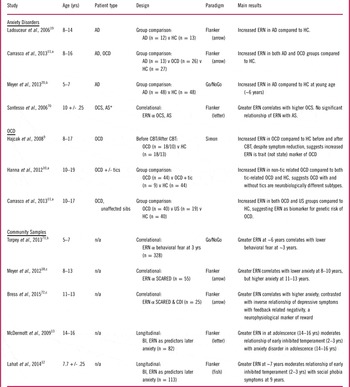
In 1987, PitmanReference Pitman 6 suggested that the symptoms of OCD might originate with dysfunction in a comparator system that compares an internal goal with a perceived outcome, generating a mismatch, or error signal, when the perceived outcome does not match with intention, leading to performance adjustments. According to this “cybernetic theory,” in OCD, larger error signals (mismatches) are generated, leading to compulsive rituals to correct the mismatch, eg, repeated checking to ensure safety.Reference Pitman 6 The discovery of the error-related negativity (ERN), a negative amplitude, event-related potential (ERP) that occurs 50–100 msec after an erroneous response, permitted a test of this hypothesis. Indeed, in 2000, Gehring et al Reference Gehring, Himle and Nisenson 7 reported elevated ERN in patients with OCD in response to errors on a simple cognitive task that does not elicit OCD symptoms. The finding has since been replicated in multiple samples of adultReference Endrass and Ullsperger 8 and pediatric patientsReference Hajcak, Franklin, Foa and Simons 9 – Reference Carrasco, Hong and Nienhuis 11 (see Table 1). Although the details of what causes the increased error signal were not specified (deficient comparator, overly low threshold for mismatch detection, unobtainable internal goals), the cognitive neuroscience approach of performance monitoring—detecting errors and adjusting behavior—held out the promise of a mechanistic understanding of OCD.
Error-related negativity (ERN) and pediatric obsessive compulsive and anxiety disorders: a summary of the published literature
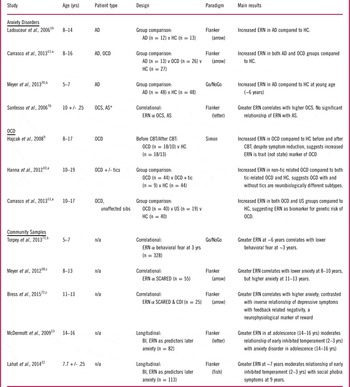
Anxiety disorder (AD) samples included generalized anxiety disorder, separation anxiety disorder, social phobia, and specific phobia. There were no obsessive-compulsive disorder (OCD) diagnoses in any AD sample, except for the study by Meyer et al,20 in which 2 of 48 AD patients had comorbid OCD (with other ADs). HC=healthy control; ERN=error-related negativity; CBT=cognitive behavior therapy; US=unaffected siblings; SCARED=Screen for Child Anxiety Related Disorders; CDI=Child Depression Inventory; BI=behavioral inhibition.
* OCS=obsessive compulsive symptoms in a community (ie, nonclinical) ranged from none to subclinical based on parent report on the obsessive-compulsive subscale of the Child Behavior Checklist (CBCL) (Achenbach, 1991). Non-OCD anxiety symptoms (AS) were also examined in the same sample using the CBCL.
a,b,c Partial subject overlap across studies.
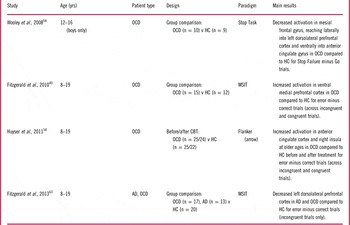
fMRI studies of error-processing in pediatric obsessive compulsive and anxiety disorders: a summary of the published literature

OCD=obsessive-compulsive disorder; AD=anxiety disorders including generalized anxiety disorder, separation anxiety disorder, social phobia and specific phobia; CBT=cognitive behavioral therapy; HC=healthy controls; MSIT=Multisource Interference Task.
However, it soon became apparent that hyperactive ERN is not specific to OCD. ERN hyperactivity also occurs in non-OCD anxiety and in relationship to anxious temperament in nonclinical populations, including in pediatric samples.Reference Olvet and Hajcak 4 , Reference Moser, Moran, Schroder, Donnellan and Yeung 5 , Reference Endrass and Ullsperger 8 , Reference Lahat, Lamm, Chronis-Tuscano, Pine, Henderson and Fox 12 , Reference McDermott, Perez-Edgar, Henderson, Chronis-Tuscano, Pine and Fox 13 . Interestingly, ERN magnitudes are reduced in persons with psychotic disordersReference Foti, Kotov, Bromet and Hajcak 14 and attention deficit hyperactivity disorder,Reference Geburek, Rist, Gediga, Stroux and Pedersen 15 leading some investigators to hypothesize that a hyperactive response to errors is a sign of internalizing disorders.Reference Olvet and Hajcak 4
What, then, is the function of hyperactive error responses in obsessive compulsive and anxiety disorders, in general, and in pediatric patients in particular? Several possible theories relating increased ERN to anxiety have been suggested. Anxiety involves the anticipation of future threat or the worry of an imminent bad outcome. Clinically, it manifests across a spectrum of disorders in children, eg, excessive fear of bad consequences due to temporary separation from parents (separation anxiety), being observed by peers (social anxiety), minor mistakes carrying out “every day” concerns (generalized anxiety), or accidental harm to self or loved ones (OCD). Thus, increased ERN may reflect a source of worry, indexing increased affective valuation of errorsReference Olvet and Hajcak 4 , Reference Proudfit, Inzlicht and Mennin 16 and driving obsessions or worries about errors leading to bad outcomes. Alternatively, it is possible that an increased ERN reflects a compensatory response for deficiencies in control systems, and that these deficits give rise to anxiety,Reference Bishop 17 as detailed in the next section. Another recent theory posits that increased ERN may reflect a secondary effect of anxiety on the brain, rather than a source of anxiety itself; specifically, Moser et al Reference Moser, Moran, Schroder, Donnellan and Yeung 5 suggested that increased ERN may signify a mechanism by which anxious individuals re-activate task goals, in the face of distracting levels of anxiety, to maintain normal performance. In this scenario, an increased ERN occurs to prevent decrements in performance due to anxiety, but the ERN does not directly contribute to anxiety expression.
These theoretical explanations are important steps in understanding the mechanistic significance of increased ERN in OCD and anxiety disorders, but a definitive explanation has yet to emerge. However, in combination with neuroimaging studies, the performance monitoring approach has begun to shed light on neurocircuits that may underlie anxiety. As we will postulate below, imbalanced engagement of brain circuits involved in affective valuation of performance and those engaged in control of performance may combine to drive symptom expression.
Neurodevelopment of ERN in Anxious Youth
Emerging research shows interactions between developmental stage and the relationship of ERN to anxiety in children that, hypothetically, could derive from differential development of affective valuation relative to cognitive control during error-processing. For instance, greater ERN amplitude has been associated with higher levels of subclinical anxiety in early adolescence (11–13 years),Reference Meyer, Weinberg, Klein and Hajcak 18 which is consistent with findings in older youth,Reference Hanna, Carrasco and Harbin 10 , Reference Carrasco, Hong and Nienhuis 11 , Reference Ladouceur, Dahl, Birmaher, Axelson and Ryan 19 whereas the opposite pattern was observed in younger children (greater ERN with lower levels of subclinical anxiety at 8–10 years).Reference Meyer, Weinberg, Klein and Hajcak 18 Even further complexity is suggested by the finding that young children with clinically significant anxiety exhibit increased ERN relative to age-matched healthy controls.Reference Meyer, Hajcak and Torpey 20
At this stage, these findings are not completely reconciled, but suggest complex interactions between error processing, developmental stage, and severity of anxiety. In prepubertal children with low subclinical anxiety,Reference Meyer, Weinberg, Klein and Hajcak 18 greater ERN amplitude may reflect effective signaling for higher level cognitive control, which, in turn, could mitigate subclinical anxiety symptoms by enabling behavioral adjustment (e.g., switching from repetitive worries or compulsions to more appropriate, less anxious behaviors).Reference Muris, van der Pennen, Sigmond and Mayer 21 In contrast, in prepubertal children with clinically significant anxietyReference Meyer, Hajcak and Torpey 20 and in postpubertal individuals with subclinical to clinical levels of severity,Reference Olvet and Hajcak 4 , Reference Moser, Moran, Schroder, Donnellan and Yeung 5 , Reference Endrass and Ullsperger 8 , Reference Meyer, Weinberg, Klein and Hajcak 18 increased ERN could reflect increased affective valuation of errors, unresponsive control system driving error signal up, and/or an imbalance between these processes. Emerging research supports the contribution of both affective and cognitive subcomponents of error-processing to the ERNReference Edwards, Calhoun and Kiehl 22 —sub-components that may mature at different time points and may differentially contribute to ERN–anxiety associations during specific periods of development.
A Neural Network for Affective Valuation and Cognitive Control in Response to Errors: Evidence from fMRI
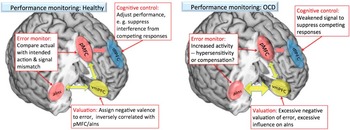
Functional neuroimaging research has provided important data about possible neural substrates of the ERN in particular, and error processing in general, that can inform theory linking this psychological function to anxiety and OCD. For instance, functional MRI (fMRI) has been combined with electrophysiological methods in healthy individuals to localize the ERN to dorsal anterior cingulate cortex (dACC),Reference Mathalon, Whitfield and Ford 23 , Reference Debener, Ullsperger, Siegel, Fiehler, von Cramon and Engel 24 as well as rostral ACC,Reference Edwards, Calhoun and Kiehl 22 , Reference Mathalon, Whitfield and Ford 23 , Reference Agam, Hämäläinen and Lee 25 mid-cingulate,Reference Agam, Hämäläinen and Lee 25 lateral prefrontal cortex,Reference Edwards, Calhoun and Kiehl 22 , Reference Doñamayor, Heilbronner and Münte 26 and inferior parietal cortex.Reference Doñamayor, Heilbronner and Münte 26 Historically, most of the fMRI research on error processing has focused on the posterior medial frontal cortex (pMFC), encompassing dACC and pre-SMA,Reference Ridderinkhof, Ullsperger, Crone and Nieuwenhuis 27 which operates as part of a system of dissociable neural networks that regulate cognitive and affective response to errorsReference Sridharan, Levitin and Menon 28 (Figure 1). In healthy individuals, the pMFC co-activates with anterior insula across a wide variety of tasks,Reference Sridharan, Levitin and Menon 28 comprising a network that is centrally involved in performance monitoring to integrate external task demands with internal motivational state.Reference Allman, Hakeem, Erwin, Nimchinsky and Hof 29 – Reference Cavanaugh and Shackman 32 During performance monitoring, the pMFC also co-activates with other regions, such as dorsolateral prefrontal cortex (dlPFC), to mediate adjustments in behavioral response to external task demands.Reference Kerns, Cohen, MacDonald, Cho, Stenger and Carter 33 While the pMFC is anatomically linked to motor and pre-motor areas that carry out response selection, the anterior insula plays a more prominent role in detecting salience (both externally and internally cued) through bidirectional projections to pMFC and emotion processing regions, such as the ventro-medial prefrontal cortex (vmPFC).Reference Barbas 34 The vmPFC, a brain region that evaluates the significance of stimuli and events,Reference Roy, Shohamy and Wager 35 – Reference Taylor, Martis and Fitzgerald 37 normally deactivates with errors and exhibits a reciprocal, anti-correlated relationship with the pMFC and anterior insula.
Schematic illustration of performance monitoring and proposed disruptions in OCD. (A) In healthy subjects, components of the performance monitoring network include the pMFC working in concert with the anterior insula (aIns) to monitor behavior and detect mismatches (errors), and then send a signal to the dlPFC, which increases control to suppress unwanted interference and improve performance. The vmPFC, which typically deactivates during tasks that require an external focus of attention, also modulates activity in the pMFC and aIns, possibly to provide a signal that determines the value of a task and a subsequent error. (B) In OCD, evidence suggests that several of these components are disrupted (although results in children and adults differ slightly). Activity is increased in the monitoring nodes (pMFC and anterior insula, aIns), and the connection between the vmPFC and aIns is increased, which may signal the greater negative valuation that OCD patients place on errors. Other disrupted nodes may include the pMFC-dlPFC connection, and a weakened ability to overcome interfering activity from valuation centers that drive compulsive behaviors.

The networks that support performance monitoring functions mature dramatically in adolescents,Reference Rubia, Smith, Taylor and Brammer 38 – Reference Davies, Segalowitz and Gavin 41 which provides a context for considering how pathological development of these networks could contribute to pediatric anxiety disorders. Closely related to performance monitoring are executive functions that resolve conflict between competing response options, thus adjusting performance to overcome interference. According to conflict theory, errors are merely a manifestation of unsuccessfully processing response options that interfere with one another.Reference Yeung, Cohen and Botvinick 42 , Reference Carter, Braver, Barch, Botvinick, Noll and Cohen 43 In typically developing youth, age-related changes in the location of midline prefrontal activation, from more rostral (vmPFC) to more dorsal areas (pMFC), have been observed for conflict-processing,Reference Perkins, Welsh, Stern, Taylor and Fitzgerald 44 as well as emotion regulation.Reference Perlman and Pelphrey 45 These findings suggest that mobilization of networks involved in task control (eg, pMFC), over those involved in affective valuation (eg, vmPFC), could contribute to the maturation of capacity for performance monitoring. Studies of connectivity between network nodes for task control (pMFC, dlPFC, anterior insula) and affective valuation (vmPFC), at rest and during task, support this notion. With age, resting state connectivity between pMFC and anterior insula increases, while connectivity with vmPFC decreases.Reference Fair, Dosenbach and Church 46 Age-related increases in functional coupling between vmPFC and dlPFC support improved performance in children during tasks that require cognitive control over affective valuation,Reference Steinbeis, Haushofer, Fehr and Singer 47 implicating interactions between nodes for cognitive and affective aspects of performance monitoring in its maturation.
Increased pMFC-Based Error-Signaling in OCD and Anxiety Disorders: An Adaptive Response for the Recruitment of Cognitive Control?
In adult OCD, imaging studies of error-processing have shown increased pMFC activation,Reference Ursu, Stenger, Shear, Jones and Carter 48 as well as greater activation of more rostral aspects of the ACC.Reference Fitzgerald, Welsh and Gehring 49 , Reference Maltby, Tolin, Worhunsky, O’Keefe and Kiehl 50 Hyperactivation of the pMFC to cognitive conflict has also been reported by some,Reference Ursu, Stenger, Shear, Jones and Carter 48 , Reference Maltby, Tolin, Worhunsky, O’Keefe and Kiehl 50 , Reference Yucel, Harrison and Wood 51 but not all studies of adult OCD.Reference Fitzgerald, Welsh and Gehring 49 , Reference Stern, Welsh and Fitzgerald 52 In patients with pediatric OCD (8–19 years), increased pMFC activation occurs during high-conflict trials (collapsed across correct and incorrect)Reference Fitzgerald, Stern and Angstadt 53 and when errors are examined in separation.Reference Huyser, Veltman, Wolters, de Haan and Boer 54
The role of pMFC hyperactivation in OCD during performance monitoring remains unclear, but recent clinical translation work provides some clues. In an fMRI study of patients with pediatric OCD before and after cognitive behavioral therapy (CBT), Huyser et al Reference Huyser, Veltman, Wolters, de Haan and Boer 54 found that conflict-related pMFC and dlPFC activity increases associated with symptom improvement. The relationship of increasing pMFC and dlPFC activity with decreasing OCD severity suggests that greater activation of these regions may reflect a compensatory mechanism, enhanced by CBT, to enable young patients to control symptoms. That is, patients typically endorse insight that their anxiety-provoking obsessions are excessive, 55 raising the possibility that feared outcomes are appropriately detected as “thinking errors,”Reference Gilbert 56 but cognitive control is insufficiently engaged, allowing symptoms to persist. In other words, greater pMFC activity may reflect conflict between intentions and affect—the normal “security concerns” that become exaggerated in OCDReference Szechtman and Woody 57 —and not errors, per se, but situations where errors are perceived as possible. Signaling by pMFC may enable engagement of dlPFC to implement cognitive controlReference Cavanaugh and Shackman 32 , Reference Kerns, Cohen, MacDonald, Cho, Stenger and Carter 33 over inappropriate intrusion of affect during task execution in OCD. In theory, this mechanism would support response to CBT, which teaches patients to ignore anxiety induced by obsessions as a “false alarm” and resist compulsive urges until the anxiety fades away.Reference Schwartz 58
Functional neuroimaging research in patients with non-OCD anxiety disorders has traditionally employed emotion-inducing, rather than error-eliciting, cognitive conflict tasks, but recent work supports the possibility that anxiety could manifest as the result of impoverished recruitment of prefrontal cortical control. Some studies of non-OCD anxiety have examined cognitive control over emotion, and these studies show excessive pMFC activation to emotional conflict,Reference van den Heuvel, Veltman and Groenewegen 59 but reduced dlPFC recruitment during tasks requiring the regulation of emotional response.Reference Goldin, Manber, Hakimi, Canli and Gross 60 During non-emotional cognitive conflict, higher levels of trait anxiety in healthy adults associate with exaggerated electrophysiological response in an area of midline prefrontal cortex that may localize to pMFC,Reference Moser, Moran and Jendrusina 61 , Reference Righi, Mecacci and Viggiano 62 but reduced dlPFC recruitment.Reference Bishop 17 In our own work, we have found reduced dlPFC activation to errors in pediatric OCD and non-OCD anxiety,Reference Fitzgerald, Liu and Stern 63 consistent with earlier work in pediatric OCD patients.Reference Woolley, Heyman, Brammer, Frampton, McGuire and Rubia 64 Failure to appropriately recruit dlPFC during performance monitoring may reflect insufficient capacity to engage cognitive control, contributing to deficient capacity for adjusting repetitive anxious thoughts and behavior. Taken together, these findings raise the possibility that increased pMFC and reduced dlPFC recruitment by conflict and errors may generalize across OCD and non-OCD anxiety disorders. Since greater pMFC signaling in response to error- and conflict-detection recruits more dlPFC-based cognitive control,Reference Kerns, Cohen, MacDonald, Cho, Stenger and Carter 33 increased activation in both regions may support increased regulatory control over anxiety.
Excessive Affective Response and Insufficient Cognitive Control During Performance Monitoring in OCD and the Anxiety Disorders: An Integrated Model
At this stage of research, many questions remain about the cause of ERN hyperactivity in OCD and anxiety disorders, particularly in pediatric patients. The developmental trajectory of neurocircuits complicates the picture for performance monitoring. Given these considerations, we suggest it may be useful to consider that an imbalance between neural networks for affective evaluation and task execution occurs during error-processing in patients.
Given emerging evidence that a widely distributed network contributes to the ERN,Reference Edwards, Calhoun and Kiehl 22 , Reference Doñamayor, Heilbronner and Münte 26 , Reference Gehring, Liu, Orr and Carp 65 multiple subcomponent processes mediated by distinct network nodes may contribute to the ERN. Indeed, Edwards et al Reference Edwards, Calhoun and Kiehl 22 recently used joint independent component analysis of simultaneously collected ERN and fMRI to reveal two temporo-spatially distinct components contribute to the ERN: (1) an earlier component (48 msec) associated with fMRI activity in caudal ACC and lateral prefrontal cortex (lPFC) and (2) a later component (86 msec) associated with activity in the rostral ACC. The authors interpreted their results as evidence that the ERN reflects early engagement of cognitive processes in caudal ACC and lPFC (eg, mismatch detection, signaling for adaptive control) and later engagement of affective processes in rostral ACC (eg, affective valuation of error significance).
These separable substrates for cognitive and affective response to errors may show differential rates of development, such that links between neurocircuits for performance monitoring and anxiety could differ at different stages of development. Specifically, deficits of neural substrate for adaptive control (e.g., caudal ACC, lPFC) may couple with excessive reactivity in substrate for affective response (e.g., rostal ACC, vmPFC) to drive anxiety across development, while the specific nature of these abnormalities (too little adaptive control, too much affective response, or the combination) may vary with patient age.
Accordingly, several imaging studies of error processing in OCD show increased activity not in the dorsal or caudal ACC, but in the rostral-ventral extent of the medial prefrontal cortex, including the vmPFCReference Fitzgerald, Welsh and Gehring 49 , Reference Maltby, Tolin, Worhunsky, O’Keefe and Kiehl 50 , Reference Stern, Welsh and Fitzgerald 52 (however, see Ursu et al Reference Ursu, Stenger, Shear, Jones and Carter 48 and Woolley et al Reference Woolley, Heyman, Brammer, Frampton, McGuire and Rubia 64 ). In resting state studies, patients with OCD have shown hyperactivityReference Whiteside, Port and Abramowitz 66 and aberrant connectivity of the orbitofrontal region, including vmPFC.Reference Beucke, Sepulcre and Talukdar 67 In adult patients, we have found excessive activity in the anterior insula related to the negative valuation of an error, and this activity was associated with increased connectivity between the vmPFC and anterior insula.Reference Stern, Welsh and Fitzgerald 52 More ventral midline response to errors in the perigenual ACC and vmPFC could be a source of inappropriate intrusion of negative affect (ie, hypersensitive emotional response to errors) that requires enhancing cognitive control mechanisms (increasing pMFC, dlPFC) or restoring separation between circuits for affect and cognition during error processing (eg, reciprocal anterior insula-vmPFC interactions) to improve OCD. Interestingly, in pediatric OCD, error-related activation in the rostral ACC increases from childhood through adolescence,Reference Huyser, Veltman, Wolters, de Haan and Boer 54 suggesting that atypical engagement of this vmPFC sub-region may represent a developmentally sensitive mechanism of illness that emerges with age. Atypical interactions between anterior insula and vmPFC have not been demonstrated in pediatric patients, and additional research will be needed to determine whether failure to develop reciprocal interactions between these regions uniquely characterizes OCD in adults.
A consideration of a cognitive-affective imbalance in OCD and anxiety disorders has several implications for future research. For example, it is not clear if the negative affect associated with an error represents a more general signature of anxiety, or more specific affects, such as worry, apprehension,Reference Moser, Moran, Schroder, Donnellan and Yeung 5 or frustration.Reference Spunt, Lieberman, Cohen and Eisenberger 68 Additional research is needed to determine whether vmPFC hyperactivity may be the source of a pathological negative appraisal of error commission in OCD and non-OCD anxiety disorders. In addition, developmental neuroimaging work is needed to determine whether there are sensitive periods for performance monitoring abnormalities during which certain interventions are most likely to be successful.Reference Casey, Pattwell, Glatt and Lee 3 For instance, in healthy youth, pMFC-based networks for performance monitoring continue to develop through adolescence and into young adulthood,Reference Fair, Dosenbach and Church 46 , Reference Ferdinand and Kray 69 suggesting plasticity that may make performance enhancing strategies (eg, cognitive control training) particularly beneficial for adolescent patients. By contrast, in anxiety, atypical vmPFC-insula interactions during performance monitoring may emerge later in development, necessitating other strategies to reduce anxiety in older patients.
Conclusion
ERN and fMRI research consistently demonstrate hyperactivation to errors in midline prefrontal cortex in pediatric and adult patients with OCD and non-OCD anxiety disorders. These abnormalities have been variably localized, and we have suggested that more posterior activations may reflect a compensatory process by which increased signaling for cognitive control can reduce anxiety, while more ventral activations may represent the source of a pathological negative appraisal of error commission, triggering anxiety symptoms. We have also considered the maturation of neural substrate for cognitive control and affective/evaluative aspects of error-processing, suggesting that specific abnormalities of these functions may vary with illness severity and stage of development. For instance, impoverished recruitment of prefrontal control may set the stage for the emergence of anxiety, and may need to be specifically targeted in young patients to reduce symptoms. By contrast, adult patients may have missed the developmental window in which mechanisms for cognitive control are most amenable to modulation. Instead, in older patients, enhancing reciprocal connections between pMFC- and dlPFC-based networks for control and vmPFC-based affective valuation may need to be a focus of treatment. It is also important to understand whether or not the signals from ERP and fMRI studies represent compensations for or causes of anxiety, in order to design cognitive training or neuromodulatory therapies that would seek to increase (in the case of compensatory activity) or decrease (for targets causing anxiety) signaling. In conclusion, error-processing networks present potential targets for novel treatments, such as cognitive training or transcranial magnetic stimulation, to reduce and even prevent illness. However, developmentally sensitive alterations of error processing will need to be considered, since these networks may need to be targeted differently at different stages of development.
Disclosures
Kate Fitzgerald has the following disclosures: NIMH, independent investigator, research support. Stephan Taylor has the following disclosures: St. Jude Medical, independent investigator, research support; Neuronetics, independent investigator, research support; NIMH, independent investigator, research support.