

1. INTRODUCTION
South Africa is no stranger to transition and is still esteemed among nations of the world for the (largely) peaceful constitutional transition that unfolded over the closing decades of the 20th century: from decades of apartheid rule to a state founded on democracy, respect for human rights, the rule of law, and a unique multi-sphere system of government. The country's socio-economic transition, however, has been far more tortuous. Decades into democratic rule, South Africa is still struggling with low economic growth; high levels of structural unemployment, poverty and inequality; and a resource-intensive, fossil fuel-based economy.
For more than ten years the South African government has promoted the idea of a ‘just transition’ to a climate-resilient, low carbon economy, as a means to address many of these complex, interlinked socio-economic challenges. The 2011 National Climate Change Response White Paper, for example, presents the government's vision for a ‘long-term, just transition to a climate-resilient and lower-carbon economy and society’.Footnote 1 The National Development Plan 2030, adopted by the South African Parliament in 2012, supports the ‘transition to an environmentally sustainable, low-carbon economy’ as a cross-cutting policy objective that needs to be integrated into all government plans.Footnote 2 Moreover, in a 2019 ‘roadmap’ outlining governance reforms of the country's public utility, Eskom, the national Department of Public Enterprises outlines the key pillars of South Africa's ‘Just Transition process’. These key pillars include creating an inclusive economy based on the cheapest energy available, protecting and growing jobs from low-cost energy, and enabling energy access and security to all South Africans.Footnote 3 Clearly, the South African government understands that a just transition involves an energy transition: namely, a systemic shift away from fossil fuels towards increased reliance on renewables and other energy sources.Footnote 4
Until recently, a just energy transition in South Africa has been slow and difficult to achieve, as it has in other parts of the world.Footnote 5 Fossil fuels remain the dominant energy source, even though renewable energy sources are making inroads.
Formally, South Africa is not a federal state. Section 1 of the 1996 Constitution states that South Africa is one sovereign democratic state. A ‘functional’ form of federalism nevertheless exists as a result of the entrenchment in the 1996 Constitution of a multi-sphere system of government. Along with the historically entrenched position of Eskom and the recent introduction of private electricity generation, this positions South Africa as a peculiarly interesting case study to examine issues in energy federalism. In line with the expanded conception of dynamic energy federalism of Hari Osofsky and Hannah Wiseman, this article uses ‘federalism’ in a sense that extends beyond static views of multi-level governmental relationships to include complex interactions among governmental and non-governmental actors.Footnote 6
The questions guiding the flow of this article include the following.
• What form of federalism prevails in South Africa?
• Which theories of federalism resonate with the South African case?
• How does South Africa's functional federalism facilitate or constrain interactions between the different spheres of government (national, provincial, local) and with non-governmental actors?
• Does this functional federalism help or hinder a just transition?
The article begins by explaining the functional federalism that applies in the unitary state of South Africa. It is a form of federalism which also affords significant powers to the local sphere of government. Section 3 of the article briefly explains a theory of energy federalism. This draws on insights from classical federalism, public choice theory, and Osofsky and Wiseman's dynamic energy federalism. Section 4 offers a detailed overview of the tripartite (physical, market, and regulatory) features of the South African energy system in order to identify the key governance challenges arising in this system. Section 5 comments on how the South African case both benefits from and contributes to theoretical insights into the allocation of power for a just transition in a federalist system.
The energy sector in South Africa encompasses both liquid fuels and an electricity sector.Footnote 7 This article, however, focuses specifically on the electricity sector, where the dynamics of energy federalism play out far more clearly than is the case for liquid fuels. South Africa's heavy reliance on oil importsFootnote 8 and its tight central control over petroleum products leave little space for any decentralization of power over liquid fuels. For electricity, however, this is a vastly different story.
2. FUNCTIONAL FEDERALISM IN A UNITARY STATE
South Africa is characterized as a unitary state. It is not a federation, confederation, or league of any form. This is clear from the very first provision of the 1996 Constitution, which states that South Africa is ‘one, sovereign democratic state’.Footnote 9 Yet, federalism may exist nonetheless in South Africa, in so far as it is a binding constitutional agreement according to which powers of central, regional, and even local governments are divided in ways that allow for both unity and diversity in policy and lawmaking.Footnote 10
At the start of negotiations that led to democratic rule after decades of apartheid, the dominant African National Congress (ANC) was resistant to considering any form of federalism. The ANC preferred a centralized state that would be able to drive a development agenda. Federalism became a highly ‘emotive’ issue, as it was seen as a ploy for parties protecting minority racial and ethnic groupings to entrench their interests in specific regions.Footnote 11 However, the multi-party negotiations that led to the Constitution – which was drafted by a democratically elected assembly, and certified by the new Constitutional Court – produced a ‘very decentralized’ system.Footnote 12 This is reflected in the Constitution's conferral of legislative and executive authority on three ‘spheres’ of government – namely, upon the national, provincial, and local levels.Footnote 13 In practical terms this translates as one national government; nine provincial governments; and a sphere of local government constituted by eight metropolitan municipalities, 44 district municipalities, and over 200 local municipalities.Footnote 14
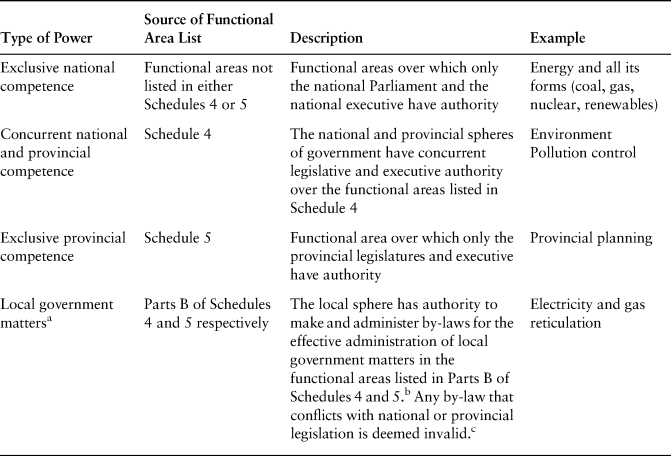
The Constitution states that the three spheres are ‘distinctive, interdependent, and interrelated’.Footnote 15 Elaborating on this vision, the constitutional drafters established a sophisticated matrix of exclusive, concurrent, and overlapping powers organized around the notion of ‘functional areas’ of governance, as set out in Schedules 4 and 5 of the Constitution. Table 1 below sets out the allocation of these powers in functional areas related to energy.
Exclusive and Concurrent Powers under the South African Constitution, 1996

Notes
a Constitution, 1966, s. 156(1). Municipalities have executive authority and the right to administer local government matters, in addition to any other matter assigned to them by national or provincial legislation.
b Ibid., s. 156(2). This power, however, is subject to extensive supervision by the national and provincial spheres, which includes the potential for national and provincial governments to intervene in failing municipalities.
c Ibid., s. 156(3).
Neither ‘energy’ nor any of its forms (oil, gas, nuclear, renewable energy, and so on) are listed as a functional area in Schedules 4 and 5, making these matters the exclusive preserve of the national sphere. Significantly, however, ‘electricity and gas reticulation’ is listed as a local government matter in Part B of Schedule 4. This constitutional mandate affirms the historical role that municipalities have played in the electricity distribution industry, and is the foundation upon which they flex their power to procure electricity from generators of their choice.Footnote 16
The Constitution not only establishes a matrix of exclusive, concurrent, and overlapping powers that intersect across three governmental spheres, but prescribes that the spheres must relate ‘cooperatively’. The principles for this system of ‘cooperative government’ are set out in Chapter 3 of the Constitution. The strong bias of the principles of cooperative government is to promote cooperation and coordination, and to avoid conflict.Footnote 17 The principles exhort ‘all spheres of government and all organs of state within each sphere’ to preserve the peace, national unity and indivisibility of the Republic;Footnote 18 to secure the wellbeing of the people of the Republic;Footnote 19 and to provide effective, transparent, accountable, and coherent government for the Republic as a whole.Footnote 20 Principles aimed at avoiding, rather than supporting, conflict include the need for all spheres of government, and all organs of state within each sphere, to respect the constitutional status, powers and functions of government in the other spheres;Footnote 21 to not assume any power or function except those conferred upon them in terms of the Constitution;Footnote 22 and to exercise their powers and functions in a manner that does not encroach on the geographical, functional or institutional integrity of government in another sphere.Footnote 23
The Constitution also underscores the need for various dimensions of cooperation, such as ‘fostering friendly relations’,Footnote 24 ‘coordinating actions and legislation’,Footnote 25 and ‘adhering to agreed procedures’.Footnote 26 It also expressly states that spheres of government and organs of state within each sphere must avoid legal proceedings against one another.Footnote 27 Some commentators have gone so far as to claim that this establishes a constitutional duty to resolve intergovernmental disputes at the political level.Footnote 28 In the case of National Gambling Board v. Premier of Kwa-Zulu Natal,Footnote 29 the Constitutional Court held that the duty to avoid litigation requires each organ of state to fundamentally re-evaluate its position, to consider alternative possibilities and compromises, and to do so with regard to expert advice.Footnote 30
Victoria Bronstein has argued that the allocation of powers in the 1996 Constitution creates a system of ‘functional federalism’ – namely, a system that establishes the limits and centres of powers, and allocates powers in broad brushstrokes, but still leaves enough discretion for judges to actively consider how different levels of government can function most effectively within the constitutional framework. This is notwithstanding the bias against conflict resolution through the courts that is inherent in the principles of cooperative government enshrined in the Constitution.Footnote 31
The courts have not shied away from opportunities to consider questions about the rightful allocation of powers between the different spheres of the South African state. In doing so they have carved out areas of exclusive power, despite the apparently more fluid and overlapping scheme constituted by Schedules 4 and 5. With regard to this point, the Constitutional Court's decisions in the 1999 case of Ex Parte President of the Republic of South Africa: In re Constitutionality of the Liquor Bill,Footnote 32 and the 2010 case of City of Johannesburg Metropolitan Municipality v. Gauteng Development Tribunal Footnote 33 are notable. In the Liquor Bill case, which dealt with the allocation of legislative and executive powers between the national and provincial spheres of government, the highest court laid the foundation for a ‘Constitution-makers’ vision’ of a scheme based on each sphere's ‘appropriate’ functional areas. This stance resonates with the claims of classical federalism – that is, that regulatory authority for particular issues should each reside exclusively in a single level of government (‘assumption of exclusivity’), and that the allocation of such authority within a state remains static (‘assumption of stasis’).Footnote 34
The Gauteng Development Tribunal case applied and extended these principles. The case dealt with overlapping – and conflicting – provincial and municipal laws, as well as executive orders on land-use zoning and development. The case turned essentially on the proper meaning ascribed to ‘municipal planning’ in Part B of Schedule 4 of the Constitution. In reaching its decision, the Constitutional Court did not resort to cost-benefit arguments, or refer to the matching principle, or draw insights from public choice theory in determining how to allocate regulatory authority. It simply affirmed the discretion of the court in Liquor Bill to allocate functional areas between different spheres of government according to what the court itself deemed ‘appropriate’.Footnote 35 The Constitutional Court then extended this principle by holding that, while these functional areas ‘were not contained in hermetically sealed compartments’, they nonetheless remained distinct from one another.Footnote 36 ‘The constitutional scheme propels one ineluctably to the conclusion’, the Court continued, ‘that, barring functional areas of concurrent competence, each sphere of government is allocated separate and distinct powers which it alone is entitled to exercise’.Footnote 37 Having made this point, however, the Court seemed to overlook that the Constitution already identified the local government matters set out in Part B of Schedule 4 as matters of concurrent national and provincial legislative competence.
In this it seemed that the Court was intent on saving a form of authority which had always been the preserve of local government (zoning and approving development applications), emphasizing the position of local government within a context of concurrent national and provincial framing powers. The Court, accordingly, went on to interpret ‘municipal planning’ as an exclusive functional area of the local sphere of government. The Court held that, although this function was framed and guided by national legislation, the local sphere needed to be granted autonomy to perform its functions, and exercise its powers, within the parameters of its constitutionally defined space. On this reasoning, the Court determined that the province's attempt to create a parallel process for land-use zoning and development was an unjustified and unconstitutional encroachment upon local powers.Footnote 38 As will become apparent below, this understanding of the constitutional scheme is relevant to the question of whether local authorities can source electricity from generators other than Eskom.
This brief overview of the multi-sphere constitutional design of the South African state begins to reveal a complex institutional matrix comprising three interacting spheres, with exclusive, concurrent, and overlapping powers. This is the space in which interactions over governance in the electricity sector, and movements towards a just transition in South Africa, play out. In the electricity sector, the role of the provinces recedes in favour of the national and local spheres. Considerable ambiguity remains, however, because the scope of the exclusive power of the national sphere over energy or electricity is not stated explicitly in the Constitution. The scope of the phrase ‘electricity and gas reticulation’, which is identified in the Constitution as a local government matter, is also left ambiguous. The Constitutional Court nevertheless has made it clear that the realms of bounded autonomy, linked to the description of functional areas in the Constitution, must be preserved. Moreover, both national and provincial spheres may supervise the exercise of local government matters. Added to this is the fact that, notwithstanding a constitutional bias towards the political resolution of intergovernmental disputes, the courts have staked boundaries between different spheres of government.
3. LOCATING POWER IN A FEDERALIST SYSTEM FOR A JUST TRANSITION
What does federalism theory have to say about the proper allocation of powers for a just transition, climate change, and renewable energy? In a recent contribution on ‘clean energy federalism’, Felix Mormann draws on theoretical insights from three bodies of literature on federalism to reflect upon the positioning of climate change and renewable energy policies.Footnote 39 Classical federalism and the ‘matching principle’, public choice theory, and dynamic energy federalism offer insights into clean energy federalism.
Classical federalism favours the national level of government as the ideal level at which policy innovation on climate change and clean energy should take place.Footnote 40 The twin assumptions of classical federalism – exclusivity and stasis – have already been discussed above. Yet, on their own they are not sufficient for principled decisions on where authority should appropriately be located. Arguments over which level of government (national, state, or provincial) should have pre-eminence are fundamentally indeterminate. In the area of environmental federalism these arguments have waged for years. The scholarly debate on environmental federalism dates back to an influential 1970s article by Richard Stewart, which argued for federal regulation of environmental issues in preference to state regulation on a variety of political and economic grounds. Stewart maintained, for example, that state regulation would trigger a regulatory race to the bottom as states competed to capture mobile industries.Footnote 41 Richard Revesz chipped away at the pillars of Stewart's argument in a series of articles published in the early 1990s claiming, for instance, that interstate competition in environmental standard setting would increase social welfare.Footnote 42
In the mid-1990s, however, Henry Butler and Jonathan Macy devised a ‘matching principle’, according to which regulatory authority should, as far as is possible, be conferred upon ‘the political jurisdiction that comes closest to matching the geographic area affected by a particular externality’.Footnote 43 Thus, according to this principle, if a local or state authority is able to ensure that environmental externalities are internalized within the geographic boundaries of its jurisdiction, there should be no need for federal involvement.Footnote 44 Federal regulation might, however, be preferable if it avoids the spillover effects and externalities that would arise from state regulation.Footnote 45 Applied to climate change, the matching principle implies that climate change policy ideally should be formulated at either the international or the federal level – in the absence of international consensus – because the effects of climate change are ‘global’ in scope.Footnote 46
In his analysis of the appropriate ‘home’ for renewable portfolio standards and feed-in-tariffs, however, Mormann argues for a ‘nuancing’ of the matching principle. Focusing on only one dimension of a policy issue (the reach of the externalities of carbon pollution, for example) obfuscates the ‘cornucopia’ of other, more localized costs and benefits that climate and clean energy policies can create.Footnote 47 Local environmental benefits include reduced health impacts from noxious air pollutants associated with coal-fired power stations, and better conservation of precious water resources. A variety of more localized economic benefits also flow from renewable energy policies. These include higher employment resulting from the refinement and development of abatement technologies.Footnote 48 ‘Nuancing’, as Mormann points out, does not invalidate the matching principle. Rather, it may lead to a different policy ‘home’ for issues that would otherwise have been allocated to the national, or even international, level.
In federalism literature the application of public choice theory has also favoured federal over state action.Footnote 49 As Mormann notes, the key justification for a centralist bias is that federal regulation is a better guard against agency capture and policy distortions arising from the lobbying of ‘well-organized, cohesive industry groups’.Footnote 50 In the literature on environmental federalism, centralized policymaking has also been justified on the basis of increased economies of scale and reduced transaction costs.Footnote 51 On the other side of the coin, it has been argued that a pro-federal bias homogenizes environmental concerns and exacerbates the organizational problems of interest groups. Many scholars also recognize that national consensus on policy issues – climate change and clean energy, in particular – is notoriously difficult to achieve.Footnote 52 The allocation pendulum, it seems, can swing either way.
Finally, dynamic energy federalism challenges classical energy federalism's twin principles of exclusivity and stasis. As its nomenclature suggests, dynamic energy federalism focuses on the dynamics that can arise when actual jurisdictional overlaps within and between the governmental and non-governmental sector are accepted as the norm rather than the exception.
In Kirsten Engel's influential article published in 2006 on dynamic environmental federalism in the Unites States (US), she identifies that the federal government frequently intervenes in matters that could be considered purely local in nature. This includes, for example, regulating municipal dumpsites. Meanwhile, state and local governments tend to concern themselves with issues that are plainly national or international in character, such as regulating greenhouse gas (GHG) emissions.Footnote 53 Given this, Engel argues that the political dynamics operating within federal structures be given full sway.Footnote 54 Federal and state governments function as alternative centres of power, and any given matter should presumptively be within the authority of both jurisdictions.Footnote 55 She also discourages the courts from assuming a federalism-policing role, and from attempting to draw clear boundaries between federal and state regulatory powers.Footnote 56 Dynamic environmental federalism, she maintains, allows a particular level of government to lead policymaking and implementation. This can prompt subsequent responses at the more optimal level of government.Footnote 57 The overlapping nature of these responses creates a regulatory safety net, which allows one level of government to step in if another fails adequately to address the problem.Footnote 58 It also combats the risk of regulatory capture by elite interest groups, which may not be able to influence policy initiatives at every level of government.Footnote 59 Finally, it allows for more devolved levels of government to function as laboratories for regulatory innovation. With regard to this point, novel social and economic policies can be implemented at the state or local level of government without putting the rest of the country at risk.Footnote 60
Similarly, Osofsky and Wiseman have coined the term ‘dynamic energy federalism’. They provide the first systematic account, in an article published in 2013, of energy federalism in the US.Footnote 61 Like Engel, they argue that energy scholarship has focused excessively on the methodology of ‘scale matching’ which characterizes traditional federalism.Footnote 62 Their aim instead is to highlight the multifarious interactions that occur within the multi-level energy governance system of the US. Osofsky and Wiseman devote an extensive portion of their article to ‘mapping’ how key institutions engage dynamically on both a ‘vertical’ and ‘horizontal’ plane.Footnote 63 This mapping exercise lays the groundwork for identifying three common governance challenges in federal systems: (i) having adequate authority for the energy system to function and to evolve in response to challenges; (ii) balancing between cooperation and conflict within an institutional structure that simultaneously incentivizes fragmentation and overlap; and (iii) mediation between the diversity of public, private and hybrid actors within energy governance systems.Footnote 64 The last of these governance challenges assumes an expanded conception of federalism, which includes complex interactions among governmental and non-governmental actors.Footnote 65
The concern of Osofsky and Wiseman here is how to include private actors, such as owners of private utility companies, in governance processes so as to minimize the potential for capture by special interests.Footnote 66 Firstly, to deal with the authority deficit, the authors propose the creation of institutions or multi-institutional structures with capacity for multi-level, cross-cutting regulatory authority. Secondly, to ensure a balance between cooperation and conflict, they propose the creation of structures through which hierarchy can be defined, cooperation can take place, and conflicts can be resolved. Thirdly, to ensure that energy governance accounts for the diversity of public, private and hybrid actors, the authors propose the creation of institutions that integrate key public and private stakeholders with structural and procedural protection against capture.Footnote 67 The authors are quick to caution, however, that policymakers must be mindful of the complex interactions taking place in a multi-level governance system.Footnote 68 Recognizing these interactions ‘enables a more nuanced understanding of possibilities for structuring energy law institutions’.Footnote 69
What do these insights add to our understanding of South Africa's functional federalism, and its allocation of authority over the electricity sector? None of these theories feature overtly in the Court's reasoning in the Liquor Bill or Gauteng Development Tribunal cases. Nevertheless, one can discern echoes of classical federalism in the Constitutional Court's concern to protect distinct and exclusive powers, particularly for the local sphere. Secondly, the constitutional design does seem to lend itself to dynamic energy federalism. The originality of the powers granted to the three spheres of government, coupled with the ambiguity inherent in listed concurrent and overlapping powers and unlisted exclusive powers, establishes a fertile plane for complex vertical and horizontal engagements. Finally, the Constitution emphasizes the unitary nature of the South African state, and the legislative conflict provision in section 146 favours the national sphere of government. These provisions probably have far less to do with public choice theory than with establishing a strong central state to drive a developmental agenda. The relationship between national regulation and corruption, agency capture, economies of scale, transaction costs, and environmental concerns is nonetheless worthy of further consideration.
4. THE TRIPARTITE STRUCTURE OF THE SOUTH AFRICAN ENERGY SYSTEM
To facilitate a deeper analysis of the South African energy-electricity system in the context of functional federalism and a just transition, this section of the article borrows from Osofsky and Wiseman's conception of a ‘tripartite structure’. This is a system which comprises, firstly, physical processes that underlie the energy system. Secondly, the system also includes market-related processes, namely the demand for energy sources and their supply from transnational and national sources. Thirdly, the structure encompasses the regulation of energy supply and demand, including the vertical and horizontal relationships among and between public and private actors.Footnote 70
4.1. Physical Processes
South Africa's installed capacity for primary and secondary energy supply is still dominated by fossil fuels, although integrated electricity generation planning envisages a moderate transition to renewable sources.Footnote 71 The latest Energy Sector Report (based on 2016 energy balances), pegs the share of coal in total energy supply at 69%, crude oil at 14%, and renewables and waste at 11%.Footnote 72 Natural gas and nuclear each contribute 3% to the total primary energy supply.Footnote 73
Relying on 2010 statistics, the 2016 Integrated Energy Plan put the share of coal in electricity generation at 90%, followed by nuclear energy and hydroelectric sources at 5% and 4.5% respectively.Footnote 74 However, this energy mix has already changed, as the government's plans to diversify the electricity generation mix have started to bear fruit. In the Integrated Resource Plan (2010), the country's first integrated electricity plan, the Department of Energy identified the need for an additional 38 gigawatts (GW) of generation capacity sourced from renewables (17.8 GW), nuclear (9.6 GW), gas (6.3 GW), new coal (6.3 GW), and imported hydroelectric power (2.6 GW).Footnote 75 With these commitments in place, by 2030 the top three energy sources for electricity generation would have been coal (65%), nuclear (20%), and renewables (9%).Footnote 76
Over a mere eight-year period since then, however, several key assumptions have shifted. These include projections of electricity demand, Eskom's existing plant performance, and the cost of new generation technologies. Electricity demand has not increased as originally projected, the efficiency and output of Eskom's coal-fired power plants has been disappointing, and the costs of renewable energy have declined. With these factors in mind, the second Integrated Resource Plan (IRP2019) presents an ‘emerging’ long-term plan to 2030, which assigns a larger share of electricity generation capacity to solar photovoltaic, wind, and concentrated solar power facilities. This includes a projected increase in the current installed capacity of approximately 4 GW to a planned capacity of 26.5 GW in 2030. This brings the overall contribution of renewable technologies to the total electricity generation capacity in South Africa to 33.8% in 2030.Footnote 77 Over the same period the percentage of installed coal capacity is planned to drop to 43%.Footnote 78 The report predicts that this will be driven by the decommissioning of 11 GW of coal-fired power.Footnote 79 Meanwhile, an estimated 7.2 GW of new coal-fired power will be added to the grid. Over the foreseeable future, therefore, coal will continue to play a significant role in electricity generation. Yet, the proportion of renewable energy will continue to increase significantly.
The current and future energy mix in South Africa largely reflects the country's stock of natural resources. South Africa has significant reserves of coal, and features among the world's top coal-producing countries.Footnote 80 The amount of available coal is contested. However, estimates range in the billions of tonnes, which will satisfy electricity generation and liquid fuel production needs over the medium to long term.Footnote 81 The South African government's desire is to continue to harness these coal resources. The IRP2019 points out that while South Africa will be decommissioning its existing coal fleet, the government will invest in ‘high efficiency low emissions’ (HELE) technology, as well as ‘super’ and ‘ultra-critical’ plants with carbon capture and storage (CCS) technologies.Footnote 82
Alongside coal there is significant potential in South Africa to harness solar, wind, biomass, and biogas resources. The country's daily solar radiation varies between 4.5 and 6.5 kilowatt hours per square metre. It also has a large total estimated area of high radiation of 194,000 square kilometres (km2).Footnote 83 The Integrated Energy Plan reports that if only 1% of this high radiation area were to be made available for solar power generation purposes, it would generate approximately 64 GW of electricity.Footnote 84 However, some of the highest solar radiation areas – such as the Northern Cape – are located long distances away from the country's main centres of electricity consumption.Footnote 85 Wind power potential is generally ‘good’ along the entirety of South Africa's 2,850 km-long coastline, with a few areas having ‘very good’ potential.Footnote 86 A few inland areas have moderate wind potential.Footnote 87 The report also indicates good opportunities to develop biomass and biogas resources.Footnote 88
While South Africa has significant reserves of uranium, the Koeberg reactor on the west coast is the country's only nuclear facility. The Zuma administration (2009–17) lobbied aggressively for a nuclear build programme, with a price tag of 1 trillion rand (R1 trillion).Footnote 89 This initiative was widely tainted by allegations of corruption. Yet, it was included in the first Integrated Resource Plan, which projected a new nuclear generation capacity of 9.6 GW. Under President Cyril Ramaphosa, however, the government has cancelled this project, although the IRP2019 still holds out the possibility of developing small nuclear power generation units.Footnote 90
South Africa is limited in hydroelectric capacity, gas, and oil. The country is water-stressed, and almost all hydroelectric resources are already fully utilized, although plans are continuing for South Africa to benefit from the Grand Inga Hydro-Electric project.Footnote 91 Shortfalls in conventional gas supplies are met through imports from neighbouring Mozambique. A long-standing policy initiative to undertake hydraulic fracturing in the Karoo region has not yet commenced.Footnote 92 As an importer of crude oil, the South African economy is extremely vulnerable to oil market volatility.Footnote 93 With the exception of oil, gas, and potentially future hydroelectric power, South Africa's primary energy sources are not dogged by geopolitical risk. Ageing energy infrastructure and poor governance of the coal sector, in particular, have posed greater risks to energy security than geopolitical factors.
Electricity generation and transmission are concentrated in Eskom, the public utility company. Eskom's transmission assets include numerous substations, transformers, and about 33,000 km of transmission lines. These network with a regional market through the Southern African Power Pool.Footnote 94 The transmission system is ageing and requires new investment.Footnote 95 Electricity distribution infrastructure (distribution lines, reticulation lines, and underground cables), on the other hand, is split between Eskom and the individual municipalities.
Unsurprisingly, given the heavy reliance on fossil fuels, decarbonizing the energy sector will help South Africa in meeting its international climate change commitments. Between 1990 and 2015, South Africa's carbon dioxide from energy (CO2e) emissions increased by 57%, from approximately 350 megatonnes (Mt) to 537 Mt per annum.Footnote 96 Energy-related emissions make up the largest share of GHG emissions, at 440 Mt per annum or around 80%, and about 65% of this amount is used for generating electricity and heat.Footnote 97 At 9.6 Mt per annum, South Africa's GHG emissions per capita are higher than the G20 average;Footnote 98 and, although the energy intensity of the economy has declined, it is still among the highest in the world as a result of heavy dependence on fossil fuels.Footnote 99
South Africa has nevertheless made firm climate change mitigation commitments. The country is a party to the United Nations Framework Convention on Climate Change (UNFCCC),Footnote 100 the Kyoto Protocol,Footnote 101 and the Paris Agreement,Footnote 102 and there is strong government support for climate change mitigation and adaptation.Footnote 103 Still, the South African nationally determined contribution (NDC) stresses the need to balance GHG mitigation with the need for development, economic growth, and poverty alleviation.Footnote 104 The NDC proposes a ‘peak, plateau and decline’ trajectory, with emissions peaking in the range of 398 to 614 Mt of CO2e per annum between 2020 and 2025. It is envisaged that emissions will then plateau for a decade, before declining in absolute terms thereafter. This decline could nevertheless be far more precipitous if widespread decarbonization of the electricity sector could take place sooner.
4.2. Market-related Developments
South Africa has a large surface area (more than one million km2), and a comparatively low population density (130th in the world).Footnote 105 However, energy demand is unevenly distributed. Energy needs are concentrated in Gauteng province, the economic hub of South Africa, and 12 large municipalities.Footnote 106 Energy usage is highest in the industrial sector (52%), followed by the transport sector (19%).Footnote 107 Within the industrial sector the largest users are iron and steel producers (18%), and in the chemical and petrochemical sector (14%), while the proportion of energy use attributed to mining and quarrying is around 10%.Footnote 108
Two major lobbying groups represent the industrial sector's interests in energy-related issues. In late 1999, large industrial users established the Energy Intensive Users Group as a voluntary, non-profit association, which advocates reliable, quality electricity supply at affordable prices.Footnote 109 Despite their lobbying efforts, the price of electricity has increased by 523% over the past decade.Footnote 110 The other key lobbying group is the unions. The Congress of South African Trade Unions (COSATU) is part of the governing tripartite alliance,Footnote 111 and its membership includes key unions which stand to be affected by a shift away from fossil fuels in the energy mix. The Coal Transporters Forum, a voluntary association representing the interests of companies that transport coal, has already flexed its muscle to resist change. The Forum sued Eskom in a bid, firstly, to prevent the utility from signing any further power purchase agreements with independent renewable energy power producersFootnote 112 and, secondly, to have all previous power purchase agreements with renewable energy producers declared invalid. However, its application was dismissed in a judgment handed down in March 2019.Footnote 113
The residential sector accounts for only 8% of energy use, but demand from this sector has increased as a result of the government's integrated national electrification programme. In 1996, only 58% of the population had access to electricity.Footnote 114 Access was also highly racially skewed with only one in four black households electrified. By 2016, electricity access had increased to 88% of households as a result of billions of rand of public investment spent in connecting 6.7 million households.Footnote 115 Universal and affordable access remains a key objective in South Africa's energy policy.
The electricity sector, however, is dominated by Eskom. The public utility company came into being in 1923 as the Electricity Supply Commission of South Africa, and is the largest producer of electricity in Africa.Footnote 116 It also emits 42% of South Africa's GHGs.Footnote 117 Eskom is vertically integrated, owning an (ageing) fleet of coal-generated power stations, the Koeberg nuclear reactor, an extensive transmission network, and 40% of distribution facilities.Footnote 118
In recent years Eskom has been reeling from corruption and maladministration, severely affecting its ability to meet electricity demand. In late 2007, disruptive ‘load shedding’ (which is a rolling disruption in electricity supply) hit the country for the first time, precipitating the start of the country's protracted energy crisis. Further blackouts occurred in 2014, 2015, and in early 2019. In December 2019, unprecedented ‘stage 6’ load shedding was implemented as 13,000 megawatts (MW) was made unavailable on the national grid.Footnote 119 Rotational load shedding has had ‘severe’ consequences for the economy.Footnote 120 At the time when load shedding was first implemented, policymakers and parliamentarians attributed the blackouts to a shortage in generation capacity, and responded by developing the country's first integrated electricity plan.
Since then, however, it has transpired that Eskom has been mired in state capture and corruption. For example, investigative journalists have revealed that an investment company linked to the notorious Gupta family was used to siphon off more than R500 million from the utility company.Footnote 121 Procurement linked to the construction of two new coal-fired power stations, Medupi and Kusile, also appear to have provided fertile grounds for corruption to flourish. In April 2018, President Ramaphosa signed a Proclamation establishing a Special Investigating Unit to investigate potential maladministration and corruption associated with the construction of these facilities, among other matters.Footnote 122
Corruption, maladministration, and the ongoing need to avert load shedding have thrust Eskom into a vicious cycle of loss and debt. Eskom is now at risk of bankruptcy.Footnote 123 The utility reported a R20.7 billion after-tax loss for the 2018 financial year, spending a reported R6.5 billion on open gas cycle turbines to avert load shedding. It is also owed R19.9 billion by defaulting municipalities.Footnote 124 Eskom's non-current liabilities have climbed to an unsustainable R495 billion,Footnote 125 and there are insufficient cash flows from its operations to service its debts.Footnote 126
As sole shareholder, the government has stood by Eskom: the utility is simply too big to fail. Eskom's fate has a direct impact on the country's sovereign credit rating and threatens its most recent investment grade rating with Moody's.Footnote 127 In his 2019 State of the Nation address, President Ramaphosa announced ‘firm support’ for Eskom of R23 billion over ten years. This support was ‘front-loaded’ and funds were made available immediately to ensure that Eskom remains a going concern over the next two years.Footnote 128
In October 2019, Eskom's perilous financial state prompted the adoption of a ‘roadmap’ to reform the South African electricity supply industry. This roadmap sets out plans to establish an Eskom Holdings company, with separate subsidiaries for generation, transmission, and distribution respectively. The government characterizes this move as ‘the largest institutional transformation South Africa has undertaken in a strategically important area in recent history’.Footnote 129 Steps are also being taken to set up a transmission subsidiary over the short term. The roadmap envisages that the formation of such a transmission entity, operating under the parent company Eskom Holdings, ‘will foster a competitive market and … encourage the use of diverse sources of energy’.Footnote 130
Concurrent with Eskom's downhill spiral over the past decade, the government has implemented a very successful Renewable Energy Independent Power Producer Procurement Programme (REI4P). Between 2011 and 2018, a number of ‘bid windows’ opened in tandem with ministerial determinations for renewable energy under section 34 of the Electricity Regulation Act 2006.Footnote 131 The REI4P was initially conceptualized as a means of implementing the vision in the Integrated Resource Plan 2010 of 17.8 GW of renewable energy installed by 2030, of which 6.3 GW has been procured to date.Footnote 132 The REI4P model is based on procuring private sector investment through an open and transparent bidding programme, run under the auspices of the Independent Power Producers Office.Footnote 133 Renewable independent power producers sign a 20-year power purchase agreement (PPA) with Eskom and must obtain a licence from the National Energy Regulator of South Africa (NERSA). There is no government support for these projects, other than support for Eskom in the event that it defaults on its buying obligations,Footnote 134 and the projects are cost-neutral to Eskom as prices are passed on to consumers.Footnote 135 All successful REI4P bidders must contribute to socio-economic development through job creation, social uplifting, and economic transformation.Footnote 136
The success of the REI4P programme can be gauged by a variety of criteria. The bid windows were fiercely contested: out of 390 submissions over the course of the four bid windows, 92 bidders were selected for procurement.Footnote 137 To date, the programme has attracted R209.4 billion of committed private sector investment, a quarter of which is foreign direct investment.Footnote 138 More than 38,000 job years have been created – a critical contribution in a country with persistently high structural unemployment – and black South African equity shareholding stands at more than half.Footnote 139 The programme has won numerous awards for being fair, open, transparent, and secure.Footnote 140 It has also contributed to climate change objectives, with GHG emissions reductions of 33.2 Mt of CO2e and water savings of 39.2 million kilolitres.Footnote 141 Also, significantly, renewable energy pricing has edged steadily downward with each bid window. For example, the average price for wind technology in the first bid window was 365 cents per kilowatt hour (c/kWh) (in 2011), which fell to 62 c/kWh by 2016.Footnote 142
In July 2016, the REI4P programme suffered a bump in the road when Eskom, in defiance of government policy and ministerial statements, suddenly refused to sign any further PPAs. The utility argued that it could not afford to sign the PPAs and that the country did not need the additional power.Footnote 143 This move was widely denounced as unlawful and Eskom's arguments dismissed as spurious.Footnote 144 The programme recommenced in April 2018,Footnote 145 but not without short-term damage to planned projects and investor sentiment.Footnote 146 The stalemate nevertheless exposed Eskom's resistance towards the REI4P, obstructing the introduction of competition in the electricity market.
While the headlines have been captured by Eskom's woes and its face-off with independent renewable power producers, small-scale embedded generation (SSEG) – namely, any generation project under 10 MW – has been gaining pace.Footnote 147 Solar photovoltaic is the technology of choice for SSEG, although there are also small wind and biogas projects.Footnote 148 It is estimated that hundreds of megawatts of solar power have been installed, as residences, businesses and industrial sites have sought increasingly to safeguard their security of electricity supply.Footnote 149 The quality of South Africa's solar resources, a drop in the price of solar photovoltaic, and disruptions arising from load shedding, distribution system failure, and cable theft have been the main factors driving this rapidly evolving sector. At the moment, municipalities and NERSA serve as the gatekeepers for this industry. The Eskom roadmap envisages that a newly created distribution entity under Eskom will be given powers to purchase electricity from SSEG installations, and calls for the urgent formulation of policy parameters in this area.Footnote 150
4.3. Regulation
The source of regulatory power over the energy sector derives from the original legislative and executive powers conferred by the Constitution. As outlined in Section 2, the South African Constitution establishes a multi-sphere system of government which allows for functional federalism. Whilst energy per se is a functional area exclusive to the national sphere, national and provincial spheres of government have authority to govern the environment and pollution control, and the local sphere has authority to pass by-laws on and to administer electricity and gas reticulation. This constitutional responsibility of the local sphere must also be seen in the context of broader constitutional objectives, which include providing services to communities in a sustainable manner, and promoting a safe and healthy environment.Footnote 151 The developmental nature of local government in South Africa is also statutorily reinforced in the Municipal Systems Act, 32 of 2000.Footnote 152
The national government has developed an extensive suite of policies and laws to govern the energy sector, including renewable energy. Pertinent policies include the White Paper on Energy Policy (1998), the White Paper on Renewable Energy Policy (2003), and the Energy Efficiency Strategy (2005). Relevant laws include the National Energy Regulator Act, 40 of 2004; the Electricity Regulation Act, 4 of 2006; and the National Energy Act, 4 of 2008.
Two additional features of regulation of the energy sector at the national level are pertinent here. The first is the establishment of NERSA as an independent regulator for the electricity, gas, and petroleum pipelines sectors.Footnote 153 NERSA comprises five full-time and four part-time commissioners appointed by the Minister of Energy.Footnote 154 These commissioners must have adequate legal, technical, business, economic or other experience relevant to the electricity, piped-gas and petroleum pipeline industries.Footnote 155 No state officials have ex officio membership of NERSA.
The functions of NERSA are regulatory, facilitative, and adjudicatory in nature. In the electricity sector, for example, NERSA is required to license or register generation, transmission, and distribution facilities; regulate prices and tariffs; mediate disputes between generators, transmitters and distributors, customers or end users; and establish and manage monitoring and information systems, among other tasks.Footnote 156 NERSA is thus both gatekeeper – no-one may operate any generation, transmission or distribution facility in South Africa without a licence from NERSAFootnote 157 – and referee, serving as a forum for the resolution of disputes. The significance of NERSA for a just transition is that the institutional apparatus for licensing renewable energy operators is already in place (and has been exercised through the REI4P project), and it provides a structure through which conflicts between renewable operators and Eskom can be resolved.Footnote 158
The second notable feature of the national electricity regulatory framework is the central control exercised over sourcing new generation capacity. Under section 34 of the Electricity Regulation Act 2004, the Minister of Energy, in consultation with NERSA, may determine that new generation capacity is needed in order to ensure the continued and uninterrupted supply of electricity.Footnote 159 In doing so, the Minister may also determine the types of energy source from which electricity must be generated, and the percentages of electricity generated from such sources.Footnote 160 Furthermore, the Minister has discretion to decide upon sellers or purchasers of new generation electricity.Footnote 161 These ministerial powers underlie the development of integrated resource plans for electricity.Footnote 162
One of the specific aims of centralized control over sourcing new generation capacity is to streamline tendering procedures. The Minister's powers under section 34 include the requirement that new generation capacity must be established through a tendering procedure that is fair, equitable, transparent, competitive, and cost-effective, and that new generation capacity must provide for private sector participation.Footnote 163 In exercising her powers to source new generation capacity, the Minister is not bound by the State Tender Board Act of 1968.Footnote 164 She also has a variety of ‘necessary or incidental powers’, such as applying for environmental authorizations under relevant environmental laws, which can later be transferred to a successful tenderer. The Minister may also issue any guarantee, indemnity, or security that is ‘necessary or expedient’ for the future successful deployment of new generation capacity.Footnote 165 These rules have grounded the very successful REI4P programme described in Section 4.2 above.
The constitutional allocation of powers, the principles of cooperative government, a framework for integrated electricity planning, central control over a renewable energy procurement programme, and the establishment of NERSA have not assured the country of cooperation in the electricity sector. Numerous conflicts have appeared in the wake of Eskom's downhill spiral. Eskom is suing NERSA for the latter's failure to approve its proposed 2020–21 tariff increase, with the matter being heard in the High Court in January 2020.Footnote 166 Meanwhile, the City of Cape Town has threatened legal action over the question of sourcing electricity generation from providers other than Eskom. The municipality has also approached the court, seeking its permission to purchase electricity directly from independent power producers, and the matter was due to be heard in May 2020.Footnote 167 In January 2020, however, it was reported that the ANC had endorsed a market-friendly approach to South Africa's energy crisis. This could include allowing municipalities to procure their own energy, expanding the renewable energy independent power producers programme, and freeing up SSEG for businesses.Footnote 168
4.4. Assessment
The brief overview of the tripartite structure of South Africa's electricity supply system allows one to identify key points of power in a matrix of interactions constituted by physical, market, and regulatory features. In the case of physical resources, the contestation is clearly between coal and renewables. Although nuclear was touted as a potential carrier for baseload electricity during the Zuma administration, the nuclear build programme has since been almost irremediably tainted by corruption, and it is unlikely that it will ever be the main source of electricity supply. Gas and hydroelectric sources are far eclipsed by South Africa's abundant coal and renewable resources.
Eskom has been the dominant player in the electricity market for almost a century, preceding the current government's attempts to introduce integrated electricity planning and independent regulation through NERSA. For decades, municipalities have also undertaken the function of reticulating and distributing more than half of all electricity produced. These have, in recent years, been joined by independent renewable power producers, who have exposed Eskom's generation business to competition for the first time. While intensive users represented by the Energy Intensive Users Group have long lobbied for cheap and secure baseload power supplied from coal, the recent fall in renewable energy prices is shifting their allegiance. Unions, on the other hand, are still more clearly invested in keeping coal burning. Meanwhile, the state capture that is being exposed at Eskom has been so crippling that a roadmap for breaking up the utility into separate generation, transmission, and distribution businesses is already on the table. Over time, this is likely to make the players and interactions arising from market forces far more complex.
In the field of regulation, the national sphere of government dominates through the powers granted to the Minister of Energy, and through the establishment and working of NERSA. As the dominance of Eskom recedes, however, the market and regulatory power of municipalities will become more important. Not only does it seem likely that municipalities will be allowed to procure electricity independently from renewable power producers, they are also already gatekeeping SSEG by requiring that homes and businesses apply for SSEG, or by directly setting SSEG tariffs.
5. DOES FUNCTIONAL FEDERALISM IN SOUTH AFRICA HELP OR HINDER A JUST TRANSITION?
This article has established that South Africa's commitment to a just energy transition plays out against the canvas of functional federalism entrenched in the Constitution's multi-sphere government design. This design favours the national sphere and cooperation over conflict, but creates space for contestation and potential diversity in law and policymaking. The space for diversity has been strengthened, in particular, by the Constitutional Court's affirmation of areas of exclusive functioning for the local sphere. The article has also established that theories of federalism provide helpful, but not definitive, guidelines for thinking through the appropriate home for clean energy law and policymaking. Strong arguments have been presented both for more, and less, centralized control. Osofksy and Wiseman's conception of dynamic energy federalism, however, is less a set of prescriptions than a helpful conceptual guide to the key governance challenges that can arise in federalist systems. The following concluding thoughts, therefore, focus on authority, conflict, cooperation, and how to navigate the diversity of governmental and non-governmental actors.
The problem of lack of authority in the South African electricity sector can be seen from a variety of dimensions. On the one hand, the country needs strong and centralized authority to deal with the lack of universal access, a crucial policy issue at the time the democratic government came into power. National government leadership on the issue of climate change commitments and the need for a just transition has been a key advantage of the country's constitutional arrangements. The country also needs a national hand to tackle the long-standing, historically entrenched dominance of Eskom, and its linkages to a mineral energy complex and energy-intensive users. It is highly unlikely that provincial or local governments, on their own, could have initiated any meaningful change towards freeing the country from Eskom's coal-fired stranglehold. Over the past ten years, the national government has done a great deal to pave the way for an energy transition by establishing an independent energy regulator. It has also implemented a process of integrated energy planning. The national government has developed the award-winning renewable energy procurement programme: an initiative that capitalizes on economies of scale through a central procurement office. More recently it has developed a roadmap for restructuring Eskom. In proceeding this way, the national sphere of government has realized its exclusive constitutional mandate over energy.
In other respects, however, centralized national authority has been less constructive. The REI4P programme has entrenched, rather than weakened, Eskom's dominance by tying renewable power producers into 20-year, government-backed PPAs with Eskom. The national government was also unable to check the corruption and maladministration that has brought Eskom to the brink of financial ruin. While corruption has spread through every sphere of government, it has arguably been most deeply rooted in the national sphere, as the State Capture Commission is revealing. Over the past decade, provincial and local governments have not had sufficient authority to change the market for electricity generation. It is only recently, with the demonstrated success of the REI4P programme, that municipal leaders like the City of Cape Town have started to apply pressure. The constitutional space for exclusive (yet bounded) municipal authority over municipal planning and electricity and gas reticulation will no doubt be of assistance in this endeavour.
Even with the recent conflicts between Eskom and NERSA, between the Minister of Energy and coal transporters, and between the Minister of Energy and the City of Cape Town, the South African regulatory framework for electricity has facilitated cooperation rather than conflict. The conflict has been both destructive (with Eskom's recalcitrance to sign PPAs), and constructive (with municipalities lobbying to purchase electricity from providers other than Eskom). It seems evident, on the one hand, that giving more authority to municipalities and to big business for SSEG could accelerate change towards a just transition. South Africa has already done the groundwork for developing a regulatory space for these actors to function within a framework of national policy guidance. This has afforded these actors more authority to harness local benefits associated with clean energy. As an organ of state, on the other hand, Eskom should be disciplined for failing to function according to the principles of cooperative government set out in the Constitution. A worrying feature of the current debt-ridden state of Eskom, however, is that the national government might need the country to buy coal-fired power as its sovereign risk rating is bound to the utility company's fate.
Finally, until recently there was little need to navigate the tensions between public and private actors in electricity generation, transmission, or distribution. This status has changed rapidly with the success of the REI4P programme. It will change even more with the imminent unbundling of Eskom. The South African government would therefore do well to create, or reform, institutions that integrate key public and private stakeholders with structural and procedural protection against capture.
6. CONCLUSION
South Africa, as with the rest of the world, is in the grip of a deepening climate emergency. In this context, debates on clean energy federalism can focus on whether differentiated centres of power could move societies towards low carbon futures, or how a just transition can be achieved where differentiated power is already the norm. The South African case study set out in this article is a contribution to the latter debate. As the article shows, the unique multi-sphere system of government established in the 1990s has produced an interesting set of interactions between government and non-governmental actors. Although there are many reasons to be despondent – load shedding, state capture, Eskom's debt – there are also many reasons for hope. The continued evolution of electricity governance in South Africa will therefore remain of interest for scholars interested in the many different forms of federalism.