

“The American people are concerned about the government takeover of health care. I think it’s important for us to lay the groundwork before we begin to repeal this monstrosity and replace it with common-sense reforms that will bring down the cost of health insurance in America.” – Future Speaker of the House John Boehner referring to the Affordable Care Act after Republicans gained the House majority following the 2010 elections (National Public Radio 2010).
“I’m very disappointed. I’m disappointed because I do believe in the traditional sense of marriage, that marriage is between a man and a woman. But, I also respect the Supreme Court of the United States. And, the Supreme Court of the United States has made a decision. As I repeatedly said while they were considering it, we’ll honor what the Supreme Court does. It’s the law of the land. It’s the way America functions.” Statement from Ohio Governor John Kasich right after the release of the US Supreme Court decision legalizing same-sex marriage (Columbia Dispatch 2015).
The two quotes above represent vastly different reactions to a disagreeable policy decision. In the first, a political leader vows to continue the fight and overturn a recently made policy decision. In the latter, a political leader considers the battle done, accepting a policy defeat without attempting to challenge it further.Footnote 1 This article proposes that these two contrasting reactions to a policy defeat stem from one decision coming from an institution like the US Congress where its legitimacy is based on representation and elections, and the other coming from an institution like the US Supreme Court where its legitimacy is based on legalistic decision-making processes. If the US Congress passed a law legalizing same-sex marriage in 2010, the reaction from opponents would almost certainly not have been to accept it and quickly move on.
A large literature concentrates on the ability of the judiciary’s legitimacy to induce acceptance of its decisions because as the judiciary lacks a direct enforcement mechanism for its decisions it must rely upon public support of its decisions to be an effective institution (Dahl Reference Dahl1957; Vanberg Reference Vanberg2005; Whittington Reference Whittington2007; Clark Reference Clark2011). The acceptance of a decision does not require that someone agree with a policy decision. Only that they do not challenge it any further and move on from the controversy. Most studies generally support the ability of the perceived legitimacy of the judiciary to induce acceptance of disagreeable policy decisions (Gibson and Caldeira Reference Gibson and Caldeira1995, Reference Gibson and Caldeira2003, Clawson et al. Reference Clawson, Kegler and Waltenburg2001; Gibson, Caldeira, and Spence Reference Gibson, Caldeira and Spence2005).
While the acceptance of disagreeable legal decisions is required for the effective functioning of the judiciary, the acceptance of a decision by a representative institution undermines a core feature of democracy: those who win an election can and, under some circumstances, have an obligation to challenge and overturn displeasing policies passed prior to that election (Dahl Reference Dahl1998). An institution that cannot challenge previous policy decisions cannot be called democratic or representative. This inherent aspect of a well-functioning representative democracy provides the basis for the theory of this article and leads to its core hypotheses. Institutions with legitimacy based on elections and representation cannot induce acceptance of disagreeable decisions. Only institutions with a form of legitimacy based on legalistic decision-making can induce acceptance of disagreeable decisions.
This hypothesis will be tested using an observational study of state supreme courts. That study will be supplemented with two experiments that manipulate whether the institution making the decision is a legislature or supreme court. The main observational study will use a survey to show that courts in states with judicial elections and substantial amounts of campaign activity cannot induce acceptance of their decisions. Only nonrepresentative courts with legitimacy based on legalistic decision-making are able to induce acceptance of their decisions. This shift occurs because judicial elections provide legitimacy through representation and accountability, which changes the substance of an institution’s legitimacy from one based on a court’s legalistic nature to a more democratic form of legitimacy based on representation. This transformation in the form of an institution’s legitimacy breaks the usually strong link between legitimacy and decisional acceptance (Woodson Reference Woodson2018). This leaves courts in states with substantial amounts of judicial campaign activity without their most effective tool to build support for their decisions: transferring their institutional legitimacy onto their individual decisions, which causes the public to accept those disagreeable decisions rather than challenge them (Gibson, Caldeira, and Spence Reference Gibson, Caldeira and Spence2005; Woodson Reference Woodson2019).
Distinguishing representation from politicization
Elections have two distinct, often diverging, effects on the perceived legitimacy of the judiciary (Gibson Reference Gibson2012; Woodson Reference Woodson2017). The negative politicization effect results from campaign activities such as attack ads, policy promises, and accepting campaign contributions (Gibson Reference Gibson2012). The positive legitimization effect results from the representation and accountability provided by elections. The overall effect of judicial elections on the legitimacy of courts must take into account both of these effects. Some studies have found that the overall effect of elections is positive or at least neutral (Gibson Reference Gibson2012; Woodson Reference Woodson2017), while others find that elections under some circumstances reduce support for courts (Cann and Yates Reference Cann and Yates2016; Benesh Reference Benesh2006; Wenzel, Bowler, and Lanoue Reference Wenzel, Bowler and Lanoue2003; Jamieson and Hardy Reference Jamieson and Hardy2008).
The findings balancing the negative politicization and positive representational effects of judicial elections highlight how politicization and representation are two different concepts, and, more importantly, that they have different effects on public support for courts. However, much of the time in the literature on public opinion toward courts, a court representing the American public is treated as one aspect of the overall concept of politicization, with scholars making no distinction between a representative court and an ideological or partisan court (Scheb and Lyons Reference Scheb and Lyons2001; Gibson and Caldeira Reference Gibson and Caldeira2009).Footnote 2
Recent research shows that while many legal scholars consider a representative court to be politicized, the American public does not seem to agree. Multiple studies (Woodson and Parker Reference Woodson and Parker2021; Woodson Reference Woodson2018) show using factor analyses that the American public makes a distinction between a political court where judges follow their own policy preferences and a representative one where judges are influenced by the public’s preferences. In addition, Woodson (Reference Woodson2018) finds that a court perceived as following public opinion is evaluated differently by the public than one perceived as following the justice’s personal ideology, with displeasing decisions having no effect on the legitimacy of representative courts and decreasing the legitimacy of political courts.
These studies highlight how the American public’s view toward courts cannot be simplified into one spectrum that ranges from politicized to legalistic. Rather, the public makes a distinction between various non-legalistic forms of judicial decision-making. Gibson and Caldeira (Reference Gibson and Caldeira2011) make a similar point and propose the public makes a distinction between ideological decision-making and politicized decision-making that is self-interested and strategic. Those findings from Gibson and Caldeira (Reference Gibson and Caldeira2011) though are contradicted by the findings in multiple studies discussed in the previous paragraph (Woodson Reference Woodson2018; Woodson and Parker Reference Woodson and Parker2021).
In addition to those empirical studies, historical analysis shows that there has long been support for the concept of a representative judiciary – also referred to as popular constitutionalism – among the American public and political elites (Kramer Reference Kramer2004; Engel Reference Engel2011). Under popular constitutionalism, the people are the ultimate authority on the interpretation of the Constitution, and while judges make decisions on constitutional matters, they are doing so as servants of the people who are supposed to be accountable to and represent the people (Friedman Reference Friedman2003; Pozen Reference Pozen2010). According to Kramer (Reference Kramer2004, 232), prior to “the broad change in public attitudes toward the Court that occurred in the latter half of the twentieth century…most people’s unarticulated, intuitive sense in earlier generations presupposed the rightness and naturalness of popular constitutionalism.” That mass public support was matched at the elite level with many of America’s most historic Presidents such as Jefferson, Jackson, Lincoln, and both Roosevelts expressing support for a more democratic and representative judiciary (Engel Reference Engel2011).
Legitimacy with judges as representatives
This previously-dominant American legal tradition based around popular constitutionalism meant that “judges were conceptualized as representatives of the people and servants of the popular sovereignty equal to the other branches and not necessarily as neutral arbiters held apart from politics” and this principle “placed federal judges on equal representational footing with Congress and the President” (Engel Reference Engel2011, Reference Engel74). When judges are conceptualized as representatives of the people’s will, the basis of legitimacy for the institution will follow from that principle, and – like that of the legislative and executive branches – the basis of legitimacy for a representative judiciary is its connection to and representation of the people.
One supposition of this article is that this representative form of democratic legitimacy coexists alongside the legalistic form of legitimacy, with both providing legitimacy for the American judiciary in varying degrees depending upon the individual and the context. The historical analysis from Kramer (Reference Kramer2004) and Engel (Reference Engel2011) shows that it has varied across time, and the current study proposes that it also varies based on the method used to select judges. Thus, the effect of electing judges is not just to change the amount of legitimacy but also to transform the substance of that legitimacy by turning a court into a representative and accountable institution.
Acceptance and the two forms of legitimacy
The distinction between these two forms of legitimacy matters because each has different effects on the public’s attitudes and behavior (Woodson Reference Woodson2018). The literature on the acceptance of disagreeable judicial decisions – like the literature on the judiciary’s perceived legitimacy – generally concentrates on the judiciary’s unique legalistic nature and its separation from politics, and multiple studies have shown that when the judiciary is perceived as a legalistic institution its legitimacy has a strong effect on acceptance judgments for individual decisions (Clawson et al. Reference Clawson, Kegler and Waltenburg2001; Gibson and Caldeira Reference Gibson and Caldeira1995, Reference Gibson and Caldeira2003; Gibson et al. Reference Gibson, Caldeira and Spence2005).
The current study does not dispute that under many, if not most, circumstances the judiciary’s legitimacy will have a strong effect on acceptance judgments. It only proposes that when a court is perceived as a representative institution the link between those two breaks, and legitimacy will no longer affect acceptance judgments. The explanation for why this occurs borrows heavily from Woodson (Reference Woodson2018), which also examined how the public perceiving a court as representative changes the criteria used to evaluate that court.
That study examined the effect of a court decision on the amount of legitimacy attributed to the US Supreme Court. It found that when a court is perceived as legalistic, both pleasing and displeasing decisions increase legitimacy. When a court is perceived as ideological or political, legitimacy becomes a function of policy decisions, with pleasing decisions increasing legitimacy and displeasing ones decreasing it. Most importantly for the current study, Woodson (Reference Woodson2018) found that when a court is seen as following public opinion – that is, acting as a representative court – legitimacy is unaffected by a person’s policy evaluation of a decision.
Woodson (Reference Woodson2018) argued that the legitimacy of a representative institution was unaffected by displeasing decisions because of the basic democratic norm that after an election the losing side is required to treat their loss as legitimate and comply with the policy decisions made by the winners. However, basic democratic norms also allow the losing side to contest the next election, and then if they win, overturn any of the policy decisions made by the previous party in power. For a representative institution that faces elections, tolerance of disagreeable decisions is at-best short-term and only lasts until the next election. Dahl’s (Reference Dahl1998) influential definition of democracy that emphasizes its procedural aspects reinforces this point. He states that “the democratic process required by the three preceding criteria is never closed. The policies of the association are always open to change by the members, if they so choose” (Dahl Reference Dahl1998, Reference Dahl38).Footnote 3
As the above discussion of democratic norms highlights, challenging previous policy decisions is an essential and integral part of representative democracy. When a legitimate representative institution makes a policy decision, the public only has an obligation to comply with the decision. They are under no obligation to accept that decision as the final word on the matter and cease from attempting to change that policy in the future. This point provides the basis for this article’s background principle concerning how legitimacy perceptions affects acceptance judgments: nonrepresentative and unaccountable state supreme courts have a legalistic form of legitimacy, and this form of legitimacy has a strong effect on whether the public accepts or challenges a court decision. However, when judges are selected using elections involving substantial amounts of campaign activity that fundamentally changes the substance of an institution’s legitimacy into one predominately based on representation and accountability, and this form of legitimacy has little to no effect on acceptance judgments.
Judicial elections and election activity
The 50 American states select judges in various idiosyncratic ways, and not all election systems provide the same level of perceived accountability and representation. In most research on judicial selection, the states are simplified into the four traditional categories of partisan elections, nonpartisan elections, retention elections, and appointment systems.Footnote 4 However, this categorization does not take into account all the variation. For example, some states use partisan primaries and nonpartisan general elections, and the length of term as well as the number of judges varies by state. In addition to these many variations in the formal laws governing judicial selections, the informal norms surrounding those elections also vary. In some states, norms have developed that cause judges to routinely face competitive elections with robust campaigns while in others judges rarely face an electoral challenge (Gann Hall Reference Gann Hall2015).
The distinction between these two types of election systems is essential because the presence of elections alone is not enough to fundamentally transform the legitimacy of an institution from a form derived from a court’s legalistic nature to a form derived through representation. The elections and the associated campaigns must be robust enough to provide some semblance of perceived representation and accountability for the public to begin treating an institution as if it is a representative institution.
Woodson (Reference Woodson2017) used six different measures of election activity to differentiate between states that have robust election systems that offer actual accountability and those where the elections provide no accountability and in practice resemble appointment systems. The six measures of election activity were the number of open-seat elections, the number of competitive elections, the number of challenged elections, the total number of elections, per-capita campaign contributions, and the percentage of people in the state who stated their state’s supreme court is elected. The analysis from Woodson (Reference Woodson2017) showed that the presence of elections provides legitimacy to courts, but that increases in campaign activity as proxied by those six measures decrease the amount of legitimacy attributed to state supreme courts. Importantly, the analysis found no significant differences between the perceived legitimacy of the four traditional categories of judicial selection – appointment, retention elections, nonpartisan elections, and partisan elections. This provides evidence that the measures of election activity are picking up on real variation in how courts operate and the public’s perception of those courts, and that the informal norms affecting how each state’s judicial selection system operates sometimes have more impact on public opinion than the regulations written into law.
Only in states high in election activity where the elections resemble those for representatives in a legislature will a court be treated by the public as if it is a representative institution, and in this circumstance, institutional legitimacy perceptions should not affect acceptance judgments. In places low in election activity where judges technically face election, but those elections offer little to no real accountability, the public will instead treat those institutions as if they are appointed, or nonrepresentative institutions, and in this circumstance, institutional legitimacy perceptions should affect acceptance judgments. To put this in more straightforward statistical terms, the main hypothesis of this article is that as election activity in a state increases the marginal effect of legitimacy perceptions on acceptance judgments will decrease.
Gann Hall (Reference Gann Hall2015) provides an alternative method of differentiating between those states with robust judicial election systems and those where judicial elections offer neither competition nor accountability. Rather than being based on counts and the overall level of election activity, Gann Hall uses the percentage of contested elections, the percentage vote share for challengers, the percentage of competitive elections, and the percentage of incumbents defeated. Both the percentage of contested races and the percentage of competitive elections variables can be created using two of the election activity indicators, and those two measures will be used as robustness checks for all the subsequent analyses.
Election activity is theorized as a relatively stable attribute of each state’s judiciary that measures the surrounding judicial elections and campaign activity. As a result, the election-counting and campaign finance variables use data from the five two-year election cycles prior to survey being fielded in 2013 (generally 2002–2012) to allow a longer-term view of that state’s judicial behavior. However, it is possible that rather than being a relatively stable attribute that needs to be measured over the long-term it could vary in the short-term based on recent events and salient elections. Future research should investigate the degree to which the basis of legitimacy shifts because of short-term events or more long-term trends. However, even if recent events are more powerful, longer-term trends should also matter to some degree. This is especially true for a concept like the legitimacy of a political institution, which should remain relatively stable over time (Easton Reference Easton1965).
Study design
This article describes two different studies that use the same question wording, and both include a manipulation that varies whether a legislature or court makes a policy decision. The first study asks about state legislatures or state supreme courts and uses a nationally representative sample. The second asks about the US Congress or US Supreme Court and uses a sample from Mechanical Turk.
The first study relies upon a national survey fielded by YouGov in March 2013 with a weighted stratified sample of 1165 respondents. Surveys conducted by YouGov are completed by respondents over the internet.Footnote 5 The survey used a stratified sample in which each of the four traditional categories of judicial selection method are equally represented. This ensures an adequate sample from all types of selection systems. Because the sample is composed of individuals embedded in states, all analyses use a multilevel model with a random intercept by state and standard errors clustered by state. The study included an attention check that started out like a traditional item and then told the subjects to answer in a specific manner. The 134 subjects who failed that attention check are excluded from the analysis. In addition, the 12 subjects who indicated they were not American citizens and the 18 subjects who had never heard of the institution involved in the study were excluded from the analysis.
The survey begins by asking the subjects their position on the juvenile life sentence without the chance of parole, assesses their opinion on a variety of topics including the subject’s state supreme court, presents them with a decision attributed to their home state’s supreme court that opposes their initially stated position. After the decision, the subject’s level of acceptance for the decision is measuring using a three-item scale. This study design ensures that every subject receives a decision that they initially disagree with. This is essential because people will not challenge a decision and attempt to get it overturned when they agree with the policy aspects of a judicial decision (Gibson et al. Reference Gibson, Caldeira and Spence2005).
Representation or politicization
Judicial elections have multiple effects on the legitimacy of courts: a politicizing effect through campaign activities and a legitimizing effect through the representation provided by elections. This article proposes that the more a court’s legitimacy becomes based on representation; the marginal effect of legitimacy on acceptance should decrease. Woodson (Reference Woodson2015) uses three separate studies to show that a court being perceived as politicized has that same effect. As the perception that a court uses a politicalized decision-making process increases, the marginal effect of perceived legitimacy on acceptance decreases. Thus, one task must be to determine whether it is the representation provided by robust elections or the politicization associated with the campaigns that is breaking the link between legitimacy and acceptance. That will be done using a model that controls for politicization perceptions and an experimental manipulation.
The experimental manipulation randomly varies whether the institution making the decision is the state legislature or the state supreme court of the subject’s home state. The experimental manipulation is intended to act as a manipulation of the representativeness of the institution. It should be noted that this study design cannot directly test whether election activity changes the basis of legitimacy for state supreme courts. It can only make predictions based on the theory that it does, and then test whether those predictions about the public’s reaction to policy decisions are correct. However, the experimental manipulation will be able to show that the public uses similar criteria to evaluate both a representative court and a state legislature, presumably because both are representative institutions accountable to the public through elections.
Approximately one-fifth of the subjects (199) were included in the legislature condition, with the remaining 4/5 in the court condition (796).Footnote 6 For the state supreme court condition, the institution is the official name of that state’s court of last resort. For most states, that follows the pattern of “(State Name) Supreme Court,” but in states with nontraditional names like New York where the court of last resort is called the “New York Court of Appeals” the official name is used.Footnote 7 In that condition, the subjects read about a court decision concerning the constitutionality of the juvenile life sentence. In the state legislature condition, the institution is called “(State Name) State Legislature.” In that condition, the subjects are told the state legislature passed a bill allowing or banning the juvenile life sentence. The only other difference between the items in the two conditions is how the decision-makers are described. In the court condition, they are called judges, and in the legislature condition, they are called members.Footnote 8 See the Supplementary Material for the full text of all items used in the analysis.
Politicization perceptions are measured using three items taken from Woodson (Reference Woodson2015). These items ask whether the court “gets too mixed up in politics,” whether the judges “are little more than self-interested politicians,” and whether they “usually follow a firm and proper set of guiding principles when making decisions.” These three items are summed (with the third one being reverse coded) to create an additive index that ranges from legalistic decision-making perceptions at the low end to politicized perceptions at the high end.
Initial issue position
The initial issue position item asked the subjects to indicate whether they think juveniles who are at least 16 years old and convicted of murder should be eligible for a life sentence without the chance of parole. Following this, they are asked how strongly they hold their opinion and how personally important the issue is to them on a four-point scale.
Perceived legitimacy
The legitimacy items come from the scale developed in Gibson, Caldeira, and Spence (Reference Gibson, Caldeira and Spence2003). It assesses whether people support making fundamental changes to how an institution operates. It has been used extensively in previous studies and is the standard legitimacy scale in the judicial literature. The subjects are asked their level of agreement with four statements concerning either their state’s highest court or their state legislature (depending upon the experimental condition) that ask about reducing the power of the institution or getting rid of it. The legitimacy perceptions variable is an additive index of the four items.
Institutional decision
The court’s decision read: “The (institution name) issued a decision saying the government [CAN/CAN NOT] impose a sentence of life in prison without the chance of parole on 16-year-old juveniles convicted of murder. The justices said this type of penalty [does not/does] constitutes cruel and unusual punishment and thus [does not/does] violate the Constitution.” The sections in square brackets change depending upon the subject’s answer to the initial issue position item to make the statement contrary to their stated position. In the legislature condition, the text is changed to say “passed a bill” rather than “issued a decision,” and the text ends by saying the juvenile life sentence should or should not be allowed.
Acceptance of decision
Following the decision, the subjects are asked three items designed to assess whether they accept the decision or desire to challenge it. Using the same measurement strategy as Gibson, Lodge, and Woodson (Reference Gibson, Lodge and Woodson2014), one item asks about acceptance generally and two items ask whether the subjects support specific methods that could be used to challenge the decision. The general acceptance item in the court condition reads “Do you accept this decision and consider the final word on the matter, or do you think there ought to be an effort to challenge it and get it changed?” After indicating which option they prefer, they are asked how strongly they feel on a four-point scale. Next, they are asked whether they would support or oppose removing the judges who voted for this decision on a seven-point scale. The third acceptance item asks whether the subjects would “sign a petition in support of a group that was attempting to overturn the decision” with a four-point scale. In the legislature condition, the questions reference a law or bill rather than a court decision. Before constructing the acceptance index, the first item is combined with its strength follow-up. Following this, each item is recoded with 0 as the minimum and 1 as the maximum and then the three items are added together.
Measures of election activity and competition
Woodson (Reference Woodson2017) uses six different indicators to differentiate between states with robust judicial election systems and those where the elections provide no accountability and in practice resemble appointment systems. All of these variables use data from the five election cycles prior to the survey being fielded in 2013 (generally 2002–2012). This helps to provide a long-term view of that state’s judicial selection system. The first is based on the level of campaign spending, with the measure being the natural log of the total amount of campaign donations to judicial candidates over that time period divided by the state’s population. The data came from the online database of the National Institute on Money in State Politics. The next set of indicators is based on counts of specific types of state supreme court elections over that time period. They are the number of total elections, challenged elections, open-seat elections, and competitive elections, with competitive being defined as no candidate receiving more than 60% of the combined vote for the top two candidates.Footnote 9 The final indicator uses an item from the survey asking whether the subject’s state supreme court is elected or appointed. In those states with more active elections, a greater percentage of the population should know their state’s court is elected. Thus, the percentage of people from the survey sample within each state who say the court in their state is elected acts as the final indicator.
None of these indicators measure the concept of election activity directly, but rather measure what would be expected to occur in a state high in election activity. A state high in election activity should have routine competitive elections with substantial campaign funding and a state population that generally knows their court is elected. On the other hand, a state low in election activity will have few if any contested elections with little campaign funding and most people indicating the court is appointed. Under those circumstances of six imperfect indicators, rather than using them individually the analysis will focus on an election activity index that combines all six measures into one overall index. The election activity index is created by first transforming each of the six indicators to range from 0 as their minimum to 1 as their maximum. All six indicators are then summed together, and that composite election activity index is recoded once more to range from 0 to 1.
Since appointment states by definition have 0 elections and no campaign funding, these states are coded as a 0 on the number of election and campaign funding variables. Because some people in states with appointed courts thought their state’s court was elected, the election activity indicator based on the survey item is nonzero for some appointed courts. However, every appointment state has a lower election activity index score than every state with either retention, partisan or nonpartisan elections. The highest election activity score for an appointed state is .08. The lowest score for a non-appointed state is .09.
Two of the measures from Gann Hall (Reference Gann Hall2015) will be used as an alternative method of measuring the degree to which a state’s election system offers real accountability, and both can be created using the election activity indicators. One measure is the percentage of contested elections, which can be created by dividing the total number of elections by the number of challenged elections. The second measure used from Gann Hall (Reference Gann Hall2015) is the percentage of unsafe seats, which is similar to the concept of a competitive election. The variable used to measure the percentage of competitive elections can be created by dividing the total number of elections by the number of competitive elections. The Gann Hall (Reference Gann Hall2015) measure used a cutoff of 55% of the vote to indicate an unsafe seat. Rather than shift to a 55% threshold, the analysis will continue to use the 60% threshold used in Bonneau and Gann Hall (Reference Bonneau and Gann Hall2009) as that data is readily available and already coded. For both of the robustness check variables, appointment states are coded as a 0.
Control variables
The model also includes a number of control variables. It includes a variable for specific support for the court, which is defined by Easton (Reference Easton1965) as assessing a person’s evaluation of the court’s past policy. This is measured using two items that are combined into a single scale – one that asks about job performance and another that ask about ideological agreement/disagreement with the court. Another variable assesses the subject’s perception of the fairness of elections in their state, which helps to control for the subject’s feelings toward the state’s overall political system. A variable assesses the subject’s support for the rule of law. The model also includes a variable assessing the subject’s awareness of their state’s supreme court or state legislature, depending upon condition. Support for the rule of law, perceived election fairness and court awareness are all additive scales constructed from two items. The model also includes a variety of other control variables like political interest, education, ideological self-placement, indicators for race, gender, and age. It also controls for the strength of a subject’s prior opinion on the juvenile life sentence and the perceived importance of that issue.
Data analysis
The first step in the analysis is to examine the effect of the four traditional categories of judicial selection on acceptance. The models in Table 1 look at both the average effect of selection system on acceptance and the interaction between legitimacy and selection system. The model in column 1 contains indicator variables for each of the selection systems, with appointment states as the excluded category.Footnote 10 With that variable coding, each indicator variable compares the average level of acceptance in its respective category to the appointment category. The models also include the series of control variables mentioned in the study design section, but those coefficients are excluded to conserve space.Footnote 11 In column 1, the coefficients on the selection system indicator variables and the differences between any of the four categories are all statistically insignificant with p > .1. Based on this analysis, the four traditional categories of judicial selection do not have a detectable effect on the average level of acceptance.
Acceptance and the four traditional categories of judicial selection

Robust standard errors in parentheses.
* p < .05
The model in column 2 adds an interaction between each of the selection system indicator variables and legitimacy, which tests the moderating effect of selection system on the relationship between legitimacy perceptions and acceptance judgments. The three interaction coefficients and the differences between the marginal effects within each category are all statistically insignificant with p > .1. This shows that the four traditional categories of selection system do not have a detectable effect on the relationship between legitimacy and acceptance.Footnote 12
Election activity
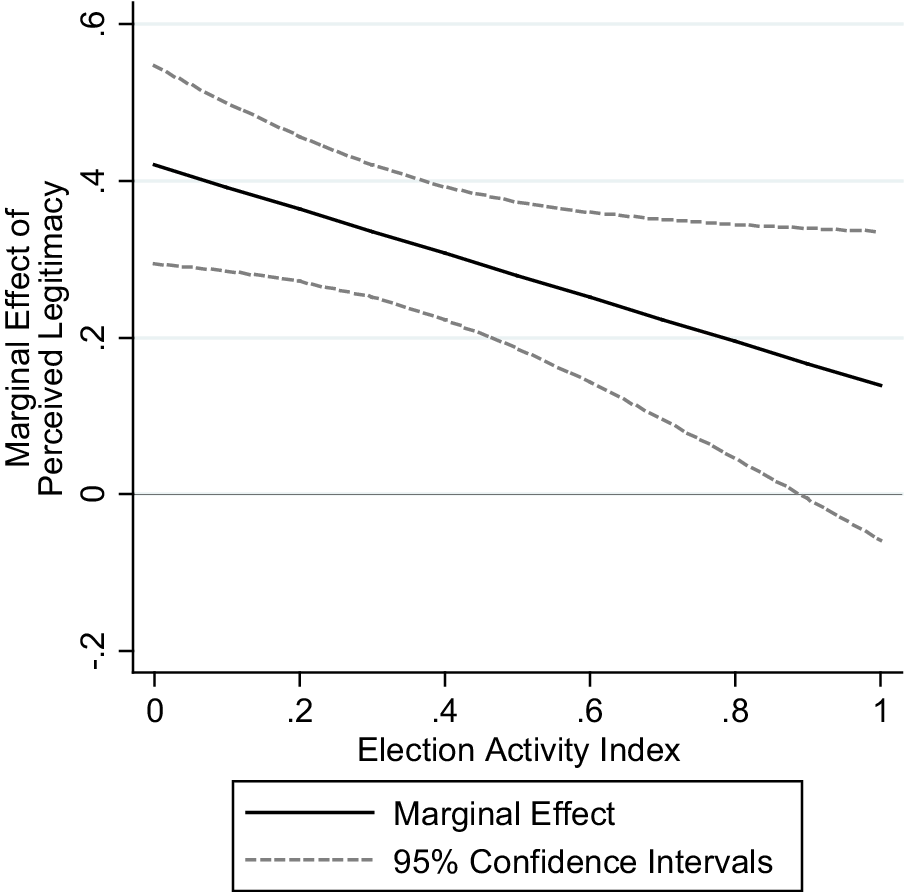
The model in column 1 of Table 2 interacts perceived legitimacy with the election activity index. In that model, the interaction between the election activity index and legitimacy perceptions is negative and significant at p < .05. Figure 1 displays the marginal effect of perceived legitimacy on acceptance judgments across the range of election activity, with the dotted lines representing 95% confidence intervals. At the lowest level of election activity, which are exclusively appointed courts, the marginal effect of legitimacy is .42. This marginal effect decreases as election activity increases. It is .28 when election activity reaches .5 on the scale. At the highest level of election activity, the marginal effect of legitimacy becomes statistically insignificant. These results show that the effect of election activity is to decrease the marginal effect of legitimacy on acceptance, and for the states with the highest election activity remove that influence all together.
Acceptance and election activity

Robust standard errors in parentheses.
* p < .05
Election activity and the marginal effect of legitimacy on acceptance.

Columns 2 and 3 of Table 2 provide robustness checks using the alternative measures from Gann Hall (Reference Gann Hall2015) based on the percentage of competitive elections (column 4) and the percentage of challenged elections (column 5). Both interactions between perceived legitimacy and these measures are negative and statistically significant at p < .05, with the marginal effect of legitimacy being approximately .40 at the lowest level of those measures and then decreasing as the level of competition increases.
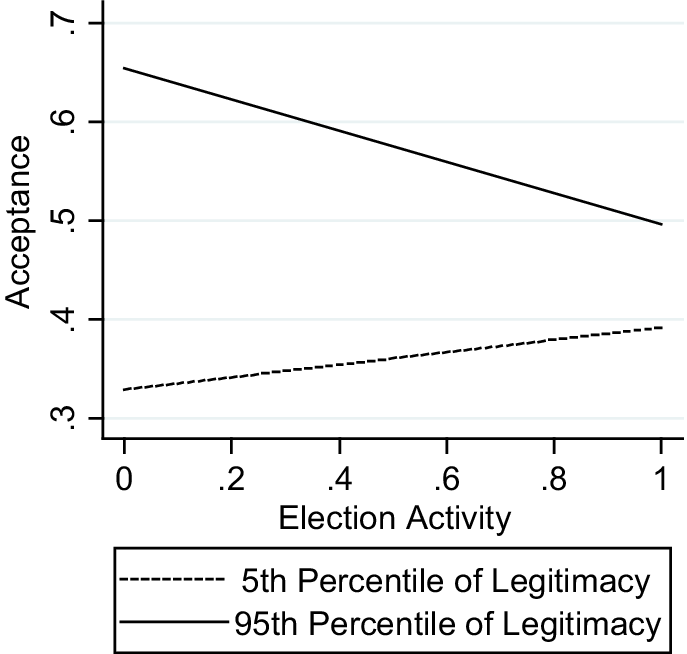
The above analysis showed that the marginal effect of legitimacy decreases as election activity increases. Figure 2 provides another way of looking at the data to show that this also leads to a reduction in acceptance, but only for institutions with high levels of legitimacy. That figure shows the level of acceptance across the range of election activity for both a court at the fifth percentile of legitimacy perceptions and one at the 95th percentile.Footnote 13 For courts with low levels of legitimacy, election activity has no detectable effect (p > .1) on the level of acceptance, with the values of acceptance ranging between .33 and .39. However, for courts at the highest level of legitimacy, the marginal effect of election activity is negative and significant at p < .05. The level of acceptance for a highly legitimate court at the lowest level of election activity is .64, and that decreases to .50 at the highest level.
Election activity, legitimacy, and the level of acceptance.

This analysis suggests that only a highly legitimate court that is either appointed or has low levels of election activity can induce high levels of acceptance. Even if a court with high levels of election activity is considered legitimate, because its legitimacy does not affect acceptance it struggles to induce acceptance. In addition, any court with low levels of legitimacy will struggle to induce acceptance.
Testing the mechanism – Representation or politicization
The previous analyses show that the level of election activity in a state substantially changes the marginal effect of legitimacy on acceptance judgments for judicial decisions. This section will examine whether that effect is associated with the politicization or representation provided by robust judicial elections.
Study 1 included a measure of politicization perceptions that can be used to test whether election activity still moderates the effect of legitimacy on acceptance when controlling for politicization perceptions. The model in column 1 of Table 3 interacts legitimacy perceptions with both the measure of election activity and the measure of politicization perceptions. In that model, the interaction between legitimacy perceptions and election activity remains statistically significant at p < .05, and the magnitude of the interactive effect is virtually unchanged (.28 in column 1 of Table 2 compared to .27 in column 1 of Table 3). The interaction between politicization perceptions and legitimacy is in the expected negative direction, but statistically insignificant. Based on these results, it appears that controlling for politicization perceptions does not change the effect of election activity, and thus the effect of election activity is independent of the effect of politicization perceptions.Footnote 14
Testing the mechanism: Representation or politicization

Robust standard errors in parentheses.
* p < .05
X p < .1
The next analysis takes advantage of the experiment embedded within Study 1 that manipulated whether the subject read about their state supreme court making a decision on the constitutionality of the juvenile life sentence or about their state legislature passing a law concerning the same issue. If the representativeness of the institution is the key distinction causing the results shown in Table 2, the relationship between legitimacy and acceptance should be similar for a state legislature and courts high in election activity. Column 2 of Table 3 includes a model of acceptance examining the effect of the experimental manipulation, which is coded 1 for those in the condition describing a law passed by a state legislature and 0 for those in the condition describing a decision made by the state supreme court. Both the manipulation and the measure of election activity are interacted with legitimacy perceptions, and both interactions are negative and significant at p < .05.Footnote 15
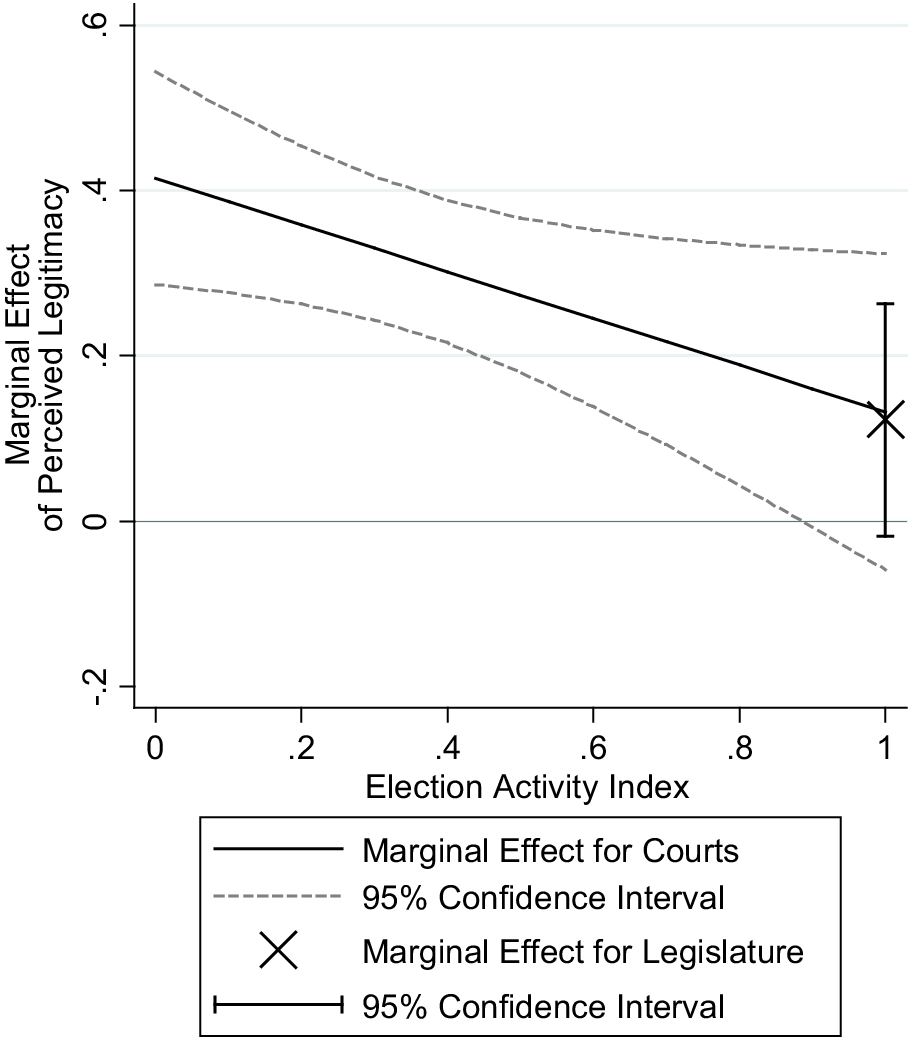
Figure 3 provides a fuller explanation of these results. The solid line shows the marginal effect across the range of election activity for the subjects in the court condition. The dotted lines are 95% confidence intervals. The results replicate those from Figure 1. For courts at the lowest level of election activity, the marginal effect of legitimacy perceptions is .41, and for those at the highest level of election activity, it is .13. The key finding involves the marginal effect of legitimacy within legislative condition, which is represented by the X on Figure 3. The marginal effect of legitimacy perceptions within the legislative condition is .12, almost exactly matching the marginal effect of a court with the highest level of election activity. This model confirms that when it comes to the relationship between legitimacy perceptions and acceptance judgments a court high in election activity is treated similarly to a state legislature, leading to the conclusion that it is the presence of robust elections and the representation provided by those elections causing these effects and not the perception that a court is using a politicized decision-making process.Footnote 16
The legislature/court manipulation, and the marginal effect of legitimacy on acceptance.

Study 2
Study 2 provides another test of some of the proposed theoretical mechanisms. It presented the subjects with the same legitimacy items, policy decision, and acceptance items as the first study, but replaced the state institutions with their federal counterparts. The subjects were randomly assigned to either a condition where the US Congress passed a disagreeable law concerning the juvenile life sentence or one where the US Supreme Court made a disagreeable decision. The study had a sample of 198 American citizens from January 2013 and was gathered using Mechanical Turk.
The correlation between the perceived legitimacy scale and the scale measuring acceptance of the disagreeable policy decision was r = .40 and statistically significant at p < .05 for the US Supreme Court condition. That decreased to r = .15 in the US Congress condition, which is statistically insignificant with p > .1. The difference between those two correlations was statistically significant at p < .05 (one-tailed test). This replicates the findings from the experimental manipulation in Study 1 that the relationship between legitimacy and acceptance is smaller for a legislature than it is for an appointed court.
Separating compliance and acceptance
The theory of this article makes a distinction between compliance with a policy decision and the acceptance of one. It argues that basic democratic norms require citizens to comply with decisions from a legitimate representative institution, but those same democratic norms also allow the public’s elected representatives to challenge any disagreeable policy decision after the next election. If this is the case, the perceived legitimacy of a representative institution should not affect acceptance judgments but should affect whether someone complies with a policy decision. Study 2 included an additional item that indirectly assesses the respondents’ desire to comply with the policy decision. That item asked the subjects whether they would be more or less likely to vote for a public official who vowed to disobey the policy decision and refuse to implement it. The correlations between perceived legitimacy and the item assessing compliance is r = .44 in the US Supreme Court condition and r = .28 in the US Congress condition. Both are significant at p < .05 and the difference between the two correlations is insignificant with p > .1, showing that the legitimacy of both an elected legislature and an appointed court affects compliance attitudes.
Supplemental Kentucky study
The compliance item from study 2 does not directly measure whether the person will comply with the policy decision, but instead measures voting intentions. Another existing study includes two of the same legitimacy items used in this article and an item that directly measures the public’s willingness to comply with a disagreeable policy decision (see Gibson Reference Gibson2012 for more detailed description of the study). The survey had three waves, and all the items used here come from the third wave. The compliance item read “People should obey the [institution name] even when they disagree with its decision.” Wave 3 was conducted in early 2007, with 1006 Kentucky residents answering the necessary items. Importantly, that wave assessed legitimacy perceptions and compliance attitudes for both the Kentucky State Legislature and Kentucky Supreme Court. It did not include an item measuring acceptance.
The study can still be used to confirm that the perceived legitimacy of a representative institution like a state legislature is related to compliance attitudes using a more direct measure, and that the relationship is similar for a judicial institution. The correlation between an additive scale of the two legitimacy items and the compliance item is r = .22 for the legislature items and r = .19 for the court items. Both are statistically significant at p < .05. Once again, legitimacy perceptions and compliance attitudes are related for both a legislature and a court, and when using an item that directly measures compliance attitudes, the size of the relationship is similar for both types of institutions.
These analyses concerning the distinction between acceptance and compliance provide evidence for a second component of this article’s theoretical framework. They show that the perceived legitimacy of a representative institution increases the public’s desire to comply with a policy decision but does not affect acceptance judgments. On the other hand, the legitimacy of a legalistic institution affects both.
Conclusion
Legitimacy does not come in just one form, and different types of institutions rely on different forms of legitimacy. Representative institutions whose members are chosen through robust elections – whether they are a court or a legislature – can rely upon a form of legitimacy derived through representation and accountability. Nonrepresentative courts cannot rely upon that form of legitimacy but instead must base their legitimacy upon their legalistic nature and decision-making processes. However, one form of legitimacy cannot replace the other without it fundamentally changing that character of that institution and the manner in which the public interacts with that institution.
While this article cannot directly test whether election activity changes the basis of legitimacy for state supreme courts, the empirical data supported the predictions based on that theory. The analysis showed that a measure of legitimacy perceptions affects acceptance judgments for courts low in election activity, when presumably legitimacy is based on a court acting in a legalistic manner. As the level of election activity increases the effect of legitimacy on acceptance decreases, and at the highest level of election activity, when presumably legitimacy is most clearly derived through representation, the effect becomes indistinguishable from zero. This pattern cannot be attributed to election activity increasing politicization perceptions. Rather, based on the results of the experimental manipulation, it seems the public treats courts with robust elections like they treat state legislatures, presumably because both are representative institutions accountable to the public through elections. Importantly, this pattern of results holds when using both the election activity measure from Woodson (Reference Woodson2017) and the percentage-based measures of electoral competition based on Gann Hall (Reference Gann Hall2015).
Each state’s choice of formal judicial selection method and, perhaps even more importantly, the norms governing the conduct of the state’s elections (Woodson Reference Woodson2017; Gann Hall Reference Gann Hall2015) determine whether a state’s judiciary is treated by the public more as a representative institution or an unaccountable one. State supreme courts high in election activity will be treated more like representative institutions. While these institutions can still induce compliance with their decisions, substantial amounts of election activity breaks the link between legitimacy and acceptance, which significantly reduces the ability of those institutions to induce acceptance and build public support for their decisions.
Many legal scholars worry that elections and judges acting like political candidates will undermine the perceived legitimacy of the judiciary. Some of those concerned were assuaged by studies showing that elections may actually provide legitimacy rather than degrade it (Gibson Reference Gibson2012). However, the empirical results in the current study show that even if elections provide legitimacy, that form of legitimacy will no longer be transferred to its specific decisions. Thus, the courts held accountable through elections may remain legitimate, but their decisions will still be undermined and challenged because the public refuses to accept them.
While representative courts will struggle to induce acceptance, appointed courts and those low in election activity effectively convert their institutional legitimacy into public acceptance of individual decisions. This means an appointed court with lower levels of legitimacy may be more effective at building public support for its decisions than an elected one with a greater amount of legitimacy. Sometimes what matters most for the effectiveness of an institution is not just the amount of legitimacy but the form of that legitimacy.
Supplementary material
The supplementary material for this article can be found at http://doi.org/10.1017/spq.2024.18.
Data availability statement
Replication materials are available on SPPQ Dataverse at https://doi.org/10.15139/S3/OTQEZW (Woodson Reference Woodson2024).
Funding statement
This study received funding through a grant from the Law and Social Science Division of the National Science Foundation (Grant Number 1223199).
Competing interest
The author declared no potential conflicts of interest with respect to the research, authorship, and/or publication of this article.
Author biography
Benjamin Woodson is an associate professor at the University of Missouri-Kansas City who specializes in public opinion of the judiciary.