INTRODUCTION
Deficits in the social domain are the hallmark of moderate-to-severe traumatic brain injury (TBI) (Andrews, Rose, & Johnson, Reference Andrews, Rose and Johnson1998; Duff, Mutlu, Byom, & Turkstra, Reference Duff, Mutlu, Byom and Turkstra2012; Gomez-Hernandez, Max, Kosier, Paradiso, & Robinson, Reference Gomez-Hernandez, Max, Kosier, Paradiso and Robinson1997; McDonald & Flanagan, Reference McDonald and Flanagan2004; Milders, Fuchs, & Crawford, Reference Milders, Fuchs and Crawford2003; Tate, Lulham, Broe, Strettles, & Pfaff, Reference Tate, Lulham, Broe, Strettles and Pfaff1989; Temkin, Corrigan, Dikmen, & Machamer, Reference Temkin, Corrigan, Dikmen and Machamer2009; Ylvisaker, Turkstra, & Coelho, Reference Ylvisaker, Turkstra and Coelho2005). They persist in the chronic phase of an injury, and they are one major predictor of overall long-term outcome (Morton & Wehman, Reference Morton and Wehman1995). For instance, individuals with TBI display deficits in affect recognition ability (Rigon, Voss, Turkstra, Mutlu, & Duff, Reference Rigon, Voss, Turkstra, Mutlu and Duff2018), have high rates of socially inappropriate behaviors (Pettersen, Reference Pettersen1991), poor levels of social integration (Dumont, Gervais, Fougeyrollas, & Bertrand, Reference Dumont, Gervais, Fougeyrollas and Bertrand2004; Knox & Douglas, Reference Knox and Douglas2009), problems producing and understanding verbal and non-verbal communication (Rousseaux, Verigneaux, & Kozlowski, Reference Rousseaux, Verigneaux and Kozlowski2010), and deficits in empathy (de Sousa et al., Reference de Sousa, McDonald, Rushby, Li, Dimoska and James2011).
Individuals with TBI can report a decrease in their social network and loss of preinjury friendships, lower levels of social support, a reduction of opportunities to establish new friendships and to engage in leisure activities, and high degrees of social isolation (Bier, Dutil, & Couture, Reference Bier, Dutil and Couture2009; Finset, Dyrnes, Krogstad, & Berstad, Reference Finset, Dyrnes, Krogstad and Berstad1995; Morton & Wehman, Reference Morton and Wehman1995; Rauch & Ferry, Reference Rauch and Ferry2001). These are chronic problems, often persisting well after the acute and subacute phases of a TBI, and they are particularly challenging to address clinically (Morton & Wehman, Reference Morton and Wehman1995). Indeed, individuals with TBI often report social isolation to be their main concern in the chronic phase of their injury (Klonoff, Snow, & Costa, Reference Klonoff, Snow and Costa1986; Morton & Wehman, Reference Morton and Wehman1995). Given the positive association between social relationships and mental and physical health, a thorough knowledge of the mechanisms underlying, and the factors leading to, social isolation following TBI is important, as it has the potential to inform clinical practice (e.g., development of new treatments, counseling and prevention programs) and improve long-term health outcomes.
Social isolation (i.e., aloneness, the state of being alone) is a construct distinguishable from loneliness (i.e., the perception of being alone while desiring to be in the presence of others) (Heinrich & Gullone, Reference Heinrich and Gullone2006). In healthy populations, depending on the situation, aloneness can be viewed positively as a desirable condition, often promoting activities important for the self, while loneliness is mostly represented as an aversive state (Heinrich & Gullone, Reference Heinrich and Gullone2006).
Indeed, it has been reported that the perception of social isolation (e.g., the feeling of being lonely) and objective measures of social isolation (e.g., social network size) do not necessarily go hand in hand (Cacioppo, Fowler, & Christakis, Reference Cacioppo, Fowler and Christakis2009; Pressman et al., Reference Pressman, Cohen, Miller, Barkin, Rabin and Treanor2005; Stokes, Reference Stokes1985). For instance, studies found that college students who report higher degrees of loneliness are not necessarily more socially isolated (i.e., with smaller or less dense social networks) (Stokes, Reference Stokes1985). Instead, perceived loneliness is strongly influenced by variables related to individual differences (e.g., self-esteem, depression, attitude toward others) (Cacioppo et al., Reference Cacioppo, Fowler and Christakis2009; Levin & Stokes, Reference Levin and Stokes1986). In particular, two personality variables are often reported to be associated with loneliness in healthy populations: extraversion (being prone to seeking the company of others and experiencing positive emotions) and neuroticism (being sensitive, nervous, or prone to negative affect), which have been found to be, respectively, negatively and positively associated with loneliness (Pressman et al., Reference Pressman, Cohen, Miller, Barkin, Rabin and Treanor2005; Saklofske & Yackulic, Reference Saklofske and Yackulic1989).
Individuals with TBI report higher levels of loneliness, as well as smaller social network sizes (Morton & Wehman, Reference Morton and Wehman1995). This indicates that they are both lonelier and more alone than healthy individuals. Moreover, TBI leads to an increase in neuroticism and a decrease in extraversion (Norup & Mortensen, Reference Norup and Mortensen2015). While a large body of work has examined how social and cognitive skills that contribute to an individual’s ability to maintain a social network (e.g., theory of mind, communication skills, mood disorders) (Bibby & McDonald, Reference Bibby and McDonald2005; Douglas, Bracy, & Snow, Reference Douglas, Bracy and Snow2016; Douglas & Spellacy, Reference Douglas and Spellacy2000; Turkstra, Norman, Mutlu, & Duff, Reference Turkstra, Norman, Mutlu and Duff2018) can deteriorate as a consequence of TBI, to date, no study has examined how individual differences in personality traits are related to social network size and loneliness following moderate-to-severe TBI.
Loneliness can have several consequences in different domains (cognitive, affective, and behavioral, as well as physical health and mortality) and can give rise to self-reinforcing loops in which lonely individuals perceive the world as threatening and expect negative social interactions, which in turn elicit others’ negative behaviors and increase perceived loneness, thus causing low self-esteem and feelings of anxiety (Hawkley & Cacioppo, Reference Hawkley and Cacioppo2010). Given the interplay between individual difference variables and variables related to social isolation, this information is crucial to develop a more comprehensive model of loneliness following TBI, and to further our understanding of ways in which social deficits post injury can be assessed, prevented, and treated.
The aim of the current study was to examine relationships between perceived loneliness, social network size, and personality variables related to loneliness (neuroticism and extraversion) in individuals with moderate-to-severe TBI. Based on previous literature, we hypothesized that individuals with TBI would have smaller social network sizes than healthy comparison (HC) participants, and report higher degrees of loneliness. In particular, we hypothesized that social network size and loneliness would be positively associated, that personality variables would be significantly associated with social network size (negatively in the case of neuroticism and positively in the case of extraversion), that personality variables would be significantly associated with loneliness (positively in the case of neuroticism and negatively in the case of extraversion), and that personality variables would mediate the relationship between social network size and perceived loneliness in TBI.
METHODS
Participants
All data described in this manuscript were obtained in compliance with regulations of the University of Iowa Institutional Review Board. Individuals with TBI were recruited through the University of Iowa Brain Injury Registry, while HC participants were recruited from the Iowa City community. Brain injury severity was determined using the Mayo Classification System (Malec et al., Reference Malec, Brown, Leibson, Flaada, Mandrekar, Diehl and Perkins2007). TBI injuries were considered moderate-to-severe when at least one of these criteria was met: (1) Glasgow Coma Scale (GCS) <13, (2) positive acute CT findings or lesions visible on a chronic MRI, (3) loss of consciousness (LOC) >30 min, or (4) post-traumatic amnesia >24 hr. HC participants were recruited using fliers and mass emails and chosen because their demographics characteristics matched with individuals with TBI. Inclusionary criteria for HC participants were: (1) no self-reported history of head injury or LOC and (2) no history of neurological, psychiatric, or learning disorders. All included participants were free of aphasia, as shown by an aphasia quotient higher than 93.8 on the Western Aphasia Battery (WAB) (Shewan & Kertesz, Reference Shewan and Kertesz1980) or by assessment by a speech language pathologist.
In total, 37 participants with TBI were mailed the survey and completed the study at home. Of the 37 participants with TBI who received the packet, 29 completed and returned their questionnaires. For 1 of these 29 participants, responses were incomplete. Of these 29 participants, 25 were reachable by phone to complete the interview to measure social network size. Of the 29 contacted participants, 25 completed the SNS interview. In total, 24 participants with TBI had complete all responses to the surveys as well as the phone interview. In total, 49 HC participants were mailed the survey, and 41 returned it and completed the SNS interview.
Twenty-four individuals with moderate-to-severe TBI, and 41 HC participants were included in the final sample. The two groups did not significantly differ on age (T(63) = .54; p = .59), education (T(63) = −1.78; p = .08), or sex (χ2(1, N = 65) = .64; p = 45) (Table 1).
Participant demographics

Note. HC = Healthy comparison participants, TBI = Traumatic brain injury, p = p-value, SD = Standard Deviation, N/A = Not Applicable.
Injury-related information was acquired through medical records and semi-structured interviews. In the current sample, information on GCS was available for 10 participants, on LOC for 14 participants, information on anterograde amnesia on 13 participants, and on CT or MRI findings for 21 participants. Participants had sustained their TBI in adulthood, a minimum of 15 months and a maximum of 393 months before testing: the youngest participant to sustain a TBI had done so at 20 years old. One participant had sustained two separate TBIs. Causes of injury were falls (15), motor vehicle accidents (7), assaults (2), and non-motor vehicle accidents (2).
Procedures
Participants were mailed the a packet of questionnaires and completed the study at home. A pre-paid mailing envelope was included in the packet so they could return it by mail once completed. The questionnaires were part of a larger study on social functioning and health in TBI that included 15 questionnaires, and took approximately 1 hr to complete. In addition to completing the measures of loneliness (UCLA Loneliness Scale) and personality [NEO Five-factor Inventory (NEO-FFI)] that are described in the present study, participants also completed surveys assessing empathy, physical activity, and life satisfaction. The participants received the packet of questionnaires compiled in this order: UCLA Loneliness Scale, physical activity questionnaires, empathy questionnaires, life satisfaction questionnaire, personality NEO-FFI, and some additional empathy questionnaires. Once the packet returned to the lab, a research assistant to the study contacted participants by phone to complete SNS interview over the phone (see below).
Perceived Loneliness
Perceived loneliness was measured using the UCLA Loneliness Scale–Version 3 (Russell, Reference Russell1996). This scale measures an individual’s subjective perception of the degree of loneliness experienced on a daily basis. The scale contains 20 items (e.g., “How often do you feel alone?”; “How often do you feel close to people?”). Participants are asked to respond to the statements using a 4-point Likert scale that ranges from Never (1) to Always (4), with higher scores indicative of greater loneliness. The UCLA Loneliness Scale is highly reliable and valid (for further information, see Russel, Reference Russell1996), and has been used in TBI samples (Hagger & Riley, Reference Hagger and Riley2017; Struchen et al., Reference Struchen, Davis, Bogaards, Hudler-Hull, Clark, Mazzei and Caroselli2011).
Social Network Size
Social network size (SNS) was measured by the National Social Life, Health, and Aging Project Social Network Module (NSHAP) (Cornwell, Schumm, Laumann, & Graber, Reference Cornwell, Schumm, Laumann and Graber2009). The NSHAP’s social networks module is a well-validated and reliable measure of social network size. One of its strengths is that it allows individuals to identify people who are most important to them through the use of a name generator prompt, rather than simply summing up the number of people they interact with from each category of their life (e.g., friends Versus co-workers).
Participants were asked to list the people in their life that they consider to be important to them: “Looking back over the last year, who are the people with whom you most often discussed things that were important to you?” SNS was determined by the number of names provided. This module has been widely used in nationally representative samples of healthy adults, thus providing substantial normative data that can serve as a point of comparison (Cornwell, Schumm, Laumann, Kim, & Kim, Reference Cornwell, Schumm, Laumann, Kim and Kim2014; Kotwal, Kim, Waite, & Dale, Reference Kotwal, Kim, Waite and Dale2016). Furthermore, while the NSHAP has not been used in TBI populations before, it has been previously used in a study of patients with neurological damage to the hippocampus, of which one patient had incurred a TBI (Davidson, Drouin, Kwan, Moscovitch, & Rosenbaum, Reference Davidson, Drouin, Kwan, Moscovitch and Rosenbaum2012).
Personality Traits
Personality traits were determined using the NEO-FFI (McCrae & Costa, Reference McCrae and Costa2010). We focused in particular on extraversion and neuroticism, as they are the two personality traits that have been found to be most often associated with loneliness (Saklofske & Yackulic, Reference Saklofske and Yackulic1989).
Statistical Analysis
One tailed t tests were carried out to compare group scores on loneliness, SNS, neuroticism, and extraversion. We expected individuals with TBI to report higher levels of loneliness and smaller SNSs. Moreover, we expected them to self-report higher scores in neuroticism and lower extraversion. Bonferroni correction for multiple comparisons was applied (significant p-value = .05 / 4 = .013).
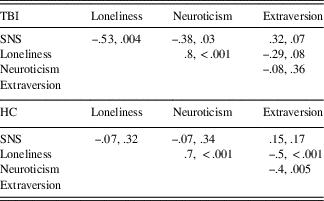
To test our hypothesis that the relationship between loneliness and SNS was mediated by personality traits, a mediation analysis was carried out using the PROCESS tool (Hayes, Reference Hayes2012). Before carrying out the mediation analysis, we examined the one-tailed correlations (in the predicted directions) between dependent variable (SNS), independent variable, and mediators, to ascertain the presence of the prerequisites necessary to carry out a mediation analysis (i.e., significant correlations between dependent and independent variables, and between dependent and independent variables and the mediator). We found significant correlations in the expected directions between neuroticism and loneliness (r = .8; p <.001), between neuroticism and SNS (r = −.4; p = .03), and between SNS and loneliness (r = −.53; p = .004). However, there was no significant relationship between extraversion and loneliness (r = −.29; p = .08), or between extraversion and SNS (r = .32; p = .06). For this reason, we carried out the mediation analysis with only neuroticism as a mediator (Table 2).
Correlations between social network size, loneliness and personality traits within the two groups

Note. For each cell, we report Pearson’s r and then one-tailed p-value (r, p). HC = Healthy comparison participants, TBI = Traumatic brain injury, SNS = social network size.
The mediation model was set up as follows: SNS was entered as the independent variable, Loneliness was entered as the outcome variable (i.e., we hypothesized that people with smaller SNS would report higher perceived loneliness), neuroticism was entered as a mediating factor (i.e., we examined whether the association between SNS and loneliness was mediated by specific personality traits), and the specific indirect effects associated with the mediator (neuroticism) was examined. A total of 10,000 bootstrap samples were used to evaluate the bias-corrected 95% confidence intervals of direct and indirect effects.
Within the HC group, SNS and loneliness were not significantly associated (r = −.16; p > .05): for this reason, we did not run the same mediation analysis in the HC group.
RESULTS
Group Comparison and Correlations
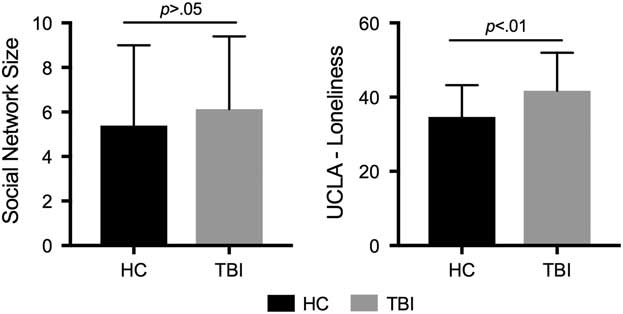
As predicted, individuals with TBI scored higher on the loneliness scale (T(63) = 2.98; p = .002; d = .75), which indicates that they self-reported higher loneliness than HC participants (TBI = 41.71 ± 10.25; HC = 34.66 ± 8.55). They also reported higher neuroticism (T(63) = 2.89; p = .003; d = .71) (TBI = 35.33 ± 9.02; HC = 29.63 ± 6.8), but not extraversion (T(63) = −1.68; p = 0.05; d = .42) (TBI = 41.78 ± 5.44; HC = 39.25 ± 6.50). Last, contrary to our prediction, individuals with TBI did not report a smaller SNS than HC participants (T(63) = .32; p = .22; d = .21) (TBI = 6.13 ± 3.27; HC = 5.39 ± 3.6) (see Figure 1).
Group comparison of social network size and loneliness. Group comparison of social network size and loneliness. Individuals with TBI did not report significantly smaller social network sizes than HCs; however, individuals with TBI reported significantly higher levels of loneliness.

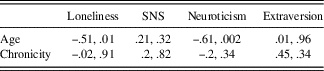
To aid interpretation of our results, and to examine the data for possible confounds, we also examined, within the TBI sample, correlations between age, chronicity, and the behavioral variables of interest (SNS, loneliness, and personality variables). Without correcting for multiple comparisons, chronicity was not significantly associated with any variable, with the exception of a positive association with extraversion (r = .45; p = .03). Age was significantly and negatively associated with loneliness (r = −.51; p = .01) and with neuroticism (r = −.61; p = .002), but not with SNS or extraversion (see Table 3).
Correlations between age, chronicity, and behavioral variables in the TBI group

Note. For each cell, we report Pearson’s r and then one-tailed p-value (r, p). SNS = social network size, TBI = traumatic brain injury.
Mediation Analysis
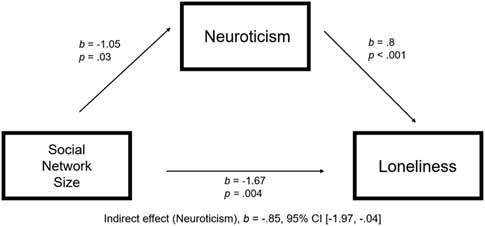
In our mediation model for the TBI group, SNS was significantly associated with both loneliness (b = −1.67; t = −2.95; p = .004) and neuroticism (b = −.83; t = −2.05; p = .03). Both correlations were negative (i.e., in the predicted directions). Neuroticism was a significant predictor of loneliness (b = .78; t = 5.45; p <.001). As hypothesized, the mediation model also revealed a statistically significant indirect effect of SNS on loneliness (as measured here) through neuroticism, the personality variable selected as a mediator (b = −.27; 95% CI[−.55, −.01]) (see Figure 2).
Mediation analysis in the TBI group. Results of the mediation analysis in the TBI group, showing a significant indirect effect of neuroticism. A total of 10,000 bootstrap samples were used to evaluate the bias-corrected 95% confidence intervals of direct and indirect effects.

DISCUSSION
In the current study, we examined the relationship between SNS and personality variables in a sample of individuals with a history of moderate-to-severe TBI. We first compared individuals with TBI and HC participants on all variables of interest, and found that while individuals with TBI reported significantly higher values of loneliness and neuroticism, they did not have smaller SNS, nor were they significantly less extroverted than HC participants. Then, we investigated the relationship between SNS and loneliness within the TBI group, and how it is impacted by individual differences in personality. We found that while SNS was a significant predictor of loneliness, this relationship was mediated by neuroticism (but not by extraversion). We discuss each finding below.
First, our finding that individuals with TBI did not report smaller SNS than healthy individuals is partially in contrast with previous work that reported reduced SNS following TBI (Morton & Wehman, Reference Morton and Wehman1995; Temkin et al., Reference Temkin, Corrigan, Dikmen and Machamer2009). One possible reason for this discrepancy is that we used a measure that has not been used before to examine social isolation in TBI, and we looked at a time range post-injury that was wider than for some of the previous studies (Oddy & Humphrey, Reference Oddy and Humphrey1980; Weddell, Oddy, & Jenkins, Reference Weddell, Oddy and Jenkins1980). It is possible that the large discrepancies found in the first few years after a brain injury lessen as an individual learns compensatory strategies to navigate the social environment. Of interest, while individuals with TBI did not report a smaller social network, they self-reported higher degrees of loneliness. Increased loneliness is a common complaint among TBI survivors, and it has been observed using several different measures (Struchen et al., Reference Struchen, Davis, Bogaards, Hudler-Hull, Clark, Mazzei and Caroselli2011).
The discrepancy between SNS findings (not reduced in TBI) and loneliness findings (reduced in TBI) can be interpreted in the framework of the main analysis of the current study, which aimed to investigate the relationship between these two variables and its mediation by personality traits. Personality changes have often been reported following a brain injury, as have changes in SNS. It is likely these variables mutually influence each other, and that as social isolation influences post-injury personality, the opposite also occurs. Here, we focused on how the relationship between SNS and loneliness is mediated by personality variables, and found that when neuroticism is added to the model the relationship between SNS and loneliness becomes non-significant. In other words, these data suggest that individuals with TBI do not feel more lonely because they have fewer friends (in fact, they do not), but because they have higher levels of neuroticism (i.e., the tendency to experience negative affect), and this might lead them to interpret their SNS more negatively.
This finding, coupled with the fact that, in our sample, SNS was not significantly different between groups, has important clinical implications. First and foremost, these data suggest that interventions aimed at reducing perceived loneliness in the chronic phase of a TBI might benefit from focusing on offering coping strategies that improve their ability to view their social network positively, rather than only on giving individuals with TBI strategies to enlarge their SNS. Indeed, previous studies have reported that an increase in satisfaction with social life can be obtained without a corresponding increase in SNS (Struchen et al., Reference Struchen, Davis, Bogaards, Hudler-Hull, Clark, Mazzei and Caroselli2011). This supports the idea that targeting personality variables (i.e., neuroticism) that are associated with SNS might be a fruitful strategy to tackle the issue of perceived loneliness in chronic TBI.
Indeed, an integrative meta-analysis of loneliness reduction interventions found that interventions addressing maladaptive social cognition through cognitive behavioral therapy (over interventions focused on improving social skills or on enhancing social support), for instance, were the most successful (Masi, Chen, Hawkley, & Cacioppo, Reference Masi, Chen, Hawkley and Cacioppo2011). There is preliminary evidence that neuroticism (i.e., the tendency to experience feelings of anxiety, depression, and to respond poorly to stressors) can be effectively reduced using cognitive-behavioral therapy (Hedman et al., Reference Hedman, Andersson, Lindefors, Gustavsson, Lekander, Ruck and Ljotsson2014), as well as other types such as mindfulness based cognitive therapy (Armstrong & Rimes, Reference Armstrong and Rimes2016).
Not only did self-ratings of extraversion not significantly differ between groups, extraversion was also not significantly associated with SNS or with loneliness, and thus the prerequisite to examine it as a mediating factor did not exist. This suggests that when targeting loneliness in individuals with TBI, strategies aimed at decreasing negative affect and the negative perception of one’s SNS and social interactions might be more effective than strategies aimed at promoting opportunities for new social interactions. It is also possible that people with TBI report equal SNS but that the quality of the friendships is reduced, which in turn leads to higher perceived loneliness.
Of interest, within the HC group there was no significant relationship between SNS and loneliness. As a significant relationship between the independent and outcome variable is required to build a mediation model, we did not carry out the mediation analysis for this group. A lack of association between loneliness and SNS has been reported before in healthy individuals (Stokes, Reference Stokes1985). This is not surprising, considering that, while small social network size (i.e., aloneness) is not always considered undesirable, loneliness tends to have negative connotations. The lack of significant negative correlation between SNS and loneliness within HCs signifies that some healthy individuals who have small SNS do not suffer because of it, and do not desire larger circles of friends.
Conversely, within the TBI group, individuals who have smaller SNS also tended to report higher degrees of loneliness (significant negative correlation). We speculate that this might be due to the fact that smaller social networks are less likely to be the result of a specific choice for individuals with TBI than for HC participants. While we did not explicitly ask our study participants whether they were satisfied or not with their SNS, future studies examining loneliness should take this variable into consideration. Within the HC group, there was also no association between SNS and personality variable, which replicates findings from previous studies (Pressman et al., Reference Pressman, Cohen, Miller, Barkin, Rabin and Treanor2005). Indeed, similar mediation models that examine whether personality variables mediate the relationship between loneliness and SNS have not, to our knowledge, been previously examined in HCs, and this might be due to the fact that the prerequisites to carry out a mediation analysis have not been met in healthy populations.
The study has several limitations. First, there is a wide range in time since injury, from less than 2 years to several years. While all participants were in the chronic phase of their injury (e.g., for at least 1 year, which is the time interval for the SNS questionnaire), the time since injury might influence an individual’s SNS. That said, time since injury did not significantly correlate with loneliness, neuroticism, or with SNS. Second, we only assessed SNS and personality variables from the perspective of the individuals with TBI, and did not corroborate these findings with proxy reports (e.g., from close others), which should be considered when interpreting our results, as individuals with TBI can have poor self-awareness (Bach & David, Reference Bach and David2006).
This is particularly relevant because of the population we tested and because of the time frame taken into consideration (1 year, as opposed to only a few months), which could present issues in a population with memory and awareness problems, or who might have a poorer understanding of social norms and, thus, lack a full understanding of the line between friendship and acquaintance. Moreover, we did not assess the quality of these friendships, which could also strongly influence perceived loneliness (independently from SNS).
In addition, it should be kept in mind that it is unlikely that personality variables by themselves determine perceived loneliness following TBI. Indeed, it is probable that these variables interact with other factors, such as social skills, social support, physical disability, psychiatric disorders (especially considering that neuroticism and mood disorders often go hand in hand, which could present a confound), brain function and structure, lesion patterns, etc. While we did not assess several of these measures, future research should examine how the interplay between these factors leads to perceived loneliness in the chronic phase of TBI. Moreover, future studies should seek to collect longitudinal data to better determine whether there is a causal relationship between personality variables and loneliness.
Last, the current study’s sample size presents another limitation. It should be noted that within the TBI group in particular there was considerable attrition (13 participants who were inducted in the study did not participate until the final stage), which might have led to a bias in the sample. For instance, we speculate that it is possible that individuals who are more lonely decided to opt out of the study; the opposite could also be true. Future studies on the topic of loneliness in TBI should aim to recruit larger samples to increase the generalizability of the findings.
In conclusion, our findings have shown that neuroticism mediates the relationship between social network size and self-perception of loneliness following moderate-to-severe TBI. These results indicate that individual differences in personality variables play a role in perceived social isolation, inform current models of loneliness following TBI, and provide clinicians with new possible targets for the treatment of psycho-social deficits and social isolation following TBI.
ACKNOWLEDGMENTS
The authors have no conflict of interest to disclose. There are no sources of financial support to disclose.