

From at least the 1980s, the eruption of the Thera volcano has been a strongly debated topic, not only in archaeological contexts, but also in geology and volcanology. This discussion has been particularly intense with regards to the exact dating of this event around the middle of the 2nd millennium bc, as this topic directly touches upon the chronology of the Second Palace Period on Crete and the Shaft Grave period of Mycenae (Warren Reference Warren1987; Reference Warren1988; Warren & Hankey Reference Warren and Hankey1989; Michael & Betancourt Reference Michael and Betancourt1988; Hardy & Renfrew Reference Hardy and Renfrew1990; Manning Reference Manning1999; Reference Manning2012). These two entities are nodal points linking the European Bronze Age sequence to the Egyptian and, to a lesser extent, the Mesopotamian dynastic lists. In this way, Thera directly touches the archaeology of Europe and the Near East, from the Eastern Mediterranean through the Aegean to the British Isles (Eggert & Wotzka Reference Eggert and Wotzka1987; Barfield Reference Barfield1991). Apart from the chronological debate about the validity of relative versus absolute chronologies, another question concerns the consequences this exceptional volcanic eruption had on the societies living at that time in the Aegean and, maybe, even beyond. Spyridon Marinatos (Reference Marinatos1939) vocalised the supposition that the Thera eruption could have triggered the end of the Palace Period. In light of the dimension of this natural disaster (ie Hardy et al. Reference Hardy, Doumas, Sakellarakis and Warren1990a–Reference Hardy, Keller, Galanopoulos, Flemming and Druittb), which is possibly recorded in the Greenland ice (Hammer et al. Reference Hammer, Clausen, Friedrich and Tauber1987) and in stunted tree growths from several regions in the northern hemisphere (LaMarche & Hirschboeck Reference LaMarche and Hirschboeck1984; Baillie & Munro Reference Baillie and Munro1988), questions emerged about possible ‘global’ effects on the environment and society (eg, Baillie Reference Baillie1996).
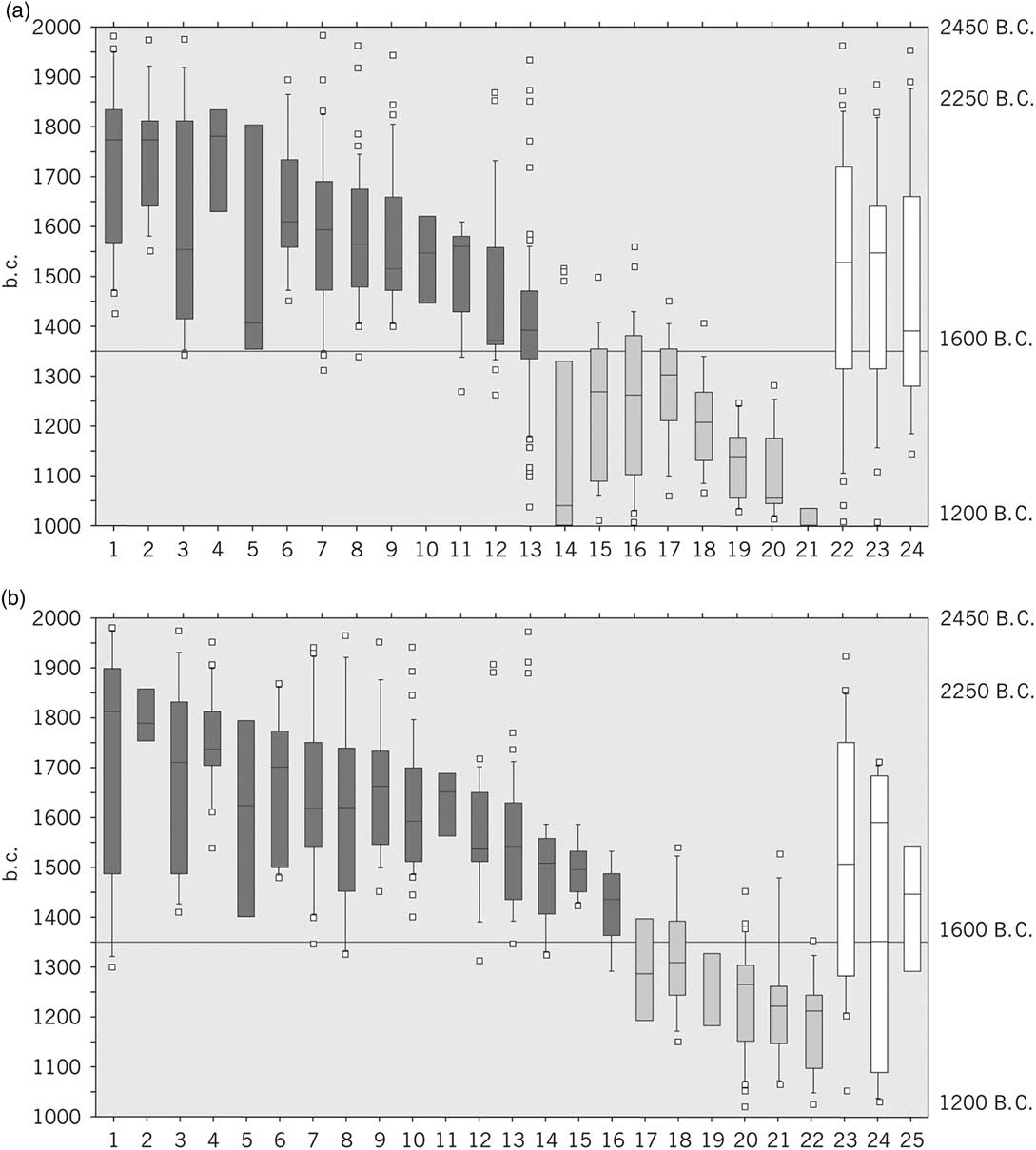
The possibility that major historical and social upheaval occurred in most of Europe around 1600 bc became more plausible when all archaeologically relevant radiocarbon dates that fell between 2000 and 1000 bc (uncalibrated) published up to 1990 were systematically evaluated (González et al. Reference González, Lull and Risch1992). The calibration of 1063 more or less reliable dates revealed that most European regions showed an unexpected break in archaeological ‘cultures’ or material manifestations around 1600 cal bc, which cannot be explained by a wiggle in the calibration curve. This allows the European Bronze Age to be split into two chronological and socio-economic horizons (Fig. 1). This historical break seems to be independent of the Thera eruption, although a backdating of this event to the end of the 17th century bc obviously opened up the possibility for a connection between the two.
Absolute chronology of the archaeological entities dating to the 2nd millennium bc in (a) the Mediterranean, and (b) Atlantic and Continental Europe, after the calibration of radiocarbon data available up to 1990 (González et al. Reference González, Lull and Risch1992, 97, 103; created by S. Gili Suriñach) Key: Fig. 1a: 1) Middle Helladic; 2) Bronze Age north-eastern Iberia; 3) Torreano; 4) Mt Claro-Bonnanaro; 5) Tarxien; 6) Bronze Age southern France; 7) Motillas; 8) Argar; 9) Middle Minoan; 10) Bronze Age Lower Guadalquivir; 11) Bronze Age Ebro-Segre; 12) Bronze Age Spanish Levant; 13) Late Minoan IA–B; 14) Early Nuraghic; 15) Late Minoan II–III; 16) Cogotas I; 17) Late Bronze Age south-eastern Iberia; 18) Middle Bronze Age southern France; 19) Appenine–Sub-Appenine; 20) Late Helladic IIIA–B; 21) Milazzo; 22) Pretalayotico; 23) Bronze Age Iberian chain; 24) Polada Fig. 1b: 1) Early Bronze Age Atlantic France; 2) Early Bronze Age Carpathians; 3) Early Bronze Age Central Europe; 4) Bronze Age A1 Central Europe; 5) Cordoned Urns, Ireland; 6) Period I Scandinavia; 7) Food Vessels; 8) Tumulus Armoricains; 9) Bronze Age A2 Central Europe; 10) British Early Bronze Age barrows; 11) Veterov; 12) Barbed Wire Netherlands; 13) Collared Urns, Britain; 14) Middle Bronze Age Carpathians; 15) Middle Bronze Age Balcans; 16) Hilversum Niederlande; 17) Noua-Coslogeni-Sabatinovka; 18) Middle Bronze Age Central Europe; 19) Middle Bronze Age Britain; 20) Drakenstein; 21) Wessex II; 22) Middle Bronze Age Atlantic France; 23) Tumulus Armoricains II; 24) Glasinac; 25) North-Pontic Timber Graves

The rescue of the Nebra sky disc from the illegal antiquities market and the ensuing interdisciplinary study of the entire hoard from Mittelberg near Nebra (Meller & Bertemes Reference Meller and Bertemes2010) revealed that this singular ritual burial took place around 1600 bc. The deposition of such valuable, well-crafted, and symbolic objects in Nebra, as well as in other Central European hoards (eg, the large hoard of swords in the Carpathian basin or the hoard finds from Trassem in Rhineland-Palatinate, which are comparable to the Nebra finds), seems to mark the end of an epoch and worldview (Meller Reference Meller2010; Reference Meller2013). In light of this, one must ask if the date 1600 is only a random marker, or if it corresponded to extensive regional social change against the background of the Thera eruption.
In order to delve more deeply into this question, a conference was devoted to this topic as part of the Archaeological Conference of Central Germany in Halle 14–16 October 2011. Particularly in the resulting publication, the attempt was to move beyond the usual portrayal of socio-ecological processes and interpretive narratives of more or less contemporary archaeological cultures, and to bring together results from the natural sciences and archaeology through a series of structured questions (Meller et al. Reference Meller, Bertemes, Bork and Risch2013). In fact, a discussion was initiated that went beyond the scope of the original conference about social change, resistance, breaks, as well as continuity during a pivotal point in the history of Europe and the Mediterranean (see also Kneisel et al. Reference Kneisel, Kirlies, Dal Corso and Tiedtke2012). This contribution is an attempt to gain a historical understanding of the presently available palaeo-environmental and archaeological information, which to a considerable extent was brought together by different authors and research teams in the proceedings of the 2011 Halle conference. This comparative research does not aim to merely juxtapose evidence and readings or to demonstrate – or falsify – a specific starting hypothesis or theoretical model, rather our priority has been to search for material and symbolic traces that might be related to each other. The more realms (environmental, economic, social, political, ideological, etc.) that are touched by such relationships, the higher the probability that we are not only observing a correlation or a casual coincidence of facts, but a structure produced by changes in the material conditions of societies, and often their own understanding of these changes. The difficulty lies in the knowledge that even deep environmental and social changes will be experienced and responded to in different ways by each community and political organisation, leading to diverse material and symbolic expressions. Only if the analysis reaches the relationships established between these expressions will it be possible to grasp the historical dimension of a given event, such as the eruption of the Thera volcano.
LOCAL SOUTHERN AEGEAN COMMUNITIES IN LIGHT OF THE THERA VOLCANO ERUPTION
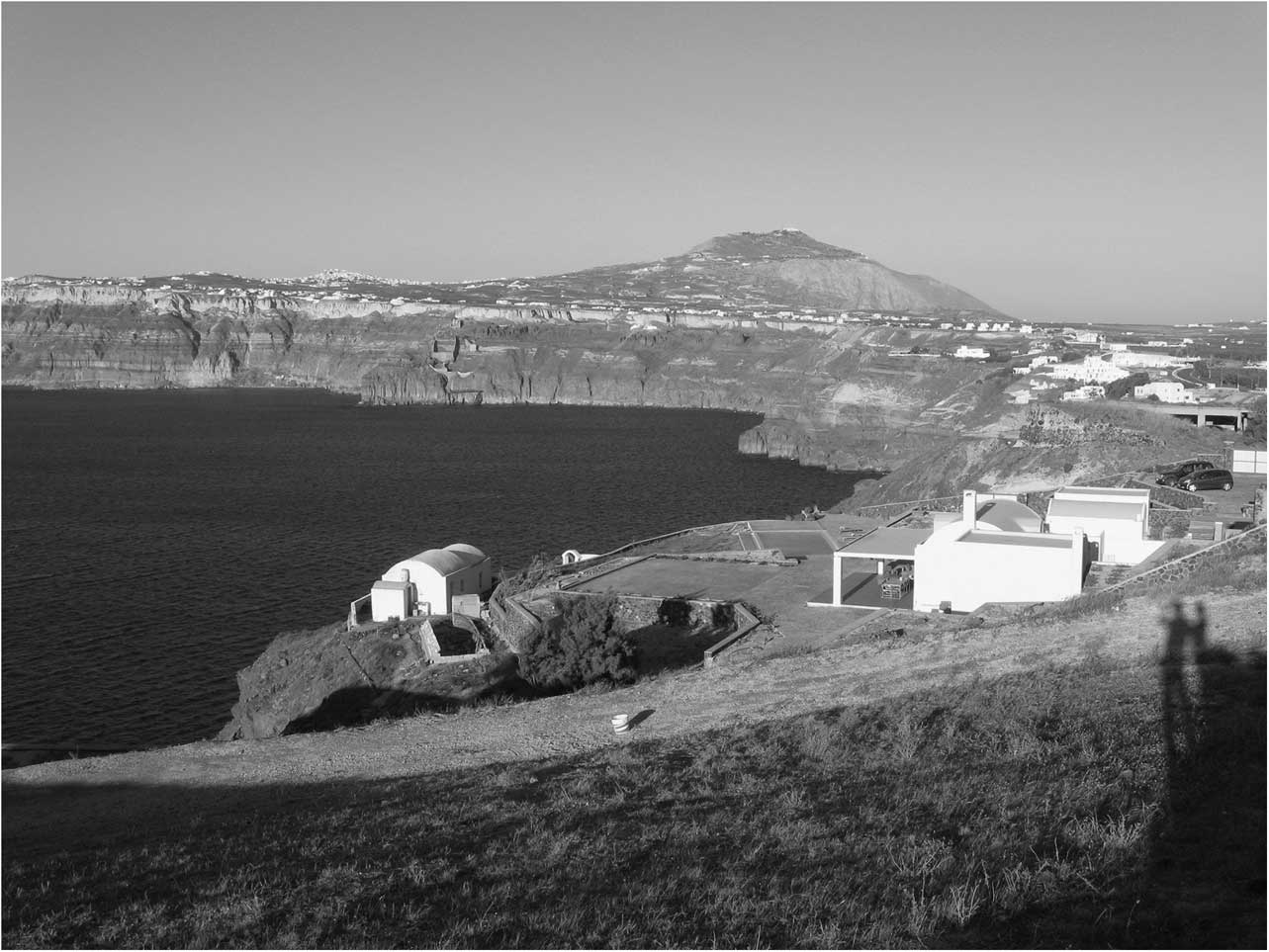
Recently there has been solid evidence from archaeological and various natural science disciplines that the Thera volcanic eruption can be dated to the second half of the 17th century bc, most probably around 1613±13 bc (Friedrich & Heinemeier Reference Friedrich and Heinemeier2009; Friedrich Reference Friedrich2013; Badertscher et al. Reference Badertscher, Borsato, Frisia, Cheng, Edwards, Tüysüz and Fleitmann2014). Although indirect evidence – such as acid signals in the Greenland ice cores or growth anomalies in North American, Irish, and Anatolian trees – can be contested, there is currently no better alternative and no more secure explanation for most of these ‘catastrophe markers’. Thus the possibility that many of these markers are tied to the same natural event cannot be ruled out. Furthermore, certain methodological considerations actually support this interpretation (Baillie Reference Baillie2013), including new dendrochronological analyses (Pearson et al. Reference Pearson, Dale, Brewer, Kuniholm, Lipton and Manning2009). There is no radiometric proof from secure natural or archaeological contexts that would make a later or earlier dating of the Thera eruption more plausible. After the absolute dating of two olive trees that were buried by the Minoan tephra layers of Thera, it is possible to date the dramatic volcanic eruption with 95.4% certainty (2σ) between 1627 and 1600 bc (Friedrich & Heinemeier Reference Friedrich and Heinemeier2009). This date is also in agreement with the radiocarbon results obtained from short lived seed samples from the destruction levels of the Akrotiri settlement on the southern coast of Thera island (Manning et al. Reference Manning, Bronk Ramsey, Kutschera, Higham, Kromer, Steier and Wild2006; Manning & Kromer Reference Manning and Kromer2012), and with the volcanic derived bromine peak in northern Anatolian speleothems (Badertscher et al. Reference Badertscher, Borsato, Frisia, Cheng, Edwards, Tüysüz and Fleitmann2014). Although a fundamental scepticism towards such an early date of the Thera eruption seems to persist among some authors (Cherubini et al. Reference Cherubini, Humbel, Beeckman, Gärtner, Mannes, Pearson, Schoch, Tognetti and Lev-Yadun2014), we argue that the time has come to move beyond the strictly chronological debate and to consider the wider historical and social implications of this epoch-scale event (Fig. 2).
Southern part of the Thera caldera. The uppermost light-coloured tephra layer on the 150–200 m high escarpment of the caldera belongs to the Minoan eruption c. 1627–1600 bc. In the background is the Profitis Iliad: the highest mountain of the island at 566 m above sea level (R. Risch)

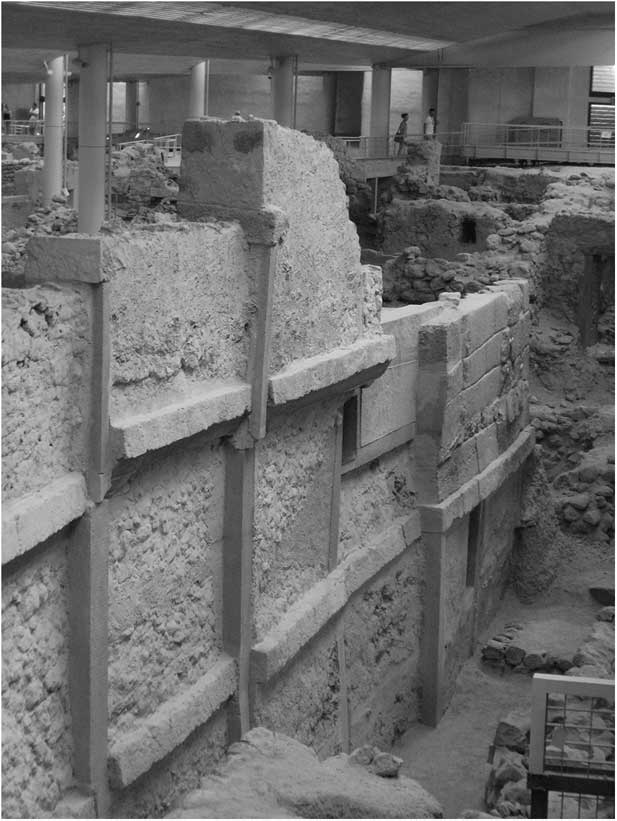
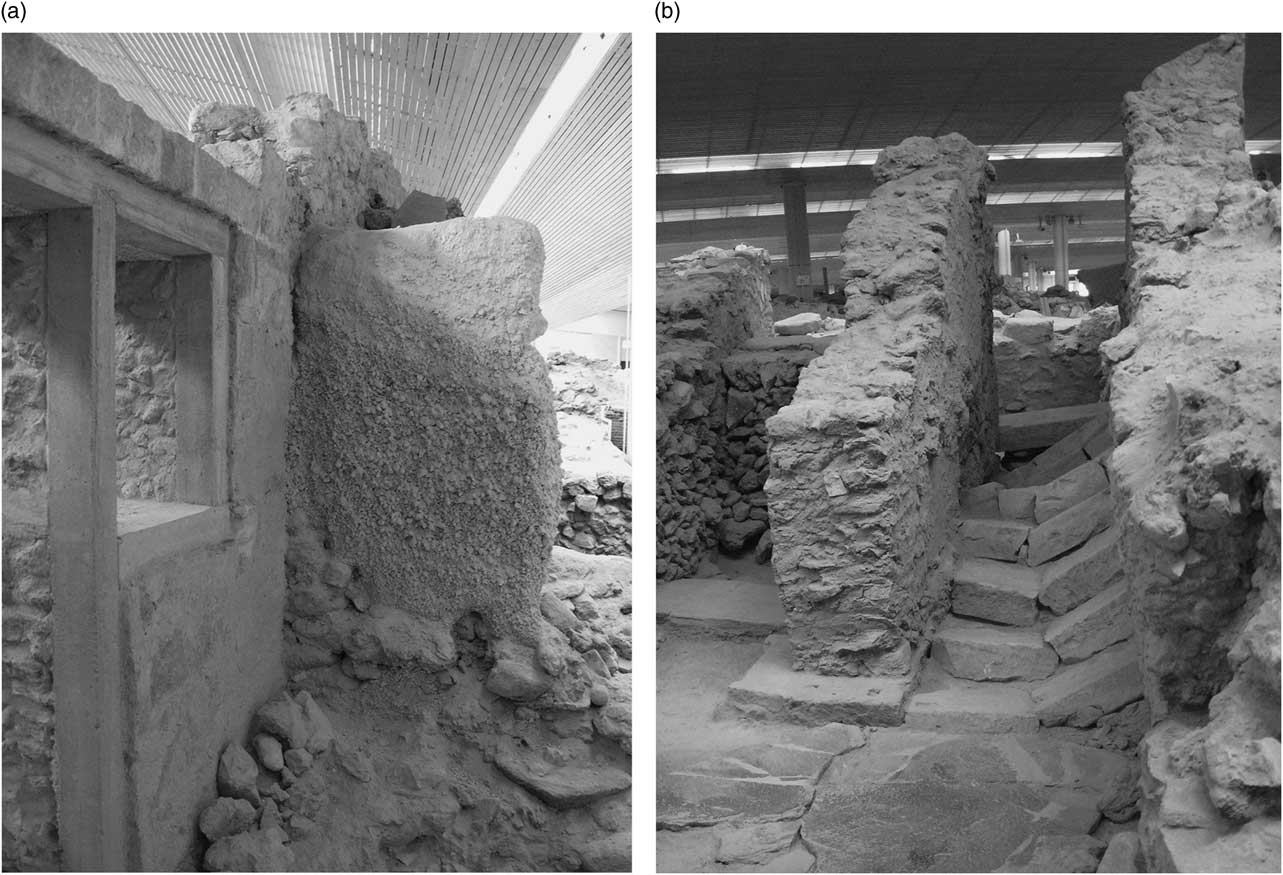
The extensive excavations at Akrotiri, on the southern coast of the island of Thera, have revealed that this city had been evacuated rather systematically before the critical explosion, also known as the Plinian event, of the volcano. The inhabitants abandoned their cities and homesteads possibly during summertime, leaving the island towards the end of the 17th century bc before the impending natural catastrophe, whose menace must have been noticeable. Some time prior to that – possibly several months or only a few weeks before – there was an earthquake, which is evidenced by the significant renovation and reconstruction works in the city of Akrotiri that were underway before they decided to leave the island (Figs 3–4). Up until this point there had only been a single death on the whole island that could be connected to the eruption, so the evacuation must have been well organised. This in turn allows one to draw important inferences about the political and social conditions in the Minoan region. The house doors were closed, valuable objects, especially metal, were almost completely cleared from the houses, and other evidence of a hasty departure such as plundering (a typical side effect of modern earthquakes) is not discernable (Marinatos Reference Marinatos1999a, Reference Marinatos1999b, Reference Marinatos1999c; Michailidou Reference Michailidou2013). The logistics of such methodical abandonment of the island required extreme social cooperation and substantial means, especially ships for transport.
Akrotiri. North wall of the three-storey building Xesté 2 (R. Risch)

Akrotiri. Left: house wall with abutting tephra layers that covered the city first after the population left. The rubble under the tephra layers is a result of the earthquake that preluded the Plinian eruption. Right: the stairwell of house Xesté 1 that was damaged during the earthquake (R. Risch)

The population of the Minoan city Akrotiri alone has been estimated to be a minimum of 2000 people; two additional cities were possibly located at the northern and southern edges of the caldera (Højen Sørensen et al. Reference Højen Sørensen, Friedrich, Katsipis and Søholm2013). When one also takes into account smaller settlements and farmsteads, which are standard on Crete and are recognisable in the murals in Akrotiri, then the population of the whole island could have been around 10,000 people. Additionally it seems that the most important household goods from every single house were also loaded onto the ships. It is also unknown what happened to the cattle and domestic animals, since almost no skeletons were found in the city ruins. Ships with up to 46 oars, additional crew, and some passengers are depicted on the frescoes from Akrotiri. In the ‘ship’s catalogue’ from the second song in the much later Iliad, Homer writes that such Mycenaean war ships could transport an average of 80 people with equipment (Hom. Il. 2, 493–759). Even if – in the face of such an ominous situation – the larger Cycladic ships could have packed 100 people with their personal effects onto their decks, they would have still needed 100 ships for the evacuation of 10,000 people. It is highly unlikely that Thera possessed such a large fleet. For example, all of the Ionic Islands were only able to provide 12 ships for the Trojan War at the end of the 13th century bc.Footnote 1 Therefore it is worthy of consideration that ships from other islands participated in a rescue mission. Surely the palatial economy of Crete would have been able to produce such a fleet in a short amount of time, which is again supported by the ship’s catalogue in the Iliad.Footnote 2
Moreover, due to archaeologically recognisable connections and close social relations between Akrotiri and the Minoan centres, it is reasonable to believe that the people fled to Crete. Even when there were only a few weeks or months between the first warning signs – the so-called ‘precursory phases’ – and the devastating eruption, the successful evacuation of the population of Thera would have been an extraordinary political, organisational, and logistical accomplishment, especially when considering the limited communication technology and the distance between Thera and political centres on Crete.
When looking at modern experiences with rescuing refugees, a long list of questions comes to mind, for example, how did they ask for help and how was the plea received? Did the Minoans rescue their neighbours out of solidarity or was it a type of economic deal? How many ports took part, and how were thousands of refugees received, housed, and fed? On this note, it must be mentioned that the situation on Crete was also problematic at this point in time. There is evidence in many of the Minoan palaces and settlements of an earthquake in the second Late Minoan Phase (LM IB; around the time of the Thera eruption) that caused considerable damage (Driessen & Macdonald Reference Driessen and Macdonald1997). It is thought that this was the same earthquake that also damaged buildings in Akrotiri just before the city was abandoned. One important question, which affects the survival of the island’s inhabitants, is how much time passed between the sailing of the last ship from the island and the first volcanic eruption. After the first (Plinian) eruption, an enormous amount of material fell from a height of several kilometres into the sea and triggered the first tsunami. Refugee ships that were still too close to Thera or were just off the northern coast of Crete would not have survived. On the other hand, the tsunami waves on the open sea would hardly have been noticeable (McCoy Reference McCoy2009, 87). Thus it is not possible to say if the rescue mission was successful based on scientific data alone. However, there is also archaeological evidence that at least part of the population from Thera made it to Crete. At the excavations on Mochlos, a small Minoan settlement on the north-eastern coast of Crete, there is evidence of a large amount of construction that took place around the time of the Thera eruption. It has been deliberated that this was a consequence of the arrival of the Thera refugees and their additional spatial and economic requirements (Soles Reference Soles2009). The use of new building techniques that use a combination of ashlar walls and stone rubble masonry, which are typical for Akrotiri but rather unusual on Crete, and the presence of ceramics from Thera in the tephra layers could be explained by the arrival of the Therans. The limited room on the peninsular settlement of Mochlos would, however, support the idea that the Cycladic population would have to have been divided and integrated into several settlements (Figs 5–6). At least in Kato Zakros, on the eastern coast of Crete, there are similar construction techniques being used as in Akrotiri and Mochlos (Soles Reference Soles2009). Thus the escape must have been successful, with most of the population of Thera surviving at least the first phase of the natural catastrophe.
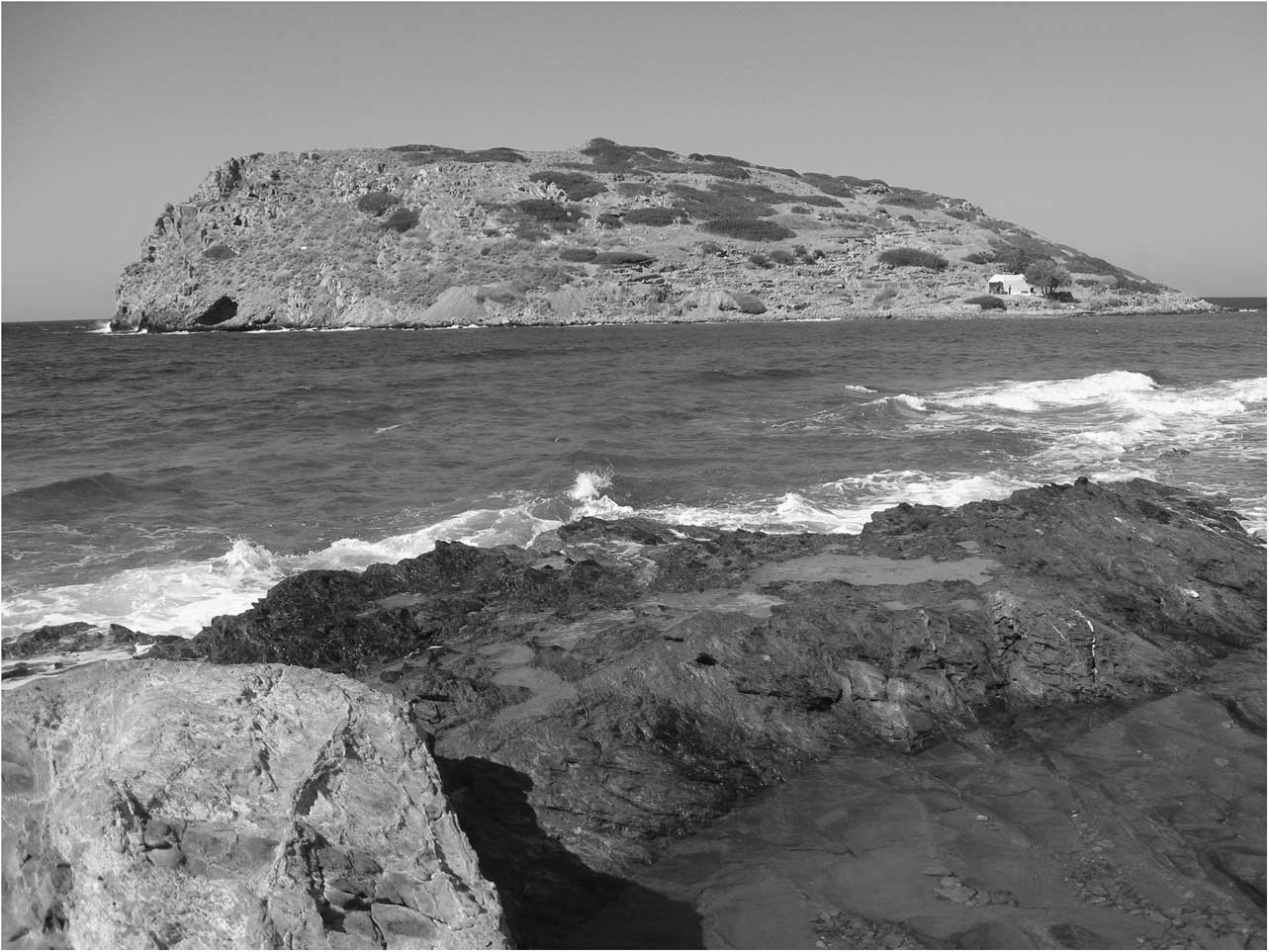
The settlement on the Island of Mochlos on the northern coast of Crete was still connected to the main island in Minoan times. This was possibly a refuge for the refugees from Thera (R. Risch)

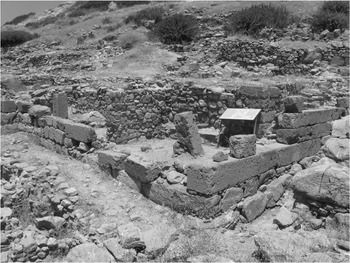
Mochlos. The building B2 with its facade of sandstone blocks was used as a Minoan temple at the time of the Thera eruption. The central columns of the antechamber probably crumbled as a result of the earthquake (R. Risch)

The course of the actual volcanic eruption after the escape of all of the inhabitants is geologically very well documented (eg, Oppenheimer Reference Oppenheimer2013). After a first Plinian eruption, whose volcanic plume could have reached up to 36 km in height, sea water infiltrated a volcanic vent and set off two or three additional explosions. These eruptions and the collapse of the caldera led to massive pyroclastic flows that covered almost the entire island – except for the mountaintops and steep slopes above 350 m – with a several metre thick layer of tephra. Additionally, large lava blocks measuring 0.5–2 m in diameter where thrown over several kilometres and flattened the houses in Akrotiri that were still standing (Friedrich Reference Friedrich2013; Michailidou Reference Michailidou2013). Even the beaches on the southern coast of the Island of Ios, roughly 18 km to the north of Thera, are still strewn today with football sized blocks of lava. The entire amount of material ejected from the volcano is estimated by different authors to be 30–100 km3; tephra from the island of Thera can be found in core samples in western Anatolia, the Black Sea, the south-eastern Aegean, and eastern Mediterranean, and recently on Mount Ida on Crete (McCoy Reference McCoy2009; Siart & Eitel Reference Siart and Eitel2013). It is difficult to say in what time-frame this exceptional natural phenomenon took place, but it is possible that it all happened within the space of a few days.
Massive amounts of material falling from the sky, especially from the collapse of the caldera and the pyroclastic flows of the third or fourth phase of the eruption, could have triggered dozens of smaller and larger tsunamis that would have spread out in rings around Thera. At the source, these waves could have been up to 35 m in height and would have reached the opposing coastlines in 10 to 20 minutes (Bruins et al. Reference Bruins, MacGillivray, Synolakis, Benjamini, Keller, Kisch, Klügel and van der Plicht2008; McCoy Reference McCoy2009, 87; Friedrich Reference Friedrich2013; Oppenheimer Reference Oppenheimer2013). Traces of the destruction from these tsunamis have been found in several archaeological sites on the northern coast of Crete as well as in western Anatolia (Bruins et al. Reference Bruins, MacGillivray, Synolakis, Benjamini, Keller, Kisch, Klügel and van der Plicht2008; Brogan & Sofianou Reference Brogan and Sofianou2009; Bertemes Reference Bertemes2013). Geomorphological studies from Palaikastro in north-eastern Crete have shown that the largest tsunami reached at least 300 m inland and flooded the whole city (Bruins et al. Reference Bruins, MacGillivray, Synolakis, Benjamini, Keller, Kisch, Klügel and van der Plicht2008). Thus it must be taken into account that – except for a few more or less important parts of the coastal cities, harbours, and wharves – all of the trade and war ships, as well as smaller fishing boats, anchored on the northern coast of Crete would have been destroyed by the successive tsunamis. Only those boats that were out to sea would have survived this natural catastrophe. Sailing in the immediate vicinity of Thera would also have been made difficult for several years due to the large amounts of pumice floating on the water (McCoy Reference McCoy2009, 85). As long as this material remained on the surface of the water, Thera and the neighbouring islands like Ios would have been practically inaccessible.
The dimension of the Thera eruption is obvious when compared to other natural catastrophes in the Early Bronze Age, such as the so-called Avellino eruption in Campania. Various (and somewhat contradictory) radiocarbon samples show that the Somma-Vesuvius became active around 1995–1880 cal bc and desolated a large part of the Campanian plain in a very short amount of time. Here as well the eruption started with an opening phase, which was then followed by a Plinian phase. More eruptions followed after the caldera collapsed, which led to a pyroclastic flow (Orsi et al. Reference Orsi, Cioni and Di Renzo2013; Di Lorenzo et al. Reference Di Lorenzo, Di Vito, Talamo, Bishop, Castaldo, de Vita, Nave and Pacciarelli2013). If the amount of material set free by the Thera eruption has been estimated to be between 30–100 km3, then the estimates for the Somma-Vesuvius eruption, which are around 4–5 km3, are much lower. Nevertheless, the pyroclastic layers can be found in the Campanian plain, up to 20 km north-west and north-east of the volcano, and innumerable settlements were destroyed. Unlike the situation on Thera, not all of the people and animals survived, which can be seen, for example, in the skeletal remains in the excavations at San Paolo Belsito and Nola-Croce del Papa. Objects left behind in the houses and footprints point to a hasty escape. Some of the survivors returned to the settlements shortly after the eruption, but probably only stayed for a short period of time, since there was widespread destruction of the landscape, as well as a possible change in the groundwater table and a drop in the temperature of about 2º C. Only 500 years later, at the end of the Italian Middle Bronze Age, was it possible to resettle the entire fertile plain (Di Lorenzo et al. Reference Di Lorenzo, Di Vito, Talamo, Bishop, Castaldo, de Vita, Nave and Pacciarelli2013). Before this the Vesuvius went through two additional but smaller sub-Plinian eruptions (AP1 and AP2), whose eruptive columns reached a maximum 10–15 km in height. These events have been dated to 1622±32 cal bc and 1528±48 cal bc respectively (Orsi et al. Reference Orsi, Cioni and Di Renzo2013) and thus are roughly contemporary with the Thera eruption.
Aside from the economic and settlement historical consequences of these volcanic eruptions in the first half of the 2nd millennium BC, there is also the question of how the affected societies dealt with these phenomena. The Thera eruption would surely have been noticed throughout the entire eastern Mediterranean and the aftermath of the Avelino eruption was possibly felt as far away as 1500 km. At the time of the AP1 and AP2 eruptions, Minoan and Mycenaean ceramics are found on the Aeolian Islands, in Sicily, and in the Gulf of Naples, so there must have been contact between southern Italy and the Aegean before the middle of the 2nd millennium bc (Castellana Reference Castellana2000; Jung Reference Jung2013), and the inhabitants of both areas must have spread the news of the catastrophe and its consequences. Did such unforeseen and spectacular natural phenomena lead to an ideological confrontation of the existing view of the world? Was the ideological legitimisation of the established power structure of the Early Palace Period questioned? At least in the Minoan area, it is possible to look more closely at this question, thanks to a wealth of iconographic and symbolic data in the form of wall paintings, ceramics, glyphs, etc. Many authors have stressed the strong ties Minoan society and ideology have to the natural world (Marinatos Reference Marinatos1984; Doumas Reference Doumas1992; Højen Sørensen et al. Reference Højen Sørensen, Friedrich, Katsipis and Søholm2013). Thus, it is often difficult to separate day-to-day buildings from ritual and public/political structures in Akrotiri just by looking at the rich wall paintings alone. The depicted scenes and compositions allow for several different interpretations, since the correlation between landscapes and floral elements and depictions of fauna and the human world are very fluid and extremely manifold. Above all, the motifs give the impression of a harmonious and all together positive worldview. In spite of the realistic and detailed painting style that allows for the identification of depicted plants and animals, we stand before the scenes like strangers in front of a readable but unrecognisable script. None of the symbolic references and depicted activities are clearly understandable for us, but we can suspect that they are scenes from ancient mythology or sagas, which have not survived in any textual form in Antiquity. Greek society at the time of Homer and Hesiod apparently did not share the same worldview as the inhabitants of Thera in the 17th century bc. Consequently, a profound change in religious beliefs must have taken place in the Aegean between the Thera eruption and the poetry of the 9th/8th centuries bc or even Mycenaean times, which are portrayed in this poetry.
This change in worldview and ideology can already be felt in the LM IB phase, just after the Thera eruption, not only in the architectural design of the palaces, but also in the paintings (Neuser Reference Neuser2013). One of the most emblematic as well as enigmatic elements of Minoan liturgy, the so-called ‘lustral basins’, was ignored after the Thera events. Earlier ritual rooms were either abandoned or concealed and natural elements in the artwork lost their importance or became subordinate to a symbolic arrangement where the human figure played an ever more central role. The palatial society experienced extreme technological and organisational advancements after 2000 bc – as seen in the ‘Thera rescue mission’ previously described – and must have envisioned nature after the volcanic eruption as an unpredictable, destructive, even ‘chaotic’ entity; this could have become the ideological reference point for new power relationships. State structures and highly developed forces of production are better suited to a polytheistic and patriarchal religion, in which the human-like gods embody and legitimise concrete characteristics and corresponding attitudes (Lambert Reference Lambert2007, 249–83).
This drastic ideological break also possibly explains why no exceptional and dramatic natural phenomena appear in the antique written sources, although it is possible that Thera would have just been resettled around the time of Homer and Hesiod. Mainly male gods ruled the world, while Nature was simply the location for the events or an instrument in the hands of the gods; it was no longer an independent force. It has been speculated that the battle between Zeus and Typhoeus, which is described in Hesiod’s Theogony (Verse 820–80), is actually an analogy of a volcanic eruption and resulting tsunami – possibly of the Thera eruption itself (Masse Reference Masse1998, 83–4). Even the legendary Atlantis, which Platon describes in his dialogues ‘Timaios’ and ‘Kritias’ (Plat. Tim. 24e–25c; Plat. Kritias), has also been compared to the Minoan Thera, even though Platon describes this place as being on the other side of the Pillars of Hercules. Even when these interpretations are correct, the first half of the 2nd millennium bc lies concealed in the background of the new god sagas and only appears in a fully mythological manner.
Likewise there is no clear evidence of the Thera eruption in the Egyptian sources, although it must have been noticeable in the Nile delta (Quack Reference Quack2013). In this case, the events should have been recorded by Hyksos of the Second Intermediate Period. However, the rulers of Lower Egypt were conquered at the end of the 15th century bc by King Ahmose (18th Dynasty) and this was recorded in the official Egyptian historiography as a mere foreign body whose own history was to be concealed from the official annals. Thus the 16th century bc in Egypt also represents a break, even when it was caused by more socio-political factors.
THE THERA ERUPTION AND THE END OF THE MINOAN PALACES
Aside from the impact on the Minoan social and religious self-image, the destruction of the northern coastline, and the definitive or temporary abandonment of certain palaces and buildings,Footnote 3 the Thera eruption did not by any means signal the end of the Minoan palatial society. After 1600 bc in the phase LM IB, there is new development of many of the palaces,Footnote 4 cities,Footnote 5 and, above all, the so-called villas, which are more a type of rural settlement (eg, McEnroe Reference McEnroe2010, 93, 113). The end of Minoan society occurred several decades after the Thera eruption, around 1522–1512 cal bc – based on the available radiocarbon data (Manning et al. Reference Manning, Bronk Ramsey, Doumas, Marketou, Cadogan and Pearson2002) – and is marked by the destruction and abandonment of almost all of the palatial complexes except for Knossos. It seems more plausible today that there was internal socio-political conflict, rather than a flood of immigrants or invasion from the mainland, where the Myceneans were usually the main suspects (Niemeier Reference Niemeier1982; Reference Niemeier2013). There are found not just simple burnt layers, but often what can be described as purposeful destruction of symbolically important structures and objects, such as the well-known city sanctuary of the Ivory-Kouros from Palaikastro. Apparently this seemed to fulfil a socio-historical decision to end a specific centuries-old power and social structure.
Was there a connection between this socio-political upheaval and the Thera eruption? Could this enormous volcanic event have had enduring consequences for the climate that in the end led to the collapse of the southern Aegean world? At least in the eastern Mediterranean there are indications of a very unstable climate after c. 1600 cal bc, with extreme rainfall, flooding, and a slow development of colder and more arid conditions (Siart & Eitel Reference Siart and Eitel2013). Marine core samples in the Aegean Sea have also identified this so-called Rapid Climate Change (RCC) just above the Thera ash layers. It is not possible, however, to find a causal relationship between the two events, since the RCC lasted until about 800/500 cal bc (Rohling et al. Reference Rohling, Hayes, Mayewski and Kucera2009). Syria was also marked by extreme arid conditions during the 16th century bc (Fiorentino et al. Reference Fiorentino, Caracuta, Quarta, Calcagnile and Morandi Bonacossi2012). Even in the central Mediterranean there are signs of drought (Caracuta et al. Reference Caracuta, Fiorentino and Martinelli2012). The cooling phase between 1550 and 1000 cal bc can also be identified in the western Mediterranean. In this area there are, however, signs of increased aridity starting at the beginning of the 2nd millennium bc and in particular in the first half of the 17th century bc, ie before the Thera eruption (Lull et al. Reference Lull, Micó, Rihuete Herrada and Risch2013).
Just as in the Mediterranean, the Alps also profited from warmer climatic conditions during the first half of the 2nd millennium bc. But, from the first half of the 16th century to about 1350 bc, lake level rose, glaciers advanced, and there were large climatic fluctuations (Billamboz Reference Billamboz2013). Dendrochronological evidence characterises the entire 16th century as being extremely unstable (eg, Billamboz Reference Billamboz2005). Around the middle of the 2nd millennium, many supra-regional climatic indicators coincide with each other and point to a general cooling in the northern hemisphere that – at least in the alpine area – led to a higher amount of precipitation (Pétrequin et al. Reference Pétrequin, Magny and Bailly2005). At least two landslides in the Alps can also be dated to around the time of the Thera eruption, which could have emanated from heighted tectonic activity in the area (Patzelt Reference Patzelt2013). In view of current palaeoclimatic research, it can be postulated that there was a phase of heightened tectonic activity and aridity around the middle of the 2nd millennium bc, while the eruptions of Thera and Vesuvius just before the middle of the 2nd millennium only incidentally coincided with the beginning of significant climatic fluctuations and changes.Footnote 6 Direct consequences to the climate from the Thera eruption were probably only noticeable until the following year. In the dendroclimatological sequence from Anatolia, all analysed trees from several different species show an exceptionally cooler and wetter year at the end of the 17th century, which can only correspond to the Thera eruption (Kuniholm et al. Reference Kuniholm, Kromer, Manning, Newton, Latini and Bruce1996). The general climatic degradation, which could be felt around 1600/1500 bc, was more a result of a cyclic reduction of solar activity and a change in atmospheric circulation in the northern hemisphere that lasted several hundred years.
However, current knowledge can hardly be compared with the perceptions of Bronze Age societies. The concurrence of sudden dramatic natural events with mid-term climatological/ecological changes could possibly be seen as a connected phenomenon. In regions such as the eastern Mediterranean, where these changes had negative effects on the harvests and thus consequences for the general economic basis of the population, it is feasible that such periods characterised by natural events could have been the catalyst for profound social and ideological upheavals.
A characteristic trait of human beings is to search for causal links between different observations, even if they refer to completely unrelated events. Decades of complex scientific research allows us today to think that the Thera volcanic eruption around 1613±13 bc had no enduring effect on the climate of the eastern Mediterranean, but no evidence was available for the Aegean communities to argue against a direct relation between the impressive eruption of Thera and the destruction caused by it, the climatic deterioration and, consequently, decreasing agricultural production. The significant increase of rural establishments during the LM IB period and simultaneous reduction of the size of some cities, such as Gournia, could certainly be understood as a strategy to secure subsistence production, and might also be related to the need to obtain additional economic resources for the substantial repair works and rebuilding needed in the palaces, towns, and cities after the Thera events. Crafts, as well as trading, also expanded during the LM IB period, which can be seen, for example, in the case of pottery production and its wide distribution in the eastern Mediterranean. Such an increase in interaction, which definitely implied specific economic decision-making at the highest political level of the Minoan states, might have represented another strategy to warrant the island’s subsistence stocks.
In any case, this phase of economic intensification and expansion placed additional pressure on the Minoan landscape and the local population used to achieve the necessary surplus production demanded by the palatial state system. Any further decrease of the food yields would have implied a further expansion of the agricultural territories by means of increasing the workforce. The experience or memory of a series of natural hazards/catastrophes, such as earthquakes, volcanic eruptions, tsunamis, and increasing periods of drought would have undermined the ideological legitimation of the Minoan states among the population, especially if the palatial strategies failed to face and explain these events.
ASSESSING SOCIAL CHANGE IN THE MEDITERRANEAN & EUROPE AFTER THE THERA ERUPTION
It must be expected that the intense relations between the Cretan world, not only with the eastern Mediterranean, but also with the central Mediterranean, the Balkans, and beyond, created or formed part of a wider communication network across large parts of Europe. In this respect the Nebra Sky Disc is a good example of this expected exchange in goods and information that unified very different regions of the world. Near Eastern wisdom was perpetuated on a bronze disc, whose copper came from the Alps (in the region of Mitterberg), and tin and gold from Britain (Cornwall) (Meller Reference Meller2013). Moreover, the ‘Dover boat’ from this region, dated 1575–1529 cal bc, must be mentioned as a splendid example of vessels that were over 15 m long with 16–20 rowers, which were connecting distant regions along the Atlantic coast at that time (Clark Reference Clark2004; Lehoërff Reference Lehoërff2012). Our knowledge of the mechanisms, routes, and biases of these interregional networks is still very limited, but we should begin to consider the possible effects of an increasingly intense circulation of information over larger distances on European and Mediterranean societies and their understanding of reality. So far unknown explanations and beliefs were moving into new spaces at the same time as goods. In such an interconnected world the information and meaning of an exceptional and unique event such as the eruption of the Thera volcano could have had a much deeper impact on distant societies than merely climatic effects. Particularly among societies that were already experiencing severe socio-economic asymmetries and political crises, such shocking, so far unknown experiences with destruction could lead them to question the dominant ideological legitimation of their own social organisation.
Archaeological sources can at least give an approximation of the objective and subjective aftermath of the natural events of the late 17th and 16th centuries bc. However, factors such as economic, social, and ideological changes, as well as continuities at this time in the Mediterranean and Europe, must also be taken into consideration. There are at least four probable hypothetical socio-economic scenarios:
-
1. Continuity: Societies in which no changes are noticeable around 1600–1500 bc that would correspond to an unchanged archaeological picture.
-
2. Growth: Societies which exhibited a pronounced increase in production with unchanged rituals and symbolic forms of expression. Such a development exhibits a general increase in archaeological evidence.
-
3. Collapse: Significant economical and social crisis that could lead to a societal collapse. In this case there would be expected to be, for example, abandonment and/or destruction of settlements, dramatic changes to the burial rites, or changes to the deposition patterns.
-
4. Regeneration: Societies which first appear around 1600–1500 bc and show hardly any contacts to earlier archaeological entities. When this process can be connected to the third scenario (Collapse), there should be migration processes and flight movements.
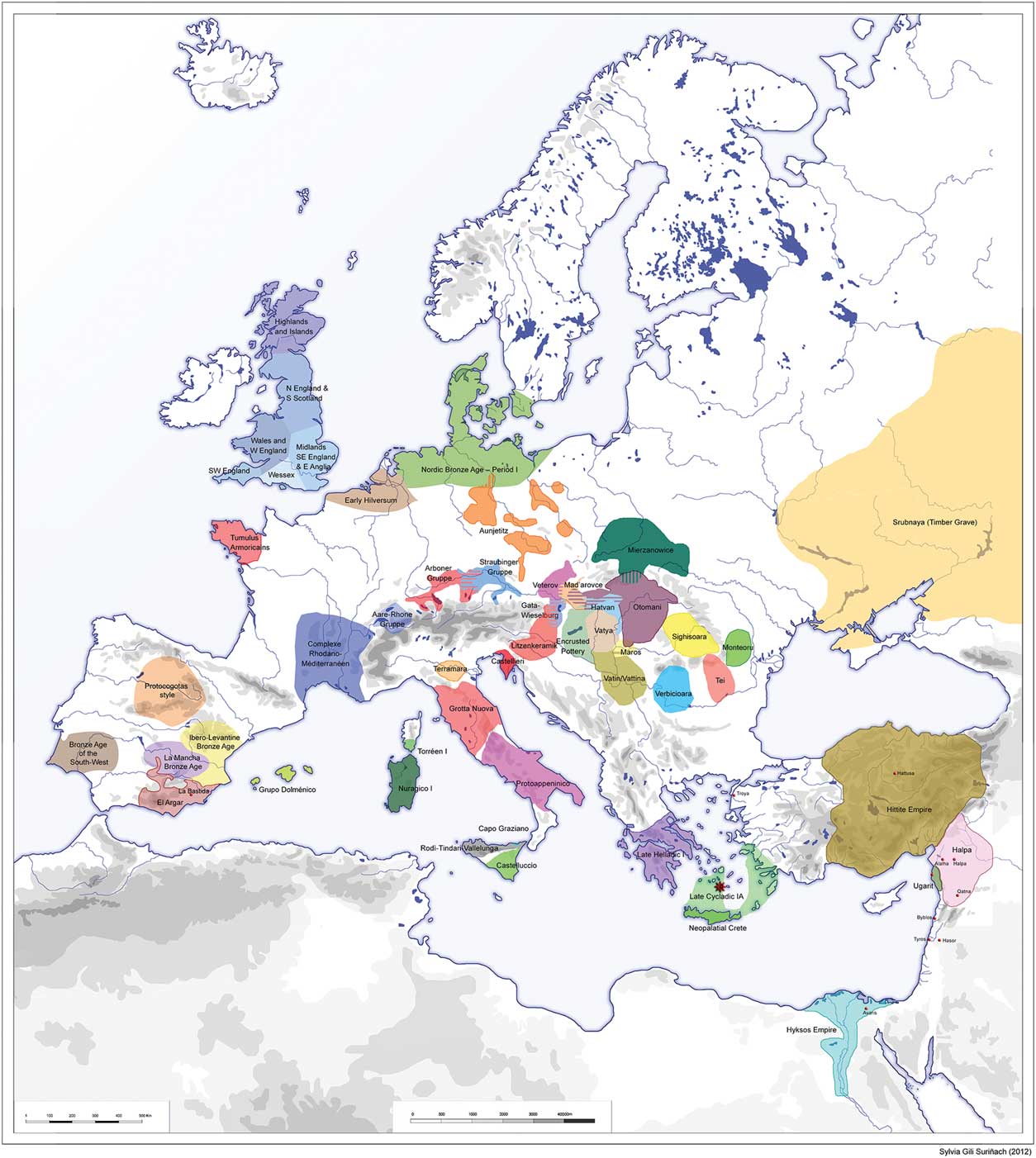
A detailed examination of the archaeological deposition of the above mentioned scenarios would need to be the focus of a long-term international research project. However, developmental tendencies are presented here, which are particularly clear in the conference proceedings 1600 – Cultural Change in the Shadow of the Thera-Eruption? (Meller et al. Reference Meller, Bertemes, Bork and Risch2013). The starting point for such a discussion must be the social/political situation from the Near East to Atlantic Europe around 1600 BC (see Fig. 6). After over 100 years of prehistoric research, which for the most part developed under a cultural-historical paradigm, it is possible to map out the archaeological evidence. This shows that archaeological cultural provinces, as defined by G. Kossinna or V. G. Childe, were not sharply delineated for most of the continent. Aside from ‘culturally empty’ areas, the many entities shown in Figure 7 do not represent a combination of archaeological features that can be more or less plausibly connected to concrete social or ideological entities (on Fig. 7, areas with sharply defined limits), but rather to the dissemination of specific (ceramic) styles or other indicators such as certain burial forms. On the other hand, in other regions there are overlaps in the archaeological groups. These situations cannot easily be explained as being due to insufficient research, since the definition of an ‘archaeological culture’ was for a long time the primary goal of archaeological interpretation. Thus it seems that in many regions there was no standardisation of social practices and material distinctions. These regions and their populations are often ignored in fundamental discussions about the Bronze Age, since they lack a specific recognisable ‘identity’, understood as a recurring set of formal and conceptual traits. This absence makes them passive or marginal entities that did not participate in the corresponding ‘epoch change’ in established archaeological research.
Europe and the Mediterranean at the time of the Thera eruption around 1600 bc (H. Meller & R. Risch; graphic design S. Gili Suriñach & N. Seeländer)

Actually, these apparently ‘non-identifiable’ or ‘culture-less’ areas make it clear that many societies in the first half of the 2nd millennium bc resisted the new ruling and social structures or simply avoided them. These areas were also seemingly not particularly affected by the ecological and social changes during the 16th century nor did they appear to profit from the collapse of earlier power structures; this can be seen by their subsequent development. Such a marginal and/or refuge area was located, for example, in the Balearic Islands, where megalithic graves were still being erected in the 17th century and collective burials in caves and dolmen were still the norm (Micó Reference Micó2006). Hopefully, in the future Bronze Age research will put more focus on this dynamic phenomenon of social resistance in other parts of Europe and the Mediterranean. New findings from the central and northern Iberian Peninsula – which was a rather disregarded area for quite some time – show that the extreme socio-economic changes taking place in the Mediterranean were hardly noticeable there (Abarquero et al. Reference Abarquero, Blanco-González, Esparza and Rodríguez2013). These so-called Proto-Cogotas groups developed more or less continually until 1450 bc, and even had – when looking at the distribution of their signature ceramic styles – a significant influence on neighbouring regions, especially on the post-Agaric societies in southern and eastern Iberia after 1550 bc.
Large parts of southern Italy, as well as the islands of Sardinia, Corsica, Sicily, and the Aeolian Archipelago reflect the first socio-economic scenario, in which there was generally continuity in the settlement structures and forms of economy (eg, Castellana Reference Castellana2000). A similar situation can be seen in the region of southern Germany where there is a change in the burial rights, deposition habits, and house forms, but the settlement patterns, economic organisation, and long-distance contacts remain for the most part unchanged (Nadler Reference Nadler2001; Innerhofer Reference Innerhofer2013).
The second socio-economic scenario, in which societies maintain continual development of productivity after the Thera eruption, holds true especially for the Greek mainland, especially the Peloponnese, and in the Mycenaean regions. During the ensuing centuries there was an increase in and centralisation of accumulation of goods in the fortified hilltop settlements and corresponding necropolises (Voutsaki Reference Voutsaki2010). Accordingly, economic development was accompanied by a pronounced socio-political differentiation, which was unparalleled in any other part of Europe. This led in the end to the formation of the Mycenaean city-states.
Around the same time the Hittite Empire was developing in central Anatolia, which expanded during the 16th century bc into western Anatolia, northern Syria, and upper Mesopotamia, and was documented in written sources (eg Klengel Reference Klengel2002). The economic and political situation of the Hittite Empire must have been sufficiently consolidated at this time in order to carry out the famous military campaign and plundering of Babylon (c. 1150 km from the Hittite capital of Hattuša) under King Mursili I.
So it was possible that certain political structures were able to develop their power in conjunction with noticeable economic growth, even though they were both spatially and temporally close to the Thera catastrophe and were living in a climatically unfavourable time. One must then wonder how much the expansion of these new state structures profited from other societies’ crises – this is a concept that has been uttered many times in conjunction with the Hellenisation of Crete. The dominant economic position of the Mycenaean centres could have also been a decisive factor for the construction of rather foreign looking strongly fortified settlements, which appeared in Apulia around 1600 bc or even earlier (Scarano Reference Scarano2012; Cazzella & Recchia Reference Cazzella and Recchia2013; Jung Reference Jung2013). The unusually rich burials from Trinitapoli, which most likely date to the 16th century, contain exotic grave goods such as ivory and amber, that point on the one hand to contact with the Mycenaean world, and on the other hand document the first appearance of a ruling class in the area (Tunzi Sisto Reference Tunzi Sisto1999). This situation was observed in Apulia and could correspond to the fourth socio-economic scenario, although it is not yet clear how much can be attributed to a foreign entity in Italy, which would explain the violent destruction of these settlements by the native population in the 15th century bc.
After 1800/1700 bc fortified settlements were founded in northern Italy and in the Alpine area, including the Terramare settlements with ditches and banks in the Po Valley (Vanzetti Reference Vanzetti2013), fortified hilltop settlements in the Alps (Krause Reference Krause2005; Primas Reference Primas2013; Krenn-Leeb Reference Krenn-Leeb2013), or the lakeside dwellings surrounded by palisades in the peripheral area that were, however, abandoned before 1500 (Billamboz Reference Billamboz2013). The fortification of certain settlements comes not only at a time of increasing metal production – which can be seen in the mining activities at Mitterberg in the eastern Alps – but also during a period of increased population growth. Thus, during the transition from Period 1 of the Italian Middle Bronze Age to Period 2, ie at the beginning of the 16th century bc, there was an expansion of the Terramare settlements, in which the entire populated area in the Po Valley tripled (Vanzetti Reference Vanzetti2013). In the French Jura Mountains there was also a period of population growth around 1500 bc (Pétrequin et al. Reference Pétrequin, Magny and Bailly2005).
Another area that also exhibited a sudden increase in sedentary population is northern Europe. Here there was an increase in the number as well as the size of the average longhouse during the transition from IA to IB, which dates to around 1600 bc (Fokkens Reference Fokkens2009; Artursson Reference Artursson2010). At the same time in Scandinavia an abnormally large amount of metal was consumed, as can be seen in both hoards and graves, that would have required the import of a large amount of raw materials – possibly from the Alpine area (Vandkilde Reference Vandkilde1996; Filipp Reference Filipp2013). In contrast to the above mentioned southern areas, fortification played no role in the north.
In general, it seems that central Anatolia, the Greek Mainland, much of (and especially) northern Italy, eastern France, the ore-rich Alpine area, western Germany, and the Nordic regions were economically the most dynamic regions after 1600. That means that there were tangible societies that could correspond to the second socio-economic scenario. From a political point of view they are, however, completely different structures.
The answer to the aforementioned question – how much did these societies profit from the economic and political crises and/or collapse of other societies – can be approximated by identifying those archaeological groups that pertain to the proposed third socio-economic scenario. In this scenario it is possible to definitively place the Neopalatial state society of Crete, which collapsed at the end of the 16th century most likely as a result of internal revolt. A second example is El Argar in the western Mediterranean, which also developed a strong state structure around 1900 bc, possibly consisting of several territorial political units (Lull et al. Reference Lull, Micó, Rihuete Herrada and Risch2011; Reference Lull, Micó, Rihuete Herrada and Risch2013; Chapman Reference Chapman2003). The sudden end of this societal formation around 1550 – a few decades before the Neopalatial collapse – was also traced back to internal social unrest, which seemed to have its roots in increasing social differentiation and an economically based ecological crisis at the end of El Argar. This collapse also seems to have had consequences for the periphery around El Argar (Hernández et al. Reference Hernández, Jover and López2013). On the one hand, it led to the abandonment of many hilltop settlements and the fortification of Motillas in the southern Meseta. On the other hand, new power centres were formed in c. 2 ha large settlements at Cabezo Redondo (Alicante); they were much smaller than those of El Argar, but with great political and economic importance, which can be seen in the ‘treasure from Villena’ and similar gold finds from the settlement (Hernández et al. Reference Hernández, García and Barciela2014).
From a solely structural point of view, the development of Cabezo Redondo after the collapse of El Argar can be compared to the Palace from Knossos after the end of the Neopalatial regime: on the Iberian Peninsula the rest of the northerly societies, the so-called Proto-Cogotas, profited from this collapse (Abarquero et al. Reference Abarquero, Blanco-González, Esparza and Rodríguez2013), just as those on the Mycenean mainland and in the Aegean arose out of the political and economic vacuum created by the collapse of the respective state institution. In both areas there is an expansion of northern elements (ceramic styles, economic practices, and, at least in the Aegean case, languages) in the socially agitated southern areas, which, however, did not have similar structures. While the Mycenean states formed in the Aegean, relatively small economic/political territories were forming on the Iberian Peninsula that were ruled from 2–5 ha sized hilltop settlements. Definitive clues for the appearance of large coherent states or hereditary aristocracy are, however, absent.
Similar to what was happening on the south-east Iberian Peninsula, a comparable development might have been taking place in the Carpathian Basin and in the middle Danube during the 16th century bc. Just as in El Argar, there was the creation of states or state-like organisational forms around 1900 bc, with marked social differentiation led by a ruling class with hereditary rights. These were above all economic centralisations intended to control the distribution of strategic raw materials such as metal. These were not the ‘chiefdoms’ whose power potential had to be continually renewed through a subjective perception of their reputation, but instead were fixed socio-economic structures. Before 1600 bc there was even an expansion of the most powerful of these societies, the Otomani group, especially to the west (Batorá Reference Bátora2013). These demographic and political phenomena are reminiscent of the roughly contemporaneous expansion of the El Argar culture on the south-east Iberian Peninsula (Lull et al. Reference Lull, Micó, Rihuete Herrada and Risch2011). In both cases, this seems to be about the control of raw material, in particular of mineral-rich areas. Similar as in El Argar, the economic and political landscape in the Carpathian Basin up to the mid-Danube was comprised of 0.2–12 ha hilltop and/or fortified settlements (Batorá Reference Bátora2013; Peška Reference Peška2013; Fischl et al. Reference Fischl, Kiss, Kulcsár and Szeverényi2013; Krenn-Leeb Reference Krenn-Leeb2013). These settlements were not only demographically and architectonically important, but also seemed to control metalworking and the production and circulation of other labour intense and exotic goods (Batorá Reference Bátora2009; Peška Reference Peška2013; Krenn-Leeb Reference Krenn-Leeb2013). In the 16th century, during the so-called Koszider Horizon, there was a significant decline in the number of settlements (Fischl et al. Reference Fischl, Kiss, Kulcsár and Szeverényi2013). Although there are not yet any reliable absolute dates, the socio-political conditions seemed to have peaked at the end of that century. The economically highly developed settlements were abandoned and sometimes concluded with burn and destruction layers (Batorá Reference Bátora2013; Krenn-Leeb Reference Krenn-Leeb2013). The contemporaneous growth, preference for cremation rites over inhumations, and changes in burial goods show how profound the social and ideological changes in the 16th century bc must have been (Batorá Reference Bátora2013; Krenn-Leeb Reference Krenn-Leeb2013; Primas Reference Primas2013).
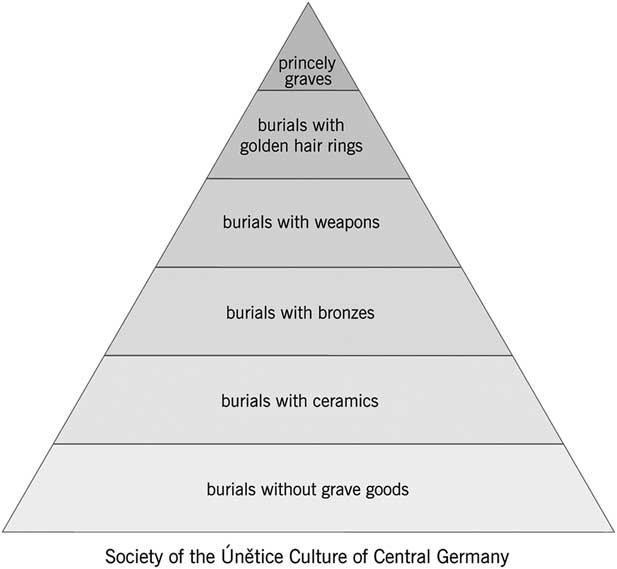
Eastern central Europe was settled by members of the Únětice Culture during the first half of the 2nd millennium bc. Using the example of central Germany, it is possible to easily follow the establishments of a steep social hierarchy already starting in the 20th century when there were only a few rulers and many subjects. The leadership is possibly hereditary, with members spread over at least three ranks determined by their gold and weapon grave goods (Fig. 8) (Schwarz Reference Schwarz2014). The rulers manifested themselves with large grave monuments and an excessive amount of bronze weapons, and in single cases (similar to the god-like rulers in the Near East and Egypt) weapons made of gold. The rulers apparently commanded an effective military organisation that allowed them to control the region north of the Harz Mittelgebirge to Silesia for almost 400 years (see Meller Reference Meller2013; in Reference Mellerpress; Schwarz Reference Schwarz2014, 727–9). This control applied to the central, north–south as well as east–west (and vice-versa) travel routes. These routes were of utmost importance, as can be seen by looking at raw materials such as salt, copper, gold, and amber. In the region of Halle there was extensive salt production. Amber was imported from the north and copper out of the south. The Nebra Sky Disc shows that in addition to copper from the eastern Alps, tin and gold were imported from Cornwall (Ehser et al. Reference Ehser, Borg and Pernicka2010; Lockhoff & Pernicka Reference Lockhoff and Pernicka2014).
Social organisation in the Únětice Culture of central Germany (after Schwarz Reference Schwarz2014, 718, fig. 1a; graphic design R. Schwarz & A. Reinholdt)

The classical Únětice system had already been dissolved in Bohemia by 1750 bc, where it fell to the pressure of developing cultures to the south (Ernée Reference Ernée2013, 463–4). North of the Mittelgebirge these changes were not felt for another 100 years. At the time the Nebra Sky Disc was deposited, between 1600 and 1550 bc, there were deeply rooted changes taking place. This affected settlement intensity and demography less and social organisation more (see Zich Reference Zich2013; Meller Reference Meller2013).
The steep, clearly defined hierarchies within the organisation of the military were toppled by local rulers, represented in the archaeological record by sword warrior graves. The former long range contacts lost ground to regional relationships. However, the developmental changes in the adjacent areas to the south and north escalated with the demise of the Únětice political power structure. These areas lived through a singular boom, which was made possible through trade on a direct route between the regions of origin and the consumers of the raw materials. Figure 9 clearly shows this phenomenon. In the eastern Alpine region, especially in the mining area around Mitterberg near Bischofshofen, large amounts of copper were extracted from the end of the Early Bronze Age to the beginning of the Middle Bronze Age. Already at the beginning of mining in the 18th century, the Nebra Sky Disc was constructed out of copper from the Mitterberg mines, meaning that this copper had already reached central Germany by this time (Fig. 9; Pernicka Reference Pernicka2004; Reference Pernicka2010). In the following centuries Mitterberg copper passed unhampered to the north and provided for the successful beginning of the Bronze Age in the Nordic countries. It is possible that in reciprocation, amber found its way all the way to Mycenaean Greece (Genz Reference Genz2004, 170).
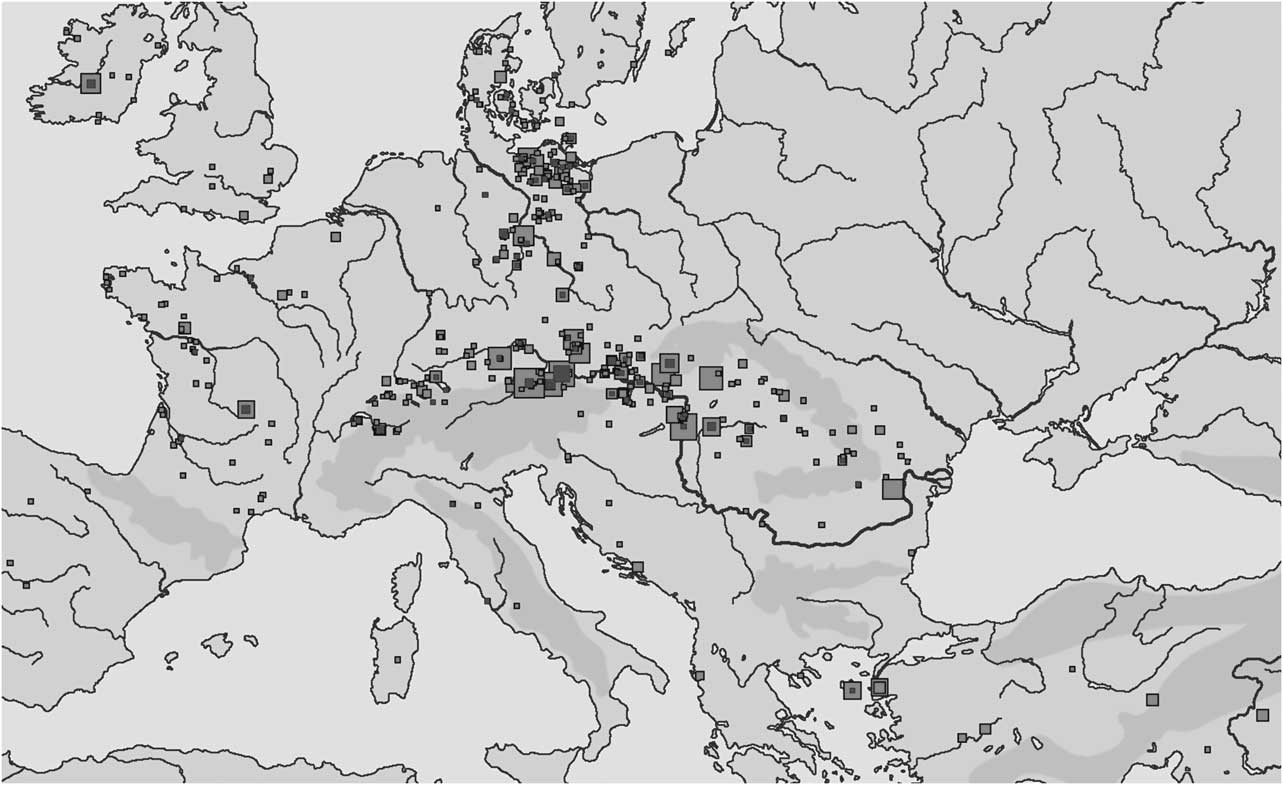
Distribution of the Early and Middle Bronze Age metals with trace elements closely resembling the Nebra Sky Disc. High similarity is marked with dark grey squares, while lower values are shown in light grey. These artefacts presumably derive from ores coming from the Mitterberg mining region of the eastern Alps (E. Pernicka; graphic design: N. Seeländer)

With social upheaval taking place in the central region of the Únětice culture after 1600 bc, it was no longer possible to control the transport routes as society relapsed into insignificant rural chiefdoms. This is also true for the way along the river Oder, which allowed the flow of ideas and Bronze Age technologies up to Scandinavia (see Swieder Reference Swieder2013; Vandkilde Reference Vandkilde2014). A more fluid social mobility is also seen in the Carpathian and Central European regions at the end of the 17th and in the 16th century. After that there was an extended distribution of ‘culturally specific’ ceramic styles, stronger contacts to the shaft tomb horizons of the Aegean, and western influences from the tumulus phenomenon (Fischl et al. Reference Fischl, Kiss, Kulcsár and Szeverényi2013; Batorá Reference Bátora2013; Peška Reference Peška2013; Krenn-Leeb Reference Krenn-Leeb2013).
New radiocarbon dates show a significant change in the Eurasian Steppe regions from the 16th to 15th centuries bc (Chernykh Reference Chernykh2008). After the end of the more sedentary Srubnaja timber grave culture, archaeological evidence is scarcer, explained by the resumption of nomadic and half-nomadic economic forms.
The cause of the breakup of the Carpathian and Central European societies has been debated by different authors and has been attributed to both social and climatic factors, although colder and wetter conditions first became noticeable after 1500 bc, ie after the downfall of the already mentioned power centres of this area. The social impact of a climatic decline has thus been put to question since, especially in Northern Europe, where its consequences would have especially been felt, there was a period of enormous economic and demographic growth after 1600. The premise for such a development is increased harvests and stable livestock breeding.
The plundering of rich inhumations in Lower Austria is definitive proof of social resistance, loss of power, and legitimation of the Early Bronze Age elites and the change of socio-political structures in which they embodied. As in Minoan Crete and El Argar, it also seems that in the Carpathian Basin and central Danube, social change was the primary culprit for the breakup of the first state or state-like structures in Europe. At this point in time, the Central and Western European societies were still able to rebel against the new mechanisms of social exploitation and the culminating power circumstances which were unfolding in all three areas between 2000/1900 and 1600/1500 bc. After 1500 in Europe there was a general decentralisation of economic production – which is visible for example in metallurgy – and also in political power; in the Eastern Mediterranean the new political vacuum was occupied by new political entities. These were above all the Hittite Empire in Anatolia and Near East from Mursili I, the New Kingdom in Egypt around 1504 bc (after the definitive banishment of Hyksos by King Ahmose), and Mycenaean city-states around the mid-15th century.
CONCLUSIONS
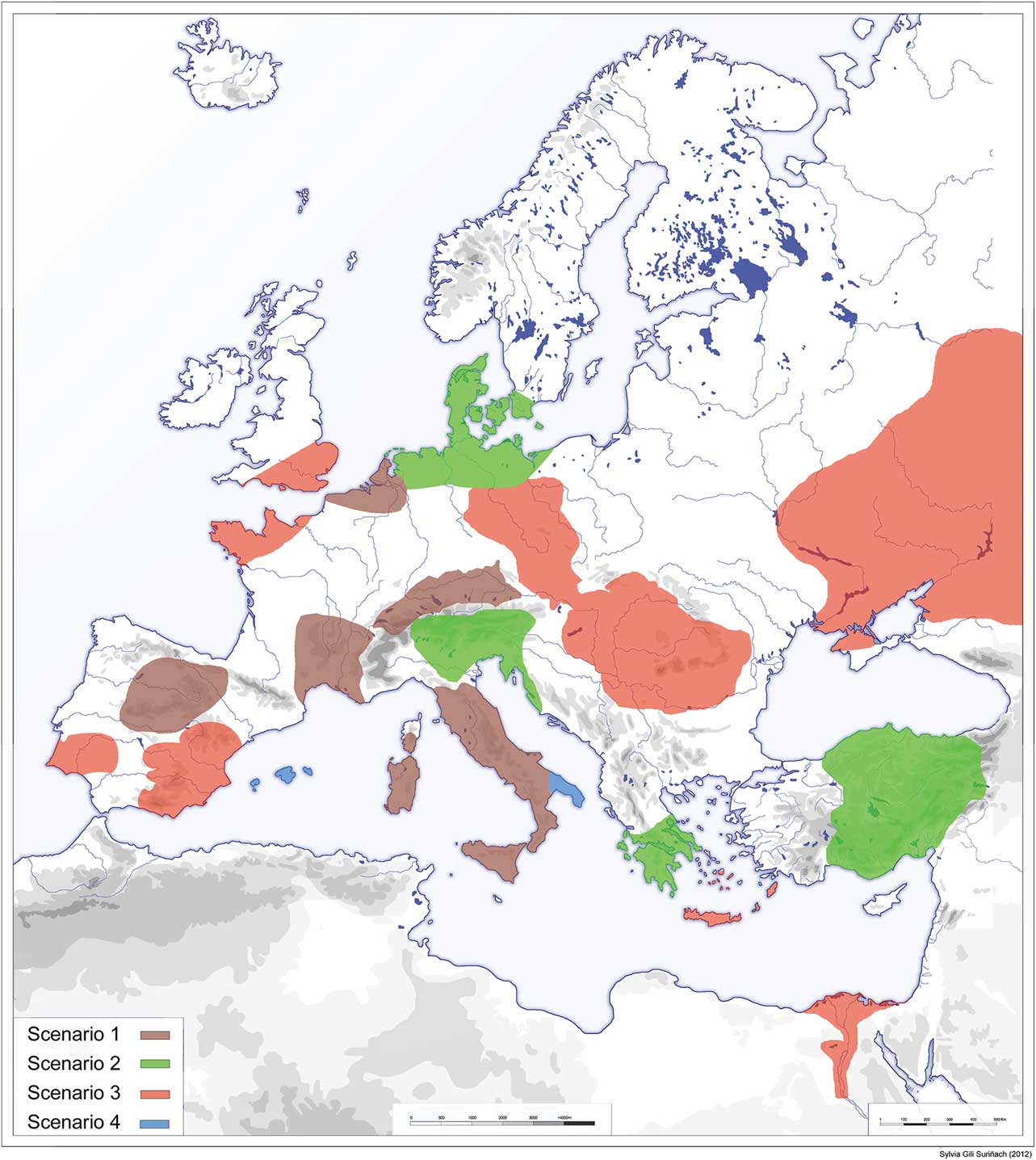
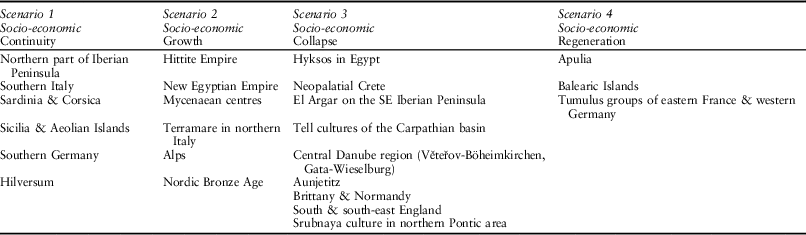
The socio-political relationships of the most studied archaeological groups from the first half of the 2nd millennium bc are summarised in Table 1. It shows that the 16th century was clearly a period of deep social transformations. Only a few areas, mostly islands, seemed to have developed more or less continuously (Scenario 1). When we map the different historical developmental patterns, it shows that the different socio-economic scenarios in the 16th century did not form closed spaces, but instead are spread out like a mosaic over Europe and the Mediterranean (Fig. 10). This shows that the described social and political changes and continuities cannot be explained by climatic conditions, or at least were not primarily caused by a climatic decline. It also seems that the societies who lived closer to Thera were not affected more strongly by the volcanic eruption as more distant regions. Thus it becomes clear that the volcano eruption from 1613±13 bc did not cause any immediate and wide-ranging economic and social crises – except those on the island itself.
Different socio-economic processes during the 16th century bc: Scenario 1 – Continuity; Scenario 2 – Growth; Scenario 3 – Collapse; Scenario 4 – Regeneration. The new societies emerging after 1600–1500 bc in the regions pertaining to Scenario 3 are not considered (H. Meller & R. Risch; graphic design S. Gili Suriñach & N. Seeländer)

Change and continuity in europe and the mediterranean during the 16th century BC

The eruption incidentally happened to take place at the beginning of a period of climatic instability and increased aridity in the eastern Mediterranean. Therefore the perception of such a spectacular eruption and the lack of an explanation from the then ruling class could have led to the challenging of the established power structures – when there was an additional simultaneous or a subsequent peak in social exploitation and economic deficits. In light of this, it does not seem random that precisely these forms of society that have clear archaeological evidence for the concentration of surplus, of territorially organised power structures, and a developed division of work and social inequality did not survive past the 16th century bc (Scenario 3).
Independent of their distance to Thera – according to the current state of research – there seems to have been social movements in Minoan Crete, in the Argar Culture in south-east Spain, in the Carpathian Basin (Tell) societies up to Moravia and Lower Austria, as well as the Únětice area of Central Europe, which aimed to overthrow the established ruling structures, to change the settlement patterns, and to cancel earlier burial rights that were used to identify and legitimise social differentiation. Even the Atlantic elite on both sides of the English Channel was effected by this upheaval (Darvill Reference Darvill2013). Destruction layers in the central settlements, plundering of graves, more frequent appearance of deposits of exceptional objects – such as the case of the Nebra Sky Disc or the Slovakian gold treasures (Barca, Spišský Štvrtok) –, the dissolution of earlier territorial boundaries, and the refusal of the established symbolic systems indicate that these social changes present a deeply cutting upheaval. This upheaval, which took place within a few generations in very different European territories that were sometimes hundreds of kilometres apart, speaks of a time of heightened social communication and also possibly increased mobility within Europe, which is quite plausible when looking at the archaeological evidence (Kristiansen & Larsson Reference Kristiansen and Larsson2006).
The destruction of all Early Bronze Age power centres in Europe does not, however, signify an economic or social regression for most of Europe (Scenarios 2 & 4). On the contrary, there is quite a bit of evidence for intensification in production and circulation of goods and raw materials after 1500 bc. The breakup of early centres of power and their territorial borders and the socialisation of certain handicrafts, such as metallurgy, apparently led to an expansion of the production of goods and an even more extensive diffusion of raw materials and products. This can be seen, for example, in the growing number of metal workshops and casting moulds, the wide-ranging appearance of Atlantic metal types, the increase in distribution of Mycenaean ceramics in the central and western Mediterranean, as well as the intensive exploitation of salt deposits in Hallstatt.
What fundamentally differentiated the developments in the eastern Mediterranean and the Middle East after 1500 bc is that the development of the forces of production and circulation networks was not controlled by urban centres and territorial states, but instead mostly emanated from different decentralised political entities and from relatively mobile population groups. Up until the Early Iron Age and the expansion of the Phoenicians and Greeks, there were only isolated occurrences of complex settlement forms with significant fortified structures (eg, in the Adriatic-Italian area) or a personal accumulation of wealth in graves, like as in the Early Bronze Age in most areas identified by the third scenario. Thus for Europe, the revolutions in the 16th century bc mainly resulted in a social break with those political organisational forms that most closely resembled the oriental state entities or similar structures that could have developed into such. The apparent dramatic interruption of this historical process made it possible for the development of new social organisational forms and economic structures that were not necessarily less dynamic, but did not allow the development of class societies with inherited ownership and institutionalised power structures, like those which were surely known in the Aegean or Near Eastern areas. From this perspective, Neopalatial Crete, Argar, Otomani, Únětice, etc. were not – as they are usually portrayed – the characteristic and long term definitive social forms in the European Bronze Age, but were instead temporally and spatially limited outliers, which were more or less concurrently overcome by internal social forces in the 16th century bc.
We see the wall paintings in Akrotiri and their symbolic language as foreign because the 16th century bc was a distinct break in social, political, and ideological self-images of the first class societies in Europe. In the end, it seems to have been the ‘culturally empty’ areas shown in Figure 7 and the rather materially inconspicuous and non ‘normalised’ societies pertaining to Scenarios 1 & 2, which historically established themselves in Europe for the next centuries.
Acknowledgements
This paper is dedicated to all the authors participating in the conference and subsequent monograph, 1600 – Cultural Change in the Shadow of the Thera-Eruption?, without whom our initial aim to draw a historical geography of the time around 1600 bc would have been impossible. We are particularly grateful for the discussions maintained with and comments from Bernd Zich, Svend Hansen, and Ralf Schwarz. Our special thanks also go to Erica Hanning who translated the original German text.