Clostridium difficile intestinal infection (CDI) is a leading cause of morbidity and mortality, both within healthcare environments and in the community.Reference Gerding and Lessa 1 Although the epidemic strain BI/NAP1/027 was first identified using pulsed-field gel electrophoresis (PFGE) and polymerase chain reaction (PCR) ribotyping techniques,Reference Gerding and Lessa 1 the application of next-generation sequencing (NGS) to investigate the epidemiology of C. difficile has demonstrated greater diversity within genotypes than was previously recognized.Reference Eyre, Cule and Wilson 2 In a seminal study by Eyre et al,Reference Eyre, Cule and Wilson 2 36% of patients had no identifiable hospital or community contacts as a source for their infection despite C. difficile genomic differences of only 0–2 single-nucleotide variants (SNVs), which suggests complex modes of C. difficile acquisition.
Without a clearly defined incubation period for CDI, current Society for Healthcare Epidemiology of America (SHEA)— Infectious Diseases Society of America (IDSA) definitions classify nosocomial versus community acquisition according to the time interval since the patient’s most recent healthcare exposure.Reference Cohen, Gerding and Johnson 3 Although patients who develop community-acquired CDI have not, themselves, had healthcare exposure, it has been acknowledged that their household or residential contacts with recent hospital admissions could provide a source for community acquisition of C. difficile.Reference Chitnis, Holzbauer and Belflower 4 The potential for this mode of transmission is likely to reflect the complexity of the residence in terms of numbers and health status of its residents. Long-term housing provision within a ‘hostel’ facility for chronically homeless adults, most of whom have chronic illness, exemplifies a high order of residence complexity. Case management strategies that include provision of hostel-type accommodation have been shown to reduce emergency and inpatient admissions of such residents,Reference Sadowski, Kee, VanderWeele and Buchanan 5 and tuberculosis and blood-borne virus transmission events have been identified in this context.Reference Kmietowicz 6 , Reference Neale and Stevenson 7 Here, we report a cluster of cases of CDI involving 4 hostel residents among 7 patients with CDI due to C. difficile ST-295. Identification of this unique strain enabled resolution of its transmission from its recognized nosocomial origin (patient 1),Reference Mac Aogáin, Moloney, Kilkenny, Kelleher, Kelleghan and Boyle 8 possible carriage to the hostel (patient 2), and subsequent nosocomial transmission following hospital admission of a hostel patient (patient 4) with recurrent CDI.
METHODS
Patients’ clinical details and their C. difficile isolates were collected prospectively with the approval of our institutional review board. CDI was diagnosed in accordance with Irish national guidelines.Reference Mac Aogáin, Moloney, Kilkenny, Kelleher, Kelleghan and Boyle 8 Following identification of C. difficile DNA using a EntericBio PCR kit (Serosep, Annacotty, Ireland) at the diagnostic enteric laboratory, stool specimens were treated with ethanol shock before anaerobic incubation, using cycloserine-cefoxitin egg-yolk medium. Next-generation whole-genome sequencing of C. difficile colonies was performed at the TrinSeq Genome Sequencing Laboratory (Trinity College, Dublin, Ireland) with downstream read mapping and SNV calling performed as previously described.Reference Mac Aogáin, Moloney, Kilkenny, Kelleher, Kelleghan and Boyle 8 Strain phylogenetic comparisons based on genome-wide SNV calls were performed by neighbor joining (BIONJ) using PhyML (ATGC, Montpellier, France).Reference Guindon, Dufayard, Lefort, Anisimova, Hordijk and Gascuel 9 Genomes were assigned sequence types according to the PubMLST database,Reference Griffiths, Fawley and Kachrimanidou 10 and an epidemiologic analysis was performed following the approach of Eyre et al.Reference Eyre, Cule and Wilson 2 A PCR-based ribotype analysis was also performed on each isolate as previously described.Reference Mac Aogáin, Moloney, Kilkenny, Kelleher, Kelleghan and Boyle 8 CDI episodes were classified according to current IDSA/SHEA definitions.Reference Cohen, Gerding and Johnson 3 The hospital is a 1,015-bed acute tertiary care facility with annual inpatient admissions exceeding 25,000 and an immediate catchment population of ~350,000. The hostel is within this catchment population; ~66% of its residents are allocated to single en-suite bedrooms.
RESULTS
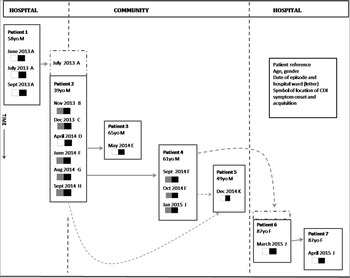
The details of CDI episodes confirmed to have been caused by C. difficile ST-295 are presented in Figure 1. Patient 1 had a prolonged hospital admission on ward A, during which he developed nosocomial CDI in March 2013, with 4 recurrences by September 2013. We identified the defining single-nucleotide variant (SNV) for C. difficile ST-295 as one that had evolved in this patient in June 2013 from an ST-2 isolate.Reference Mac Aogáin, Moloney, Kilkenny, Kelleher, Kelleghan and Boyle 8 Patient 2 was admitted to ward A in July 2013, while patient 1 was symptomatic. Patient 2 had subsequent hospital admissions (from the hostel), with no further known contact with patient 1 or ward A, and this patient presented in December 2013 with community-onset symptoms of hospital-acquired CDI.
Cluster of ST-295 C. difficile infection. Horizontal axis illustrates the patient’s location at the time of inferred C. difficile transmission, with separation of locations by line style. Vertical axis illustrates time of cluster, from September 2013 to April 2015. Patient details are presented as pseudonym, age, gender, and CDI episodes with date and panels to represent IDSA/SHEA classification code. Hospital-onset, hospital-acquired CDI episodes are displayed as rectangular panel with white and dark gray fill  . Community-onset, hospital-acquired CDI episodes are displayed as rectangular panel with light and dark gray fill
 . Solid arrows (
 ) illustrate the transmission event from exposure to one symptomatic patient. Dashed arrows (
 ) indicate exposure to two symptomatic patients. Dashed extension to patient details represents identified ward contact for transmission, meeting criteria of Eyre et al.Reference Eyre, Cule and Wilson
2

Patient 3 had been diagnosed with hospital onset of hospital-acquired CDI. He had no identifiable shared hospital exposures to either patients 1 or 2, but he was a resident of the hostel at the same time as patient 2. His only symptoms of CDI occurred as a hospital inpatient.
Patient 4 presented with community-onset symptoms in September 2014. Because he had an inpatient admission during the previous month, this episode was classified as community onset, hospital-acquired CDI. However, he had known exposure to patient 2’s community onset of CDI symptoms in August 2014 (Figure 1). This factor raised concern over the possibility of patient 4 having community-acquired infection. Patient 4 had a recurrence in October 2014 that warranted hospital readmission.
Patient 5 was diagnosed with CDI in December 2014 as a hospital inpatient. He was also a resident of the hostel at times when both patients 2 and 4 experienced community-onset of symptomatic CDI.
With new symptoms of CDI, patient 4 had another hospital admission in January–February 2015. CDI diagnoses were made for patient 6 in March 2015, and patient 7 in April 2015. C. difficile ST-295 was subsequently identified in the fecal samples of patient 6 in March 2015 and in patient 7 in April 2015. Some areas within the hospital ward (J) were common to both patients 4 and 6, and later, to patients 6 and 7.
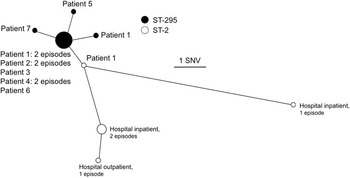
In PCR-based ribotype analyses, all C. difficile ST-295 isolates were classified as ribotype 020. Phylogenetic comparison of genomic data showed that all ST-295 isolates clustered together as a distinct branch from ribotype 020 isolates belonging to ST-2 (Figure 2). Within our collection of 200 additional C. difficile clinical isolates with NGS information over the course of the outbreak investigation, only 5 ST-2 isolates were within 10 SNVs of ST-295. There is no plausible clinical explanation to support alternate hypotheses for the evolution and transmission of ST-295 isolates.
The phylogenetic relationship between ST-295 and closely related ST-2 isolates. A neighbor-joining tree illustrates the phylogenetic relationship between ST-295 (black circles) and closely related ST-2 (white circles) isolates observed during the outbreak investigation. Larger circles represent clusters of genetically indistinguishable isolates. In addition, 16 additional ST-2 isolates identified during our investigation are not shown because they differed from the index case (Patient 1) by >10 SNVs. All identified isolates that differed from the index case by <10 SNVs are included in the tree.

In October 2014, the CDI outbreak cases from the hostel (patients 2, 3, and 4) were reported to the responsible public health department; the first recognition of a possible CDI transmission within the hostel was made by a primary care physician. We subsequently learned that another patient from the same hostel was admitted to another hospital with CDI in September 2014, but, unfortunately, that isolate could not be recovered for investigation. The community hostel is under the governance of a voluntary organization. It is not classified as a healthcare facility, and cleaning standards are not equivalent to those of a healthcare institution. 11 When these cases were recognized, public health action was undertaken. Residents were encouraged to practice good hand hygiene; environmental surfaces were treated with either 1,000 ppm of chlorine agent or bleach preparations; 12 and dedicated equipment was used to clean bedrooms of symptomatic residents.
A root-cause analysis was undertaken by the hospital’s infection prevention and control team for nosocomial onset cases in response to the link identified between patients 6 and 7.
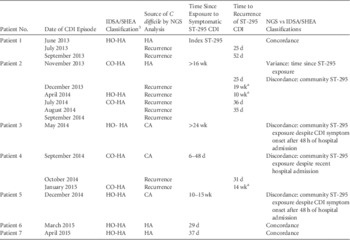
Table 1 presents an evaluation of the epidemiological classification of each patient’s CDI episode(s) according to IDSA/SHEA guidelinesReference Cohen, Gerding and Johnson 3 and in light of the NGS results. Findings for patients residing in the community hostel (patients 2, 3, 4 and 5) were discordant between the SHEA/IDSA classifications of their initial episodes and the acquisition source inferred by NGS analysis.
Comparison of Society for Healthcare Epidemiology of America (SHEA)—Infectious Diseases Society of America (IDSA) Classification of Clostridium difficile Infection Episodes with Next-Generation Sequencing Analysis

NOTE. HO, hospital onset of symptoms; HA, hospital-acquired infection; CO, community onset of symptoms; CA, community-acquired infection.
a Cannot exclude reinfection from environmental spores versus intestinal carriage.
DISCUSSION
The resolution of a link between these cases by virtue of their sharing a C. difficile strain with sequence type 295 provides new insight into current surveillance definitions. Although prolonged carriage of C. difficile prior to a first episode of CDI has not been reported previously, our findings suggest that patient 2 may have had nosocomial acquisition of C. difficile ST-295 16 weeks before his symptoms began. This time lapse exceeds the maximum interval of 12 weeks between hospital discharge and symptom onset recognized by earlier surveillance recommendations.Reference McDonald, Coignard and Dubberke 13 These surveillance definitions acknowledge the complexity of attributing the source of C. difficile exposure when patients have been admitted to multiple facilities.Reference McDonald, Coignard and Dubberke 13 We cannot exclude the possibility of other mutual contacts across multiple hospital wards; however, Eyre et al’s analysis of such intermediate contacts, either asymptomatic or with negative enzyme immunoassay results, suggests that this is more likely a chance finding than a source of transmission.Reference Eyre, Cule and Wilson 2 Our NGS results favor community acquisition of C. difficile by patients 3, 4, and 5, all of whom had episodes categorized as hospital-acquired CDI by current IDSA/SHEA definitions.Reference Cohen, Gerding and Johnson 3 We believe that, with the increasing complexity of the epidemiology of CDI, NGS enhances the capacity to distinguish between community and hospital acquisition as well as the ‘trafficking’ between them.
The community hostel setting was an interesting aspect of this case cluster. Patients 2, 3, and 5 had single bedrooms in close proximity. As a consequence of their medical issues, patients 2, 3, 4, and 5 all had antibiotic and proton-pump-inhibitor exposure prior to their first CDI episode. Appropriate infection prevention and control measures were taken in the hostel under the guidance of public health personnel. No new ST-295 infections have been detected in the 14 months since this intervention.
Hospitalized patients with suspected and/or confirmed CDI are normally placed in single rooms with en-suite facilities, accompanied by enhanced cleaning and disinfection of the room and equipment during the symptomatic period. Additional investigations have been conducted as a result of the likely link between patients 6 and 7.
We believe patient comorbidities, with further antibiotic exposure, to be the predominant cause for the recurrent disease experienced by patients 1, 2, and 4, but we cannot definitively exclude further environmental acquisition.
Although only 1 SNV distinguishes ST-295 from ST-2, its occurrence within the housekeeping gene atpA generated a new alleleReference Griffiths, Fawley and Kachrimanidou 10 and new sequence typeReference Mac Aogáin, Moloney, Kilkenny, Kelleher, Kelleghan and Boyle 8 that served as a molecular marker for case recognition in this cluster. Ribotype analysis could not provide this degree of resolution, which supports its replacement by NGS.Reference Eyre, Cule and Wilson 2 To our knowledge, this is the first description of an ST-295–associated cluster and the first evidence of possible C. difficile transmission among residents of hostel facilities for homeless adults with chronic illness.
ACKNOWLEDGMENTS
Financial support: G.M. received grant support from Health Research Board, Ireland (HPF-2014-716). Additional support was provided by Department of Clinical Microbiology, Trinity College Dublin, Ireland.
Potential conflicts of interest: T.R.R. has been an advisory board member for Astellas Pharma (Ireland). All other authors report no conflicts of interest relevant to this article.