Being an egghead seems to be a station in life to which no one aspires but which everyone would like to think himself natively qualified.
Charles Frankel, 1956Footnote 1On 16 November 1957, the Saturday Evening Post published an article by Charles Price recounting the peculiar sites of daily life in his home town of Princeton, New Jersey, a place “where there are so many great thinkers that a man without a Ph.D. is a nonconformist.” The gossipy article, assigned the splashy, vaguely anthropological title “I Live among the Eggheads,” typifies the treatment given eggheads in 1950s America. Price's lavishly illustrated piece – several photographs were accompanied by weirdly zoological captions such as “Professors at play” and “Professors in parley” – sensationalized the explicitly dull lives of Princeton's most ordinary men. “In my town,” Price dished, “people are talking about organizing a fourth symphony orchestra; three, apparently, are not enough.” The article focussed primarily on the excessive braininess of Princeton's ordinary citizens, a highly accomplished assemblage of intellectuals that included physicist Robert Oppenheimer, author John O'Hara, and the anomalous literary critic Richard P. Blackmur, who was “held in awe by Princetonians because he doesn't have a college degree.” In language that at times lapsed into ethnographic exoticism, Price excavated the minutiae of existence in a town “becoming as well known for its eggheads as Hershey, Pennsylvania, is for its chocolate bars.”Footnote 2
This essay studies the emergence of the egghead in Cold War American culture. The curious creature discussed so dispassionately in Price's article was the subject of much discussion and debate in Cold War American culture. I argue that the emergence of the egghead shifted representations of intelligence in American culture to cast an air of suspicion on those who appeared too smart for their own good – a strategy that emerged from within conservative ranks seeking to cut off radical challenges to the political power of America's elite through the advance of intellectual democracy. At the same time, however, the egghead was treated as a uniquely American curiosity, and was therefore also used to affirm America's “native” intelligence. The fascination with eggheads in Cold War American culture complicates our understanding of a period too easily characterized as anti-intellectual.Footnote 3 Though the egghead might have emerged as part of a discourse critical of intellectual elitism, the character was far more complicated than this framework has allowed. Studying the egghead reveals the complex nexus of race, gender, and sexuality at the heart of American representations of intelligence, and illustrates the dangerous implications of pitting liberalism against conservatism at a moment when American identity was widely conceived as being under threat.Footnote 4
It bears noting that the appearance of the egghead in the 1950s corresponded with a moment of curious fascination with overly smart Americans who were treated as objects of envy, intrigue, and celebration within popular culture. Nowhere was this more visible than on television quiz shows, where brainy Americans competed with one another to win both public praise and wads of cash.Footnote 5 The 1959 quiz show scandal, in which Charles Van Doren's long run of wins revealed an intricate network of behind-the-scenes coaching on the show Twenty One, reveals the seriousness with which braininess was approached in the 1950s: revelations of the fix sparked massive retaliation against Van Doren, a Columbia professor of English, for having been represented as smarter than he actually was.Footnote 6
The quiz show scandal both affirms and disrupts the dominant narrative about Cold War-era eggheads in the United States. The fascination with Van Doren's brain reveals the centrality of intelligence in American popular culture, and his celebrity indicates an extraordinary amount of interest in wickedly smart people who were in every other sense completely ordinary. Yet Van Doren was alluring precisely because he exposed the limits in representations of Cold War-era intelligence: it became impossible to depict a contestant who was both an unassuming, non-threatening, “normal” family guy, and wildly intelligent. Van Doren reveals the limits of incorporating brainpower into the discourse of Cold War liberalism; his failure to conform to operative myths about eggheads in the 1950s resulted in surveillance, policing, and, ultimately, overwhelming public opprobrium. Van Doren ultimately embodied the impossibility of imagining a liberal, non-eggheaded smart man, and his failure confirmed the danger eggheads were imagined to engender within the expansion of Cold War-era liberalism.
Before turning to the specific features that characterized the Cold War egghead, I want to return briefly to Charles Frankel's epigraph that began this article. The fundamental paradox that Frankel identifies – the simultaneously seductive and repellent reactions elicited by the egghead's emergence – was irresolvable in Cold War American culture, in part because the egghead signified a broader set of contradictions that dominated the postwar years. The notion that Americans by and large wished to believe themselves “natively” qualified to eggheaded-ness points to the expansion of exceptionalist language to describe American identity during a period of pitched conflict between the political ideologies of the US and the USSR. The culture of the Cold War demanded that Americans recognize themselves as inherently qualified to export democracy around the globe at the very moment when US citizens were conceived to be precariously close to being compromised by subversive menaces. The paradox of the egghead could not be resolved any more than could the contradictions immanent to the Cold War: the egghead affirmed the maleness, whiteness, and heterosexuality of brainpower, but also indicated that even those who possessed this identity had to conform to a set of proper behaviors to retain their claims to power. White heterosexual manhood was reified as the model for American citizenship, but the underlying assumption that all white heterosexual men were equally eligible for citizenship was fundamentally compromised. The egghead's fragile shell housed a curious mixture of contradictions concerning American identities, politics, and behaviors that was, ironically, nearly impossible to break.
INVENTING THE EGGHEAD
Before the 1950s, “egghead” was an innocuous term referring to nothing more troubling than a person who possessed a bald pate and an oval head. A Warner Brother's character bearing the name was featured in such animated films as Egghead Rides Again, a 1937 Merrie Melodies short featuring dull-witted man who failed to convince anyone that he was truly a cowboy.Footnote 7 By the end of the decade, however, the egghead had become an instantly recognizable cultural type whose bodily signifiers reflected a dangerously subversive disposition and giant brain.
The first substantiated use of the term in reference to an overly intelligent person appeared in a Stewart Alsop column from 1952.Footnote 8 Alsop was a popular columnist who covered the American political scene with a particularly sharp, no-nonsense approach. In a column about the emerging presidential campaign, Alsop attacked those intellectuals he found superficial for deserting Eisenhower in favor of Stevenson simply because the latter candidate possessed greater polish and presented a sophisticated persona. According to one contemporary journalist, Alsop “named them ‘eggheads,’ inspired presumably by the spectacle of Adlai Stevenson's impressive and egg-shaped forehead, distorted to twice its height by one of the humorous tricks that television plays with elevated and shining objects.”Footnote 9 Another author claimed that Alsop was merely repeating a comment he overheard from a supporter of Stevenson who reportedly said, “I know he has all the eggheads with him, but they aren't enough to elect him.”Footnote 10
Though the term “egghead” did not appear until 1952, the general character type it described had a number of antecedents. “Whether or not [the term “egghead”] was suggested by the oval shape of his head,” wrote one author in an article about the egghead in the Saturday Review, “the significant thing was the necessity for a new word, instead of intellectual, ‘longhair,’ or ‘highbrow.’”Footnote 11 The longhair was a curiosity at a distinct remove from everyday folk; he was elitist, distinguished, and nonpolitical. The “double-dome,” a close relative of the “highbrow,” was a less commonly used phrase that specifically referred to professors. None of these terms outlived the 1950s, but their legacy included more than their attacks on intelligence through disparaging labels. Each term also emphasized the physical bodies of the figures they characterized, and “longhair” bore the added implication of gender transgression, equating the cultured man with effeminacy and excessive grooming. The overtones of homosexuality in this particular designation were not incidental; the longhair's effeminacy was a particularly significant predecessor to the egghead who was also conceived as queerly feminine.
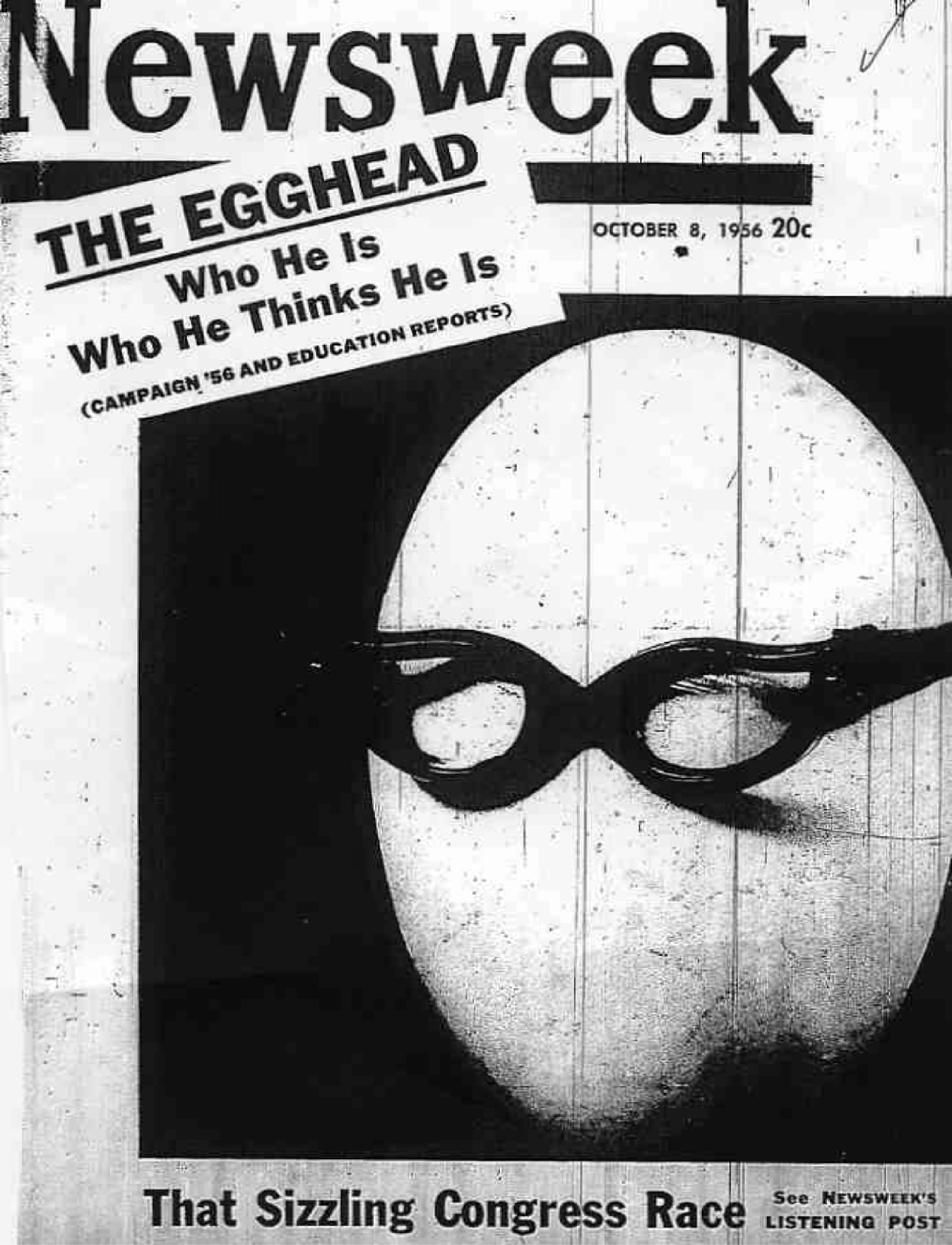
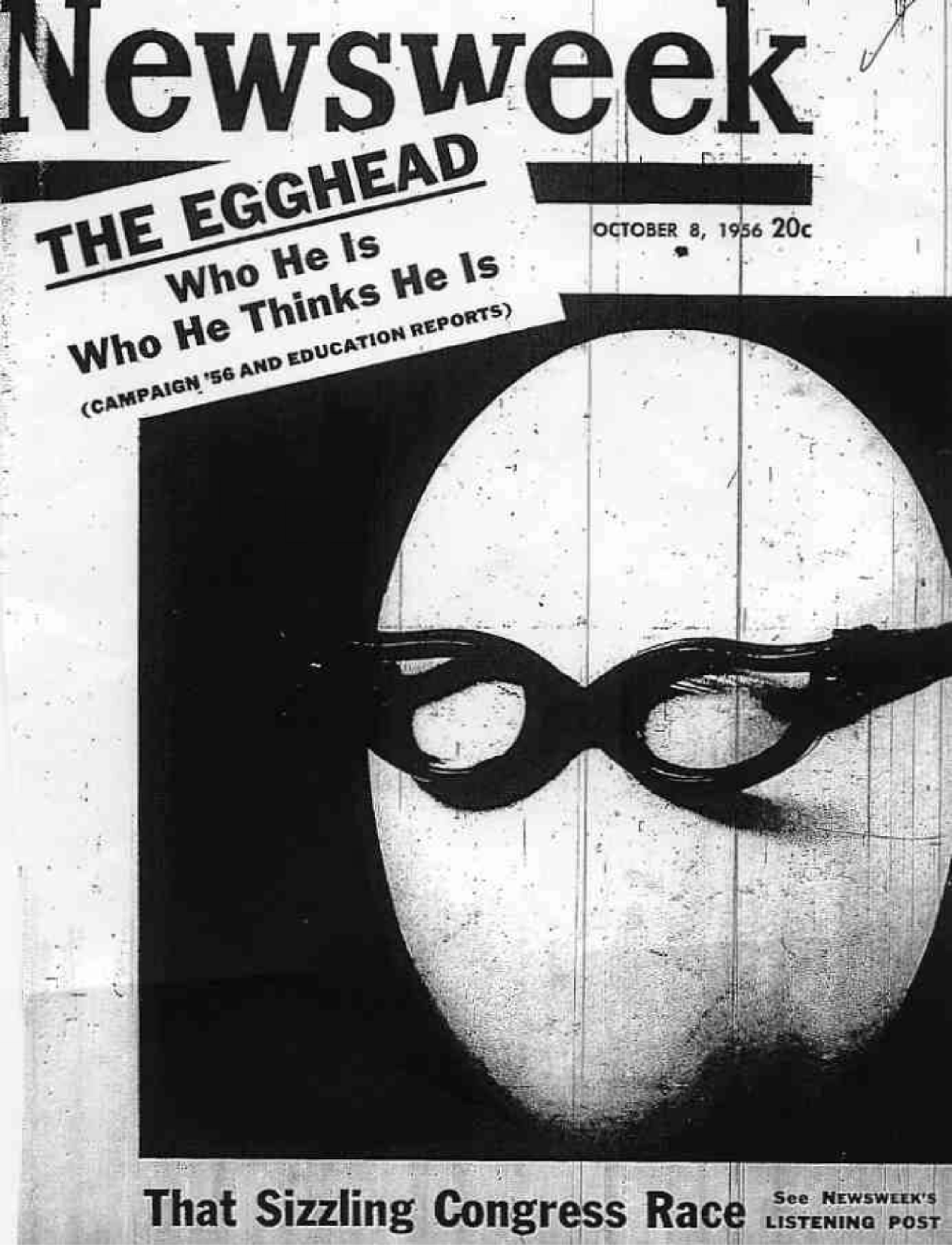
A signature moment in the evolution of the egghead occurred in October 1956, when Newsweek featured an egghead cover story. The image on the magazine's cover featured a white egg donning spectacles of a decidedly old-fashioned, feminine type (Figure 1). The egghead was depicted in noirish shadow and positioned in an asymmetrical composition to the right side of both the magazine's cover and the photograph's borders. This double asymmetry, combined with shadowing and an eerie absence of facial features, rendered the image ominous and vaguely threatening. The headline, positioned like a jotted note at another awkward angle overlapping both the photograph and Newsweek's masthead, read, “The Egghead/Who He Is/Who He Thinks He Is.” The enclosed article promised to dissect the egghead in an authoritative way that would disrupt the egghead's own notion of self.
Newsweek, 8 October 1956.
The Newsweek cover story attributed the meteoric rise of the egghead to two factors: first, the smartness associated with eggheads was increasingly valuable because “much mechanical progress often creates problems as well as solves them.” The egghead was a byproduct of modernization.Footnote 12 Second, the egghead appeared because American intelligence in particular was growing so rapidly. The article observed “the lightning spread of popular education, and with it a striking rise in public tastes. Drugstore book racks, once the undisputed home of Mickey Spillane, now also shelter the paperbound works of Plato, Shakespeare, Freud, and St. Augustine.” Footnote 13 The egghead, in this definition, became a site of nationalistic pride.Footnote 14
Such American exceptionalism continued through the author's lengthy recounting of the egghead as a stalwart presence in US history. In seeming contradiction to the claim that the egghead emerged out of the increased need for smarts brought on by modernization and twentieth-century innovation, the article argued that Jefferson, Madison, Hamilton, and other “founding fathers” could all be considered eggheads.Footnote 15 But in contrast, in the contemporary US, “an assured social position [for the egghead] was generally absent.”Footnote 16 The chief contribution to the culture of the egghead within the early twentieth century, then, was divorced from his assured social status. The historical account of the egghead found in the widely circulated Newsweek article vacillated between a number of contradictory terms, defining the egghead as historical and timeless, positive and negative, and emerging from the powerful and from the masses. The egghead, in other words, engendered a representation of intelligence in American life that was uniquely capable of sustaining mutually incompatible characteristics. The shifty egg depicted on the cover did not elude definition as much as it encompassed a paradox.
In this article, as in many other depictions, four features connect the egghead with Cold War-era debates about American identity. First, the egghead was portrayed as antipopulist. Second, the egghead embodied a racialized, gendered identity. Third, the egghead was represented as queer, both sexually and vis-à-vis social norms. Fourth, the egghead was conceived as politically subversive. Even when celebrated, the egghead was always represented as a transgressive figure. These features crystallized in the figure of the egghead during a particularly intensive moment in US history. It is to these four features that I now turn.
THE EGGHEAD AS ANTIPOPULIST
One constant feature in representations of the egghead was a criticism of his intellectual elitism.Footnote 17 In the context of the 1950s, the expanded rhetoric of populism foregrounded the threat that intellectuals posed to American democracy. Widespread associations of eggheads with intellectuals rendered the egghead immediately suspect as antipopulist. Following the end of World War II, higher education was made accessible to greater numbers of Americans than ever before through the GI Bill, which made education affordable to many working-class people. Consequently, the ranks of post-secondary students swelled, though these advances disproportionately favored white men.Footnote 18 Still, as higher education was represented as being more widely available, intellectuals came to seem an archaic reminder of the closed university doors and ivory towers that had prevented many Americans from pursuing university degrees.Footnote 19 Setting up an intellectual class was not only archaic, it was irrelevant to the newly “democratized” universities.
At the same time, the language of populism exploded in the 1950s. The historian Michael Kazin has argued that this decade saw the rise of a conservatism that believed a “conspiratorial elite organized both inside government and in the wider culture was forcing Americans into a regimented system that would destroy their livelihoods and tear down their values.”Footnote 20 In this context, the association of eggheads with an antipopulist “persuasion” due to their intellectual elitism ensured the term's opprobrium. “The people of America did not resist the word [egghead],” wrote an author in The Nation in 1960, “it seemed to fit their fears and resentments. It illustrated the gap between them and the liberal intellectuals, the gap which rendered both ineffective – and crippled mid-century America.”Footnote 21 The egghead, in other words, emerged as a term in the 1950s to articulate the disfavor felt by “the people” when confronted with antipopulist intellectuals.
The populist reaction against intellectuals, in sum, was one feature that opened up a line of critique against intelligence in the 1950s through the figuration of the egghead. It is this dimension of the popular reaction to the egghead that has been branded anti-intellectualism. This was not, however, the egghead's only feature; the term “anti-intellectual” does not fully encompass the populist critique of the egghead, which was not only anti-intellectual, but also anticollective, antielitist, and anticommunist. These factors may be collapsed into anti-intellectualism only at this particular historical moment, and cannot stand apart from the other features of the egghead that appeared with similar frequency in postwar popular culture.
THE EGGHEAD EMBODIED
In a 1955 article in the peer-reviewed journal Science, Harry J. Jerison, a psychologist, asserted that humans were distinguishable from lower mammals because of their massive brains. As he examined the proportion of brains to bodies up the evolutionary chain, and citing “the rather common notion that a given level of intelligence for a species is related to a given amount of brain,” Jerison determined that more highly evolved mammals assumed “a special evolution of the brain in the direction of the development of additional cerebral tissue, the weight of which is independent of the body weight.”Footnote 22 In other words, the smarter a mammal became, the larger the physical mass of its brain in relation to its body. In a typical incident of scientific research reflecting the ideological tenor of the times – whilst contributing its own expert voice to the discourse – Jerison offered a scientific proof for the egghead. The smarter a species became, the greater its brain grew in relation to its body.Footnote 23
The debate surrounding evolutionary brain size was symptomatic of a wider discussion concerning the embodiment of intelligence in the 1950s. Though the egghead was widely discussed as a particular type of intellectual, the term also described a particular form of embodiment. The physical characteristics of the label were predicated upon the aptness of the metaphor for describing a type of body. The egg had few features analogous to those of a human, yet this did not prevent such comparisons from being made. The egghead's smoothness was made into a phallus, engendering the egghead as male. The egghead's delicate fragility and curvy roundness became feminine features, though not explicitly female. The oval shape of the egg translated into male baldness.Footnote 24 And the egg's whiteness was retained as a racial designation.
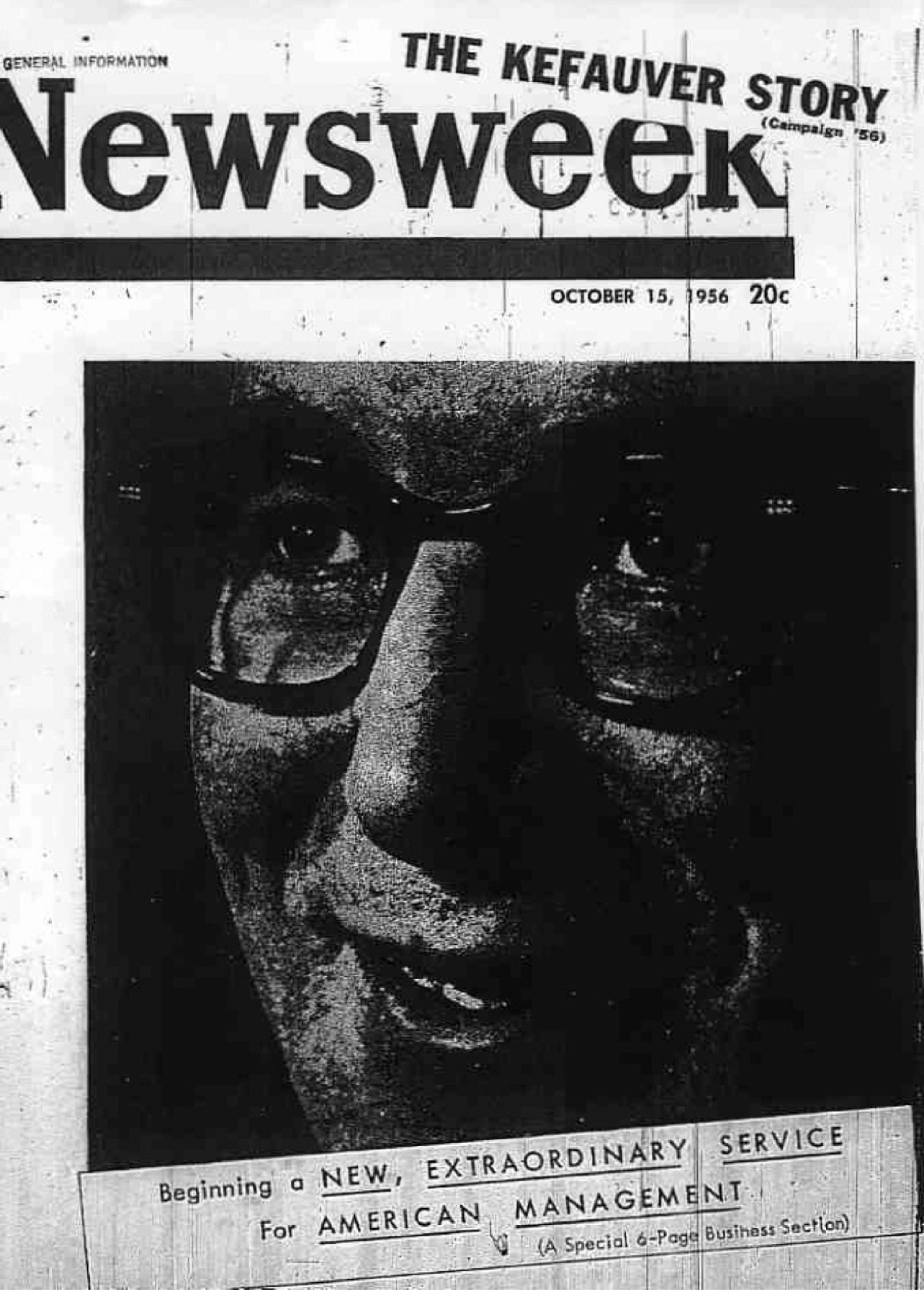
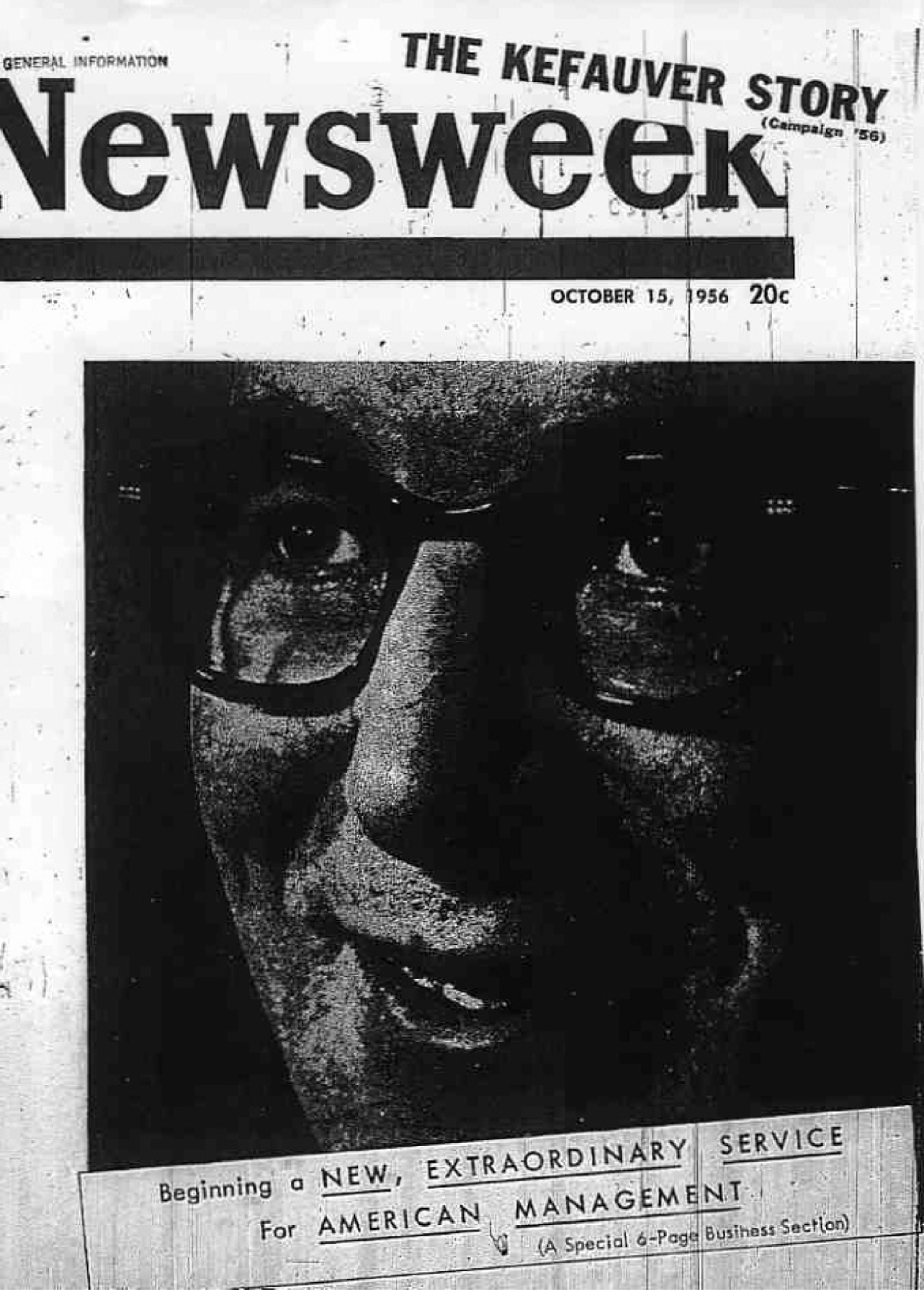
That the literal egginess of the egghead was being routinely made into a set of embodied characteristics in the 1950s is evidenced by a curious incident following the Newsweek story. The photograph on the magazine's cover on 15 October 1956, the week after the Egghead story, featured a closely cropped photograph of Estes Kefauver. When placed next to the photograph of the egghead, the shared features of the egg and Kefeauver's head are striking (Figure 2). One Newsweek reader even wrote to the magazine noting the disconcerting similarities between the image of the egg and the man.Footnote 25 One reason for this remarkable similarity was, of course, the shared compositional features of each photo: the egg and Kefauver were positioned at identical angles, their glasses were similarly oversized for the frame of the photograph, both photographs were cropped so tightly that any extraneous features were completely erased. Yet even in spite of these obvious compositional overlaps, the fact remains that the Kefauver photograph undeniably resembles the Newsweek egghead.
Newsweek, 15 October 1956.
The main corporeal features of the egghead were thus legible despite the obviously metaphorical character of the name. There was no mistaking, for example, the sex of the egghead. There are very few instances in which the term “egghead” was used to refer to women. Though the tendency to use the masculine pronoun for a universal subject in the 1950s makes the explicit gendering of the egghead less obvious (though this must not be discounted as nongendered either), almost all representations of eggheads in popular culture were men. Charles Price's exposé on eggheads in Princeton, for example, did not profile any women at all. The egghead was used explicitly to refer to male intelligence. This exclusion effectively rendered female intelligence unrepresentable. Though women surely would not have enjoyed being subjected to the unsavory characterizations of the 1950s egghead, their occlusion from representations must be seen as replicating a deeply patriarchal narrative: women were excluded from the critique of intelligence to prevent them from accessing the social empowerment intelligence could represent. Male intelligence was represented as dangerous, but female intelligence was conceived as impossible. “Intelligence is an admirable quality,” wrote the author of an article in 1954, “but no woman can possess a high degree of sex appeal because of her intellectual accomplishments alone. Men have the capacity to enjoy a woman's mind, but that is not the basis for their falling in love.”Footnote 26
A 1957 advertisement for Bonwit's 721 Club, a department store with locations in various parts of New York, offered a stark contrast between men and women through its figuration of the egghead. “Cultured,” the ad declared, “to a man, egghead. To a woman, Bonwit's Cultured Pearls in necklaces and earrings.”Footnote 27 This ad both reinforced notions of male and female difference by noting their divergent definitions of the term “cultured” – men think immediately of cultured people whereas women think of jewelry – but it also implied that the term “egghead” was specifically targeted at men as an insult to be applied to their own sex. The ad recognized the insidious associations of the egghead with maleness, an exclusive province that simultaneously separated men into classes of appropriate and inappropriate behavior and excluded women all together. The patriarchal assumptions guiding this ad, and the egghead more generally, suggested that to be a man and an egghead was bad, but to be a woman was to be wholly excluded from the conversation. The woman-as-egghead was visible primarily through her conspicuous absence.
In addition to his maleness, the egghead was almost always represented as white.Footnote 28 There is no practical reason that white eggs, as opposed to brown eggs, should have been used as the shorthand iconography for eggheads. However, the whiteness of the egghead was a metaphorical just as it was as a racial classification: by depicting the egghead as white, those racially categorized as black were again excluded. Just as with women, the egghead, though intentionally negative as a category, still represented a whole investment in American hierarchies of race and gender.
Among the most compelling appearances of the egghead's racialization might be found in Melvyn Tolson's long poem Harlem Gallery.Footnote 29 The poem is a richly textured modernist piece, each page teeming with allusions to texts that only the most highbrow, literate reader would be able to recognize. Tolson, an African American writer, was a politically engaged leftist who was particularly open about his insistence that black writers be encouraged to produce work drawing on both canonical and folkloric sources. As a manifesto for an engaged black intellectualism, Harlem Gallery is a veritable egghead extravaganza: Tolson populates his poem with arcane details and esoteric references that show off his literacy and ease with a shockingly broad assortment of texts. Yet the text also engenders the paradox of an African American egghead confronted with intellectual culture: the poem's populist character, Hideho Heights, attacks the poet – robust with highbrow allusions – as “a half-white egghead with maggots on the brain.”Footnote 30 The egghead, even when black, was saddled with signifiers of whiteness.
At the same time, the egghead's whiteness was occasionally represented as evidence for his squareness. The 1950s saw an intensive examination of the meaning of whiteness in American culture. Norman Mailer's widely discussed (and intensely problematic) essay “The White Negro,” which appeared in 1957, has been described by one literary critic as “a paradigmatic example of the white male investment in African American masculinity.”Footnote 31 In his essay, Mailer dissected the “hipster” in American life, contrasted with the “square.” “The hipster,” according to Mailer, “had absorbed the existential synapses of the Negro, and for practical purposes could be considered a white Negro.”Footnote 32 African American culture of the 1950s, historian W. T. Lhamon argues, showed Americans “how to come out of the hole.”Footnote 33 The egghead was white in a decade when this came to signify blandness and an unquestioning acceptance of the status quo. The whiteness of the egghead, in other words, served to further remove him from “the people,” or from mass culture, where black contributions were widely recognized.
Still, the egghead represented racial stability in a time when the rigid racial hierarchy in American society was being toppled by the civil rights movement, rock and roll, and the hipster writings of Jack Kerouac and the beatniks.Footnote 34 The paradox engendered by the egghead situates him at the center of a transition in American culture: the egghead represented the stultifying conformity of whiteness, but also retained the “possessive investment in whiteness” that intelligence unlocked.Footnote 35 In other words, the egghead was represented as white in order to emphasize his dullness, but also to ensure that intelligence would be used to uphold the status quo. Whether celebrated or maligned, representations of the whiteness of the egghead assured that intelligence would be inextricably associated with hegemonic constructions of American identity, and thus divorced from the possibility of representing radical social change. At the same time that intelligence was being devalued, it was also being defanged.
THE QUEERNESS OF EGGHEADS
Though the egghead was generally represented as white and male, he was not the unequivocal heir to the social privilege these categories represented in 1950s America: at a time when conformity was demanded of Americans, especially if they hoped to achieve their dreams of social empowerment, representations of the egghead often characterized him as queer. A letter to the editor following Newsweek's profile of the egghead stated unequivocally that he “is a political, economic, and sociological queer.”Footnote 36 The collapsing of different forms of “queerness” into the egghead – liberal, communist, and homosexual – guaranteed that the egghead would remain always on the margins of American political, economic, and social discourse.
Homosexuality in the 1950s was a deeply contested ground.Footnote 37 The overwhelming tenor of American responses to homosexuality was decidedly negative. Countless articles about the egghead represented him as sensitive, feminine, and sometimes explicitly gay. In Frank Fenton's 1954 science fiction story “The Chicken or the Egghead,” Francis Cary, a Hollywood screenwriter and egghead, feels so “eccentric and queer” because of his intelligence that “he even wondered if some latent homosexuality might not be creeping over him in his middle years.”Footnote 38
Perhaps the most vitriolic of such characterizations came from Louis Bromfield, who paraded through countless Cold War-era cultural venues expressing his extreme distaste for the fey qualities of American eggheads. His definition of eggheads in The Freeman had quite explicitly identified his excessive anxiety about the egghead's feminine nature through his insistently misogynistic and homophobic language. “Fundamentally superficial,” Bromfield wrote, echoing a common quality ascribed to homosexuals in the 1950s. “Over-emotional and feminine in reactions to any problem. Supercilious and surfeited with conceit and contempt for the experience of more sound and able men. Essentially confused in thought and immersed in mixture of sentimentality and violent evangelism.”Footnote 39 In his definition, Bromfield repeatedly asserted that the egghead and the homosexual shared qualities, in effect implying – without directly stating – that homosexuality and eggheadedness were synonymous. In fact, Bromfield's entire article read like a series of open taunts: “They dealt, all of them, either in terms of lachrymose sentimentality or shriveled academic abstractions,” Bromfield fumed. In his most biting attack on the egghead, Bromfield moaned that “the sentimentalist, the secluded professor in his tower of tarnished bargain-priced ivory and the hysterically emotional have all done their share to make the word ‘liberal’ seem to designate someone who is disappointed, or frustrated, frivolous, sloppy, or shallow.”Footnote 40
Bromfield's thinly veiled doublespeak failed to mask the true identity of the egghead to any but the most naive reader; who but the homosexual could be decried as “shallow,” “frustrated,” and “frivolous”? In point of fact, Bromfield's snide comment about “tarnished bargain-priced ivory” seems designed purely to bait gay men who were widely stereotyped in the 1950s as arbiters of taste.Footnote 41 As the Bonwit's advertisement discussed above implied, the egghead was cultured in such a way as to resemble the tastes of a woman. In this, Bromfield was hardly alone. “Muddled and unhappy,” a reader wrote in to Saturday Review, responding to the magazine's profile of eggheads, “they have allowed themselves by shallow emotionalism to be turned into bleeding hearts and crackpot reformers.”Footnote 42 Again, the egghead encountered the same frustrations – and engendered the same distasteful qualities – as the homosexual.
These characterizations of the egghead corresponded exactly with persistent representations of Adlai Stevenson that questioned his “manliness” as well as his sexual orientation.Footnote 43 Though there is absolutely no evidence whatsoever that Stevenson engaged in homosexual activities, J. Edgar Hoover cooked up a false charge that homosexual activity had led to a New York arrest for the presidential candidate.Footnote 44 Gossip columnist Walter Winchell's radio show declared, “A vote for Adlai Stevenson is a vote for Christine Jorgensen.”Footnote 45 And Confidential, the brand-new Hollywood scandal sheet famous for using McCarthy-style insinuation about deviant sexuality among celebrities – and provocatively bearing the teasingly ambiguous tagline, “we name the names” – published an article about unspecified “rumors” dogging Stevenson throughout his campaign.
These instistent characterizations of the egghead's queerly feminine tendencies were repeated in a 1956 ad for Donmoor Knit Shirts. The ad featured a photograph of a remarkably well-coiffed boy fussily adjusting his thick hornrimmed glasses over pouting lips. “In Praise of Eggheads,” the copy proclaimed. “Not every boy is cut out to be a star fullback or Little League pitcher. Maybe he'll be just as happy as a chess expert, a cellist, or a lepidopterist.” This characterization of eggheads – drawn in stark contrast to the manliness of a football star or some other kind of athlete – reinforced the notion that eggheads transgressed proper gender behavior, even as the ad framed its own description as “praise.” The copy continued by enthusiastically reassuring parents that even their fey little eggheads “tend to look a little more robust in DONMOOR knit shirts.” Eggheadedness was praised, but it was also a form of gender trouble that needed be resolved with the right attire.Footnote 46
Finally, the 1956 pop song “Egghead,” by Jill Corey, released as a B-side to Corey's moderately well-selling single “I Love My Baby (My Baby Loves Me),” offered a comical representation of eggheaded effeminacy. The song was a coy pop number, upbeat and cheerfully emasculating. Yet rather than presenting the egghead as merely feminine, Corey's winking delivery added a new feature by treating the egghead as sexually incompetent, a trait that, in the song, is connected with his otherwise genius nature:
Though “Egghead,” in a typical bid for radio airplay, veiled its sexual content through references to “the heart,” there was little room ambiguity: the heart was clearly not the primary organ disappointing Corey. The egghead excelled at matters of the mind, but he failed to match his brainy excess with sexual prowess. Though this song did not explicitly brand the egghead homosexual, he was represented as failing to be properly interpellated into a heterosexual identity.
In sum, the egghead in the 1950s was embodied as white and male, but he was a white male of a curious sort. The egghead connected intelligence with queer identity and behavior, thus preventing the intelligent American from accessing the rewards of social, political, and cultural power. This characterization collapsed sexual behavior into the antipopulist rhetoric assigned the egghead. Such queer desires introduced another troubling set of behaviors among eggheads, namely a transgressive political orientation that ranged from highbrow liberalism to rank-and-file communism.
THE EGGHEAD'S SUBVERSION
In a cranky letter to the editor in 1958, New York Times reader George Strong expressed a criticism of the egghead that was shared by many during the decade. “Creative thought,” wrote Strong of the sort of ideas egghead's were inclined to pursue,
has nothing to offer towards the business of moving more freight cars, melting more steel, selling more automobiles. The intellectual is far from being helpful even in aiding his own cause. Can you think of any egghead who did not find fault and was most dissatisfied with the very society which supported him?”Footnote 48
For the dyspeptic Mr. Strong, the fundamental problem with the egghead was a no-brainer: his detachment from the forces of capitalism as figured through American industry rendered him a subversive. The egghead was so detached from the populist structures of American politics and the day-to-day operations of American industry that he could manage nothing more productive than to take out his frustrations by cooking up nasty theories about the society that sustained him. Strong's argument, especially in its wholesale dismissal of egghead social critique as mere “dissatisfaction,” offered a categorical dismissal of egghead anti-Americanism. In the age of McCarthy, this was a foul charge indeed.Footnote 49
As with most of the inflammatory rhetoric assigned subversive Americans during the McCarthy era, the chief criticism levied at eggheads insinuated their communist tendencies. For some authors, this damning characterization emerged from the actual history of American communism, which had many adherents – many of them quite intelligent – during the 1930s and 1940s. Though eggheads per se did not exist in the 1930s, it did not take too much maneuvering for some to retroactively apply the term to those smarter-than-thou invidividuals who had swung to the hard left during the Depression. John Cogley, an otherwise liberal writer who penned a series of articles about eggheads for The Commonweal in 1952, spearheaded a campaign to cast suspicions on the contemporary eggheads by naming the names of their communist progenitors. “The most damning argument against the egghead these days,” Cogley wrote in 1952, “is that from this group came the Soviet-sympathizers, the anti-anti-Communists, the ‘agrarian reformer’ apologists, etc., who furthered American illusions about Soviet Russia until a few years ago.”Footnote 50 Cogley insisted that the tendency to be swayed by “dangerous” ideas such as those emerging from the Communist Party was most prevalent among the American eggheads – a finding he established as equally true in the 1930s as in the 1950s. For Cogley, the willingness to explore abstract ideas, the desire to improve society through intelligence, the effort to put brains together in the interest of creating a better world were the conditions that both birthed the egghead and caused him to follow a self-destructive path into ideological confusion and political betrayal.
In 1954, Joseph W. Martin Jr., the Speaker of the House, went so far as to claim that “left-wing eggheads” were trying to enact policy that would bring about an economic depression so that they could advance their socialist goals.Footnote 51 Such red-baiting tactics were commonly employed by Joseph McCarthy, whose fears about eggheads were the stuff of legend, and who was unceasing in his attacks on communists.Footnote 52 A 1954 New York Times article describing McCarthy's red/gay witchhunt in the face of mounting criticism noted his immovable conviction that “‘eggheads’ and ‘deluded liberals’ were playing into the hands of the communists in demanding curbs on his authority as a communist investigator.”Footnote 53 Still, the deeply ideological deployment of egghead as a term of derision was also the subject of criticism. One reader of the New York Times complained that the United States' “whole economic and political attitude is geared to the possibility of war, and any person in public life who dares to speak out against this cancer in our society is immediately branded as a ‘communist,’ ‘egghead,’ or ‘traitor to his country.’”Footnote 54
Adlai Stevenson seemed wholly bemused – and hopelessly unconcerned – by the associations of eggheads with communist subversion. One of his favorite jokes to trot out on the 1952 campaign trail when asked about the popular term he had precipitated was the line, “eggheads of the world, unite! You have nothing to lose but your yolks!” Though his amusing reframing of Marx and Engels's famous conclusion to The Communist Manifesto might have succeeded in making light of the egghead craze, it also rewarded the worst fears of conservative critics who were already convinced that liberalism represented communism in democrat's clothing, and that eggheads would be responsible for the downfall of the American way of life.
CONCLUSION
The term “egghead” was never simply used to characterize intellectuals as a class. The egghead personified four interlocked characteristics, and these were inextricable from broader changes in American Cold War culture precipitated by spreading anxieties about collectivism and communism and a growing recognition of the vulnerability of white heterosexual male hegemony. The egghead embodied the paradoxes of brainpower in the Cold War by exploiting the contradiction between a cultural desire to possess the social and political power associated with white men and a growing anxiety about the influence of subversion, homosexuality, and black culture in shaping American life. As the egghead gained traction in popular Cold War-era culture, intelligence was itself constructed as ideologically suspect. What had once been a political tool available to a variety of otherwise disenfranchised Americans became by definition tainted with hints of subversion, gender and sexual transgression, and danger.
The paradox at the heart of the Cold War construction of eggheads reveals an irresolvable conflict in cultural representations. The egghead functioned to both limit those for whom intelligence was culturally available and to malign those who attempted to advocate education and the expansion of intelligence as a vehicle for social change. Though this was often framed as a liberal political intervention, the climate of the Cold War and the attendant social inequalities in the United States in this period ensured that the popular use of the egghead label served chiefly to restore the ideological hegemony of a virulently white, masculine liberalism. Though alternatives to this model for representing intelligence would appear in later periods, the basic parameters of American anti-intellectualism were now wholly inseparable from sexual, political, and racial ideologies. The contentious language of the egghead cast a wide net, and though counterrepresentations of intelligence continued to appear and persistently challenged American structures of power, the egghead was freely available as a brooding foil to those who presumed brainpower could lead the charge of liberation.