Is there a different opinion-forming process for public support of international courts than for national courts? We argue that there is, and we find evidence that supports this hypothesis in regard to the British public and the European Court of Human Rights (ECtHR). For three decades scholars within the law and courts subfield have sought to explain public support of legal institutions and have done so successfully in regard to national courts and to a somewhat lesser extent in regard to one international court, the European Court of Justice. We seek to expand that literature to explain how the public’s evaluations of an international human rights court are shaped. This is a crucial step in understanding how these often controversial courts achieve or fail to achieve legitimacy among the member states and their publics. And concomitantly, such understanding may have significant implications in regard to national compliance with international human rights courts and the broader international human rights regime. We step outside of the law and courts literature and draw on the growing body of European governance scholarship to expand our understanding of how the public develops support for the ECtHR. We apply the second-order institution approach that argues that supranational policy and institutions are “considered of minor-importance or ‘second order,’” and thus public support of these little-known institutions is based on assessments of the nation-state rather than on evaluations of supranational politics or institutions (Desmet, van Spanje, and de Vreese Reference Desmet2012, 1074).Footnote 1 From this literature arise two hypotheses: (1) as trust for national institutions increases, support of the ECtHR will decrease, and (2) this effect is conditioned by political awareness of national politics in that those who are politically aware and trusting of national institutions will be even less likely to support the ECtHR. Our examination of public support for the ECtHR focuses on the UK public, 5 months after the controversial Brighton Declaration, which was perceived as a British-led offensive against the ECtHR that reflected a domestic backlash against the Court. As part of the British Election Study, we were able to ask a battery of questions on a monthly basis from September through December 2012, surveying a total of 4,145 respondents. We find that both trust and diffuse support for the ECtHR are rather low, and we find strong evidence to support both second-order evaluation hypotheses.
In keeping with the law and courts literature, we also test whether these evaluations hold when we change from examining trust in the ECtHR to diffuse support of the ECtHR, and we find consistent relationships. Our findings expand on the extant law and courts literature, demonstrating that public support for an international human rights court cannot be understood in isolation from national politics. This and other findings raise significant issues in regard to compliance with international human rights courts. For example, one of the presumed means of enhancing a court’s legitimacy (and concomitantly compliance)—awareness of the institution—is demonstrated not to increase support for the ECtHR.
We turn next to our discussion of the ECtHR, particularly in the context of British politics and the Brighton high-level conference and subsequent declaration, and then we turn to the two literatures that inform our study: the law and courts literature on the legitimacy of national high courts and the European governance literature. After deriving our hypotheses, we then present our core analyses. Finally, we discuss the implications of our findings.
European Court of Human Rights
Forty-seven nation-states are party to the European Convention on Human Rights and Fundamental Freedoms, covering over 800 million people. The convention went into force in 1953. It is widely accepted as the most effective international regime for enforcing human rights in the world (Donald, Gordon, and Leach 2012). The European Court of Human Rights (ECtHR) was set up in 1959 to rule on individual and state applications alleging violations of the rights protected under the convention. Originally, states had the option of ratifying the convention without opting in to the sections that recognized the Court’s compulsory jurisdiction and allowed individuals direct access to the Court upon exhaustion of all national remedies. Protocol number 11, which went into effect in November 1998, made both provisions mandatory for all convention members. It also dissolved the European Commission of Human Rights and made the ECtHR a permanent, full-time court, with the compulsory jurisdiction over all individual complaints.
The ECtHR is now considered to be “the most active and important rights-protective court in the world” (Stone Sweet and Brunell Reference Stone Sweet2013, 77; see also Moravcsik Reference Moravcsik2000, 218). The Court’s caseload has exploded under Protocol 11: in the Court’s first four decades it rendered a total of 837 judgments, compared to 1,607 in 2010 alone (Stone Sweet and Brunell Reference Stone Sweet2013, 77); in 1999 it received only 8,400 complaints, compared to 61,300 in 2010. By February 2010 the Court had a backlog of 120,000 cases, with an average delay of 6 years, and it is estimated that it will take 46 years to dispose of all the cases (Pinto-Duschinsky Reference Pinto-Duschinsky2011, 11). Judges on the ECtHR are elected for nonrenewable 9-year terms. Each state party is allocated one judge on the bench and submits a list of three nominees from the state. Judges are then elected by majority vote in the Parliamentary Assembly of the Council of Europe.
The ECtHR can be considered a specialized, international, constitutional court (Stone Sweet and Brunell Reference Stone Sweet2013) that serves three governance functions: “it renders justice to individual applicants beyond the state (a justice function); it supervises the rights-regarding activities of all national officials, including judges (a monitoring function); and it determines the content of convention rights (a lawmaking function)” (78). The Court has subsidiary jurisdiction, like the International Criminal Court; therefore, for the Court’s jurisdiction to be triggered, individual applicants must have exhausted all domestic remedies. The Court functions similarly to a constitutional court in that “the ECtHR confronts cases that would be classified, in the national context, as inherently ‘constitutional’” and in that “if the court finds that a state has violated an individual’s convention rights, it may award that victim monetary damages” (78). However, unlike national constitutional courts, the ECtHR does not have the authority to invalidate national laws that are incompatible with the ECHR. Nevertheless, the ECtHR has long held that its precedents bind all judges in the system, and it routinely indicates how a state must reform its law in order to avoid future violations.
A significant amount of criticism has been hurled at the ECtHR, especially by British conservatives: the Court is overbearing and does not take into account domestic legal culture and interferes with established domestic law; like other international courts, it has a tendency to expand its role and to micromanage the legal systems of member states; and it meddles in conflicts that should be left to national courts (Hoffman Reference Hoffman2011; Pinto-Duschinsky Reference Pinto-Duschinsky2011).Footnote 2 For example, one of the most-cited criticisms in the United Kingdom is the Court’s 2011 ruling on prisoners’ voting rights in the United Kingdom, which critics argue was a settled issue of domestic law (Hoffman Reference Hoffman2011; Pinto-Duschinsky Reference Pinto-Duschinsky2011).Footnote 3 Subsequent polls of the British public found that a majority supported British withdrawal from the ECHR (Helfer Reference Helfer2012, 1). The grumbling over the prisoners’ voting rights decision pales in comparison to the 2012 Abu Qatada case in which the ECtHR ruled that the United Kingdom could not deport a terrorist suspect to Jordan and that subsequently led to a media uproar, with the conservative press accusing “unelected Euro judges” of “bringing terror to the British streets” (Slack Reference Slack2012b) and “waging war on British justice” (Slack Reference Slack2012a). While some speculated that the Abu Qatada case, coupled with the allegations of the Court’s dysfunction, might lead to the United Kingdom’s withdrawal from the ECHR (Bowcott Reference Bowcott2012), instead the “pervasive air of backlash against the Court” led the United Kingdom, which held the 6-month chairmanship of the Council of Ministers on the Council of Europe, to call for deep reforms of the Court, with David Cameron initiating a High Level Conference on the Future of the European Court of Rights in Brighton in April 2012 (Helfer Reference Helfer2012, 1). Cameron’s strategic leaking of a draft declaration prior to the summit was perceived as a “British offensive” against the Court, and the debates at the summit and the subsequent declaration “openly raised questions about the Court’s future” (Christoffersen and Madsen Reference Christoffersen2013, 231).Footnote 4 Our surveys of British support for the ECtHR begin in September 2012 and go through December 2012, 5–8 months after the Brighton Declaration. We discuss the declaration in relation to our data set in the data section below.
Second-Order Institutions Approach and the European Court of Human Rights
For almost three decades a growing body of judicial scholars has applied Easton’s (Reference Easton1965) theory of institutional legitimacy to an increasingly broader set of judicial institutions (e.g., Caldeira Reference Caldeira1986; Gibson Reference Gibson1989; Gibson and Caldeira Reference Gibson and Caldeira1992, Reference Gibson1995; Tyler and Mitchell Reference Tyler1994; Caldeira and Gibson Reference Caldeira and Gibson1995; Gibson and Baird Reference Gibson, Baird, Lutz, Tedin and Fuchs1997; Mondak and Smithey Reference Mondak1997; Gibson, Caldeira, and Baird Reference Gibson and Caldeira1998; Baird Reference Baird2001). The literature conceptualizes legitimacy as diffuse institutional support, in other words, the public’s “willingness to support the continued functioning of the institution despite disagreement with its outputs” (Gibson and Caldeira Reference Gibson1995, 460). The literature posits two general mechanisms for the development of diffuse support: (1) the perception of the judges as objective players and the neutrality of the legal process and (2) a cumulative process of positive experience: Taber, Glather, and Lodge’s (Reference Taber and Lodge1994) “running tally.” In regard to the first, it is argued that the attentive public—the segments of the public who pay attention to courts—adopt the view that judges behave differently than other political actors—that they are “objective” in the sense that they “rely on law not values in making decisions” (Gibson et al. Reference Gibson and Caldeira1998, 345; see also Gibson and Caldeira Reference Gibson2011). Judges themselves, then, perpetuate this view through framing. As Gibson et al. note, “[the public is] exposed to a series of legitimizing messages focused on the symbols of justice, judicial objectivity, and impartiality [and over time] the slow accretion of positive messages about courts and law leads to legitimacy” (Reference Gibson and Caldeira1998, 345).
Most studies of institutional support within the judicial behavior literature have focused primarily on the US Supreme Court (e.g., Caldeira Reference Caldeira1986; Gibson Reference Gibson1989; Gibson and Caldeira Reference Gibson and Caldeira1992; Tyler and Mitchell Reference Tyler1994; Gibson and Baird Reference Gibson, Baird, Lutz, Tedin and Fuchs1997; Mondak and Smithey Reference Mondak1997), but the literature has gradually expanded to the high courts of other countries (Gibson et al. Reference Gibson and Caldeira1998; Baird Reference Baird2001) and to one international court: the European Court of Justice (ECJ; Caldeira and Gibson Reference Caldeira and Gibson1995). While the findings in regard to the other state high courts have been generally consistent with the US-centric findings, the fit for an international court has been less satisfactory.
Caldeira and Gibson derived four theoretical expectations in regard to the ECJ and the development of diffuse support based on their expansion of US literature to the EU context. First, in regard to specific support for the ECJ, they expected that over the long term, the perception that the court functions well, along with general evaluations based on the Court’s decisions, would evolve into diffuse support. Second, they expected that attitudes toward the European Union itself would influence public support, especially a public that is “bereft of information about specifics” and that does “not pay much attention to politics might well form orientations toward particular institutions from general impressions of the political system” (1995, 359). Third, they expected that the citizens may favor/disfavor the ECJ on the basis of whether the institution advances their individual political and legal values. Finally, they made a cognitive mobilization argument, asserting that the ECJ, “like most judicial institutions, is relatively obscure and not easily accessible to ordinary citizens,” and thus the degree to which an individual citizen is “integrated into modern organizations and extensive communications networks” would contribute “to social learning, learning typically supportive of the dominant values, expectations, and institutions of a political community” (360, and citations within). The authors found limited legitimacy for the ECJ in that it consistently generated low levels of diffuse support; more importantly, while they found that most individuals viewed favorably the Court’s specific performance, it had not translated into diffuse support for the institution. In addition, they found little evidence of cognitive mobilization in regard to the ECJ.
We seek to build on the law and courts literature on national institutions by using a second-order approach to understanding support for international courts, such as the ECJ and the ECtHR. The second-order institutions approach (i.e., Sánchez-Cuenca Reference Sánchez-Cuenca2000; Rohrschneider Reference Rohrschneider2002; Desmet et al. Reference Desmet2012) argues that public opinion forming is different for supranational (or international) institutions than for national institutions and that national institutions serve as the “yardstick” by which supranational institutions are evaluated (Desmet et al. Reference Desmet2012, 1075).Footnote 5 The key debate in this literature has been whether public support for European institutions is developed in response to the actual performance of the European Union itself or whether it is the performance of the national government that is the central factor in diffuse support. One viewpoint parallels the law and courts literature to some extent, expecting that higher levels of awareness and information lead to nonconditional views of the European Union, with support developed in response to actual performance of the European Union or the benefits it provides, regardless of assessments of the nation-states or its institutions (i.e., Eichenberg and Dalton Reference Eichenberg and Dalton1993; Gabel Reference Gabel1998a, Reference Gabel1998b; Kritzinger Reference Kritzinger2003). Counter to this perspective, another set of scholars (i.e., Bennett Reference Bennett1996; Anderson Reference Anderson1998; Meyer Reference Meyer1999; Desmet et al. Reference Desmet2012) argue that the nation-state is the key factor influencing citizen support for the European Union. The outlook is based in part on the underlying assumptions of a lack of interest, knowledge, or information about supranational politics, which makes it unlikely that the general public will be able to develop opinions specifically regarding the European Union. Hence most people rely on the more direct and immediate perceptions of domestic politics (Anderson Reference Anderson1998; Kritzinger Reference Kritzinger2003). Therefore, Schmitt (Reference Schmitt2005) argues that compared to the national level policy, the supranational policy level—European policy—is less important or of second order (Desmet et al. Reference Desmet2012, 1074).
From this perspective, citizens tend to view European decision making more favorably when citizens’ comparison of the quality of their national institutions with European institutions finds the national institutions lacking (Sánchez-Cuenca 2000, 169). Rohrschneider (2002) argues that the contrast in institutional quality at the two levels of governance increases the salience of the European Union’s democratic deficit. Desmet et al. (2012) argue and find that evaluations of the democratic performance of the European Union are made in light of citizens’ assessment of the quality of their own national institutions, including characteristics such as trust and corruption. More specifically, they argue that “the quality of national institutions provides a framework that is unique for every country” and that “national institutions then function as a yardstick for evaluations of democracy at a higher level” and “the better their own national institutions are, the more critical citizens will be in evaluating supranational institutions” (1075). Thus the key assumption and finding here is that perceptions of satisfactory democratic performance at the national level increase the skepticism of the European Union’s democratic performance (Christin 2005; Desmet et al. 2012).
These second-order evaluations play out in two ways. First, positive evaluations of domestic institutions are associated with lower satisfaction with EU performance.Footnote 6 While this literature focuses on non–legal institutions and EU institutions in particular, we believe that the expectations are applicable to European courts, such as the ECtHR and the ECJ, as well as to other international courts beyond Europe, such as the Inter-American Court and the International Criminal Court. While the ECtHR is not an organ of the European Union, it is very much a European institution, and more broadly so than the ECJ in terms of nation-states that are a part of the Court’s jurisdiction. As an international court, the ECtHR also suffers a potential democratic or sovereignty deficit relative to national institutions; moreover, as a judicial institution by nature, it suffers a potential counter-majoritarian difficulty (see Bickel 1962) in reviewing states’ human rights behavior. And as we noted above, the ECtHR is now considered to be “the most active and important rights-protective court in the world” (Stone Sweet and Brunell 2013, 77; see also Moravcsik 2000, 218). Thus, as the public is increasingly satisfied with the performance of domestic institutions, it would be less likely to support the less democratic international court that weakens the sovereignty of the state by reviewing challenges to the human rights policies and practices of the national institutions that the public supports. Conversely, if the public is increasingly dissatisfied with the performance of the domestic institutions, it may be more willing to accept the loss of sovereignty to a less democratic institution in order to have an additional forum in which the current government’s policies can be challenged, and thus the public may be more likely to support the legitimacy of the international court despite its democratic deficit.
Second, political knowledge conditions the effect of domestic institutional quality on evaluations of EU performance. More specifically, higher levels of domestic political knowledge can strengthen the second-order effect, with the awareness of the problems with one’s own domestic institutions making evaluations of supranational institutions more positive or more negative. Higher levels of domestic political knowledge are important in second-order evaluations because a lack of knowledge, interest, or information will prevent people from developing opinions about the European Union (e.g., Anderson Reference Anderson1998). Coupled with the fact that perceptions of the national government are more direct (Kritzinger Reference Kritzinger2003), this means that higher levels of knowledge about a domestic government that the respondent likes should enhance the importance of evaluations of the supranational institution. Political knowledge enhances second-order effects because respondents who like the national government will be more likely to be aware of any democratic deficit in a supranational institution, and similarly, those who do not like their national government will tend to see less of a democratic deficit as compared to a supranational institution (Desmet et al. Reference Desmet2012). As Karp, Banducci, and Bowler (Reference Karp and Banducci2003, 275) note, “political knowledge may bring a greater awareness of the democratic deficit or the costs and benefits of EU membership … and may also work independently by fostering greater acceptance of dominant national norms and existing institutions.” To reiterate, the evaluation takes place in light of what the respondent knows about the national government, not the supranational institution, for reasons described above. We test both of the second-order hypotheses in regard to the ECtHR.
Hypothesis 1: As trust for national institutions increases, support of the ECtHR will decrease.
Hypothesis 2: The above effect will be conditioned by political awareness of national politics in that those who are politically aware and trusting of the national institutions will be even less likely to support the ECtHR.
Because the law and courts literature primarily focuses on diffuse support of high courts, both national and international, we also test these hypotheses in regard to diffuse support, of which trust is typically operationalized as one of three components. We first describe the data and analysis necessary to investigate these two hypotheses with respect to the ECtHR.
Data and Descriptive Statistics
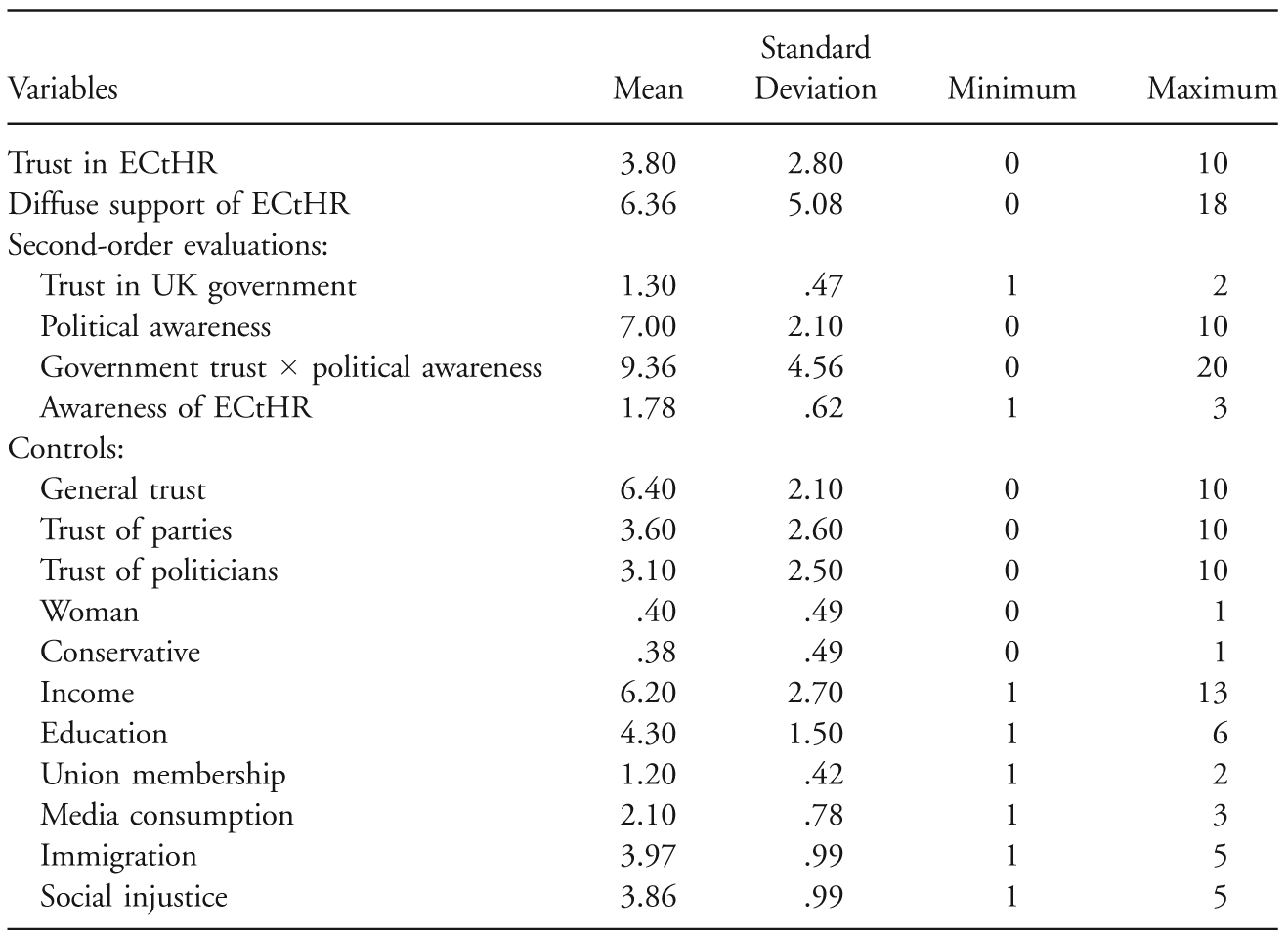
Our data come from the YouGov Internet survey that is part of the British Election Study.Footnote 7 We asked a battery of questions on a monthly basis from September through December 2012, surveying a total of 4,145 respondents.Footnote 8 The relevant questions are located in appendix B. We have two dependent variables. One dependent variable is a trust question, scaled 0–10, with higher scores indicating more trust of the ECtHR;Footnote 9 the other is a measure of diffuse support (ECtHR diffuse support), measured on an 18-point scale, that uses the combined responses to several questions typically asked in the courts literature to gauge diffuse support (e.g., Gibson and Caldeira Reference Gibson1995; Gibson et al. Reference Gibson and Caldeira1998). To save space, we detail the coding and reliability of these composite measures in appendix A. Table 1 displays the descriptive statistics for answers on this question, as well as those for our entire set of models. Notably, 23% of respondents espouse no trust in the ECtHR.
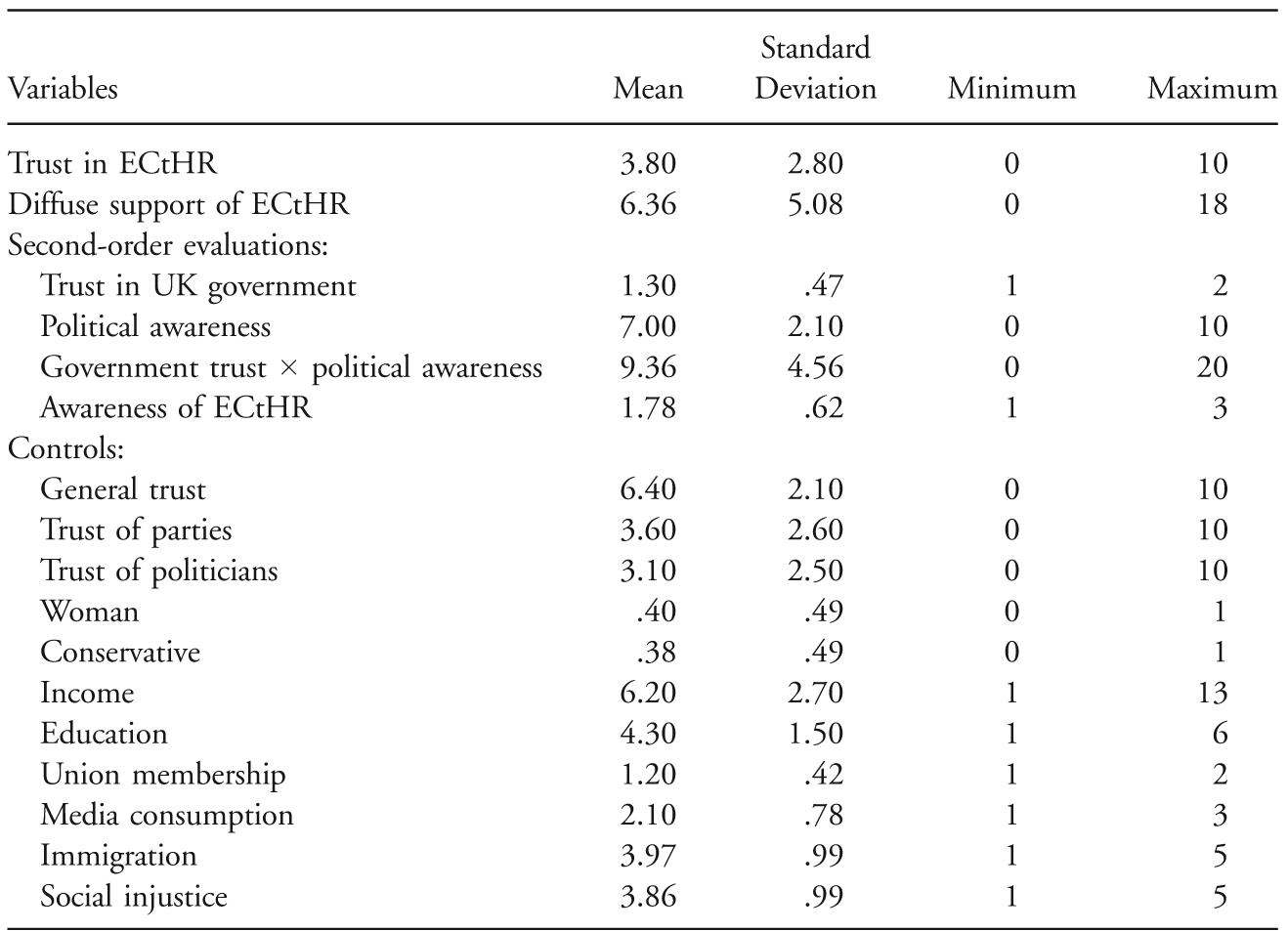
There are a set of independent variables that are critical to our investigation of the second-order hypotheses. We asked a court awareness question, which queried respondents about their level of familiarity with the ECtHR. In our analyses we exclude those who answer “have never heard of this court” or “don’t know” to the familiarity with ECtHR question as these people cannot reasonably express an opinion about the Court (see, e.g., Gibson and Caldeira 1995). Approximately 62% of respondents were very or somewhat familiar with the ECtHR. We also include a general political awareness question, measured on a 0–10 scale, with a 0 answer representing “no attention paid to politics” and a 10 answer indicating “a great deal of attention paid to politics.” We label this variable political awareness.
We also include two crucial measures of trust of national institutions. First, we include a question that asks respondents whether they believe the British government is honest and trustworthy, with higher answers indicating a yes response to the question. We label this variable trust in UK government. We interact this trust question with the awareness question, giving us the interaction term trust in UK government × political awareness. We use this interaction term to test the extent to which awareness of national institutions alters opinions of the ECtHR conditional on liking those national institutions.
In addition to these theoretically important independent variables, we include a number of control variables that other studies have suggested might be important predictors of institutional trust. First, we control for a suite of other kinds of trust. To the extent that a respondent feels that others are trustworthy, he or she may also be trusting of institutions (Almond and Verba 1963). Therefore, we include a measure of generalized trust by asking respondents to determine, on a 0–10 scale, whether people are trustworthy, with higher scores indicating greater trust (general trust). In addition, we control for whether the respondent is inclined to trust political parties (trust of parties) and politicians (trust of politicians) to account for more specific reactions to the political system. These variables are similarly measured on a 0–10 scale, with higher scores indicating greater trust.Footnote 10
We also control for a host of demographic characteristics that are likely to affect an individual’s feelings toward and awareness of the ECtHR (e.g., Gibson and Caldeira Reference Gibson and Caldeira1992; Caldeira and Gibson Reference Caldeira and Gibson1995; Gibson and Baird Reference Gibson, Baird, Lutz, Tedin and Fuchs1997; Gibson et al. Reference Gibson and Caldeira1998; Baird Reference Baird2001). First, we include a dummy indicator for the sex of the respondent, with 1 representing those who are women. We include a measure of the partisan inclinations of the respondent based on a set of questions about party loyalties, which are detailed in appendix B. From these questions we created a dummy variable equal to one if the respondent identified with either the Conservative party or a set of nationalist parties, which we label conservative.Footnote 11 Our measure of media consumption is premised on the frequency with which the respondent reads a daily newspaper, with higher scores equating to more media consumption. We also include standard indicators for education (higher scores indicate more education) and income (higher scores indicate higher income). Finally, among the demographic variables, we include a dummy indicator of whether the respondent belongs to a labor union (union membership).
We include two variables meant to capture how respondents feel on two issues that we believe might be especially salient when evaluating the ECtHR in light of feelings toward the national government. First, we ask respondents how they feel that the British government is handling immigration, with higher scores indicating less support for government policies on immigration. Second, we ask respondents how they feel in general about social injustice in the United Kingdom, with higher scores indicating a greater belief that social injustice is a major problem in Britain.
ECtHR Second-Order Analysis
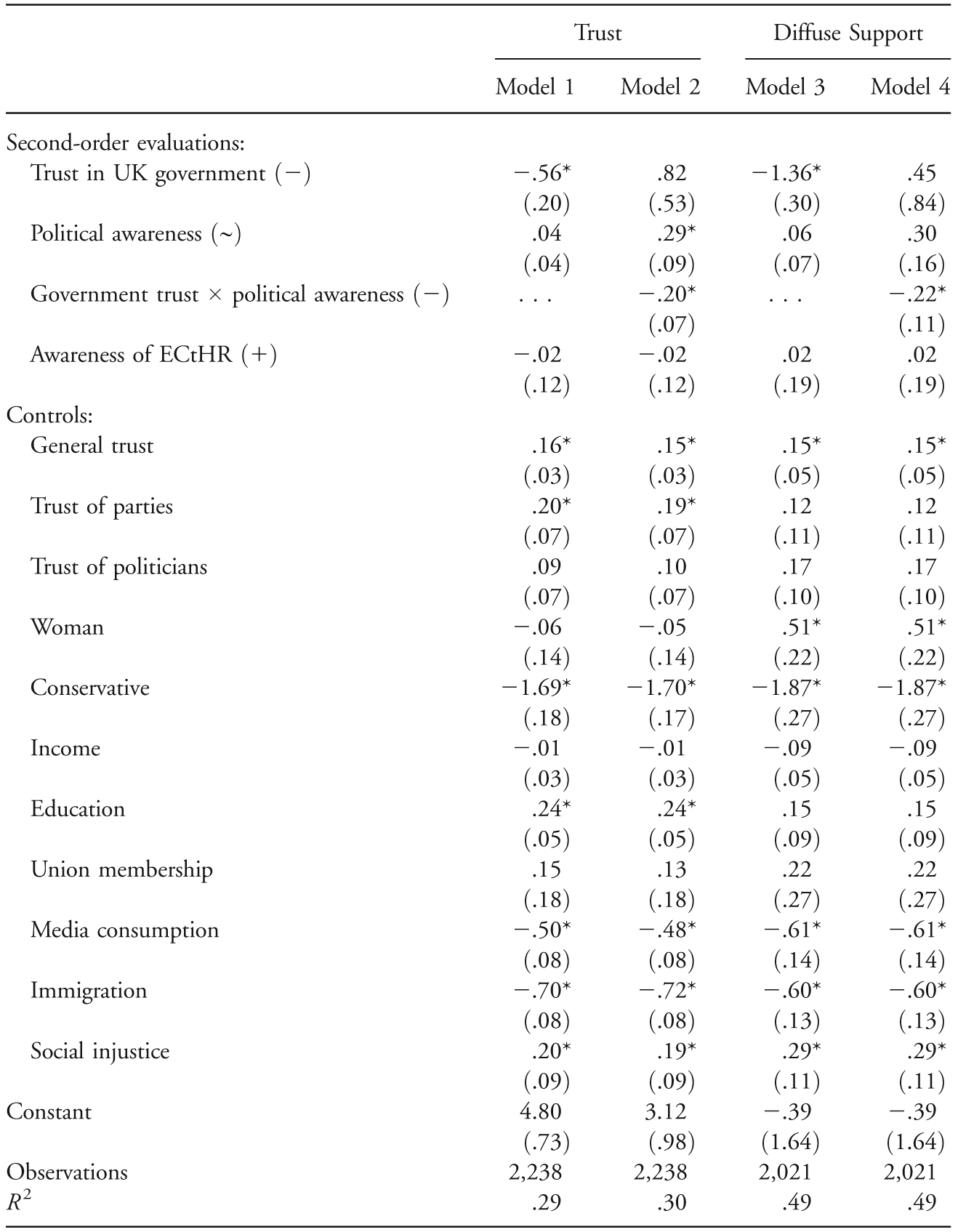
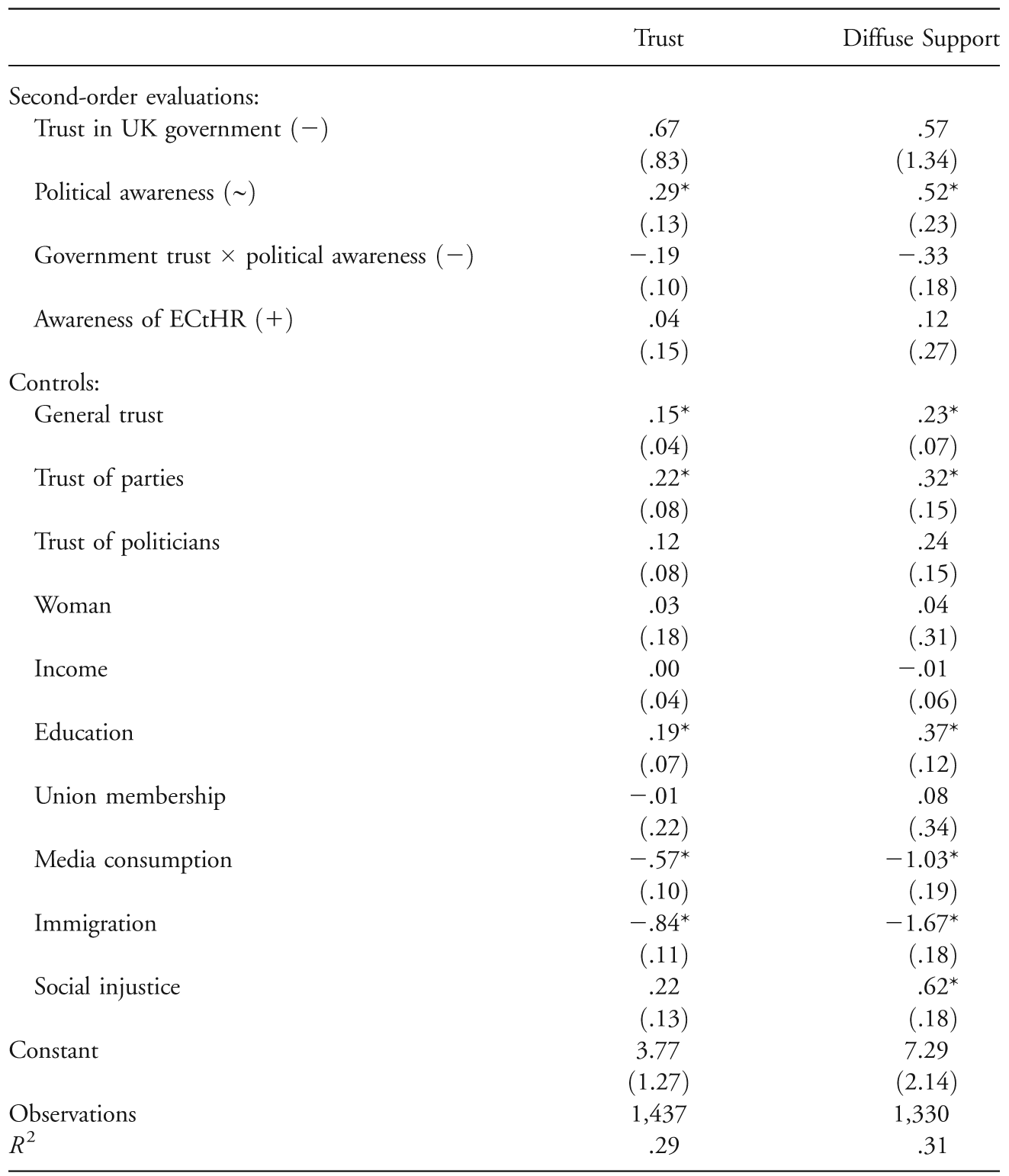
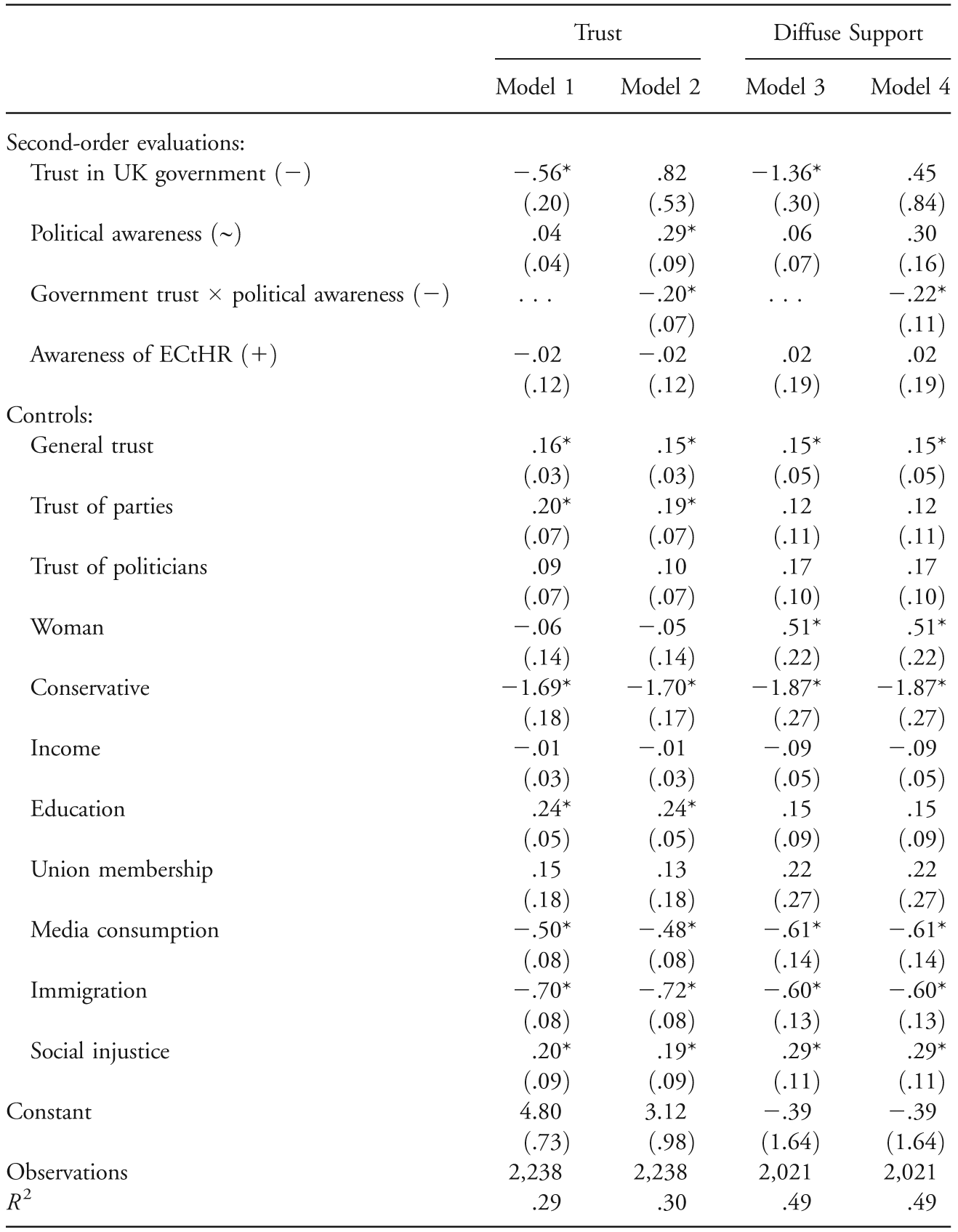
To understand trust of the ECtHR, we estimated four regression equations, each with various combinations of the interaction terms. We use ordinary least squares (OLS) with our dependent variables since we have 11 potential response levels for the trust question and 18 potential response levels for the diffuse support question.Footnote 12 Table 2 reports the results of these regression analyses. Overall, each of the models fits the data well, explaining between 29% and 55% of the variance in trust (or diffuse support) of the ECtHR. As noted above, our models exclude respondents who gave “don’t know” answers to any of our questions as well as those who said they had “never heard” of the ECtHR or answered “don’t know” since these respondents cannot form reasonable opinions of the court.Footnote 13
Note.—Entries in parentheses are standard errors.
* Significant at p < .05 (two-tailed).
We find support for our first hypothesis. In model 1, the model without any interactions, there is support for the notion that respondents in the United Kingdom evaluate the ECtHR in a manner similar to how others in Europe have evaluated the European Union. The coefficient on our government trust variable is negative and significant, indicating that increased trust of the national government decreases trust in the ECtHR. Roughly, going from not trusting the British government to trusting it decreases trust in the ECtHR by a half point on the 11-point scale—equivalent to a 5% decrease in the level of trust. But of course this treats the effect of trust as unconditional, and as we will see, as the level of awareness among respondents increases, so too does the effect of trusting the British government. We do not find support for the law and court literature’s key assumption that awareness of a court will be associated with increased support for the court. Awareness of the ECtHR is not statistically significant in any of our models, whether examining trust or diffuse support as the dependent variable.
Several of the control variables are significant, and most affect trust in the ECtHR as we would expect. We will interpret these variables using model 1 (as these results are mostly stable across models). First, general trust in people makes people marginally more likely to trust the ECtHR: a two standard deviation increase in general trust leads to an increase in trust of the ECtHR of about one-third of a point. Conservative respondents are significantly less likely to support the ECtHR. Conservatives are 1.7 points lower on the trust scale than those who do not identify with the conservative or nationalist parties.Footnote 14 Those who consume more media—here measured by frequency of reading a newspaper—are less likely to trust the ECtHR. Those who read a newspaper every day are about 0.5 point lower on the trust scale than are those who never read a newspaper. Both of the variables capturing specific issues that we believe could be linked to the work of the ECtHR are statistically significant. The worse respondents feel the British government is handling immigration policy, the less they support the ECtHR. In some ways this is a curious result, as a second-order approach to this issue would imply that dissatisfaction with the national government’s handling of the issue would lead to greater trust of an international institution’s policy. On the other hand, respondents who dislike loose immigration standards are also likely to dislike the ECtHR in regard to this specific issue. In fact, immigration and citizenship rights are one of the four issues Jackson (1997) identifies in which the ECtHR has most frequently challenged UK domestic law.
The social injustice variable also achieves statistical significance as those who strongly believe that social injustice is a problem in the United Kingdom are more likely to support the ECtHR, by about 1 point on the 11-point scale (moving across the scale of the social injustice variable). This finding fits the expectation of the second-order approach in that dissatisfaction with UK human rights policy is translated to support for the ECtHR. The more potent effect of the social injustice variable in the diffuse support models may reflect “institutional commitment” as Gibson and Caldeira (1995, 471) phrase it, or in other words, it reflects “the willingness to defend institutions against structural and functional alterations that would fundamentally alter the role of the institution.” In any case, those who strongly disapprove of the United Kingdom’s handling of social justice issues seem more likely to support the role of this international human rights institution. Finally, women are not more likely than men to trust the ECtHR (as reported in models 1 and 2); however, they are significantly more likely to lend diffuse support to the ECtHR (models 3 and 4). Since trust is one of the three components of diffuse support, this result suggests that for women, diffuse support is driven more by institutional commitment than trust for the institution. This is a curious result that merits further study.
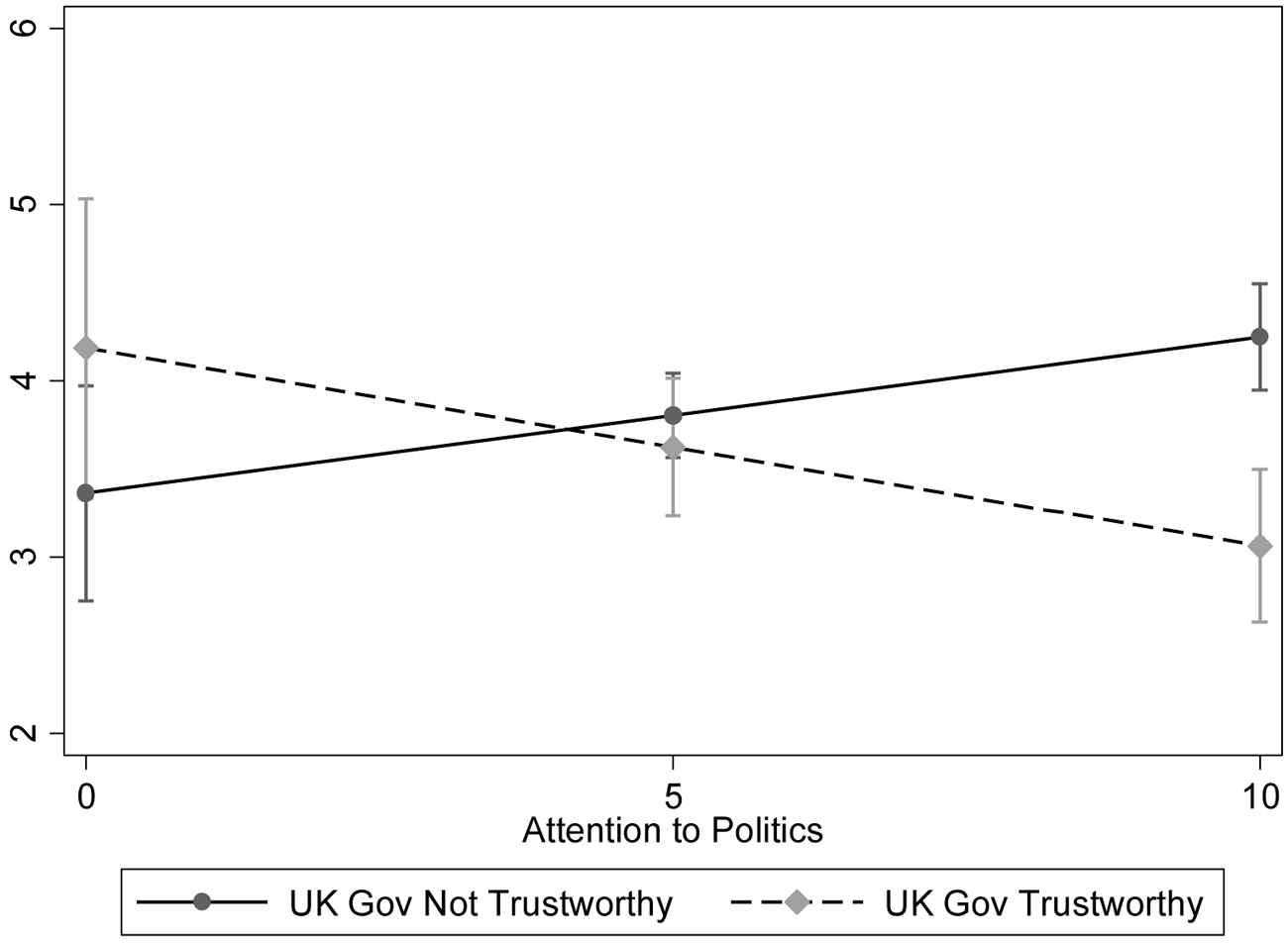
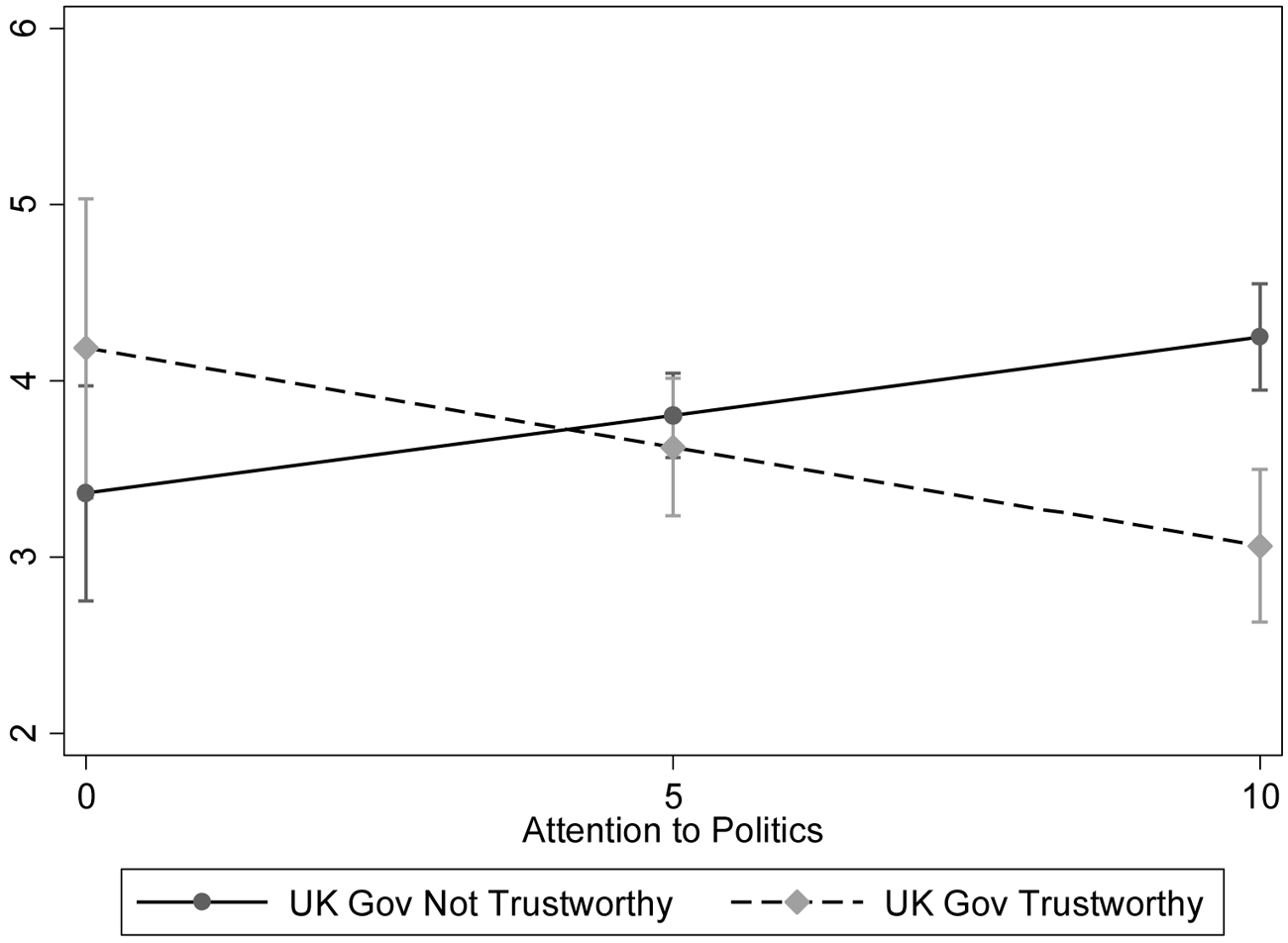
Does awareness/attention to politics modify the second-order evaluation of the ECtHR? Models 2 and 4 provide evidence of a similar pattern of evaluation for the national government: increasing knowledge of domestic institutions and increasing trust of those institutions lead to decreasing trust of the ECtHR. Figure 1 depicts this relationship with respect to trust of the ECtHR, which supports our first two hypotheses. With the coefficients from model 2, a respondent who trusts the British government but pays no attention to politics rates the ECtHR at 4.2 on the 11-point trust scale, whereas a respondent who trusts the British government and pays a great deal of attention to politics rates the ECtHR at 3.1 on the trust scale. Similarly, a respondent who does not trust the British government and pays no attention to politics rates the ECtHR at 3.4 on the trust scale, whereas a respondent who does not trust the British government but pays a great deal of attention to politics scores the ECtHR at 4.2 on the scale.
Trust of the British government and attention to politics
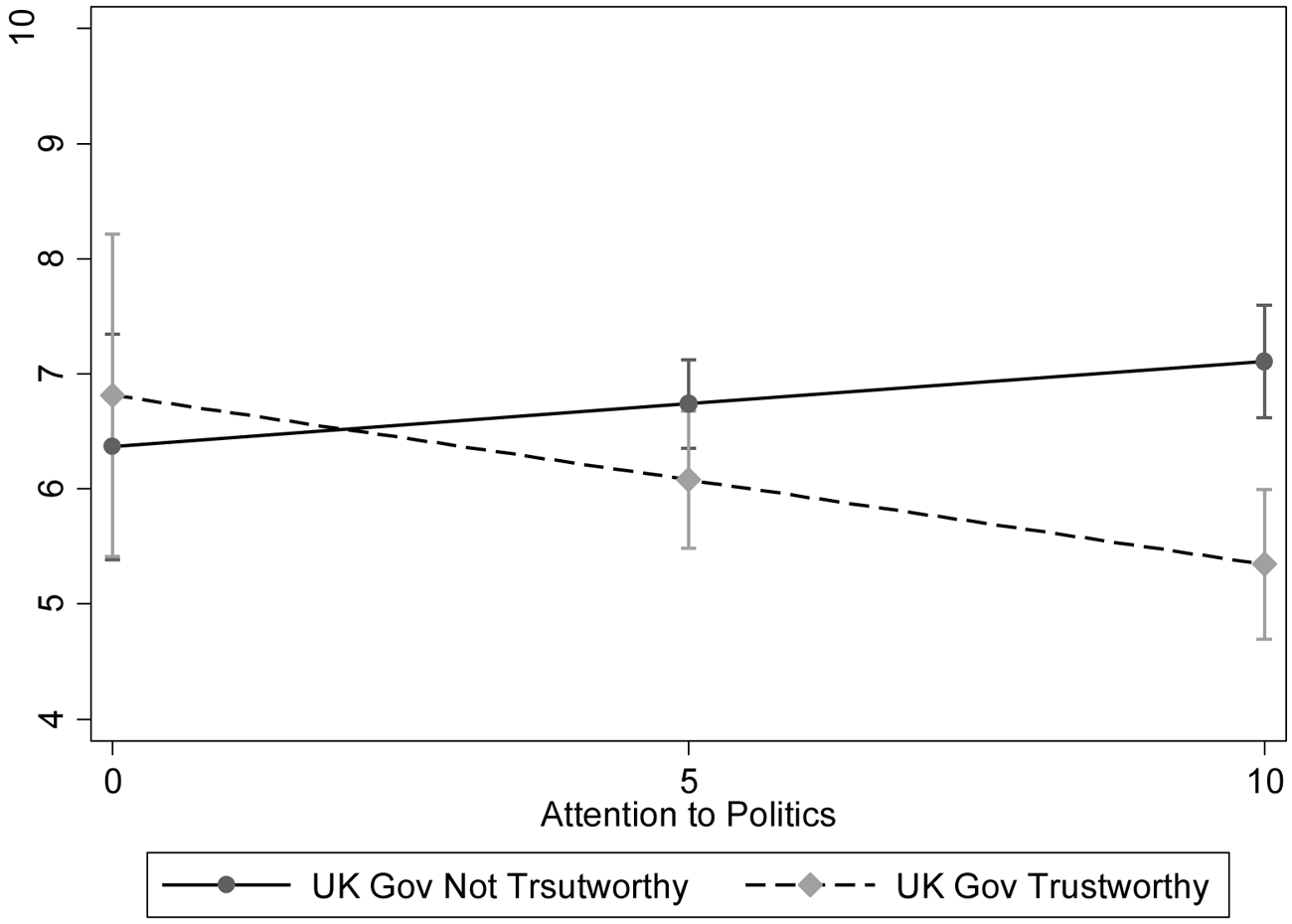
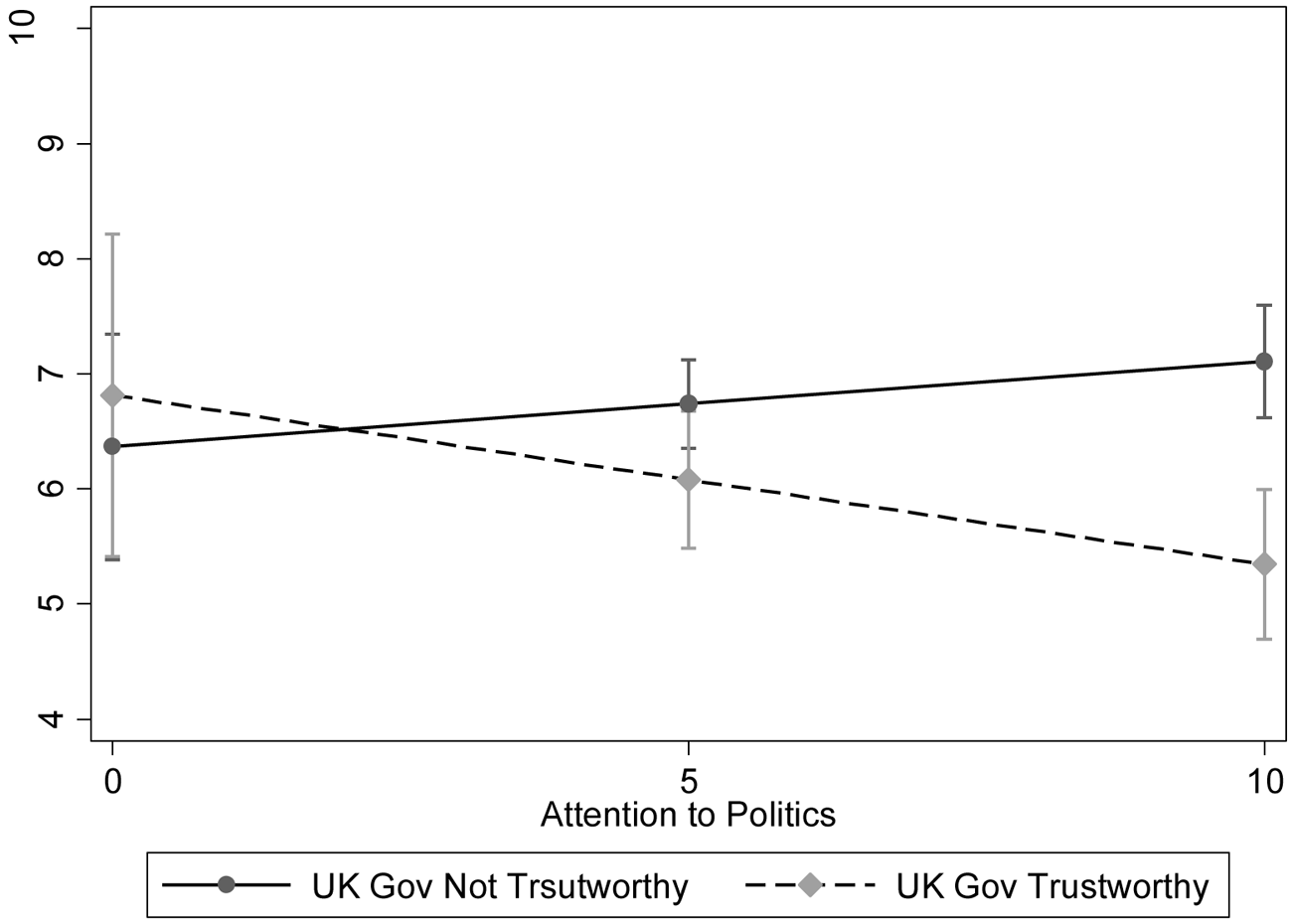
We retest these relationships using diffuse support for the ECtHR as the dependent variable (instead of trust) in models 3 and 4. Here we find the same pattern that we do for trust in the ECtHR, which is not entirely surprising given that trust of an institution is often operationalized as a component part of diffuse support. First, support for hypothesis 1 is evidenced by the effect of increasing trust in the UK government in model 5. There, respondents who trust the government are about a full point and a half lower on the diffuse support scale. Figure 2 illustrates second-order knowledge effects for the ECtHR when the dependent variable is diffuse support instead of trust; reassuringly, figures 1 and 2 look quite similar. Here we see that there is a marked decline in diffuse support for the ECtHR for those who trust the British government and pay considerable attention to politics: diffuse support for the ECtHR is relatively high, 7.3 on the diffuse support scale for those who do not follow politics; but as attention to politics increases, diffuse support for the ECtHR decreases to 4.9 on the scale. This is additional evidence for hypothesis 2.
Diffuse support of the ECtHR, trust of the British government, and attention to politics.
Discussion
In this article we set out to build on the traditional law and courts legitimacy approach to understanding public support of legal institutions with respect to explaining support for international courts. We have proposed that the second-order evaluation approach of the European governance literature is a useful addition to more traditional approaches for understanding diffuse support (and trust). We have tested these hypotheses in the context of support for the European Court of Human Rights with the British public, and our analyses support these hypotheses. Awareness of the ECtHR does not predict trust or diffuse support, but instead it is evaluations of domestic politics and institutions that influence these assessments. There is strong evidence that political knowledge is a conditioning relationship in these evaluations. Specifically, as British citizens more positively evaluate their primary national institutions, they express less diffuse support for the ECtHR, and this negative relationship is enhanced the more aware the citizen is of British politics. And these results hold for nonconservatives and conservatives alike.
Substantively, legitimacy is particularly crucial for the ECtHR because it is often in the position of ordering a government to do something that it has already explicitly refused to do and, more importantly, the ECtHR is subsequently reliant on a recalcitrant government for compliance (Cah, Koch, and Bruch 2011). To the extent that the ECtHR is viewed as illegitimate, it may be that national governments have more room to evade full compliance with a decision or flatly refuse to comply. The extensive literature on the relationship between public opinion of the US Supreme Court and compliance with its decisions suggests future avenues for fruitful investigation of the relationship between the ECtHR and national governments.
This article has several potential implications beyond demonstrating that the public assesses international courts differently than national courts. Our analysis demonstrates that supranational legal institutions are largely assessed through a similar mechanism applied to supranational governance and political institutions generally. While the British context may be somewhat unusual in that the state has a newly created national supreme court, other EU states such as Bulgaria and Hungary have experienced somewhat similar transformation of their courts in the post-Soviet era. These findings suggest the merit of further study of other European Convention states. This analysis also demonstrates that second-order evaluations are tied not only to the European Union but also to a non-EU institution, the ECtHR, which suggests that the approach is likely applicable to other international institutions, particularly within human rights regimes such as the Inter-American Court of Human Rights and the African Court on Human and Peoples’ Rights and the International Criminal Court. This probability suggests a clear potential for future research.
The implications of our findings for compliance are somewhat complicated, to the extent that public support might influence UK compliance with the rulings of the ECtHR. Support for the ECtHR within the British public is not likely to be fostered through efforts by the Court to promote awareness of itself as awareness has no effect. Furthermore, our findings suggest that to the extent that countries with poor human rights records are also likely to have less trusted national institutions, the ECtHR may have increased support in the very places where its rulings may be the most important. Yet, other scholars of compliance with the decisions of international courts have suggested that compliance with ECtHR decisions is most likely in places that already have robust domestic institutions that respect human rights, such as the United Kingdom (Hillebrecht 2014). Again, these possibilities indicate a direction for subsequent work.
The Brighton Declaration also presents a potential inflection point for the role of the ECtHR and expressly calls into question the source(s) of the ECtHR’s legitimacy to an “unprecedented degree” (Christoffersen and Madsen 2013, 239). The declaration suggests a fundamental need to better understand the political conflicts that will ultimately determine the effectiveness of the Court. Indeed, the declaration itself can be seen as an attempt by national authorities to regain some measure of sovereignty over the ECtHR, and it is probably the case that the success of this attempted retrenchment to the national level will depend on the support given to the Court by national publics. Complicating attempts to understand the role that legitimacy will play in the future of the ECtHR is the fact that there has been a concomitant empowering of the national legal apparatus that may or may not support the decisions of the Court, a process that may be accelerated by the Brighton Declaration (Christoffersen and Madsen 2013). In the United Kingdom this has taken the form of the passage of the Human Rights Act in 1998 and the subsequent creation of the United Kingdom Supreme Court (UKSC).
In addition, we recognize that the ECtHR as a European institution is distinct in that its jurisdiction or its policy space, so to speak, is narrower in that it is limited to the human rights enumerated in the convention. Thus, there is the possibility that a specific national institution will function as the yardstick for the evaluation of the supranational institution; in the case of the United Kingdom, the most comparable domestic institution would most likely be the new UKSC. In future work we plan to examine explicitly how the UKSC affects perception of the ECtHR by analyzing the effect of evaluations of the new UKSC on trust and support for the ECtHR. We also plan to examine the question of whether the ECtHR affects the new UKSC’s ability to develop support. Ultimately this means that a highly legitimate UKSC may be able to aid the ECtHR in the United Kingdom, given that the UKSC is likely to rely on separate pathways to develop support. Such an analysis might tell us whether a zero-sum trade-off exists between support for the ECtHR and the UKSC and will allow us to test whether the ECtHR can channel its influence through the UKSC. We hope to examine how the ECtHR might benefit from such cooperation as such cooperation among the courts is not as much of a stretch as one might initially imagine and may reflect the respectful relationship between the international court and the UK courts, as well as the broader patterns within the global context.
Appendix A Measuring Diffuse Support and Robustness Check
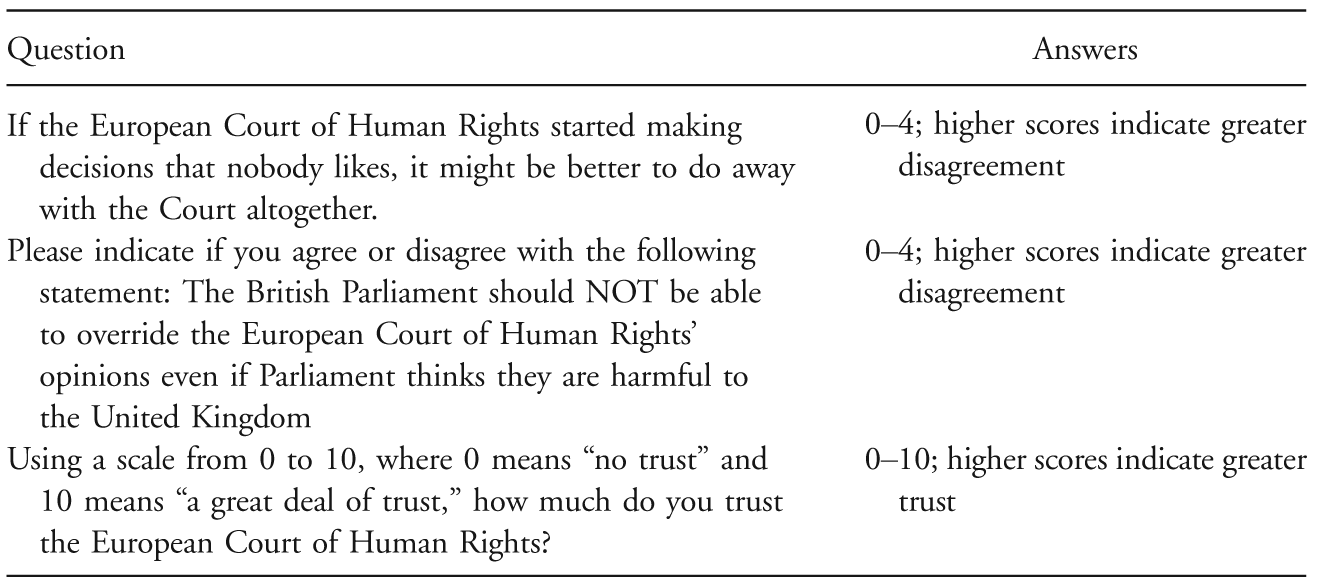
Measuring Diffuse Support
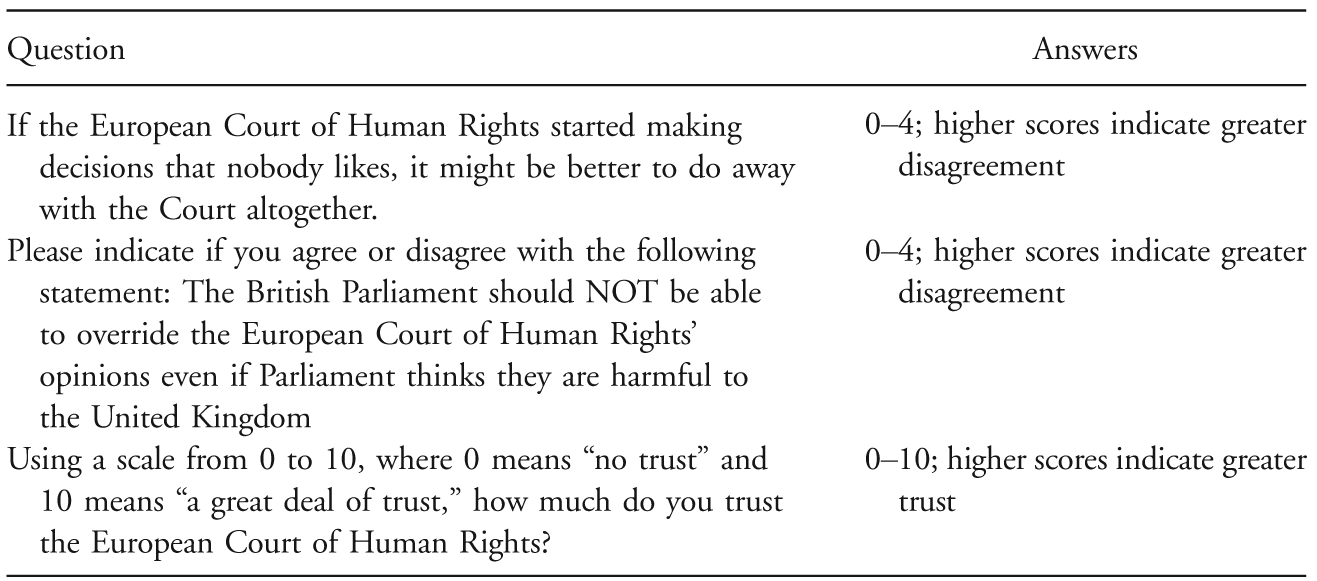
Readers may wonder how we created our measure of diffuse support. We followed the lead of major scholars in this area of research (e.g., Gibson and Caldeira 1995). In addition to the trust question, which we discuss more fully in the main text, we asked two additional questions about the ECtHR, and from these questions we generated an index of diffuse support. We then used these indices in our model of support for the ECtHR. Table A1 shows those questions for both courts. Because this is an index constructed of three questions, we checked whether the index we created is internally consistent using Cronbach’s alpha. The alpha for the ECtHR index is 0.78, where anything above 0.70 is considered good.
Nonconservatives and Second-Order Support
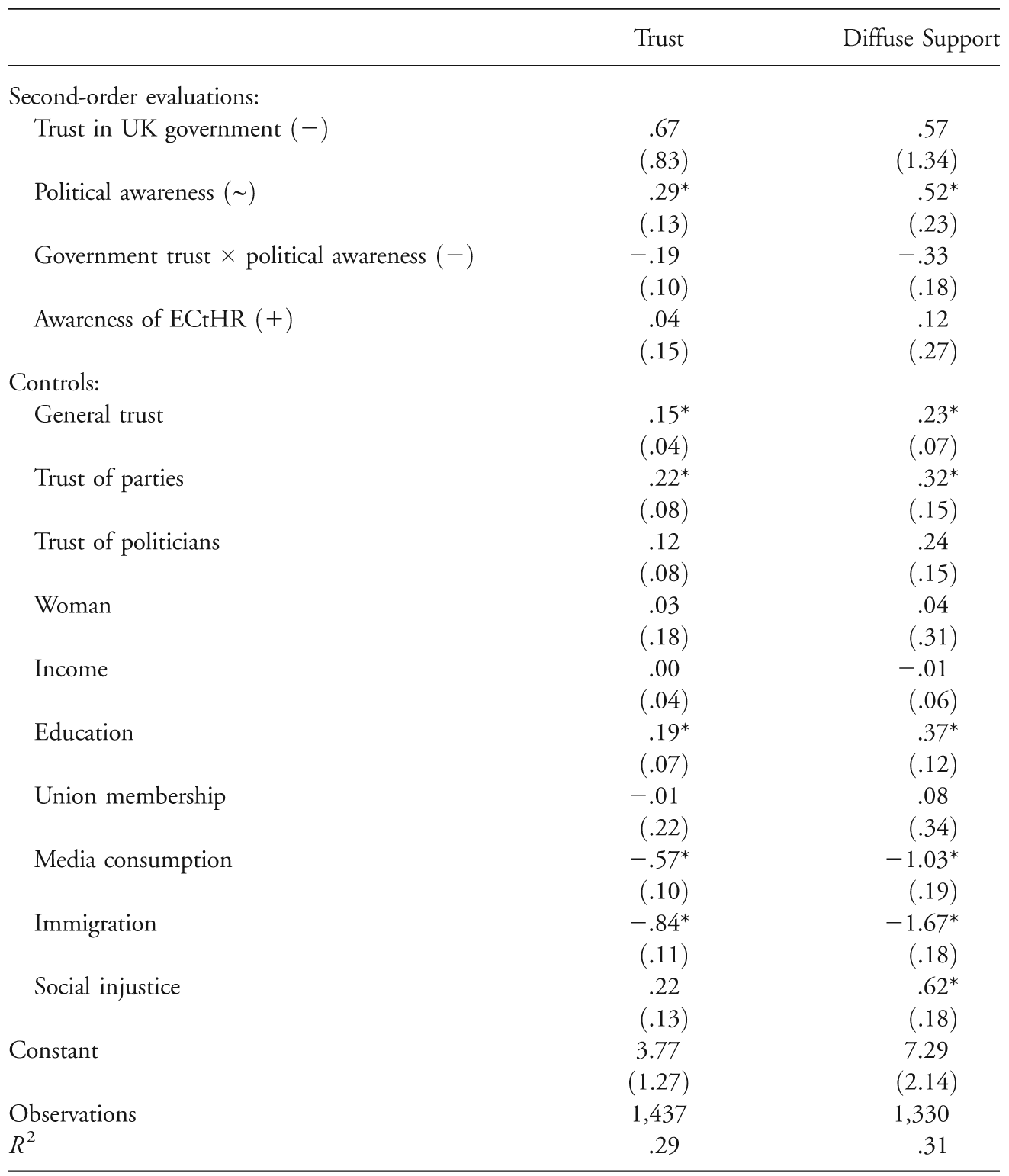
During the time period our survey was in the field, from September through December 2012, the British government was controlled by conservative politicians. Therefore, it is reasonable to suspect that our findings with respect to second-order evaluations of the ECtHR are driven solely by conservative identifiers in our sample. In other words, it is potentially the case that only conservatives will prefer the British government at this particular point in time to a supranational court given that they also control the national government. To determine whether such evaluations from conservatives are responsible for our results, we included a control for ideology in the model, but another approach to accounting for this issue is to split the sample into conservative and nonconservative respondents and reestimate the models. In this robustness check we are concerned only with reactions among nonconservatives in our sample. The models displayed in table A2 are replications of models 2 and 4 from table 2 using only nonconservative respondents.
Note.—Entries in parentheses are standard errors.
* Significant at p < .05 (two-tailed).
In general, the results follow those presented in table 2. Focusing on the interaction terms that test our theoretical propositions, with respect to a general second-order evaluation of trust of the ECtHR, the interaction is negative and significant (at p = .07), as expected. Similarly, the interaction with respect to diffuse support is also negative and statistically significant (at p = .07), reflecting the results reported in table 2 in the text.
Appendix B Survey Instrument
Below are the questions we asked respondents. In some instances, which are noted below, we altered the ordering of the answer choices in the survey for our models to ease interpretation.
-
1. What is your gender?
Male (1)
Female (2)
[Recoded as dichotomous, with 1 equal to female and 0 otherwise]
-
2. Do you think that the Government has, on balance, been honest and trustworthy, or not? [Reversed]
Yes—honest and trustworthy (2)
No—not honest and trustworthy (1)
Don’t know (3)
-
3. On a scale from 0 to 10, how much attention do you pay to politics and public affairs (where 10 means a great deal of attention and 0 means no attention)?
10—Pay great deal of attention
9
8
7
6
5
4
3
2
1
0—Pay no attention to politics
Don’t know
-
4. Think for a moment about whether people with whom you have contact can be trusted. Use the 0 to 10 scale again, where 10 means definitely can be trusted and 0 means definitely cannot be trusted.
10—People definitely can be trusted
9
8
7
6
5
4
3
2
1
0—People definitely cannot be trusted
Don’t know
-
5. Thinking about how well democracy works in this country, on the whole, are you very satisfied, fairly satisfied, a little dissatisfied, or very dissatisfied with the way that democracy works in this country?
[Reversed]
Very satisfied (4)
Fairly satisfied (3)
A little dissatisfied (2)
Very dissatisfied (1)
Don’t know (5)
-
6. How well do you think the present government has handled the number of immigrants coming to Britain?
Very well (1)
Fairly well (2)
Neither well nor badly (3)
Fairly badly (4)
Very badly (5)
Don’t know (6)
-
7. Social injustice is a major problem in Britain [reversed to as below]:
Strongly disagree (1)
Disagree (2)
Neither agree nor disagree (3)
Agree (4)
Strongly agree (5)
-
8. How often do you read a daily morning newspaper?
[Reversed]
Every day (3)
Sometimes (2)
Not at all (1)
-
9. At what age did you or will you complete your full-time education?
14 or under (1)
15 (2)
16 (3)
17–18 (4)
19–20 (5)
21 or over (6)
-
10. Do you belong to a trade union?
[Reversed]
Yes (2)
No (1)
-
11. Could you tell me your total annual household income before any taxes or other deductions?
Less than £5,000 per year (1)
£5,000–£9,999 (2)
£10,000–£14,999 (3)
£15,000–£19,999 (4)
£20,000–£24,999 (5)
£25,000–£29,999 (6)
£30,000–£39,999 (7)
£40,000–£49,999 (8)
£50,000–£59,999 (9)
£60,000–£69,999 (10)
£70,000–£79,999 (11)
£80,000–£89,999 (12)
£90,000–£99,999 (13)
£100,000 or more (14)
Prefer not to say (15)
-
12. Using a scale from 0 to 10 where 0 means “no trust” and 10 means “a great deal of trust,” how much do you trust political parties?
0—No trust
1
2
3
4
5
6
7
8
9
10—Great deal of trust
Don’t know
-
13. Using a scale from 0 to 10 where 0 means “no trust” and 10 means “a great deal of trust,” how much do you trust politicians?
0—No trust
1
2
3
4
5
6
7
8
9
10—Great deal of trust
Don’t know
-
14. Overall, do you strongly approve, approve, disapprove, or strongly disapprove of Britain’s membership in the European Union? [reversed]
Strongly disapprove (1)
Disapprove (2)
Approve (3)
Strongly approve (4)
-
15. Generally speaking, do you think of yourself as Conservative,Footnote 15 Labour, Liberal Democrat, or what?
Conservative
Labour
Liberal Democrat
Plaid Cymru
Scottish Nationalist
Green
United Kingdom Independence Party (UKIP)
British National Party (BNP)
Other party
No—none
Don’t know
-
16. [For those who said none or don’t know above]: Do you generally think of yourself as a little closer to one of the parties than the others? If yes, please say which party?
Conservative
Labour
Liberal Democrat
Plaid Cymru
Scottish Nationalist
Green
United Kingdom Independence Party (UKIP)
British National Party (BNP)
Other party
No—none
Don’t know
-
17. How familiar are you with the European Court of Human Rights?
[Reversed]
Very familiar (3)
Somewhat familiar (2)
Not very familiar (1)
Have never heard of this court (·)
Don’t know (·)
-
18. If the European Court of Human Rights started making decisions that nobody likes, it might be better to get do away with the Court altogether.
Strongly agree (1)
Agree (2)
Neither agree nor disagree (3)
Disagree (4)
Strongly disagree (5)
Don’t know (6)
-
19. The British Parliament should not be able to override the European Court of Human Rights’ opinions even if Parliament thinks they are harmful to the United Kingdom.
[Reversed]
Strongly agree (5)
Agree (4)
Neither agree nor disagree (3)
Disagree (2)
Strongly disagree (1)
Don’t know (6)
-
20. Using a scale from 0 to 10 where 0 means “no trust” and 10 means “a great deal of trust,” how much do you trust the European Court of Human Rights?
0—No trust
1
2
3
4
5
6
7
8
9
10—Great deal of trust
Don’t know